CAPTAIN AMERICA: THE WINTER SOLDIER

By Marc S. Sanders

Anthony and Joe Russo direct one of the best action pictures of the last 20 years as they pit the heroic patriot against weaponized SHIELD planes, trap him in an elevator with 15 strong arm men to take on singlehandedly, and most especially the dude dressed like the American flag goes up against a mysterious figure that possesses a highly weaponized steel arm. Best yet, none of these sequences pertain to the story so much as they frame it.

Chris Evans returns as Steve Rogers aka the first title character, and he’s even better this time around. Captain America: The Winter Soldier hearkens back to the thematic 1970s conspiracy theory features like The Parallax View with Warren Beatty and Three Days Of The Condor with Robert Redford as Cap first finds himself on one side of an important debate for our modern times. When is too much warfare enough? How far must we go to serve as a means of protection? Evans appears as if he’s researched the strong position held by his character, and he’s believable in his mindset. Is the motive out of fear, or power, or could it actually just all be for protection? He’s convincing in his character’s argument. Naturally, if he can’t agree with the powers that be, he’ll find himself on the run with allies like Scarlett Johansson as Black Widow and Anthony Mackie as the supercool Falcon.

Johansson is given much more to work with as she trades “Buddy Cop Movie” wits with Evans as well as helping him with his dating scene. She also offers up some sharp intelligence to a promising complex former KGB/spy. It’s about time she get her own film in the series. She’s overdue. (Well…now we all know how that turned out.)

It’s especially appropriate that Redford himself is recruited as Secretary Alexander Pierce. Redford plays puppet master for a film that offers the biggest altering twists the MCU has offered up to this point. To handle the role requires an actor with a history to his career and since Redford has dabbled in films of this nature, he fits right in. He must have been especially pleased to accept this role recognizing the layered angles to a script provided by Christopher Markus & Stephen McFeeley.

Sebastian Stan returns with an astonishing turn as his character Bucky. When all the surprises are revealed by him, your pulse will likely not have come down following a thrilling highway shootout.

Lastly, credit must be given to Samuel L Jackson. This film offers the most for his Nick Fury character to play with. Fury finds himself on the wrong end of an argument that leads to a shocking betrayal and sabotage. Jackson’s roles often fall into the same routine of timing and delivery, screaming “mother effing” frustrations. It’s often lovingly joked about but it gets tiring too. Here however, he’s given a chance to be the victim of a brutal attack and deal with an aftermath. It’s the best material written so far for the Nick Fury character.

The Russo brothers, not normally known for big budget extravaganzas, surprised audiences with a well-executed film that offers suspense, extensively choreographed action sequences and great characterizations all around. They have identified Captain America as the soldier of morals, but moreover they recognize where he stems from. The Brothers certainly haven’t forgotten that he’s really a 95-year-old man at the time of this story. That sets up some good laughs. The adventure of the picture is top notch and thankfully it primarily all takes place in daylight where nothing is strategically hidden and appearing as shortsighted work in dark photography. The Russos know how to pinpoint exactly where Cap needs to throw his shield, what it should bounce off of, and how the hero should get it back. Everything here is top notch.

Captain America: The Winter Soldier only gets better with repeat viewings, and you really don’t even need the other MCU films to follow its trajectory. It’s worth watching at any given moment.

THOR: THE DARK WORLD

By Marc S. Sanders

Like Louis Letterier’s The Incredible Hulk, director Alan Taylor’s Thor: The Dark World is a very underrated installment in the Marvel Cinematic Universe. It focuses on a lot of humor with well edited action and moments that allow all the major players to offer up good material.

First Chris Hemsworth as Thor. Yeah, he’s doing the same thing and that’s fine. If it ain’t broke, don’t fix it. Moving on… This is an important chapter in the MCU, as it introduces the second of the legendary Infinity Stones, the red Aether, which consumes Thor’s love interest from Earth, Jane Foster, played by Natalie Portman. Fortunately, it provides better writing for Portman to play with. She really is the MacGuffin of the film, and she works as a story device to explore more of Asgaard, one of the best set pieces in all of the Marvel films. Jane uncovers the mysterious stone, or rather liquid, that has been hidden away for centuries; this is all Lord Of The Rings stuff. Once she finds the stone and is consumed with it, then the film segues into its originality.

Apparently, it’s not good if the Aether is used for destruction while the Nine Realms are in Convergence, which we are told happens every 5,000 years. What is Convergence? Well, that’s where it’s fun to watch Thor: The Dark World. The Nine Realms line up, literally like a rainbow of circles stacking on top of one another. It’s really cool to look at. What’s more fun is how Jane and her crew drop random objects into an open space within a deserted London warehouse and then it disappears, and then drops back down to them from above their heads. Sometimes, they drop something, only the objects don’t return at all. I like all of this stuff, because it’s all visual and ultimately that is what movies are about. Showing us something. Asgaard, The Convergence, Thor’s swing of his hammer, the Aethar, it’s all fun to see. I’ll credit Alan Taylor’s direction for a lot of this. He’s shown great achievements in Game Of Thrones. He carries his visions over to Thor’s universe.

Next is the villain is Malekeith, the head of the Dark Elves, with some really wicked looking makeup, and it only gets more wicked as he progressively gets more powerful. He wants to get the Aether and bring the Nine Realms into Darkness. Christopher Eccleston (best known for G.I. Joe; that should tell you something) takes on this role which is nothing special. I don’t care so much about the villain in this film as I do about the conflict of the story. The conflict is the real treat. Eccleston is nothing special. He’s not bad. He’s not good. He’s just nothing special. Moving on…

Tom Hiddleston is back as the trickster Loki, one of the best written characters in all of the Marvel Cinematic Universe. The script gives him a lot to play with and opportunities to irritate and antagonize Thor who reluctantly recruits his assistance. “Well done. You just decapitated your grandfather.” See the movie (again?) and you’ll love the timing of this line. Hiddleston has fun with the levity of Loki but there is a sad central story to the adopted son of Odin. During his first appearance in the film, following his incision of the New York alien invasion from The Avengers, Loki is arrested in chains to stand before his father, and Hiddleston clicks his heels together at attention, giving a serious grimace before declaring “I really don’t see what all the fuss is about.” Hiddleston continues to work and develop at this favorite character who remains tricky and unpredictable. I love it.

Anthony Hopkins is back as Odin, Thor’s father. Yeah, he’s doing the same thing and that’s fine. Again, if it ain’t broke, don’t fix it. Moving on…

There’s a lot of fantastic sci fi and fantasy sequences to this film and from a CGI perspective, it’s artistically beautiful. It’s just a fun ride of exploration. Thor was never a favorite comic book character of mine growing up. The MCU opened my eyes to something special in his adventures and those that surround him. It’s even great when Thor jumps on the tube to return to a battle in Greenwich Village. I’m expecting some energetic debate on my feelings towards this film. Bring it on and I’ll match you. As Thor might say after his hammer turns a giant rock monster to rubble, “Anyone else?”

Reader, if I can quote this film three times in a review that should tell you how much I love Thor: The Dark World.

INTERNAL AFFAIRS

By Marc S. Sanders

Internal Affairs has a promising start as we see Richard Gere as decorated officer Dennis Peck compromise a police shooting in favor of his fellow officer (Michael Beach) who has just shot a fleeing unarmed suspect in the back. Right away it’s apparent that Gere is the bad guy here and soon we will see how Andy Garcia as new Los Angeles Internal Affairs officer Raymond Avila will investigate Peck for his violations. Unfortunately, the movie from director Mike Figgis reduces itself to simply having the male characters of the film, including William Baldwin as another dirty, drug addicted cop, physically abusing the female characters around.

This film from 1990 shows its age for sure with frizzy hair sprayed dos and large lapel jackets and skinny ties, but that was not my main issue. It would not be until 2006 in the Martin Scorsese film The Departed that we would see what I was hoping for with Internal Affairs; how a dirty cop works, and how the righteous cop gives pursuit. If only Figgis’ film was smart enough to focus on the method behind Dennis’ actions of crime and police superiority. Instead, we get a Richard Gere who actually shows he can play an effective bad guy, psychologically messing with Andy Garcia’s character by giving him the illusion that he’s having an affair with his wife. What’s Garcia’s response to this? He slaps his wife, played by Nancy Travis, in the middle of a crowded restaurant. When the two clear the air about what’s going on, they slap each other again before making up.

Gere also slaps and physically threatens his own wife played by Annabella Sciorra to drive the point home that she better not talk to the Internal Affairs department. As well, Gere also slaps around his mistress, a wife of one of his criminal associates. William Baldwin’s character slaps around his wife too. You seeing a pattern here?

It’s one thing to depict domestic abuse in film. There’s room for that. Because it sadly happens all too often, it’s appreciated if it’s handled with sensitivity. Here though, the abuse against women is used as a punchline to a scene, one after the other, and the overall theme of the picture is not supposed to be domestic violence. It bothers me that Mike Figgis tosses this kind of material around like effective drama, seemingly trying to make it look sexy to smack a good looking woman around by a good looking man. About the only woman in the cast not to get abused is Laurie Metcalf as Garcia’s lesbian mentor and partner. She gets referred to as a “dyke,” by both the villain and the hero of the film. This is just a very cold, thoughtless picture that runs short on imagination.

How does Garcia get the idea to investigate Gere’s character? He just has a sneaky feeling about the guy. That’s all that’s necessary to move things along here. In a better police film like The French Connection, the cops were displayed with step-by-step surveillance tactics that first put them on to a low rent street hood that ultimately leads to something bigger. We saw a method to their instincts that led to something tangible and proof worthy. I wish Mike Figgis, with a screenplay by Henry Bean, delved more deeply into what made the Dennis and Raymond characters so good at what they do. Films like Heat and Dirty Harry explore those backgrounds. Internal Affairs just takes the cheap shots of beating and dominating the women in these characters’ lives, while never showing the drive for what they do. Ultimately, the film comes up short sighted, and especially very, very insensitive. This is just an abusive film.

THE TOWERING INFERNO

By Marc S. Sanders

The kid who played Bobby Brady of TV’s The Brady Bunch and Gregory Sierra (Julio from Sanford and Son) star alongside OJ Simpson and an Oscar nominated performance from Fred Astaire in The Towering Inferno. This is one of the best films to be churned out of the Irwin Allen disaster machine of 1970s movie making.

William Holden is the proud builder of a beautiful new skyscraper in the heart of San Francisco. Paul Newman is the sensible architect who manages to acknowledge what’s wrong the construction of the building. Namely, a jerky Richard Chamberlain, as the building’s electrician, opted for faulty, less expensive wiring that conveniently overheats on the eve of the building’s grand celebration that includes a Senator (Robert Vaughn) and the Mayor with his wife in a loud, baggy Pepto Bismol colored dress. Seriously, it’s never hard to make this woman out among a sea of formally dressed extras who are celebrating on the grand opening located on the building’s promenade floor. Floor number 135 to be more precise. Because it’s so high up, we are treated to a scenic, outside elevator that’ll eventually not make it to the ground allowing a couple of screaming extras to be held in treacherous suspense. Good stuff here, for sure.

Steve McQueen’s coolness eventually arrives as the main fire chief leading the high rise charge against the blazes. His Thomas Crown Affair co-star, Faye Dunaway, is here to cue the romantic rhythms of John Williams’ score, and to hop into bed with Newman for some afternoon delight.

The story is that Newman and McQueen were at odds for who was getting top billing. Watch the very beginning of the film for the inventive compromise for the name placement in the credits.

The real stars of this who’s who cast are the special effects. Now I truly mean this. Nearly fifty years later, and the visual effects of the massive fires, explosions, helicopter sequences, and enormous heights still hold up. There’s lots of good footage that burns up, crushes, floods and drops a handful of extras for a fast paced three-hour epic disaster flick.

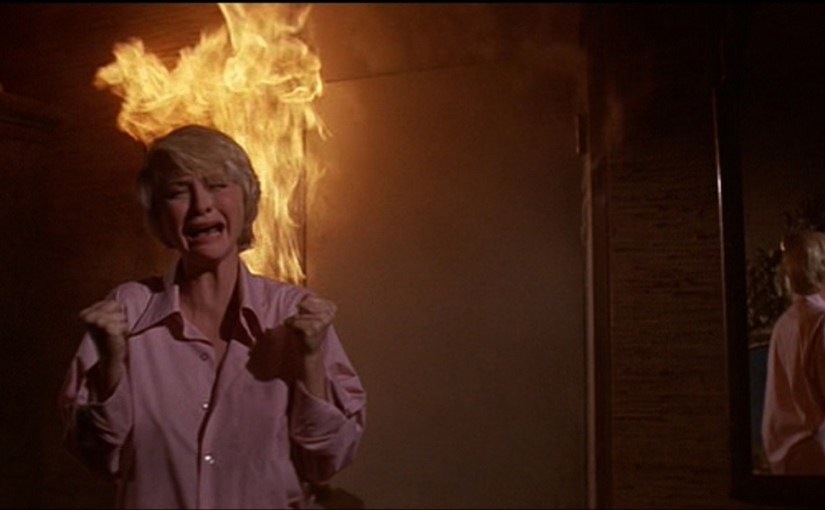
Astaire might have been the sole acting nominee but I just can’t get over how the debonair, prime for a Love Boat appearance with no hair out of place Robert Wagner didn’t get any recognition. This man puts just a damp washcloth on his head, promises his half naked sweetie that he’ll “be back with the whole fire department,” and sprints straight into the flames for the grandest death scene in film history. It’s a glorious scene for sure when Wagner buys it. I cheer every time I see it. The dude just face plants into the flames. Doesn’t even bend down or kneel to pray. This guy just topples over like a Jenga tower, with the washcloth remaining on his head.

The Towering Inferno amazingly did not beat out The Godfather Part II for Best Picture. I know. I’m stunned as well, reader. Uh huh! Nevertheless, it’s still worth a watch all these years later. If anything, you get to see some pretty eye-popping visual effects and action scenes directed personally by Irwin Allen. You also get to familiarize yourself with the best talent in Hollywood that was working at the time. There are also lots of great moments amid the soapy cheesiness of the script.

Most of all, and this is where I finally get sincere, it’s a film that does not make light of our country’s firefighters who continue to risk their lives everyday so that any one of us can survive. Not enough films embrace the proud men and women who stand between us and danger. The Towering Inferno salutes that immeasurable bravery.

ARTHUR

By Marc S. Sanders

I would love to be friends with Arthur Bach. Sure I’d be wined and dined, living a lifestyle where money is no object, toy trains are at my disposal, and drinks on a serving platter are brought to me constantly. Arthur has got it all. Well, not all of it. He’s never been in love. He hates his cold hearted father and he only has one friend, his dependable butler, Hobson.

Dudley Moore’s greatest role is Arthur from 1981. The best protagonists in comedy are the ones who go against the order. Arthur is a spoiled kid in an adult’s body. He lives to smile and laugh and drink and play and drink some more and more. It’s easy when you are sitting on three quarters of a billion-dollar fortune. Imagine though if you could lose all of that money. The only way to hold on to wealth is to marry a woman named Susan (Jill Eikenberry) that you are not in love with, simply to merge two wealthy families together for even more industrial power. Arthur is made to be a pawn by his own unloving father, as well as Susan’s ruthless father (Stephen Elliott) who is proud to share how he killed a man when he was eleven years old. No matter. Arthur will just marry Susan and cheat on her, as his elderly grandmother Martha (Geraldine Fitzgerald) suggests.

All seems easy until Arthur becomes over the moon in love with a woman named Linda (Liza Minnelli) who is caught shoplifting a tie in Bergdorf’s in New York City. Arthur can’t stop thinking about Linda but the family would never approve. Linda is a waitress dreaming to become an actress, but lives a poor life with her unemployed father (Barney Martin).

Dudley Moore and Liza Minnelli have one of the best on screen chemistries ever in film. They look like they belong with one another, and their timing is perfectly solid. When they share moments together their on-screen laughter shows up naturally and intermittently. I imagine no matter how many times they rehearsed their scenes together it was never the same way twice.

As an individual performance, Moore works like a great stand up comic having the best show of his life. His drunkenness is hilarious with his slurs and infectious non stop giggles and outrageously loud laughter. He gives The Joker a run for his money in the laughter department.

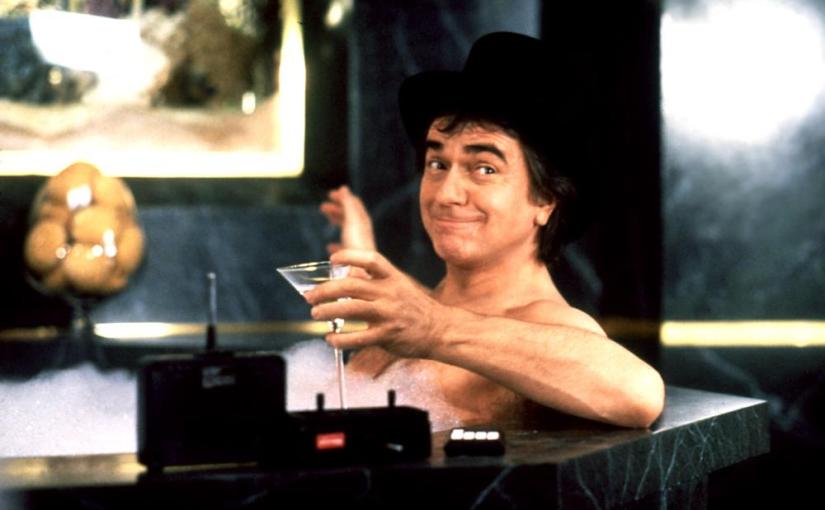
Early on, he escorts a prostitute to dinner at The Plaza Hotel and his interactions with family members and those of the wealthy social circle are a great contrast in comedy. Throughout the film, Dudley Moore will use every prop he can get his hand on to make his inebriated state all the more funny from simply a telephone to a mounted moose head. Moore is also a helluva piano player.

The most special relationship though is Arthur’s connection to Hobson (beautifully played with blue blood dryness by Sir John Gielgud). A man like Hobson is not one you’d expect to associate with a man as immature and childish as Arthur, but you find a nurturing dimension to Hobson’s character. He’s Arthur’s surrogate father. He teaches Arthur to be practical about his good fortune. At the same time, he doesn’t dismiss Arthur’s happiness. Gielgud is at times surprising and positively touching. He also has some of the best lines in the film. After agreeing to run Arthur’s bath, he retorts with “Perhaps you’d like me to come in there and wash your dick for you, you little shit!” His impression of Linda: “Normally one would have to go to a bowling alley to meet a woman of your stature.”

As Hobson becomes ill, so must Arthur finally learn to grow up. The moment I lost my mother eight years ago, the very first thing that occurred to me was that I am no longer a child. I actually got my first grey hairs immediately after mom unexpectedly passed. No longer was there the protective guidance to make decisions and therefore as Hobson continues to deteriorate, Arthur becomes aware of tough decisions he must make regarding sobriety, wealth and most importantly love. With Hobson by his side, Arthur Bach is a beautiful character arc of comedy and sadness. As a kid growing up in the ‘80s, Arthur Bach was one of the first to demonstrate the change in a character’s arc for me. I really started to recognize depth and dimension; different angles and perspectives that a well written character faces.

The film is over 40 years old, but still has its magic to make you laugh and cry. Arthur is just an enormously touching comedy.

21 BRIDGES

By Marc S. Sanders

What a huge loss it is to no longer have Chadwick Boseman after being taken so early in life by cancer.  His heroic role in Black Panther is what is arguably celebrated most.  However, even a small, standard cop film like 21 Bridges is evidence of his magnetism on screen.

In this movie, Boseman portrays Andre Davis, a New York police detective who is under investigation by Internal Affairs for an abundance of shooting incidents.  Yet he is still on the beat.  When he is summoned to the aftermath of a violent crime scene after midnight in Manhattan, it is up to Andre and his new partner Frankie Burns (Sienna Miller) to track down two killers who ran off with a large supply in cocaine while taking out seven police officers in the getaway.   The best way to catch the bad guys is to shut down the twenty outlets off of Manhattan Island. That means all bridges, tunnels and ferries are closed off until sunrise.  Now it becomes a closed off maze to locate and apprehend the men.  One problem for Andre and Frankie is that the entire police force is looking to taking out the suspects as punishment for killing their comrades.  Andre is actually not the shoot first cop he’s unfairly being characterized as, though.  Sounds simple and familiar, yes.  However, Andre slowly realizes that there may be a complicated conspiracy involved. 

Directed by Brian Kirk, 21 Bridges won’t rank up there with Andrew Davis’ The Fugitive or even the best of the Dirty Harry installments, but the film moves at a brisk pace and the action is spectacular, and at times unexpected.  The early heist of the drugs from an underground wine cellar is fast and shocking when a shootout erupts that goes for a thankfully suspenseful long time.  Kirk doesn’t make it easy for the bad guys (Steven James, Taylor Kitsch) to make their escape.  When they do, the desperation is engaging. 

While this picture didn’t generate much box office success, there’s no question that Boseman would have been a go to leading man in the same vein as Keanu Reeves or Tom Holland has become. My theory: it should not have been released against blockbuster power hitters. Had it come out in January or February, this would have been a sleeper hit for sure. Boseman looks great as the hero and righteous cop, competing with the standard police veterans (JK Simmons) who remind the hero he doesn’t know what he’s talking about, etc.  We, the viewers, know better though.  Boseman looks very cool and athletic in his dark blue overcoat and drawn pistol, running through the streets of Chinatown or within apartment staircases and hallways as he maintains the chase.  Chadwick Boseman is just a solid leading man.  No question about it.

The script by Adam Mervis and Matthew Michael Carnahan is full of surprises that fit in the sense of the picture.  Nothing comes out of left field, but I wasn’t looking for surprises either.  So, when a new development presented itself, I appreciated it.  It kept the movie alive.

So again, Chadwick Boseman is huge loss within the Hollywood ranks.  I read that a sequel was considered.  I would have liked to see that with Boseman reprising his role because it’s a good part for him.   

If you have grown tired of watching the Marvel and Star Wars films and series for the 50th time and you’re looking for something new, seek out 21 Bridges.  It’s a first-rate solid crime thriller.

HOUSE OF GAMES

By Marc S. Sanders

David Mamet is one of the most renowned writers of the last fifty years.  The first film he directed was for his script, House Of Games, with his wife at the time, Lindsay Crouse, and Joe Mantegna.  It’s also important to point out that he recruited well known con artist and card trick player Ricky Jay to consult on the film and join the cast.  When you are constructing a film about the confidence game, a guy like Ricky Jay, who is widely known for his slight of hand and scam artistry, is important to ensure your story remains solid and airtight. (Note: seek out videos of Ricky performing eye popping card tricks and magic on You Tube.  He’ll make you believe that you’ve never seen a card trick before because not many come close to his mastery with a deck in hand.)

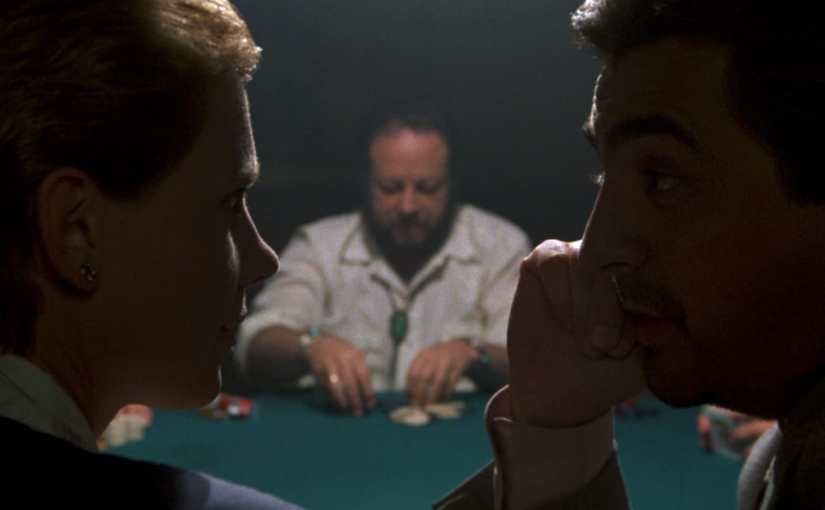
House Of Games plays like an instructional or “how to” video demonstrating how to be a successful con artist.  Crouse portrays a psychiatrist with a best-selling book titled “Driven” that focuses on obsessive behaviors.  One of her clients reveals that his compulsive gambling habits have put him $25,000 in debt with a card shark.  Crouse takes it upon herself to confront the card shark (Mantegna) on behalf of her frightened client.  Shortly thereafter, he’s got her acting as his wife to determine if the guy at the other end of a poker table is bluffing.  Then he’s introducing her to his con artist buddies, and she is becoming enamored, not only with him, but with the art of the con and the steal.  Her mundane life gives her the urge to see more.

The other Unpaid Critic, Miguel, recently reviewed this picture.  At the time of this writing, I have not read his review, but he forewarned me that the performances are stripped down to nothing.  Mantegna and Crouse are left bare to just delivering Mamet’s dialogue.  Miguel hadn’t liked this film the first time he saw it many years ago.  On my first viewing, this past week, I was engrossed.  However, I could foresee the ending as quickly as the film began.  I dunno.  Maybe it’s because I’ve seen several con artist films before like The Grifters and the granddaddy of them all, The Sting.  Films that focus on the best liars seem to always move towards a twist where even the viewer is scammed.  It’s fun to participate in the activity.

With House Of Games, the sequence of events move step by step.  Following the two characters’ introductions to each other, Mantegna is caught in the middle of doing another con but now he’s reluctantly forced to include Crouse in on the game.  This time it is seemingly much more complex and grander than the first time they worked together at the poker table.  It also gets all the more confusing when an unexpected murder is involved.  This con spells out a long night for the couple who are also falling for one another. 

Miguel is right.  The performances are most definitely stripped down and often the dialogue is wooden.  Crouse and Mantegna are deliberately flat.  I don’t even think they laugh or smile if I remember correctly.  It is likely because Mamet wants the viewers to follow along and pick up on how a successful con job is meticulous in its methods.  A con artist is not going to make waves with loud, angry monologues or passionate seductions and outrageous silliness.  What’s important is that everything that plays out seems convincing with no distractions that lead to doubt.  So, when the only African American in the cast (extras included) leaves a key on a hotel counter, you notice it.  It happened for a reason.  Later, when the characters come upon a BRIGHT RED Cadillac convertible, you are going to remember it.  A Swiss army knife with tropical artwork on the handle.  A gun metal briefcase with a large amount of cash.  A gun.  A murder.  Props and scenarios guide Mamet’s picture. Not the characters. 

Fortunately, the film remains very engaging.  As well, while I could figure out what was being played here during the entire course of the picture, as a viewer I had no choice but to feel proud of myself for uncovering the puzzles and riddles at play.  For me, watching House Of Games was like answering “Final Jeopardy” correctly when none of the contestants on screen had a clue. At least I was smiling by the end.

GREAT EXPECTATIONS (1946, Great Britain)

by Miguel E. Rodriguez

Director: David Lean
Cast: John Mills, Valerie Hobson, Jean Simmons, Martita Hunt, Alec Guinness
My Rating: 8/10
Rotten Tomatometer: 100%

PLOT: A humble orphan boy in 1810s Kent is given the opportunity to go to London and become a gentleman, with the help of an unknown benefactor.


Before moving on to full-blown epics like Lawrence of Arabia and Doctor Zhivago, Sir David Lean’s reputation was already assured with his small-scale masterpieces like Brief Encounter [1945], Oliver Twist [1948], and Summertime [1955], one of the finest Katharine Hepburn films you’ve probably never heard of.  Among these little gems is another Dickens adaptation, Great Expectations [1946], co-starring an impossibly young Alec Guinness.

Having never read the source novel nor, in fact, seen any of the other adaptations (there are at least five others, according to IMDb), I was able to go in “cold” with no preconceived notions or, ahem, expectations of my own.  What I found was a surprisingly engaging melodrama full of gothic overtones and the kinds of coincidences and contrivances that are rife in Dickens’ literature.  Yet they do not feel like contrived literary devices.  They feel like the kinds of coincidences, large or small, that populate our ordinary lives.  (I’ll bet the narrator at the beginning of Magnolia LOVED Dickens.)

The movie opens with a young boy, Pip, visiting the graves of his mother and father.  These opening scenes set the tone: dark skies, bare trees creaking in the incessant wind, and an unexpected encounter with an escaped convict who demands food and a file, for the shackles still hanging from his wrists.  Pip is terrified and complies.  Later the convict is captured and has the opportunity to give up Pip as one who aided a criminal, but in an oddly moving scene, he merely says he stole the food with no one’s assistance.

Later, Pip is introduced to the lovely young Estella (Jean Simmons in one of her earliest roles), who lives in a sprawling, decaying mansion owned by the eccentric old Miss Havisham (Martita Hunt).  Miss Havisham has summoned/hired Pip because it amuses her to watch children play, but more importantly because it also amuses her to watch Estella flirt with and continuously berate Pip as being a commoner, a blacksmith’s son, and someone who is otherwise unworthy of Estella’s affections.  The reasons for Miss Havisham’s cruel games may be guessed at by the dilapidated state of the wedding dress she wears day and night and by the crumbling, molding wedding cake sitting on a cobwebbed banquet table.  (Miss Havisham’s mansion is one of the creepiest gothic locations I’ve ever seen.  I half-expected the story to take a macabre turn, a la Edgar Allen Poe, with a deserting bridegroom rotting away under the floorboards or something.)

Time passes, and in the first of those melodramatic contrivances of which Dickens is so fond, Pip is granted the chance to go to London to become a gentleman.  His livelihood will be sponsored by a handsome annual stipend from an anonymous benefactor through a corpulent attorney named Mr. Jaggers.  (Dickens has some of the greatest character names in literature: Jaggers, Magwitch, Herbert Pocket, Uncle Pumblechook, Mrs. Whimple…I love it.)  Pip enters this new stage of his life assuming, as we all do, that his anonymous benefactor is none other than Miss Havisham.  Makes sense, right?

Through the course of this second act, Pip falls in love with the beautiful but heartless Estella, who warns him she has no heart and only seeks to conquer and discard her many suitors.  This is her way of expressing genuine affection for Pip.  Would Pip rather she do the same to him?

He also meets and befriends his London roommate and business partner, Herbert Pocket, played by an inconceivably young Alec Guinness in his first major screen role.  This was, as they say, the beginning of a beautiful friendship, leading to collaborations between Lean and Guinness on The Bridge on the River Kwai, Lawrence of Arabia, and Doctor Zhivago, not to mention Guinness’ very next role as the odious Fagin in Lean’s own version of Oliver Twist.

The rest of the story, involving Jaggers’ mysterious maid, a test of Pip’s loyalty, the identity of his benefactor, and the wholly unforeseen fate of Miss Havisham, I leave for you to discover.  It all ends, it seemed to me rather abruptly, but it is satisfying.

To fans of Lean’s more ambitious films, a small film like this one hardly seems as if it were made by the same director.  In today’s terms, it might be like watching a small character-driven film made by the Russo brothers (Avengers: Endgame, Captain America: Civil War, etc.).  In his Great Movies Review for this film, Roger Ebert points out the difference between these two stages of Lean’s directing style:

“[Lean] was an editor for seven years before directing his first film, and his career stands as an argument for the theory that editors make better directors than cinematographers do. …What the earlier films have is greater economy, and thus greater energy, in their storytelling.”

Indeed, Great Expectations hurtles along breathlessly, not as quickly paced as a Marx Brothers comedy, but certainly without wasting a single moment on anything that is not necessary to move the story along, or at least provide just a small dash of character or color to the proceedings.  (One of my favorite small touches was the gruesome death masks hanging on the wall of Mr. Jaggers’ office.  For me, it was a kind of foreshadowing, alluding to the possible fate of the convict Pip encountered at the beginning of the film.) In his later epics, Lean’s pacing slows down in favor of presenting the viewer with grand desert or mountain vistas, so instead of watching a play, it feels like we’re at a museum. This isn’t a bad thing. It’s merely a different style of storytelling.

There is another, perhaps more famous, adaptation of Great Expectations out there, by the famed Mexican filmmaker Alfonso Cuarón, starring Ethan Hawke, Gwyneth Paltrow, and no less than Anne Bancroft as Miss Havisham, renamed Ms. Dinsmoor in this version.  It was updated to present day, some other character names were changed, and it is supposedly drenched in atmosphere.  I have yet to see it.  Until I do, Lean’s early masterpiece will remain my favorite version of this timeless tale, abrupt finale and all.

HOUSE OF GAMES (1987)

by Miguel E. Rodriguez

Director: David Mamet
Cast: Lindsay Crouse, Joe Mantegna, J.T. Walsh, Ricky Jay
My Rating: 8/10
Rotten Tomatometer: 96%

PLOT: A psychiatrist is led by a smooth-talking grifter into the shadowy but compelling world of stings, scams, and con men.


I’m sitting here trying to figure out how to summarize the story of David Mamet’s House of Games without giving away plot points, and it’s virtually impossible.  Mamet’s screenplay is composed almost entirely of double-crosses, triple-crosses, short cons, long cons, and the kinds of surprises that are greatly diminished in their description.  Remove one surprise, and the whole thing collapses like a house of cards.

A distinguished psychiatrist, Margaret Ford (Lindsay Crouse) pays a visit to a handsome con artist, Mike (Joe Mantegna), on behalf of one of her clients, who is distraught because of how much money he owes to Mike.  Dr. Ford is unexpectedly intrigued by Mike’s business methods, Mike senses this, and takes her to a back room where he and some other gentlemen are playing poker.

(These men don’t talk much, but when they do, it’s almost exclusively in poker patter.  “A man with style is a man who can smile.”  “Damn cards are as cold as ice.”  “The man says you gotta give action to get action.”  “Everybody stays, everybody pays.”  It’s like they learned how to talk from watching endless episodes of the World Series of Poker on ESPN2.)

Mike makes a deal with Margaret: if she helps him beat the hot player (Ricky Jay) at the table, he’ll tear up her patient’s marker.  The hot player has a tell when he’s bluffing.  Mike will go to the restroom.  If the hot player shows the tell, Margaret will tell Mike, and Mike will beat him because he’ll know he’s bluffing.  Mike goes to the bathroom, the hot player reveals his tell, and Margaret tells Mike when he comes back.  The hot player raises the pot, but Mike can’t cover it.  Margaret comes to the rescue: she’ll stake Mike with her own money.  But, uh oh, turns out the hot player wasn’t bluffing…and now Margaret owes $6,000 to a total stranger.

And that’s where I have to stop. If you think I’ve given too much away, you’ve got to trust me – I haven’t.  That’s barely the preface.  What follows is a character study of a woman who suddenly realizes that, after a lifetime of helping patients, she needs some kind of release, a change in routine.  Mike can provide this much-needed change.  The fact that it involves conning innocent people out of their hard-earned money is incidental.

Her fascination lies in Mike’s method.  For a great con to work, you can’t take someone’s money.  They have to give it to you.  They have to trust you to do the right thing.  The trick is working out how to gain the other person’s confidence without them realizing what’s happening.  We are shown two or three examples, and they’re all brilliantly sneaky.  At one point, Mike tells Margaret the cardinal rule of the con: “Don’t trust nobody.”  After watching this movie, I can’t say I agree 100% with this credo, but a healthy dose of skepticism never hurt anybody.

So how does Margaret square that credo, or anything about Mike’s lifestyle, with her profession?  She helps people for a living.  Her livelihood depends on getting strangers to trust her, but not to take their money…although let’s not forget she is well paid for her services.  Is her fascination with Mike an acknowledgement of the similarities between the two of them?

The screenplay doesn’t provide easy answers.  When we get to the final shot of the film, we can clearly see the choices Margaret has made, but it’s still unclear as to why she made them.  This is one of those movies where the complexities only really come alive during lively discussions afterwards.

Before watching it for this review, the last time I had seen House of Games was over thirty years ago.  At the time, I was unimpressed.  I originally gave it a 2 out of 10 on the IMDb website.  It was slow, the actors looked like they were giving bad performances, and nobody talked like real people talked.

Since then, I’ve had the opportunity to see not one, but three films by a French director named Robert Bresson.  (Bear with me here, I do have a point.)  Bresson, who was active mainly in the ‘50s and ‘60s, was famous for his method of shooting scenes over and over again, take after take, until all emotions had been drained from the actor.  His philosophy, in a nutshell, was that, in a film, the story isn’t everything, it’s the only thing.  If a screenplay couldn’t carry an emotional impact just by virtue of the story alone, if he had to rely on someone’s specific performance to make the movie work, he wasn’t interested.  The results are films that are curiously compelling, despite their utter lack of anything modern audiences might recognize as a typical acting performance.  His films are routinely included on the most prestigious lists of greatest films ever made; seven of them made it onto the 2012 critics’ poll by Sight & Sound magazine, a feat unequaled by any other director.

Sitting down to watch House of Games for the first time in three decades, after having seen Bresson’s films for the first time, I think I see what David Mamet was going for, in this, his directorial debut.  The actors aren’t quite dead-panning the entire time, but their performances (with one or two necessary exceptions) are pared down to the bare minimum of emotion.  Vocally, they’re angry, curious, flirtatious, what have you.  Facially, they’re ciphers.  Which, if you’re a good con man, that’s exactly what you want to be: a blank slate for the unlucky mark to interact with, then forget immediately.

I think back to those poker players and their mournful aphorisms, always said in nearly monotone.  And then I think to the film’s finale when Margaret believes she might be able to turn the tables on Mike (long story), and as the frantic words come out of her mouth, there’s not a smidgen of emotion on her face.  Like…a poker player.  Neat.

ALL ABOUT MY MOTHER (1999, Spain)

by Miguel E. Rodriguez

Director: Pedro Almodóvar
Cast: Cecilia Roth, Marisa Paredes, Penelope Cruz, Antonia San Juan
My Rating: 8/10
Rotten Tomatometer: 98% Certified Fresh

PLOT: A single mom fulfills her son’s last wish by going on a search for her estranged husband, whom she has not seen since before her son was born.


Whatever you might think personally of director Pedro Almodóvar’s films, you can’t say he doesn’t have range and/or versatility.  In one of his previous films, Women on the Verge of a Nervous Breakdown [1988], he takes potentially dark material (a suicidal woman’s quest to find out why her lover abruptly left her) and turns it into farce (police officers accidentally eat drug-laced gazpacho intended for another suicide attempt).  In All About My Mother, winner of 1999’s Oscar for Best Foreign Film, Almodóvar takes potentially farcical material (a mother searches for her estranged husband, who happens to be a transvestite named Lola, and makes friends with a pregnant nun) and turns it into solid, albeit soapy, melodrama that is rather unique in its matter-of-fact treatment of its transvestite characters and situations.

Manuela (Cecilia Roth), a single mother and part-time actor, takes her teenaged son, Esteban, to see a local production of A Streetcar Named Desire in Spanish.  (The night before, they watched All About Eve together, so she’s clearly teaching him right.)  Esteban is so taken with the performance of Huma Rojo (Marisa Paredes), the lead actress playing Blanche, that he waits outside the stage door to get her autograph.  Huma absently gets in a cab and drives away, Esteban runs after her, and is struck dead by a car in traffic.  In a scene of poignant irony, Manuela must sign some official forms to release her son’s body as an organ donor, just days after portraying a grieving mother in a hospital video about…becoming an organ donor.

Manuela discovers her son’s journal in which he is literally writing all about his mother, and he mentions his sadness because he never knew his father, and his mother has told him nothing about his father his entire life.  So begins her quest to locate the long-lost father, whom she refers to as either Esteban or Lola, depending on the context.

After she travels across Spain to Barcelona, her first encounter is with an old friend, a transvestite hooker named Agrado, which roughly translates to “liking” or “agreeable.”  Agrado helps Manuela find a job through the social services of a nunnery, where they meet Rosa (Penelope Cruz), a nun dedicated to assisting hookers of all sorts escape their scandalous lives and find wholesome work elsewhere.  Rosa talks about leaving soon to go to El Salvador to assist in similar work there…but alas, she soon finds out she is pregnant herself.

Meanwhile, Manuela also connects with Huma, the actress whose autograph her son was seeking.  Soon she is hired as an assistant and even, through circumstantially suspicious events, manages to appear onstage as an emergency substitute for Nina, the actress portraying Stella, who is also having an on-again/off-again fling with Huma…

And so on and so on.  At times, All About My Mother feels a little too much like a telenovela, those famous Spanish-language soap operas whose plotlines pack more melodrama into one episode than Dynasty did in an entire season.  But as wacky as the situations got, the movie never gets out of hand, so to speak.  It never wallows in the trashy elements, like a John Waters or Russ Meyer movie, for example.  It simply presents the situations, and the characters face it, deal with it, and move on with their lives.  If I find the situations trashy or overly sensational, that’s my problem, at least in Almodóvar’s world.

That’s one of the charms of this film.  There is a running gag where Agrado, the transvestite hooker – pre-op, by the way – gets hit on by both men and women, and neither gender seems to care about her seemingly incompatible sets of equipment, if you get my drift.  (The guy even offers to do to her what she would normally do to him.  I don’t remember the exact line, but at one point the guy says something like, “Hey, if you think it will relax me, I’ll try anything.”)  In virtually any other movie, that scene would be milked for laughs, or it might be the defining scene for the Agrado character.  But instead, it showcases the…I’m not sure what word I’m looking for here…the “non-issue” attitude that everyone in the movie has to transvestites, gays, lesbians, or any other sexual orientation that might otherwise be a distraction in most American films.  Manuela’s husband is himself a transvestite hooker.  Okay, she accepts it, everyone accepts it, even Rosa the pregnant nun accepts it, and let’s get on with the story.

There is a remarkable scene where Agrado has gotten a job as an assistant to Huma, the actress, and for various reasons a performance has to be cancelled.  Agrado goes in front of the curtain, informs the audience, and offers to tell her life story as compensation for anyone who wants to stay.  She proceeds to itemize every bit of cosmetic surgery she has had done to herself in the past few years in order to become…herself.  Eyes, nose, breasts, jaw reduction…all so she can be more authentic.  “And one can’t be stingy with these things, because you are more authentic the more you resemble what you’ve dreamed of being.”

And then the movie moves on.  It’s a bravura moment that might have been the centerpiece of another film, but in this one, it’s just a dash of character color that deepens everything around it.

I should also mention the lighting style throughout nearly the entire film.  On a few occasions, we are treated to scenes from that stage production of Streetcar, and we clearly see the theatrical lighting.  But in many, if not ALL interior scenes throughout the rest of the movie, the lighting is roughly similar to that of a stage production, or maybe a TV production.  Nothing is lit like I have come to subconsciously expect.  Instead, it all has a kind of heightened reality to it, or maybe “un-reality”, which paradoxically makes it more engaging to watch instead of being distracting.  I think I’m being a little contradictory, but it’s the best description I can provide.

Pedro Almodóvar has been directing shorts and feature films since 1974 and shows no signs of slowing down.  I can’t promise I’ll eventually watch everything he’s ever done, but of the two films of his I’ve seen, this one is my favorite so far.  There’s an abundant love of theater, theatricality, and especially for his characters in his work.  You or I may not like all of them, but he doesn’t seem to care.  Almodóvar seems to be arguing there is humanity in everyone, not exactly a groundbreaking message, but certainly one that was still not widely accepted, even as recently as 1999, and even less so today, unfortunately.  He’s saying, “Look at someone, and don’t see their differences.  See them.  And get on with your life.”