TOMORROW NEVER DIES

By Marc S. Sanders

Pierce Brosnan’s second outing as James Bond is Tomorrow Never Dies and it is his best appearance in the series.

Bond faces off against Elliot Carver (a gleefully bloodthirsty Jonathan Pryce), a global media mogul who enjoys creating worldwide conflict for the best news headlines in print, television and the newfound medium of something called the internet. His pawns are Great Britain and China, and just like any worldwide media mogul he has his own stealth war ship for apprehending missiles and using them against the nations. This ship also has a massive drill that can penetrate a ship’s hull. Oh yeah, Carver also has the means to redirect a sea vessel into enemy territory. Bet Ted Turner or Rupert Murdoch could never do any of these things. Carver also has a big, blond bruiser of a guy called Mr. Stamper (Gotz Otto) – another in a long line of big, blond bruiser guys to face off against 007. Stamper is nothing compared to Robert Shaw in From Russia With Love, though.

Dame Judi Dench is back as M. I like how she holds her own too. As an actor, Dench has such command of any role she plays. If she is in a scene, everyone listens to her primarily. Even in a goofy Bond movie, Dench puts these films above the standard fare.

Teri Hatcher is also good in a small role as Carver’s wife Paris, and a former flame of Bond’s. M encourages Bond to “pump her for information.” Ahem!

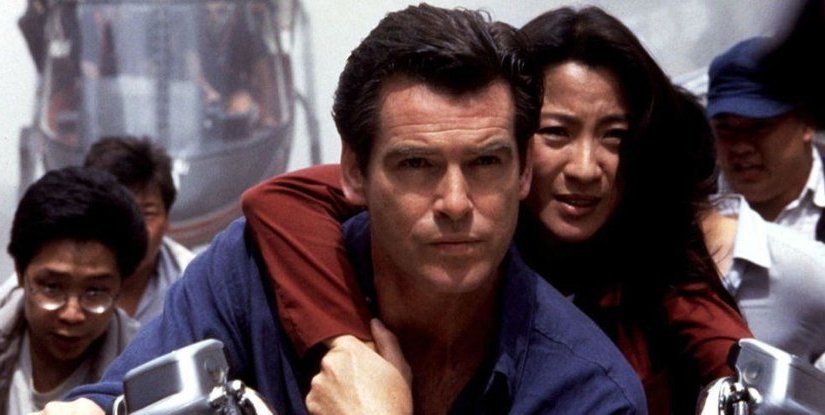
With the Brosnan entries from the 90s, the series was updating itself for a more mainstream feel. So the female stand-in is Michelle Yeoh as a Chinese agent named Wai Lin. Yeoh plays one of the best sidekicks/Bond girls of the series. This agent can hold her own while firing off two machine guns, one on each arm and offering up a great display of karate moves. Yeoh works well with Brosnan especially when handcuffed together while riding a BMW motorcycle and evading machine gun toting cars and a massive helicopter terrorizing a bustling Vietnam village. A fantastic sequence.

Before that, Bond pilots his BMW 700 series from his backseat on his cell phone pad, within a parking garage. Bazookas, guns, crowbars, sledgehammers and missiles can’t stop this luxury car though. After all, the Germans do make some of the best automobiles. Another really entertaining action scene.

I think this is a better film than GoldenEye. Brosnan appears more comfortable with the role and his humor is funnier. He rides the motorcycle through a laundry clothesline and Wai Lin tells him to go faster. Bond’s response: “Alright. Keep your shirt on!” I liked it. I was having a good time with the film.

Roger Spottiswoode was the director this time and he does a fine job. All of the action scenes are well orchestrated and edited.

I’ll also give props to Sheryl Crow for her alluringly sexy and haunting title track. I have never forgotten the song since I saw the film.

Tomorrow Never Dies is a great action film worth checking out whether you’re a James Bond fan or not.

I really like this entry.

GOLDENEYE

By Marc S. Sanders

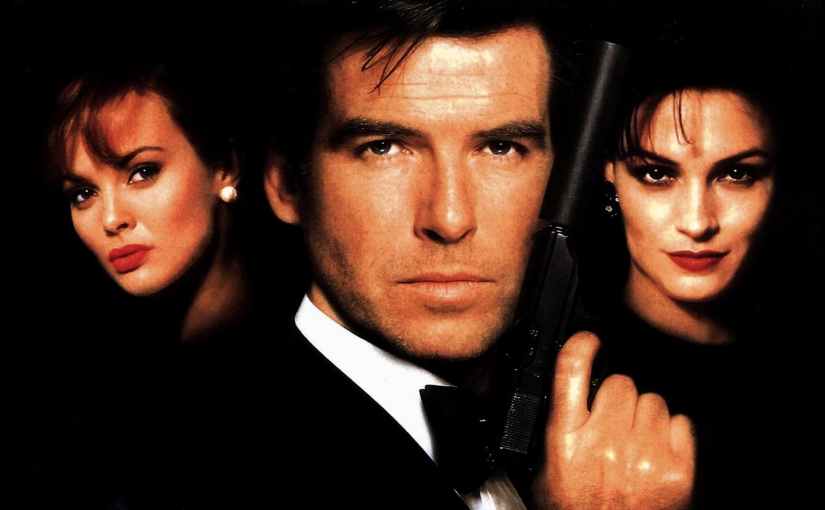
Over six years went by following Timothy Dalton’s last appearance as James Bond. He wasn’t likely to come back and the big question, besides if we’d ever see another film, was who would carry the Walther PPK pistol next as 007. Pierce Brosnan was not a likely choice as I recall, having missed out on the opportunity before with a flimsy Remington Steele contract commitment with NBC. Yet, one day my brother called me at work to share with me the news that Brosnan had signed on. His first film in the everlasting series was Goldeneye directed by Martin Campbell (eventual director of Casino Royale and Green Lantern). It was a welcome debut for the former odds-on favorite contender.

Bond goes up against the Russians in a post-Cold War 1990’s era, with Sean Bean as his adversary, also once known as Bond’s ally, Agent 006-Alec Trevalyen.

With Famke Jannsen as sidekick Xenia Onatopp (holding on to the sexual innuendo tradition), Alec steals a super helicopter that allows him to take possession of the Russian Goldeneye disc. Dame Judi Dench, making her first appearance as M, assigns Bond to locate the disc and find out what Alec intends to do with it. Forget about what the disc is for; you don’t uncover that until the end of the film.

Brosnan is a good physical Bond and he does the tongue in cheek well, sounding much like his Remington Steele character. Screenwriters Jeffrey Caine and Bruce Fierstein provide a wealth of signature puns for Bond to deliver. Onatopp can masterfully kill someone by squeezing a victim between her thighs. Bond’s observation: “She always liked a tight squeeze.”

The film has an outstanding but unrealistic opening scene with a motorcycle trying to catch up to a descending airplane. There’s also a fun tank/car chase in Red Square, and a great action-packed ending in Cuba where a satellite is hidden to aid Alec in his plot.

Bean’s role, like most of those on his resume, makes for a great villain – a real equal to Brosnan in physicality and wit. A great match up.

The Bond girl is also very good. Beautiful but not exuding too much sexiness. More so, actor Izabella Scorupco as Natalya, the Russian computer analyst, is an intelligent addition to the story. Alan Cumming is fun as a nerdy analyst as well. I love when he consistently boasts “I AM INVINCIBLE!!”

Goldeneye was well celebrated upon its release. James Bond was back and updated for the modern action film. The first scene of the film cemented Brosnan as the super spy with a true to life stunt where 007 bungee jumps off of a high-altitude water dam, with just enough time to take out his cable pistol. As soon as the scene graced the screen, fans sat up with attention.

This was a James Bond everyone could love.

SMOKEY & THE BANDIT

By Marc S. Sanders

Does a comedy get much better than Smokey & The Bandit?

Stuntman Hal Needham re-energized the car chase comedy with this classic from 1977 featuring foul mouthed Jackie Gleason as Sheriff Buford T Justice of Portague County, Texas pursuing the charismatic, cocky and lovable Bandit played brilliantly by Burt Reynolds. It still holds up as a hilarious film.

Big Enos and Little Enos Burdette (Pat McCormick, Paul Williams), in matching cowboy hats and suits, challenge The Bandit to bootleg 400 cases of Coors beer from Texas back to Georgia in 28 hours; that’s 1800 miles total. They’ll pay him $80,000 to do it. Bandit recruits his best pal, The Snowman (the terrific Jerry Reed who also sings memorably on the soundtrack), to drive the truck hauling the manifests while he pilots the black Trans Am at 110 mph, distracting law enforcement away from the truck. On the way back from Texas, Bandit picks up a hitchhiking bride (an adorable Sally Field as Carrie soon to have the handle of “Frog”), who has fled from her wedding to Sheriff Justice’s son, Junior (a great dim-witted Mike Henry).

That’s all there is to it!

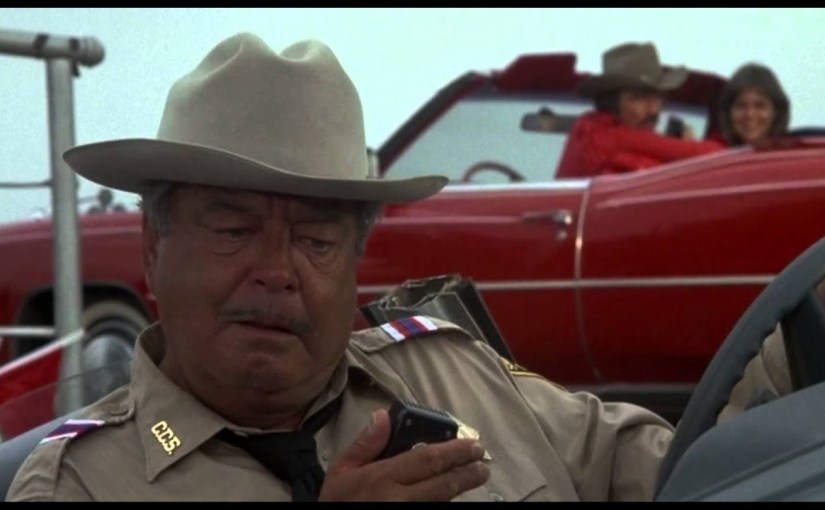
From there, it’s just one pursuit after another with the Trans Am doing ungodly stunts like jumping bridges and dodging roadblocks from state to state, while keeping Smokey Bear Sheriff Justice off his tail. A great on-going slapstick gag is seeing the excessive damage piled on to the Sheriff’s squad car. He loses the roof, the driver’s side door, the muffler and so on. The car keeps up with The Bandit, though, and Sheriff Justice never loses his hat.

This film doesn’t belong to any one member of the cast. Collectively it belongs to all of them. Every character is memorably quoted and given great comedic moments to laugh at over and over again. Even The Snowman’s basset hound, Fred has his share of laughs.

It’s impressive to think how influential this film actually became. The black Trans Am with the gold eagle spread across the hood, became a classic car much like any James Bond vehicle. The hit series The Dukes Of Hazzard made its debut shortly thereafter, and stole much of this film’s themes and gags. Tons of crash ‘em up stunt filled chase comedies attempted to duplicate the success of this film in the late ‘70s and early ‘80s, including further team ups of Needham, Reynolds, Reed and Field (Hooper, The Cannonball Run).

Hal Needham, with his cast and crew, really touched on something special with Smokey & The Bandit. As one of the first films I ever saw in theatres, it’ll always remain as a favorite movie going experience that I shared with my brother and babysitter, Mrs. Garcia. Along with late night viewings of the classic 39 episodes of The Honeymooners, Jackie Gleason will always stay on top as one of my favorite funny men. I’ll still watch and happily quote this picture endlessly for years to come.

“Now lemme have a diablo sandwich and a Dr. Pepper and make it fast. I’m in a g-ddam hurry!”

THE FUGITIVE

By Marc S. Sanders

In 1993, Andrew Davis directed the best Alfred Hitchcock film that was not directed by Alfred Hitchcock. The Fugitive with Harrison Ford being pursued by Tommy Lee Jones was a runaway smash. As we now live in an age of cell phones and the World Wide Web, you’d think this film might be somewhat dated but it is the last thing on your mind while watching. This is a tense, taut thriller that never, ever lets up. Another favorite picture of mine.

The opening credits serve as a prologue, showing Dr. Richard Kimble struggle with a one armed man in his home after his wife (Sela Ward) has been assaulted and killed. Kimble becomes the accused and eventual guilty party who is sentenced to death.

Davis is now ready to show his first of many wonderful set pieces. As Kimble’s prison bus careens off the road landing on railroad tracks, an oncoming train collides with the bus. Kimble and another prison inmate now have the opportunity to escape and go on the run. Enter Tommy Lee Jones as Deputy Sam Gerard and his team of smart, intuitive misfits to catch up to Kimble who has made a mad dash into the dense Illinois woods. Because Kimble and Gerard are depicted to be incredibly smart, Kimble only remains a few steps ahead throughout the picture. Later in the film, Kimble makes his way back to Chicago to search for the one armed man and uncover exactly why his wife was murdered.

Location shots are masterfully done in The Fugitive. From the woods to a sewer system (a manufactured set I believe), to the streets of Chicago and Cook County Hospital.

The train crash is one of the all time best moments in film. No miniatures. No CGI. This is a fully loaded train crashing into a bus, and this is where you can not deny the craftsmanship of great filmmaking. Cameras were positioned at multiple angles to capture the mayhem in one take.

The other great set piece occurs during the actual St Patrick’s Day parade in Chicago. Gerard once again gets Kimble in his sights and Kimble manages to blend in with the parade marchers. The quick editing of improvisational camera work is spectacular here. Kimble and Gerard are literally in the same frame and yet Gerard can’t see what’s under his nose. Moments like these can’t be storyboarded. Andrew Davis’ production could not stop the actual parade for another take. It all had to be done on a now or never basis.

I watch The Fugitive and I always think back to Alfred Hitchcock’s best work like The Man Who Knew Too Much and North By Northwest. An innocent man is unexpectedly swept up in a conspiracy where he becomes the target and his adrenaline and instincts must kick in to save himself. The only thing he’s armed with is his mind. There’s also an unusually creepy antagonist, The One-Armed Man. This makes the film incredibly foreboding. I know the film stems from the legendary television series, but Davis treats this villain as if he’s among the ranks of Hitchcock’s use of Martin Landau or James Mason.

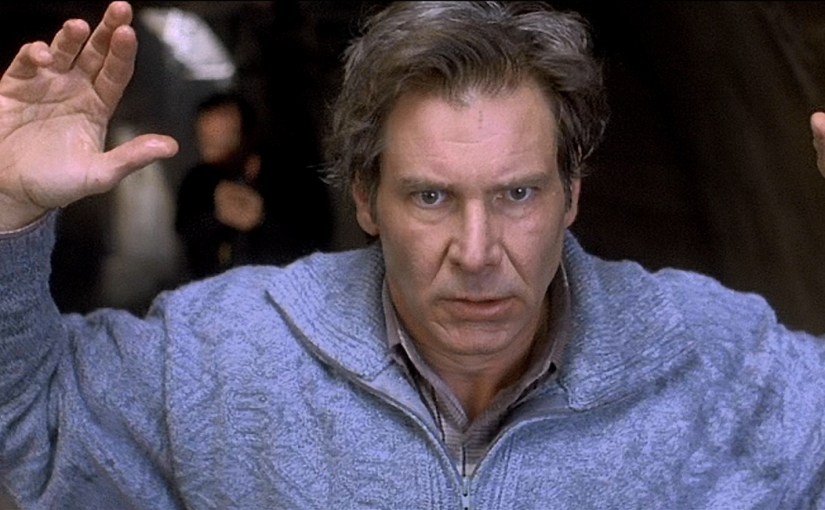
Harrison Ford is great at never glamorizing his role. He doesn’t suddenly become Rambo. He becomes a man of convincing desperation. Ford shines in roles like these such as his other films like Witness, Air Force One, and Frantic.

Tommy Lee Jones gives one of my most favorite performances on film. He plays Gerard with non stop adrenaline. He has exquisite chemistry with his team, including Joe Pantoliano. As well, Gerard is only interested in fetching what has escaped. He has no interest in guilt or innocence, until he realizes that Kimble has no interest in the consequences of escape. Kimble is interested in his innocence. Even Gerard becomes attuned to Kimble’s drive. Here is where the script is wise. There is no dialogue to imply what Gerard is thinking. Tommy Lee Jones has a way of giving a great close up to show what he’s thinking. He trusts the audience will presume what’s driving his intuition.

Davis pulls out all the stops with this film. There’s magnificent action shots of Gerard’s helicopter quickly flying over the ambulance that Kimble is racing away in. A great cat and mouse maze sequence happens within a sewer system. Lighting is perfect, there. Nothing is overly dark. There’s also incredible overhead shots of the dam and ravine that Kimble makes for a getaway with an absolutely surprising dive from an enormous height.

The Fugitive is smart and action packed to the teeth. You are in full focus while watching the ongoing pursuit. This film was nominated for Best Picture. Rare for an action film, but also a testament to its greatness. Tommy Lee Jones deservedly won the Oscar for Supporting Actor.

No doubt for me that The Fugitive is a must-see film for any kind of moviegoer. There are moments to feel scared, to laugh, and to cheer. When it is finally over and the story arrives at its satisfying conclusion, you cannot help but let out a deep breath. You feel like you’ve run a hundred miles, or at least as long as Richard Kimble ran towards his innocence. Your time will be well spent investing in the The Fugitive. An absolutely fascinating picture of great, mounting suspense.

ALL THE PRESIDENT’S MEN

By Marc S. Sanders

People talk too much.

Ten minutes into Alan J Pakula’s film, that’s all I can think about. William Goldman’s dialogue heavy script pounds away at depicting Washington Post reporters Carl Bernstein and Bob Woodward’s uncovering of the Watergate break in, and it shows that simply, people talk too much. So much so that just a stutter or a name in passing conversation will dig the hole deeper and deeper towards self-incrimination, and that of other accomplices. Once a source trips up, then a good reporter can pounce.

Names, dates, slamming doors, rotary phones, typewriters and papers fly fast and furiously during Pakula’s film and that’s what upholds the breakneck pace of the investigative journalism. In a film like this, a crime is depicted and investigated, only the words are the real weapons.

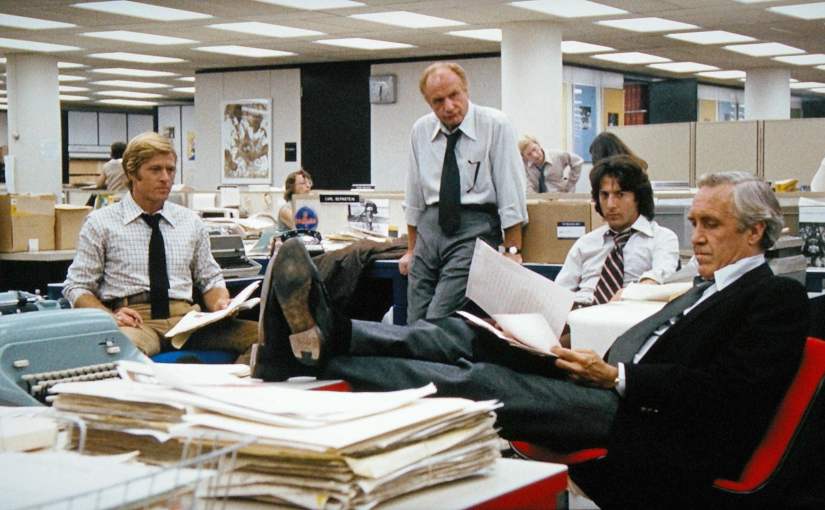
I don’t find All The President’s Men to be a history lesson in the corruption of Nixon’s administration. Rather, I only see what was necessary for Woodward & Bernstein to truthfully prove the corruption took place. The reporters, played by Robert Redford and Dustin Hoffman, seem to run on endless adrenaline of coffee, cigarettes and fast food effectively showing their drive while donning loose ties, wrinkled shirts, and crumpled notepads amid unkept desks and apartments. It’s visually convincing. A story like this doesn’t sleep, nor does it take a vacation. A story like this makes a viewer feel like he/she is still up at 2am, catching a cab to meet a shadowy source in a haunting parking garage; thanks Hal Holbrook for Deep Throat (“Follow the money.”).

Redford has a great scene where Pakula never stops running the camera on close up for over six minutes. All that Redford is doing is dialing, and talking on the phone while maintaining two different conversations. I don’t know if this moment happened in real life but I imagine the best reporters in a pre internet phase had to hold out for opportune times like this to fall into their laps. The cut does not end and Pakula was instinctively wise to do that. The scene itself serves that harrowing pace. Less is more in a moment like this. Props to Redford for maintaining the statuesque momentum.

Equally so, Hoffman has a couple of good moments with Jane Alexander (his eventual costar in Kramer vs Kramer.). She beautifully depicts a victim of intimidating threat, and Hoffman must tread carefully with his questions by strategically letting himself into her home, puffing on a cigarette, sipping cold coffee, speaking softly and eventually getting out his notepad as she gradually breaks down her shell. Alexander doesn’t make it easy and so their scenes work so well in taut suspense of low whispers.

Nixon’s cohorts really are not the antagonists here. In essence, Goldman’s script (based on the reporters’ published book) welcomes the challenge of acquiring factual reporting as the overall conflict. This is best represented by Jason Robards’ portrayal of Post Editor Ben Bradlee. Robards won an Oscar, and he so deserved it. He wouldn’t give “Woodstein” a break until the truth willed itself out by the proper means that are necessary. He’s intimidating in the role but he’s open minded enough to not ignore the young reporters’ instincts. I love watching his scenes; the way he commands an office from a chair with his feet up or fidgets and writes with his red pen. When his boys finally get a solid piece, Bradlee’s character breaks for one moment to knock on a desk and clap his hands as he walks away from his men. They got it. He didn’t relent, and they finally got it. I love that moment. Simply marvelous.

All The President’s Men remains a favorite film of mine. The dialogue moves so fast that after seeing it a number of times I still haven’t connected all the dots, and yet that’s what I appreciate about it. I see something new every time.

JAWS

By Marc S. Sanders

Steven Spielberg’s third film, Jaws, is more than just an adventure or thriller piece of filmmaking. I believe it explores the dichotomy of motivations by man versus the intrinsic behavior of nature. In other words, in the peak season of summertime a great white man-eating shark will never care about how important it is for a small harbor town to sell the necessary amount of ice cream cones or hotel bookings to make an annual profit. You wanna swim with nature, then die by nature.

The New England coastal town of Amity Island has a new Police Chief named Martin Brody (Roy Scheider). When he comes upon what’s left of a girl’s mutilated corpse on the beach, he takes it extremely seriously when he learns the cause of death was a shark attack. The Mayor (Murray Hamilton) cannot afford to be mired with the inconvenience of a large fish just before the always profitable 4th of July weekend. So, the beaches must continue to stay open.

When the town gets a bloody public viewing of the problem at hand, a young, wealthy, educated oceanographer named Matt Hooper (a perfectly cast sarcastic and smart Richard Dreyfuss) is recruited. His knowledge with the science of shark behavior is not very welcome to anyone but Brody.

One dynamic of Hooper is his reliability of technology. Will any of his expensive tools be enough to rid the town of this shark?

As well, will a bounty hunt worth $3,000 satisfy? Any Joe Blow fisherman will take a crack at it. Spielberg’s film explores Hooper’s intellect of sea life, against the buffoonery that follows from others both near and far. Why not randomly toss some sticks of dynamite in the water or bait the animal with a pot roast while you’re at it? Maybe that’ll work. It’s money and technology in the face of one of nature’s most dangerous creations.

Will a sea faring Ahab like fisherman named Quint (Robert Shaw playing one of the greatest characters ever on screen) do the trick? His philosophy stems from his experience with the might of sharks in general. An illustrious monologue from Shaw describing Quint’s harrowing experience aboard the USS Indianapolis confidently tells us he’s seen what sharks can do. He’s floated in the blood red waters that sharks leave behind. Therefore, Quint has devoted his life to hunting one shark after another, boiling their large jaws of teeth for trophy hangings. He’ll win battle after battle, but never will he win the war with the nature of the ocean water.

Brody might be the only sensible guy, though. He fears the water and won’t go near it. He’s over with danger, leaving the cop’s life behind in the city for what he expected of the tranquility of ocean front real estate.

A mounting pressure always exists in Jaws. The townsfolk are hard pressed resistant to allow their businesses to avoid prosperity because of something as silly as a shark that isn’t even known to swim in these waters normally. Money is what matters. Money is what’s needed to live. During the age of quarantining with the spread of Coronavirus, Jaws is a fair allegory for the argument of staying at home or going back to work. You could die, but it’s still expensive to live.

The other argument lies in what’s more appropriate for this problem. Hooper’s technology or Quint’s hunter instinct. A metal “anti shark cage” with a spear of poison vs tying barrels to the predator and drowning him out in the shallows.

Spielberg with a script by Carl Gottlieb adapted from Peter Benchley’s best selling novel proposes no easy answer to ridding an ocean area of a man eating, uncompromising animal. That’s the thrill that keeps Jaws alive for over 45 years. Sharks will never change. Man might, but nature’s creatures will consistently emote the exact same patterns of behavior.

Unlike the fantasies of Jurassic Park or a Friday The 13th picture, a beast born of nature with enormous strength will always be unpredictable performing on God’s purpose. It will never be negotiable. If you’re a raggy fisherman like Quint, your old, leaky boat might keep you afloat for so long, but a shark will also not feel intimidated, no matter how many others of its kind this hunter might have conquered before.

Experience, technology or disregard for the elements of nature will not always win. Something unconquerable will come along.

To maintain the strength of the film’s monstrous antagonist is to watch the movie with your own most frightening, worst case scenario in mind. Hence, Spielberg gratefully never shows the great white until long after half the film is over. Masterful shots occur where his cameras seem positioned just at the surface of the water. When swimmers make desperate runs for the shore, away from danger, it feels as if the viewer is frozen in fear and getting trampled on by the panicked extras cast in the picture. What could be so terrible that these people are swimming and running away from? When Spielberg finally shows the gigantic shark emerge from the water, Scheider’s shock with his suggestion of needing a bigger boat assure you that, yes, this problem is actually this insurmountable.

Additionally, Spielberg uses props to keep the mystery of his beast alive. When the shark pulls a dock off its moorings with his bait, we know the fish is turning around to pursue its next victim as the wreckage now floats in the direction of a man’s panicky, desperate swim.

Most effectively beyond Steven Spielberg’s camerawork, has got to be the pulse pounding and blood curdling soundtrack from John Williams. (Cliche descriptions they may be, but I’d argue Williams’ score created the terms, nonetheless.). Without his music, the narration of the story would be a little lost, I’m sure. John Williams’ repetitive string notes that build, feel like the dialogue of the underwater monster. His music goes beyond the short rhythm everyone is familiar with. Looking at the opening scene with Susan Backline portraying the moonlight skinny dipper in the opening scene of the film, Williams brings in a variety of different sounding instruments that leave an impression of her body being torn apart by something she’s truly not aware of. Splashing, screams, body thrusting and harsh chords of long strings with percussion the emote panic and anarchy make for one of the most memorable opening scenes of any film. Spielberg with a collaboration of cinematography from Bill Butler and Williams orchestration make for an arguably unforgettable and frightening scene on the same level of the shower scene in Psycho.

Jaws transcends generation after generation. Everyone eventually has some kind of familiarity with the film, even if they’ve never seen it. People have seen the poster, heard the music or truly refused to step in the water off a coastline out of fear for what can’t be seen. Few films ever leave a subconscious effect on a viewer or a general public, but Jaws is most definitely one of those exceptions.

NETWORK

By Marc S. Sanders

Without question, what would become the absolute most prophetic film ever made is Sidney Lumet’s biting, satirical masterpiece called Network with its script from Paddy Chayefsky. 

Network works on all cylinders because it was released following a shedding of maybe the last of pure American innocence.  The country had finally pulled out of a losing war in Vietnam.  Our President Nixon was shamed out of office.  Happy housewife programs like The Donna Reed Show and Leave It To Beaver were behind us.  The outright, prejudiced Archie Bunker was who Americans were tuning in to each week.  There was even an incident of a newscaster, named Christine Chubbuck, who shot herself dead on live television.  Looking back, today in 2022, it all seems inevitable that we would arrive at where we are now; where we are always seeking some semblance of showmanship and we’ll get our own brand of infamy no matter how desperate we become.

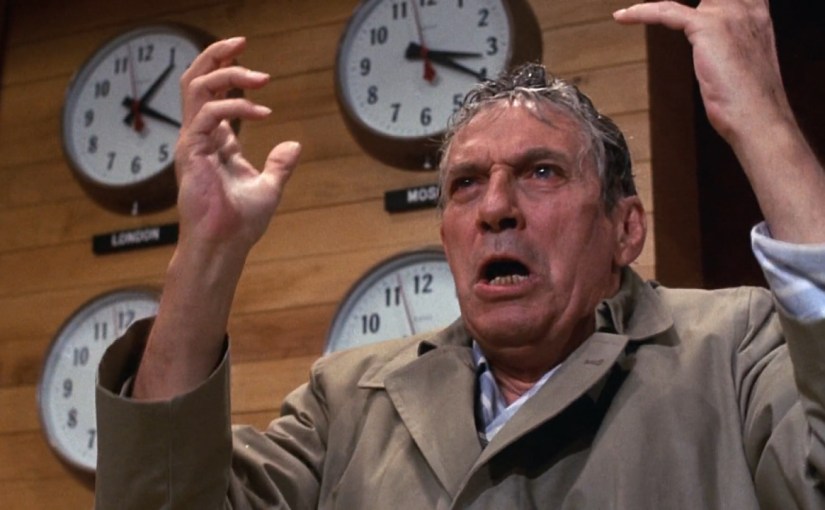
Chayefsky’s script focuses on the fictional network of UBS in present day, 1976.  Well known newscaster Howard Beale (Peter Finch) announces on air that the following week will be his last broadcast as the network has opted to let him go due to poor ratings.  So, he entices his viewers to tune in when he will kill himself live on the air.  It’s a hilarious scene actually due to the ignorance of everyone else in the studio.  The director is flirting with his assistant. Another crew member is eating a sandwich.  No one is even paying attention to the centerpiece they have on the air.  Howard Beale has been taken for a granted as a has been for so long, it really doesn’t matter what he has to say as long as he’s reading the cue cards.  Who’d ever announce on live television in front of millions of viewers that he was intending to kill himself?

Max Schumacher (William Holden), the head of the news division, takes his friend into hiding from the media frenzy suddenly created.  Yet, the next night and after much convincing, Beale is permitted to go on the air again, and make a statement to undo whatever outlandish damage this has all become.  Instead, he decries that life is bull shit.  Max, fed up with the corporate tugs of war already, opts to leave him on and ironically a new opportunity presents itself.  Beale’s moment of insanity and his gradual mental breakdown might be real, but man, this could also pull the UBS news division out its ratings slump and bring it ahead of CBS, NBC and ABC. 

The young and energetic Diana Christensen (Faye Dunaway) in the entertainment division, works her way into the news division and takes over its programming from Max.  She convinces the corporate honchos like Frank Hackett (Robert Duvall) to use Beale as a ratings appeal.  The entire company eventually understands what Diana foresees could actually work when a rain-soaked Beale storms on to the studio set urging his viewers to shout out their windows that they are “mad as hell, and I’m not going to take this anymore.”  Now, the evening news consists of sections featuring Howard’s ranting and ramblings, as well as Sybil The Soothsayer and other such nonsense, most notably a new program from an actual terrorist group known as The Ecumenical Liberation Army. 

From there, the detritus of what UBS commits to for lead ratings night after night only validates that television is not about morals and objectivity in the industry of news reporting.  A slight telling moment has Beale come to Max with an old black and white photograph of them posing with the likes of Edward R Murrow and Walter Cronkite.  They reflect joyfully on the memories, but now they are just memories. These kinds of men of the airwaves no longer exist. Beale is now a jester to the masses who tune in for his mad man speeches labeled as “news.” 

Long before the buffoonery of out of touch Presidential Candidates and over opinionated newscasters who lacked any merit or research to uphold their viewpoints, Chayefsky and Lumet were nervy enough to actually believe moviegoers would buy this satire. 

No matter the medium, satire is maybe the riskiest category of entertainment.  Someone is going to be pissed off and offended.  Others won’t believe this could ever be possible.  In elementary school, I remember reading a short story that proposed cutting down on overpopulation by having people eat their young.  You know what?  After much discussion with fellow classmates at the time, the idea had some logic to it.  Recently, Adam McKay wrote and directed a film called Don’t Look Up that presented a what if scenario to the inevitable end of the world by means of an incoming comet crashing down into Earth.  Unlike Network, some of the elements in that film didn’t work for me.  So, satire is a crap shoot.

Had I seen Network when it was first released, I wonder what I would have thought.  Would I have bought all of its absurdity?  I believe I saw it before reality television became such a novelty and ever since that first time watching, I truly accepted the logic that comes across the decision makers at the UBS network.  Corporate functionality, no matter the industry, relies on monies.  Nothing else matters.  UBS quickly learns that image can be spared.  Money is what keeps everyone happy and afloat.  If the performance of the company falters, changes need to be made; no matter how desperate those actions may appear to be. 

So, Howard Beale becomes a sensation for the UBS network and he is at least besting or tying with top rated shows like All In The Family and Little House On The Prairie.  Yet, Howard is also a mentally ill raving lunatic who needs treatment.  What happens when he declares something to the public that is detrimental to the corporate future of UBS, its top one percent, and its shareholders.  You can’t censor a lunatic with reason.  Ned Beatty as Arthur Jensen, the all-powerful, emperor like CEO, delivers a commanding scene that is one for the ages in response.  He truly deserved his sole career Oscar nomination here…all for one scene perfectly staged in a dimly lit board room with his giant stature poised behind rows of green banker lamps.  He turns Beale into his own prophesized pawn.  Now, that may satisfy the man at the top of the pyramid, but at the end of the day, what about the ratings?????

Chayefsky’s script is one of the greatest ever written.  Not only are the satirical ideas so clearly drawn, but the dialogue is biting with truth in its sarcasm and wit.  When Diana suggests giving The Ecumenical Liberation Army its own weekly program depicting real life footage of their massacres and kidnappings across the country, a staffer retorts “What do you wanna call it?  The Mao Tse Tung Hour?”  When Beale asks the god like image of Arthur Jensen “Why me?”, the response is simply “Because you’re on television, Dummy!”

Maybe we thought the limit of influence stopped with television.  The script for Network felt sure of that.  Yet, we’ve graduated from the simplicity of television and we’ve entered the age of the internet.  Suicides and violence, pornography, slander, opinions and viewpoints can all easily be conjured up by the devices we use to access the internet and we can slant our own news stories in our own way.  News is no longer reported with an objective, omnipotent narration.  It’s dramatized.  I may be a resident in Florida but if someone captures a live on-going police car chase happening on the freeways of Los Angeles, it’s brought to my attention for the thrill of the story.  From a news perspective how is a car chase on the other side of the country relevant to me?  I don’t know the drivers or what motivated them.  I don’t live there.  So, it’s not going to affect my commute home.  Yet, my local news station finds it imperative to show it to me.  No matter the heights of insanity a subject may be, if it’s watchable with a ratings potential, I can rely on my local journalists to bring it to me fast and immediate with zoom in close ups and hi definition.  They’ll even replay it for me in slow motion a hundred times, just to stretch the story until the commercial break.

Network also explores the corporate obsession America entered into by the mid-70s.  Chayefsky uses the Diana Christensen character as a departure from the wholesome Donna Reed image.  Women are working in the offices now.  They are beautiful, smart, strong and assured.  Yet, have they also lost their humanity?  Has this happened to only women?  Diana uses her edge to sleep with her mentor, Max, a much older married man of 26 years.  The aging Max surrenders to his libido but is it worth it?  Diana is too quick in bed and while she’s love making, she’s orgasming to the latest ratings poll from her wunderkind, Howard Beale.  Chayefsky demonstrates how maddening corporate America has become by sucking any emotion of love, loss, happiness and sadness that people are heretically born with.  It’s as if a cancer has killed whatever natural stimuli people were gifted with, and he’s not wrong.  People don’t work 9 to 5 jobs any more.  They work 12 to 12.  When they are not working, they are enhancing their “social status” by means of social media. 

Network is one of the greatest films ever made.  Lumet and Chayefsky put everything on display in its no holds barred honesty.  Still, the performances must be recognized.  This film has one of the greatest casts ever assembled.  Dunaway is magnificent as the young woman with the drive to turn the television industry on its ear.  She deserved her Oscar.  Robert Duvall never received enough credit as the unforgiving corporate lackey resting just under the top while making sure profit is provided before anything else.  William Holden was already in his golden years of film acting by this time.  With Beatrice Straight, playing his wife (in her brief but Oscar winning role), they represent an honorable profession and household that is now long gone.  His character is fired twice within the first hour of the film by the modern corporate mentality, and then he’s resigned to write a tired book about his journalistic accomplishments because there is simply nothing left to do.  He’s a dinosaur in the modern age of television and business.  Peter Finch was the first to win a posthumous Oscar for his turn as Howard Beale.  If this character were real and was televised as the film demonstrates, I can’t deny that I would buy into his raving rhetoric.  I’d have no idea what he’s talking about.  I wouldn’t care, but I would tune in later in the week when John Belushi would mimic him on Saturday Night Live.

With each viewing of Network, you find something new to relate with every time.  The reason is that it stays consistent with the evolution of our planetary function.  Even in this age of Covid where stories are never consistent yet always hyped for dramatic impact, there is something to nod at and understand from the messages of Network.  It could be a world war, a new president, an assassination, a school shooting, a police chase, a riot or a pandemic.  Network had already considered the response to any topic that’s ever been the top story. 

Network is one of the most important films ever made.

THE SUGARLAND EXPRESS

By Marc S. Sanders

Steven Spielberg’s second film, and first full-length theatrical release, is The Sugarland Express.  It’s inspired by real life events that consisted of a convict couple making their way to the Sugarland estate, located in Texas, to reunite with their toddler child living with foster parents.  Goldie Hawn played the mother, Lou Jean, who easily springs her husband, Clovis (William Atherton) from a pre-release penitentiary.  Clovis only had four months to go before a full release.  Once they’re out, they hijack a police car with the deputy driving and make their way across the state for Sugarland.  The rest of the police force, along with out of state authorities, are hot on their tail.  Pitifully speaking though, this becomes a long, drawn-out slow car chase.  It’s a pretty dim-witted story, but because it’s based on fact, well, some thought it’d make for an interesting two hours on film.

Unlike Spielberg’s first film, Duel, I didn’t find much inventiveness with The Sugarland Express.  If anything, it was likely green lit following what the director accomplished so well, at such a low expense, with his first film.  Car crash/car chase movies were also becoming trendy in the early ‘70s with Steve McQueen’s Bullitt becoming such a pioneering film of incredible automobile stunt work.  The French Connection would go on to win Best Picture a few years later with a centerpiece car chase to hang its hat on as well.  The Sugarland Express however is quite silly and very inferior to those pictures, though.

I was impressed with the infinite number of cars at Spielberg’s disposal and many of them get bashed up and crashed up in so many ways.  Yet, I grew tired of the novelty too.  The stakes didn’t seem so high with this film.  It is perhaps a film of its time.  After so many on the run pictures that were made with much better sophistication in the decades that followed, Spielberg’s film often feels unconvincing and unintentionally silly.  A funny moment occurs when Lou Jean needs to finally pee following miles and miles of endless driving.  The outlaws force the police led by Ben Johnson, in a nothing role with a big cowboy hat, to bring in a port o potty in the middle of an open field.  Cop cars are everywhere.  It’s clear as day outside.  Yet no one takes the opportunity for aggressive action.  Lou Jean gets to relieve herself.

As the pursuit carries on, Lou Jean and Clovis become celebrities, and crowds of townsfolk approach the car they occupy to lend them money and good wishes and even a pet pig.  Silly stuff mostly, but just not very amusing to me, and Goldie Hawn, who is normally a natural and adorable comedienne, is not very endearing here.  Lou Jean mostly screams in her redneck dialect and as a former beautician, styles her hair in the back seat applying endless amounts of hair spray to irritate Clovis and the deputy.

I didn’t find much camera work to impress me from Spielberg either.  I appreciated one moment in time however.  As the characters manage to hide out in an RV parking lot overnight, they watch an outdoor screening of a Roadrunner cartoon short out their back window.  Wile E Coyote falls victim to one of the Roadrunner’s tricks, and Spielberg captures a close up of Atherton with a foretelling expression of doom cross over his face.  It’s a nice moment that brought me back into the film, but then the ongoing themes of the film return thereafter.

I don’t care if it’s a true story.  I don’t care how ridiculously absurd it all amounted to.  The Sugarland Express was just noise for me.  Other absurdist stories of the 1970s, approached their subject matter better.  Films like Dog Day Afternoon whereas the ordeal continued to prolong, so did the mental exhaustion and desperation of the characters.  I’m afraid Spielberg just didn’t capture any of that here.

THE TRAGEDY OF MACBETH (2021)

by Miguel E. Rodriguez

Director: Joel Coen
Cast: Denzel Washington, Frances McDormand, Alex Hassell, Brendan Gleeson, Corey Hawkins, Stephen Root
My Rating: 8/10
Rotten Tomatometer: 93% Certified Fresh

PLOT: William Shakespeare’s tragic tale of murder and guilt gets a stylistic re-telling with moody direction from Joel Coen and powerhouse performances from its two leads.


I am of two minds when thinking about Joel Coen’s take on William Shakespeare’s Macbeth.

First, I must admit I am no Shakespeare scholar. I can count on one hand (maybe two) the number of filmed Shakespeare adaptations I have seen, and I can count on one finger how many theatrical productions I’ve seen. I’ve only read two of the Bard’s plays beginning to end: Othello and Julius Caesar. I have acted in a production of the popular Shakespeare parody The Compleat Workes of William Shakespeare (Abridged), but I doubt anyone would find that an acceptable credential.

So I must be honest and say that, when it comes to the nitty gritty specifics of the dialogue in The Tragedy of Macbeth, I was lost for, oh, 50-60% of the time. Like, “out to sea” lost. I am moderately familiar with the story, so in those times I was lost, I was able to glean what was going on or what was being said in context. I know who Banquo and Macduff and poor Duncan are, and so was able to follow their various comings and goings as revealed in the frequent chunks of expositional dialogue.

[Full disclosure: If the name of the Ross character is ever actually mentioned in the film, I must have missed it…for the duration, I wondered what his name was, and he is a vital character in certain scenes.]

But I have to say, whatever I missed in the dialogue was more than compensated for by the sensational visual language of the film, and by the stunning performances from the two leads.

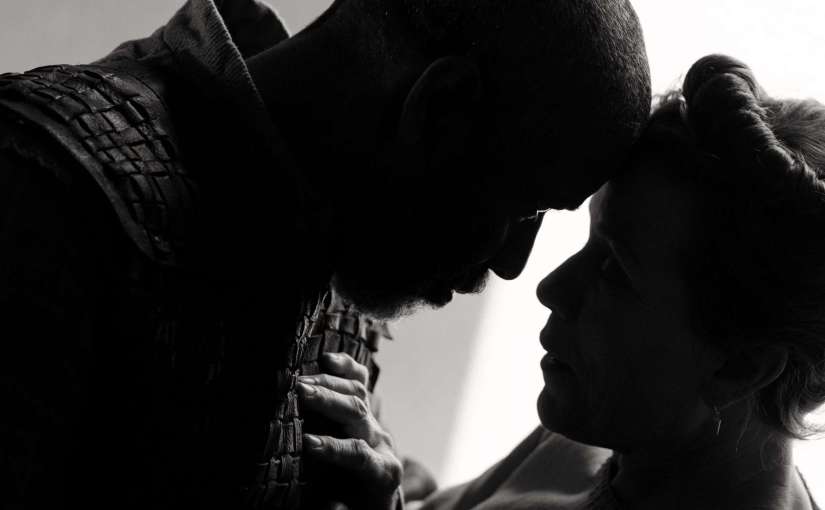
First, it was shot in glorious black-and-white, and it was all shot on soundstages, giving the director (Joel Coen, working for the first time without his brother Ethan) and cinematographer (Bruno Delbonnel [Amélie, Across the Universe]) absolute control over the lighting and shadows. The resulting visuals look like something out of the early silent films of Fritz Lang and, especially, F.W. Murnau, with compositions that must have taken hours and hours to set up, with high-contrast shadows creating elaborate framing devices on walls and floors. When Macbeth famously sees a dagger before him, it’s accomplished by shining a reflective light on a highly polished door handle. In the few shots that take place outside the castle, more often than not shadows are moving slightly in the frame, as if the sun or the clouds were in constant motion. Those shadows always seem to be sliding down over the characters, perhaps mirroring Macbeth and his lady’s constant downward spiral towards their fate.

Another factor in the visual look of the film was the decision to frame it in the standard 1:33 ratio, sometimes known as the “Academy” ratio. Basically, instead of watching the film on a rectangle-shaped viewing area, you’re watching it on a square set in the middle of the screen. One might think that doing so would limit the possibilities of visual expression, but not so. For me, it had the effect of making everything a little more claustrophobic, which I think is important in cementing the state of mind of our two main characters. As the guilt over their evil deeds threatens to overwhelm them both, the smaller screen is a constant, subtle reminder that their options are limited, and becoming fewer as time goes on.

All in all, a visual feast, in a nutshell.

But what makes The Tragedy of Macbeth even more delightful to watch are the performances. To be sure, everyone involved acquits themselves incredibly well. (Keep your eyes open for a young man named Harry Melling, aka “Dudley Vernon” from the Harry Potter film franchise.) But the two that shine brightest are Denzel Washington as Macbeth and Frances McDormand as Lady Macbeth.

Lady Macbeth is as quietly vicious and malicious as they come, and it helps that her attitudes are quite at odds with McDormand’s kind, open features. It is a little startling to see the face of good-hearted Marge Gunderson fiercely exhorting Macbeth to commit regicide in sharp, clipped tones, her whispers piercing the air between them like poison darts. Her despair at her husband’s inability to calmly deal with the guilt is clearly evident; when he reveals he went above and beyond what was originally planned, her shocked “are-you-kidding-me” looks are worth pages and pages of dialogue. And, of course, in the late stages of the story, when madness finally overtakes her, when no amount of washing will wipe the blood from her hands, her animalistic howls of anguish are almost worth the price of admission.

But the highlight of the whole venture (for me, anyway) was watching Denzel Washington demolish the screen as Macbeth himself. Words fail me. I haven’t seen a performance this amazing and praiseworthy since Daniel Day Lewis in There Will Be Blood. I may not be a Shakespeare scholar, but I know enough to understand that making it flow as easily as normal speech takes a great deal of research and rehearsal and collaboration. What I would not GIVE to see him reprise this role on stage somewhere! He navigates the twists and turns of Shakespeare’s tortured syntax as easily as if he was telling a story about his day at work. As with any great performance, there are peaks and valleys, and his teeth-clenching, fist-pumping outbursts are used as periodic punctuation marks, not entire sentences. There is a brief scene where he angrily berates a messenger, and his seventeenth-century taunts and name-callings are as surgical and cutting as anything from Mamet. It’s a miraculous performance, and I would not be surprised in the least if he gets another Oscar nomination. (The same goes for Frances McDormand…what a duo!)

(I would be remiss if I did not also mention the performance by a little-known actress, Kathryn Hunter, as the famous Witches. Her voice and face open the film, and if there’s any justice, it will go down as one of the great opening sequences of the movies. There are portions of her performance that must have taken great courage and trust in director Coen, to make sure she did not come off as simply a kook. She does not. She is one of the most ineffably creepy individuals in a movie in quite some time. I dare not say more without ruining the effect. But she was breathtakingly successful.)

When I walked out of The Tragedy of Macbeth, I can clearly remember thinking, “Well, great movie, but one that I wouldn’t purchase for my home video library, because how can it possibly equal the experience of seeing these precise visuals married to these insane performances, on a big screen?” But the more I think about it, the more I think I will pick up a copy when it becomes available, for a couple of reasons. First, a little extra culture never hurt anyone, and second, it will be worth the purchase price just to see Washington and McDormand tear up the screen as the Macbeths again, not to mention those stunning visuals, AND those creepy witches. This movie is really growing on me.

ROCKY

By Marc S. Sanders

Rocky is a story about a bunch of losers.  It really is. It’s actually a film that does not represent or follow the standard ho hum formula that so many other well-recognized sports films that are so familiar, since it premiered on screens in 1976. 

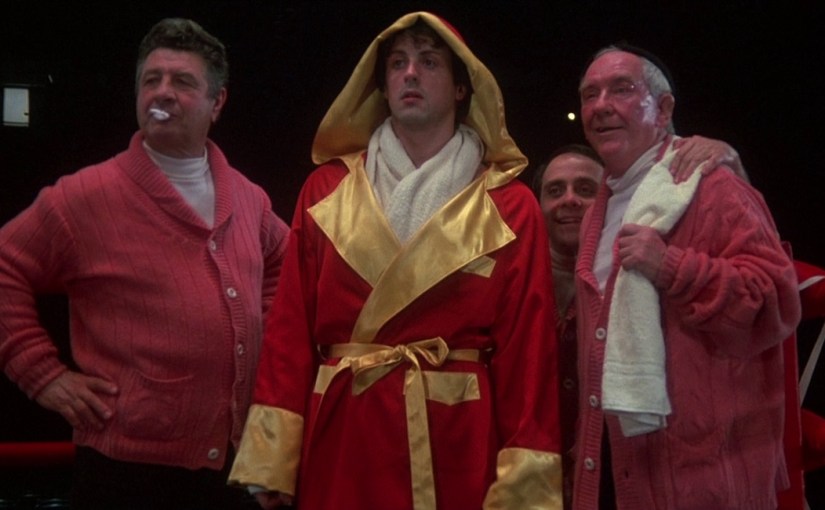
If you examine Rocky, what you’ll find is a story about a boxer by the name of Rocky Balboa (Sylvester Stallone in a role that broke through everything for him), who is not shown doing much boxing or even training.  Instead, the southpaw boxer known as The Italian Stallion, is displayed as a heavy collector for a loan shark in and around the south side of a dirty Philadelphia.  Early on in the film, Rocky delivers monies to the loan shark and his driver asks Rocky “Did ya get the license plate?”  Rocky asks for what, and the driver snaps back with “For the truck that ran over your face.”  It’s delivered with a little humor but it’s also sad.  Is there anyone to uplift poor Rocky’s spirits?  His one-time trainer, Mickey (Burgess Meredith), kicks him out of the gym because he’s tired of Rocky at age 30 wasting his life with the scum of the streets.  Rocky lives in a filthy apartment barely making scratch from underground fights.  About the only redeeming quality Rocky seems to show is his tender loving care for his two turtles, Cuff and Link.  So, it is surprisingly charming when he sweet talks a mousy, petite woman named Adrian (Talia Shire, truly in an underrated performance) for a date. 

Adrian is also a loser, or at least she’s treated like one by her brother, Paulie (Burt Young).  He’s constantly putting her down for her looks and lack of men in her life and any other opportune moment he can find.  It’s the only way that Paulie can build confidence in himself; by putting his sister down.  Beyond that, all he has going for him is his job in the meat locker.  His one dream is for Rocky to give him a job working for the loan shark.  Such aspirations.

By luck, Rocky is called upon by the Heavyweight Champion of the World, Apollo Creed (Carl Weathers), to fight him in the ring.  Anyone else would jump at this chance.  For Rocky, it’s just a way to earn a fast $150,000 and use his face as a punching bag for Creed on live television.

All of these characters within this circle come out of their shells once Rocky is given the opportunity of a lifetime.  The first win for Rocky is when he wins over Adrian on an adoring, near penniless date when he takes her ice skating on Thanksgiving night.  They’re only given ten minutes to skate together.  The transition thereafter is quite revealing.  Director John G. Avildsen transforms Adrian’s appearance by removing her ugly glasses and hat.  Rocky is pleasantly surprised by the red winter coat she wears later in the picture.  Adrian becomes more talkative and expressive.  Initially, she couldn’t even look Rocky in the eye.  When Rocky gives her a shout out at a press conference on TV, Adrian laughs and cuddles up next to Rocky.  Someone has finally treasured her and she adores it so appreciatingly.  Shire really demonstrates a nice character arc, where she comes out from under the strong arm of her brother to find her independence and make choices for herself.  An amazing scene occurs near the end between Shire and Young.  The pent-up frustration the siblings have for one another finally boils over.  This scene is what won both of these actors their Oscar nominations.  It’s a moment in all of the Rocky films that doesn’t get enough recognition.

Mickey is the one who gives tough love to Rocky.  He shares with Rocky his own battles in the ring during the first half of his near 50 years in boxing.  All of the blood and sweat didn’t amount to much beyond the gym he has for the local fighters.  What he earned as a fighter was a cauliflower ear and no family except the poor kids who go in and out of his southside gym.  Now he has a chance at the big time and he has to win over Rocky’s affections so that he can train him properly for the fight that’s coming up.

The biggest loser of course is the title character.  Credit must first go to Stallone for an outstanding insightful script that looks much deeper than any of the numerous sequels that followed this film.  The original Rocky is not about punches.  The script eventually transitions into determination with Rocky giving a sorrowful monologue to Adrian acknowledging he’s a loser with no chance at beating Creed.  At the very least, all he wants to do is settle for going the full 15 rounds with the champion and never falling down on the mat for a count of 10.  Only then can Rocky triumph with a personal victory.

Rocky won the Oscar for Best Picture and Avildsen won Best Director in 1976, beating out incredible films like Network, Taxi Driver and All The President’s Men.  I’ve thought about this endlessly over the years.  Why did it win?  I mean look at the competition it had.  The script for Network is one of the most admired and amazing scripts in Hollywood history; now it’s regarded for how prophetic it has become.  The other two films gave brutally honest, yet cynical portraits of the lack of innocence in the United States.  These other films rightfully question if America is the greatest and most thriving country in the world.  Just writing this, I think I answered my own question, though I will endlessly ponder anyway.  Rocky is the one positive entry of nominated films that year.  Rocky Balboa put aside the differences he had with others and overcame the adversity of those that would antagonize and guide him down the wrong paths. 

It’s totally cliché now to say this but Avildsen’s film, Rocky, is an awe-inspiring triumph.  It’s still okay to identify the picture as such, because it was the first to do what only so many imitations thereafter tried to duplicate.  The outcome of the fight within the film was not about winning the belt and the fortunes of money.  It was a breakthrough from a wasted life – the life of a loser; the lives Rocky, Adrian, Paulie and Mickey were all sadly living before the chance opportunity of supporting one another came to pass.  As Bill Conti’s unforgettable soundtrack closes out the picture, you are not just crying for Rocky and Adrian as they profess their love for one another in the middle of a crowded boxing ring.  You are crying because you realize you can believe in changing your life with will, stamina, endurance, personal strength, confidence and then…finally…love.