LOVE, ACTUALLY

By Marc S. Sanders

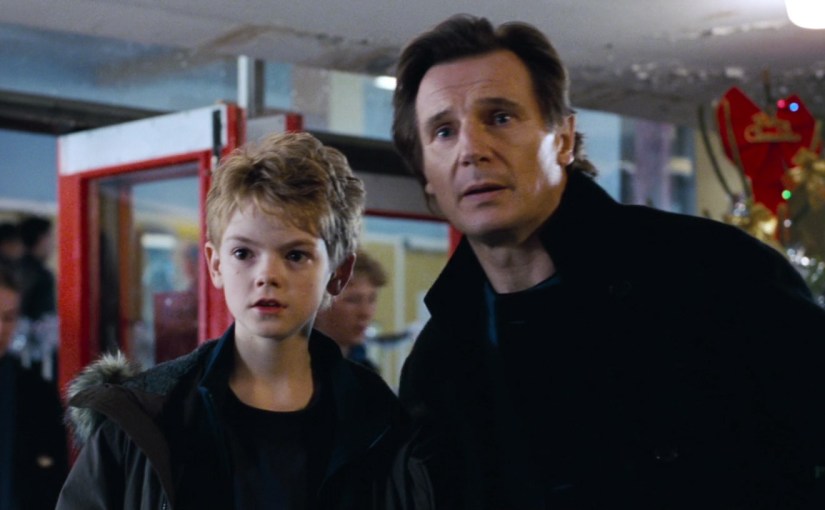
Love, Actually is like a warm favorite blanket to snuggle up in. Richard Curtis writes and directs a collection of the greatest British actors (along with American Laura Linney) in a kaleidoscope of love and relationships against the backdrop of beautiful London, England during the five weeks leading up to Christmas.

I won’t list my favorite characters or actors. In a film this treasured, this loved and this appreciated, that would be like picking your favorite child. It’s impossible when every single storyline is perfectly executed with thought and tenderness.

The stories of love uncovered, love that’s lost, love based in friendship, and love drowning in heartache beautifully jump from one to the next and then back again. Curtis is wise to not show all of the facets of each story early on. Some stories reveal more about themselves later that’ll leave you hurting for those that are not so merry and those that offer plenty of cheer.

I’m especially happy that Curtis did not compromise in the language or subject matter of his tales. Strong language at times makes for some memorable dialogue and nudity presents a normality to how we really are with those we have affections for.

It’s fair to say everyone in life experiences some variation of love. Yes! I mean everyone. Richard Curtis reminds you that love is a natural instinct, and so we can not focus on the easily recognized gloom of our world. To have these stories captured around Christmas time only enhances what we treasure, or what we wish we didn’t have to endure at times. Curtis’ blazing soundtrack helps along the way.

Love is hard. Love is challenging. Love will sweep you off your feet and love will destroy everything you thought you had. However, love will never leave you with complete regret. It’s never the love we have for someone that we regret. It’s only a wish to have it wholesome, healthy, happy and pure.

Love, Actually is all around.

ARGO

By Marc S. Sanders

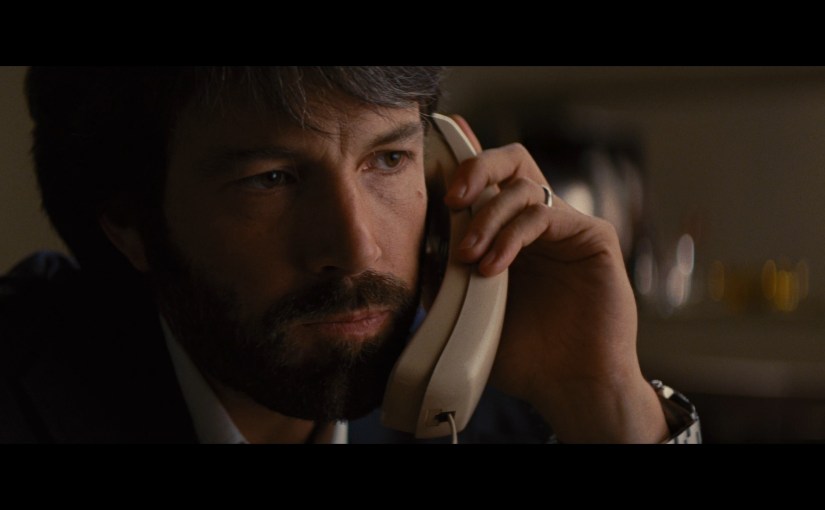
Ben Affleck’s third directorial effort Argo is his best. It makes me wonder why he followed this with playing Batman, a done to death cinematic character.

Argo showed promise of another great actor/director in the same vein as Orson Wells, Woody Allen, Robert Redford and Clint Eastwood. I’m sure Affleck will direct again but a Batman commitment certainly sidelines you. I hope he’ll direct again. I’m a big fan of his previous films, The Town and Gone Baby Gone.

The story tells of one aspect of the Iranian hostage crisis that spanned the end of 1979 through 1980. Six employees of the riot stormed American embassy in Iran manage to escape and hide in the Canadian ambassador’s home. Slowly but surely their hideaway will be revealed and they will inevitably be taken prisoner. Affleck plays CIA operative Tony Mendez who is tasked with getting them out. His plan, with assistance from John Goodman as legendary Hollywood makeup artist, John Chambers, and Alan Arkin as producer Lester Siegel, will make up a cockamamie story about producing a fake science fiction Star Wars rip off film called, you guessed it, Argo. They will do marketing write ups, poster advertising, and even a costumed table read at the Beverly Hills Hotel, all with the intent to just appear authentic as a film studio seeking out production locales in exotic Iran. The six hostages naturally are the film’s crew.

Affleck directs two acts here with two different narratives using both masks of theatre. Namely comedy and tragedy. The pleasure comes in watching Arkin and Goodman pair up to bring the Hollywood flavor that’s necessary. It’s great fun, especially when watching Arkin (in an Oscar nominated role) shyster his way with character actor Richard Kind to buy the Hollywood script-these two guys are like Oscar and Felix. Goodman is great as the been there done that Hollywood insider. He says “You can teach a Rhesus monkey to be a director.”

The drama comes with Affleck’s talent for delivering taut tension from his directing especially but also from his own performance as well as his cast of six hostages consisting of Tate Donovan, Scoot McNairy and Kerry Bishe. Bryan Cranston is also good as Mendez’ comunica from home. Cranston is just good in anything.

The tension builds with intimidating locals screaming of their loyalty to the Ayatollah as well as the eventual airport security. It’s all very nerve racking.

The critique for the the film lies in its own admission of historical inaccuracies. The escape was not as tense as the film suggests. More importantly, the caper was really primarily pulled off by the Canadian Ambassador, Ken Taylor (great actor Victor Garber). No. Canada is not given enough credit in the film. Still, here is a rare exception where I don’t mind. I guess because the suspense Affleck offers up is at its peak. You really shake your head at it all.

Forgive the cliche but Argo is a nail biting, edge of your seat thriller. At best, I can be grateful for learning about the true story following seeing the film. It’s a story that was kept hidden for 17 years. In these times of hardship and turmoil in America, it’s fortunate that a success can finally be celebrated.

Argo was undoubtedly worthy of its Best Picture Oscar win, and Ben Affleck should have at least been nominated for Best Director.

Fun Fact: Argo is produced by two former Batmans: George Clooney and Ben Affleck.

DIE HARD 2: DIE HARDER

By Marc S. Sanders

I think we’ve debated enough about whether Die Hard is considered a Christmas movie. So what about the next installment, Die Hard 2: Die Harder?

Truthfully, who cares?!?!?

Director Renny Harlin (Cliffhanger with Sylvester Stallone) takes over from John McTiernan and he does a capable job of depicting a frenetic Christmas Eve at Dulles Airport in Washington DC, sprinkled with the latest in early 90s technology like fax machines, pagers, tasers and even a reference to Radio Shack. But by golly, the film still remains modern as The Simpsons is shown on local TV.

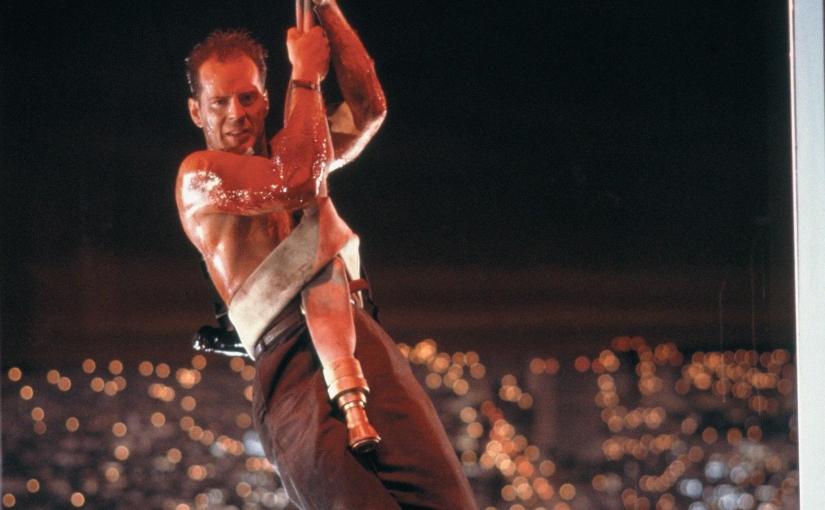
The ingredients are pretty much the same as the first film and while Alan Rickman is sorely missed, William Sadler does alright as a cold hearted Colonel on a mission to aid an escape of a powerful drug overlord. Bruce Willis’ John McClane will not allow that to happen.

Willis is maverick and defiant again though this script doesn’t allow for better one liners that the first film offered. He’s doing his same one man army schtick though with an endless supply of bullets for his service weapon, and it’s nice to return to form.

Harlin is a good action director featuring snow mobiles, shootouts, shootouts on snow mobiles and exploding planes and satellites. Amazingly enough though, a crowded Christmas airport is unaware of all these massive fires and explosions going off all over the nation’s capital and all proceeds as normal until it’s broadcast on TV in the last act of the film. Meh!!! Everyone has Christmas on their mind.

Heck…well then I guess Die Hard 2 (with the inventive subtitle Die Harder) is in fact a Christmas movie. Glad that’s settled.

Happy Holidays. Let it Snow!

DIE HARD

By Marc S. Sanders

The long lasting appeal of Die Hard really stems from so many sources. Most importantly though is the performance of Bruce Willis.

Watching it this evening in a theatre commemorating its 30th anniversary, I found myself still laughing and relishing the fantastic set pieces of editing for great sound and visuals from Director John McTiernan. Yet, tonight Willis is what stood out for me. There’s not much dimension to New York cop John McClane but there is a great transition from being a reserved nervous flyer to an estranged husband with feelings of awkwardness at his wife’s Christmas party and finally to deliriously unhinged and reckless when faced with going up against a superbly brilliant villain from Alan Rickman, his very first film role. Willis goes wild against Rickman’s team of terrorists that hail from all different nationalities and races. (Hans Gruber was an equal opportunity employer.) The mouth on McClane doesn’t hold back for any kind of authority. It’s fun. It’s hilarious and you can’t help but pound your fist in the air with a “right on!”.

Rickman is great as well. His well tailored and groomed persona is a perfect counterbalance to Willis’ lack of class and style. Both are at the top of their game but using different devices to fight with. The playing field of a high rise tower is equal for them. Yet their tactics are different.

McTiernan offers up plenty in side humor from ego minded FBI guys both named Johnson (love that joke) to conniving reporters, to a coked up yuppie hostage and henchmen who all carry themselves differently. McTiernan bravely stops the approach to action to allow his audience to realize the setting on Christmas Eve with great note reminders from a film score by Michael Kamen and even a run through the roses only to have a kick ass swat officer get pricked. A terrorist takes a moment to snack on a Nestle Crunch before a firefight. Porno pictures on the walls of a construction area give Willis an opportunity to offer a glimpse. Great lines as well are so celebrated (“Yippee Kai Yeah Mother Fucker”).

But Willis is the real fun stuff as he gets into hand to hand combat with terrorist Alexander Godunov, he offers a promise to “kill ya, and cook ya” with his “had enough” delivery.

Roger Ebert always took issue with naivety of the law enforcement officials in the film especially actor Paul Gleason as an dumb antagonist. That’s okay and he’s not wrong. However, this is Die Hard where an 80s Los Angelos offers gas for .74 cents and ever relies on their characters getting caught up in a scenario they never fathomed. Had Die Hard been made in post 9/11 it wouldn’t carry that smirk inducing charm. It wouldn’t be fun.

We were fortunate to get one of my favorite Christmas movies when it did come before the age of cell phones and social media.

There were action films long before Die Hard. Yet the original 1988 film set the standard by what most films of action offered in subsequent years. More often than not, they were all fun films in their own right but whether you liked those films or not, they often remain comparisons against Die Hard. That’s the best compliment any film could receive.

FUN TRIVIA: Die Hard is the first of McTiernan’s teddy bear films. Can you name the other one that shows a giant teddy bear with its hero?

NATIONAL LAMPOON’S CHRISTMAS VACATION

By Marc S. Sanders

Not until December 25, 2021, had I seen National Lampoon’s Christmas Vacation.  Friends and colleagues couldn’t believe it, the same way they can’t believe I’ve never eaten a cheeseburger.  I’m not a big Chevy Chase fan.  I think the one film I like of his, because of him, is Neil Simon’s Seems Like Old Times.  The guy is just not a draw for me.  My fellow Cinephiles (Thomas Pahl, Miguel Rodriguez and Anthony Jason) introduced me to Fletch earlier this year.  Wow, did that movie start with a really interesting premise that just stumbled like 2,000-pound stone slowly sinking to the bottom of a very deep and empty sand trap.  The film didn’t work because of Chevy Chase.  Once it got past its exposition, Fletch relied too heavily on boring and unfunny schtick from a very unfunny Chevy Chase.  I was waiting for Christmas Vacation to fall into that same trap.  For a fraction of the film, thankfully, it didn’t.

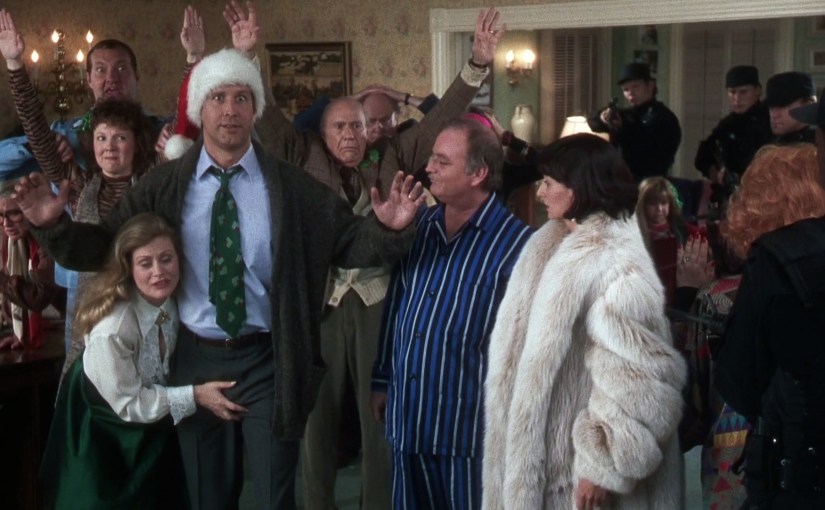
By and large, what works with Christmas Vacation is because of its writer John Hughes, who writes with the consistency of humor that worked in Ferris Bueller’s Day Off and especially Planes, Trains and Automobiles.  The slapstick is most apparent here, then in other Hughes film released before.  (Home Alone would win that record title a year later, of course.)  As I said, Christmas Vacation relies entirely on the slapstick element.  There is no sensitive allowance for warm hugs or coming of age realizations and character arcs.  Clark Griswold gets in one predicament after another.  Like a mediocre Three Stooges short, some of those predicaments work.

Pun intended, the biggest highlight is when Clark decorates his Chicago suburb home with an infinite number of lights, eventually disrupting the next-door neighbors intimate candlelit dinner and blinding them into pratfalls.  The timing is pure John Hughes craftsmanship; John Hughes…not Chevy Chase

Stupid set ups include Clark getting trapped in the attic, unbeknownst to the rest of the family, as well as him hanging from the outside gutters and losing control of a tall ladder.  What works in these moments are what worked for the humor in Ferris Bueller with the school principal character, or Steve Martin’s character in Planes, Trains… .  Clark tries to come up with a way to get out and tip toe across the floor beams of the attic, trying to avoid a haphazard accident in the process.  The floors creak.  The items he finds in the attic squeak and grind.  When he’s hanging from the gutter, the rusty piece of metal is gradually giving way as he holds on for dear life.  I appreciated the prop humor.  The victim might be Chevy Chase, but that could’ve been anybody.  I guess sometimes, the pie is funnier than the one who gets it in the face.  So, there are moments that work.  I like the beginning as well where the dumb patriarch takes his family out to the forest to literally cut down a tree and then carries his optimism that he can actually fit it in the living room.  Moe, Larry and Curly had this kind of positivity when they convinced the Hoi Polloi that they could repair a plumbing problem in a mansion.

Much doesn’t work here either, though.  An overabundance of relatives show up to celebrate the holiday.  The set up is the same as in Hughes’ first film, Sixteen Candles.  However, in that film, each grandparent was given a moment to stand out among the masses.  Christmas Vacation doesn’t capitalize on that so much despite great talent that features Diane Ladd, Doris Roberts and EG Marshall.  No relative is a given a personality or unique and humorous annoyance.

The most remembered relative is Randy Quaid’s Cousin Eddie, but honestly, I found nothing funny about the guy and I thought he only served for irritated facial expressions to capture Chevy Chase in close up.  I know.  I know.  Before seeing this film, I was well aware of the “Shitter’s full” routine.  Okay.  Okay. Shit, poop, doodie, whatever you want to call it is funny.  Shit is God’s endless joke on the living beings he/she/they created.  A two word sentence of dialogue while draining a hose full of shit does not a movie make, though.  Otherwise, there is nothing marvelous about Randy Quaid in this film or the other relative extras that appear.  Clark’s (third time recast) kids could have also been funny but the script doesn’t let them.  There was just no material for these people on the page.  We know how pitch perfect actors like Juliette Lewis and Johnny Galecki have become over their careers.  I’d argue they are funnier and more talented actors than Chevy Chase ever was, but like the other supporting players the script didn’t consider the talent.  Beverly D’Angelo is back as Clark’s wife too.  Moving on…

I could have had regretted watching this film.  I finally, finally, FINALLY gave in per the insistence of practically everyone I know, on a whim, when I saw it available on HBO Max.  I don’t regret watching it.  Truly I don’t.  Yet, I don’t feel better having done so either.  Christmas Vacation is not an all-time great comedy or holiday film.  I don’t believe it did anything for anyone’s career.  Notice I didn’t mention the director’s name, because it doesn’t matter and I haven’t heard from that guy since this picture.

The film is just there, I guess, and as each passing December comes and goes, it is awarded new life…. unlike the electrocuted, exploding cat that perishes under a love seat.  Now that’s funny! Thankfully, this precious feline gave up his lives for a chuckle from me.  Had it been Chevy Chase though, then this review might have gone in another direction.

MATEWAN (1987)

by Miguel E. Rodriguez

Director: John Sayles
Cast: Chris Cooper, Mary McDonnell, David Strathairn, James Earl Jones
My Rating: 9/10
Rotten Tomatometer: 94%

PLOT: The (mostly) true story of a West Virginia coal town where the local miners’ struggle to form a union rose to the pitch of all-out war in 1920.


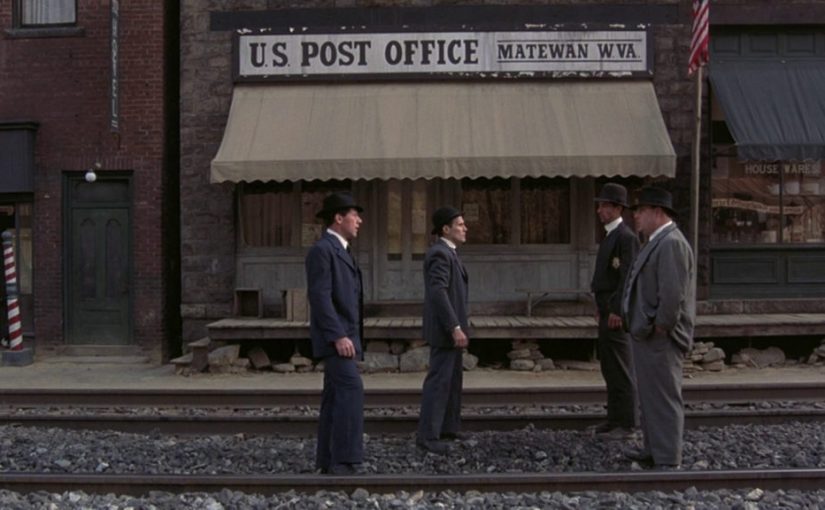
A few nights ago, I watched Matewan for the first time.  I haven’t seen many of director John Sayles’ films, but I’d venture to say it’s one of his best.  With loving authenticity and a keen ear for dialogue and music, Matewan depicts a nearly forgotten chapter of American history when coal miners in 1920 West Virginia attempted to unionize, the big corporation that owned the mine attempted to suppress and intimidate the workers, and everything came to a head one fateful day on the train tracks leading in and out of town.

I can’t pin down exactly why, but I haven’t been able to stop thinking about this movie.  When I was watching it, I tried to stop so I could go to bed and finish it in the morning.  But when I tried to sleep, my mind wouldn’t stop racing, thinking about the film, its message, its look, the SOUND of it.  I had to get back out of bed and finish it to the end before I was finally able to sleep.

The plot is nothing new, at least in broad strokes.  Small town locals take on corporate America and show them what for.  Seen it once, seen it a hundred times.  But for some reason, when this film showed scenes of company men evicting miners from their homes, or humiliating dinner guests at the boarding house where they’re staying, or spreading lies about union organizers, even employing a spy…I got mad.  I wasn’t just upset at the bad guys in a knee-jerk way, like disliking Nazis in a World War II film.  I was genuinely angry.  And I stayed angry for days whenever I thought about the movie.

Maybe it’s the thought of this particular kind of injustice depicted in Matewan that fueled my anger.  Here are people, poor people, desperate people, who lost their land, their homes, their dignity, and their lives so other men hundreds or thousands of miles away could report a six percent increase in profits at the next stockholder’s meeting.

There’s a powerful but terrible scene when the mining boss is introducing a group of new employees to the mine and its rules.  They are presented with tools…but they’re loans from the company, and their cost will be deducted from their first paycheck.  Miners can sharpen the tools with the company’s tool sharpeners…for a monthly fee.  The company provides a doctor…for a monthly fee.  The train ride to the mine was provided by the company…cost to be deducted.  The men are paid in company “script”, redeemable only at the company store.  Purchase any items available at the company store from an outside merchant…and you’re fired.

I remember thinking, this is literally slave labor.  How could anyone live like that, day after day, going down into a hole in the earth where the very real possibility of death, sudden or protracted, loomed over you every moment you’re down there?  And then to hear that the company could make conditions safer, but it’s just too expensive?  No WONDER they wanted to unionize.

Anyway.  Like I said.  It stuck with me.

Leaving aside the story, the film is extremely well made, especially considering the filmmakers were working within an extremely limited budget.  They employed the services of Haskell Wexler, one of the gods of movie cinematography, whose credits include Who’s Afraid of Virginia Woolf? (1966), In the Heat of the Night (1967), and One Flew Over the Cuckoo’s Nest (1975).  He employed a lot of low-light and natural-light photography, and as a result, even though Matewan was released in 1987, the movie looks and feels like a classic ‘70s movie.  It’s so precisely of a particular time and place that it’s a little jarring to see contemporary actors like Chris Cooper and Mary McDonnell in scenes that look like something out of Barry Lyndon or McCabe & Mrs. Miller.

The music choices are also out of this world, especially in a scene where musicians from three separate ethnic communities start riffing on each other’s music.  It’s an eloquent symbol of the kind of community and camaraderie that was needed for the miners to succeed in their task.

The story moves onward.  The miners first rally around Joe Kenehan (Chris Cooper), who came to town with the specific goal of unionizing the mine.  Then things go sour when company enforcers arrive.  The local sheriff (David Strathairn) makes a bad first impression, but later reveals his true nature in immensely satisfying style.  Guns are fired.  Lives are lost.  A spy is discovered.  And everything leads to a final showdown between powerful men with the might of corporate America backing them up and a few desperate miners who just want to be treated like men instead of so much dry goods.

If you’re anything like me, Matewan will stay with you long after it’s over.  Maybe not for the same reasons, but its memory will definitely linger.

LET THE RIGHT ONE IN (2008, Sweden)

by Miguel E. Rodriguez

Director: Tomas Alfredson
Cast: Kåre Hedebrant, Lena Leandersson
My Rating: 9/10
Rotten Tomatometer: 98% Certified Fresh

PLOT: A bullied schoolboy makes friends with the new neighbor, a girl about his age who doesn’t leave her apartment during the day and has some alarming eating habits…


A little while ago, I reviewed a movie called Klaus, a film that took an age-old pop culture trope (the origins of Santa Claus) and turned it on its ear.  I wasn’t sure when I would find another movie that would be able to do that so effectively.

Well…here it is.  Let the Right One In, a Swedish film from 2008, made huge waves at the time of its release.  Critics called it a film with “magnificent emotional resonance.”  “One of the great horror films of recent years.”  “One of the real finds of 2008.”  “A spectacularly moving and elegant movie…a remarkable film.”

Too good to be true, right?  Well, I’ve just finished watching it earlier tonight, and I can tell you, the hype is real.  While the very ending brought up more questions than it answers (where is the train going?  where are the parents?), the ride getting there was phenomenally good.  Calling it simply a “vampire movie” is almost insultingly reductive.  It poses questions about vampire lore that I had never really thought about, and it provides immensely satisfying answers.

For example, one of the most well-known rules about vampires is they cannot enter your home unless you invite them inside.  At one point in the film, a vampire hesitates at a doorway because she hasn’t been invited, and the boy asks her, “Well, what happens if you come in anyway?  Is there something in the air?”  So, she goes inside without being invited.  What happened next was totally unexpected, and it made perfect sense.  I remember thinking, “So THAT’S what they’re afraid of…”

But I’m jumping ahead.  Let the Right One In tells the story of a bullied pre-teen schoolboy, Oskar, who fantasizes about knifing his tormentors.  One day, new neighbors move into the apartment next door, an older gentleman and a preteen girl.  He meets the girl one evening out on the snowy playground in front of their apartment building.  (Her first appearance is one of the great entrances in cinema.)  She tells him her name is Eli (pronounced “Elly” in Sweden).  He says she smells funny.  She tells him they cannot be friends, even though she seems eager to make friends with Oskar.  Her eyes seem to be abnormally large, almost like a character in a Miyazaki anime.

We’ve already seen the older gentleman who moves in with her botch a food-gathering run, so it’s obvious from the get-go what exactly Eli is, and what she needs to survive.  This is all done within the film’s first fifteen minutes or so, so I promise I’m not giving anything away.

What happens after those establishing moments, I’ll leave for you to discover.  You may already be remembering countless other vampire films like Fright Night or Interview with the Vampire and thinking, “I’ve seen all this before.”  But I can assure you, you haven’t.  Not like this.

The relationship between Oskar and Eli never gets sexual (they’re both too young for that…well, Oskar is), and is handled with remarkable sensitivity and keen observation.  At one point, he buys her a snack from a vendor.  She refuses it.  He feels hurt.  So she takes one anyway and eats it.  Seconds later, she’s sick to her stomach.  What does Oskar think about this?  He’s surprised, but he takes it in stride and apologizes.  There’s something so clever about this approach, about making it between an old soul and a child, that feels fresh and new to me.  Oskar knows the term “vampire,” but clearly hasn’t seen enough movies to recognize the signs of one standing right in front of him.

Eli is forced to make a kill periodically to survive.  These attacks are done with a minimum of gore but are incredibly effective and horrifying.  There’s something instinctively creepy about seeing a little girl jump – or drop – from the shadows, clamber onto the back of her victims, and latch onto their necks with an animalistic growl.  The fact these attacks are stitched together with quiet moments, like Oskar teaching Eli morse code, creates a unique atmosphere that is impossible for me to describe satisfactorily.

(Another detail: when Eli is hungry, it’s not depicted as it is in other vampire movies, where the overpowering urge to feed makes her go mad and wide-eyed.  Her stomach rumbles.  True, it’s a little louder than when it happens to a normal person, but it feels…right.  Of course her stomach rumbles…she’s hungry.)

There is more to the story, of course, about Oskar’s bullies and Eli’s incompetent roommate and the suspicious bar regular whose friend was killed, and so on.  Better to leave the rest as a surprise.  And there are LOTS of cool surprises here.  This feels like the kind of movie Guillermo del Toro might have made if he had gotten there first.  (Oh, wait, he did make Cronos…I stand corrected.)

ROSETTA (1999, Belgium)

by Miguel E. Rodriguez

Directors: Jean-Pierre Dardenne, Luc Dardenne
Cast: Émilie Dequenne, Fabrizio Rongione, Olivier Gourmet
My Rating: 9/10
Rotten Tomatometer: 90%

PLOT: A poor young woman, teetering on the edge of desperation, struggles to support herself and her alcoholic mother.


The word “neo-realist” is used several times in other reviews or movie blogs where this little Belgian film is discussed. I’m not a film scholar, so I can’t claim to know precisely what that term describes. Without searching for the dictionary definition, I think it refers to a film in which the predominant theme or tone is that of real life, happening to real people. A favorite method of creating this tone is to use non-professional actors in all the key roles, so one never gets a sense of acting from a performance, only reality.

If I got that right, then Rosetta is definitely a neo-realist film, and I typically do not like neo-realist films. I have seen Bicycle Thieves (1948) a couple of times, and while I acknowledge its place in cinema history and its craftsmanship, the appeal of the film (commonly called a masterpiece of Italian neo-realism) eludes me. It’s not my favorite genre and/or time period.

But Rosetta undercut my preconceived notions of the genre and had me riveted from its opening moments to its severely unconventional ending, ninety short minutes later.

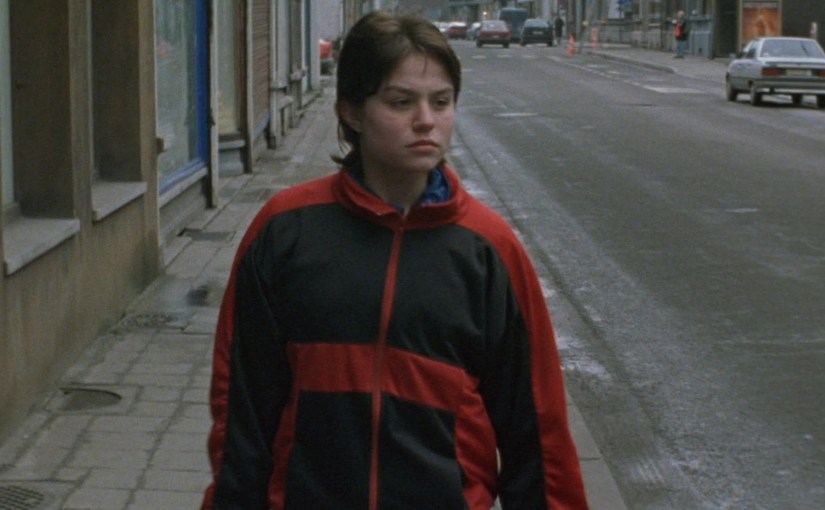
The determining factor is the camerawork, at least at first. We immediately follow this young girl, Rosetta (a gutsy, award-winning performance by Émilie Dequenne), maybe 16 or 17 years old, who is walking briskly through a factory floor, though we’re not sure why at first. As she walks, the camera follows her, hand-held, unsteady, very queasy-cam, but it lends a sense of immediacy to the shot. The camera is almost running just to keep up with Rosetta, and I was instantly curious. Where is she going? Why is she walking so fast? Is she about to punch someone out?

But no, she’s about to be fired for being late, and when her boss intercepts her, she refuses to go quietly, to a point where security has to be called and chases her through the entire building. Why so desperate? Aren’t there other jobs to be had for someone her age out there?

Apparently not. This will be a theme throughout the film: her constant hustle to get a paying job. At one point, someone offers to hire her and pay her under the table, but she refuses: “I want a real job.”

Wherever she goes, the handheld camera follows right behind her, like a paparazzo who won’t give up. We only get a handful of long shots, like when she crosses a busy street after getting off a bus. Virtually every other shot is right behind her or right next to her. The effect creates the idea that Rosetta’s life is composed mostly of sleep and hustling to make that next dollar, or franc. In between, she maintains her trailer home with her alcoholic mother, a woman who is so pitifully down the road of addiction that she demeans herself with the landlord of their trailer park to pay for their water, just so she can keep the money to pay for more liquor. Rosetta ruthlessly tries to keep her mother in check, constantly berating her for her behavior, their familial positions clearly reversed.

Rosetta is not a happy film. How can it be? It simply follows this girl’s life from one crisis to another. But I was totally engrossed in a way that reminded me, for some reason, of another movie, Noah Baumbach’s The Squid and the Whale, which was also shot and filmed in such a way that the actors (most of them recognizable and famous) didn’t feel like actors, and as such felt more real than many other films.

So…what is the takeaway from this movie? Is Rosetta a good person? She has noble intentions, I believe, but she is forced to be strong and calculating as a way of keeping her and her mother afloat. At one point, she meets a young man, might even like him, but at one point, on the shore of a small lake, he falls in and appears to be drowning…and Rosetta takes an awfully long time to decide whether to help him or not. After all, if he dies…she might be able to take his place at work.

I just watched a video essay on Netflix about how it’s not always necessary for you to like a character in a movie in order for it to be enjoyable. Overall, I’d agree with that assessment, especially with Rosetta (though What About Bob? is the CLEAR exception). This film was both dazzling and simple, a neat trick, involving a character I didn’t always agree with, but who I believed made the only choices she could make in her situation. I found myself asking what I would do in her place. Left to fend for myself with no steady job and an alcoholic parent, how would I fare in this world? How would you? Rosetta answers that question in a way that makes sense for the lead character. Her answers may differ from yours. Discuss.

FLIGHTPLAN (2005)

by Miguel E. Rodriguez

Director: Robert Schwentke
Cast: Jodie Foster, Peter Sarsgaard, Sean Bean (who, miraculously, does NOT die in this film)
My Rating: 8/10
Rotten Tomatometer: 37%

PLOT: A bereaved woman (Foster) and her daughter are flying home from Berlin to America. At 30,000 feet, the child vanishes, and nobody will admit she was ever on the plane.


I get it. Flightplan strains at the leash of credibility. A lot. In order for the plot to work, the audience has to believe that a number of people would have to be involved in a massive conspiracy, a cacophony of coincidences that screams “CONTRIVED” to any sane moviegoer.

But, as ridiculous as it seems, the movie still works incredibly well, even upon repeat viewings. Director Robert Schwentke has not exactly distinguished himself since this film (credits include R.I.P.D., Red, and the last two Divergent movies), but Flightplan displays a surefire command of tone, creating a claustrophobic atmosphere while keeping the camera free to move around the plane along seemingly impossible paths.

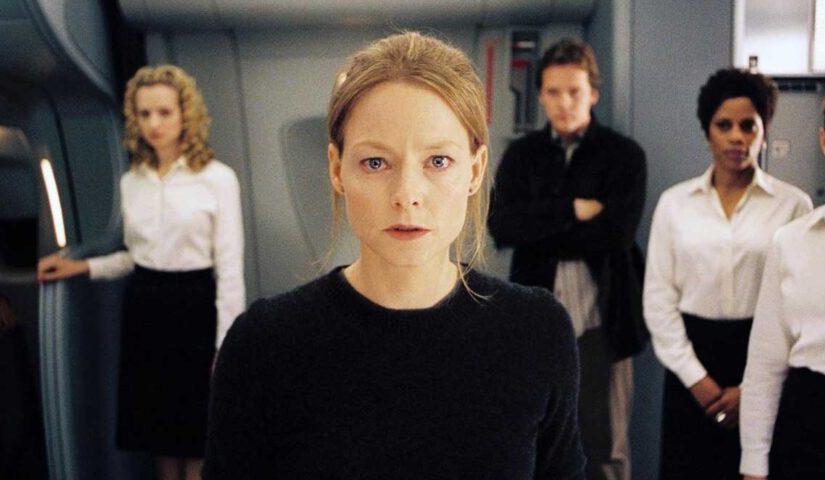
This film is a classic example of what Roger Ebert called a “locked room” puzzle. A girl is missing on an airplane – admittedly a very LARGE airplane, but still. There are only so many places she can be. The plane is searched, but she’s nowhere to be found, leaving only two possibilities: she was never there to begin with, or someone’s lying. But who? And why? She thinks she recognizes an Arab passenger on the plane…was he staring in her apartment window the previous night? Is she going crazy, or has there been an actual kidnapping? That’s the central mystery, and it carries the movie for most of its brief running time.

(There’s a neat section where Foster’s character (who, coincidentally, helped design the plane they’re on), monkeys around with the plane’s electronics and gets the oxygen masks to fall, to create a diversion for herself. Tell you what, that would get MY attention.)

The final resolution is…well, let’s say it answers all the questions of what happened without addressing HOW it happened. A lot of folks found that unsatisfactory (thus the 37% on Rotten Tomatoes), but the movie is so well-made and executed that, by the time the credits rolled, I didn’t mind it so much. But, you know…that’s just me.

A CHRISTMAS CAROL (1984)

by Miguel E. Rodriguez

A CHRISTMAS CAROL (12/17/1984)
Director: Clive Donner
Cast: George C. Scott, David Warner, Joanne Whalley, Edward Woodward, Susannah York
My Rating: 10/10

PLOT: In 19th-century London, a bitter old miser who rationalizes his uncaring nature learns real compassion when three spirits visit him on Christmas Eve.

——————————

[SPOILER ALERTS! (For anyone whose souls are so dead they have never seen or read A Christmas Carol before…)]

The TV version of A Christmas Carol that first aired on CBS in 1984, starring the legendary George C. Scott as Ebenezer Scrooge, is the best version of Charles Dickens’ story that I’ve ever seen.

Oh, but let me tell you why.

Without exception, every other version I’ve ever seen, including live theatre versions, have made humor and lightness their prevailing mood. The musical Scrooge (1970) does have its share of dark moments towards the end, but the darkness is derailed by an unnecessary detour into cartoonish humor (while in the depths of Hell, no less). I’m not saying that making the story fun is wrong, necessarily. After all, it’s a Christmas story, with a strong message of redemption, so why shouldn’t it be a joyous experience? Right?

Ah…but this 1984 version takes a novel approach. It realizes what I’ve always known all along: that this is, above all, a ghost story with a Christmas message. And not all ghost stories are merry and bright.

Take the Ghost of Christmas Present, for example. In this version, he’s played by Edward Woodward, with a deep booming voice, an absurdly hairy chest, and hidden stilts making him upwards of 7 feet tall. His eyes twinkle, but something about his grin and hearty laughter gives you the sense of a cat toying with a mouse. There are moments when he berates poor Scrooge for his vices, and his voice becomes intense, and the smile vanishes from your face, and he tells Scrooge that his life may be worth less than MILLIONS of other souls like Tiny Tim, and…it’s quite a moment. It reminds you that this is a morality tale.

Another example, of course, would be the ever-popular Ghost of Christmas Yet to Come. In every other version I’ve seen, this specter doesn’t speak, just points, usually with some kind of musical flourish. This version is no different, except the filmmakers ingeniously use an intensely creepy sound effect whenever this Ghost points or nods. It’s like someone pulling a violin bow across a huge piece of sheet metal. The effect is not comic or melodramatic. It’s deeply unsettling.

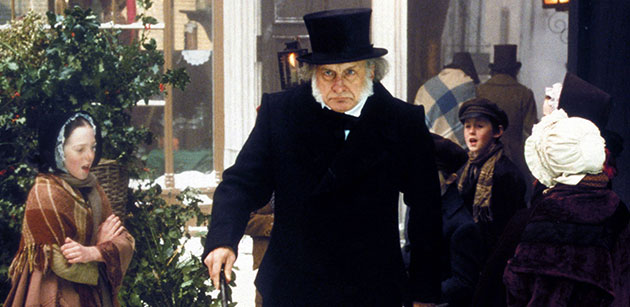
Of course, yet another reason to love this version is the towering performance from George C. Scott as the proto-Grinch, a man for whom Christmas is just an “excuse for picking a man’s pocket every twenty-fifth of December.” He injects moments of sly humor if you watch carefully (to the mute Ghost of Christmas Yet to Come, he mutters, “You’re devilishly hard to have a conversation with”), but for the most part he plays the character completely straight with nary a grin to be seen except on the rarest occasions. This is an aspect missing from every other version. The prevailing wisdom seems to be to amplify and overdo the character of Scrooge, so he’s not as unlikable, I guess. Not this time. Scott creates a mean, heartless, ruthless businessman who would as soon bankrupt you as say two words to you. Even Albert Finney’s interpretation in Scrooge, as completely as he disappears into the role, is not as dark and merciless as George C. Scott’s version.

It’s that darkness that appeals to me here. Yes, yes, the ultimate scenes of happiness and redemption are all there – the boy on the street, Scrooge skipping around his room, “giddy as a drunken man”, the massive turkey – but I love this version because it remembers its roots. This is a gothic ghost story, and as far as I’m concerned, any version of A Christmas Carol would do well to remember that.