SCARY STORIES TO TELL IN THE DARK (2019)

by Miguel E. Rodriguez

Director: André Øvredal
Cast: Zoe Margaret Colletti, Michael Garza, Gabriel Rush
My Rating: 3/10
Rotten Tomatometer: 80% Certified Fresh

PLOT: In order to save their lives, a group of kids face their fears as manifested by a haunted book of stories that write themselves.


I learn from Wikipedia that Scary Stories to Tell in the Dark is based on a popular series of horror stories from the ‘80s, written for a young-adult audience, much like the Goosebumps books, I would imagine.  (I have to imagine, because I have never read a single Goosebumps book.)  If the stories are anything like the trilogy of so-called terror presented in the film, they must be scary indeed.  At least on paper.

The plot: a group of teenagers in 1968 – why that year, specifically?  No idea – discover a book in a local haunted house, a REAL haunted house, that is supposedly filled with stories that a crazy woman would read to local kids through the walls of her basement where she was kept prisoner by her family.  They unwisely take the book from the house and should therefore be unsurprised when the stories in the book start to play out for real.

As a film, Scary Stories delivers occasional shocks without suspense.  You know what I’m talking about, right?  The scene where something jumps at the screen and the soundtrack goes DA-DUM!!!  …and it’s just a cat.  The entire movie is like that.  There are attempts to build suspense, but they fail to do so.

Ironically for a film with “Stories” in its title, I think the problem lies with the storytelling.  The stories on their own are fairly creepy, and seem like they could provide material for a much scarier film.  A scarecrow that comes to life?  A creepy-looking woman who just keeps walking closer and closer to you no matter what you do?  An animated corpse wondering who stole its big toe?  (Okay, maybe not that last one, but you get the idea.)  These would indeed be great stories to tell in the dark, preferably around a campfire or at a slumber party with the lights out and the doors and windows unlocked.

But the film stumbles, and it’s hard for me to pinpoint exactly what happened.  Maybe it rushes through the “in-between” material, the filler between the episodes of terror.  By rushing through those scenes, we really don’t get to know enough about the children who wind up in peril, and consequently we don’t care when they’re being stalked by monsters, etc.

Maybe it’s the fact that these stories, scary as they are on their own, are re-treads of classic horror tropes that we’ve seen over and over and OVER again.  But it can’t be that because, honestly, I have no beef with old tropes, as long as you tell the story well.  (Some might call that “putting old wine in a new bottle”, but if it’s a snazzy enough bottle, I’ll give it a pass… Avatar, anyone?)

So it has to be the storytelling.  The shocks were only periodically effective, and there are some disturbing visuals.  (My favorite involves the creepy-looking woman who keeps getting closer and close, which reminded me of a better film, It Follows.  For that matter, if you want a GREAT horror movie centered on a book, beg, borrow, or steal (not really) The Babadook.  Now THERE’S a scary story.  But I digress.)

There are some disturbing visuals, but the film just felt like it was keeping everyone at arm’s length.  Instead of getting sucked into the stories, I felt like I was watching it from inside the concession stand at a drive-in.  I was a distant observer.

You wanna know what the best part of the movie was?  The full trailer for Zombieland: Double Tap before the movie even started.  Not a great sign.

THERE WILL BE BLOOD (2007)

by Miguel E. Rodriguez

Director: Paul Thomas Anderson
Cast: Daniel Day-Lewis, Paul Dano, Ciarán Hinds
My Rating: 10/10
Rotten Tomatometer: 91% Certified Fresh

PLOT: A story of family, religion, hatred, oil, and madness, focusing on a turn-of-the-century prospector in the early days of the business.


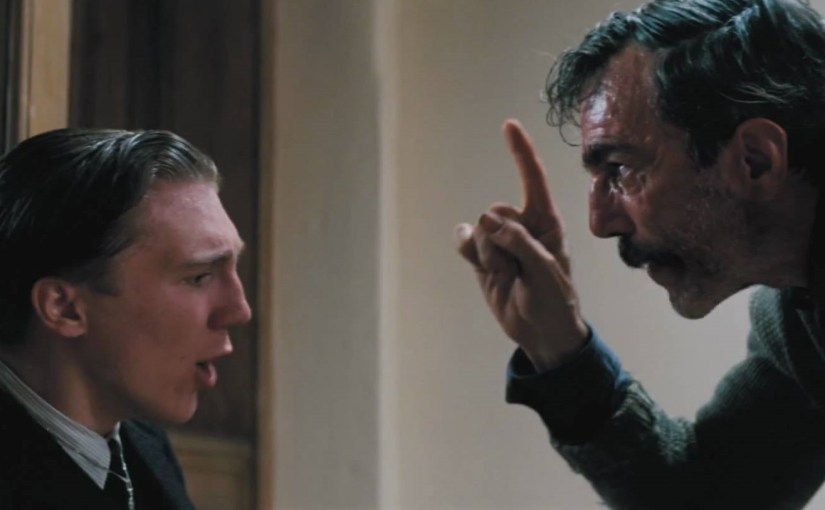
My first draft of this review got up to nearly 1300 words before I realized I was just spinning my wheels.  This is quite simply one of the most original, most daring, most engrossing films of the new millennium that I have ever seen.  And after a while, my first draft became just a list, ticking off and describing scenes that I feel make it great, rather than a precise review.

So instead of giving a full film summary, which you can find elsewhere online, I’m going to try and instead give an actual review.  I’m going to gush a little bit (no pun intended), because it’s a masterpiece, but I’m just going to have to live with that, I guess.

When I first saw this movie (with my good friend Marc Sanders, as it happens, at a free preview), I remember leaving the theater feeling inspired.  Daniel Day-Lewis’s Oscar-winning performance in There Will Be Blood has, to this day, been in the back of my mind every time I’m on stage, whether it’s a drama, comedy, or whatever.  It genuinely makes me want to be a better actor.  Oh, I’ve seen great performances before from the likes of Nicholson, Hoffman, O’Toole, and the rest, but there’s something about the laser-like intensity of Day-Lewis’s performance as Daniel Plainview that had me gawping at the screen in awe as the film played out.  I can’t fully explain it.  It was, and remains, a religious experience to behold.

(For those of you unfamiliar with the story, Daniel Plainview is a turn-of-the-century prospector who thrives in the early days of the oil boom in America, but when his ambition crosses paths with a fire-and-brimstone preacher named Eli Sunday, things get a little testy.)

So, there you go, the acting is not just top-notch, it’s revelatory.

But then there’s the movie itself, exhibiting a level of craftsmanship I haven’t seen since the heyday of Stanley Kubrick.  The plot itself reads like one of those summaries of films that great directors dreamed of making, but were unable to for various reasons, like Kubrick’s unrealized biography of Napoleon.  I mean, who wants to see a 160-minute movie about oil drilling?  Why would anyone care?  Why should anyone care?

Director Paul Thomas Anderson’s ingenuity relies heavily on the acting and casting choices, and of course the ingenious screenplay, but any discussion of the film also has to mention the score.  As much as any other element, the film’s musical score creates and sustains a mood of dread and suspense over such banal scenes as pipeline being laid, oil derricks being built, men surveying land, etcetera.  The atonal and urgent score suggests that what we’re seeing is the prelude to some sort of apocalyptic event or incipient bloodshed.  It keeps you on the edge of your seat, as if around the corner an earthquake or mass murder is waiting.

(Sometimes the ABSENCE of the score is just as disturbing, as in the scene in a church when Daniel Plainview is reluctantly baptized, or most of the scenes in the finale, taking place in 1927.)

But ticking off these technical details still feels lacking.  This is the second draft of this review, and I still feel as if I’m not getting across how much this movie works on the viewer.  Or, at least, how it worked on ME.  This was only the third time I’ve watched the movie since first seeing it in 2007, and I was hooked all over again, right from the opening shot, with those dissonant strings playing over a panorama of sunbaked hills and scrub brush.

The movie just FEELS perfect.  It’s anchored by Daniel Day-Lewis, who is in literally every scene except two that I can recall.  But the artistry of everything else at play is just…I am at a loss for words.  It is, as another review puts it, “wholly original.”  There is just nothing else like it.  Sure, it’s definitely inspired by Kubrick, but it takes things to another level.

It’s one of the best films I’ve ever seen.

ONCE UPON A TIME…IN HOLLYWOOD (2019)

by Miguel E. Rodriguez

Director: Quentin Tarantino
Cast: Leonardo DiCaprio, Brad Pitt, Margot Robbie, Timothy Olyphant, Dakota Fanning, Bruce Dern, Luke Perry, Al Pacino, Kurt Russell
My Rating: 10/10
Rotten Tomatometer: 84% Certified Fresh

PLOT: A fading television actor and his stunt double strive to achieve fame and success in the film industry during the final years of Hollywood’s first Golden Age in 1969 Los Angeles.


Quentin Tarantino’s ninth film is a little bit like Beethoven’s Ninth Symphony.  It’s big, bombastic, and goes the long way around the barn to get to the finale, but in the end it all makes sense and is a transcendent experience.

Let’s see, where do I start?

First of all, the film’s evocation of 1969 Los Angeles is like Mary Poppins: practically perfect in every way.  I’m no fashion scholar or visual historian, but every exterior shot of the city was pretty convincing to my layman’s eyes.  The movie theatres, the movie posters, the restaurants (anyone else remember “Der Weinerschnitzel”?), the cars, those HUGE sedans sharing the road with VW Bugs and M/G’s…it’s clear they did their homework.

There’s the performances by the two leads.  Tarantino once said he considered himself the luckiest director in modern history because he was able to get DiCaprio and Pitt to work on the same film.  Can’t argue with him on that score.  They carry the film in a way that few other tandems could have.  (Newman and Redford come to mind.) Mind you, DiCaprio and Putt don’t look much like each other, considering one has to be the other’s stuntman, but you get the idea.

Above all, there’s the story.  DiCaprio plays Rick Dalton, a former leading man from ‘50s TV westerns who is now playing colorful bad guys in ‘60s TV westerns.  Brad Pitt plays Cliff Booth, the stuntman who’s been taking the dangerous falls for Dalton for years.  Dalton happens to live next door to Roman Polanski and Sharon Tate on Cielo Drive in the Hollywood Hills.

All the trailers, and all the industry buzz, reveal that the Manson family and Sharon Tate play a part in the film.  That’s no spoiler.  Given what we know about those events, the movie plays like Gimme Shelter, the landmark documentary about the ill-fated concert at Altamont that was actually due to take place a few months after the events of this film.  It’s all very suspenseful, in the sense that we know what’s coming, but we’re just not sure how the movie is going to approach it.  So every scene with poor Sharon Tate in it is overshadowed by the fact that we know her ultimate fate in history.

It’s like the famous Hitchcock analogy of suspense.  Two people are eating at a restaurant when a bomb suddenly goes off under their table…that’s surprise.  Put those same two people at the restaurant, where the audience knows there’s a bomb under the table, but it doesn’t go off right away as the two people eat and converse and have dessert, and we’re wondering will they leave BEFORE the bomb goes off or not…?  That’s suspense.

And that’s the genius of this movie, with Tarantino’s sprawling, winding screenplay.  We get to know Rick Dalton and Cliff Booth intimately, we get the rhythms of their relationship, of Dalton’s mood on set, of Booth’s quiet acceptance of his role as Dalton’s sole support system.  We are treated to lengthy scenes showing Dalton at work on the set of a TV western, so we can appreciate the vast differences between an actor and their characters.  There’s a brilliant backstage scene between Dalton and a child actor who is impossibly, hilariously advanced for her age, and who winds up giving Dalton some goodhearted advice.

And interspersed through it all is Sharon Tate.  Sharon Tate bopping to music at home.  Sharon Tate picking up a female hitchhiker on her way into town.  Sharon Tate almost passing, then backing up to admire with youthful excitement, her name on the marquee of a movie theatre, right next to (gasp) Dean Martin’s name!  Sharon Tate dancing, walking, smiling, drinking…living.  She’s the diner at the restaurant, and the Manson family is the bomb we know will eventually go off.  It casts a pall over the proceedings, but not in a bad way.  It’s an interesting way to bring the reality of the situation into focus from time to time.

And now I have to end this review before I inadvertently give away certain, ah, plot elements that elevate Tarantino’s film from a mere character study or period piece into the heady heights of cinematic transcendence.  I have not myself read any reviews of the film, so I can only guess that whatever negative reviews are out there probably center on the film’s finale, or perhaps on its meandering script.  All I can say, or will say, is that I am firmly on Tarantino’s side on this one.  The way the conclusion was written and filmed is the kind of thing that people will still be talking about years from now.

So just take it from me.  If you’re a movie fan, and ESPECIALLY if you’re a Tarantino fan, this is right up your alley.  It’s easily his most slowly paced movie since Jackie Brown, but that just gives you time to e-e-e-ease into the characters, like putting on a tailored suit piece by piece.  This film, like Beethoven’s Ninth, is a masterpiece.

MIDSOMMAR (2019)

by Miguel E. Rodriguez

Director: Ari Aster
Cast: Florence Pugh, Jack Reynor, Vilhelm Blomgren
My Rating: 6/10
Rotten Tomatometer: 82% Certified Fresh

PLOT: A couple travels to Sweden to visit a rural hometown’s fabled mid-summer festival, but what begins as an idyllic retreat quickly devolves into a series of increasingly bizarre rituals at the hands of a pagan cult.


There is a lot to like in Midsommar, the second film from Ari Aster, director of last year’s masterful Hereditary.  It clocks in at 2 ½ hours, and the vast majority of that running time is devoted to creating and maintaining an atmosphere of unsettling oddness, where I was constantly asking myself, “Okay, what the hell is going on here?”  That’s a tricky task, because if you get it wrong, you wind up boring your audience.  And I was never bored during Midsommar.  So there’s that.

The plot: a young woman, Dani, suffers a terrible tragedy and turns for comfort to her boyfriend, Christian, who, truth be told, had been looking for an excuse to end things with Dani before the aforementioned tragedy struck.  But he stays with her more out of duty than real love, and they wind up going to Sweden with a bunch of friends on the recommendation of a college classmate of theirs who tells them of a marvelous nine-day solstice celebration held in his hometown, a quaint country village in the middle of nowhere that doesn’t seem to have or need electricity.

This place is…strange.  In scenes of ordinary behavior that nevertheless manage to somehow give you goosebumps, we observe the villagers performing tasks that would be at home in Amish country: folding clothes, preparing meals, gathering flowers, and the like.  Everything is brightly lit due to the perpetual sunlight at that time of year in that part of Sweden, and all that light somehow, instead of draining the scenes of suspense, actually increases it.  It’s very hard to describe accurately.  (Even the architecture contributes to this sense of unease, with a couple of buildings built with the kind of angles that would have been at home in a Tim Burton film.)

The film takes its time establishing this bright, passive weirdness.  One of the college friends asks the purpose of one of the strange buildings and is told it’s a temple…but no one is allowed there.  There are plainly crops in a field…but it’s difficult if not impossible to tell what’s being grown.  There’s a large bear in a wooden cage that the villagers seem not to notice or care about.   Some of the young village women openly admire Dani’s strapping boyfriend, much to Dani’s annoyance.

Then there’s a bizarre ceremony that starts out with a ritualized dinner, and then two of the older villagers are taken to a high cliff on the edge of the village, and…

Well, that’s when things REALLY start to get weird.  And bloody.  And even more trippy.  I think that’s where I have to stop describing events in the movie.

So.  Like I said, the film does a great job at creating this superbly unsettling atmosphere and maintaining it.  I couldn’t wait to see what was coming up next. But then the movie reached a point where it became obvious how it was going to end…

SPOILER ALERT, SPOILER ALERT, I SAY AGAIN, SPOILER ALERT.

When it became clear that this was NOT going to have a Hollywood ending, I didn’t mind at first.  I mean, Hereditary doesn’t end happily, and I thought it was brilliant.  (Well, I didn’t at first, but I do now.)  But…ugh.  In the last five minutes or so before the credits, instead of sucking in my breath at the audacity of this ending, I was instead shaking my head, saying to myself, “What the f***…?”  And not in a good way.  Midsommar ends with a whimper, not with a bang.

Which is so disappointing.  For 135 minutes, I was breathless with anticipation for the next scene.  And they lost me in the last five.  I HATE it when that happens.

I’m sure there are levels to Midsommar that make it more than just a horror movie.  No doubt there are all sorts of psychological – psychiatric? – parallels between the rituals of the village and the relationship between Dani and her boyfriend.  No doubt.  But when a movie loses me that badly at the end, all the poetic symbolism in the world won’t make me change my opinion.

Midsommar is a long ride for a short day at the beach. A crowded beach with no lifeguard and lots of seaweed.

UNITED 93 (2006)

by Miguel E. Rodriguez

Director: Paul Greengrass
Cast: Ben Sliney, Khalid Abdalla, Corey Johnson
My Rating: 10/10
Rotten Tomatometer: 90% Certified Fresh

PLOT: A real-time account of the events on United Flight 93, one of the planes hijacked on September 11th, 2001, and of the chaos on the ground as the FAA and the military grasped what was happening.


There are a handful of movies that can still make me cry when watching them, even on repeat viewings, and even then it doesn’t always happen.  Fearless, directed by Peter Weir, is one of them.  The finale of Edward Scissorhands still has the power to choke me up.  The transition from black-and-white to color at the end of Schindler’s List can still bring a lump to my throat given the right circumstances.

But only one movie has made me shed real tears every single time I watch it, and I’ve seen it now at least four times.  I used to watch it every time September 11th came around, as a sort of (morbid?) remembrance of that terrible day.  I haven’t done so the last couple of years simply because the emotional reaction I have to the movie and the events it depicts is just too much to deal with.

Paul Greengrass’ United 93 is unlike any other film about 9/11 that I’ve ever seen.  Many people praised Oliver Stone’s World Trade Center when it came out, but I found that movie too pumped up with melodrama and forced situations.  United 93, on the other hand, takes a documentary approach and simply follows the passengers and crew boarding their flight, like any other, on their way to a date with destiny that nobody saw coming.

Intercut with the flight itself are scenes on the ground, in various air traffic control centers, and the FAA itself.  One of the masterstrokes of the film was to cast Ben Sliney as himself.  Ben Sliney, for those who don’t remember, was the FAA Operations Manager on 9/11.  In fact, it was his first day on the job in that new position that very morning.  It was his decision, after seeing the carnage in NYC and the Pentagon, to take the unprecedented step of grounding ALL air traffic over the United States.

The movie’s effectiveness comes partly from the re-enactments of the ground controllers, trying to make sense of garbled messages coming from first one, then two, then three flights, something about people taking control – and then seeing those flights disappear from radar coverage.  And then someone in the tower sees smoke coming from downtown New York…  Those scenes, more than any documentary I’ve seen, really bring back the memories of that morning for me, the disbelief and utter shock of seeing that building burning and smoking.  And then the second plane hits…

But the movie’s real power is with the flight that ultimately didn’t hit a significant target, crashing instead in a field in Pennsylvania.  (There has been some speculation about its intended target, but the truth is we’ll never know.)  The scenes aboard United 93 have been pieced together using recorded phone conversations from passengers, flight deck recordings, and data on the plane’s flight path.  There’s no way to know how accurate some of these events are, but the point of the movie is that it feels 100% real.  The fear on the face of the hijackers, the fear of the passengers, the slow realization that this flight is headed to another target, and their gradual determination to do something about it.

Watching those scenes, with the knowledge that this flight will eventually crash with total loss of life, is an unbearably sad experience.  The final few minutes of the film, as the passengers rush their attackers and frantically try to break down the cockpit door, fills me with dread.  I find myself thinking, unreasonably, “Maybe this time they’ll get to the cockpit in time…maybe THIS time they’ll get the one pilot among the passengers behind the wheel this time…”  But no.

So WHY, oh, WHY do I give this movie a “10” when it’s such an immensely tragic experience?

Because this movie does not feel like a cheap attempt to cash in on a national tragedy.  Instead, it feels more like a memorial to those brave souls who did everything they could to keep themselves alive, to keep their attackers from fulfilling their evil deeds.  As much as any soldiers who gave their lives attacking a beach head, these everyday civilians deserve our gratitude, and they should be acknowledged as genuine heroes.  I believe United 93 treats them as such.

TOY STORY 4 (2019)

by Miguel E. Rodriguez

Director: Josh Cooley
Cast: Tom Hanks, Tim Allen, Annie Potts, Keegan-Michael Key, Jordan Peele, Christina Hendricks, Keanu Reeves, Joan Cusack
My Rating: 9/10
Rotten Tomatometer: 98% Certified Fresh

PLOT: A new toy called “Forky” joins Woody and the gang, and a road trip with old and new friends reveals how big the world can be for a toy.


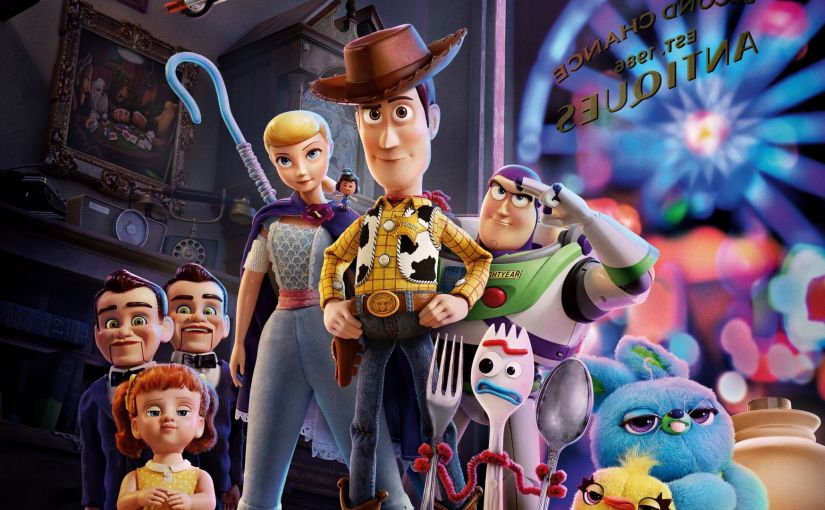
Frankly, one of the best “perks” of Toy Story 4 is the return of Bo Peep.  I had always wondered what had happened to her in Toy Story 3 that had Woody so sad.  I’m glad we got to see why she was no longer around, and I’m glad we get to see how she’s fared in the intervening years.  Just wanted to get that out of the way.

Toy Story 4 is not quite the pinnacle of perfection that is Toy Story 3, especially when it comes to the heartstring-tugging, but it’s a marvelous film on its own, and the ending is a fitting curtain call to the franchise.  Woody, Buzz, and the gang have gone through more hair-raising, death-defying adventures than Indiana Jones, it sometimes seems, and the fact that they reach the start of truly new chapters in their lives by the time the credits roll is comforting.

This fourth film introduces an intriguing element in the form of a doll named Gabby Gabby.  She’s one of those dolls that every girl seems to have owned at some point in her life…at least, every girl born before the year 2000, I’d guess.  She resides in an antiques store, and she has a problem: her voice box is defective.  When you pull her string, instead of a little girl’s voice, you hear what sounds like a 45 being played at 33 1/3.  (You older readers can explain that to the younger ones.)

Her potential salvation: Woody’s voice box is in perfect working order.  All she has to do is somehow exchange voice boxes with Woody, and she’ll have the chance to get a little human girl to love her enough to take her home.

This is…creepy.  There’s something unsettling about this Gabby Gabby character because she’s a cute little doll who essentially wants to perform an organ transplant whether Woody wants to or not.  She’s just so…matter-of-fact about it.

I’m doing a lot of simple play-by-play, and not really giving a sense of the movie itself.  That’s because, while it’s skillfully made and emotionally engaging, it’s not like this movie breaks new ground, exactly.  I think it’s a good thing this will finally be the last Toy Story film.  It’s becoming much harder to imagine what else Pixar can put these characters through, and I’d hate for them to push things too far like they did with the Cars franchise.

But don’t get me wrong, it was incredibly entertaining, and I loved every minute of it.  If you liked the first three movies – heck, if you love ANY Pixar movie – you won’t be disappointed by this one.  It’s just…you’ve gotta see it for yourself.  At this point, any further reviewing of the movie would involve spoiler alerts and scene descriptions and re-telling my favorite lines, and that’s not really a review anymore, that’s just a synopsis.

Suffice to say: “Toy Story 4” delivers the kind of movie we’ve come to expect from Pixar.  It’ll make you laugh, jump, laugh some more, give you a couple of hanky moments, and it’ll look GREAT doing it.

RUNNING SCARED (2006)

by Miguel E. Rodriguez

Director: Wayne Kramer
Cast: Paul Walker, Cameron Bright, Vera Farmiga, Chazz Palminteri
My Rating: 8/10
Rotten Tomatometer: 41%

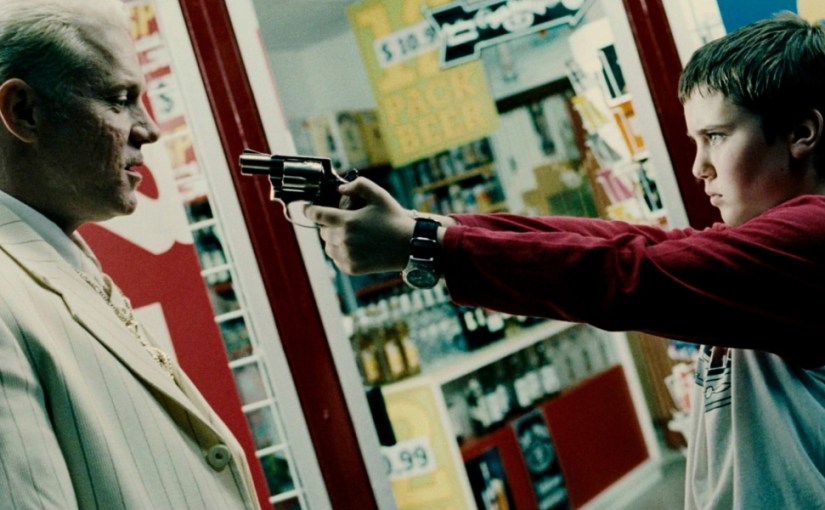
PLOT: A low-ranking thug (Walker) is entrusted by his boss to dispose of a gun that killed corrupt cops, but things spiral out of control when the gun somehow winds up in the hands of his neighbor’s son (Bright).


So…okay.

First of all, this is most assuredly NOT a remake of the quintessentially ‘80s comedy thriller of the same name, starring Billy Crystal and Gregory Hines, who, although they were very funny, were two of the most unconvincing street cops since…ever.

No.  This is one of the most twisted, sordid, blood-soaked retelling of a Grimms-esque fairy tale I’ve ever seen.  Like someone kidnapped Quentin Tarantino and force-fed him only moonshine and methamphetamines for a week, then told him to sit down and re-write the story of Hansel and Gretel, but to make it take place in modern-day lower-middle-class New Jersey, and don’t forget the guns, Russian thugs, and brief, um, cunning linguistics.

Yeah.  It’s that kind of movie.

I haven’t read the negative reviews of this film, so I couldn’t tell you what turned so many people OFF.  I can only report what turned me ON.

A big part of it is the energetic storytelling at work: lots of digitally enhanced camera tricks, the occasional rewind, tilting the camera when you really didn’t have to, sudden speed-ups…very stylistic.  Tony Scott did a bit of the same thing in Domino, released a few months earlier, and Oliver Stone sort of pioneered this kind of thing with the wildly weird Natural Born Killers.  So it’s not like I haven’t seen this before, but it really works with this lurid material.

Which brings me to another big part of why I like this movie: the story.  On the surface, it’s your standard kid-in-peril, race-against-time thriller.  Paul Walker absolutely, positively HAS to get his hands on the dirty gun that Cameron Bright manages to steal and go into hiding with.

But tilt your head and squint your eyes, and you can see the whole thing is basically a guns-blood-and-broads version of a classic fairy tale, where a young innocent traverses the unforgiving countryside while being pursued by deadly forces.  On the way, he meets up with various colorful characters, who aren’t all bad, but they’re certainly not all good.

In this case, instead of trolls and ogres, our innocent character encounters, not necessarily in this order: the Russian mafia, a hooker with a heart of gold, her vengeful pimp, a creepy homeless guy, crooked cops, his own abusive father, and, in the movie’s squirmiest moment, a creepy married couple who show an inordinate amount of compassion for, and interest in, this lost child, and who seem to have the most nefarious motives of anyone else in the film.

And that’s just the “B” story.

The “A” story revolves around Paul Walker’s character trying to retrieve the gun Bright has stolen.  He bounces around like a pinball with his own son in tow, spewing profanity like it’s going out of style, beating up lesser thugs, lying to superior thugs, always just one step behind Bright who is sure Walker is going to kill him.

I dunno, for me, the dynamic camerawork and the shocking subject matter all worked.  It’s a fun, trippy ride, with just desserts getting served all around.  I’m sure people have an issue with the ending, but what would they have preferred when it comes to a popcorn movie like this?

After all, how do MOST fairy tales end?

LATE NIGHT (2019)

by Miguel E. Rodriguez

Director: Nisha Ganatra
Cast: Emma Thompson, Mindy Kaling, John Lithgow
My Rating: 7/10
Rotten Tomatometer: 79% Certified Fresh

PLOT: After being accused of hating women, the female host (Thompson) of a popular late-night talk show makes a “diversity hire” for the writer’s room: Molly Patel (Kaling), whose straight-talking instincts put her at odds with her boss and co-writers.


On the whole, Late Night is like the best movie Judd Apatow hasn’t made yet.  It’s funny (not explosively funny, but pointedly funny), smart, and actually has something relevant to say about a host of topics, but mostly it’s about women: women in the workplace, in Hollywood, in positions of power, in traditionally male-dominated industries, even women and sexual indiscretions.

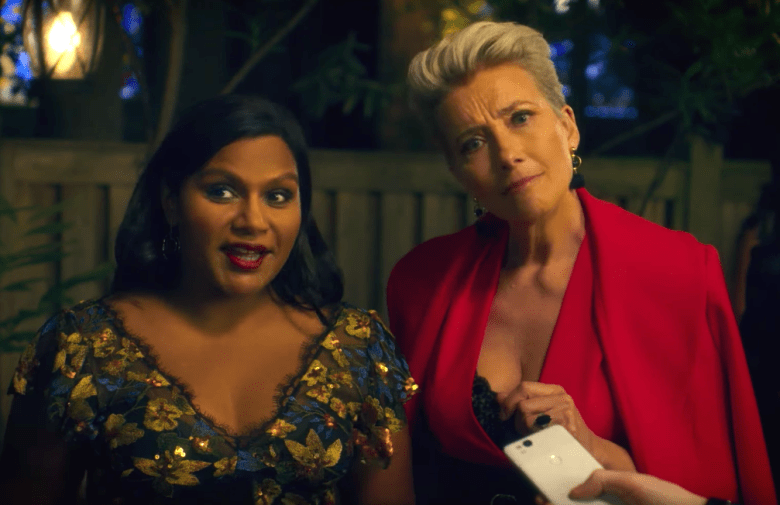
Mindy Kaling (who also wrote the screenplay) plays Molly Patel, a chemical plant worker who lands an interview for a writing job at one of the most popular (fictional) late-night shows on television, and also the only one hosted by a woman: Katherine Newbury, played with style and wit by Emma Thompson.

(For the record, I could watch Emma Thompson read the phone book, and I would say that was also done with style and wit, and I’d probably be right.  But moving on…)

Molly’s interview is perfectly timed, because Katherine desperately needs a “diversity hire” after she is accused of hating women.  The fact that her writer’s room consists of all white men does not help her case, so Molly is hired more or less on the spot.  IMDb tells me that Mindy Kaling once interned for the Conan show, so I personally have no idea how accurate the characterizations are of these writers, but I got the feeling they were pretty spot on.  For example, when she’s first introduced to the room, a couple of the guys immediately ask her for sandwiches and coffee.  In another twist, she uses the ladies room, only to discover that, since there are so few women employed there, all the male writers use the ladies room as well…but only when “duty” calls. (…he said as he chuckled to himself.)

We have the makings of what could have been a great comedy.  As it is, we have a pretty good comedy.

My issues are at the screenplay level.  The story is awesome, the characters are awesome, and the screenplay does make some sharp criticisms of the current status quo.  (The best and funniest scene occurs when Katherine takes to the streets, a la Conan or Jimmy Fallon, and does a “White Savior” bit; it sounds terribly racist when I write it out like that, but I assure you, it’s hilarious and not a bit racist.)  But…there were times when I thought the screenplay was pulling its punches.

For example, there’s a moment when Katherine decides to deliver a politically charged joke in her monologue (it’s a doozy, by the way).  Given the plot developments by that time, I thought there would be more of that kind of material later on.  But there isn’t.  Alas.

There are lots of moments like that, when the screenplay felt like it was building to some kind of climactic, powerfully-written dialogue or monologue that would really lay into the characters and the audience, like an Aaron Sorkin script, or even like a comedy from earlier this year, Long Shot.  But it never QUITE happens.

(Okay, there IS one scene that does deliver a great payoff…it’s played out on an empty stage between two of the main characters, and it has as much heartfelt emotion and drama as any Merchant Ivory film.)

I liked this movie.  I felt like there was MORE that could have been said and done with this material that could have elevated it even more. But it is ultimately a feel-good movie that has some very funny scenes and has a lot to say. 

THE LOBSTER (2015)

by Miguel E. Rodriguez

Director: Yorgos Lanthimos
Cast: Colin Farrell, Rachel Weisz, John C. Reilly, Olivia Colman
My Rating: 4/10
Rotten Tomatometer: 87% Certified Fresh

PLOT: In a dystopian near-future, single people, according to the laws of The City, are taken to The Hotel, where they are obliged to find a romantic partner in forty-five days or be transformed into an animal.

[So, yeah, this is about 1,800 words of how much I disliked the majority of this movie, so this review is FULL OF SPOILERS, because it pissed me off so much…if you have ANY interest in seeing this movie, I’d seriously advise against reading this review.  I’d advise you MORE against SEEING the movie, but whatever, dealer’s choice.]


“The course of your relationship will be monitored closely by our staff and by me personally. If you encounter any problems, any tensions, any arguing, that you cannot resolve yourselves, you will be assigned children. That usually helps, a lot.” – Hotel Manager (Olivia Colman)

(That’s the best line in the movie, just thought you should get the highlight now.)

——————


I first became interested in The Lobster after discovering The Favourite, one of the very best films of 2018.  I thought director Yorgos Lanthimos’s vision and directorial style were stunningly original, and the story was exquisitely well-acted by all three of the female leads.  So, by extension, I figured The Lobster would be more of the same.  It came highly recommended by other friends, and I remember seeing it in stores with that now-familiar “Certified Fresh on Rotten Tomatoes” sticker.

Well, I just finished watching The Lobster on Netflix.  It was, putting it mildly, a major letdown.

It had a promising start.  The opening scene features a woman driving wordlessly through some countryside.  She stops on the side of the road, and as she exits the car, you can see she’s carrying a revolver.  She calmly walks into a field and approaches a nearby donkey and…well, let me just say that my attention was immediately grabbed.

Eventually, the audience is fed enough information to deduce that, for reasons left unexplained, single people from The City (it’s never referred to by its proper name) are being trucked to a resort hotel in the country.  Their personal possessions are confiscated, and they are assigned small rooms with single beds.  They are calmly informed that, if they manage to pair up with another hotel guest, they will both be relocated to a room with a queen bed, and from there to a yacht.  (They are mum about what’s supposed to happen after that.)

If, however, you are unable to pair up with someone after 45 days, you will be literally transformed into an animal.  You are permitted to decide which animal.  Well, naturally. (David, our “hero” (Colin Farrell), wants to be a lobster if his time comes, although not for any reasons that Phoebe Bouffay might celebrate…)

So…yeah.  You’ve basically got Logan’s Run meets Black Mirror.

—————–

For the first section of the film, taking place mostly in and around the resort, I was mesmerized.  It felt like the best films of Spike Jonze, or even Monty Python.  For example, The Hotel strictly prohibits masturbation.  When John C. Reilly’s character breaks this rule, his punishment is bizarre but, I would imagine, 100% effective.  (And let me just say, it’s probably not what you’re thinking.)

Another bizarre moment: sexual intercourse with any other guest while still single is also strictly prohibited, but as part of the “treatment” for a single person, once a day, a maid comes to your room to replace any tranquilizer darts you may have used the previous night (long story) and then performs, for lack of a better word, a lap dance.  This dance, while technically “erotic”, is drained of any sexual chemistry.  It defies description.  It is one of the most bizarre things I’ve seen on film in recent years.

Now, I LIKE bizarre.  This whole opening third of the film is right up my alley.  I had literally NO idea where any of this was headed, and that thrills me. But then…disaster strikes, at least from my point of view.

David, Colin Farrell’s character, can take it no longer and engineers an escape from the Hotel.  In the surrounding forests, he discovers a band of Loners, single people who survive off the land, as they are unwelcome in The City.  They pride themselves on being able to do what they want where they want (as long as it’s not in The City), but they ALSO have strict rules about not pairing up.  Masturbation: A-OK.  Hooking up: VERBOTEN.

From an allegorical point of view, I believe The Hotel represents the cult of Couplehood, or Marriage, if you like, that tends to assault single folks, in one way or another, their entire single life.  (Argue with me all you want, but if you want concrete examples, look no further than television commercials, game, set, match.)  On the other end of the spectrum, you’ve got the cult of Singularity [my own name, not from the film], the folks who love being single so much that, when their friends couple up, the single friend backs off from invitations and begs off of parties and fades away, because who needs that pressure, am I right?

So the rules of the Loners make sense from that perspective.  But…from a STORY perspective, the movie comes to a stop once David finds himself in that forest.  He meets a beautiful woman (Rachel Weisz, credited only as “Short Sighted Woman”), they flirt surreptitiously, they develop a forbidden relationship, they go undercover into the city with another faux couple (just to prove they can, I guess), and then they are discovered by the leader of the Loners.  The Loner leader tricks Short Sighted Woman into seeing an eye doctor on the pretense of getting her vision corrected, but instead, the doctor [SPOILER ALERT] blinds her as punishment for her transgression.

BLINDS her.  Don’t you think a severe tongue-lashing and two nights without food or water would have sufficed here?  I mean, what the actual f***?

At this point, I was getting tired of this story.  I felt bogged down by melodrama after a seriously promising start.  (For example, the way in which the forbidden relationship between David and Short Sighted Woman was discovered was absurdly preventable; it felt like something that happened only because the screenplay required it, not because it was something the characters would actually do.)

——————————

So, now we’re at the REAL reason I disliked this movie so much.  If you’ve stuck with me this long, we’re at the home stretch.  MAJOR spoiler follows, so last chance to bail.

David and the newly-blinded S.S.W. engineer a second escape and wind up on foot on a country road, presumably heading into The City.  At this point, I made a startling realization.  From an allegorical point of view, David and S.S.W., at least to a small degree, represented my relationship with my own girlfriend.  They were in a relationship, but not an officially “sanctioned” one (Marriage), so they don’t belong in The City.  And they’re a couple, but not truly “single”, so they don’t belong at The Hotel.  They’re in relationship limbo, at least as far as cultural designations go.

I was like, “Hey!  Finally, a movie that acknowledges a relationship like mine!  …although I certainly don’t feel like I’m navigating a no-man’s land, but at least we’re being represented in some small way.”

So.  They wind up at a diner, where David makes a decision: he will blind himself with a steak knife.

What.  The f**k.  What is this plot point supposed to represent in this allegory?  The need (requirement?) for one partner in a relationship to make drastic changes to themselves, physically or otherwise, in order to belong with the other person?  I understand the need for change and compromise in ANY relationship, but here’s my two cents: if you decide your relationship depends on you BLINDING YOURSELF for your partner, you need to check yourself before you wreck yourself.

So, picture the scene: David leaves blind S.S.W. at the table and heads to the bathroom.  We see him preparing to do the deed.  The knife is in his hand.  He stuffs paper towels in his mouth to stifle the screams that are sure to come.  He holds the steak knife with the point JUST about to penetrate the eyeball.  Suddenly, CUT back to S.S.W. at the table.  Waiting.  And waiting.  And waiting some more.  A waiter refreshes her water glass.  She continues waiting.  Through the diner window, construction is in progress across the street.  She waits.  And waits.  And waits.

Suddenly…CUT TO BLACK…ROLL CREDITS.

Reader, I am being 100% truthful when I say, at that point, I literally flipped the double-bird at my TV screen and yelled out, “WHAT THE F**K!!!”

I mean, seriously…what is the POINT of that dangling participle of an ending?  There are only three possible outcomes: he blinds himself and returns to S.S.W., OR he chickens out and returns to S.S.W., OR he chickens out and bails on S.S.W.  Since we get the Schrodinger’s Cat ending, it is simultaneously ALL of those endings and NONE of those endings, which is extraordinarily FRUSTRATING BEYOND BELIEF.  I got NO resolution to the story OR the characters.  Do they try to find safe harbor in The City, perhaps on forged documents?  Do they travel the country, taking only the back roads and taking shelter in backyard sheds or hastily dug shelters?  ARE THEY BOTH BLIND during all this?

Don’t tell me, “Well, it’s up to you what happens.  What do YOU think he does?”  I don’t know, I DIDN’T WRITE THE SCREENPLAY.  Farrell plays the character with an almost childlike simplicity, so it’s impossible to predict what he’ll do.  This serves the story extremely well in the first part of the movie, but it does the viewing audience no favors when it comes to this absurd anti-climax.

I felt short-changed and cheated at the end of this movie.  And I really liked the characters, and I liked the first third of the story, and I stuck with it hoping it would arrive at a grand conclusion, some epic, symbolic imagery that would bring things full circle or SOMETHING.  And I got bupkis.  That’s not how you treat a viewer, folks.  I felt insulted.

So.  Despite my hatred for the ending, I still give it a 4 (rounding up 1/3 of 10) because of how original and oddball the first third of the film was, and how much promise it displayed.  If they had stuck with that tone all the way through, I could see this REALLY being a gem.  As it is, I would like to quote Admiral Ackbar:

“IT’S A TRAP!”

GODZILLA: KING OF THE MONSTERS (2019)

by Miguel E. Rodriguez

Director: Michael Dougherty
Cast: Kyle Chandler, Vera Farmiga, Millie Bobby Brown, Ken Watanabe, Bradley Whitford
My Rating: 6/10
Rotten Tomatometer: 40%

PLOT: Five years after the events of Godzilla (2014), humanity finds itself once again at risk as multiple titanic creatures awake from slumber and wreak devastation on the planet.  Who can stop them?  Indeed, WHO?


In many ways, Godzilla: King of the Monsters reminded me of Guillermo del Toro’s kaiju epic Pacific Rim, although, to be fair, the monster battles were far superior in del Toro’s film.  But that’s the framework in which this movie should be measured: the monster battles.  With a title like King of the Monsters, one shouldn’t walk into a screening of this film expecting a screenplay by Ernest Hemingway.  You won’t find self-reflexive, multi-layered dialogue here.  You want that, wait for Oscar season later in the year.

No, this is a popcorn movie, pure and simple, and on that level, I believe it succeeds.  We got two monster “species” total in 2014’s Godzilla reboot, and in this sequel, we get an additional six at least.  We got two major monster sequences in the first film…this time we get, jeez, four, I think?  I lost count.  In the summer blockbuster vein of “bigger is better”, G:KotM pulled out all the stops.

At least, in terms of the monster battles.  The screenplay is one giant cliché after another.  Think of the screenplay for Independence Day and square the cheesiness factor.  Then think of all the monster movies you remember from your youth, and imagine someone funneled every cliché from those terrible scripts into this one.  Yeah, it’s like that.

  • One character talks about humanity being a scourge to the planet, and how it ought to be eradicated by the titans in order for the planet to survive.  As my friend Marc Sanders pointed out, they should have just called Thanos; he could have fixed the problem in a SNAP, thank you, I’m here all night.
  • At one point, a kidnapped little girl is taken to a military-style bunker and, in a feat that rivals Houdini, manages to steal an EXTREMELY important piece of hardware, climb into an air shaft, and literally stroll out the UNGUARDED front gate, presumably while all the grownups are too busy watching the world end on their computer monitors.
  • At another point, it’s determined that the best way to revive an injured Godzilla is to fire a nuclear weapon into his radioactive underwater lair.  Alas, the launching mechanism has failed, and it’s impossible to detonate it remotely, meaning someone must volunteer to hand-carry a nuclear warhead, place it literally RIGHT NEXT to Godzilla, and blow themselves up.  Because, why not?  Instead of feeling like a heroic moment, it felt really, REALLY contrived.

But, I mean…it’s not like any of that really matters here, does it?  To re-state an important factoid, the title of the movie is Godzilla: King of the Monsters.  KING OF THE MONSTERS.  This is simply a mindless, monstrous summer diversion that oddly appealed to me, but only when we saw the monsters fighting.  It kinda took me back to my childhood, watching one of any number of Godzilla films in syndication.

I’m not saying it’s better than the 2014 film, let me be clear.  I thought that film, helmed by Gareth Edwards (who went on to direct the sensational Rogue One), was a more “awesome” movie in the most literal sense of the word.  There was a sense of grandeur, almost, to Godzilla that bordered on reverence. King of the Monsters is all about the fight.  The rumble.  The battle for dominance.  Only one can be king, and Godzilla will not give up his throne without a fight.  Or three.

Many moons ago, I went with my good friend Marc to see what promised to be a cheesy movie: Freddy vs. Jason (2003). Was it cheesy? Yes. But did it deliver on its title? Brother, we got, not one, but THREE showdowns between the two title characters. I got what I paid for and had no complaints.

Same principle applies here.