
By Marc S. Sanders
amazon ( n.) a large strong and aggressive woman; Synonyms: virago. amazon ( n.) mainly green tropical American parrots; 2. Amazon ( n.) (Greek mythology) one of a nation of women warriors of Scythia (who burned off the right breast in order to use a bow and arrow more effectively);
As I reflect on watching the 2020 Best Picture Oscar winning film, Nomadland, I considered the literal translation of the word “amazon.” To many of us, I would think the word has an entirely different meaning. Director, writer and editor Chloe Zhao probably considers both the literal definition of the first noun (noted above), as well as the brand name that seemingly runs the world these days.
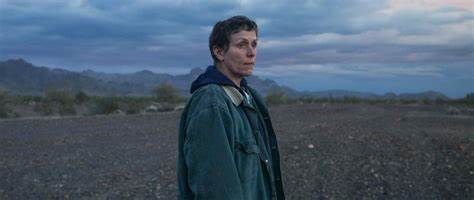
Fern, played without compromise by Frances McDormand, is likely a strong and aggressive woman, though only subconsciously large. I’d argue you would have to be in order to survive as a nomad within a pre-Trump era mid-western America with a beat up van as your mobile residence and a deep plastic bucket for a toilet that isn’t hard on your knees when used. Fern is a former resident of Empire, Nevada. Empire and its postal zip code no longer exist as of 2011 when the sheetrock factory that sustained the town closed up after 88 years, thus forcing all its residents to give up their homes and relocate elsewhere. Now that Fern is widowed, she does not see any other way to live other than in the van she calls “Vanguard.” She lives paycheck to paycheck with seasonal jobs that are hopefully available. The first of these jobs includes a packing facility for Amazon. Once the holidays are over, it’s up in the air as to what she’ll come across next.
Zhao is an observational director. To depict a film about a lonely, uncertain post middle age nomadic widow will require shots of the country like frost on the ground, deep snow, endless roads, hot deserts and moonlit campfires with other nomads who come by Fern’s way. These people (many of which are real life nomads in the film) might travel individually but they are a community as well. They teach one another in ways of being resourceful with auto repair or what’s the best bucket for a toilet. They provide people like Fern with temporary job opportunities. They also counsel one another with how to deal with grief and share their own health challenges like the various forms of cancer and illnesses they endure and how they plan to live out the remainder of their limited time on earth. One woman with an inoperable brain tumor is determined to make it back to Alaska. What drives these people is not necessarily a will to survive. More importantly, it’s the knowledge that they will cross paths with one another again. An experienced nomad who lost a son to suicide never considers saying goodbye to anyone he encounters. Rather, he is staunch in telling others that he’ll “see them down the road,” at another time and place. He reminds Fern that to live this life is to never close the book or end a chapter, and memories of those we have lost can only stay alive if Fern and others stay alive.
I appreciate a film like Nomadland simply because I’ve never been the brave traveler. One of my greatest fears is being lost and alone. It has always terrified me. I still don’t trust the navigation apps on my cell phone. I have to see the destination in front of me. Luckily, my wife keeps me in check. Yet, Nomadland is a film that gives me an opportunity to explore places I might never arrive at, while I sit safely in front of my flat screen. Chloe Zhao shoots with wide lenses to take in gorgeous landscapes. How fortunate for Fern that she can encounter all of this beauty in person. How fortunate, as a viewer, a film like this allows me to witness what’s out there. How sad though as well that sometimes this way of life seems treacherous and nonsensical. Whatever entity created the earth allowed no sympathy for a flat tire or a broken-down engine, when you have no means of paying for replacement parts. As well, mother nature is not always going to be that companion that holds your hand during lonely times. Corporate America certainly won’t do that either, but it is a necessary evil. Thank you, Amazon!
Frances McDormand is perfect for this role as she carries no inhibitions about herself. She will truly show herself sans makeup or coiffed hairstyles, floating nude in a stream, or go so far as to literally defecate on screen in that practical bucket to demonstrate how truly unglamourous and unforgiving the life of a nomad is.
Nomadland is not a favorite film of mine, but I can’t help but appreciate its honesty thanks to Zhao, McDormand and the numerous real-life nomads that inhabit the picture. It’s a sad story; not a triumphant one, but it is also a film that tries to emulate the comfort of being “houseless…not homeless” as Fern describes with absolute certainty. It might not be the life for many of us, but it is definitely a life meant for Fern.
 2 UNPAID MOVIE CRITICS!!!!