
by Miguel E. Rodriguez
DIRECTOR: Federico Fellini
CAST: Marcello Mastroianni, Anita Ekberg, Anouk Aimée, Yvonne Furneaux
MY RATING: 8/10
ROTTEN TOMATOMETER: 95% Certified Fresh
PLOT: In episodic fashion, we follow the life of a philandering tabloid journalist in Rome as he chases stories and skirts with equal enthusiasm.
Fellini’s La dolce vita is easily one of the most critically acclaimed movies ever made. Roger Ebert counted it as one of his favorite movies of all time, second only to Citizen Kane, perhaps. In a video introduction to the Blu-ray disc, Martin Scorsese calls it “the movie that changed the world.” It won the coveted Palme d’Or at Cannes and an Oscar for its costume design.
But I gotta be honest: for most of its nearly 3-hour running time, I found myself wondering what the fuss is all about. It’s only when a pivotal event occurs around the 2.5-hour mark that I was shocked out of my stupor and began to reflect on everything I had seen before and what came after. This is a movie that lulls you along and doesn’t reveal what it’s REALLY about until it’s ready to.
In episodic fashion, La dolce vita [rough translation: “The sweet life”] follows the life of Marcello Rubini (Marcello Mastroianni), a philandering tabloid journalist who lives in Rome and chases stories and skirts with equal enthusiasm. He has a fiancé, Emma (Yvonne Furneaux), but that might be too strong a word for it. She tells everyone they meet that Marcello is her fiancé, and he seems to care for her occasionally, but he seems to fall instantly in love with every beautiful woman who crosses his path. In the movie’s famous opening, with a statue of Jesus suspended underneath a helicopter flying over the city, Marcello even tries to get the numbers of several bikini-clad rooftop sunbathers, but they can’t hear him over the noisy helicopter.
As a tabloid journalist, Marcello has made friends with some of the city’s famous, or infamous, higher-ups. Along with his photographer friend, Paparazzo, he contrives situations where a candid photo or two can be snapped of, say, a prince dining with someone he really shouldn’t be dining with. (Indeed, this movie provides the origin of the word “paparazzi”, so named after the group of rude, pesky, pushy photographers jostling each other for a good celebrity photo, the tawdrier the better.)
In no particular order, Marcello interacts with an old flame, an old madame, a stunning but airheaded Swedish movie star and her jealous actor boyfriend, a mob chasing two children who claim to have seen the Madonna, another old flame, a teenaged waitress, his own father, a rowdy group of actors and dancers, and a group of intellectuals who fill about 20 minutes of screen time with endless philosophizing. (I’m sure I left something out.) The only person in that last group with anything interesting to say is a man named Steiner, who worries about his two children growing up in a world that can be obliterated with a phone call.
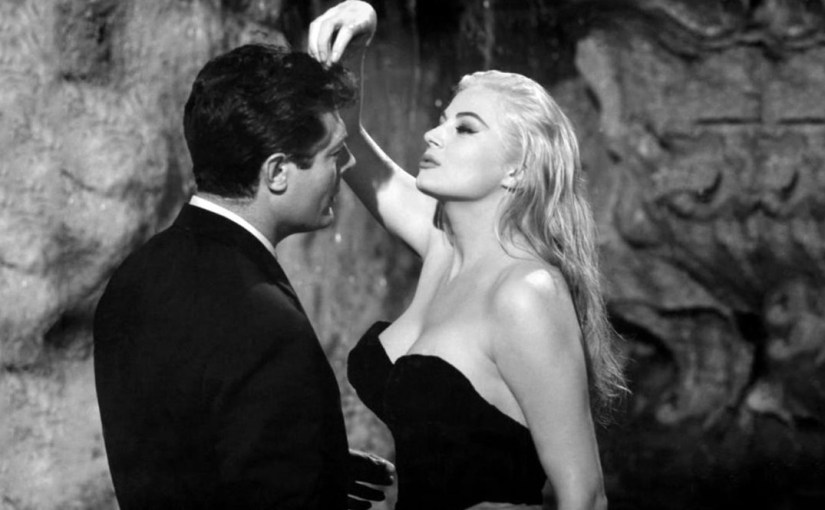
I’m sure there is a LOT of subtext going on in this first long section, but God forgive me, I was waiting for a story. There is, of course, the famous sequence where Marcello follows Sylvia, the Swedish actress played by the zaftig Anita Ekberg, into the Trevi Fountain in the middle of the night. He is bewitched by her, indeed by all women, even by his so-called fiancé, Emma, whom he berates mercilessly one night and throws out of his car…but the next morning he dutifully drives back to the same spot where he left her, where she apparently spent the night, and takes her back home.
I guess the idea we’re supposed to get is that Marcello is the living embodiment of the male gaze. It doesn’t seem as if he will ever be happy with any woman he meets because there is always another one waiting around the next corner, or in the next bar, or at the scene of the next tabloid story. I’ve read that the film can be interpreted as an excoriating satire of Rome’s upper class, whom we mostly see as vapid, self-absorbed free spirits with lots of money and nothing of real value to contribute to the human condition. That’s a good interpretation, but that kind of leaves Marcello out of the equation, unless we’re supposed to believe that he’s also part of the upper class? I never got that impression. If he were, what’s he doing chasing rumors and gossip for a living?
This is all well and good, but to beat that dead horse a little more, I was waiting for a story. We’re getting a fully drawn character in Marcello, but he wasn’t doing much of anything, except watching him listen to the people either clamoring for his attention or warning him to beat it.
But THEN…something utterly unexpected occurs, an event that I can’t even really hint at because it works so well. When it does, Marcello goes into an existential tailspin, questioning his values, his morals, and his profession. It’s this event, and Marcello’s reaction to it, that finally gave me some clarity of what this movie was really about.
There’s a sensational closing sequence that takes place an indeterminate amount of time after this unexpected incident. Marcello leads a rowdy group of actors and dancers to a friend’s empty house. Nobody home? No problem – he just shatters a sliding glass door and lets everybody in. This kind of behavior is interesting because, before “the incident”, you might have noticed Marcello trying to exit a party gracefully, or gracefully decline an invitation to somewhere or other, or politely keeping quiet in his chair or in a corner. That Marcello is gone. This NEW Marcello wants to party like there’s no tomorrow. (This leads to a genuinely ugly moment when he bullies a drunk actress into getting on all fours as he rides her back like a pony and slaps her bottom, then later covers her in feathers ripped out of a sofa pillow…that moment felt to me as raw as watching Nicolas Cage self-destruct in Leaving Las Vegas.)
The film’s coda may also provide a clue to what the movie’s about, or at least partially about. We opened with Marcello unable to talk to the sunbathers over the noise of the helicopter. In the final scene, on a beach after the drunken party, Marcello is hailed from afar by this teenaged waitress he encountered earlier in the film. She motions to him and tries to yell to him, but the crashing surf is too loud for either of them to understand the other. Rather than walk closer to each other and try to reach some mutual understanding, he ruefully smiles and waves goodbye. Marcello was never able to truly connect with anyone for the entire film, not even his own father, and despite the changes brought about by external circumstances, he finds himself even more unable to do so than before.
I guess, if there’s a message here somewhere, it’s that we should try to connect, find some kind of common ground with those around us as much as we can. Life has much to offer, but how sweet can it be when we shut ourselves off from those who just want to love us for who we are?
 2 UNPAID MOVIE CRITICS!!!!