SLEEPING BEAUTY

By Marc S. Sanders

When the Walt Disney Studios released Sleeping Beauty in 1959 it was not received as well as other classics like Snow White And The Seven Dwarfs or Cinderella. Financially it didn’t prove to be as close to a success to Disney’s prior films. I dunno. Maybe moviegoers were tiring of the semi fluid animation where the drawn characters freely move but the backdrops remain in place. The gimmick of animation might have been getting old and stale.

My opinion though is that Sleeping Beauty carries a perfect blend of charm, humor, beautiful colors (whether it’s pink or blue) and most certainly suspense.

Princess Aurora is born, but during her introductory ceremony the evil fairy Maleficent curses her to die on her sixteenth birthday when she pricks her finger on a spinning wheel. The delightful fairies, Flora, Fauna and Merryweather (the original Golden Girls) agree to hide her in the forest, thus avoiding Aurora’s impending doom. This trio is are terrific with their squabbling and intentions to avoid magic use. No magic will ever bode well in dress making or baking.

This is one of the best examples of Walt Disney’s knack for beautiful storytelling in imagination and fantasy. It’s a perfectly innocent film, rated G, but it consists of terrific personality from all of the main characters, even Aurora’s true love to be, Prince Phillip with his trusty steed, Samson, who will carelessly toss Phillip off his back and into a pond.

Moreover, Maleficent is one of the greatest tools of suspense in all of film. A hauntingly well executed scene puts Aurora in a trance forced to follow a floating neon green light. Maleficent’s spell has possessed her and forced her to meet her destiny. Yet as the scene is playing out and Aurora slowly climbs the castle’s stone staircases, you hope to god she doesn’t prick her finger. The scene plays out slowly building on fear and anxiety. A great bedtime story moment.

Another highlight is one the greatest achievements in the studio’s history involving Maleficent transforming into a hideous black dragon breathing bolts of green/yellow fire and smoldering the bridge beneath Phillip as he tries to defeat the beast. Phillip loses his footing, ready to fall into a bottomless void, the three good fairies shake their heads in terror and the music builds. It’s a great scene of bold adventure.

Aurora is adoring as she harmonizes about meeting a handsome prince “once upon a dream.” A beautiful sequence set in the forest where the lovable creatures allow our heroine to play within her fantasies.

Sleeping Beauty has everything. Adventure, romance, music, suspense, and one of the best cast of characters, most especially well delivered from the evil Maleficent. It’s an absolutely perfect accomplishment in storytelling and filmmaking. A film that continues to sustain the Mouse House’s awe inspiring legacy.

Every family and young child especially should watch Sleeping Beauty.

NORTH BY NORTHWEST

By Marc S. Sanders

A story of mistaken identity becomes one of the grandest adventures on film with Alfred Hitchcock’s North By Northwest. The movie plays at such a fast pace, moving from one locale to the next and it all feels convincingly possible.

Before James Bond, there was the dashing Cary Grant in his sharp, fitted light grey suit (the best suit to ever be shown on film) portraying advertising executive Roger Thornhill who simply raises his hand in the air while meeting some colleagues at The Plaza Hotel in New York and is suddenly mistaken for a man named George Kaplan. Soon he’s forced into a car by two men and driven to an estate property belonging to someone named Townsend (James Mason) who implores “Mr. Kaplan” to cooperate or else. Suddenly, Thornhill who continues to insist he’s not Kaplan is on a cross country journey while escaping the authorities who want him for murder while he tries to prove his true identity and exonerate himself.

Cary Grant is dashingly fun with Hitchcock’s camera. It’s refreshing for a change to watch an innocent protagonist not lay on the heavy drama and panic so much. Hitchcock with Grant were going for a sweeping story of cat and mouse play.

What Alfred Hitchcock does best is put the viewer right in position of Thornhill. For the most part (definitely through the first forty minutes) the viewer only knows what Thornhill knows. We know he’s been mistaken for someone else and we are only given the opportunity to put a few names with faces and get a hold of a crumpled photograph. That’s all we and Thornhill have to go on.

Later on, it’s only fortunate that Thornhill comes upon one of Hitchcock’s celebrated blond actresses he was always reputed to cast. This time it is the incredibly striking Eva Marie Saint as Eve Kendall who becomes a willingly helpful train companion for Thornhill. Cary Grant and Eva Marie Saint make for a spectacular on screen couple. Their chemistry is so natural together.

Not much else should be said about the story of North By Northwest. The entertainment comes from what each new scene reveals. Hitchcock incorporates all the expected twists and makes sure to use a MacGuffin, of course. This time it involves a statue and microfilm. What’s on it? That does not so much matter really. It’s the need to pursue it that’s important. The pursuit is what drives the picture from New York City to the United Nations, all the way to a curious auction house for fine art and then on to the four famous faces of Mount Rushmore in South Dakota.

Naturally, Hitchcock is the master once again as he points his camera up close on Grant, Mason and Saint and then quickly will cut to one of their points of view to lengthen the suspense. Running after or away from something in the moment is where Hitchcock is very strong as a storyteller. It keeps you alert as a viewer. Very alert!!!

James Mason makes for a terrific villain as Townsend, or could he be someone else? He’s got that sneaky inflection in his voice and short build that makes for a great antagonist against Cary Grant’s tall stature. Mason’s sidekick, Leonard (a mysterious looking Martin Landau) is also a spooky guy to keep your distance from.

The most celebrated scene probably also contains one of the best captions caught in film. I speak of the very surprising crop duster chase. As Roger Thornhill finds himself in a quiet, Midwestern dirt road intersection, an airplane crop duster turns into a frightening menace. The best shot occurs as Grant runs quickly towards Hitchcock’s camera and the plane flies overhead rapidly getting closer in the upper left side of the screen. As Grant runs and runs, he fills more of the screen, but so does the crop duster. The editing alone is spectacular, as an oil rig eventually comes into play with Grant about to get run over. Story wise, I adore this scene as somehow the life of a man who routinely gets in taxicabs and hob nobs through New York City on a daily basis suddenly has found himself in a dusty field running for his life. What was never expected is suddenly all that matters to this ordinary man.

Hitchcock plays with what’s around to play with. Other than a quick gag in Superman II, l don’t recall many films incorporating Mount Rushmore as such an important element to its picture. Every crevice or ledge or finger hold is important to the edits of the climax in North By Northwest. When Eva Marie Saint is holding on for life, I truly believed she could actually fall. [SPOILER ALERT] Actually, Hitchcock wanted you to believe that as the very last scene doesn’t even truly reveal the solution to her predicament. I like his method of editing this way. Hitchcock seemingly offers no option for survival as Grant and Saint’s hands barely hold on to one another. The editing is just so damn good here.

I’d be remiss if I also didn’t recognize one of the greatest orchestral scores in film. Bernard Hermann’s stirring, fast paced rhythms keep the running man theme in play. The movie seems to play by the beats of Hermann’s conduction. Action films of the future seemed to adopt some measures from he did with this film.

North By Northwest will always remain as one Alfred Hitchcock’s best films. There is not one error in the picture. Every shot is done with deliberate intent to sustain the mystery of suspense. Humor is included even at times on a risqué and subtle measure. Alfred Hitchcock again invites the simplicity of storytelling to introduce the complexity of fear and mystery and outstanding suspense. Not many films compare to North By Northwest.

12 ANGRY MEN

By Marc S. Sanders

This film lives up to its reputation.

This was the great Sidney Lumet’s first theatrical film, and for a project limited mostly to only a claustrophobic and hot room, it boasts a lot of talent; Henry Fonda, Martin Balsam, Lee J Cobb, Jack Klugman, Jack Warden, EG Marshall.

For a black and white picture Lumet and his crew are effective at showing tiny details like sweat on brows and shirt stains, a broken ceiling fan, and the mental exhaustion of limited breathing space as twelve citizens debate over the guilt or innocence of a young man on trial for killing his father by stabbing. Lumet’s camera (just like when I watched The Verdict) is constantly traveling, even if it’s in a tiny confined space. He zooms in when he needs to and he changes angles to get the most of 12 different perspectives. Lumet keeps it interesting by changing up his use of lens. As the afternoon proceeds into early evening, the camera navigates more closely to the table they sit at. The men are uncomfortable, frustrated with each other, more impatient and more concerned with their consciences about sending a man to death. The actors do well with translating these factors, but Lumet sends the message home.

What I found most interesting is the different variations of how each juror eventually comes to changing his mind. Almost all of them arrive at that point in a new or different way. Credit goes to screenwriter Reginald Rose for that. Additional credit for the different variations of how the jurors repeatedly cast a vote; raising hands, notes, anonymously, not anonymously and so on. Rose changes it up each time to keep the viewers’ attention.

Rose’s script will only tell you so much. The attorneys don’t appear in the film, deliberations are done, we only get a close up of the defendant but there’s not enough material for a viewer to cast judgment. The film opens with the judge giving a boring routine instruction as to how the jury should proceed. He might as well be telling them how to complete an SAT exam.

Yet what we are treated to are the faults and overcomings of the human spirit. Ed Begley is a juror who gives a brilliant monologue that stereotypes the defendant’s ethnic background, though we never know what race or ethnicity he is. As he continues to rant, every other juror steps away from the table. Begley seems to get more ashamed of his thought process as he carries on, but he doesn’t stop until he’s ordered to by another juror. Amazing!!! In 1957, when Jim Crow and McCarthyism were on the horizon or rampant, this film was not having it. It’s the best scene in the film.

Henry Fonda is great as the one who only asks for sensibility. He adds weight to the case they are deliberating over that the others are sadly failing to recognize. A man’s life is in their hands.

I’d argue that the facts of the case and evidence presented carry very little complexity to what a real murder trial might offer. I’d also argue that what serves as a fulcrum to sway each vote is maybe a little too convenient (presuming the time it takes for one witness to walk or whether a witness wore glasses), but that doesn’t matter. What’s most important is whether each of these men can live up to the demand of recognizing reasonable doubt; the necessary requirement for a trial by jury. In that sense, 12 Angry Men succeeds.

I CONFESS

By Marc S. Sanders

Alfred Hitchcock’s 1953 film noir I Confess is an absolute must see. An underrated film that held my attention all the way to the end. Perhaps because of its subject matter and setting within the Catholic Church it didn’t hold the reputation of Hitch’s other more well known classics like Psycho, The Birds and North By Northwest. Those films played with their suspense. They had fun with humor and special effects to carry their adventures and horror. I Confess has a little more serious weight to its story, as it examines the scruples of its characters within a murder yarn.

Montgomery Clift portrays Michael Logan, a Catholic Priest, who hears the confession of a murder from the church’s maintenance man (O.E. Hasse), late one night. Only now, sworn to his oath of confidence, he must keep it undisclosed. That might be a little challenging when it is gradually revealed that Fr. Logan might have a connection to the victim, a well known attorney.

Anne Baxter plays Ruth Grandefort, the wife of a politician, caught speaking with Logan just outside of the scene of the crime the next morning. Inspector LaRue (Karl Malden) has reason to follow up on these people. Immediately, your mind will likely go somewhere. When a man and a woman are caught whispering to one another in any murder mystery, well, what are you gonna think? Still, could it be something else entirely? Alibis are not quite solid and unlikely suspects are caught together. Why? What do they know? What’s the connection?

Hitchcock shoots a mystery turned inside out. You know who the killer is in the first five minutes. From there he pursues the red herring until it’s conclusion. The mystery isn’t really the issue here. The question is whether Logan and Grandefort will avoid a frame up. Can Fr. Logan maintain his oath while maintaining his innocence? Det. LaRue has every reason to believe he’s got his culprit, and yet he doesn’t.

Film noir set in Quebec sidles up to questions of morality beautifully here. I was truly wondering whether Logan was going to get exonerated. Hitchcock applies the suspense in that perspective. It’s a great twist on the traditional Agatha Christie motif. He’s got a great tracking shot (actually he was probably carrying the camera and walking on his own two feet) of the maintenance man walking at a fast pace alongside Logan down a hallway, reminding him of his commitment of confidentiality. “As long as you’re a priest…”. Hitch got my pulse racing at this moment.

The three principal players (Clift, Baxter and Malden) are very good here. None of the performances feel dated. As well, Hasse as the murderous German caretaker makes for a good, creepy foil, always looking in from the outside to make certain the investigation never sways away from Logan.

The set up is really well executed from Hitchcock using a script by George Tabori & William Archibald, adapted from an early 20th century play by Paul Anthelme. It’s a little surprising to see a priest caught up in a murder and perhaps some other sinful acts in a film from 1953. There were actually aspects of the original script that Warner Brothers insisted be excised.

However, had this film been made today, there’d likely be an uproar over a Catholic Priest being considered for murder or even participating in a possible affair.

The shock of it all still works in I Confess. A priest is a prime murder suspect? Never! How could it be? Yet, that’s what engaged me. We all are capable of carrying out the worst acts imaginable. The same could be said that we are all capable of holding true to our moral character. Our capabilities are embedded in our human mindset. The question is what is everyone willing to believe.

SUNSET BLVD

By Marc S. Sanders

One of Billy Wilder’s most famous films is Sunset Blvd. A film that’s always escaped me despite seeing two productions of the stage musical, most recently on Broadway with Glenn Close as Norma Desmond. No matter how it is interpreted, it is a haunting story narrated from the grave of young screenwriter, Joe Gillis. In the 1950 film, Joe is played by William Holden. Norma is played by Gloria Swanson, with Erich von Stroheim as her butler Max.

Joe is a down on his luck screenwriter trying to avoid his car being repossessed. Events lead him toward hiding the car in the garage of a mysterious mansion belonging to one time silent film star, Norma Desmond, now obsolete during the age of talkies. She was big at one time. Though Norma insists she is big. “…it’s the pictures that got small.”

Joe is caught in Norma’s web, feeling obligated to write her story while she provides him with all the money and clothes that she can, to keep him close with no opportunity to escape. Even a sneak away to a New Years Eve party leaves Joe feeling compelled to return to Norma where Max has set up living quarters for him.

Holden’s voiceover narration is wry and descriptive like a novelist’s words being emoted vocally. Feelings are shared allegorically. It lightens the mood of Wilder’s film which is a quite dark and strangely sad depiction of a one time film star who has aged amid her isolation and is all but forgotten among the Hollywood elite. Even Cecil B DeMille (playing himself) doesn’t carry much interest in Norma anymore. It’s especially quite telling later in the film when she unexpectedly shows up on the Paramount lot. She had been called upon, but not necessarily for a new role, rather something else entirely.

Swanson is unforgettable as Norma; one of the greatest and most memorable film characters to ever grace the screen and the part is drawn out so well within the Oscar winning script from Wilder and his long time collaborator Charles Brackett. Swanson gives honesty to Norma’s madness; look at the famous final stair descending scene. It doesn’t get much better or more impactful than that. Don’t believe me? Go watch Carol Burnett spoof that moment. It’s one of the greatest cinematic moments ever placed on celluloid.

I digress.

Yet, I get Norma’s refusal to accept the changes to Hollywood films. She tells the modern screenwriter, Joe, that back then they had FACES, not dialogue. I get it Norma. I truly get it.

Joe is challenged to maintain his own present state of mind. He’s a writer with ideas like a baseball picture. Only he needs a producer to invest. Sure the money comes to him easy from Norma but it’s conditioned under her rules and unwavering possessiveness. It’s a shame when Joe only gets an opportunity at something following meeting Betty Schaefer (Nancy Olson), a pretty, up and coming writer herself, and engaged to his best friend. Joe is stuck. He has to be covert in sneaking away to write with Betty unbeknownst to Norma. Worse, he has to resist the urge to get intimate with Betty as well. Joe has multiple problems to contend with here all stemming from being stuck in someone else’s past that offers no stimulation sexually or creatively. Wilder and Brackett pen a perfect character conundrum. Joe has no escape.

It may sound silly but I couldn’t help but think of Paris Hilton while watching Sunset Blvd. I’ve never followed the heiress’ comings and goings. However, I recall a time in the early 2000s when Hilton would be all over reality TV. She was in every magazine and on every gossip headline. Not anymore. Reality TV, like network TV, is losing its flame quickly to the newest medium of streaming services. Hilton is now 15 years older. (Desmond is only 50 in the film, when she’s all but washed up.) Could Paris be wondering what’s become of her starlight? Is Paris waiting for the “Joe” who she’ll insist on being her boy toy? My mind actually drifted towards this subject!!!!

If anything, it tells me that Sunset Blvd still holds relevance. Mediums change and those that were once prominent sadly become obsolete. Either we change with the times, or we opt to be abandoned by an ever developing future.

Sunset Blvd should be seen simply as a reminder that our history never stays stagnant. However, a danger lies in refusing to move on or in Norma’s case losing the opportunities to move on. We might all be ready for our close up Mr. DeMille, but doesn’t that mean someone needs to be holding the camera?

WUTHERING HEIGHTS

By Marc S. Sanders

1939 is a pioneering year for film with timeless classics like Gone With The Wind, Stagecoach, and The Wizard Of Oz making their debuts on the silver screen. Arguably, it is one of best years ever for cinema. Finally, I was able to see another sampling from this period, William Wyler’s adaptation of Emily Brontë’s novel, Wuthering Heights.

Laurence Olivier portrays Heathcliff, a wandering “gypsy boy” welcomed into the home where the story derives its title from. Over time, he develops animosity from Henry, the son of the landowner, while building a an affectionate relationship with the daughter, Cathy (Merle Oberon). Heathcliff and Cathy fantasize of royal, romanticized adventures along the neighboring rock side. Following a sneak away moment to observe a social gathering dance on a nearby estate, Cathy is tended to and welcomed by Edgar (David Niven), and eventually marrying him, much to Heathcliff’s dismay. From there, moments of melodrama, that likely served as a precursor for modern day soap operas, occurs.

Wuthering Heights caught my attention from the moment it began because I thought I was about to journey through a servant’s ghost story retelling of what became of the lovers never meant to end up together. A stranger wanders on to the property in the midst of a fierce snowstorm and swears he heard a woman’s voice outside and witnessed two shadows. Was this written by Brontë or Poe? Then the tale plays out.

Olivier is the most impressive of the cast, naturally. He’s very striking and handsome. While watching with friends, we all agreed that he might have made a good James Bond or Bond villain. Whether he’s the poor, oppressed Heathcliff or the later, wealthier property owner, Olivier offers a commanding presence that you can’t ignore.

The story doesn’t wow me as much as the the set design and camera work for 1939. Edgar’s grand ball room and foyer are a sight in wide measure with gorgeous, prominence ranging from large bookshelves and furnishings to a functioning fireplace. Was this a real home that Wyler’s camera moved through, or just a Hollywood set?

It was good to catch up with a classic. I’ll likely not watch on repeat, but Wuthering Heights is a treasured story in literature and film. I’m appreciative of the experience.

ETERNALS

By Marc S. Sanders

Was I dozing on and off during Marvel’s latest film, Eternals, or was I becoming interested and uninterested during a bloated running time of two and half hours?

As an avid comic book reader during the 70s and 80s, especially Marvel comics, I must admit I don’t know much about the team of gods known as The Eternals.  So, I went into this film kind of blind.  Reader, I don’t feel any more educated having seen the film.  These expressionless number of characters arrive on Earth 7000 years ago and apparently, they are assigned with protecting the planet’s course of events through history by fending off CGI monsters knowns as the Deviants, and that’s all they are supposed to do.  Allow the dinosaurs to perish.  Let Hitler do his thing.  Have Thanos snap his fingers.  Just take care of the Deviants. 

You know what the Deviants look like to me?  An early stage of computer graphics that we would see on a behind the scenes DVD documentary contained on the second disc of a Jurassic Park 25th anniversary edition.  The geeky visual effects wizard would show this deviant on his lap top as an early concept of a raptor or T-Rex.  I dunno.  Maybe it was the screening I saw at a Regal Cinema that soured me on the visuals in Eternals.  Everything seemed so dim and unlit at times.  When the Eternals are taking refuge in a woodsy campsite, that looks as simple as the Honey I Shrunk The Kids playground in Disney World, and a dino like Deviant roars and picks up a character with it’s tentacles only to toss the person into a wood shed, I felt like I was watching one of those 3D amusement park rides.  The computer animation blended with the human actors never flowed convincingly in this film.  This is maybe the worst looking special effects film in Marvel’s library of films. Nothing looks natural here. 

A small sect of the characters is interesting.  Most are quite boring actually.  Take Ikaris for example.  This guy, played by Richard Madden, flies and shoots powerful yellow laser blasts from his eyes.  Otherwise, there’s nothing I can say about his background.  He’s so unentertainingly morose and blah.  Sersi (Gemma Chan) is just the same, and yet she’s supposed to be more optimistic.  Almost twenty-four hours later and honestly, I forgot her powers or what she’s about.

Angelina Jolie is here too.  Moving on.  Salma Hayek is here as well, and yeah, moving on.

The most interesting character is the one causing controversy in the news over being the first Marvel super hero to have a gay kiss.  That’s only a fleeting moment and truly unworthy of causing any kind of uproar.  (Find something better to get pissed about people! Men fall in love with one another.  This is nothing new.) Brian Tyree Henry plays Phastos, who specializes in advancing technology over time that somehow becomes knowledge to the humans of Earth without him taking credit for it.  Phastos has a funny situation as he balances being a god on the planet for the last 7000 years, while also being a current day family man.  More so, he’s a tragically sad character.  The best moment (not scene, because regrettably it is not explored long enough) depicts Phastos gazing upon Hiroshima in 1945 following the dropping of the atomic bomb.  He can not help, as a god, to feel responsible for this outcome, while being consoled that this is not his responsibility to accept.  Remember Phastos, you’re just here to fend off dumb looking, unfinished monsters.

The other good character is Kingo (Kumail Nanjiani) – the god who eventually goes on to be a conceited and well-loved Bollywood actor/director.  Nanjiani is best used as the humor factor of the film with his tag along assistant cameraman (Harish Patel) who films all of the ongoing action for a possible documentary.  This is a good setup for a joke that doesn’t materialize well enough.

Marvel lent too much responsibility to its director Chloe Zhang, who to my knowledge does not have much experience with the big budget extravaganza films that’s expected of these installments.  Zhang was a large contributor to the script.  I’m going to take a guess and presume she’s not the comic book expert that say, Sam Raimi or Kevin Smith are.  She’s an Oscar winning director (Nomadland) who is a master photographer, but a film like Eternals tells me that if you take her out of the natural environments and put her in fantasy land computer graphics, you are not going to get the same thing.  This is like asking a guy who flips burgers at McDonald’s to prepare a $200 well aged Filet Mignon.  With Zhang directing this film, reader you are just not getting your money’s worth.

Everything seems very flat in Eternals.  The script is repetitive.  The narration of the story is that the team gradually reunites with one another following the unexpected death of one of their members.  When the characters do meet up with each other though, they explain the same news again and again and again.  This might be the way it is in real life when your 99-year-old grandfather kicks the bucket and you make one phone call after another.  However, in a film that luxury is not necessary to move the picture along.  Audiences are much more intelligent than this film gives credit.  They’ll make the safe assumption that when Phastos comes on the scene, he’ll have been caught up to date.  Yet, the picture ignores that opportunity of convenience, and just needlessly stretches the running time.

Eternals is not The Avengers.  These guys are boring.  They are written boring.  For the most part, they are acted boring.  There’s no sarcasm or biting insults among them.  There’s hardly any affection among them either, or even hate.  Think even beyond the Avengers for great team ups. Consider Daniel Radcliffe, Emma Watson and Rupert Grint in the first Harry Potter film, or Han, Luke and Leia in the original Star Wars trilogy.  There’s a chemistry to those characters that’s not in the Eternals; a love/hate relationship of jabs and hugs among the peers.  Even when they sit around a table for dinner, the most interesting thing the Eternals can talk about is who is going to take over the Avengers now that Iron Man and Steve Rogers are no longer around.  These folks have been separated from themselves for the last couple of thousand years or so.  Don’t they wanna catch up with one another, and maybe talk about themselves and what they’ve been up to?

The other issue with the film is the constant time jump from the times of B.C. to present day back to B.C. to early 20th century to present day and on and on.  This isn’t a Quentin Tarantino film where the fun is in piecing these moments together.  These time jumps have no impact.  I’d argue that it might have been more effective to just begin at the Eternals’ arrival on Earth and go through time chronologically.  Take me on a 7000-year journey.  Let me see what I can uncover.  For an observational director like Chloe Zhang, this is a missed opportunity here.  She could have demonstrated how the Eternal characters develop over time and get mixed up in side stories like becoming a private school teacher, or a loving dad or a film maker.  Then you have an arc to each of these misfits.  You’ll even have an arc to the planet Earth, and that could be very cool.  Don’t know what I mean?  Look at Zhang’s Nomadland from last year or Terrence Malick’s The Tree Of Life, or even Kubrick’s 2001: A Space Odyssey.  Eternals could have better demonstrated how history has an impact upon itself.

Within the Marvel lexicon, this is not a necessary film.  It quickly dismisses the biggest story that came down the pike with the Thanos character causing all kinds of trouble, and then settles into its own mire.  In other words, who asked for this picture?  I have to wonder if Marvel films are finally jumping the shark or crawling from under the dumpster (remember Glenn from The Walking Dead).  Have they used up all of the hot properties, that Disney owns at least, and are now settling for these minor characters?  Maybe or maybe not.  After all, the best parts of Eternals, for this comic book reader at least, were the post credit scenes.  Still, I didn’t pay $12.00 to wade through two and a half hours of sleep-inducing material just so I could catch a glimpse of two vague teaser moments either.

HARRY POTTER AND THE GOBLET OF FIRE (2005)

By Miguel E. Rodriguez

Director: Mike Newell
Cast: Daniel Radcliffe, Emma Watson, Rupert Grint, Ralph Fiennes, Brendan Gleeson
My Rating: 9/10
Rotten Tomatometer: 88% Certified Fresh

PLOT: A young wizard (Radcliffe) finds himself competing in a hazardous tournament between rival schools of magic, but he is distracted by recurring nightmares.


[DISCLAIMER: This review will more than likely contain spoilers, as well as Potterhead references galore.  I apologize in advance.]

When I first saw this movie, I grieved over how much of the enormously entertaining book had been sacrificed on the altar of box office viability.  Why not make two films out of it?  (Which they did later on with the final book, of course.)  What happened to Winky?  What on earth is going on with the tournament scoring?  (Seriously, try to keep track of it…it makes no sense in the film.)  Where’s the subplot about how Rita Skeeter obtains her inside information?

Watching it again years later, for perhaps the 6th or 7th time, I think I’m a little mellower.  Comparing a movie to its source material is a fool’s errand.  There’s a great story about how, years ago, someone complained to Raymond Chandler how Hollywood had ruined his book, The Big Sleep.  Chandler calmly pointed to a bookshelf, and said, “Well, there’s my book right there.  Hollywood didn’t ruin it.  It still exists.”  (I’m paraphrasing, to be sure.)

So.  Movies and books, apples and oranges.  To quote Carl Weathers in Predator: “It comes with the job.  I can accept it.”

Having said all that, I think the best way to give my impression of the film of H.P.a.t.G.o.F. is to list what it gets right and what it gets wrong.

RIGHT: The second task, involving hidden treasures in the Black Lake.  I loved the look of the mermen and mermaids and the hinkypunks.  This scene managed to captured almost exactly what I saw in my head when I read the book.

WRONG: The first task, involving retrieving a golden egg.  We see FAR too little of how the other contestants fared in their attempts, jumping right past the first three just to see what Harry does.

RIGHT: “Mad-Eye” Moody.  I’ll never be able to read the books again without seeing Brendan Gleeson’s magnificent performance in my head.  That amazing enchanted eye, the facial tics, the glee with which he transforms a student into a ferret…it’s perfect.

WRONG: The Yule Ball.  As it appears in the film, it literally brings the movie to a halt.  It’s all about the interpersonal relationships between Ron, Hermione, and Harry, but nothing happens to move the plot forward.  I can’t help thinking there was a better way to stage this pivotal event.

RIGHT: The events in the graveyard.  I can recall vividly the moment when I read the words, “He was dead” in the book.  I sat up on the sofa, my eyes grew wide, and I exclaimed out loud, “Holy s**t!”  The movie gets this entire sequence right.  As I recall, the graveyard covered two or three entire chapters in the book, and the film condenses it nicely into a 10-minute sequence.  (Approximately.)  It’s the moment, in both the books and the films, when the franchise became much more than “kid stuff.”

WRONG: Snape’s role in the film.  The movie curiously omits the incredibly relevant moment in the book when, after Dumbledore observes the Dark Mark on Snape’s arm, he tells him, “You know what to do.”  And Snape nods curtly and leaves the room.  That comes into play to a GREAT degree in the latter stages of the franchise.  Ah well.

And I’ll leave it there.  I could go on.  All in all, it’s a good film, a great spectacle, and a turning point for the series.  They could have called it, Harry Potter and the Advancement of Maturity.

QUICK TAKE: Good Night, and Good Luck. (2005)

By Miguel E. Rodriguez

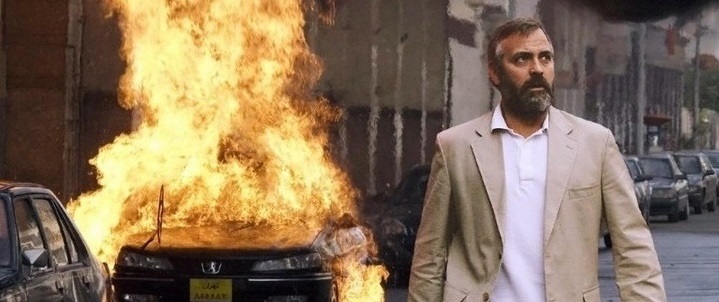
Director: George Clooney
Cast: David Strathairn, Patricia Clarkson, George Clooney, Jeff Daniels, Robert Downey Jr., Frank Langella
My Rating: 8/10
Rotten Tomatometer: 93% Certified Fresh

PLOT: In the early 1950s, broadcast journalist Edward R. Murrow (Strathairn) looks to bring down Senator Joseph McCarthy.


I feel eminently unqualified to discuss the historical merits of Good Night, and Good Luck.  I am no history scholar.  What I know about the Hollywood blacklist and the HUAC hearings can be traced to sources such as movie reviews, the movies themselves, documentaries, and The Manchurian Candidate.  (The original, not the remake.)

As such, all I can report is that this movie is solidly well-made, photographed in gorgeous black and white, and is an immensely satisfying experience, because a bully gets what’s coming to him, on national television.  If there are times when it lags a little, well, civics lessons can’t be fireworks all the time.

David Strathairn is not quite a dead ringer for legendary newsman Edward R. Murrow, but he’s close enough, and he’s never less than convincing, especially when delivering Murrow’s broadcasts in that inimitable deadpan that somehow sounds more informed than the average reporter.

I especially enjoyed the segment where McCarthy appears on Murrow’s program to defend himself against charges made by Murrow on a previous show.  Shortly thereafter, Murrow goes over McCarthy’s rebuttal line by line, identifying each falsehood and inaccuracy.  That took guts back then, but Murrow stood for truth, as corny as that sounds, and he wasn’t about to let McCarthy’s lies slide.

All in all, Good Night, and Good Luck is a great film, maybe even an IMPORTANT film, because of our ever-shifting political climate.  You never know if another McCarthy will rise up, and you wonder if anyone will be around, like Murrow, to put them in their place.

[TRIVIA NOTE: look fast for Simon Helberg (Wolowitz on “The Big Bang Theory”) in what amounts to approximately five seconds total screen time.]

ZATHURA: A SPACE ADVENTURE (2005)

By Miguel E. Rodriguez

Director: Jon Favreau
Cast: Josh Hutcherson, Dax Shepard, Kristen Stewart, Tim Robbins
My Rating: 9/10
Rotten Tomatometer: 75% Certified Fresh

PLOT: Two young brothers (Hutcherson, Jonah Bobo) are drawn into an intergalactic adventure when their house is hurled through the depths of space by the magical board game they are playing.


If only all family movies were like this.

Too often, so-called family films are mealy-mouthed cream puffs that appeal to the short attention span of their target audience, leaving the parents either bored to tears or fatigued from sitting through 90 minutes of explosions.  The scripts are subpar and tend to treat kids as if they’re not all that bright.

Not Zathura.  With his third film (after the forgettable Made and the Christmas neo-classic Elf), director Jon Favreau proved that he’s the real deal.  Here’s a REAL family film with something for everybody: comedy, family drama, peril, thrills, a killer robot, fearsome aliens, and nostalgia.

The nostalgia part is especially notable.  The board game at the center of the film is constructed to look like something made in the ‘50s or ‘60s, which, to the kids in the film, is practically ancient history.  But for me, I found the film nostalgic in the way it captures the kind of fun I used to have at the movies.

Not that I don’t still have fun, mind you.  It’s just that, when I was a kid, sci-fi and fantasy films felt more real, you know?  It was so easy to imagine myself as a resident of the Goondocks, or discovering an alien in the cornfield behind my house, or building a spaceship in the backyard with my two best friends.  Zathura captures that kind of feeling like few other modern family films can.  It’s a movie that has the potential to live on in the imagination after countless other films have vacated your consciousness.

And the VISUALS.  I don’t know what kind of budget the movie had, but it looks like a $100 million movie.  The killer robot is absolutely convincing, as are the aliens.  Which brings up another great element of the film: danger.  The bad guys in this movie may occasionally look a little cartoony, but they are not to be trifled with.  That’s something a lot of kid’s movies tend to get wrong.  The filmmakers lose their nerve in creating real villains, for fear of pissing off too many parents.  In reality…dude, kids can handle it.  Give the bad guys fangs and spinning saw blades.  It just makes it that much more satisfying when the bad guys LOSE.

Zathura barely made its money back, and that’s including domestic AND worldwide grosses (okay, I looked it up).  I could be wrong, but I’ll bet too many people thought it was a Jumanji ripoff.  It IS based on a book by the same author as Jumanji (and The Polar Express, as it happens).  But it is possible, I think, to see Zathura in its own light.  It’s a fantastic movie that will please all ages.