GRAN TORINO

By Marc S. Sanders

I had a few reasons to watch this movie. One, a good friend, Greg Spiegel, had given this film his full endorsement on a number of occasions. Two, as some of you know, I’ve been a huge admirer of Clint Eastwood for as long as I can remember, since age 8 or 9 I imagine, when I saw his Dirty Harry films and even Fido Beddow in Every Which Way But Loose (and its sequel; those films are much better than maybe they are given credit for actually).

Eastwood matured as a filmmaker during the mid 80s and on into the present. He transitioned into films that delivered messages that sometimes even contradicted his past films as the gunslinger who never asks questions and always knew where to shoot. Films like Unforgiven and A Perfect World really showcase the tragedies of violence perfectly, and I think Gran Torino is worthy of being added to that list.

Eastwood plays Walt Kowalski, a racist Korean War veteran, who never left the war he used to fight in. The war comes home with him 50 years later to his Michigan neighborhood where he seems to be the only Caucasian American to live among a melting pot of other races; highlighted especially here are his Hmong neighbors who look past Walt’s prejudices to befriend him following his unintended gesture of protection from an intrusive gang. From there, Walt makes a bond with young Tao, a boy with no male influence in his life, and Tao’s sister.

Eastwood is probably the best director to direct himself. He knows how to position his camera and lighting, or lack thereof, to carve out the lines on his face and hide himself in haunting shadows to show a riddled history to Walt. He also adheres to similar themes that worked well in other films. A defiance to religion represented by a young minister looking to help Walt is reminiscent to the sarcastic approach Eastwood’s character used in Million Dollar Baby. The neglect of a protagonist’s family, and most especially, the connection of the pessimistic old man with the young child, barely adult, as well echos the Clint Eastwood/Hilary Swank pairing in that film. I don’t mind if it’s a repeat actually. Relationships like these are hardly shown in films these days, and I think they are important. Films like Harold & Maude and The Karate Kid show that gaps in generations are not an excuse to separate ourselves. (Heck, I even attempted it when I wrote my play, Arnie & The Itch.)

Eastwood has great, uncompromising racial affection (yes, those two words work nicely here) with his two Asian co-stars Bee Vang and Ahney Her, who are well cast in their own right.

Name calling is a method of maintaining a relationship in a film like this. The PC bandwagon is tossed out so the actors, especially the minority Asians, find something more wholesome to a prejudiced old coot.

The language is strong in Gran Torino, but I say it’s an important film to show to many kids to learn of a neighbor’s tolerance; of what goes on behind a closed door or even if that neighbor sits quietly on his porch with a dog by his side and a beer in his hand. We learn of the roads they have crossed, the battles they have fought, and the accomplishments they’ve made. Learn from these people. Learn from the humanity they carry; the honest humanity that may look offensive on the outside yet is present due to a tormented history inside.

I could say “these whipper snappers with their phones” but it’s honest frustration. It’s hard to learn what a person really is by means of a handheld device. To learn about a person, you have to eat with them, work with them, speak to them and even appreciate their 1972 restored Ford Gran Torino, automobile.

This was a great effort in performance and production from Clint Eastwood. I’m glad I watched it finally.
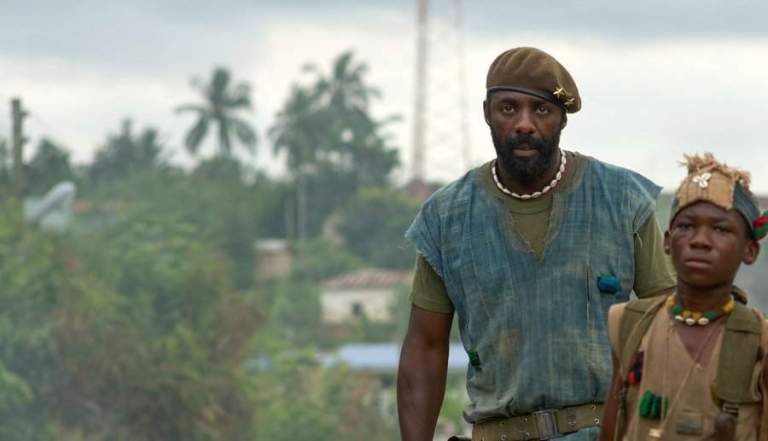

BEASTS OF NO NATION (2015)

by Miguel E. Rodriguez

Director: Cary Joji Fukunaga
Cast: Idris Elba, Kurt Egyiawan, Abraham Attah
My Rating: 8/10
Rotten Tomatometer: 92% Certified Fresh

PLOT: In an unnamed African country, a young boy gets separated from his family and is trained to be a soldier for a guerilla combat unit.


It’s been said – I don’t remember by whom, maybe François Truffaut – that there is no such thing as an anti-war film because combat scenes are inherently thrilling.  Look at the D-Day landing in Spielberg’s Saving Private Ryan.  Brutal and horrific…but visceral and powerful and exciting at the same time.  Squint at those scenes a little bit, think about the ultimate sacrifice made by so many soldiers for their country, and it’s almost a recruitment film.

There are, as always, exceptions to the rule.  I challenge anyone to watch the Russian film Come and See, about the experiences of a young soldier during World War II, and come away feeling anything but dismay and disgust at the institution of war.

Beasts of No Nation is also an exception.  Directed by Cary Joji Fukunaga (No Time to Die, co-writer of It [2017]), it features numerous combat scenes involving pre-teen boys firing machine guns, tossing grenades, and wielding machetes on men, women, and children.  The movie is fictional, but the experiences are taken from true-life stories of real boys who were kidnapped by rebel armies.

The young boy in this story is Agu (Abraham Attah in a brilliant, subtle performance).  He’s maybe 11 or 12 years old.  In the opening scenes, we see he and his family are poor, but happy.  He plays with his friends.  They try to sell an “imagination TV” to anyone who will listen to their pitch.  (What is an imagination TV?  …use your imagination.)

One day rebel forces march into town.  Or government forces.  It’s never made quite clear, and I think that’s on purpose.  In this unnamed country, one side is as bad as the other, so it really makes no difference.  His mother and sister are whisked out of town to relative safety, while Agu and his father and brother are left behind.  However, he is soon separated from them (in a scene that reminded me oddly of Empire of the Sun, though even more traumatic) and he runs into the jungle where he is soon captured by a roving combat squad led by a man known simply as the Commandant (Idris Elba, in another brilliant performance).  The Commandant sees potential in Agu and takes him under his wing.

Here’s where it starts to get disturbing.  Agu is trained to be a soldier.  This involves standard training about how to move in the field, but it also involves a brutal hazing ritual where he must run between two columns of men who beat him with heavy sticks as he passes.  Make it through and you graduate.  Get knocked out and…well, you don’t want to get knocked out.  He and other boys are subjected to a cloud of smoke and haze created by burning gunpowder.

Why do this?  From the army’s standpoint, a young boy makes an ideal soldier.  He requires little pay, eats less food than a grown man, never questions orders, and provides unswerving loyalty in return.  The trick is teaching them to kill on command.  For Agu, this part of his training comes when a prisoner pleading for his life is brought before him.  The Commandant hands him a machete.  “This man is with the people who killed your family,” he says.  The scene is simply shot, but it’s horrifying to see Agu’s eyes go blank as he stares at the prisoner.  The culmination of this scene is one of the most disturbing visuals I’ve seen since Requiem for a Dream.  The most chilling part is Agu’s voiceover, which we hear at many other points in the film: “God, I have killed a man.  It is the worst sin…but I am knowing, too, it is the right thing to be doing.”  Brr.

Whether Agu finds redemption or rescue or whatever, I leave to you to discover.  I will say the movie looks marvelous.  Director Fukunaga served as his own cinematographer AND camera operator (after the first operator tore a hammy on his first day).  It’s well made, directed with a sure hand and a fine visual instinct.  I don’t want to give away too much about the ending, but watch Agu’s face.  As he speaks, you can see the blank, flat stare of someone who has seen enough to know he’s seen too much.  It’s the face of someone who has been through more than any of us should be put through.  And he’s not even old enough to shave yet.  That’s what makes Beasts of No Nation a truly anti-war film.

TROUBLE WITH THE CURVE

By Marc S. Sanders

Roles for the “aging has been” who is either about to retire or refuses to retire seem reserved these days to Robert Redford or Clint Eastwood.

Back in 2012, Eastwood gave up his director’s chair to star in a little known film about an aging baseball scout in Trouble With The Curve. I’ve seen him play this kind of role many times before like In The Line Of Fire, or Grand Torino.

There’s nothing memorable about Trouble With The Curve, but it does feature some good scenes between Eastwood and Amy Adams as his tough as nails attorney/estranged daughter who forces herself upon his scouting trip to look after him when it seems his health, particularly his vision, is deteriorating. Adams is good as the underestimated baseball expert. She can recognize a 95 mph pitch and she can triumph over you in reciting RBI stats, batting averages, etc. Give her a bat and she can also cream a ball outta the park.

Justin Timberlake is the necessary pretty boy romantic interest for Adams, but he doesn’t offer much to the film in the way of humor or even sex appeal. This guy is a great actor beyond his music. (See The Social Network)

The movie belongs to Eastwood alone.

First time director and regular Eastwood crewman, Robert Lorenz does well with the baseball footage of young prospects and the end is satisfying as the argument weighs whether experience and instinct can still trump the power of technology.

Has baseball truly come to rely on what a computer says is the best first round draft pick? Wow…how sad.

PREDATOR

By Marc S. Sanders

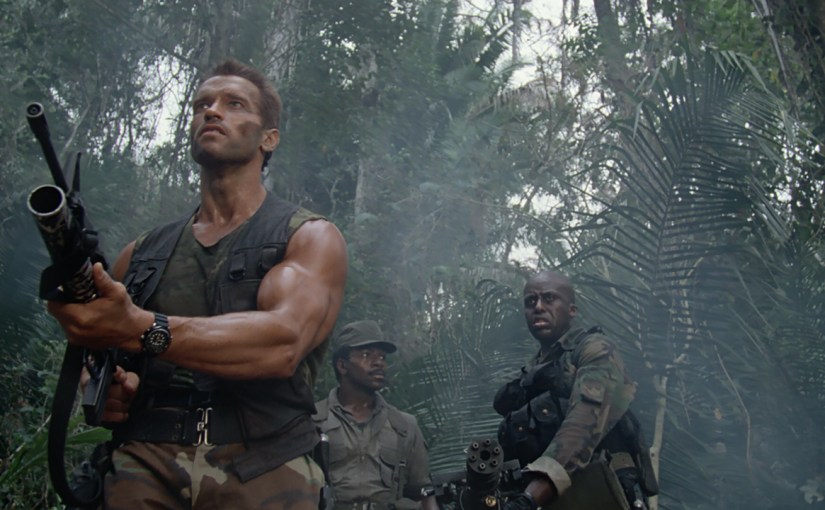
Predator is not only my favorite Arnold Schwarzenegger film, but it also remains as one of the best action films of all time.

The main reason for my praise stems from its cast consisting of the Austrian headliner followed by Carl Weathers, Jesse Ventura, Bill Duke and Sonny Landham. The cast is sensational because they take the science fiction material seriously by evoking their machismo gradually evolving into fear. Director John McTiernan displays all of this very well through quiet and covert close ups as each character sums up the possibility that they are being hunted for sport by an entity they are not familiar with.

McTiernan makes use of his setting to the point that the real-life dense jungle of trees amid thick humidity, within South America, is its own character. I don’t know how he did it but, in this film, McTiernan and his cinematographer capture flawless tracking shots of running over uneven grounds and roots, leaves and low hanging foliage. It’s really spectacular how it all moves fast without any chopped up quick cuts like a Michael Bay movie for example. In this movie, the chases are actual chases.

An outrageous Oscar crime is that this film lost its Visual Effects prize to Innerspace. That gnaws at me when you consider the vagueness of the Predator’s chameleon like invisibility shape. It leaves the viewer intentionally as confused as these expert Gung Ho military men are. They can’t quite make out what this thing is because McTiernan wisely follows Spielberg’s Jaws technique by not showing you the creature until all the cards are dealt. The viewer is left curious and aware but still in suspense. There’s a kaleidoscope of transparency in the figure that scopes these men but what is it, really? The best horror films present the horror by literally not showing you the horror.

I like how this rescue team is continuously displayed with their talents for covert sabotage, hand signals, caution and focus. The actors are actually setting up the booby traps and climbing and ground crawling.

It’s honestly a very well-acted piece most especially from, yes Schwarzenegger, as well as Bill Duke and his psychological trauma during the 2nd half of the film, and Sonny Landham as the Tracker Billy who can relay what transpired with a keen Native American sense of environment. It’s a great collection of characters all together.

Sadly, the majority of the follow up films in the franchise do not live up to what originated here. In the first installment, the story is condensed in an efficient 90 minutes that leaves enough time for one story of adventure and rescue before it gets to all its sci fi suspenseful showpieces. The follow up films never took advantage of the strengths used here from over 30 years ago.

Predator is a brilliantly edited, well shot, taut and a gripping yarn of imagination and fear.

From 1987, it hasn’t aged a bit.

THE VERDICT

By Marc S. Sanders

Sidney Lumet is a master filmmaker at shooting predominantly talkie films. In The Verdict by David Mamet, his best special effect is, at least, the just as legendary Paul Newman as washed-up alcoholic attorney Frank Galvin. Lumet opts to shoot Newman for the screen talent he is. Occasionally, his camera points up at Newman, who looks as if he will fall over. Lumet also makes Newman look great as he runs down a hallway, or with a stare of his familiar blue eyes. The chemistry of camera and performance are blended rhythmically.

Alcoholism has been depicted countless times, but Newman’s interpretation ranks at the top of the list. He can’t function without his drink whether it’s gaining a high score on pinball, flirting, reading a brief or even getting a fast protein fix by dropping an egg yolk in a beer. Paul Newman makes you wonder if Frank Galvin is going to pass out or fall asleep even while he’s barely practicing legal brilliance. He toes the line beautifully between coming undone and barely squeaking by. This is one of his best roles ever.

Frank is given a chance to salvage himself as goes up against the Boston Archdiocese and the hospital it owns in a case of medical negligence, who are represented by a conniving antagonist in the form of James Mason with his limitless resources, power, strategies and army of lawyers. If this were a silent film, I’d buy it with Mason twisting a handlebar mustache. He’s absolutely a man you love to hate.

The dialogue crackles against simply the inflection of vocals from Newman, Mason, an unexpected Charlotte Rampling as Galvin’s sudden love interest, a difficult judge played by Milo O’Shea, and Frank’s assistant played Jack Warden. The delivery of lines, the twisty double crosses, and conflicts play to the precision of great Shakespeare. So much so that when on the rare occasion these characters curse or the ominous cue of music steps in, it’s all shocking and applauded.

The settings are great for atmosphere too. Worn in leather chairs, polished cherrywood tables and courtrooms with their squeaky floors. This is a well-worn Massachusetts backdrop of legal reputation and intimidation.

Every member of the filmmaking team from Lumet to the cast, to the composer,Johnny Mandel, and David Mamet’s fantastic script have been thought out and measured to completion.

Some will say this film is dated (rotary phones, ladies’ hairstyles, wardrobe; year of release was 1982). I say its themes are still significant. Power is something that must always be overcome by a weak, flawed protagonist. Whether or not Frank Galvin can do it, matters not. It’s the struggle that’s important to follow in a film like The Verdict.

STAR TREK IV: THE VOYAGE HOME

By Marc S. Sanders

We owe a lot to H.G. Wells, author of The Time Machine.  Without Wells, Marty McFly would not become familiarized with a souped-up DeLorean, and Earth as we know it would be decimated by the year 2286 because a probe, in the shape of a Ring Ding pastry, from the far reaches of space could not find its humpback whale friends to say hello to.  If Star Trek IV: The Voyage Home is not the best of the film series, it is certainly the most fun and delightful.  (For the record, my personal favorite is Star Trek II: The Wrath Of Khan but sometimes I switch to Star Trek VI: The Undiscovered Country.)

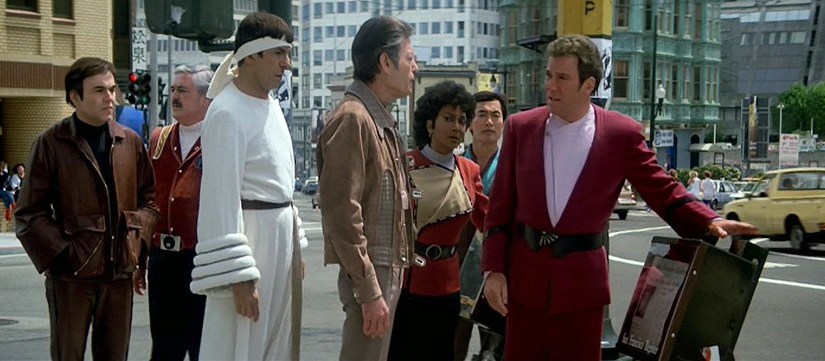
Kirk, McCoy (William Shatner, DeForest Kelley) and company have managed to resurrect their comrade Spock (Leonard Nimoy, also returning to the directing chair). Now, they are enroute from the planet Vulcan to Earth awaiting trial for the crimes and violations they committed in the prior film.  However, they must follow a detour back in time to the year 1986 and pick up a pair of humpback whales.  The sea mammals are the only creatures that can speak with an alien probe and salvage the Earth from becoming destroyed.  The probe isn’t an enemy.  Its arrival is simply unsettling the planet’s oceans and core because it can’t communicate with whale life, that is now extinct by the time 2286 has arrived.

So, in a Klingon Bird of Prey that they took command of and dubbed the HMS Bounty, our favorite Federation crew, arrive in late 20th century San Francisco.  Problems lay ahead though.  Their dilithium crystals (fuel) are depleted, they are unfamiliar with the daily activities of life during this period, and just how are they to find a pair of mammoth whales by walking around the city?  As well, Spock is not exactly himself since his rebirth.  His knowledge is there, but his common sense that stems from his human half is lacking.  This leads to some funny engagements with the city folk as he develops a habit for some colorful language not commonly used in the 23rd century.  A scene on a city bus with a punk rocker is a terrific highlight. 

Well, within the film’s two-hour time frame a pair of whales is located at The Cetacean Institute and they are overseen by a spunky and emotionally caring guide named Gillian portrayed by Catherine Hicks.  Now the gang has just gotta get home to their time before it’s too late.

The script for The Voyage Home is really quite brilliant and such a pleasant surprise.  All of the characters have their own moments for humor to occur.  The best being that Chekhov and Uhura (Walter Koenig, Nichelle Nichols) have to find a nuclear power source to make up for the lack of dilithium crystals.  Imagine, during the time of Reagan/Gorbachev Cold War politics, a man with a heavy Russian accent politely asking a motorcycle cop where he may find the “nuclear wessels…NUCLEAR… WESSELS.” It’s also inspiring to place a cynically cranky Dr. McCoy in a city hospital only to question how medical practices were ever tolerated at this time. “Is this the dark ages?”

William Shatner and Leonard Nimoy make such a sincere pair of friends as Kirk and Spock.  Shatner is especially good in the Star Trek films because he performs with a way of sarcasm and whimsy.  He works like Errol Flynn, unreserved while he swings into the danger.  Yet, he’s also so sincere.  There’s a flirtatiousness to him that’s impossible not to like.  He’s just so personable.  You also feel for his Kirk when he wishes his old friend, Spock, would just return to the way he once was and simply address him as “Jim,” not Admiral.  I couldn’t help but relate to it as someone who may wish that with a relative suffering from dementia.  The loved one is still there, and yet he/she is not there.  That’s how Shatner touchingly approaches this relationship.  The chemistry between Shatner and Nimoy is unparallel.  The recasting of the roles in later years has not matched up.  The original actors just read each other’s timing perfectly like Laurel & Hardy or Felix & Oscar.  There’s Newman & Redford.  There’s Lemmon & Mathau.  There’s Shatner & Nimoy.

I always had my facts mixed up.  I was always under the impression that this film was nominated for a Best Screenplay Oscar.  It in fact wasn’t.  Yet, it really should have been.   The Voyage Home has a message on the importance of preservation of life and an urge to hold on to the integrity of our environment.  Thankfully, it’s not preachy.  There’s a combination of science fiction, adventure and humor at play here that I don’t think has ever worked better in what I’ve seen of the Star Trek universe of films and TV series. This is just a very, very smart film with good, insightful direction from Leonard Nimoy. 

Nearly forty years later and this picture still holds up.  So many of our planet’s species remain endangered.  Many are suspected to be extinct by the hands of man.  The Voyage Home touches upon these facts.  It still feels so up to date that you even get a lump in your throat at the top of the film when a dedication is made to the memory of the Space Shuttle Challenger crew.  The makers of this Star Trek installment really presented a timeless film with the help of time travel, and you don’t have to be a Trek fan to appreciate its merits.

ME AND YOU AND EVERYONE WE KNOW (2005)

by Miguel E. Rodriguez

Director: Miranda July
Cast: John Hawkes, Miranda July, Miles Thompson
My Rating: 8/10
Rotten Tomatometer: 82% Certified Fresh

PLOT: A lonely shoe salesman and an eccentric performance artist struggle to connect in this unique take on contemporary life.


There is a scene in Me and You and Everyone We Know, Miranda July’s directorial debut, where Christine, an aspiring artist played by July herself, has submitted a videotape of her experimental video shorts to a museum curator who’s looking for examples of new art in a digital world.  At the end of the video, July addresses the camera and bemoans the fact that the curator will probably never watch the tape or get that far.  She pleads: “If you are watching this, then just call this number, the number you see on your screen, and say, ‘macaroni.’  …Just ‘macaroni’ and hang up.  No questions asked.”

In that moment, in the middle of a movie where I was never bored but constantly off-balance, I connected with Christine.  I’m guessing other people do, too, but I’m just guessing.  Who among us has never wanted validation or confirmation from someone, anyone, the world, that, yes, I see you and I hear you?  That right there is one of the reasons I do theatre, man.  I don’t always talk about it, but it’s there.  And I appreciated seeing that heartfelt emotion acted out in such a quirky and direct way.

That’s just one of the charms of this movie that defies description.  It’s a romantic dramedy where the two ostensible romantic leads can function around other people, but just barely.  There is also a subplot about two young boys who are bullied by two witless teenage girls.  How witless?  They thoughtlessly flirt with a much older man who starts leaving sexually graphic notes on his living room window so the girls can see them as they walk to school.  I won’t even tell you how their bullying of the two boys leads to the kind of sexual experimentation I devoutly hope doesn’t happen…but probably does more than I would care to admit.

Now, I’m making this sound like a Larry Clark movie (Kids, Bully), but it’s not.  The main story involves Christine and Richard (John Hawkes), a recently separated father (of the two young boys).  Richard works at a shoe store and is a hopeless romantic, not just when it comes to love, but life in general.  He tells his co-worker, “I want to be swept off my feet, you know?  I want my children to have magical powers.  I am prepared for amazing things to happen.”  But his idealism sometimes moves him to do and say odd things.  Near the beginning of the film, as he’s preparing to move out of his house and into a small apartment, he runs out to his front yard, gets his kids’ attention, and carefully and methodically uses lighter fluid to set his hand on fire.  Why?  His explanation (if I remember it correctly) is semi-reasonable, but I can’t help thinking there might have been a better way to demonstrate his thought process.

Christine is an aspiring artist who makes short experimental videos in which she provides voice-overs to still photographs.  In my mind, they are examples of how she might relate to people in real life if she weren’t so terrified of how other people might respond if she reaches out to them in person.  Her day job is as a taxi service for the elderly – sort of a proto-Uber service.  One day she drives a client to the shoe store where Richard works.  Richard notices small scars on Christine’s ankles.  She says her shoes rub her ankles, but all shoes do that because she has low ankles.  Richard looks her dead in the eye and says one of the best lines in the film: “You think you deserve that pain, but you don’t.”

Something passes between them, and the rest of the film, as far as these two are concerned, is about getting these two dysfunctional people together.  There are obstacles, of course.  A sick kid, an unexpected visit from the ex-wife, some examples of logic that seems rude but really isn’t.  It’s hard to explain.  But theirs is the thread that holds the rest of this weird film together.

And weird it is…but in that good way, you know?  Richard’s two sons are Robby, maybe 7 years old, and Peter, probably about 12 or 13, right when the hormones are kicking in.  In their off time, Peter visits an online chat room where he starts interacting someone who calls themselves “Untitled.”  (He calls himself “NightWarrior.”)  Their conversation gets racy.  If you think this is improper or immoral to show in a film, allow me to direct you to my own experiences on AOL chat rooms when I was that age.  (That’s one of the things the movie gets exactly right: the teenage boy’s curiosity/fascination about sex.)  Thing is, Peter is doing the chatting with Robby right there next to him.  Robby has no idea what he’s reading.  When Peter jokingly asks Robby for something dirty to type, Robby launches into this incredibly detailed scatological description of what he thinks is dirty.  At first, I was a little shocked, but then I started laughing because this is something else the screenplay gets exactly right.  Ask a really little kid to say the dirtiest thing they can think of, and this is the kind of thing you’re most likely to hear.

The movie is full of little moments like that.  The main love story is tooling along, and suddenly a store-bought goldfish is left on top of someone’s car in a baggie.  We’re watching Christine agonize over whether to call Richard or not, and then those two teenage girls from before persuade Peter, the teenage son, to let them give him what they call a “Jimmy Ha Ha.”  It’s exactly what you’re thinking.  Why do they do this?  Because they want to settle an argument over which of them can do it better.  Where were those girls when I was in high school???

And don’t even get me started about what happens when Robby, the youngest boy, starts posing as NightWarrior and chats with Untitled on his own.  This exceedingly weird situation, which I can honestly say I’ve never seen in any other movie before, leads to a moment when Untitled asks to meet NightWarrior in person.  The payoff of this story thread is sure to divide audiences, but I found it both hilarious and oddly touching.

If I’m making the movie sound like a mixed bag, well, it is.  But nothing ever goes too far in the taste department.  The perv who leaves graphic notes on his window has an interesting reaction when his bluff is called.  The Untitled/NightWarrior stuff comes to a proper close, in my opinion.  And Richard and Christine?  Well…what kind of romantic dramedy ends with the lovers NOT getting together, right?

Bottom line: Me and You and Everyone We Know is constantly engaging, constantly weird, but never boring, never conventional.  It held my interest for 90 minutes.  That’s more than I can say for most romantic dramedies involving poop jokes and “Jimmy Ha Ha’s.”

A MAN ESCAPED (1956, France)

by Miguel E. Rodriguez

Director: Robert Bresson
Cast: François Leterrier, Charles Le Clainche, Maurice Beerblock
My Rating: 8/10
Rotten Tomatometer: 100%

PLOT: A captured French Resistance fighter during WWII engineers a daunting escape from a Nazi prison in France.


In an old Peter Benchley novel called Q Clearance, a White House staffer tries to get his chatty secretary to pare down her long-winded stories by saying (I’m paraphrasing here): “I want you to imagine the story you’re telling me is a nice big hamburger patty.  Now put that patty on a hamburger bun and cut off all the meat that doesn’t fit, and only tell me about what’s left.”

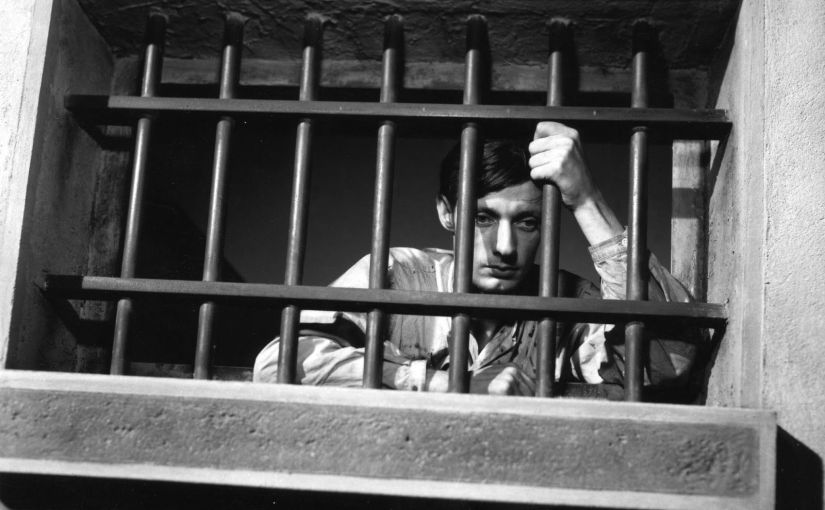
In a nutshell, that’s A Man Escaped.  In this prison break film, there are no overly dramatized shots or scenes or performances.  There is no musical score aside from snippets of a Mozart mass heard here and there.  There are no shots showing simmering tensions between our hero and the prison guards or his fellow prisoners.  We are only shown what’s outside the prison twice.  Everything beyond the walls is established by strategic use of sound effects: traffic, train whistles, dogs barking, children playing.  Director Robert Bresson is only interested in showing us the story.  No dramatics, no theatrics, just a good story well-told.  He used only non-professional actors, people who would get on with the business of telling the story without giving a “performance.”

Fontaine is a French Resistance fighter captured by the Germans in France in 1942.  He is brought to prison where he is beaten for trying to escape during his transfer.  A voiceover tells us everything we need to know about his surroundings, his cell, his neighbors, and his desperate desire for escape.  He smuggles a letter to his colleagues outside the walls via a prisoner who is allowed visits from his daughter.  But then that prisoner is transferred, and he is alone once again.

The film is meticulous in the details of his escape plan.  We learn in an opening title card that all the details are based on the memoirs of a resistance fighter who really did engineer an escape.  Even if some of the minute details were changed for the movie, all that matters is that it’s extremely plausible.  We see Fontaine sharpening the handle of a metal spoon to make a chisel; carefully loosening the wooden boards of his cell door; unspooling the chicken wire in his meager bedframe to create rope; even cannibalizing an air duct to create primitive grappling hooks.  When he’s forced to shatter a pane of glass, he dumps the shards into his politely named “slop bucket” and empties it into a well with the other prisoners.

Watching these details unfold, I was reminded of many other prison escape films that seem to have borrowed from A Man Escaped.  His method of disposing waste materials is referenced in The Great Escape and The Shawshank Redemption.  Chiseling through the door panels reminded me of Escape from Alcatraz and Eastwood tunneling through the wall.  At one point, Fontaine must time his efforts with a passing train whistle, just as Andy timed his efforts to thunderclaps in the sewers of Shawshank.  Just when you think you’ve seen it all, you realize somebody else did it first.  Discuss.

The planning of the escape is where the film generates most of its suspense, especially when Fontaine is informed he will be executed.  The next day, another prisoner, Jost, is assigned to his cell.  Fontaine is almost ready to make his escape.  Is Jost an actual prisoner or a snitch planted by the Germans?  In a chilling voiceover, Fontaine realizes he will either have to trust Jost with his plans or kill him when the time comes.  Does he have it in him to do that?  We wonder along with him.

There are bits and pieces of conversations among the prisoners in the shared washroom, and we hear from a preacher and a priest about various spiritual aspects of prison life and our natural tendency towards liberation over incarceration.  There is fruit for discovery there, but I must be honest, I don’t remember too much about it now.  A Bible verse is quoted about Nicodemus questioning the concept of being “born again,” but aside from the obvious similarities of salvation and escape, I’m afraid any larger implications didn’t stay with me later.  I was more impressed with the main storyline of Fontaine’s escape rather than with the spiritual and philosophical implications of imprisonment, communication, liberation, etcetera.  Maybe when I watch it again, I’ll have more to say on that topic, but not today.

A Man Escaped doesn’t have all the fireworks we have come to expect from a prison break movie, but it is still captivating to watch.  The idea that the nitty-gritty details of his plan are even partially based on fact is remarkable.  Ask yourself if you would have known how to make rope out of chicken wire and strips of cloth.  Heck, I have problems tying my own SHOES in the morning, let alone making rope.

COMING TO AMERICA

By Marc S. Sanders

Now Coming To America is a special kind of film. It’s rare movie where you’ll find a G rated story wrapped in R rated material and ultimately that is what Eddie Murphy and director John Landis brilliantly achieved.

Murphy plays Prince Akeem living a privileged life in the country of Zamunda where he has his own personal butt wipers and concubines who ensure him the royal penis is clean. He is now of the age where he is ready to meet his bride who has been groomed since birth to accommodate every need and preference the Prince has. However, Akeem is mature enough to realize that he wants to be married to someone who likes him for who he is, and not his wealth and stature. So with his best friend Simi (Arsenio Hall) in tow, they travel to Queens, New York under the guise of poor, humble people to find Akeem’s true love.

The story is Disney like and very simple. The gags are what has allowed Coming To America to hold on to its beloved longevity over thirty years later. It is one of Murphy’s last great films before he resorted to a lot of silly kiddie tripe like Daddy Day Care. This is a film that does a 180 flip on the Beverly Hills Cop storyline. In Cop, Murphy was the loudmouth offensive stranger in strange land. In this film, he remains a stranger, only this time the setting is full of loudmouths; this is Queens after all. Akeem is a lovable guy with good intentions and sensitivity. When he meets Lisa (Shari Headley) the daughter of a McDonald’s rip off franchisee (a hilarious John Amos), he becomes enamored and approaches with care despite her dating a jerk (Eriq La Salle) who inherited his family’s “Soul Glo” hair product enterprise.

The best attraction of the film however are Murphy and Hall’s various other characters they portray like Murphy as Randy Watson, lead singer of the band Sexual Chocolate (you know him as Joe the Policeman from the What’s Going Down? episode of That’s My Momma) and Hall as Reverend Brown who believes “There is a god someWHERE!!!” Not to mention the barbers who hang out beneath their apartment. Murphy and Hall are such a skilled pair of chemistry together. Why didn’t they do more films together? Harlem Knights? Ahem…let’s just not talk about that.

Landis was a good comedy director, a staple of the 1980’s films who would let the talents play for the camera and not try to reinvent the wheel. His approach here is the same as when he directed Murphy with Dan Aykroyd in Trading Places, or when he helmed Michael Jackson’s legendary Thriller music video. He knew these guys knew what they were doing. So, he just positioned the camera and let them go. Coming To America does run a little too long in some moments. I’m impressed by Paula Abdul’s choreography of tribal dancers, but I didn’t need to see all three minutes of it. A few of those moments run long, when all I want to do is get to the next gag or story development.

Still, if you are not a prude, I recommend Coming To America for a family viewing with your pre teen kids. I showed it to my daughter who is at the age when the sheer utterance of a curse word is hysterical; that’s a rite of passage in childhood as far as I’m concerned. The film contains no overt sexually active scenes, but there is some female nudity, and so what? My daughter knows what she is looking at. Bottom line Coming To America is a sweet Cinderella story that kids will love and adults will laugh at, over and over again until they know every line by heart.

THE FIRM

By Marc S. Sanders

Sydney Pollack was the first director to take a crack at adapting one of John Grisham’s best-selling books, namely the still most popular novel, The Firm. Wisely, and with a measure of risk, Pollack took the script from David Rabe, Robert Towne and David Rayfiel and maintained a true adaptation for the first hour of the film while inventing a new kind of second half that I think improves upon Grisham’s story.

Mitchell McDeere (a well cast Tom Cruise) is the most sought after Harvard law graduate in the country. A small Tennessee firm makes an offer to him that outbids any of the big leaguers. Considering that Mitch comes from a poor broken home with a brother (David Strathairn) currently in jail for manslaughter, the offer and treatment given to Mitch and his school teacher wife Abby (Jeanne Tripplehorn) could not be more enticing. A house, a car, school loan payoffs, and a near six figure salary in the first year is not something anyone would walk away from.

Once the happy, young couple are comfortable though, a curious FBI man (Ed Harris, an MVP of this stellar cast) inquires if Mitch finds it odd that this firm has four of its lawyers dead within the last ten years. The two most recent casualties perished in a boat accident.

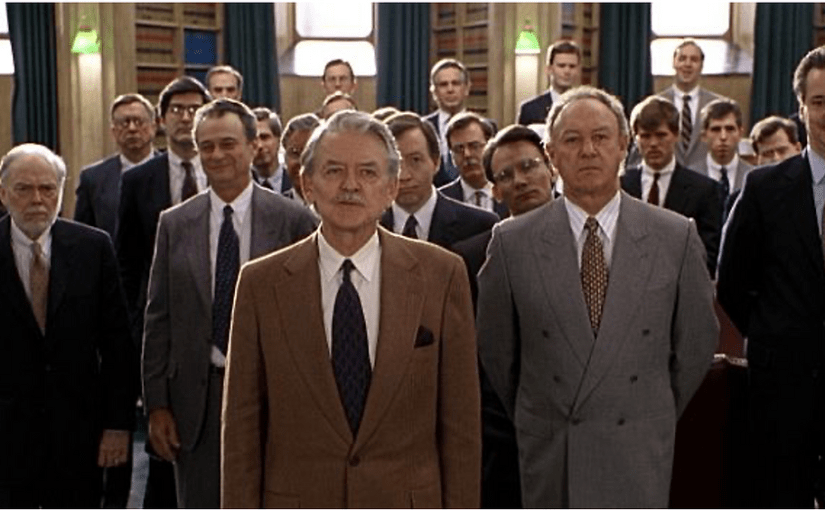
The sharp minded Avery Tolar (another welcome performance from Gene Hackman) is assigned to make sure Mitch follows the path the firm expects of him. Avery also has his sights set on Abby. For a guy who has never been regarded as good looking, Hackman plays a pretty effective flirt.

The firm, led by a seasoned Hal Holbrook with a charming Mark Twain like bow tie, and a perfect henchman villain played by Wilford Brimley (definitely on my top list of best bad guys) are involved with the Mafia and their shady dealings of money laundering, racketeering, murder and embezzlement. Now Mitch is stuck.

The FBI want to use him to uncover the firm’s activities but that risks blowing his career and maybe his and Abby’s life. If he doesn’t cooperate, then the Feds will run him in with the rest of the gang.

A second hour focuses on a complicated way for Mitch to get out of this ordeal. It means a lot of white collar work and contrived timing in the script. Fortunately though, Pollack builds suspense with foot chases and some allies on Mitch’s side, including Holly Hunter as an hourglass figured, bombshell secretary to a private investigator (Gary Busey) that Mitch went to see. His plan involves traveling to and from the Cayman Islands, and making copies of legal documents to build evidence of mail fraud against the firm.

Mail fraud???? That’s right mail fraud. It’s not a sexy crime, but the script with Pollack’s direction and a hard pounding piano soundtrack from Dave Grusin manage to keep the suspense up and alert.

Pollack directs Cruise to sprint across downtown Nashville for some great sights and hideouts in broad daylight. Your adrenaline moves with the film even if you can’t connect all the dots of Mitch’s complex plan.

In fact, it’s best to just give up on following every little step Mitch and his team take to stay ahead of the firm. What works best is the seemingly no win scenario for Mitch and Abby. Pollack follows a Hitchcock trajectory. He leaves the bomb on the table but doesn’t detonate it right away. Thus the suspense holds steady.

So, the best kind of counsel I can give is to just enjoy The Firm as it runs through its paces. It’s a solid white-collar thriller.