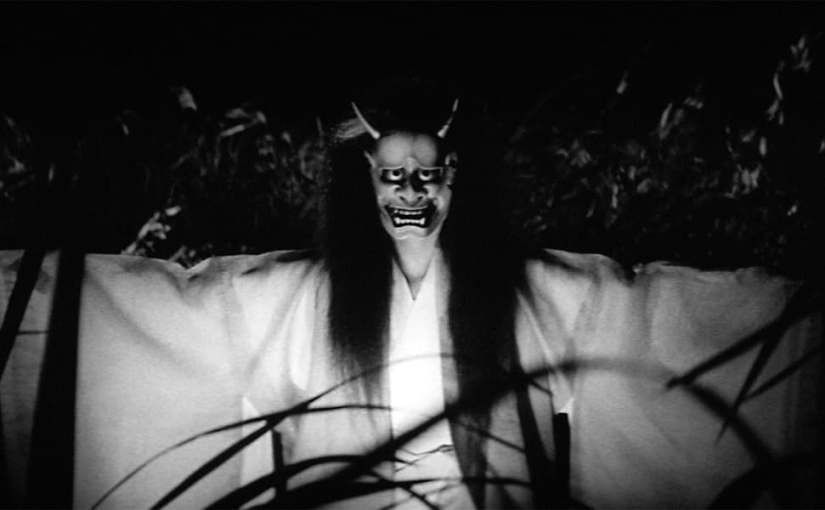
ONIBABA (Japan, 1964)

by Miguel E. Rodriguez

DIRECTOR: Kaneto Shindô
CAST: Nobuko Otowa, Jitsuko Yoshimura, Kei Satô
MY RATING: 7/10
ROTTEN TOMATOMETER: 90%

PLOT: In feudal Japan, two women kill samurai and sell their belongings for a living. While one of them is having an affair with their neighbor, the other woman meets a mysterious samurai wearing a bizarre mask.


Squint your eyes, and long stretches of Onibaba look as if they were adapted from comic books.  I’m not talking about the eye-popping colors of Kirby, though.  More like the moody noir of Miller or McFarlane…especially Miller.  Extreme closeups, off-centered faces (to make room for word balloons, of course), sneering lips and bared teeth, gratuitous female nudity, shocking violence, the possibility of supernatural elements getting involved in the story – we’ve got all the makings of a new chapter for the Sin City saga.

But Onibaba misses its chance for true greatness by the disappointing nature of its ending, which I cannot, in good faith, describe in detail here.  The last time I felt this cheated by the ending of a film was when I watched the original Night of Living Dead for the first time.  When the credits for that movie rolled, I wanted to throw popcorn at the TV.  Since I didn’t have popcorn, I cursed out my friends instead.  C’est la vie.

The story of Onibaba begins as we see two women – one older, one younger – living in poverty in medieval Japan.  Some later exposition informs us of an ongoing war far away between two warlords.  Weary soldiers from both sides wander into the tall grassy fields where the women live, and the women promptly kill them, take their clothes and belongings, and sell them to local merchant for bags of millet.  (We never learn the women’s names, by the way.  They are identified only by how they relate to Kichi, a man we never see: one is Kichi’s mother, the other is Kichi’s wife.)  The bodies of the men they kill are disposed of in a large, ominous pit hidden by the tall grass.

I should mention yet another stylistic and visual flourish.  The two women live in a grass hut constructed in a vast field of tall grass at least six, possibly seven feet tall.  There is poetry in many shots when the wind rises and pushes the grass.  In one neat overhead shot, the only way we can see a man pushing his way through the grass is by tracking the hole he makes as he walks.  It’s an indescribably lyrical moment in an otherwise mundane scene.

ANYWAY.  A neighbor arrives, Hachi, with sad news for the two women: Kichi has been killed.  When he asks how the women got by during his absence, they are cagey.  It’s here where we get the first of many masterful sequences where faces and eyes are used to convey emotion more vividly than any prose could.  When Hachi propositions the young woman, now a freshly-minted widow, she sneers.  But as days go by, Hachi wears her down, and they begin an affair, much to the mother-in-law’s disapproval.

Night after night, the young widow wanders off to Hachi’s shack, while the mother-in-law sneaks off and follows her, disapproving but never interrupting their liaisons.  All she offers as a rebuke are stern words and resentful glares.  This cycle repeats itself several times, and despite the visually unique methods of showing us these middle passages, I found myself wondering where this was going.  No doubt people more knowledgeable than I can make conjectures about how this might be a representation of Japanese culture at the time: the old severely disapproving of the young, but powerless to stop the march of progress.  It’s not a far-fetched theory, but if so, it’s an obvious one.  So, what’s the point?

Hope arrives (story-wise) in the form of a tall samurai warrior the mother-in-law encounters in the tall grass one night.  He wears a fearsome demon mask and demands the old woman show him the way to the nearest town.  She asks him to remove the mask.  He refuses, but he assures her that he is very handsome underneath.  Right.

At this point, I was on the edge of my seat.  At last, here we go, some real horror-story stuff.  The mask looks awesomely horrifying, not like the kind of demons we tend to think of, but a weird, bug-eyed, fanged face that still looks vaguely human, which only makes it that much creepier.  When the old woman finally gets her hands on the mask (I won’t say how), she formulates a plan.  The next night, when the younger woman sneaks off to another rendezvous with Hachi, she is confronted by a tall figure with long black hair with the face of a demon…gliding through the grass is if it were floating over the ground.  Floating?  People can’t float.  …what exactly is going on here?

At this point, I was primed for a Twilight Zone kind of twist, revealing the true nature of the samurai warrior, the mask, and the old woman.  (Onibaba translates to “demon woman”, according to the main titles of the movie.)  But what?  I was pleasantly surprised by my eagerness to see what would happen next, even if it were mildly predictable.  The movie had shown great visual flair, so even if the ending was a cliché story-wise, it would look really cool.

But…alas.  The film’s ending teases us with several minutes of truly disturbing stuff psychologically, and then throws it away in a moment of ambiguity, the kind of open-endedness that may inspire discussions on the movie blogs, but which is terribly unsatisfying when it doesn’t work.  And here, unfortunately, it doesn’t work.  It leaves us with more questions than answers, and when “The End” appears, it almost feels like the director and/or screenwriter said, “That’s it, I’m out of story.”

The liner notes of the Criterion Blu Ray for Onibaba inform me that it’s based on an ancient samurai legend, so I guess I can’t totally blame the director/screenwriters.  But I just wish there had been something meatier waiting at the end of what had been a visual treat.  If it had provided a nudge into something deeper or more visceral, I’d have been ready to put Onibaba near the top of my favorite Japanese films.  Visually, it’s stunning with a surprisingly modern feel.  But, oy, that ending.

POOR THINGS

By Marc S. Sanders

A sexually explicit rendering of Mary Shelley’s Frankenstein is brought to life by Yorgos Lanthimos’ film, Poor Things.  The strongest element of the picture is certainly Emma Stone’s uncompromising performance as Bella Baxter.  It’ll at least get an Oscar nomination.  The film will likely collect an abundance of nominations as well for it’s fantastical imagination in art direction, garish costuming and makeup and directing.  Maybe there will be some accolades for Willem Dafoe and Mark Ruffalo as well.  The adapted screenplay of Alasdair Gray’s novel, written by Tony McNamara, is a contender too.  It’s already being hailed by many outlets as a top 10 picture for 2023.  Yet, I grew tired of the novelty, and bored with the excessive sexual exploits of Bella.

Bella was once a pregnant woman who deliberately plunged herself off a London bridge to escape her misery.  Godwin Baxter (Willem Dafoe), who Bella appropriately recognizes as simply God, discovers her lifeless body in time to conduct an experimental procedure.  Replace Bella’s brain with that of the unborn child she carries and raise her from there.  God is scarred and altogether bizarre, and recruits a medical student named Max (Ramy Youssef) to observe the reborn girl’s progression and behavior; a grown woman with that of an infant who is learning to speak, walk, eat, and behave for herself.  After a while it is decided by God that Max will become engaged to Bella.  However, another man enters the picture, Duncan Wedderburn (Mark Ruffalo), who convinces Bella to accompany him on a sojourn.  God permits the idea as an opportunity for Bella to learn what is out there and not restrict her.  It is at this point, that Lanthimos’ film transitions from a blue tinge monochrome photography to vibrant color as Bella and Duncan travel to destinations such as Lisbon, Alexandria, and Paris, where Bella abandons a destitute Duncan to join a Parisian brothel.  Bella sees opportunity.  She can earn money for allowing men to put their things inside her.

I could not help but think of films like Forrest Gump, The Curious Case Of Benjamin Button and even Pinocchio while watching Poor Things.  An unwise subject discovers an independence to witness how a world around her functions.  As she learns, she matures, and she realizes she does not need to be held down by any party.  Shelley’s monster also broke free of its master’s clutches, tried to acclimate itself, but was revolted against for its grotesqueness on the outside and simply for being misunderstood.  Bella does not encounter such a fate.  Instead, she discovers acceptance but only at what she’s worth monetarily speaking with a simple attraction limited to individual thought.

Poor Things is constructed in the narrative themes of Yorgos Lanthimos’ preferred way of filmmaking.  Just like The Favorite, it’s deliberately weird and proud of it.  Nothing appears conventional.  You could substitute the settings for Paris, London and even the cruise ship that Bella and Duncan travel on for set pieces in Wonka.  It’s all fantasy with an adoption of real-world locales.  I surmise Lanthimos excuses these outlooks as a perception of Bella.  The settings look like they were spawned from a pop-up children’s book.  It’s all so different but I found it to be tiring. If someone were to argue that it is inventive as opposed to another stale backdrop of London Bridge or the Eiffel Tower, I wouldn’t debate them. Yet, I was growing tired of the piece. 

Moreover, the second act of the film concentrates abundantly on Bella’s adventures within the brothel.  Bella discovers the comfort of self-pleasure.  Later, the sensation is enhanced by the possibilities of getting satisfied by the company of a man.  The audience chuckled.  So did I, but I also squirmed quite a bit.  Bella insists to God that she wants to “go adventure,” and God allows her his blessing.  Yet, I found these series of sexual encounters to be overly exploitive.  Nothing is held back on what Emma Stone performs for the camera as a concubine for one needy, stinky, and ugly gentleman caller after another.  She takes it the traditional way, the oral way, the way from behind and much more.  She is captured with S & M straps across her nude body and the Oscar winning actress goes all the way to sending the scenes home.  It’s as if Yorgos Lanthimos needs to deliver his point, but it’s not enough to try it once, twice, or even three times.  I get it already.  Bella is used for whatever fetishistic imagination the male mind can fathom and more importantly she thrives off of the stimulation. She happily recounts how a pineapple can be used in the bedroom.  It’s even better that she can get paid for this lifestyle.  It sounds amusing while I type this all out, but I was not entirely comfortable watching it either.  I’ve seen enough porn in my day to not be shocked, and I wasn’t shocked.  Yes, I was amused at times.  Look, I don’t have ice water running through my veins.  Eventually, though, I was just bored.

Godwin Baxter is an interesting character as played by an always reliable Willem Dafoe.  Early on, we see how in addition to his experiment with Bella, God has toyed with the ideas of blending different breeds of animals together.  Roaming his estate are the likes of a dog crossed with a chicken and a pig crossed with…you know what I can’t even remember after seeing the film only once.  There was also a duck crossed with something.  Kind of sophomoric material and I think Lanthimos would accept that observation as a compliment.  Oh yeah, there was a goat crossed with something too; was that the pig?  What I think lacks from Poor Things, however, is to probe if these kinds of experiments should even be conducted and I cannot recall a conversation that goes in that direction.  Max seems taken aback by what he witnesses but he never investigates further.  This is all most unusual (a serious understatement) and it’s hardly ever questioned. Even Jeff Goldblum tossed a contrary opinion at the idea of Jurassic Park.

I suppose I wanted more from Poor Things.  Beyond sexual pleasure and what can be gained from it, isn’t there anything else that naïve Bella has to learn about?  I guess in conjunction, she also learns how to earn a wage and a gumption to stand up for herself.  What about love and the fear of death?  What about what else occurs within the world around her?  What about loss, or betrayal?  As well, Godwin’s occupations never go further than what we see he is capable and daring enough to do.  How do others consider his experiments?  What residual effects stem from his accomplishments?

I’m glad I saw Poor Things.  I think I’d like to see it again actually because I may gain a greater understanding from the attempts the script strives for in accordance with Lanthimos’ vision.  I know this film is not for everyone, though.  It’s proudly peculiar, but its plodding in its glee to step very far over a line that most filmmakers wouldn’t dare go.  It has my salute for what it has set out to do.  Nonetheless, I’m not sure I’m a fan of the material it served, though.

WHAT EVER HAPPENED TO BABY JANE? (1962)

by Miguel E. Rodriguez

DIRECTOR: Robert Aldrich
CAST: Bette Davis, Joan Crawford, Victor Buono, Maidie Norman
MY RATING: 9/10
ROTTEN TOMATOMETER: 92% Certified Fresh

PLOT: A delusional former child star torments her paraplegic sister in their decaying Hollywood mansion.


I have heard of this movie by reputation almost my entire life, and only now, near the end of my 52nd year on Earth, have I finally sat down to watch What Ever Happened to Baby Jane?, a movie that has been called a camp classic, a horror film in the guignol tradition, and a showcase for two of the greatest bitches in the history of cinema.  And let me tell you, it was worth the wait.  Bette Davis’s performance as Baby Jane Hudson is the stuff of legend: evil, despicable, vile, and impossible to look away from.  She doesn’t just chew the scenery, she purees it.

And yes, before faithful readers get up in my grill, this is one of the slowly growing list of films where the main character is an absolute douchebag, and I not only tolerate it, I celebrate it.  It’s impossible not to.  Like Christian Bale or Jack Torrance, Davis hypnotizes viewers by so perfectly embodying the character that it becomes impossible to imagine anyone else playing it.  It’s been said that at one point, Joan Crawford was going to play Baby Jane, but as talented as Ms. Crawford was, I can’t imagine her improving on Davis’s fearless performance.  This is the very definition of “commit to the bit.”

If you’re like me before I watched the movie, you know the bare bones of the story.  Back in the heyday of vaudeville, Baby Jane Hudson with her golden curls was the darling of the stage, entrancing audiences with her heartbreaking rendition “I’ve Written a Letter to Daddy.”  Her slightly older sister, Blanche, was ignored by her talented sister and, tragically, her father.  But karma is a bitch, and in the early-to-mid-1930s, Blanche becomes a Hollywood superstar, while Baby Jane toils in obscurity, clearly an inferior talent to her celebrated older sister.

One night, there is a terrible “accident” in front of their house (an old Hollywood mansion that once belonged to Valentino), and Blanche is paralyzed from the waist down.  For the next thirty years, Blanche is confined to a wheelchair on the second floor of their mansion, while the delusional Jane, who in her late sixties still wears her Baby Jane makeup and curls, dutifully brings up Blanche’s meals and verbally abuses her.  Their part-time maid, Elvira (Maidie Norman, unknown to me, but quite good in a pivotal role), discovers a trove of Blanche’s fan mail…opened and discarded by Jane.

How to describe these scenes of emotional and verbal abuse?  The words that come out of Jane’s mouth are as harsh as you can get in a movie from 1962.  (In one scene, watch her mouth carefully, and you can see her call Blanche a “bitch” just as a buzzer drowns out her voice.)  But because Blanche, with the patience of a saint, puts up with it, we the audience are forced to accept it.  I mean, I wanted to punch Jane in the face about 30 minutes into this two-plus-hour movie, but I had to tough it out because Blanche is toughing it out.  At that point, I just wanted to see what kind of karmic fate awaited this intolerable harridan.  I wanted her to get trampled by horses while being drawn and quartered by four tractors.

But this is just summary.  I’m not doing the movie justice.  For a 61-year-old movie, it felt just as tense and thrilling as anything I’ve seen in theaters this or any year.  The term “camp” I absolutely disagree with when applied to this movie.  Camp occurs when someone genuinely believes they’re making a great film, and the result is so laughably bad it’s good.  Ed Wood is camp.  Reefer Madness is camp.  Troll 2 is camp.  But NOT What Ever Happened…  Director Robert Aldrich knew what a casting coup he got with Davis and Crawford in the leads, two actresses whose well-known feuds were constantly reported.  All he had to do was turn them loose on the script and keep the cameras rolling.  Rather than getting a movie that got overcooked by hammy histrionics, Aldrich got a top-notch thriller that keeps audiences off-kilter right up to the last five minutes.  That’s not an exaggeration.  As such, this cannot qualify as “camp” because the result was not a bad movie, but a brilliant one.

The different ways in which the screws get turned in such a claustrophobic thriller are ingenious.  Blanche has a pet parakeet that flies away while Jane is cleaning the cage…so she says.  Jane serves dinner to Blanche one day, always with a covered dish, and just as she walks out, she casually mentions there are rats in the basement.  Blanche and we look with horror at the covered dish waiting on her table.  Blanche tries to send a distress signal to their next-door neighbor; the way THAT scene plays out would have warmed the cockles of Hitchcock’s heart.  Blanche discovers that Jane has been practicing forging Blanche’s signature…UH oh.  One day the maid, Elvira, sees too much, and I found myself yelling at the screen when it becomes apparent her life is in danger.

The whole movie works on you like that.  I did a lot of yelling at the screen, just like your stereotypical rude audience member.  At one point, Jane has lied and lied and dug a hole so deep she can’t find a way out, and she pleads to Blanche, “Help me, Blanche, I don’t know what to do!”  The things I yelled at the screen at that point, I will not repeat here, but they involved words that rhymed with “witch”, “ducking”, and “blunt.”  That’s how well the movie got under my skin, in a good way, I should hasten to add.

What Ever Happened to Baby Jane? is one of the finest thrillers I’ve ever seen.  I hesitate to call it a horror film because, in a way, I guess it transcends the horror genre.  It includes some occasional horrific imagery, but the movie is too complex, too rooted in real-world physics and situations for me to see it as a horror film.  It’s a domestic thriller that flirts with self-indulgence, but the performances are so good, we forgive it when, for example, Jane performs her old Baby Jane number, her voice croaking on the high notes like a frog on helium.  In any other movie, I can imagine people would shake their heads and mutter, “Oh, brother…”  In this movie, we still shake our heads, but in awe of an utterly unafraid actor.

As for why I give it a “9” instead of a “10”…ask me after watching it yourself and I’ll tell you.

THE DEER HUNTER

By Marc S. Sanders

After watching the 1978 Best Picture winner, The Deer Hunter, I followed up by reading some of the trivia about the film on IMDb.  Please do not think I’m a terrible person, but the racial overtones within the portrayals of the Viet Cong never occurred to me.  I guess I can only surmise that war is hell, and I suppose that when any one of us are being held in captivity our prejudices go out the window, and the hatred we feel towards another human is directed at the ones who are exercising their sadistic torment upon us.  It does not matter where they come from or what they look like or even if they are related to me.  Being held prisoner and forced to participate in games of Russian Roulette must allow my seething abhorrence. 

Another important factor that was questioned in Michael Cimino’s film is whether games of Russian Roulette were in fact forced upon POWs during the Vietnam War.  Many veterans insist it wasn’t, therefore holding a strong grudge against the filmmaker.  Cimino argued that he had testimony and photographic evidence to its validity.  I will not even give you an opinion.  I do not know enough about that terrible conflict, and I will not disrespect the service that so many men and women devoted during its time.  I can only focus on the context of the three-hour film. 

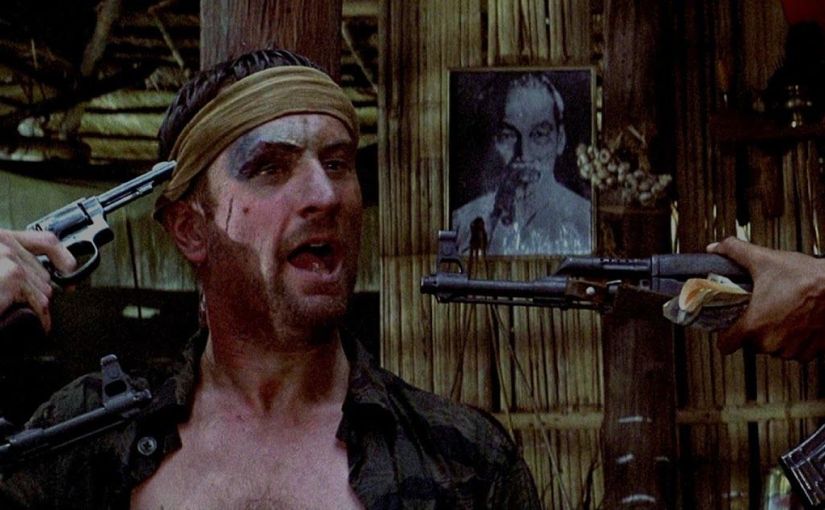
In this movie, I see a perspective of three buddies from a small Pennsylvania steel mill town who voluntarily enlist in the army in the late sixties to serve in the Vietnam War.  Thereafter, they are held as prisoners of war, confined in submerged bamboo cages infested with rats and mosquitoes.  They are only let out to compete against one another in face to face Russian Roulette by a forceful unforgiving Viet Cong.  Upon escape, the three men are separated with different measures of terrible destinies to live with afterwards.

Mike, played by Robert DeNiro, is the Green Beret Army Ranger who returns home to a lifestyle he can no longer lead.  Steve (John Savage) has been permanently traumatized both mentally and physically as he has lost both legs.  Nicky’s (Christopher Walken) whereabouts are unknown.

Before any of this occurs, there is a lengthy first act to The Deer Hunter.  The three men are celebrating their send off to serve, but more specifically Steve is getting married.  Michael Cimino takes much of his time focusing on the ceremony, which contains orthodox Russian traditions, and the party with an enormous amount of wedding guest extras (probably the whole town) to carry out endless, drunken celebrations. 

The first time I saw this film I grew bored with the wedding footage.  It seemed to be overly long and tiring.  Pointless, even.  On this most recent view, however, I found it completely absorbing.  There’s an unbeknownst future to all of these people, not just the three eventual servicemen.  None of the people in this Pennsylvania town live extravagantly.  It’s special for the ladies to wear their formal pink bridesmaid dresses but they run through the wet streets of the town on their way to church.  The men throw on their tuxedos that they likely wore only one time before during their prom.  Once the reception begins for Steve and his wife, Angela, everyone is sweaty and out of breath, happily drunk and wobbly.  They lean on one another in a sloppy way for a group photo. They never stop drinking.  More importantly, they never think about how scary or horrifying the Vietnam War could be for them.  They are celebrating a happily wedded future for their buddy Steve and their soon to come legacies as American war heroes.  Nicky even takes a boozy moment to propose to Linda (Meryl Streep).  Already an abused woman, she immediately accepts.  Mike can only gaze with inebriated amazement at a uniformed serviceman who is disturbingly quiet as he sidles up to the bar.  Mike insists on buying him a drink. 

Late into the night and onto the next morning, the guys are doing their traditional favorite activity with a ride into the mountains for some deer hunting.  They change out of their tuxes and into their hunting gear as they tease one another and gorge themselves on Twinkies with mustard.  None of these boys have a care or worry in the world, except for nerdy Stan (John Cazale) who has once again left his hunting boots behind.

There’s a relaxation and calmness to these people; to the men who are staying behind, to the ones getting ready to leave and to the women who share in their lives.

Regardless of the questions of racism or authenticity, Michael Cimino, with a joint screenplay written with Deric Washburn and Louis Garfinkle, show how the war not only directly changes those that served but also the ones who welcome them home.  Steve’s wife is not only separated from him but also appears mute and inactive.  Linda attempts to move on with her life but is absent of comfort from Nicky, the man who proposed to her on a whim.  Mike is not capable of being the drunken party leader or precise deer hunter he used to be.  The deep scars of the three also draw scars for everyone else back home.

The Deer Hunter is a very difficult film to watch.  The picture ends leaving you feeling traumatized because it stretches from innocent celebration and debauchery over to some of the worst images that could ever be fathomed.   Wars end in a truce, a victory or a defeat, but the conflict does not cease for many of those who participated as pawns for a governing power. 

Nicky never comes back to Pennsylvania.  He tries calling home, but he can never follow through.  He has been changed permanently by his time as a killing soldier and captive who was being forced to use his life for stakes.  Mike returns dressed in his uniform with his medals signifying his achievements but as soon as he sees the “Welcome Home Mike” banners he insists the cabbie drives on by and he does not enter Linda’s trailer home until he sees all the guests leave the next morning. 

There’s a haunt that Cimino’s film ends with as the remaining members of the group assemble following a funeral and segue into singing “God Bless America” together.  I don’t ask this question as a means to minimize anyone who has served or lives as an honored citizen of our country; should these folks who must endure loss from now on be chanting about blessing America, or should they be pleading for a blessing upon themselves? The characters of The Deer Hunter struggle internally and are desperate for a salvation and peace. 

War may be a chaotic, unforgiving hell, but living thereafter is another kind of hell that you cannot escape from.

SEVEN DAYS IN MAY (1964)

by Miguel E. Rodrigugez

DIRECTOR: John Frankenheimer
CAST: Burt Lancaster, Kirk Douglas, Fredric March, Ava Gardner, Edmond O’Brien, Martin Balsam
MY RATING: 9/10
ROTTEN TOMATOMETER: 91%

PLOT: United States military leaders plot to overthrow the President because he supports a nuclear disarmament treaty, and they fear a Soviet sneak attack.


Barely two years after The Manchurian Candidate shocked audiences, director John Frankenheimer delivered the goods again with a political conspiracy thriller that is the equal of Candidate in almost every way.  Were it not for some overcooked sermonizing during a transitional scene, I would almost call Seven Days in May a perfect example of the genre.  I’m frankly a little surprised it’s not mentioned more often in the same breath with other similar thrillers like Fail Safe, The Parallax View, and Three Days of the Condor.

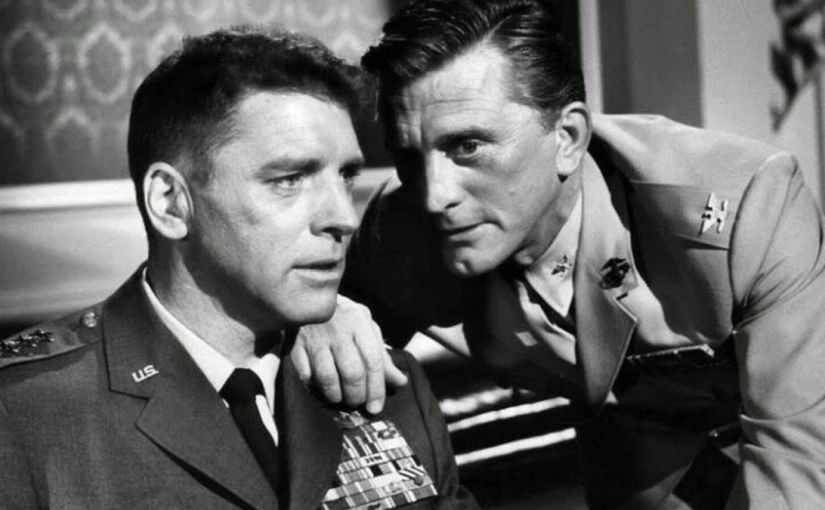
The action starts on a Monday and, predictably, spools out over the next seven days.  We learn that the current American President, Jordan Lyman (Fredric March) has just signed a nuclear disarmament treaty with the Soviets, this being the height of the Cold War in the early 1960s.  His actions have brought his approval ratings to a record-setting low, and demonstrators outside the White House express their desire to see someone else in the Oval Office: General James Scott (Burt Lancaster), a hawkish individual who sees no evidence the Russians will ever honor such a treaty.  General Scott’s aide is Colonel “Jiggs” Casey (Kirk Douglas), a soldier who disagrees with Scott’s views privately, but who knows his duties and performs them admirably.

Over the next couple of days, Casey picks up scraps of conversations from senators and other generals critical of the President.  There is talk of the President attending an “alert”, or an exercise in which armed forces are scrambled in a drill; uncharacteristically, he’s attending alone – no press.  A friend of Casey’s mentions something called “ECOMCON”, a secret Army base in El Paso, and a mysterious “Site Y.”  A Pentagon messenger relays a teletype message from General Scott to other members of the Joint Chiefs about who’s placing bets in the Preakness pool…then gets transferred to Pearl Harbor.  Casey wonders why questions about a horse race would be broadcast over Top Secret channels…

Watching Casey piece the clues together is one of the pleasures of this movie.  It never talks down to the audience, depending on them to follow Casey’s line of reasoning while he draws his own conclusions.  Once he brings his suspicions to the President, and the President elects not to attend the alert, things start happening very fast.  It’s here where the height of suspense occurs, as three men are sent in different directions to accomplish three separate fact-finding missions.  As each man got closer to achieving their goal, there was a feeling in the air, a vibe, a tone that felt like disaster was just around the corner, knocking on the next-door window.  A man drives his car into the desert in search of the secret base in El Paso, and I half-expected the sands to just open up and swallow him whole.

Frankenheimer always was an expert at that kind of suspense generation.  Second only to Hitchcock among his contemporaries, he was a genius at creating tense situations with a minimum of flash, depending on strength of story and screenplay, and his actors, to generate a nervous tension in his viewers.  Those powers are on full display here.

It’s odd…Seven Days in May is a political thriller that doesn’t have any real action scenes or sequences.  A plane crash is referenced but never seen, as opposed to today’s films that would make room in the special FX budget to show audiences the crash.  At least in this film, it’s far more effective when it’s revealed but never seen.  That’s pretty gutsy.  There are no pumped-up chase scenes between a guy with crucial evidence and the shadow forces trying to keep it a secret.  It’s all handled very simply, which makes everything more plausible…and, as a further result, much more suspenseful.

I haven’t mentioned Ava Gardner’s character yet, Eleanor Holbrook, a former lover of General Scott’s.  How she figures in Casey’s plans to uncover evidence of Scott’s treason leads to a devastating scene involving old love letters and mistaken assumptions.  It’s some brilliantly incisive writing, and another example of how the movie achieves plausibility through simplicity.

Any further discussion would necessarily involve spoilers, so I’ll stop here.  Seven Days in May is a prime example of a good story told well, with hardly any bells or whistles.  It reminded me, for some reason, of some of those classic ‘80s thrillers where their only reason for existence was to turn up the tension without getting bogged down in subtext (Body Heat, No Way Out, Blow Out).  There is that one sermonizing speech, as I mentioned before, and I cringed a little when it happened, but it’s a minor quibble.  This is a superior thriller that deserves to be seen.

EYES WITHOUT A FACE (France, 1960)

by Miguel E. Rodriguez

DIRECTOR: Georges Franju
CAST: Pierre Brasseur, Alida Valli, Juliette Mayniel, Edith Scob
MY RATING: 9/10
ROTTEN TOMATOMETER: 97% Certified Fresh

PLOT: A surgeon goes to extreme lengths to give his daughter a new face, which was disfigured in an accident he caused.

[NOTE: This review contains mild spoilers.]


I have become a fan of many of the new breed of horror films released in the last ten years or so – Under the Skin, The Babadook, Get Out, Hereditary, Doctor Sleep, and Saint Maud, just to name a few.  Despite their cosmetic differences, these movies all accomplished the same thing: they got under my skin.  They were genuinely unsettling as their stories unfolded, and they can still creep me out to this day.

Imagine my surprise when I sat down to watch George Franju’s Eyes Without a Face, a French horror film released over sixty years ago, during a time when most mainstream American horror films (Hitchcock aside) were exercises in jump scares, cheesy special effects, and outrageous premises.  I was not prepared for how effectively this movie grabbed me from the outset and, except for a brief middle passage, did not let go.  When a movie from 1960 begins with a woman dumping a corpse into a river…a corpse with a clearly, hideously disfigured face…I don’t know about you, but I sat forward a little in my seat.  Where is THIS going?

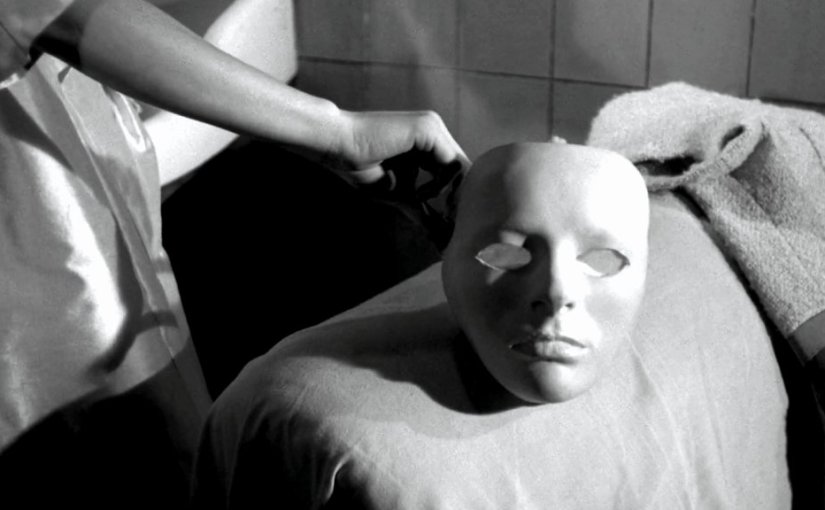
When the body is discovered, the esteemed Dr. Génessier (Pierre Brasseur) solemnly identifies it as his daughter, Christianne.  There is a funeral, Christianne’s fiancé is distraught, and the police are satisfied.  When the good doctor returns home to his large, gothic estate in the country, he goes upstairs to a room where we find his actual daughter, still alive and so disfigured the camera dares not show her face.  The doctor’s assistant, Louise (Alida Valli, still exotic-looking 11 years after The Third Man), brings in a simple but disturbing mask for Christianne to wear.  “Get into the habit of wearing it,” says the doctor.

Who was the girl in the opening scene?  What happened to Christianne’s face?  And why does Louise start searching the nearby city for young unattached women with blond hair and pretty faces?  Why, indeed?

Eyes Without a Face may not have a particularly inscrutable or complicated story, but that doesn’t matter.  The movie unfolds like a modern-day Grimm’s fairy tale, poetic, with princesses locked in tall towers, an evil father figure, and unspeakable violence hinted at but never quite seen.  Except this time, in an unforgettably shocking scene, we witness one of the doctor’s operations.

In most films of this era, shockingly violent acts were tactfully carried out offscreen.  I am thinking, for some reason, of Lawrence of Arabia, where Lawrence must execute a man in order to keep the peace between two Arabian tribes.  Lawrence pulls his gun, we see the bound man try to escape, and we cut to Lawrence as he fires his gun, once, twice, several times.  It’s a shocking scene, but we never see the carnage of those bullets.  It’s left to our imagination.

In Eyes Without a Face, we watch as the doctor gently draws a grease pencil outline around his anesthetized victim’s pretty face.  (“I must try removing it in one large section, not in pieces as before.”  Yikes.)  Then Louise hands him a scalpel, and the camera stays on Louise’s face, and I expected it to stay there for several seconds as the horror of what the doctor was doing was left to our imaginations.  But no.  We cut back to the scalpel piercing the skin as he gingerly follows his outline around her face.  Some excess blood drips down, and Louise dutifully sponges it away.

This is already pretty strong stuff for 1960, at least when I compare it to other films I’ve seen from that era (again, Hitchcock aside).  But I was doubly shocked when the movie didn’t stop there.  The face must still be removed, but to do that we need clamps, more incisions (taking care around the eyes, of course), and we watch this process in several long takes which must have had some audience members fainting in disbelief.

When the doctor is finished, another body must be disposed of, Christianne has a new face, and all seems to be well.  (The doctor reminds his daughter: “Smile.  Smile.  …not too much.”)  What makes this movie great is that there is still so much more to the story, but I’ll leave that for you to discover.

This is the kind of gothic stuff that screams for a remake today, maybe by del Toro or Ari Aster.  Although perhaps they are already fans and have made the decision that the film is too perfect as it is.  I can’t blame that viewpoint.  Eyes Without a Face has just about everything a modern horror fan could desire.  Franju plays many of the film’s creepiest scenes with no score, creating a deeply unnerving mood like in The Blair Witch Project.  It doesn’t shy away from disturbing gore.  Christianne is not just a shrinking violet, but prone to heartbreaking philosophy.  (“My face frightens me.  My mask frightens me even more.”)  To say the resolution of the story is satisfying is an understatement; it takes “poetic justice” to a whole new level.  There is Hitchcockian – or, perhaps more accurately, Clouzot-esque – suspense when Christianne’s fiancé begins to suspect there is something fishy about Dr. Génessier’s clinic and tries to set up a sting operation with the help of local police.

And so much more.  Eyes Without a Face is, for me, one of those buried treasure movies that I normally do not seek out, but when they turn out to be more than worth my time, I can’t help but share it with others.  It holds its own with modern horror films, and then some.  The fact it was made in 1960 still boggles my mind, and that just makes it even more fascinating.

[P.S… According to IMDb, John Carpenter once suggested that the selection of the mask worn by Michael Myers was influenced by Christianne’s mask from this film. I believe it.]

MAESTRO (2023)

by Miguel E. Rodriguez

DIRECTOR: Bradley Cooper
CAST: Carey Mulligan, Bradley Cooper, Matt Bomer, Sarah Silverman, Maya Hawke
MY RATING: 8/10
ROTTEN TOMATOMETER: 80% Certified Fresh

PLOT: This love story chronicles the lifelong relationship of conductor-composer Leonard Bernstein and his wife, actress Felicia Montealegre Cohn Bernstein.


Bradley Cooper’s Maestro is a film of scope and depth and tremendous technical artistry, both in front of and behind the camera.  The performances from the two leads contain some of the best acting I’ve ever seen, especially their argument during a Thanksgiving Day parade.  But I cannot deny that, for reasons I’ll try (and probably fail) to explain, I did not feel emotionally invested in the story until the final two or three reels, when something occurs that, if it were fiction, could easily be dismissed as a shameless attempt at Oscar-baiting.  The fact that this really happened lends these final scenes an emotional weight that was missing from everything that came before.

The story is straightforward, but beautifully told, visually.  After a brief prologue, we meet a young Leonard Bernstein (Bradley Cooper), in bed with his male lover (hope that’s not a spoiler), as he gets an early morning phone call that will change his life forever.  This opening scene sets the visual tone for the first half of the film: standard 1:1.33 framing as opposed to widescreen to give it a classic feel, as well as gorgeous black-and-white cinematography.  Indeed, this opening shot alone looks like it could hang in a museum of modern art and not look out of place.

Everything proceeds breathlessly from there, with some conversations held at speeds that would make the Gilmore Girls dizzy.  After a series of early musical triumphs, he meets the woman that will become the polestar of his personal life: actress Felicia Montealegre Cohn (Carey Mulligan, in a performance that will almost certainly win her an Oscar nomination).  After some verbal sparring/flirtation, it becomes clear to them, and to us, that they are meant for each other, despite his later dalliances with male fans and hangers-on.

I especially liked a scene during this early section where Felicia and Lenny – as his friends and family called him – dine with some older friends (or family? I can’t quite remember), and an older gentleman gives him some advice: “They’ll never give Leonard Bernstein an orchestra in America.  But Leonard S. Burns…”  I loved that scene because I loved how Bernstein’s entire career is a rebuke to that well-meant but wrong-minded sentiment.

This gentleman advises Bernstein to give up writing scores for musicals, but Felicia disagrees.  That sets up a wonderful sequence where Felicia and Lenny watch a rehearsal of the stage musical On the Town, with sailors leaping balletically, and then in a fantasy reminiscent of The Red Shoes, Bernstein himself becomes one of the sailors, and the dance becomes a micro-miniature of their relationship and his early successes.  It’s a thrilling little cutaway that had me grinning the whole time.

From there, the movie jumps forward chronologically in leaps and bounds, giving only a cursory glance at the 1960s before settling more or less for the rest of the film in the mid-to-late 1970s, with Bernstein’s face becoming the craggy icon that I personally remember from my own youth, while Felicia Bernstein somehow looks just as beautiful as she did thirty years and four children ago.  I would blame that on movie magic, but I mean, we are talking about Carey Mulligan here, so they get a pass.  And then the last act of the film arrives and we get a glimpse perhaps of why Mulligan receives top billing over the actor-star-director Cooper.  And that’s all I’ll say about that.

As I said, the movie looks amazing.  Obviously the period décor and costuming are all spot on, but the cinematography and direction – what theatre or film studies majors would call mise-en-scène – are just incredible to behold.  Another shot that stands out in my mind is a scene where Bernstein is conducting, and we get an angle where we are looking into the wings, but his undulating shadow looms large, and standing in that shadow, but still illuminated, is Felicia.  Verbal descriptions won’t do them justice, just see for yourself.

But as I mentioned, I just wasn’t invested in the story from an emotional standpoint.  I felt like I was watching an extremely inventive and ingenious exercise in moviemaking.  I suppose I could compare it to the recent sci-fi film The Creator, if that doesn’t get me accused of hyperbole.  Both films show supreme confidence in staging, cinematography, and direction.  But like The Creator, Maestro feels like something is missing where its heart should be for the first 75% of its running time.  Things happen, arguments take place, children are born, Lenny gets a little sloppy with his paramours, but I never felt like any of it really meant anything to me as the viewer.

I tried asking myself, “What statement is the film making?”  And I couldn’t answer that question, aside from fulfilling its purpose in presenting the facts of a story in almost documentary-like fashion.  But the performances and cinematography are so stunning that I must acknowledge that fact with a higher rating than I would normally give a film that doesn’t really grab me emotionally.  (EXCEPT for the last 25%, I mean…I don’t want to give anything away, but the last reels are heart-tugging.)

So, do you want to see this movie?  Well, certainly not if you are an absolute acolyte of Leonard Bernstein.  You’ll see some pretty cool stuff musically, but Maestro does not paint an altogether flattering picture when it comes to his personal life.  But if you want to see one of the best-acted, best-directed, best-LOOKING films of the year…Maestro is your ticket.

TRADING PLACES

By Marc S. Sanders

Dan Aykroyd and Eddie Murphy are the unaware invitees of a Prince And The Pauper R-rated, yet whimsical, scenario in John Landis’ Trading Places.  They are one of the best on screen pairings in film, and this is one of the best comedies to come out of the 1980s.

Randolph and Mortimer Duke (Ralph Bellamy, Don Ameche – another brilliant on-screen duo) are the filthy rich misers who live to make more and more money and use their wealth to cheat and make even more monies or to perhaps use those that are at their behest to test certain social experiments.  Namely, Randoph believes that regardless of a man’s environmental upbringing, anyone can become a success based on their merits.  Mortimer believes otherwise.  It’s in the blood, he claims.  Who you spawn from is how you are destined to become.  To settle this debate, they make a modest bet of switching out their protégé investment representative, Louis Winthorpe (Aykroyd), with homeless bum/con artist Billy Ray Valentine (Murphy).  Deplete Louis of all his possessions and wealth along with his sparkling reputation, his lovely fiancée, his friends and even his faithful butler, Coleman (Denholm Elliot).  At the same time, establish Billy Ray as an up and comer in the WASP Hoi Polloi and award him all of Louis’ assets, along with assistance from Coleman.  Then they will see what shakes out and who wins the bet.  A plot like this was staged in a few Three Stooges shorts during a post Great Depression phase.

The premise for Trading Places allows for a lot of gags that consistently serve the story set mostly in Philadelphia around Christmas and New Year’s.  The holidays lend an atmosphere to the picture.  The brutal cold seems to only make it downright worse for poor Louis, the suddenly accused drug dealer and petty thief.  It only looks worse for him when he’s dressed in a dirty Santa Claus suit and getting peed on by a dog just before the cold rain arrives.  For Billy Ray, the warm comforts of Louis’ home seem like a welcome respite from the chilly, damp streets he likely has slept upon night after night.  If not on the street, then in a jail cell. 

The characterizations are perfect.  I get a kick of Dan Aykroyd’s performance of Louis, the contemptible snob with not one hair out of place and the arrogant tone of his line delivery.  Eddie Murphy is basically doing his routine from all of his early work like Saturday Night Live and 48 Hrs or Beverly Hills Cop.  Yet, I have no complaints.  He’s just funny as hell and the dialogue lends to his basic schtick.  This is the Eddie Murphy I miss from most of his modern film releases.  Denholm Elliott is great at often breaking his regal character to refer to someone as a scumbag.  Bellamy and Ameche are equivalent to wicked stepsisters from a fantasy story.  They are scheming and dreadful with glee.  Paul Gleeson is that “seen that guy somewhere before” henchman working in line with the Dukes.  He’s a great jerk who gets Louis and Billy Ray into their unexpected predicament.  Jamie Lee Curtis is unforgettable as a hooker with a heart of gold, convinced to help out a poor down on his luck Louis when there’s nothing else available to his assist.  She portrays Ophelia whose got the street smarts and sometimes the Judy Holliday squeak in her voice to lend to the spoof comedy this film relies upon.  It’s hard to believe this is the same actor who was a scream queen in a couple of slasher flicks a few years before this film’s release. Never a glamourous actor, but Jamie Lee Curtis has such an amazing range that still surprises in newer films of today (see her Oscar winning performance in Everything, Everywhere, All At Once).

The imagination into this film’s story has to be admired.  When Louis and Billy Ray become aware of the ruse pulled against them, it’s suggested not to kill the villains in cold blood. Rather do unto them what they already committed. Thus, a wonderfully energetic third act is welcomed on the floor of the New York Commodities Exchange that hinges on insider trading and realistic mass hysteria for a silly, yet highly valuable commodity such as Frozen Concentrated Orange Juice.

John Landis incorporates so many side gags into Trading Places.  Imagine Billy Ray intruding upon the wealthy’s exclusive club of snobs and you get a memorable caption of ten police officers pointing their guns in his face.  Poor Louis being subjected to a strip search conducted by nerdy Frank Oz.  Randoph and Mortimer explaining how commodities trading functions to Billy Ray thereby inviting Eddie Murphy to break the fourth wall for a moment.  Even one of my favorite actors of today, Giancarlo Esposito, makes a blink and miss it appearance as Billy Ray tells a tall tale of how he got arrested after using the “Quart of Blood Technique” on ten cops at one time while two hilarious jail cell thugs listen in to his BS.  A train ride to set the victims’ plot of revenge in motion is great involving silly disguises, a New Year’s Eve costume party attended by James Belushi, and a live gorilla.  Even Bo Diddley gets a scene with Louis trying to sell his expensive wristwatch while wearing the ugliest sports jacket and tie combination.

I yearn for another comedy that reunites Aykroyd and Murphy.  We were treated to a little sampling of Bellamy and Ameche in Murphy’s later film, Coming To America.  Oh, how I wish those guys could have capitalized on that small scene.  They pair just as well as Jack Lemmon and Walter Matthau did. 

Trading Places is always a perfect holiday movie to watch in December.  It’s funny, charming, and very smart.  It remains one of the best comedies ever offered by any of the cast members listed in this film.

Looking good Billy Ray!

Feeling good Louis!

LEAVE THE WORLD BEHIND

By Marc S. Sanders

Anxiety and the unknown are the themes of Sam Esmail’s apocalyptic Leave the World Behind.  Actually, I can’t even be sure it’s apocalyptic or not until the end arrives.  Even then I wasn’t so sure.  

A family (Julia Roberts, Ethan Hawke as the parents, Farrah Mackenzie, Charlie Evans as the kids) make an impromptu getaway from New York City and rent a luxurious upstate air B & B for the next five days.  Upon arrival they are quickly relaxed amid all the amenities and beautiful outdoor pool.  A visit to the beach is refreshing until an oil tanker arrives from the deep ocean waters and drifts upon the shore with no warning.  Strange, but okay.  No need for that to ruin the vacation.

Then other unexpected occurrences happen.  A charming gentleman dressed handsomely in a tuxedo and his formally dressed daughter appear on the doorstep of the home in the middle of the night.  They are played very well by Mahershala Ali and Myha’la.  The man claims that he’s the owner of the house and while attending a concert in the city, they needed to make a quick exit and the best place to hold up was at this house.  Conveniently, he does not have any ID to prove his identity along with no specific personal items in this home he claims to own, not even the title ownership papers.  No photos of family tucked away anywhere.  He does have a key to the liquor cabinet, however.

Quickly, the scene is set where the internet goes down.  Federal blue screen warnings appear on every television channel.  Cell phones don’t work.  Deer, lots and lots of deer, appear in the backyard and then disappear.  Pink flamingos wade in the pool.  Elon Musk’s white Tesla cars have a stand out scene.  Roberts then recalls seeing a grizzled Kevin Bacon collecting an abundance of supplies when she made an earlier shopping trip in the local town.  

The paranoia starts to set in beginning with Julia Roberts’ character Amanda.  Amanda declares early on that she fucking hates people.  Hawke’s husband character, Clay, is not ready to hit any panic button and is happy to accommodate the strangers on the doorstep and just wait for the internet to be restored with a logical explanation.  Ali’s character, known as G.H., lends a welcome smile but it’s clear he’s not sharing all that he’s thinking or maybe what he knows.  

Sam Esmail’s film wants to provide a demonstration of how people respond when they don’t know all that’s going on, particularly when modern technology fails us.  A more relatable inconvenience is suggested as Mackenzie’s character Rose is frustrated that her streaming channel shut down just as she was starting to watch the final episode of the sitcom, Friends.  I felt her anguish immediately as my daughter consumes the trials and tribulations of Ross and Rachel on a repetitive cycle.  Ironically, streaming goes down and now the girl can’t watch Friends.  Netflix is the distributor of this film.  Yet, I think they just gave a ringing endorsement for a dying medium.  If only this girl collected the DVDs.  

My problem with Leave the World Behind is the slow pace of it all.  This is one of those movies where its triumphs hinge upon the final five minutes or so.  Either you applaud what sums up the last two and a half hours you invested, or you roll your eyes at where the picture drops you off with the urge to throw your popcorn at the screen.  

Watching Leave the World Behind brought back experiences of shows like Lost or The Walking Dead.  The set ups are brilliantly intriguing from one development to another.  The follow through on each new happening amounts to nothing or at least not anything where I can suspend my disbelief.  Questions are answered with questions.  It’s like calling an insurance company for information following a car accident.  You just want to slam the phone down.

When Ali’s character chooses to check on a neighbor, he sees a watch embedded in the sand nearby.  He picks it up only to get a fright that makes us jump.  The viewer sees nothing else and we are led to believe that Ali sees nothing else, until Esmail goes to a wide overhead shot showing the massive wreckage of a commercial airplane crash, complete with black smoke and flames and endless amounts of luggage and debris.  It’s hard for me to buy a scene like this.  G.H. doesn’t smell any burning fire nearby?  He doesn’t hear anything? He doesn’t see any other debris left mere inches away from the wristwatch only until Esmail’s direction goes from closeup to wide?  I cannot accept the character’s tunnel vision.  My eyes would go towards the crashed plane before I’d ever discover a wristwatch.  It’s just eerily quiet.  The director’s manipulation is a set up shock for me, the viewer, to grab my attention.  Yet, it backfires because it’s completely implausible.  There are many moments like this in the film.

Other than Marhershala Ali (who I still insist should be considered a viable candidate for the next James Bond or a 007 adversary), the rest of the cast is not dynamic enough.  Julia Roberts is working a little too hard.  Ethan Hawke is not working hard enough.  The dialogue is often boring arriving at no conclusions.  Thankfully, most scenes are enhanced by unusual camera angles from Esmail’s artistic freedoms with his lens.  It’s reminiscent of the deliberately weird structure that Stanley Kubrick often did with The Shining.  Nevertheless, it’s exhausting after a while.

Sam Esmail’s work is no doubt shown through long ponderous imagination.  I certainly felt Julia Roberts’ frustration on display, but still, I got the point.  I see no reason to repeat the same lines at higher volume.  I got the point of a lack of trust between the two parties being brought together.  However, I just got tired of the act.  The racial elephant in the room is even suggested.  Though I wish it wasn’t. People quickly forget that George Romero’s Night Of The Living Dead steered clear of any racial factor, and just look at the legacy of that film from the era of the Civil Rights Movement.

The ending that arrives seems inevitable.  Without revealing anything literal, it is doom and gloom.  However, I might have had more appreciation if suddenly the TV and internet got restored and these odd occurrences all just happened to be one big nothing.  At the very least, then I’d understand that this whole freaking planet would just go nuts without their You Tube, Instagram and Netflix.  

You might have had a conversation at one point in the last decade or so that began as “How did we ever manage to survive before the internet?”  The truth is we did just fine.  The adults in Leave the World Behind never stop to remember that though. 

BAD SANTA: Director’s Cut (2003)

by Miguel E. Rodriguez

DIRECTOR: Terry Zwigoff
CAST: Billy Bob Thornton, Tony Cox, Brett Kelly, Lauren Graham, Bernie Mac, John Ritter
MY RATING: 9/10
ROTTEN TOMATOMETER: 78% Certified Fresh

PLOT: The world’s worst department-store Santa experiences an existential crisis in between drunken benders and burgling department stores.

[Author’s note: This review is of the Terry Zwigoff-approved Director’s Cut, NOT the studio-released Unrated “Badder Santa” version created without Zwigoff’s input. The Director’s Cut improves on the original theatrical release, in my opinion, by removing a lot of extraneous scenes (the Advent Calendar shots, Willie teaching the Kid how to fight, etc.) while keeping some bits from the Unrated version, resulting in a leaner, darker, yet even funnier movie.]


I recently re-watched this movie with my girlfriend, first time for her, first time in a long time for me.  I had forgotten how relentlessly funny it is, specifically because of how vulgar, offensive, and, let us not mince words, dirty it gets.  I don’t know if it’s because this was the Director’s Cut as opposed to the original version, but I was also reminded of the earlier films of Kevin Smith.  It has all the coarseness and low-budget production values of Mallrats, but with a better story and a funnier script (all due respect to Mr. Smith).

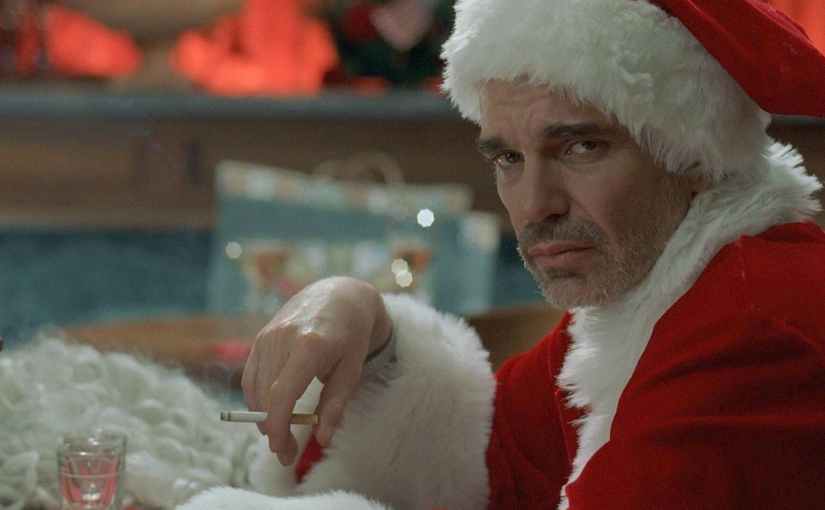
The film opens with our “hero”, Willie T. Soke (Billy Bob Thornton) getting drunk and puking in an alley while dressed as Santa Claus.  This is the high point of the movie in terms of his character.  It’s all downhill from here.  Almost.  Sort of.  Anyway, we learn that he is involved in a somewhat-feasible scam with Marcus, a felonious dwarf (Tony Cox), and his rather materialistic wife, Lois (Lauren Tom, aka “Julie” from Friends…I was today years old when I learned that, thanks to Penni).  After Soke does the Santa thing, muttering profanities under his breath the whole time, Marcus stays behind after hours, deactivates the store’s security system, and lets Soke in the back so he can crack the store’s safe.  Meanwhile, Marcus steals whatever is on the list his wife gives him.  (I liked that little touch; he’s not a random thief, he’s a very SPECIFIC thief.)

One day, a literally snot-nosed kid (Brett Kelly) perches on Santa/Soke’s knee and solemnly tells him, “You’re not Santa”…then peppers him with questions about the reindeer, Mrs. Santa, the elves, ad infinitum, while Willie does his best to keep up through his alcoholic haze.  To say this is the start of a beautiful relationship is straining the definition of “beautiful” and “relationship”, but there is a point to all of it.  Trust me.

There’s more, much more, that’s been crammed into this barely ninety-minute-long movie.  The bartender (Lauren Graham) whose non-traditional sexual kink makes Willie implausibly irresistible.  The department store detective (Bernie Mac) who senses Willie and Marcus are trouble but has plans of his own.  The store manager (John Ritter) who claims he’s no prude but who can barely pronounce the words he heard coming from the dressing-room stall in the plus-size section where Willie was…well, modesty forbids.  Not to mention the Kid’s grandmother with the apparent obsession with making sandwiches.  And the profanity.  The virtually non-stop stream of profanity pouring from Willie’s mouth.  In a comic strip, his dialogue would be almost entirely composed of symbols and punctuation marks.

The executives at the now-defunct Dimension Films must have had cojones of solid rock to give this movie the green light.  Who is this movie for?  I’ve seen so-called “polarizing” movies before, but this achieves some kind of high bar.  Some of the lines must be heard to be believed.  Bernie Mac and Tony Cox have an exchange late in the film that belongs in some kind of cuss-word Hall of Fame.  I can imagine Kevin Smith watching that scene and nodding his head in a kind of salute.

As I’ve said many times before, I have always had a hard time watching movies or TV shows with loathsome characters as the leads, no matter how funny they are.  I have never been able to stomach Seinfeld for this reason, but I do acknowledge the ingenuity of the show’s writing and the comic skills of the actors.  I just find it a shame it’s all been attached to characters whom I would cross the street to avoid.  But here is Bad Santa, with a lead character who is not only alcoholic, but who is also suicidal, who haunts mall arcades to hit on teenage girls (“She said she was eighteen”, he says at one point), has no compunction about swearing around children, and beats the crap out of some local bullies who are picking on his new friend…then has the chutzpah to look at the beating as a turning point in his life.  “You need many, many, many f***in’ years of therapy”, Marcus tells him.

And yet I don’t just like this movie, I LOVE this movie, because it makes me laugh.  I’ve been sitting here trying to self-analyze my affection (if that’s the right word) for this film, but I am failing.  I can only report that it has some of the raunchiest dialogue I’ve ever heard, that it is definitely NOT appropriate for kids, that it is certainly NOT one of Penni’s favorite movies (kudos to her for making it all the way through), and that hand-carved wooden pickles stained with blood are not the best Christmas presents ever.

And I laugh like a loon whenever I watch it.  Sue me.