THE SHADE

By Marc S. Sanders

A ghost story works best when a mystery can be upheld.  Something so shocking or fascinating must draw you in and stay with you so that you want to look around every nook and cranny you see on screen and uncover clues that will eventually give you solid answers to the questions you have.  Writer/director Tyler Chipman, partnered on a script with David Purdy, to deliver The Shade.  His prowess with a camera had me darting my eyes from one corner of the screen to the next.

Newcomer Chris Galust portrays Ryan, a pot smoking student, who looks after his younger brother James (Sam Duncan) while his mother Renee (Laura Benanti) works the late shifts at the hospital.  When he is not delivering pizzas or working on his talents for tattoo artistry, Ryan is attending sessions with a mental health counselor (Michael Boatman) to discuss his attacks of anxiety.  Except that is an understatement.  Ryan awakens from night terrors where he encounters a ghoulish woman in skeletal white skin.  Charlotte Stickles portrays this phantom, known as The Harpy, and she puts on a terrifying performance to complement her grotesque makeup design.

These haunting episodes seem to amplify once Ryan’s disturbed brother Jason (Dylan McTee) returns home from school.  Jason is usually stand offish.  He’s disrupting the house in the middle of the night with loud death metal music blaring from his room.  He looks exhausted with a pale complexion and droopy eyes, and the two older brothers seem to get into bouts with one another very easily.

Chipman and Purdy plant a lot of intriguing seeds for a good campfire thriller.  I was curious through the whole course of the film.  The cast is especially top notch with an engaging performance from Chris Galust.  It’s easy to buy into all of his fear and panic. 

Tyler Chipman is also a promising filmmaker.  He’s got magnificent shots that made me blink twice because I am not a jump scare kind of guy.  So, when Ryan opens a medicine cabinet or the creaking door of Jason’s bedroom, for example, and there’s a change in angle, I got nervous for what would appear on the other side.  Camera shots loom on a darkened closet where something appears to be crawling inside of it.  All of this is very effective work in shot, editing and performance combined. 

The prologue to the film is positively eye catching.  Tyler Chipman depicts a late-night ride out to a cemetery and the whole sequence is cut beautifully, with a nervous, young boy staying back by the headlights of the truck, to the inebriated father who slovenly walks towards a tombstone and draws a gun from his pocket to a flame that goes out of control, and then on to the figures cloaked in black who emerge from the darkened woods.  The film had my attention from the start.

Yet, despite a solid cast, I wish the script for The Shade was stronger.  There’s too much written for the Ryan character from his job at the pizza place, to working on his tattoo art, and then providing scenes with friends at a campfire and sharing time with a girlfriend.  All the side characters in these various locations, do not serve much purpose.  Most of these people are unnecessary, including Ryan’s girlfriend Alex (Mariel Morino), who is never put in danger and never lends to the mystery at hand.  Morino is doing the job that the script demands of her but her character does not hold enough weight to belong in the final cut of the film.  Simply being a worrier for Ryan is not enough.

As well, Michael Boatman’s character works more like a collector of information than someone who can lend some clues or new intel to the mystery of The Shade.  During one of a handful of scenes with Boatman, Galust’s character only seems to relay an experience that the audience has already seen.  Once Ryan finishes his description, the moment ends and nothing new is established.  This is just repetitive.

Benanti’s character could have served more purpose, as the mother to these characters.  Not enough exposition is provided for the ghostly encounters that Ryan experiences, and I was hoping Benanti’s character would offer some Act 3 surprising insight and development. Renee always looked like she had a twist in the story to share.

Tyler Chipman needs to continue on with his filmmaking career.  He knows how to handle a camera that will lead to impactful edits with effective imagery, and he cast his film very, very well.  Yet, the writing of the script is too crowded with unnecessary characters that serve no purpose and weigh down the storyline.  Instead of arguing over who should be buttering a pizza crust or having a drawn-out drunken fight during a campfire outing, more attention could have been put towards the set up provided in the first few scenes of The Shade

As I understand through IMDb, Chipman first made this tale into a film short.  I’d be up for seeing a director’s cut of The Shade now that it is a full movie.  I want to learn more about The Harpy and her direct connection to Ryan and his family.  I imagine mom and Jason have more to share.  I simply wish they offered more of their knowledge in the finished product.

NO HARD FEELINGS

By Marc S. Sanders

Jennifer Lawrence goes the route of Farrelly Brothers comedy with No Hard Feelings.  She’s a thirty something gal named Maddie Barker who gets by sleeping around with the men of Montauk, New York while being an Uber driver and a bartender on the side.  It’s easy enough to do because her mother left her with a completely paid for house.  What she didn’t account for was taxes, and now that her car has been towed away (and shortly after totaled – just watch) and the past due bills start arriving, she’s got to find some means to uphold her Uber career so she doesn’t lose her house.  Problem is the best Uber drivers drive cars.

A seasonal annoyance of Montauk occurs when the ultra-wealthy WASPS come to reside in their summer homes.  A lot of these folks are helicopter parents for their spoiled kids who have futures awaiting them at Ivy League universities.  One such couple is portrayed by Laura Benanti and an especially flaky Matthew Broderick.  (Yes!  Ferris Bueller!)  Maddie answers the ad to literally get their dweeby son primed and ready for Princeton college life by sleeping with him and breaking him out of his shell of just video games and volunteer work at the homeless pet shelter.  In return, they will transfer the title over to a run-down Buick sedan that Maddie can own outright and catch up on her bills.  If life were only this easy.

The kid is Percy Becker played by newcomer Andrew Barth Feldman.  He’s quite good in this role and I imagine when he started on the first few days of filming he felt as awkward as he appears next to the confidence and experience emulating from Oscar winning Jennifer Lawrence.  You could never imagine pairing these two up in a film.  I mean, like they wouldn’t even work as a brother and sister.  Still, the comedic premise is so absurd like a Farrelly Brothers movie, that you just have to go with what this picture offers. Thankfully, the situations are hysterical.

It’s not easy for Maddie to break Percy of his introverted personality.  Poor kid doesn’t know how to drink or how to dress at an island bar.  He has no friends. He definitely doesn’t know how to talk to girls and even a naked Maddie accompanying him on an empty beach in the middle of the night for skinny dipping has disastrous results. 

Like a lot of romantic comedies, Maddie believes she just has to quickly lay this kid, collect the prize car and no feelings of love or like will ever get in the way.  Not so fast.  Soon, we get to see the attributes Percy possesses, and he’s hard to get off Maddie’s mind.  I read that Feldman played the title character in Dear Evan Hanson on a stage tour for a year. I can completely envision that after witnessing Percy perform a sultry rendition of Hall & Oates “Maneater” on the piano.  Close ups go over to Lawrence watching from across the room and I don’t believe she was acting.  This kid is a talented performer.  Suddenly, Lawrence and Feldman are great scene partners doing some very fine work together.

I hope to see Andrew Barth Feldman in more films.  He can do both drama, and of course comedy.  Moreover, Jennifer Lawrence has officially widened her range.  Her resume is certainly eclectic and this film only enhances her record.

The premise of No Hard Feelings is near impossible to swallow.  Fortunately, the gags that follow and especially the chemistry between the two leads allow for a sweet story with broad, raunchy,  slapstick R-rated material.  Many of the more successful comedic films followed this formula like Coming To America and There’s Something About MaryNo Hard Feelings has just enough substance to be grouped within that fraternity. 

WISH

By Marc S. Sanders

Disney’s Wish seems to stand out from many other films within the studio’s vault because the lack of filmmaking confidence appears so obvious.  What does it tell you when a newly original story is continuously guided by winks and nods from past successes?  We see this thing can’t stand on its own two feet.  So, let’s dress a character up like Peter Pan and literally name a random deer Bambi.

A sorcerer trained in the arts of magic oversees his newfound Mediterranean island kingdom known as Rosas.  He is King Magnifico (Chris Pine) and he has attracted people from all over the world to reside under his rule on the condition that he collects their wishes to be held by him in glittering, floating blue bubbles.  The people of Rosas lose all memory of their respective wishes and now live month to month with anticipation that Magnifico will award them the wishes he holds as a kind of equity or collateral.   

Asha (Ariana DeBose) is a seventeen-year-old who is eager to finally witness her grandfather Sabino’s (Victor Garber) wish come true as his 100th birthday finally approaches.  She also aspires to meet the great sorcerer and hopefully become his apprentice.  As soon as she meets the King though, Asha realizes Magnifico is a greedy, selfish individual who thrives off the admiration of the people of Rosas while savoring the wealth of everyone’s longings.  In other words, Magnifico is a cult leader.

Chris Pine does good voice work here.  He’s gleeful and manipulative and uncaring and evil all at the same time.  Disney’s colorful animation lends to his vocal performance of course with Maleficent inspired glows of green spells which the character conducts.  Yet, my adult mindset could not get past the fact that I’m looking at an animated inspiration of David Miscavage, long time head of the Church Of Scientology.  Magnifico’s wife Amaya (Angelique Cabral) is the quietly naïve representation of David’s wife, Shelly (who has not been accounted for in years).  The poor people of Rosas are the brainwashed disciples believing in this false prophet.  I guess it’s not a terrible concept to apply to a fantasy, but once I see the allegorical connection, Wish makes me feel uneasy.  My fault I guess for watching too many HBO documentaries and listening to former Scientologist Leah Remini too much.

Asha is the hero of this story who makes a wish upon a star.  Actually, a literal character named Star enters the picture.  Star squeaks like a precious darling, ready to be your children’s next plush toy acquisition.  He shoots sparkling trails of gold out of his pointed appendages.  With Star’s help, Asha will reach the standard showdown with the villain by the film’s end and the awakening of the people below.  It’s all trite material that’s been done before.

Wish relies on the vast history of fantastical stories, believing you can fly and be heroic or simply a sidekick tagging along with the protagonist.  Asha has seven friends.  One is referred to as grumpy.  Huh!  How do you like that? Must it be so apparent so often though?  Thanks to Star, forest animals talk and one even makes an inside gag to Zootopia.  You’re practically asked “Get it?  See what I did there?” Magnifico bears a striking resemblance to Jafar and even resides in a similar castle to the Aladdin villain with stone spiral staircases to explore.

The colors and animation are just as engaging as nearly any other Disney film.  A few songs work, but there’s nothing on the level on what was accomplished during the days of Rice and Menken, or even more updated fare like Frozen.  I can’t recall the title of a single number from Wish.  Magnifico sings.  Asha sings multiple times.  The two duet together and it’s not terrible. Ariana DeBose could sing the phone book and I’ll feel swooned.  The supporting people of Rosa sing in choral support as well.

Still, what tainted my experience was turning a very real epidemic of cultish culture into a fantasy catered for all ages to enjoy.  The wishes the people offer up are the endless “donations” that a cult mentality always requests.  While I appreciate being accepted into a fraternity of Disney loving storytelling, I did not need to be banged over the head with so much saluting either.  The end credits contain one classic Disney character after another appearing next to the ongoing scroll.  Hi Dumbo.  Hi Genie.  Hi Peter.  Hi Belle. 

Disney always reminds us to believe our wishes will come true and yet with Wish the studio chose to go with what is blatantly familiar.  It’s time for some fresh ideas again that especially do not source themselves from the reality of harmful sects spreading false doctrines. 

NOTE: I still have a fresh idea from a very popular legendary story that Disney, nor Universal or Warner Bros has yet to touch.  Maybe it’s time I get it down on paper.  Hmm.

TUESDAY (2023)

by Miguel E. Rodriguez

DIRECTOR: Daina Oniunas-Pusic
CAST: Julia Louis-Drefyus, Lola Petticrew, Arinzé Kene (voice)
MY RATING: 10/10
ROTTEN TOMATOMETER: 82% Fresh

PLOT: A mother and her teenage daughter must confront Death when it arrives in the form of an astonishing talking bird.


Movies about death are a dime a dozen.  Movies about “Death” with a capital D, as a character, are a bit rarer, and for a movie to make its mark in this subgenre, the personification of Death incarnate must be something interesting or unusual.  Terry Gilliam’s The Adventures of Baron Munchausen portrayed Death in the expected way, a skeletal figure cloaked in black and carrying a scythe, but it could also disguise itself.  Meet Joe Black dressed Death in a tux and gave it Brad Pitt’s face and body – perhaps unlikely, but good for ticket sales.  And in the most famous movie version of Death, it was a pale man in black who played chess with Max von Sydow in Ingmar Bergman’s uber-classic, The Seventh Seal.

But no movie that I’ve ever seen has ever approached the character of Death itself the way Tuesday does.  In this film, Death is a bird.  A parrot with dirty gray feathers.  A parrot that can change size at will, sometimes as tall as a house, sometimes as tiny as a toad (or smaller), and sometimes just parrot-sized.  And, as we eventually discover, it can talk and mimic voices.

Tuesday looks and feels like an early Spike Jonze film, back in the days of Being John Malkovich and Adaptation.  It is filled with imagination and unexpected plot turns and laden with meaning, but it never feels pretentious or preachy.  It tells a familiar story – we must make peace with Death one way or the other – but the uniqueness of Death’s form and what happens after it reveals itself had me riveted for the entire running time of the film.

In this film, Tuesday is a 15-year-old girl (Lola Petticrew) who is dying of an unspecified disease that has relegated her to home-hospice care with an attentive, if slightly impersonal, nurse (Leah Harvey) and her mother, Zora (Julia Louis-Dreyfus, giving the performance of her career).  Zora has not seemed to get past the first stage of grief, denial.  She literally sneaks past Tuesday’s room so she can leave the house just as the nurse arrives, without having to speak to her.  Instead of going to work, Zora spends her day going to pawn shops and coffee shops and sleeping on park benches.

On one such day, Tuesday looks up and sees…this parrot.  The overall vibe of this parrot is hard to describe.  It looks beat up, it’s dingy, it’s blind in one eye, but there is a sense of menace to it.  Tuesday immediately intuits what the parrot is and why it’s there.  As it approaches her to perform its duty, Tuesday stops it by telling a joke.  (It’s the one about the cop who stops a guy who has twelve penguins in his car.)  The parrot takes it in and…laughs.  I’ve never been in the same room with a laughing psychotic, but I would imagine it would sound pretty much the same as when Death laughs.

And then the parrot opens its mouth and talks to Tuesday.  They have a conversation.  And suddenly Death seems to suffer some kind of panic attack, as the voices of all the creatures on Earth whose time has come assault Death’s ears.  Tuesday instinctively coaches it through a breathing exercise.  The voices go away.  She recommends a bath.  They bond.  She pages through a history book and gets Death’s commentary on dead historical figures.  Stalin: “An absolute prick!”  Jesus: “Oh, He LOVED irony.”  It mimics Jesus’ voice.  Whatever you think Jesus’ voice really sounded like, I promise you will be surprised.

Also, don’t get the idea that this is an all-out comedy because of the above dialogue.  Keep in mind that this is Death we’re talking about.  Death’s voice, when it speaks, is low, gravelly and menacing, even when it’s cracking jokes.  At one point, Tuesday plays an old song on her computer, and Death, being eternal, is familiar with it.  It even sings along and dances.  At least, as far as any parrot CAN dance.  Yet even in this moment of levity, there is still that sense of menace in the offing because of that brilliantly chosen voice, provided by an actor named Arinzé Kene, who is unknown to me, but if I ever see that he recorded an audiobook, I’m buying it.

This whole time, I’m watching the movie thinking to myself, WHERE is this GOING.  I was fascinated by this exceedingly odd couple.  The direction by first-timer Daina Oniunas-Pusic is just as assured and risky as anything by Spike Jonze or Sofia Coppola.  I was worried that it was going to veer off into a weird tangent where Death falls in love with Tuesday, but nothing like that happens.  Death knows its function, and so does Tuesday, so the problem now is how to deal with Tuesday’s mother, who is clearly not prepared to deal with Tuesday’s death, imminent or otherwise.

…and from here on out, I am going to give no more story specifics.  To say that I went into this movie cold is an understatement.  Trust me, the colder you are, the better it will be.  The ultimate message of the film, as I said, is not that far removed from any number of other films.  I would even compare it to the first Inside Out from Pixar, which demonstrated that sadness is an ultimately necessary part of becoming who we are.  Tuesday also uses a CG character (in the real world) to remind us that the only way to make peace with who we are is to make peace with where we’ll all be in 100 years.  The final words of the film are a call to action to everyone watching.

[Ed. Note: Tuesday is one of those so-called rarities, a completely original studio film, released in movie theaters before heading to a streamer, that’s not a sequel or insanely high-budget.  It’s intelligent, compelling, and non-stop surprising.  And it had absolutely zero publicity, at least in my area.  I saw no trailers, no posters, no internet hype.  According to boxofficemojo.com, it has grossed a little over $320,000 since its domestic release on June 7th.  Not exactly setting attendance records.  If you’re interested in seeing it in theaters, I’d say your window is extremely limited at this point.]

RUSTIN

By Marc S. Sanders

I’ve heard of Martin Luther King Jr.  I’ve heard of Rosa Parks.  I’ve heard of Malcom X.  I’ve heard of Medgar Evars. 

I had never heard of Bayard Rustin. 

I guess there’s just a lot of history left out of the books.

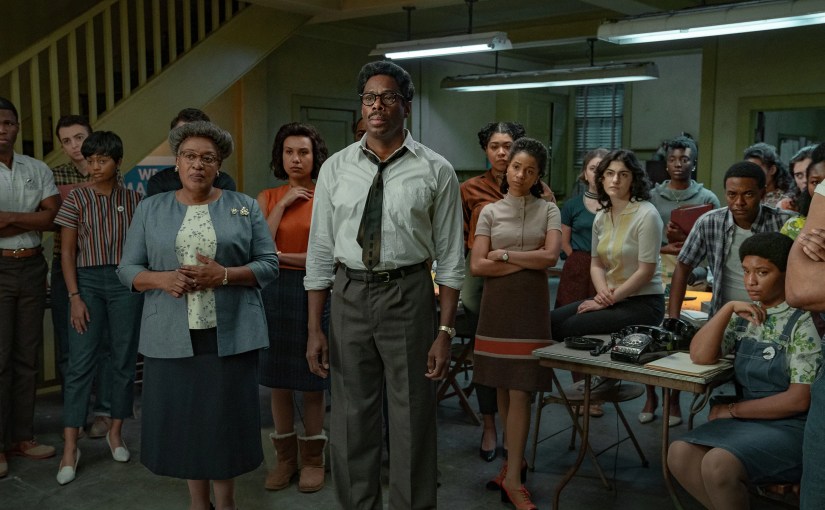
Rustin tells the story of Bayard Rustin (2023 Oscar nominee Colman Domingo) who was treated as an outcast by his friend Dr. King and the NAACP when he attempted to think of the grand possibilities of organizing the largest civil march ever to happen.  The secretly homosexual civil rights organizer eventually did see his vision come to light, however, but he had to get started with very little support or resources.  Director George C Wolfe with screenwriters Dustin Lance Black and Julian Breece use this film to depict how it all came together.

When I saw George C Wolfe’s Ma Rainey’s Black Bottom (with Oscar nominee Chadwick Boseman) my take was that it worked like a stage play on a unit set.  The sensational cast of Rustin perform in the same way, catering to what would be a live audience.  However, the unit set has been expanded to a headquarters office on the second floor, as well as Rustin’s bedroom, and the steps of the Lincoln Memorial and the National Mall in Washington D.C.  While the CGI background of the nation’s capital do not appear seamless against the cast, it is fortunate that very little of it upstages the performances from Domingo, Chris Rock, Glynn Turman, CCH Pounder, and especially Aml Ameen as Martin Luther King Jr.

Colman Domingo portrays this individual with unwavering confidence in his character.  Rustin insists on a non-violent two-day march, despite the local authorities who only grant him one day and limited resources.  One problem is that there are not enough hotels that will accommodate black guests.  Segregation might have ended in 1954, but in 1963, you would believe otherwise.  While debating with the police captain in front of Lincoln Memorial, Rustin is accused of raising his voice and yet he reminds the captain that he’s never changed the volume of his tone.  Rustin vows that this march will exceed 100,000 people from all different states.  He’s also adamant about the police authorities not carrying their service weapons to steer clear of any reason to incite violence. 

A bigger problem is bubbling within his own community of civil rights leaders.  He’s no longer associated with the NAACP which has Roy Wilkins (Chris Rock) leading the charge. Still, he needs their support. Because he does not have the respect, charm and arguably the good looks of Dr. King, Bayard’s passion falls on deaf ears and a lack of motivation from these powerful men of influence.  A large challenge comes from the arrogant Representative Adam Clayton Powell (Jeffrey Wright) who will proudly sit at the other side of the table with his long cigarette, pressed suit and pencil thin salt and pepper mustache.  With a gruff tone in Wright’s voice, this is a marvelous antagonist.

Over the radio airwaves, Senator Strom Thurmond, who was still in office at close to age 100, all the way through 2003, is building a campaign against Bayard Rustin.  Rustin has a past of suspected ties to the Communist Party, and it will also not bode well if his closeted homosexuality is revealed.  On top of that, Mr. Rustin lives with personal problems and imperfections just like anyone else.  He is trying to balance a relationship with Tom (Gus Halper) a young, white gay man and strong supporter of the cause, but Bayard is also involved with a married, closeted man as well.  None of these issues can be afforded to weigh down what Mr. Rustin and his team of youthful, optimistic volunteers are striving for.

Wolfe’s film is less than two hours, though I wish it could have been longer.  It is very engaging and certainly not difficult to follow, especially when text appears on screen to tell us who everyone is from the start.  The movie efficiently incorporates all of these dimensions into isolated episodes for Baynard Rustin to confront.  Primarily, it reflects the debates he has with the civil rights leaders and the naysayers.  There are wonderful moments shared between Colman Domingo and Aml Ameen.  Domingo also has great scenes with Gus Halper who plays Tom as someone uncompromised in the mission even if his lover is unfaithful.  Domingo is the more compelling scene partner with Chris Rock, though, who I have never considered a strong actor. A good effort is made here, but Rock is not altogether convincing as an NAACP leader. 

What I wish for, however, is some more reenacted footage of the actual historic event that famously included Martin Luther King’s “I Have A Dream” speech.  There’s a slight tease of that speech but King was so appealing in that moment that it could never be recreated so well.  It was already perfect.  What I wanted to see was some other happenings going on during this event.  We see buses arrive, chairs getting set up, people gathering, mostly black, but other races as well. What other speeches occurred on that day?  What else was said? 

I recall an episode of The Cosby Show where Theo and Cockroach had to write a school paper about the event and their parents and grandparents talked about how they drove down from New York to D.C. in buses and how hot it was that day. They described people who wore pins that said “Kiss Me I’m Black,” “Kiss Me I’m Jewish,” “Kiss Me I’m Irish,” and so on.  It might have been said to lean into Cosby’s brand of humor, but I also believe it was true.  That episode seemed much more descriptive in about ten minutes of sitcom dialogue than the film Rustin depicted. 

How was the audience on the National Mall responding?  Were people fanning themselves from the heat?  What were they saying to one another?  What songs were they singing?  Wolfe’s film only gives a tiny glimpse of this groundbreaking moment in time when 250,000 people assembled. The picture just doesn’t appear entirely painted.  Perhaps budgetary reasons were the cause of that.

Rustin is a good film and does a fine job of depicting this unsung man’s achievements despite the challenges he always faced with a smile.  Domingo is great at donning the grin with missing teeth and clumsy black framed glasses, and a loose tie with a wrinkled shirt.  He is positively absorbed in this period of time.  Still, it would have been welcome to see more of his end results. 

The picture concludes on a terrific beat before the inevitable footnote text arrives with most film biographies.  I have just observed a man who will not shut up and never tire from pursuing his seemingly impossible dream.  Baynard Rustin was likely considered a pest who would not let up.  Yet, the script closes on the fact that in spite of all I have witnessed, Bayard Rustin was likely the humblest of all of these civil rights servants.

Go learn more about our Civil Rights history and allow yourself to see one of the best performances of the 2023. 

NYAD

By Marc S. Sanders

When some people go through a midlife crisis, they might buy themselves a car, get a new job or opt to not get out of bed for several days.  When Diana Nyad goes through a midlife crisis in her early sixties, she motivates herself to swim 103 miles from Cuba to Florida.  She came up short at age 28, but over thirty years later no one is going to convince her she shouldn’t try again.

Annette Bening portrays the real-life swimmer whose determination will bear the brunt of self-torture to complete arguably the maritime equivalent of climbing Everest.  Jodie Foster is Diana’s best friend and coach, Bonnie Stoll.  As acting partners and the characters they play, the leading ladies make a good pair.  

My first compliment has to go to the makeup department led by Ana María Andrickson.  The actresses received Oscar nominations, but the work done on Bening to play Nyad is astoundingly convincing. Diana makes several attempts to try to complete this challenge that’s never been accomplished before.  With each try, the dried-up complexion, blistering sunburns, chapped lips and bloodied cracks that prominently show on her body are truly painful and awfully uncomfortable to gaze upon.  At times, I was not as focused on the dialogue shared between Foster and Bening as I was on Andrickson’s masterful work.  The makeup alone tells an impactful story. A clear oversight by the Academy.

Annette Bening is particularly good in her role.  At times she’s a terrible annoyance and unlikable.  Yet, a sixty something year old woman who wants to defy all logic and the literal forces of nature will have to be a certain brand of jerk to move forward with her goals. This also comes with the natural degeneration of a body of freckled dry skin, loss of muscle mass and arthritic bones. Bening is far removed from the glamorous roles of an impressively long career past (Bugsy, American Beauty) to get to a persistent, unwavering zenith that the real Diana Nyad had to emote.

Jodie Foster is fine as Nyad’s best friend and former lover now coach.  I’m not sure all the award nominated praise she’s received for this part is merited, but she’s worthy of falling in line with other celebratory coaching mentors like Mickey from the Rocky films and Mr. Miyagi from The Karate Kid.  The film focuses so much on Diana Nyad though that there’s not much depth to Foster’s role.  She does the job, but it did not feel like it demanded much.  Frankly, Viola Davis in Air and Maura Tierny in The Iron Claw left me with more of an impression in an astounding year of great films and performances from 2023.

The unsung cast member who’s getting next to no press recognition is Rhys Ifans as John Bartlett, an oceanographer recruited by Nyad and Stoll to gauge immediate weather patterns and what the currents of the Atlantic are expected to do during the swimmer’s trek.  Ifans is a fantastic supporting character actor who is tasked with finding that suitable small window of time for Diana to start her journey. Within the context of the script, he offers the suspense needed for this sports film.  Can Diana Nyad hold up against the very real and insurmountable warnings that John describes?

Swimming is quite boring to watch.  However, this venture has cause for concerns.  Brutal storms, stinging jellyfish with undetectable approaches, and sharks.  Salt water, weakness and fatigue, the chops of the tide and mental hallucinations are also bears of contention.  A charter boat with Bonnie and John on board with a watchful, supportive crew sail alongside the swimmer, but they can only do so much if she intends to achieve her seemingly impossible goal unassisted.

Elizabeth Chai Vasarhelyi and Jimmy Chin are the directing team for Nyad with a script written by Julia Cox based on Diana Nyad’s novel account.  Most of the film is patterned like many other sports films focusing on an underdog.  I knew nothing about this person or her accomplishments.  Frankly, what I’ve learned is unbelievably impressive beyond what this picture focuses on.  Naturally, you’ll get an idea of how the story is going to conclude.

To enhance the ho hum activity of the swimming scenes, the filmmakers incorporate some of Nyad’s dreamlike delusions to get inside her head.  Falling rainbow stars onto the ocean surface as well as a yellow brick road leading to the Taj Mahal look as fantastical as they should, even if they drift into sidebar distractions.  I appreciated the handful of scenes where Rhys Ifans lays out the desperate concern shared with Jodie Foster about a lack of progress where Diana is wasting strokes against a current as well as his fear of oncoming sharks.  He builds suspense to keep the film focused. It’s pretty cool by the way how the crew responds to the shark issue.  

In addition, as good as Bening and Foster are with enormous careers of outstanding roles, much of their shared dialogue often comes off a little too hokey.  Granted, it’s a standard sports film and it’s more impressive that it’s all true, but Nyad sometimes plays off like a cheesy TV movie lacking that cinematic edge I was looking for.

An unclear element offers glimpses of Diana’s past as a beginner child swimmer who suffered personal trauma. It’s clear what happened to her, but these quick flashbacks are also mixed in with an unclear picture of her parental lineage and other ingredients.  I still don’t know why there were snippets of Diana playing Parcheesi.  Nor do I know who she was playing with to uphold its significance in the final edit of the movie.

Nyad is a biography worth seeing. The endurance the central character sustains to achieve the impossible is tremendously inspiring.  The thought that was running through my mind over the course of the film is that this woman wants to dominate over a powerful Mother Nature.  By the end, you see real life clips of Diana Nyad insisting to audiences that no matter who you are or what age you’re at in life, nothing can defeat what you want to overcome.  As well, whatever you succeed at likely deserves enormous credit for the support team that accompanied you.  Often, I’m a naysayer of Diana’s mantra because I think I’ve chalked up at least five times more failures than successes in my life.  Still, here is the person who eventually proved me wrong.  I should also note that I learn from my failures and remain hopeful that it will lead to success.

I often tell myself never to argue with a woman. Well, at least now I know never to argue with Diana Nyad.  

THE ZONE OF INTEREST

By Marc S. Sanders

Rudolph Höss, and his wife Hedwig, have five children and they seem to live in peace and serenity within a beautiful home that contains plenty of bedroom space, sunlight, a vegetable garden, a pool to splash in and a babbling brook to fish and swim in.  You might say it is The Zone Of Interest that keeps their life so fulfilling.  Yet, beyond their pleasures is the Auschwitz concentration camp conveniently located next door for Rudolph to carry out his responsibilities as a Nazi Commandant. 

Jonathan Glazer writes and directs this quietly effective piece while breathlessly showing a flawed ignorance and apathy for the countless Jewish lives lost during the Holocaust.  The tactics Glazer uses in his film work on your senses first.  Following a long series of production company names that herald from America, England and Poland, the title of the movie appears in big white thin letters against a black screen.  Slowly over a long 3-4 minutes the letters fade as faint music and sound transition.  The music gets softer, as birds chirp and then there are faint gunshots in a distance.  A picture finally appears, and we see the Höss family basking under blue sky and sun while picking flowers alongside the brook.  It’s not even possible to identify the time or setting of this story yet.  Soon after, Rudolph (Christian Friedel) is stepping out of his home in his full-dress Nazi uniform on the morning of his birthday.  Hedwig (Sandra Hüller, Oscar nominated in Anatomy Of A Fall) and the children gift him a beautiful, freshly painted kayak.  Glazer then changes the position of his camera in the opposite direction and the towering wall of the concentration camp is just beyond the pretty stone walkway and front yard that leads out from the family cottage.  Black smoke billows from the smokestacks beyond the wall, and none of this is even remotely disturbing to the family. The pops of gunfire are heard beyond.

The Zone Of Interest does not focus on the suffering of the European Jews during the Holocaust. Jonathan Glazer’s script is wise enough to know his viewers are aware of what occurred even if the mass genocide seemed to have no imaginable end.  He never shows footage of activity inside the camp because this story is told through the eyes of a family who chose not to become aware or alarmed at that massive amount of death and torture that was happening.  The Holocaust was simply a way of life.

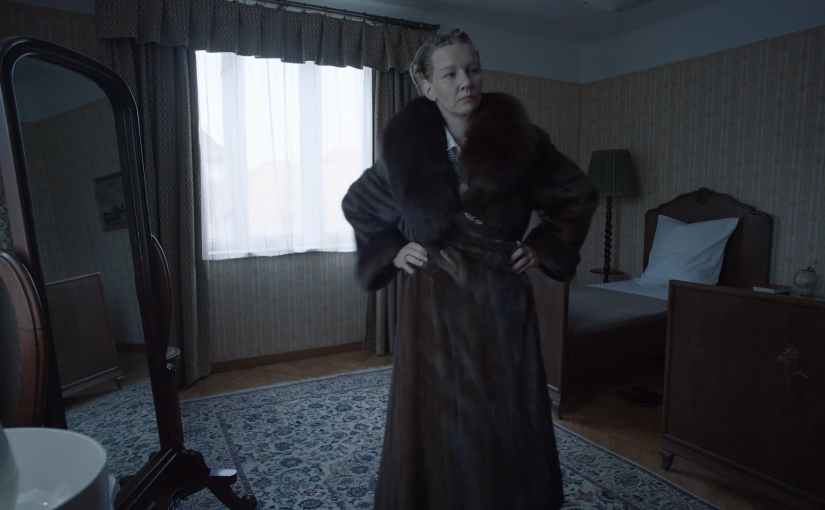
A sack is delivered to the Höss home which contains slips and nighties for Hedwig to rummage through for her use.  More interesting is a beautiful fur coat.  Hedwig tries it on for a personal fitting and looks upon herself in her bedroom mirror.  She finds a lipstick in the pocket.  Does she like the color?  She’ll have to see and draws it across her hand just like my wife and mother would do in a shopping mall.  All the while, the undisturbing (to Hedwig) next-door sounds continue on.

Miguel and I went to see this film together and had an extensive discussion afterwards.  To Miguel’s advantage, he had absolutely no idea what this film was about.  Didn’t know it was another Holocaust picture.  He didn’t know who directed it.  He didn’t know the cast.  I only knew that Jonathan Glazer wrote and directed, though I’m not as familiar with his work as Miguel is, and that it took place during the time of the Holocaust.  To observe my colleague’s surprise early on in the film gave me an interesting experience.  Miguel first witnessed the serenity and peace among the family, and then realized the sinister world that surrounds them and which they choose to be naïve towards.

The Höss family will have you believe they experience the same challenges that any ordinary family encounters.  Beyond what I have described, there are two other scenes that stay with me. 

Rudolph holds a meeting in his home. An architect/scientist is describing the effectiveness of a new model oven that will efficiently slaughter hundreds of Jews per day.  He provides well designed blueprints.  Rudolph asks for a closer estimation.  The architect says it is likely a thousand can be taken care of in one day.  Seems satisfactory.  Take a conversation like this out of the context of the picture and these men could just have easily been talking about an assembly line in a chocolate factory.

Another moment occurs between Rudolph and Hedwig.  The husband explains that because he’s been so good at his job, he’s been promoted to oversee the operations of all the concentration camps and therefore the family will have to relocate.  Hedwig is not happy about this as they have begun their new life here in their beautiful home (located next to Auschwitz).  The wife insists her husband speak to Hitler about this and request he reconsider.  Any of us would know it’s not that simple.  “Oh, excuse me Mr. Hitler…” Uh uh!  Would not work so easily. 

Jonathan Glazer demonstrates how simple dilemmas and pleasures that come with a happy home life can appear common.  Yet, in this case, should it? 

The Zone Of Interest may be a period piece.  Yet, what you witness when you watch this film is all too similar to what often occurs today.  The world has gotten smaller with information coming to us quickly by means of the internet that can update me on Middle Eastern wars or American immigration or the spread of white supremacy as quickly as developments take place.  However, I believe many still remain ignorant, often by choice, of what is presently happening.  Mass suffering and totalitarianism still runs easily and freely, but what remains important to us are the vast luxuries we treat ourselves to while hardly giving a care of what goes on outside our bedroom windows. Our toughest challenges are our inconveniences. 

I’m not chastising anyone, Reader.  We deserve our peace, our solitude, and our happiness.  The Höss family is something else altogether, though.  They live in prosperity right next to the worst way of living imaginable and the patriarch is primarily responsible for that experience.  Yet, as their comfort becomes so commonplace, the naivety only increases.  Their children grow only knowing that a train arrives on a frequent basis, with chimneys exhausting black smoke and there are distant pops on the other side of a brick wall.  It simply goes with splashing around in the garden pool or making mud pies on the edge of the brook.  The title of Glazer’s film serves the perspective of a family who are being raised not to know any better.

Miguel asked me where I would rank the picture.  At the time I gave it a middle grade.  It is a slow-moving piece.   It is not accompanied by a soundtrack of music to easily cue my emotions.  There are no big, momentous monologues.  I found the ending a little ambiguous but perhaps I was not concentrating enough, and Miguel had to explain something to me.  However, two days after watching the piece while also doing some background research on the film, it is worthy of a better grade than I originally gave it credit for while walking out of the theater.

Glazer will set up scenes where nothing happens for the longest time and then an eye opening and very uncommon discovery is made.  A particular moment happens while simply watching Rudolph waist deep in the river while fishing and wearing an SS t-shirt.  Again, out of context, this t-shirt could have been a Tampa Bay Buccaneers shirt.  There’s a disturbing comfort to moments like this before anything is revealed. 

The writer/director positions his camera like a documentarian.  There are no steady cams.  Often shots are from a far end of a hallway or outside a door frame simply to witness the commonplace activities of the family while the horrifying sounds of Auschwitz carry on in the near distance.  Miguel noticed a horizontal technique.  Glazer must have put his camera on a track to follow Hedwig as she walks off her property and marches parallel across the outside wall of the concentration camp.  She is undisturbed by anything happening on the other side of that brick structure laced with barbed wire at the top.

This is a disturbing piece that effectively shows a lack of care for suffering and horrific execution while a family attempts to live their best life and circumvent around common issues like job promotions or gardening or family time or valuing someone else’s belongings to accommodate them.  The Zone Of Interest is a haunting film and Jonathan Glazer has accomplished a tremendous feat, showing comfort just outside of a world of treachery and genocidal productivity.  This is a must watch film.

PS: My recommendation is to watch The Zone Of Interest without taking a break or taking a pause in the picture.  Watch it all the way through, unstopped.  I believe it is necessary to judge the film as a whole rather than in just parts.  As I reflect, it feels like one ongoing hour and forty minute scene.

THE HOLDOVERS

By Marc S. Sanders

Alexander Payne’s The Holdovers plays like a modern-day Christmas Carol.  Paul Giamatti is the Scrooge of the story set during mid-late December in 1970.  He’s an arrogant, unforgiving and unlikable teacher at Barton Academy, an all-boys Massachusetts boarding school.  Two other Scrooges round out the headlining cast.  Da’vine Joy Randolph is a cafeteria cook at the school.  Dominic Sessa is senior student – very bright, but also a troublemaker.  With uninvited circumstances facing the trio, they are the holdovers at the snow-covered school campus during the Christmas break, and they’ll have no choice but to get along or at least tolerate one another.

Alexander Payne often specializes in bringing attention to sad sack lonely souls like in Sideways, The Descendents, and About Schmidt.  His films begin with the characters seeming to accept their fates which lack a desire to smile and be cheerful.  Death or abandonment are common sources for their conditions.  Yet, with each of his wonderful films, it’s always fresh and new.  After an endless series of superheroes, I’m glad I get an occasional reminder of the humanity that can be found and treasured within entertaining films like The Holdovers.

Giamati is Paul Hunham.  Paul is disliked by everyone including his colleagues, the dean of the school (who was a former student of his), and especially the students.  Sessa is Angus who has a discipline problem but normally gets good grades. It’s most impressive that his B+ in Mr. Hunham’s class is leagues ahead of his classmates.  Randolph is Mary who recently lost her son, a recent graduate of Barton, after his entry in the Vietnam War.  These very different individuals have to share their lonesome disregard for one another.  Eventually though, their shields will whittle away and perhaps a couple of viewings of The Newlywed Game will open themselves up to each other.

I would be doing a great disservice to spoil the character backgrounds of these three who stem from different worlds and have nothing in common.  However, a theme found especially in Angus, and surprisingly in Paul, is a tactic of lying and exaggerating.  Within the context of the script written by David Hemingson, the untruths his characters tell work because it opens up further revelations that color in Paul, Angus and Mary’s current states.  The goal of The Holdovers is to scrape away the dirt on the surface in order to uncover the likable or sad nature hidden within. During a trip to Boston, Paul and Angus visit a museum and the irascible teacher finds an opportunity to remind his student that we do not study the past to only see what once was.  Paul tells Angus “…history is not simply the study of the past. It is an explanation of the present.” If The Holdovers were to have a mission statement, this is what the film stands upon.  Angus, Paul and Mary may all be a variation of a Scrooge, but this story explores what precisely added up to their respective states of misery.

The performances in The Holdovers are perfection.  Dominic Sessa offers one of the best film introductions in history.  This actor looks as if you have seen him before and it’s surprising that his only experience ahead of this picture were school plays, he’s done at his own Massachusetts prep school where he was discovered by the filmmakers who were scouting locations for this film.  He ranks up there with the debut performances of Whoopi Goldberg in The Color Purple and Lukas Haas in Witness.  Da’Vine Joy Randolph is heartbreaking, yet lovable as a grieving, chain smoking widow and mother.  Having also watched her bring out her acerbic funny side in Only Murders In The Building, she’s now one of my favorite eclectic character actors working today.  She is wonderful with either natural comedy and drama or just broad, satiric humor.  Arguably, Paul Giamatti occupies the best role ever written for him.  He finds the right beats during different plot points in the movie.  He’s positively unlikable but there’s an understanding to be found amidst the carnage of his past and present.  The sensitivity of Mr. Hunham eventually shines through, but Giamatti keeps it blended with the angry grouch he’s introduced as in the first few scenes of the film.  It’s a dynamic portrayal.

Alexander Payne reminds me once again that everyone we encounter in life is going through some form of turmoil and suffering.  Some of us can hide it well.  Others have given up concealing what’s not attractive or pleasing to our peers.  If we only take the time to look beyond what’s in front of us then maybe a person’s past will justify their present heartache, and we can either grieve, lend support or simply listen.  Payne will have you convinced to do anything except give up on a person.

As I write this last particular paragraph, I recall when Da’Vine Joy Randolph’s character prepares to attend a Christmas Eve party.  She lays out a nice dress.  She does her hair up attractively.  She puts on makeup.  She brings fresh baked brownies and gives them to the hostess with a welcome smile.  A few minutes later though, poor Mary is breaking down in the kitchen and Paul and Angus are seeing a colleague at her weakest when she was doing her best to uphold a semblance of strength.  Mary’s past defines her present to both Angus and Paul.

Alexander Payne is a genius storyteller of the human heart.  He’s already been quoted as saying The Holdovers is not a Christmas movie and he despises the reference.  Mr. Payne will simply have to forgive me though.  His Oscar nominated piece is a wonderful film to watch ritually during the year-end holidays.  Christmas and New Year’s may be a time to celebrate with our loved ones and the fact that we’ve lived through another year gone by.  However, it is also the loneliest for many of us who can no longer celebrate with a family or friends.  It’s important to acknowledge the pain that comes with living under that circumstance.  Fortunately, Payne, with David Hemingson’s screenplay, finds the humor needed for these souls to shed their agony and proudly reveal the faults they carry and the suffering they had no choice but to endure.

The Holdovers is funny, touching, insightful and it’ll leave you embracing a new collection of characters that will not soon be forgotten within the enormous lexicon of memorable movie roles.  

This film will likely win Oscars for screenplay, supporting actress and actor.  A shame that Dominic Sessa was not nominated as well.  There could never be too many accolades for this picture.  It’s marvelous.

The Holdovers is another wonderful film.  Another best of 2023.

ANATOMY OF A FALL

By Marc S. Sanders

Was Samuel Maleski pushed or did he commit suicide? It appears he fell from the balcony of the French chalet he shares with his wife Sandra Voyter (Sandra Hüller) and their blind son, Daniel (Milo Machado Graner).  That is the focus of Anatomy Of A Fall, one of the films to be recognized in several Oscar categories for 2023 including Best Picture, Best Director for Justine Triet, Screenplay, Editing and an acting nomination for Hüller.

Triet’s film kept my attention right from the start because this newsworthy story has all the elements many would look for in a Netflix documentary or a Dateline program.  New details are introduced in nearly every scene whether it stems from conversations that Sandra has with her attorney Vincent (Swann Arlaud) or as part of the witness interrogations during the thrilling trial scenes that take place a year after she has been indicted for causing her husband’s death.

Sandra is German.  Samuel (Samuel Theis) is French.  To stay on a common ground, they speak to one another in English.  We learn this as the film flashes back to conversations and arguments the pair have prior to the deadly scene that occurs soon after the film begins.  The inconsistency in how they communicate as a married couple will have one ponder how pertinent it is when Sandra is considered a prime suspect in her husband’s death.  Also, it’s curious that Samuel suddenly decided to record a number of their disputes.  More evidence is revealed as the story carries on.

On the surface, the story plays like a typical Law & Order episode.  However, there’s a fresh quality to this kind of supposed crime drama.  A large portion of Triet’s screenplay (co-written with Arthur Harari) takes place in a French courtroom and it’s interesting to see how the procedures of witness questioning varies from what American audiences are accustomed to.  For example, an expert on blood splatters gives testimony and conclusion. While he is still on the stand awaiting further questioning, the Procureur will divert questions directly at Sandra, the accused, for explanations. 

The material witness for both sides is Daniel. After returning from a nature walk with the dog, Snoop, he comes upon his deceased father lying in the snow with blood gushing from the side of his head.  The blind son is thoroughly questioned about if he could hear arguments coming from his parents while loud music was blasting from his father’s upper-level workspace.  He’s probed about his parent’s relationship and how he got along with his mother and his father respectively.  Daniel is also put to the test of reenactments on the day in question.  While he is outside with Snoop, could he hear the argument his parents were having over the loud volume of the music from 50 Cent playing.

A sort of competition between Sandra and Samuel is also noted, as she is a published author. He has been insecure of becoming a writer himself after giving up his job as a literature professor and moving the family into the mountains to restore this chalet as a personal project. 

The performances in Anatomy Of A Fall are outstanding, especially from its lead Sandra Hüller, whose role was specifically written with her in mind.  Of the many great dramatic moments, there’s a specific flashback scene introduced as evidentiary recording.  It is a telling argument between Sandra and Samuel in the kitchen.  Justine Triet directs this long scene as a common occurrence among most marriages but then it begins to elevate.  Just when you think the two spouses are winding down, the intensity cranks back up again only it goes from a lower pitch to a much more aggressive state very quickly.  Their quarrelling becomes erratic, and while we are watching the flashback, it cuts away the moment it gets physical. Triet wisely returns the film to the courtroom observing Sandra listening to her memory all over again while the packed audience focuses.  In particular is the boy Daniel who is learning more about what weighed on his father and mother both individually and as a married couple.  When the argument gets physical the viewer of the film is in the same position as everyone in the courtroom, or more specifically blind Daniel, left to only imagine who breaks what dish and who slaps who.

Vincent, Sandra’s attorney, reminds his client early on that there is the truth and then there is what a jury and a court of public opinion will believe.   Swann Arlaud is not an actor I’m familiar with.  (Actually, I’m not familiar with anyone involved in this film.)  Arlaud is a standout though.  I like how he listens and asks well timed questions of Sandra as she recounts what occurred the day of the incident; where Samuel was and what he was doing along with where she was, interviewing someone about one of her books, on the floor below.  Swann Arlaud has a dubious expression as he absorbs all the information.  Even he knows this could have gone several different ways.  Maybe Samuel did intentionally jump to kill himself.  Perhaps the aggravation that Sandra endured of her husband motivated her to push him over or to hit him bluntly on the head causing his fall over the balcony railing.  There’s evidence to suggest a number of different outcomes. 

Anatomy Of A Fall succeeds on the examination of a crime and how it is tried, particularly in a French court of law.  Fortunately, the script does not offer many definitive answers when it concludes.  There are hanging threads left to consider and wonder.  Yet, it goes in depth with analysis so that when the verdict arrives, I could accept either decision of guilt or innocent.  It’s unfair, but in a murder trial, especially if there’s a possibility that the accused is not guilty, then the victim is somewhat put on trial as well.  Anatomy Of A Fall lends a case for either party.  This film deserves its accolades for its fair and thought-provoking writing as well as the performances of the cast which include a main character that you might or might not find believable.

NIMONA (2023)

by Miguel E. Rodriguez

DIRECTORS: Nick Bruno, Troy Quane
CAST: Chloë Grace Moretz, Riz Ahmed, Eugene Lee Yang, Frances Conroy
MY RATING: 9/10
ROTTEN TOMATOMETER: 94% Certified Fresh

PLOT: Framed for a crime he didn’t commit, a knight in a futuristic world reluctantly accepts the help of a shapeshifting teenager to prove his innocence.


Just when I thought the Spider-Verse animated films held the current monopoly on creating cool futuristic worlds, along comes Nimona with its delirious fusion of medieval pageantry with flying cars, cellphones, and annoying TV jingles.  Put aside what some will no doubt call its “woke” agenda/storyline and just drink in the amazing visuals, as knights in shining armor wield swords as they ride hoverbikes into battle.  (There is the occasional horse, naturally…some traditions apparently die hard in this version of the future.)

The pre-requisite prologue explains how a brave warrior queen, Gloreth, defeated a vile monster a thousand years ago.  To maintain vigilance against any future attacks, Gloreth’s subjects erected a wall around their magnificent city and created the Institute, a sort of school-for-knights, to train their protectors from generation to generation.

One thousand years later, the city prepares to matriculate its current class of knights, including, for the first time in their history, a commoner, Ballister (Riz Ahmed), championed by the current Queen Valerin as a symbol of progress.  What matters a knight’s lineage if his heart is brave, and his spirit is bold?  This choice has not gone over well unanimously in the queendom, unfortunately, but she is confident in her choice.  However, in a twist of fate, Ballister’s sword malfunctions during the knighthood ceremony, resulting in the Queen’s death, and Ballister, minus an arm, finds himself a fugitive.

He has exactly two allies.  One is his romantic partner and fellow knight candidate, Ambrosius Goldenloin, a direct descendant of Gloreth herself, who spearheads the search for Ballister in an attempt to keep someone else from killing him outright.  The other is a flighty, impetuous teenager who tracks Ballister down the following night and offers her services as sidekick to what she thinks is the newest villain in town, Ballister the Queen Slayer.  This is Nimona (Chloë Grace Moretz), a shapeshifter who can assume any form she desires, although her favorites appear to be a pink rhinoceros and a giant pink whale.  She likes pink.  And punk, as it turns out.

I imagine one could be cynical and say that what follows story-wise is nothing new: our heroes overcome initial adversities and suspicions of each other, they track down clues, deal with one or two serious crises, and eventually expose the truth of what really happened the day the Queen was killed.  But that’s like saying The Stand is about a bunch of people who survive the end of the world and eventually defeat the bad guy.  Well, duhNimona doesn’t offer anything outrageously subversive in the story department.  What it offers is a fresh new imagination and perspective in how it tells this story, especially when it comes to the character of Nimona herself, the very definition of the rebel outsider who literally doesn’t fit in anywhere.

What makes great kids films work – what makes MOST films work – is how it invites the juvenile audience to identify with the main character.  In Pinocchio, what little kid doesn’t know what it’s like when a lie grows out of control?  In The Wizard of Oz, what little kid has never felt homesick?  In Harry Potter and the Sorcerer’s Stone, what kid has never dreamed that they were special, not really meant for everyday life?

In Nimona, what kid has never felt alienated at some point in their life because of something that makes them different?  They’re not as old as the grown-ups.  They’re not as young as little babies anymore.  They’re in an in-between world where they’re only as strong as the friends they make, if they’re lucky enough to make friends.  What if there is something inherently different about them?  Nimona has tried shapeshifting before, tried to explain her gift, but people immediately think of her as a monster instead of someone who’s gifted.  There are echoes of the X-Men films here, too, but those mutants were lucky enough to find a home at Xavier’s mansion.  Nimona is not so lucky.  So, she decides to embrace the monstrous role society thrusts upon her.  I imagine there are lots of people out there who feel the same to one degree or another.  I’m not a sociologist, but it seems logical.

The real villain of the story (I won’t reveal their identity) does everything in their power to manipulate the narrative in the eyes of the public.  At one point, their scheme is all but exposed, but they discover yet another way to maintain power: turn society on itself.  They reveal the existence of the shapeshifter, explaining to the city that the real monster could be sitting next to you, or playing with your child, or living in your house.  The sinister nature of this ploy made me genuinely angry, mostly because of how effective it is, both in the film and in real life.  When you’re too busy fighting each other, the true villains win.

Enough philosophy.  Nimona stands among the best animated films yet produced by Netflix (Klaus, Guillermo del Toro’s Pinocchio).  There is plenty of humor to go around to leaven the moments when the film goes deep into territories unexplored even in the best Pixar movies.  (Correct me if I’m wrong, but I can’t recall a Pixar film where a character contemplates suicide as an alternative to grief.)  The end credits inform me that Nimona is based on a graphic novel.  Guess what I’m looking for on Amazon in a few minutes.