NOMADLAND (2020)

by Miguel E. Rodriguez

Director: Chloé Zhao
Cast: Frances McDormand, David Strathairn, and a cast of non-professionals/actual “nomads”
My Rating: 8/10
Rotten Tomatometer: 93% Certified Fresh

PLOT: A woman in her sixties, after losing everything in the Great Recession, embarks on a journey through the American West, living as a van-dwelling modern-day nomad.


Nomadland is one of the most visually beautiful films I’ve seen recently.  It mostly reminded me of Brokeback Mountain (2005) with its sprawling vistas of distant mountains, lonely country roads against a looming sky, and desert badlands illuminated by that elusive light that appears only during the “magic hour” so coveted by cinematographers and photographers alike.  It’s beautiful and well-made.  As a message film that won the Academy Award for Best Picture of 2020…I mean…it’s good and admirable, but it didn’t quite get to me like it was clearly trying to.

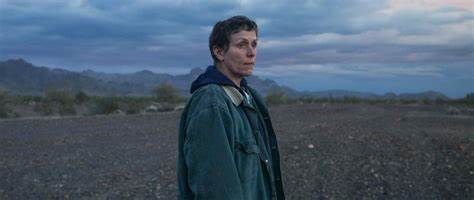
As a piece of propaganda (intentional or not), I can see Nomadland being effective for anyone who has been disillusioned of the American Dream by financial troubles.  Set in 2011, the film follows Fern (McDormand) as she hits the road in a van after the gypsum mining company her deceased husband worked for folded, displacing an entire town, Empire.  Even the town’s zip code was discontinued.  Fern literally lives out of her van, which doubles as living quarters, bedroom, dining room, and (revealed in a shot that I was stunned to learn was real) bathroom.  She works seasonal jobs throughout the American West at various parks, restaurants, and even an Amazon warehouse during the holidays.

On her travels, she encounters a large community of fellow nomads.  Periodically (I think annually), they gather at a location in the middle of the desert to trade goods, share stories and nomadic tips, and basically support each other for a week or a month or whatever…it’s not made clear exactly how long everyone stays before they go their separate ways once more.  On this occasion, she meets a fellow traveler named Dave (Strathairn) who trades her for a can opener.  Over the course of the film, Fern’s and Dave’s paths will intersect again and again.  I thought we were getting the kernel of a corny love story, but not quite.  The purpose of their relationship is pragmatic, not romantic.

Another traveler Fern meets is Swankie, a lively woman in her seventies who hangs a skull-and-crossbones flag from her van when she wants no visitors.  Honestly, it made me wish I had a similar flag to hang from my neck to communicate the same thing in public.  Anyway, Swankie reinforces Fern’s commitment to this way of living by describing trips to Alaska, a visit to a large community of swallows nesting on a cliff while on a canoe trip, and by revealing one of the real reasons Swankie has adopted this lifestyle in the first place.  All with no bills to pay, other than gas, food, and vehicular upkeep.

The movie follows Fern from one place to another over the course of a little over a year.  We see her working, driving, talking with people she meets, cooking on her tiny gas stove inside her van, dealing with the cold in the winter, reminiscing over old photos and slides.  There are two interesting side trips when she can’t avoid reaching out to…well, I guess “civilization” is the right word.  One occurs because her beloved van breaks down and she has to get to her sister’s to ask her for repair money.  Another occurs when she takes Dave up on an offer to…no, won’t spoil it.

At times, I found myself comparing Nomadland to Cast Away, Robert Zemeckis’ 2000 film where Chuck Noland (Tom Hanks) finds himself stranded on a desert island after a plane crash.  In both situations, the heroes find themselves isolated from civilization.  They must both learn to deal with an alternate way of life, and there is no alternative.  Adapt or die.  (When Swankie learns Fern doesn’t even know how to change a tire, she reprimands her.  “You can die out here.  You’re out in the wilderness, far away from anybody.  You can die out here.  Don’t you understand that?  You have to take it seriously.  You have to have a way to get help.  You have to be able to change your own tire!”  It’s a sobering reminder that, even though she has a cell phone (how she pays the bill is a mystery to me), Fern must be self-sufficient in order to survive.)

Furthering the similarities to Cast Away, there’s even a moment where Fern has an opportunity to sleep in a real bed.  We see her crawl underneath the covers…but in the middle of the night, she creeps back out to her faithful van to get a real night’s sleep, just like Chuck Noland sleeping on the floor of his hotel room.

But what does it all mean?  What is Nomadland trying to say?  I couldn’t shake the idea that Zhao’s film, based on a book of the same name, was an attempt, like Into the Wild (2007), to romanticize the concept of shedding our material needs, stripping ourselves down to the necessities, and getting back in touch with nature.  I have no doubt this notion appeals to many people.  Well, that much is clear because nearly everyone in the film besides McDormand and Strathairn are non-actors who are playing themselves, and they’re all nomads, too.  But is the movie simply showing me how and why a person makes this decision?  Or is it trying to convince me that I should do the same thing?  Is this one of Ebert’s “empathy machines” that allows me to live in someone else’s shoes for 107 minutes and experience life through their eyes, or, like Into the Wild, is it making the case that folks who haven’t made this decision themselves are slaves to a corporate system?

At one point, a gentleman named Bob, who is a real person and is one of the main coordinators of the community that meets once a year in the desert, makes a speech to the nomads who have gathered:

I think of an analogy as a work horse. The work horse that is willing to work itself to death, and then be put out to pasture. And that’s what happens to so many of us. If society was throwing us away and sending us as the work horse out to the pasture, we work horses have to gather together and take care of each other. And that’s what this is all about. The way I see it is that the Titanic is sinking, and economic times are changing. And so my goal is to get the lifeboats out and get as many people into the lifeboats as I can.

I’d be lying if I said his notion wasn’t appealing.  Who wouldn’t want to live a life of seeing the country, parts of which many of us may never see in our lifetimes?  Never being tied down to a job, to familial obligations, bills, taxes, the eternal quest for the almighty Dollar?  I get it.  But…if I didn’t have a job, didn’t earn a living, didn’t pay my bills, and have enough left over to buy a home entertainment system including the Blu-ray of Nomadland…I would never have seen this lovely film in the first place.

So, no, the concept of living as a nomad is not something I would seriously embrace…yet.  Life is good.  I have a job.  I have family.  I have friends who are as good as family.  I have the woman I love beside me.  I’ve seen Alaska, England, Greece, New York, Miami, and Key West.  Nomadland argues that, if any of that would ever change, there is an alternative to depression and slaving away and eking out a living in my retirement years in a 1-bedroom apartment.  Perhaps, on that day, I might re-evaluate my opinion of nomadic living.

But that day is not today.

Tomorrow is not looking good, either.
DICK JOHNSON IS DEAD (2020)

by Miguel E. Rodriguez

Director: Kirsten Johnson
Cast: Dick Johnson, Kirsten Johnson
My Rating: 7/10
Rotten Tomatometer: 100% Certified Fresh

PLOT: A documentary filmmaker helps her father (and herself) prepare for the end of his life.


It’s been said that, to understand what a movie is really about, examine how the main characters have changed, and there you go.  When it comes to knowing exactly what a documentary is about, I would say: describe what you’ve learned after it’s over, and that’s what it’s about.

So, what did I learn when Dick Johnson Is Dead was over?

…that’s not so easy to describe.  Several years ago, documentary filmmaker Kirsten Johnson lost her mother to Alzheimer’s.  Not long after that, her aging father, Dick, started to show signs of memory loss.  She realized she was unprepared for how to deal with the reality that, one day, her father would die.  In the film, she describes how important he is to her daily life how the concept of losing him is “unimaginable.”  To help her process this looming fact of life, she decided to make a film about it.

But not just any film.  Aside from the expected footage of conversations with her father and her children and friends and family, Kirsten Johnson stages fictional scenes depicting her father dying or being killed.  Several times.  Starring Dick Johnson himself.  (And the occasional stuntman.)  In one scene, an air conditioner falls from an apartment building onto his head.  In another, he trips down a staircase, winding up at the bottom with a broken leg and blood pooling on the floor.  My personal favorite, adding a nice mystical touch, shows Dick napping in his favorite chair and ottoman…and he simply rises off the ground and out of the frame, chair and all.

What is going on here?  Kirsten’s father is naturally willing to go along with nearly anything his daughter asks him because, you know, it’s his daughter.  But how is this helping Kirsten?  How is this helping her father?  What am I, the viewer, supposed to get out of watching those scenes staging his death?

Most of them are clearly fake.  Kirsten sometimes leaves the camera and sound running while she shouts direction from just off camera; when the scene is over, you’ll often see assistants run on and help Dick stand up and clean the blood off him, or remove his costume, or help him back to his favorite chair between takes.  But a couple of them took me by surprise and were mildly unsettling.

This is hard for me to explain.  I felt as if Kirsten was somehow taking advantage of her father’s developing dementia to help her deal with his passing.  It seemed…unseemly.  Of course, he is a volunteer, and he was never put in any danger or forced to do anything uncomfortable.  But…something about it felt wrong.  It felt self-indulgent in a way.  “I am having a problem dealing with your death, so let me put you in a coffin in a church so I can feel what it’s going to be like when it’s for real.  This will help me with my process when you die.”  I am probably being completely unfair with that analysis, but I would be wrong to omit how I felt at times during this film.

But.  On the other hand…

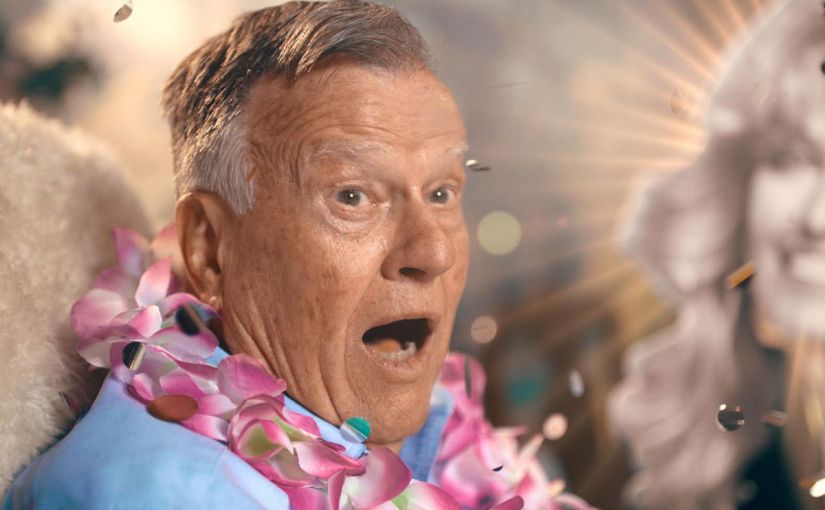
There are scenes of such lyrical beauty that I was glued to the screen.  One scene Kirsten stages is her father arriving in heaven.  Dick finds himself surrounded by actors wearing big black-and-white cutout masks of people like Bruce Lee, Farrah Fawcett, and Sigmund Freud.  (One wonders if she asked Dick who he would like to meet in heaven.)  And then, in a wonderful moment, a door opens, and in walks his wife, Kirsten’s mother…again, just an actress wearing a big cutout mask, but the picture is of her from when she and Dick first met.  And they dance together.  (With the help of some fancy editing because Dick is not as nimble as he used to be.)

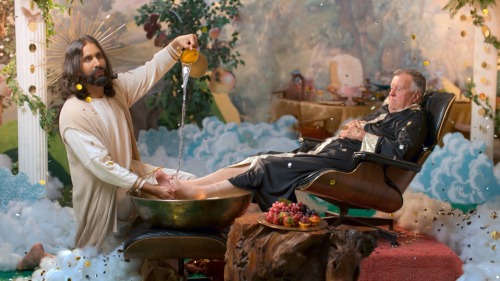
Dick was born with deformed toes, a fact of which he was ashamed for his entire life.  In another wonderful fantasy scene, Jesus Himself anoints Dick’s feet, and presto, his toes are normal again.  The look of shocked delight on Dick’s face is priceless.  …even though, you know, it’s not real, but still.


Interspersed with all this are scenes showing Dick’s slow decline in the real world.  He was once a successful psychiatrist, but he was finally forced to retire when he kept double-booking clients and not showing up for appointments.  He closes his office in Seattle, packs up, and moves in with Kirsten in her New York apartment, which is just a few doors down from the apartment where her two children live with their father and his husband.  (That scenario deserved, I thought, more explanation, but I got none…sounds like the setup for a long-running sit-com.)  Kirsten hires a caretaker with experience in caring for patients in their last stages of life.  Dick starts waking up in the middle of the night thinking he has to catch a train to work.  Multiple times.

These scenes are undeniably powerful because of the extraordinary access we get via Kirsten’s camera.  We see the amused confusion on Dick’s face when she asks him if he remembers getting up in the middle of the night…he doesn’t.  But he laughs.  “Oh, my, your father’s a wreck, sweetheart.”  It’s all doubly poignant because of how his wife succumbed to Alzheimer’s.  And here he goes down a similar road at the far end of his own life.  Powerful stuff.

…and then two extraordinary scenes occur.  I won’t spoil them.  They’re not exactly “extraordinary”, I guess, but the manner in which they occur and what we discover after they happen makes them extraordinary, to me.  And it’s here at the end of the movie that I really started feeling torn.  Yes, it’s a somber, effective look at Death with a capital “D” and how we choose to deal with it.  But…but…a part of me felt like it was shamelessly manipulative, especially those last two scenes.

Perhaps I’m the wrong audience for this movie.  Both of my parents are still alive.  I have not yet experienced that kind of loss.  I’m fifty-one years old as of this writing.  To paraphrase Indiana Jones, I’ve reached the point where life stops giving and starts taking away.  I’ve lost both sets of grandparents, two uncles, and more theatre friends and acquaintances I’d care to think about.  But I still have Mami and Papi.  I am blessed.  And I cannot for one second imagine how my ability to deal with either of their deaths would be improved by filming my mother in a coffin in a church, or by filming a scene where my father is killed after a fall.

I dunno.  It was profound and well made, and it clearly resonated with critics.  Maybe I’ll watch it again in ten or twenty or whatever years when I’ve lost at least one of my parents.  Maybe then I’ll be more in tune with Kirsten’s frame of mind.  Until then…I recommend Dick Johnson Is Dead if for no other reason than it’s one of the most unique documentaries I’ve ever seen.

ARTEMIS FOWL

By Marc S. Sanders

Why can’t Disney adapt a good book anymore? They massacred A Wrinkle In Time. Now they’ve taken a hatchet to Artemis Fowl, a Disney + byproduct that was shamelessly shelled out during the height of the pandemic.

There had to have been a more fleshed out, extended film here. Scenes are taped together with no bridge. All I can imagine is some suit insisted on cutting the guts out of director Kenneth Branagh’s film to ensure that its target kid audience would sit still, at least for 95 minutes. The same line of thinking had to have been applied to Ava Duvernay’s A Wrinkle In Time. Both films introduce characters that serve no purpose or make no sense. One character here shows up just to shout “Artemis!”

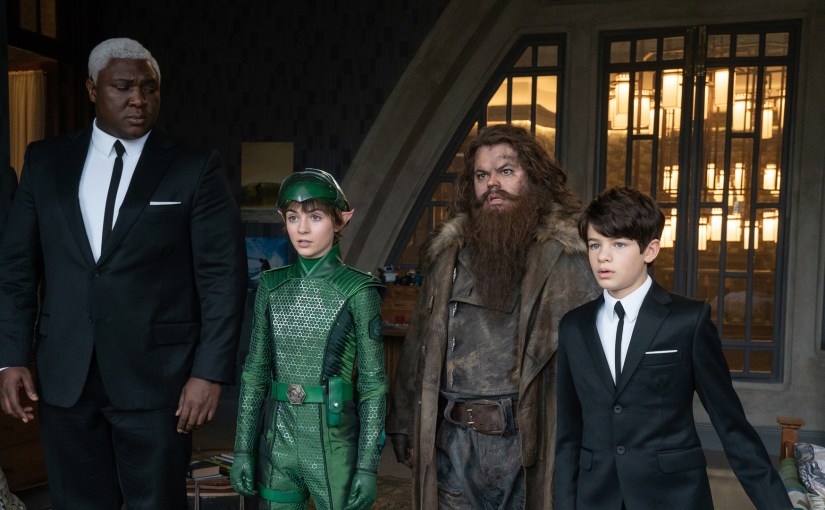
Speaking of the title character, what is he really? We are told by the narrator known as Mulch Diggums (Josh Gad) that Artemis Jr (an uninteresting kid actor named Ferdia Shaw who must’ve gotten the part cuz he looks good with sunglasses) is one of the greatest twelve-year-old geniuses of all time. He literally has an answer for any question that comes his way. So we’re told! Fact is, all this kid does is shoot a laser gun and wear a black Tarantino suit and tie. Never once in this film did I see Artemis Fowl demonstrate any of his genius, mind bending abilities. He surfs in the ocean outside his Ireland mansion. Does that merit the aptitude of a genius?

Artemis Sr (Colin Farrell) is apparently believed to be a thief of rare, priceless collectibles. After telling his son about some tale involving fairies that live in an underworld, he is soon kidnapped. It is now up to Junior with his trusty butler (Nonso Anosi) to rescue him. This butler doesn’t measure up to Batman’s Alfred. All this butler does is introduce young Artemis to a basement he was never aware of. Mulch also explains that if you call him Butler, he’ll snap you in two. Too bad we never got to see that. (Why tell us, dammit????) Then….AND I AM GOING TO SPOIL THIS SURPRISE….he dies. Tears must flow of course, but all I ever thought of was that gee, I hardly knew this guy.

Artemis Jr must recover a MacGuffin called the “Auculus.” How many times must I hear the word Auculus in a span of an hour and a half? The Auculus. The Auculus. THE AUCULUS!!!!!! Enough already. The filmmakers must believe that the more you say it, well then the more important the Auculus must be. My question: WHAT IN THE HELL DOES THIS AUCULUS EVEN DO?????

Judi Dench is here but only for the purpose of wearing a green leather trench coat that appears to weigh her down and doing what I think is likely a terrible enunciation of an elderly Irish lady’s accent. She plays the General of the fairy army. Dench is awful in this role and appears as lost in the effects as I was. Half the time I didn’t know what was going on. All of the time Judi Dench didn’t know what was going on.

The one main fairy is Holly Short (Lara McDonald) sent on a mission to go to Artemis’ mansion. Once she gets there, I truly lost track of why she was there to begin with. However, she seemed to have more activities to do than the title character is ever given. Once again, the super genius Artemis just shoots a gun. Holly at least gets to fly around with her motorized wings; yes, this is a fairy with an engine to activate her wings.

Artemis Fowl is a gorgeous looking picture. The special CGI effects are truly dazzling to look at with incredible color, but only if I’m watching a fireworks display at Magic Kingdom. Within a story, I have no clue what purpose any of the visuals serve or what possible results could come of anything. Nothing is explained here; much like this Auculus I talked about earlier.

The culture of the film is a failure as well. We are shown that this story is rooted out of Ireland. Where’s the Irish inspiration though? There’s no sense of inspiring traditions to learn from or appreciate. The soundtrack is hardly Celtic. Truly criminal is casting a Jewish Josh Gad and an English Judi Dench. For authencity’s sake, couldn’t actual Irish talent have been used instead of terrible dialects from marquee names?

There had to be a better film here. I’m talking a 2 1/2 hour film with solid, interesting exposition with mystery and questions like the first Harry Potter film. Nothing is of any consequence or comprehension here. How could I be so lost with this film?

This is a pattern for Disney of late. They acquire the rights to some wonderful children’s stories and then just mix some kind of slop in a slow cooker. A Wrinkle In Time, John Carter, and now this dreck. I don’t understand though. If the studio is so committed to packing so much into Avengers and Star Wars movies then why can’t they do the same with its other properties? I promise that kids will sit engaged with a longer film if it’s constructed with care. I know it.

Artemis Fowl is a squandered opportunity. They had the beloved novel by Eoin Colfer to springboard off of, and I know, without even reading the book, that they disregarded almost everything that made this story so special. It couldn’t be more apparent.

Artemis Fowl is a textbook example of when Hollywood does a complete disservice to its author as well as its target audience. It’s a criminal adaptation. It’s a betrayal of the intelligence that kids really come equipped with. It’s a terrible violation of culture and it’s an awful, awful, awful film.

NOMADLAND

By Marc S. Sanders

amazon ( n.) a large strong and aggressive woman; Synonyms: virago. amazon ( n.) mainly green tropical American parrots; 2. Amazon ( n.) (Greek mythology) one of a nation of women warriors of Scythia (who burned off the right breast in order to use a bow and arrow more effectively);

As I reflect on watching the 2020 Best Picture Oscar winning film, Nomadland, I considered the literal translation of the word “amazon.”  To many of us, I would think the word has an entirely different meaning.  Director, writer and editor Chloe Zhao probably considers both the literal definition of the first noun (noted above), as well as the brand name that seemingly runs the world these days.

Fern, played without compromise by Frances McDormand, is likely a strong and aggressive woman, though only subconsciously large.  I’d argue you would have to be in order to survive as a nomad within a pre-Trump era mid-western America with a beat up van as your mobile residence and a deep plastic bucket for a toilet that isn’t hard on your knees when used.  Fern is a former resident of Empire, Nevada.  Empire and its postal zip code no longer exist as of 2011 when the sheetrock factory that sustained the town closed up after 88 years, thus forcing all its residents to give up their homes and relocate elsewhere.  Now that Fern is widowed, she does not see any other way to live other than in the van she calls “Vanguard.”  She lives paycheck to paycheck with seasonal jobs that are hopefully available.  The first of these jobs includes a packing facility for Amazon.  Once the holidays are over, it’s up in the air as to what she’ll come across next.

Zhao is an observational director.  To depict a film about a lonely, uncertain post middle age nomadic widow will require shots of the country like frost on the ground, deep snow, endless roads, hot deserts and moonlit campfires with other nomads who come by Fern’s way.  These people (many of which are real life nomads in the film) might travel individually but they are a community as well.  They teach one another in ways of being resourceful with auto repair or what’s the best bucket for a toilet.  They provide people like Fern with temporary job opportunities.  They also counsel one another with how to deal with grief and share their own health challenges like the various forms of cancer and illnesses they endure and how they plan to live out the remainder of their limited time on earth.  One woman with an inoperable brain tumor is determined to make it back to Alaska.  What drives these people is not necessarily a will to survive.  More importantly, it’s the knowledge that they will cross paths with one another again.  An experienced nomad who lost a son to suicide never considers saying goodbye to anyone he encounters.  Rather, he is staunch in telling others that he’ll “see them down the road,” at another time and place.  He reminds Fern that to live this life is to never close the book or end a chapter, and memories of those we have lost can only stay alive if Fern and others stay alive.

I appreciate a film like Nomadland simply because I’ve never been the brave traveler.  One of my greatest fears is being lost and alone.  It has always terrified me.  I still don’t trust the navigation apps on my cell phone.  I have to see the destination in front of me.  Luckily, my wife keeps me in check.  Yet, Nomadland is a film that gives me an opportunity to explore places I might never arrive at, while I sit safely in front of my flat screen.  Chloe Zhao shoots with wide lenses to take in gorgeous landscapes.  How fortunate for Fern that she can encounter all of this beauty in person.  How fortunate, as a viewer, a film like this allows me to witness what’s out there.  How sad though as well that sometimes this way of life seems treacherous and nonsensical.  Whatever entity created the earth allowed no sympathy for a flat tire or a broken-down engine, when you have no means of paying for replacement parts.  As well, mother nature is not always going to be that companion that holds your hand during lonely times.  Corporate America certainly won’t do that either, but it is a necessary evil.  Thank you, Amazon!

Frances McDormand is perfect for this role as she carries no inhibitions about herself.  She will truly show herself sans makeup or coiffed hairstyles, floating nude in a stream, or go so far as to literally defecate on screen in that practical bucket to demonstrate how truly unglamourous and unforgiving the life of a nomad is. 

Nomadland is not a favorite film of mine, but I can’t help but appreciate its honesty thanks to Zhao, McDormand and the numerous real-life nomads that inhabit the picture.  It’s a sad story; not a triumphant one, but it is also a film that tries to emulate the comfort of being “houseless…not homeless” as Fern describes with absolute certainty.  It might not be the life for many of us, but it is definitely a life meant for Fern.

FYRE

By Marc S. Sanders

Fyre is a newly released Netflix documentary directed by Chris Smith that displays the hubris of a young entrepreneur named Billy McFarland, a despicable human being.

It’s an interesting story simply because Billy had all the writing on the wall yet proceeded with duping Bahamian island workers, influencers, web app designers, musical acts and concert goers into investing millions of dollars and hours of time and service into a music fest, the “Fyre Festival,” that could never possibly happen. People lost wages, ended up stranded and starved. Ultimately people were duped by the attractiveness of Instagram and Facebook, and they wanted to live within the images of what they saw.

Chris Smith offers strikingly beautiful pictures of Billy living it up with rapper Ja Rule and gorgeous women on a private island he boasts that he purchased from Pablo Escobar. The rapper and Billy think up an idea to offer the greatest music fest ever conceived. Concert goers can experience the concert while mingling with super models and celebrities, partake in the finest foods from world renowned chefs, and reside in beautiful cabanas. Thousands of people invested thousands of dollars in what could only be an illusion offered by well edited sun soaked, blue water, and white sand film footage with tan bikini models and jet skis. What they got was cheese and lettuce on bread with a rain soaked hurricane tent and a soggy strewn about mattress.

Question was who’s paying for all these acts and talent? Whose booking all of this? What about bathrooms and where is everyone expected to reside during the event?

It was a pipe dream disaster from the get go and Chris Smith’s documentary shows the orchestrator of it all act with reckless abandon and false optimism.

It’s an interesting piece. McFarland is as corrupt as a Kenneth Levy or a Bernie Madoff. One associate describes Billy as a man who knows how to separate the cash from the consumer. I believe that after watching the film. To live a life of fantasy is tempting to all of us. We all at one point yearn for something greater. Billy McFarland pounced on that idea imbedded in everyone.

Fyre will serve as warning for a buyer to beware.

LEGEND OF THE MUSE

By Marc S. Sanders

In high school my favorite writer/poet of American literature was Edgar Allen Poe. He had the colorful, yet dark, ideas of men who drown their brilliance in their subconscious madness. Having recently been invited to watch a film called Legend Of The Muse, brought back many memories of staying up past my bedtime with a flashlight in hand reading some of Poe’s best short stories while under the covers.

This film focuses on an artistic painter named Adam (Riley Egan) who is a loner relegated to his studio apartment with a messy drop cloth and blank canvases. His pale complexion tells us that his only escape appears to be the dreams or hallucinations he has for the unfortunate demise of two thugs stuck in the woods with a flat tire. These men appear to be terrorized by a strikingly beautiful entity who appears and disappears, only to reappear again for some haunts that startle Adam out of his sleep. Only after awakening, does Adam get the inspiration to paint dark, macabre images of the beautiful, almost naked girl in his dreams.

An intimidating neighbor of Adam’s coerces him to drive him out to a wooded location where a drug delivery has gone wrong. It is there that Adam connects the dots between his dreams and what actually happened to those two men.

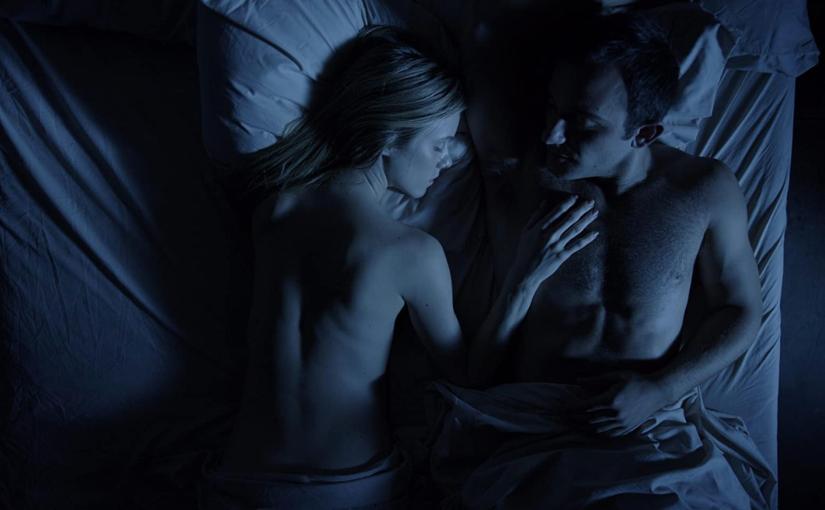
The Muse, this beautiful girl that we’ve caught glimpses of, takes up dwelling in Adam’s apartment, and as he becomes more adept and appreciated for his haunting and visual paintings, he becomes drawn to her with passionate, sexual escapades. The problem becomes that now no one can interfere with or threaten Adam or else the Muse will strike. As well, no one can become attached to Adam. Adam belongs only to the Muse.

Now this might sound like a Friday The 13th or Fatal Attraction kind of thriller. However, director and writer John Burr takes a different approach. For one thing, Adam as a protagonist is short on dialogue in the picture. It should be that way, as he’s a lonely and depressed person with no one to talk to or emote with. So Burr resorts to effective close ups of Riley Egan to highlight his isolation and state of mind. There are periods where the most frightening occurrences are Adam with his blank stares and canvases. How can he ever escape this void?  Being a playwright myself, I related to Egan’s performance, faced with debilitating writer’s block at times. The thrills of the picture pay off as Adam grows dependent on the Muse to eliminate his threats and inspire new art. It’s a nice arc for the character.

With even fewer lines (actually none), the Muse is played beautifully with a goose bump measure of fright from actress Elle Evans. There’s a more fanciful name for this possessive Muse known as “Leannan Si.” It’s apparent that John Burr was directing more so with imagery, rather than dialogue. His use of light, blood, paint, nudity and the eyes of Leannan Si stay with you and carry on a running theme throughout the film. His camera really works well with Elle Evans, with cinematography from Damian Horan. If this film would ever lead to a franchise, this could be the role Evans could profit off of for many years to come. It’s a much more sophisticated and artistic interpretation of a Freddy Krueger or Michael Myers like boogeyman. Evans seems to have invented a new kind of scare off of Burr’s screenplay.

I do not know much about how Legend Of The Muse was produced, perhaps on a small budget. Yet John Burr’s crew are resourceful within the limits of their production locations. The weakness of the film may fall within some members of the supporting cast who are given more dialogue than the two leads. Particularly, the various bullies that intimidate Adam may be trying too hard, and that took me away momentarily from the quiet sophistication of the picture. Some of them seemed like the bad guys of the week on an episode of The A Team.

Nonetheless, there are good performances from Jennie Fahn as an art gallery dealer who effectively narrates the purpose of Leannan Si’s relationship with the artist. Much like Poe, she’s poetic and eerie in her exposition. I also like actor Kate Mansi as Maria, the neighbor who takes an interest in Adam. John Burr was wise not to write either character as simple damsels in distress. There’s dimension to these ladies, much like the Muse. They are not just teenage girls running away from a killer. One provides the narrative from her character’s knowledge and experience. The other offers a motivation for Adam to invest in a personal relationship.

Considering the limited options we have amid the current pandemic, Legend Of The Muse is worth a rental to watch at home. If you find an open movie house in your area showing the picture…even better. It’s an atmospheric film with colorful imagination of a new kind of supernatural. John Burr is a visual director who makes good use of camera angles that effectively accompany the bright hues of yellow and white from Damian Horan who also does well with night scenes too. A spooky, synth like feel to the soundtrack from Alexander Rudd works nicely for building some suspense.

I’m aware I’m heavy on the compliments for this picture. Maybe more than other reviews. More importantly, I promise I’m being totally genuine as well. Why? Well, I’d like this film to build momentum and get an audience or a following. I think it deserves it as the hard work shows on the screen. I want this picture to succeed.

As I’ve admitted before, horror is far from my favorite genre. It unsettles me more often than not, and that’s usually not entertaining for me. Yet, Legend Of The Muse is not a bloodbath slasher film, either. The body count rises as the film progresses, sure. Yet, it lends to a developing story. It’s not just there to show me an accomplishment with grotesque makeup and pools of blood. Burr focuses his strengths for storytelling with Hitchcockian devices (particularly from Rear Window) and once again the best works of Edgar Allen Poe.

Legend Of The Muse should be sought out, and you can rent or purchase the film right now on Amazon Prime or Vimeo. It’s a great bedtime story for a rainy Saturday night.

THE CALL OF THE WILD

By Marc S. Sanders

I never thought I’d say it but a fully drawn CGI dog grabbed at my heartstrings with the 2020 film adaptation of Jack London’s literary classic The Call Of The Wild.

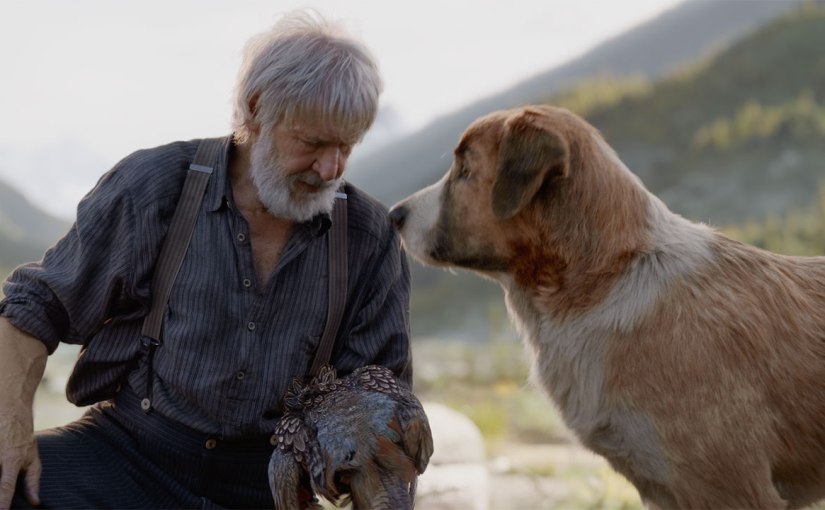
A gravelly voiced Harrison Ford narrates the ongoing journey of the St. Bernard named Buck who is kidnapped from his master’s home and eventually ends up in Alaska where a gold rush is in full swing. People from all places have come to the winter landscape during the turn of the century to purchase sled dogs as they venture off into the snow capped regions to uncover precious gold and get rich.

Buck is first recruited to drive two mail carriers (Omar Sy, Cara Gee; likable performances) through the Yukon. Though, he’s domesticated at first and not experienced with the command of “mush” and running in frigid temperatures to keep in step with seven other dogs, including the cruel canine leader known as Spitz. Soon, Buck vies for his place as leader with strength and determination and especially the respect he’s earned from the other dogs.

A second story puts him at the hands of a very cruel master named Hal (Dan Stevens). Buck and the other dogs suffer at his cruelty to continue the journey in search of gold only to get rescued by the frontiersman John Thornton (Harrison Ford). John and Buck’s relationship is the best and most touching piece of the film as it comes at a time when both characters need one another. John mourns the loss of his son as he decided to leave his wife. Buck is hurting physically while still perplexed at his Yukon surroundings.

I liked The Call Of The Wild. Though my suspension of disbelief was shattered as quick as it started. While it’s hard for me to accept that Buck will get Thornton to dry out on alcohol, as well as insist that he lead the pack by putting his foot-I mean paw- down, I could not help but be taken up in the midst of it all. Look, if Disney’s many animal characters can grab the emotions of countless moviegoers, then why can’t CGI “Buck” do the same as well. “Moving Picture Company” are the architects behind the CGI and they have achieved a nice blend of performance, emotion and effects with Buck and the other animals.

Harrison Ford responds well to the unreal animal that’s by his side. I bought it all whether they are on the canoe fighting the rapids or sharing a tent together or when Thornton sadly realizes that Buck is mapping out a new life in the wild, with a beautiful white Timberwolf. The director, Chris Sanders, periodically offers Buck a spirit to guide his destiny in the shape of beautiful yellow eyed, midnight black wolf as well.

I can’t say if this film follows London’s book precisely or goes completely off course. All I know is the film really took hold of me as I worried for Buck’s outcome. I left the film thinking of the silly, misbehaving Buck in the comfort of a master’s home all the way through the harsh elements of nature, and his encounters with the cruelty of man but also the respect of man. I really enjoyed The Call Of The Wild.

EXTRACTION

By Marc S. Sanders

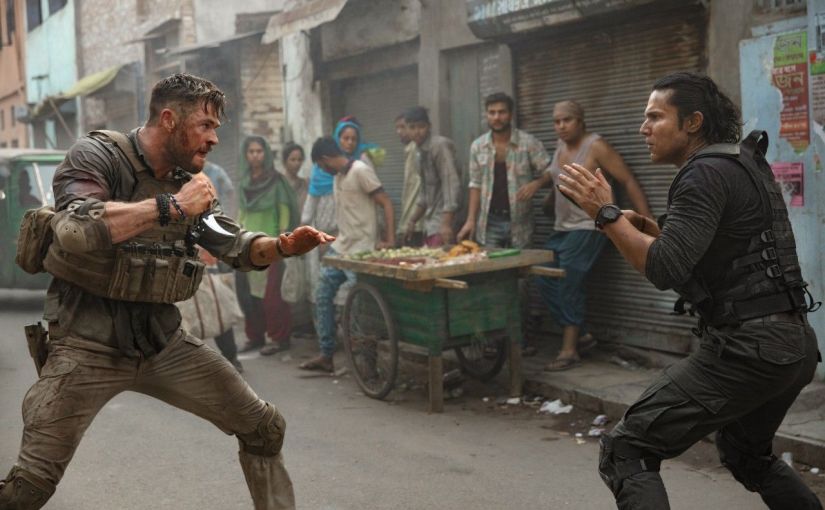
Why do some filmmakers find it to be of such “impactful dramatic narration” to show a snippet of the end of the story or film within the first two minutes of its beginning? That’s what disappointed me in the latest Netflix release Extraction featuring Chris Hemsworth as a skilled Australian mercenary hired to rescue an Indian drug lord’s son that has been kidnapped by a competing drug lord.

Hemsworth plays Tyler Rake, action hero name!!! He’s an alcoholic that manages to maintain his buff physique. I’d like to know the secret to these big action brutes, and how they stay so fit while downing bottles upon bottles of liquor and pills. Tyler has two days to get Ovi Mahajan Jr (Rudhraksh Jaiswal) out of an area of Bangladesh that is completely controlled by Amir Asif (Priyanshu Painyuli) the most powerful drug lord in Dharma, Bangladesh. Ovi Sr is another drug lord trapped in prison. Cops, civilians, street kids, practically everyone in the area operates under the command of Amir.

The rescue happens early with Tyler taking out over a half dozen guys that are holding Ovi in a run down apartment. He kills them every which imaginable. Fist, gun, knife, rake (in a top floor apartment?), you name it. From there, the bulk of the film focuses on how Tyler and Ovi are going to get safely out of the area.

Extraction is directed by Sam Hargrave and produced by Hemsworth’s Marvel super hero producer pal, Joe Russo. It is based on a graphic novel and it’s easy to recognize that. The violence is fast and gory and unforgiving. A major player gets a head shot assassination while standing at a urinal. Hargrave freezes the scene for a moment like a comic book panel. Dialogue throughout the film is somewhat limited to what could only fit in one of those speaking bubbles you find in comics.

Hargrave had me going with a number of long steady cam moments. One in particular has Tyler driving a Mercedes down a busy street while getting shot at, crashed into and rocket launched. The camera goes in and out of the car from the back seat to the front seat to the hood and the trunk and around the bad guys surrounding them. It reminded me of that celebrated sequence from Children Of Men directed by Alfonso Cuaron. Only thing is, Hargrave is not as seamless as Cuaron. I give an ‘A’ for effort, though you easily catch the breaks in the flow.

Tyler gets some assistance from David Harbour, who plays another sleazy kind of cut up, just like in Quantum Of Solace. Can this guy do anything else? (I know…Stranger Things. How about something even more that that though?). He just didn’t do anything for me here.

Tyler also gets some welcome assistance from a female mercenary named Nik Khan (Golshifteh Farahani). She’s completely bad ass, and her character really comes alive in the last 30 minutes.

Extraction is decent entertainment. Honestly, I was getting a little bored as the killings went on and on. How many different ways can a guy be shot in the head? I guess that’s why Tyler swings a dead body like a baseball bat to take out another guy or mashes a guy’s head into a car door window. You know, to mix it up a little bit.

Hargrave’s film does go beyond the normal conventions of action films at times. There are a few twists that got my attention but it’s mostly a film narrated in body count and bullets.

However, because of these mild surprises, again I ask why show me obvious material from the story’s ending as a quick pre title sequence? It would have been a much more satisfying surprise for me as a viewer had I not known what was to eventually come into play.

ONWARD

By Marc S. Sanders

I’m thinking director Dan Scanlon could very well be the next Chris Columbus or JJ Abrams or maybe…well maybe not Spielberg. But still! His new film Onward from the genius labs of Disney/Pixar is better than I ever expected.

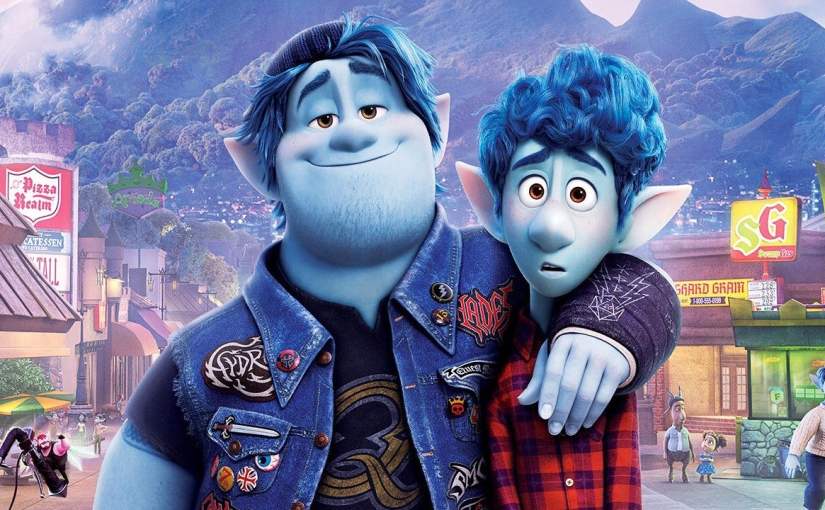
Think about it. The imagination of the film all goes in reverse. Magic and sorcery once ruled in a land of mythical creatures. But then the automobile was invented, along with cell phones, video games, exercise machines and every other every day to day invention known to mankind. Who needs magic anymore?

When two elf brothers, Ian and Barley, voices by Tom Holland and Chris Pratt, come upon their deceased father’s magical staff, they realize that as nerdy as he was, he was in fact a wizard. Some exposition allows them one day to revive him and spend only that particular day with him. It’s an opportunity for older brother Barley to reconnect and Ian to meet him. Something goes awry though when dad is only resurrected up to his waste, legs dressed in khakis with chino shoes and black leather belt. Hilarity and adventure ensue as they must embark on a quest to find a precious gem that will complete the resurrection before time runs out and the sun sets.

As the boys hop into Barley’s van called Guinevere. Adventure inspired of the level of The Goonies fare takes place. There are caverns with booby traps, maps and Holland and Pratt give up good vocal chemistry as they sort out their brotherly issues.

Julia Louis Dreyfus is mom and basically doing the typical Pixar mom but she has a great sidekick. Octavia Spenser as Corey the monstrous Manticore who runs a restaurant. To give side story filler, Dreyfus and Spenser are brought in to be on the trail of the boys. They have some good moments.

Onward has good, often funny and sentimental writing from Scanlon along with Keith Bunin and Jason Headley. It’s ironic actually. So many films from Harry Potter to Star Wars to Marvel focus on mysticism and magic that as movie goers we’ve become inundated with the gimmicks. Onward reminds us that ordinary dependence in a more grounded reality can actually lead to adventure too.

I liked it.

BIRDS OF PREY

By Marc S. Sanders

Margot Robbie is a champion actress. Just look at Bombshell (I thought she was more memorable than Oscar winner Laura Dern.). Look at I, Tonya. (I thought she should have won the Oscar that year.) Harley Quinn? She’s perfect in the role as a ditzed out, mallet carrying party gal villain turned anti hero from the Batman universe. Only problem is that as good as she is in the role, I can’t stand Harley Quinn. This is a child who just won’t sit still.

Robbie takes on her second turn in the role following the abysmal Suicide Squad. This time she produces Birds Of Prey (and The Fantabulous Emancipation of One Harley Quinn). It’s an improvement from Squad but it still seems to be all over the place. It happily acknowledges that it time jumps and corrects itself. It is happy to drop F bombs because the producers wanted a R rated female driven equivalent to Deadpool. (It never had to be Deadpool.) It even goes in rewind mode (you know, with the cassette tape sound) because the viewer or the fans of Harley need to experience the lunacy of Harley. She talks looney so we need to feel looney while she voiceovers the story that’s going on here.

The Gotham gangster Black Mask (Ewan McGregor – the next candidate in line trying to replicate Jack Nicholson’s Joker, just like Jim Carrey and Tommy Lee Jones and Arnold Schwarzenegger and on and on), wants to find a diamond that was swallowed by a kid named Cassandra Cain. Harley recruits herself to protect Cassandra, while waiting for her to shit it out. Hilarious material here. Side stuff tells us that Harley has split from the Joker.

The problem with Birds of Prey is that it does the work for the audience. I was constantly reminded that Harley is cuckoo, that I didn’t get the chance to discover it for myself. Robbie’s delivery is perfectly on point. The issue is the writing by screenwriter Christina Hodson is hackneyed. The character’s antics are too in your face. Look at Heath Ledger. The Nolans only revealed so much about the Joker. When their film ended, I wanted to learn more. Where did that guy actually stem from? He was a Joker like no other before him. The character wasn’t shoved in my face like Harley is. I had to think about him during and after the film.

The supporting cast is nothing of interest either. Rosie Perez, a great actress, plays third or fourth fiddle here as a Gotham cop who doesn’t get the credit she deserves from a department of mostly men. Mary Elizabeth Winstead just carries a crossbow that people mistake for a bow and arrow, and she gets frustrated with that. Yeah that’s ironic, I’m sure.

Still, despite the title, Harley is the main protagonist. Warner/DC got the right actor for the part. So why couldn’t they write her with more depth than this? The film starts out fun with a silly Looney Tunes animated update but then it gets all scattered with Harley breaking a thug’s legs and blowing up a chemical factory. She also shoves cheese whiz in her mouth. You go, girl!!!

Think about it. Harley used to be a renowned psychiatrist who is dropped in a vat of acid and abused terribly by Joker, only to break free of him and find her own way. This film really only TELLS us this. A better film would have SHOWN that to me. A better film would have made this the story from beginning to end. I’d love to have seen Harley before she went nuts.

You know what? I might’ve then become Harley Quinn’s biggest fan.