GOOD BOYS (2019)

by Miguel E. Rodriguez

Director: Gene Stupnitsky
Cast: Jacob Tremblay, Keith L. Williams, Brady Noon, Will Forte, Stephen Merchant
My Rating: 9/10
Rotten Tomatometer: 79% Certified Fresh

PLOT: Three sixth-grade boys ditch school and embark on an epic journey while carrying accidentally stolen drugs, being hunted by teenage girls, and trying to make their way home in time for a long-awaited party.


You will either love Good Boys for the humor, or you will hate it for exactly the same reason.  There can be no middle of the road.  You will either guffaw through the entire film, as I did, or you will gape in shock at the behavior and language demonstrated by tween boys.

If you’re one of those people who cannot comprehend the humor to be derived from watching curious boys who haven’t yet hit puberty staring at sex toys and wondering what the hell they’re for (“What are ‘a-nahl beads’?”), then this movie is not for you.  It’s just not.  No amount of philosophizing or rationalization will make it “okay.”  The fact that the movie made me laugh pretty much beginning to end carries no weight.  I respect your opinion.  If you want to stop reading this review, I wouldn’t blame you.  Now’s your chance.  I don’t want to waste your time.  Quit now.

Okay.

If you kept reading, you’re one of those people like me who laughed through every second of the trailers for this movie, hoping against hope that they didn’t just show us all the funny bits in the trailer.  Thank the comedy gods, they didn’t.  Good Boys is the funniest movie I’ve seen this year so far, and it may wind up being the funniest comedy of the year.

If you’ve seen the trailers, you know the plot: three 6th-graders accidentally steal some “molly” from two college girls, who offer to trade it for an expensive drone they captured while the boys were using it to spy on them.  See, the boys have been invited to a “kissing” party, but they know nothing about kissing, so they were using the drone to spy on these two college girls to see if they would kiss.  Before that, they tried using the internet, but instead of just searching for “how to kiss a girl”, they jumped right into searching for “boobies” and “porn”…which did not end well.

Read that last sentence.  If I were the father of one of those kids, I would not find that funny.  I can understand from an intellectual standpoint how a kid that young can be curious about such things, but if I found out my kid had been searching for that stuff online, as a parent, I’d be upset.  So I can see how this movie might put some people off.

But I promise you.  This movie magically takes what would be uncomfortable in real life and mines those situations for the kind of belly laughs that I haven’t had in a movie theater since The Hangover.  And it’s not salacious or prurient, because they have NO IDEA what they’re looking at, or even talking about.  (The description one of them gives for what a tampon is used for is worth the price of admission.)

As the movie progresses, the screenplay doesn’t forget to give us reasons to like these kids.  We get glimpses of one of their families in particular, as they inform him they’re getting divorced.  (“You’ll get TWO Taco Tuesdays now!  Just…one of them will be on Wednesday.”)  One of them has a real gift for singing, but doesn’t want to look too uncool, so he doesn’t sign up for an audition.  One has a crush on a girl, but is so nervous about her that he talks to his friends about how he hopes one day to make actual eye contact.  Too many comedies make the GAGS the point of the film instead of the characters.  While the gags are fast and furious in Good Boys, they MEAN more, and are funnier, because we know who these kids are, and what makes them tick.

I’m trying to think of what else to write, but it would just be a catalog of the best gags and lines in the movie.  (“I’m gonna be a social piranha!”)  I don’t believe finding this movie funny is bad or immoral.  I know there are people out there who might think so, and I empathize.  But I know what makes me laugh, and I have to be true to myself, so…there you go.

SCARY STORIES TO TELL IN THE DARK (2019)

by Miguel E. Rodriguez

Director: André Øvredal
Cast: Zoe Margaret Colletti, Michael Garza, Gabriel Rush
My Rating: 3/10
Rotten Tomatometer: 80% Certified Fresh

PLOT: In order to save their lives, a group of kids face their fears as manifested by a haunted book of stories that write themselves.


I learn from Wikipedia that Scary Stories to Tell in the Dark is based on a popular series of horror stories from the ‘80s, written for a young-adult audience, much like the Goosebumps books, I would imagine.  (I have to imagine, because I have never read a single Goosebumps book.)  If the stories are anything like the trilogy of so-called terror presented in the film, they must be scary indeed.  At least on paper.

The plot: a group of teenagers in 1968 – why that year, specifically?  No idea – discover a book in a local haunted house, a REAL haunted house, that is supposedly filled with stories that a crazy woman would read to local kids through the walls of her basement where she was kept prisoner by her family.  They unwisely take the book from the house and should therefore be unsurprised when the stories in the book start to play out for real.

As a film, Scary Stories delivers occasional shocks without suspense.  You know what I’m talking about, right?  The scene where something jumps at the screen and the soundtrack goes DA-DUM!!!  …and it’s just a cat.  The entire movie is like that.  There are attempts to build suspense, but they fail to do so.

Ironically for a film with “Stories” in its title, I think the problem lies with the storytelling.  The stories on their own are fairly creepy, and seem like they could provide material for a much scarier film.  A scarecrow that comes to life?  A creepy-looking woman who just keeps walking closer and closer to you no matter what you do?  An animated corpse wondering who stole its big toe?  (Okay, maybe not that last one, but you get the idea.)  These would indeed be great stories to tell in the dark, preferably around a campfire or at a slumber party with the lights out and the doors and windows unlocked.

But the film stumbles, and it’s hard for me to pinpoint exactly what happened.  Maybe it rushes through the “in-between” material, the filler between the episodes of terror.  By rushing through those scenes, we really don’t get to know enough about the children who wind up in peril, and consequently we don’t care when they’re being stalked by monsters, etc.

Maybe it’s the fact that these stories, scary as they are on their own, are re-treads of classic horror tropes that we’ve seen over and over and OVER again.  But it can’t be that because, honestly, I have no beef with old tropes, as long as you tell the story well.  (Some might call that “putting old wine in a new bottle”, but if it’s a snazzy enough bottle, I’ll give it a pass… Avatar, anyone?)

So it has to be the storytelling.  The shocks were only periodically effective, and there are some disturbing visuals.  (My favorite involves the creepy-looking woman who keeps getting closer and close, which reminded me of a better film, It Follows.  For that matter, if you want a GREAT horror movie centered on a book, beg, borrow, or steal (not really) The Babadook.  Now THERE’S a scary story.  But I digress.)

There are some disturbing visuals, but the film just felt like it was keeping everyone at arm’s length.  Instead of getting sucked into the stories, I felt like I was watching it from inside the concession stand at a drive-in.  I was a distant observer.

You wanna know what the best part of the movie was?  The full trailer for Zombieland: Double Tap before the movie even started.  Not a great sign.

ONCE UPON A TIME…IN HOLLYWOOD (2019)

by Miguel E. Rodriguez

Director: Quentin Tarantino
Cast: Leonardo DiCaprio, Brad Pitt, Margot Robbie, Timothy Olyphant, Dakota Fanning, Bruce Dern, Luke Perry, Al Pacino, Kurt Russell
My Rating: 10/10
Rotten Tomatometer: 84% Certified Fresh

PLOT: A fading television actor and his stunt double strive to achieve fame and success in the film industry during the final years of Hollywood’s first Golden Age in 1969 Los Angeles.


Quentin Tarantino’s ninth film is a little bit like Beethoven’s Ninth Symphony.  It’s big, bombastic, and goes the long way around the barn to get to the finale, but in the end it all makes sense and is a transcendent experience.

Let’s see, where do I start?

First of all, the film’s evocation of 1969 Los Angeles is like Mary Poppins: practically perfect in every way.  I’m no fashion scholar or visual historian, but every exterior shot of the city was pretty convincing to my layman’s eyes.  The movie theatres, the movie posters, the restaurants (anyone else remember “Der Weinerschnitzel”?), the cars, those HUGE sedans sharing the road with VW Bugs and M/G’s…it’s clear they did their homework.

There’s the performances by the two leads.  Tarantino once said he considered himself the luckiest director in modern history because he was able to get DiCaprio and Pitt to work on the same film.  Can’t argue with him on that score.  They carry the film in a way that few other tandems could have.  (Newman and Redford come to mind.) Mind you, DiCaprio and Putt don’t look much like each other, considering one has to be the other’s stuntman, but you get the idea.

Above all, there’s the story.  DiCaprio plays Rick Dalton, a former leading man from ‘50s TV westerns who is now playing colorful bad guys in ‘60s TV westerns.  Brad Pitt plays Cliff Booth, the stuntman who’s been taking the dangerous falls for Dalton for years.  Dalton happens to live next door to Roman Polanski and Sharon Tate on Cielo Drive in the Hollywood Hills.

All the trailers, and all the industry buzz, reveal that the Manson family and Sharon Tate play a part in the film.  That’s no spoiler.  Given what we know about those events, the movie plays like Gimme Shelter, the landmark documentary about the ill-fated concert at Altamont that was actually due to take place a few months after the events of this film.  It’s all very suspenseful, in the sense that we know what’s coming, but we’re just not sure how the movie is going to approach it.  So every scene with poor Sharon Tate in it is overshadowed by the fact that we know her ultimate fate in history.

It’s like the famous Hitchcock analogy of suspense.  Two people are eating at a restaurant when a bomb suddenly goes off under their table…that’s surprise.  Put those same two people at the restaurant, where the audience knows there’s a bomb under the table, but it doesn’t go off right away as the two people eat and converse and have dessert, and we’re wondering will they leave BEFORE the bomb goes off or not…?  That’s suspense.

And that’s the genius of this movie, with Tarantino’s sprawling, winding screenplay.  We get to know Rick Dalton and Cliff Booth intimately, we get the rhythms of their relationship, of Dalton’s mood on set, of Booth’s quiet acceptance of his role as Dalton’s sole support system.  We are treated to lengthy scenes showing Dalton at work on the set of a TV western, so we can appreciate the vast differences between an actor and their characters.  There’s a brilliant backstage scene between Dalton and a child actor who is impossibly, hilariously advanced for her age, and who winds up giving Dalton some goodhearted advice.

And interspersed through it all is Sharon Tate.  Sharon Tate bopping to music at home.  Sharon Tate picking up a female hitchhiker on her way into town.  Sharon Tate almost passing, then backing up to admire with youthful excitement, her name on the marquee of a movie theatre, right next to (gasp) Dean Martin’s name!  Sharon Tate dancing, walking, smiling, drinking…living.  She’s the diner at the restaurant, and the Manson family is the bomb we know will eventually go off.  It casts a pall over the proceedings, but not in a bad way.  It’s an interesting way to bring the reality of the situation into focus from time to time.

And now I have to end this review before I inadvertently give away certain, ah, plot elements that elevate Tarantino’s film from a mere character study or period piece into the heady heights of cinematic transcendence.  I have not myself read any reviews of the film, so I can only guess that whatever negative reviews are out there probably center on the film’s finale, or perhaps on its meandering script.  All I can say, or will say, is that I am firmly on Tarantino’s side on this one.  The way the conclusion was written and filmed is the kind of thing that people will still be talking about years from now.

So just take it from me.  If you’re a movie fan, and ESPECIALLY if you’re a Tarantino fan, this is right up your alley.  It’s easily his most slowly paced movie since Jackie Brown, but that just gives you time to e-e-e-ease into the characters, like putting on a tailored suit piece by piece.  This film, like Beethoven’s Ninth, is a masterpiece.

MIDSOMMAR (2019)

by Miguel E. Rodriguez

Director: Ari Aster
Cast: Florence Pugh, Jack Reynor, Vilhelm Blomgren
My Rating: 6/10
Rotten Tomatometer: 82% Certified Fresh

PLOT: A couple travels to Sweden to visit a rural hometown’s fabled mid-summer festival, but what begins as an idyllic retreat quickly devolves into a series of increasingly bizarre rituals at the hands of a pagan cult.


There is a lot to like in Midsommar, the second film from Ari Aster, director of last year’s masterful Hereditary.  It clocks in at 2 ½ hours, and the vast majority of that running time is devoted to creating and maintaining an atmosphere of unsettling oddness, where I was constantly asking myself, “Okay, what the hell is going on here?”  That’s a tricky task, because if you get it wrong, you wind up boring your audience.  And I was never bored during Midsommar.  So there’s that.

The plot: a young woman, Dani, suffers a terrible tragedy and turns for comfort to her boyfriend, Christian, who, truth be told, had been looking for an excuse to end things with Dani before the aforementioned tragedy struck.  But he stays with her more out of duty than real love, and they wind up going to Sweden with a bunch of friends on the recommendation of a college classmate of theirs who tells them of a marvelous nine-day solstice celebration held in his hometown, a quaint country village in the middle of nowhere that doesn’t seem to have or need electricity.

This place is…strange.  In scenes of ordinary behavior that nevertheless manage to somehow give you goosebumps, we observe the villagers performing tasks that would be at home in Amish country: folding clothes, preparing meals, gathering flowers, and the like.  Everything is brightly lit due to the perpetual sunlight at that time of year in that part of Sweden, and all that light somehow, instead of draining the scenes of suspense, actually increases it.  It’s very hard to describe accurately.  (Even the architecture contributes to this sense of unease, with a couple of buildings built with the kind of angles that would have been at home in a Tim Burton film.)

The film takes its time establishing this bright, passive weirdness.  One of the college friends asks the purpose of one of the strange buildings and is told it’s a temple…but no one is allowed there.  There are plainly crops in a field…but it’s difficult if not impossible to tell what’s being grown.  There’s a large bear in a wooden cage that the villagers seem not to notice or care about.   Some of the young village women openly admire Dani’s strapping boyfriend, much to Dani’s annoyance.

Then there’s a bizarre ceremony that starts out with a ritualized dinner, and then two of the older villagers are taken to a high cliff on the edge of the village, and…

Well, that’s when things REALLY start to get weird.  And bloody.  And even more trippy.  I think that’s where I have to stop describing events in the movie.

So.  Like I said, the film does a great job at creating this superbly unsettling atmosphere and maintaining it.  I couldn’t wait to see what was coming up next. But then the movie reached a point where it became obvious how it was going to end…

SPOILER ALERT, SPOILER ALERT, I SAY AGAIN, SPOILER ALERT.

When it became clear that this was NOT going to have a Hollywood ending, I didn’t mind at first.  I mean, Hereditary doesn’t end happily, and I thought it was brilliant.  (Well, I didn’t at first, but I do now.)  But…ugh.  In the last five minutes or so before the credits, instead of sucking in my breath at the audacity of this ending, I was instead shaking my head, saying to myself, “What the f***…?”  And not in a good way.  Midsommar ends with a whimper, not with a bang.

Which is so disappointing.  For 135 minutes, I was breathless with anticipation for the next scene.  And they lost me in the last five.  I HATE it when that happens.

I’m sure there are levels to Midsommar that make it more than just a horror movie.  No doubt there are all sorts of psychological – psychiatric? – parallels between the rituals of the village and the relationship between Dani and her boyfriend.  No doubt.  But when a movie loses me that badly at the end, all the poetic symbolism in the world won’t make me change my opinion.

Midsommar is a long ride for a short day at the beach. A crowded beach with no lifeguard and lots of seaweed.

TOY STORY 4 (2019)

by Miguel E. Rodriguez

Director: Josh Cooley
Cast: Tom Hanks, Tim Allen, Annie Potts, Keegan-Michael Key, Jordan Peele, Christina Hendricks, Keanu Reeves, Joan Cusack
My Rating: 9/10
Rotten Tomatometer: 98% Certified Fresh

PLOT: A new toy called “Forky” joins Woody and the gang, and a road trip with old and new friends reveals how big the world can be for a toy.


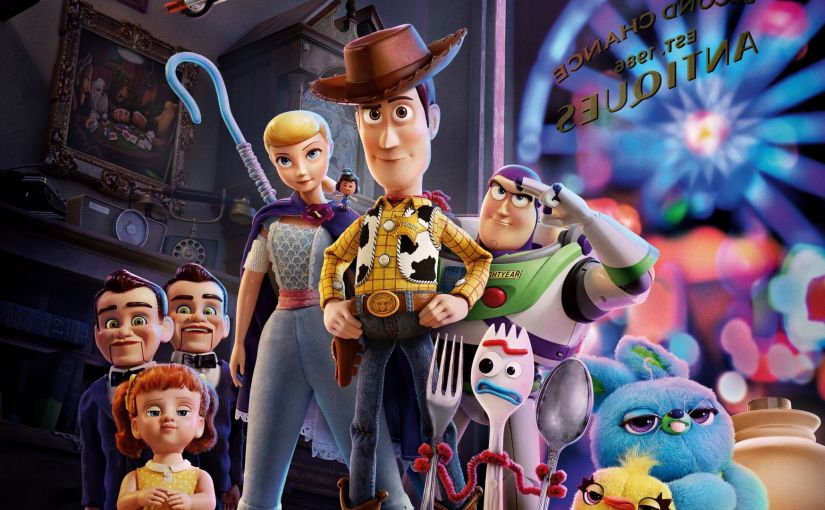
Frankly, one of the best “perks” of Toy Story 4 is the return of Bo Peep.  I had always wondered what had happened to her in Toy Story 3 that had Woody so sad.  I’m glad we got to see why she was no longer around, and I’m glad we get to see how she’s fared in the intervening years.  Just wanted to get that out of the way.

Toy Story 4 is not quite the pinnacle of perfection that is Toy Story 3, especially when it comes to the heartstring-tugging, but it’s a marvelous film on its own, and the ending is a fitting curtain call to the franchise.  Woody, Buzz, and the gang have gone through more hair-raising, death-defying adventures than Indiana Jones, it sometimes seems, and the fact that they reach the start of truly new chapters in their lives by the time the credits roll is comforting.

This fourth film introduces an intriguing element in the form of a doll named Gabby Gabby.  She’s one of those dolls that every girl seems to have owned at some point in her life…at least, every girl born before the year 2000, I’d guess.  She resides in an antiques store, and she has a problem: her voice box is defective.  When you pull her string, instead of a little girl’s voice, you hear what sounds like a 45 being played at 33 1/3.  (You older readers can explain that to the younger ones.)

Her potential salvation: Woody’s voice box is in perfect working order.  All she has to do is somehow exchange voice boxes with Woody, and she’ll have the chance to get a little human girl to love her enough to take her home.

This is…creepy.  There’s something unsettling about this Gabby Gabby character because she’s a cute little doll who essentially wants to perform an organ transplant whether Woody wants to or not.  She’s just so…matter-of-fact about it.

I’m doing a lot of simple play-by-play, and not really giving a sense of the movie itself.  That’s because, while it’s skillfully made and emotionally engaging, it’s not like this movie breaks new ground, exactly.  I think it’s a good thing this will finally be the last Toy Story film.  It’s becoming much harder to imagine what else Pixar can put these characters through, and I’d hate for them to push things too far like they did with the Cars franchise.

But don’t get me wrong, it was incredibly entertaining, and I loved every minute of it.  If you liked the first three movies – heck, if you love ANY Pixar movie – you won’t be disappointed by this one.  It’s just…you’ve gotta see it for yourself.  At this point, any further reviewing of the movie would involve spoiler alerts and scene descriptions and re-telling my favorite lines, and that’s not really a review anymore, that’s just a synopsis.

Suffice to say: “Toy Story 4” delivers the kind of movie we’ve come to expect from Pixar.  It’ll make you laugh, jump, laugh some more, give you a couple of hanky moments, and it’ll look GREAT doing it.

GODZILLA: KING OF THE MONSTERS (2019)

by Miguel E. Rodriguez

Director: Michael Dougherty
Cast: Kyle Chandler, Vera Farmiga, Millie Bobby Brown, Ken Watanabe, Bradley Whitford
My Rating: 6/10
Rotten Tomatometer: 40%

PLOT: Five years after the events of Godzilla (2014), humanity finds itself once again at risk as multiple titanic creatures awake from slumber and wreak devastation on the planet.  Who can stop them?  Indeed, WHO?


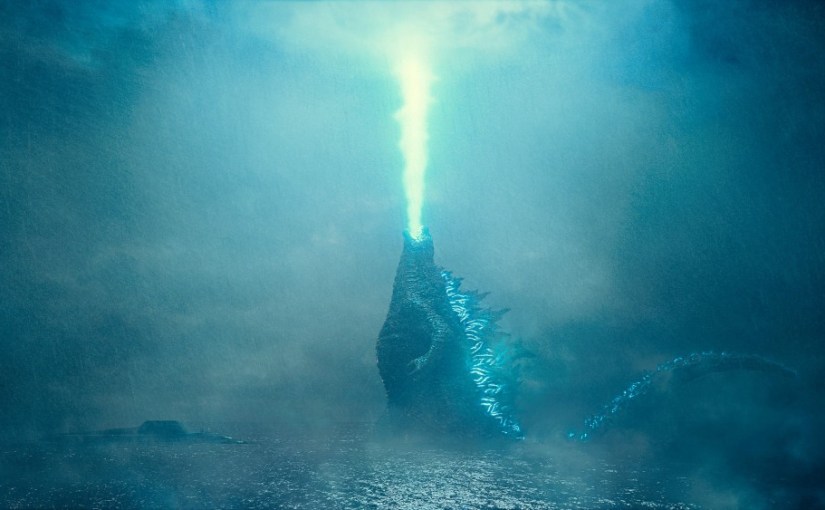
In many ways, Godzilla: King of the Monsters reminded me of Guillermo del Toro’s kaiju epic Pacific Rim, although, to be fair, the monster battles were far superior in del Toro’s film.  But that’s the framework in which this movie should be measured: the monster battles.  With a title like King of the Monsters, one shouldn’t walk into a screening of this film expecting a screenplay by Ernest Hemingway.  You won’t find self-reflexive, multi-layered dialogue here.  You want that, wait for Oscar season later in the year.

No, this is a popcorn movie, pure and simple, and on that level, I believe it succeeds.  We got two monster “species” total in 2014’s Godzilla reboot, and in this sequel, we get an additional six at least.  We got two major monster sequences in the first film…this time we get, jeez, four, I think?  I lost count.  In the summer blockbuster vein of “bigger is better”, G:KotM pulled out all the stops.

At least, in terms of the monster battles.  The screenplay is one giant cliché after another.  Think of the screenplay for Independence Day and square the cheesiness factor.  Then think of all the monster movies you remember from your youth, and imagine someone funneled every cliché from those terrible scripts into this one.  Yeah, it’s like that.

  • One character talks about humanity being a scourge to the planet, and how it ought to be eradicated by the titans in order for the planet to survive.  As my friend Marc Sanders pointed out, they should have just called Thanos; he could have fixed the problem in a SNAP, thank you, I’m here all night.
  • At one point, a kidnapped little girl is taken to a military-style bunker and, in a feat that rivals Houdini, manages to steal an EXTREMELY important piece of hardware, climb into an air shaft, and literally stroll out the UNGUARDED front gate, presumably while all the grownups are too busy watching the world end on their computer monitors.
  • At another point, it’s determined that the best way to revive an injured Godzilla is to fire a nuclear weapon into his radioactive underwater lair.  Alas, the launching mechanism has failed, and it’s impossible to detonate it remotely, meaning someone must volunteer to hand-carry a nuclear warhead, place it literally RIGHT NEXT to Godzilla, and blow themselves up.  Because, why not?  Instead of feeling like a heroic moment, it felt really, REALLY contrived.

But, I mean…it’s not like any of that really matters here, does it?  To re-state an important factoid, the title of the movie is Godzilla: King of the Monsters.  KING OF THE MONSTERS.  This is simply a mindless, monstrous summer diversion that oddly appealed to me, but only when we saw the monsters fighting.  It kinda took me back to my childhood, watching one of any number of Godzilla films in syndication.

I’m not saying it’s better than the 2014 film, let me be clear.  I thought that film, helmed by Gareth Edwards (who went on to direct the sensational Rogue One), was a more “awesome” movie in the most literal sense of the word.  There was a sense of grandeur, almost, to Godzilla that bordered on reverence. King of the Monsters is all about the fight.  The rumble.  The battle for dominance.  Only one can be king, and Godzilla will not give up his throne without a fight.  Or three.

Many moons ago, I went with my good friend Marc to see what promised to be a cheesy movie: Freddy vs. Jason (2003). Was it cheesy? Yes. But did it deliver on its title? Brother, we got, not one, but THREE showdowns between the two title characters. I got what I paid for and had no complaints.

Same principle applies here.

ROCKETMAN (2019)

by Miguel E. Rodriguez

Director: Dexter Fletcher
Cast: Taron Egerton, Jamie Bell, Richard Madden, Bryce Dallas Howard
My Rating: 8/10
Rotten Tomatometer: 86% Certified Fresh

PLOT: A musical fantasy about Elton John’s (Egerton) breakthrough years in the 1970s.


Much more so than Bohemian Rhapsody, Rocketman feels like a genuine musical.  On top of that, it also provides much more insight into the lead character than Rhapsody did.  I did feel that it was stretching a bit, trying a bit too hard to pluck the old heartstrings towards the end of the film.  But the fact remains that I was more invested in the Elton John character than Freddie Mercury.

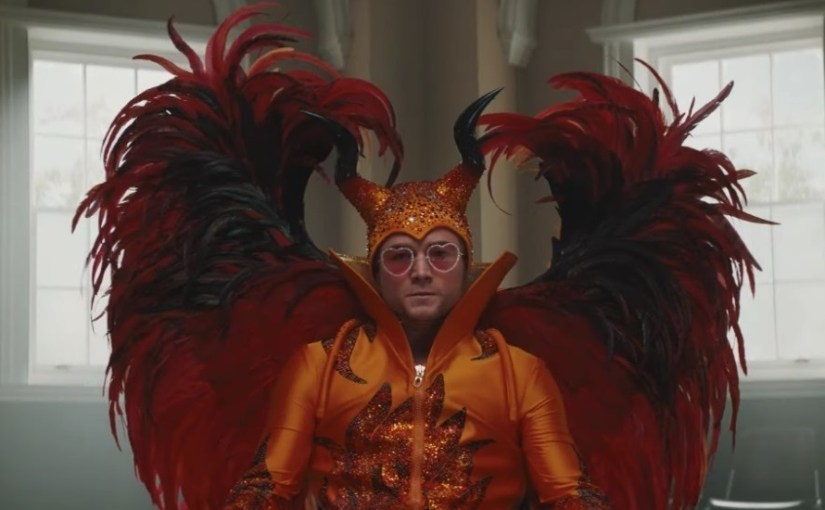
I think a big part of that improvement is due to the way Rocketman is structured.  The entire film is played out in a series of flashbacks, ostensibly during a group therapy session at a rehab clinic.  I say “ostensibly” because, in the opening moments of the film, he apparently walks into the session moments after abandoning his Madison Square Garden concert.  He is in full Elton John regalia: a flaming orange and red outfit complete with spreading wings on his back and devil horns on his head.  Through most of the film (after his meteoric rise to fame), he will do his best to live up to the devilish nature of this costume.

(This structure is not new…see, for example, De-Lovely, in which Cole Porter defends his life to a mysterious figure at the moment of his death.)

I have said over and over again, on Facebook and to my fellow cinephiles, how I cannot handle movies or TV shows with loathsome characters as the leads.  I can never and will never watch the TV show Mad Men.  No power on earth will ever compel me to sit through another screening of What About Bob? If someone had shot Jennifer Lawrence’s character in American Hustle with a shotgun, I would have cheered.

And yet here is Rocketman, featuring a lead character who, in the course of the movie…let me see…gets himself addicted to drugs and alcohol, succeeds in alienating anyone and everyone close to him, attempts suicide, gets the venue city name wrong during a massive concert (that’s a BIG no-no), ditches the people who made him famous in the first place out of misplaced affection for his smarmy manager/lover, and marries a woman (out of nowhere) knowing full well he is gay.

He does all of these things, and yet I was still on his side.  Weird, right?  The last time I felt that kind of empathy for a troubled lead character was in Ray.  (I’m not equating the two films, just remarking on their similarity.)  If I had to draw a line connecting those two films, and why I was able to handle their anti-social tendencies, the first things that come to mind are their music and their backstories.  The music produced by Ray Charles and Elton John (and Elton’s inseparable collaborator, Bernie Taupin) is on such a level that it was intriguing to me to watch their characters evolve, to see where such music comes from, and how much suffering is sometimes (always?) necessary for greatness to be achieved.

Another aspect of Rocketman’s success is the way unique visual tricks were used to convey the extreme emotional impact of certain events in Elton John’s life.  I’m thinking especially of his first concert at the famed Troubador nightclub in Los Angeles.  After a few agonizing seconds of nervous silence, Elton and his band break into “Crocodile Rock”, and when the bouncy chorus begins with its high, ‘50s-esque falsettos, there is a glorious moment when Elton, the band, and the crowd slowly levitate in the air, transported by the music.  I can imagine the real Elton John describing that moment in that specific way.  Or any number of performers describing their one supremely perfect moment in the spotlight, that one fleeting moment in time when it felt like the world revolved around them and their music, or their monologue, or their pas-de-deux.  It’s a magical sequence.

I cannot call Rocketman a perfect biopic.  As I mentioned before, it tries a little too hard at the end.  There is a bit of speechifying that is intended to get a gut-wrenching emotional reaction, but which I felt was a little too much of a muchness.  But it is an improvement on Bohemian Rhapsody.  I got a much fuller picture of Elton John’s life before he became THE Elton John, and as such, I was much more invested in how things turned out.

BOOKSMART (2019)

by Miguel E. Rodriguez

Director: Olivia Wilde
Cast: Kaitlyn Dever, Beanie Feldstein, Jason Sudeikis, Lisa Kudrow, Will Forte, Billie Lourd
My Rating: 9/10
Rotten Tomatometer: 98% Certified Fresh

PLOT: Two over-achieving high-school seniors (Dever, Feldstein) decide to experience, at long last, the party life on the night before graduation.


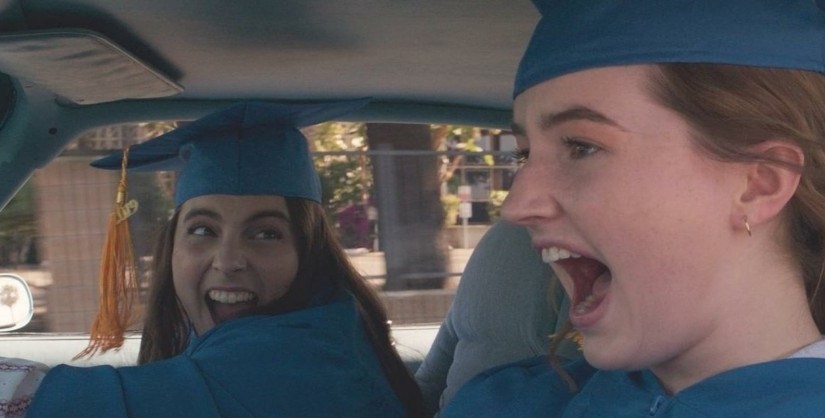
Booksmart goes on the list of the best comedies of the new millennium, along with Bridesmaids, Superbad, and a few others.  It is simply told, hilariously funny, and genuinely touching when it comes to the two lead characters and their friendship, which is put to the test when they decide to venture WAY out of their comfort zone for one last night of partying before senior high graduation.

If the trailers make Booksmart look a little like a female version of Superbad or American Pie, well, maybe that’s not necessarily a bad thing, because hopefully that will drive people to the theatre, people who wouldn’t normally care about a girl-centric comedy that doesn’t involve losing-our-virginity pacts or having carnal relations with flutes and baked goods.

In fact, the trajectory of the story most closely resembles certain comedies from the early ‘80s, the ones where everything (or ALMOST everything) happens in one crazy night, with the main characters bouncing from one bizarre scene to another, all in pursuit of that one legendary party.  Booksmart feels like the R-rated girl-power comedy that John Hughes never got the chance to make.

I don’t want to tick off the different situations in which the heroines find themselves; that would be giving too much away.  But I will mention one scene that is worth the price of admission.  The two girls find themselves at a murder-mystery-themed party, and begin to have a drug-fueled hallucination (long story).  The nature of the hallucination, and the way it manages to induce genuine laughs, while simultaneously making a statement about smashing traditional notions of female beauty, is breathtaking.

The movie does manage to capture real pathos, as well, the kind of teenage heartbreak that is unique in the human experience.  Unfortunately, I felt that the scenes in which this occurs really slow down the momentum of the movie.  However, I can’t imagine the movie being complete without it.  It felt absolutely necessary, no matter how much it may have dragged a bit.

I’m being intentionally vague with a lot of my review here.  I’ve read other reviews that have given WAY too much away, and I’m trying to avoid that here.  I simply wish to convey that this is the funniest movie I’ve seen so far this year (and I LOVED “Long Shot”), and it would be a shame to miss seeing it with a large crowd in a big movie theater.  Don’t miss this one.

JOHN WICK: CHAPTER 3 – PARABELLUM (2019)

by Miguel E. Rodriguez

Director: Chad Stahelski
Cast: Keanu Reeves, Halle Berry, Ian McShane, Laurence Fishburne, Anjelica Huston
My Rating: 9/10
Rotten Tomatometer: 89% Certified Fresh

PLOT: Picking up precisely where John Wick 2 left off, legendary assassin John Wick (Reeves) must fend off wave after wave of bounty hunters intent on collecting the $14 million bounty on his head.


You gotta love how John Wick: Chapter 3 – Parabellum starts.  About 30 seconds of opening credits, and then bang, the action picks up exactly where John Wick: Chapter 2 ended.  Wick is on the run through New York City, trying to find safe haven for himself (and his dog, aptly named “Dog”) before he becomes “excommunicado”.  At that point, a global network of assassins will make him their target and kill him.

Well…they’ll TRY to kill him.

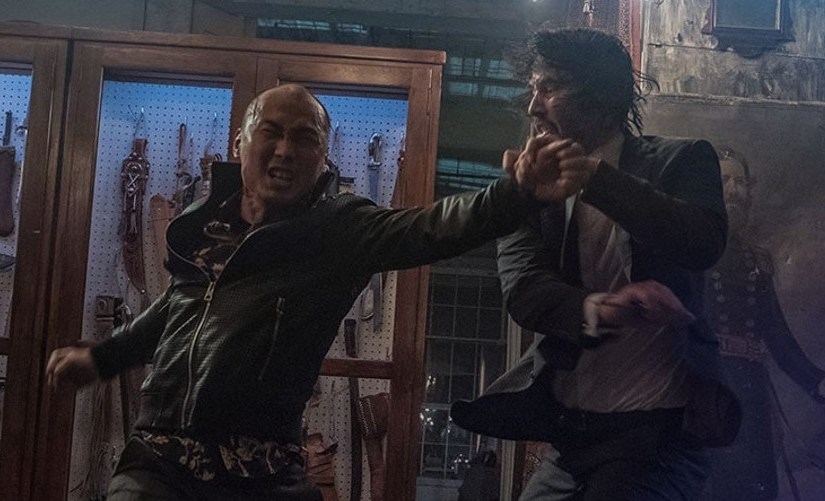
Let’s be blunt: you’re either a fan of the John Wick franchise, or you’re not.  These films are not for the casual moviegoer.  There’s just enough story to hang the fight scenes on, no more.  Everything we need to know about the John Wick character, we’ve gleaned from the first two films, and even that is minimal.  There’s no subtext, no neo-modern, meta-textual considerations to be discussed in terms of the screenplay.  The movie has but one purpose: to show off spectacularly choreographed fight scenes in which the good guy obliterates a crapload of bad guys.

I think I read somewhere there are eleven separate fight scenes in the film.  As such, the filmmakers were careful to make the fight scenes as distinctive as possible, especially when it comes to the weapons that are used.  Among these weapons are (let me see if I can remember them all): fists, knives, swords, axes, pistols, shotguns, machine guns, several thick books, a chisel, a couple of pissed-off attack dogs, and a belt.

Watching this movie was exhilarating for me.  The action scenes tapped into that teenaged part of me that used to love watching Enter the Dragon or The Good, the Bad and the Ugly.  I mean, I still love those movies, but for some reason, during Parabellum, I was positively giddy.  There was a sense that the filmmakers were attempting to provide us with the ULTIMATE action movie, the zenith, the ne plus ultra.  And I’ve gotta say, the last time an action movie gave me those kinds of vibes was The Matrix Reloaded during the freeway car chase.

There’s not much more to say about the movie.  Like I said, it has one purpose, and it does it extremely well.  If you love great fight scenes, congratulations, Christmas came early.

LONG SHOT (2019)

By Miguel E. Rodriguez

Director: Jonathan Levine
Cast: Charlize Theron, Seth Rogen, June Diane Raphael, O’Shea Jackson Jr., Bob Odenkirk
My Rating: 8/10
Rotten Tomatometer: 81% Certified Fresh

PLOT: Secretary of State Charlotte Field (Theron) hires an out-of-work journalist (Rogen) as a speechwriter; when romance unexpectedly occurs, complications ensue.


So, yeah, based on that plot summary, this is not exactly new territory.  We essentially have a gender-swapped The American President, except the President is now a Secretary of State, and Annette Bening is now Seth Rogen, whom the Secretary of State used to babysit in high school.  Sounds kinda kooky, but still nothing earth-shattering, right?

Except that the filmmakers have found a way to take a plot as old as Pretty Woman itself, and as recent as She’s Out of Your League, and inject it with astonishing humor, topical and situational, so that I found myself laughing or grinning through nearly every second of Long Shot.  And that was WITH Talky McTalkerson sitting next to us commenting to himself on the action.  (“How are you gonna say no to that face? … Oh, no, they’re stoned! … Oh, no, he doesn’t understand her!”)  But that’s another story…

I enjoyed so much in this movie, it’s hard to pick it apart for a review.  I’m not sure why.

I liked the gender-bending aspect of it.  It was cool to see a high-octane actor like Charlize Theron deliver the kind of speeches normally reserved for male romantic leads.  And it wasn’t done in an obvious way.  It’s something that only occurred to me after the scene was over.  Most of the time.

I liked the topical aspect.  Seth Rogen’s character is a high-minded reporter working for a liberal newspaper that has just been bought out by a multi-media conglomerate with a reputation for spewing propaganda.  (“Not the good kind, like ours!  The BAD kind!”)  The conglomerate is owned by Parker Wembley, an obnoxious billionaire whose influence extends all the way to the White House.  (I wouldn’t dream of revealing who plays Wembley, but it was a treat once I realized who was under all that makeup.)

The not-so-thinly veiled jabs at Fox News were a nice touch.  Wembley has his own news network, and one of the newscasts asks the question, “Are women smart enough to be in positions of power?  We’ll ask our panelists, Chris Brown, Jeremy Piven, and Brett Ratner.”  (In a movie full of funny lines, that might be the funniest.  Sorry I spoiled it for you.)

I also LOVED a scene between Seth Rogen and his best friend that gets a LITTLE political, but which really made me think about my own attitudes towards people with different political beliefs than mine.  I don’t want to spoil the scene with too many details, but I bring it up just to emphasize how much this movie has going for it besides the obligatory big laughs.

And it has some BIG laughs.  Rogen is an old hand at physical and raunchy comedy, but who knew that Charlize Theron would be able to keep pace with him?  It’s not that she does the same kind of mugging that Rogen does.  It’s the way she underplays her reactions to his behavior, and tries to keep her attraction to him low key for all sorts of reasons that make sense at the time.

Plus, Theron does get her moment in the comic spotlight when, after a hard day at work, she whispers to Rogen, “I want to smoke a molly.”  What follows is something I never thought I’d see: Charlize Theron getting wasted on drugs and dancing at a rave.  I can die happy.

(Trust me, I’m not spoiling too much, because this scene has an AMAZING comedy payoff that had me almost screaming with laughter.)

Long Shot covers some very old territory in very new ways.  There are some amazing insights into the cultural landscape of the late “20-teens” that are fresh and funny and surprisingly thoughtful.  If I had to change one thing about it, I might have tried to come up with a SLIGHTLY different ending, maybe one that didn’t tie everything up QUITE so neatly, but what am I saying?  It’s a romantic comedy.  Like they’re gonna make a rom-com where the girl DOESN’T get the guy, right?

(Yes, wiseguys, I know there are precedents – Roman Holiday among them – but that’s REALLY rare.)