UNSTOPPABLE (2010)

By Marc S. Sanders

An adventure of the unexpected needs to start with urgency. 

“Let’s say there’s a runaway train that’s barreling through the state of Pennsylvania and no one is on board to stop it.”

“Not bad.  What else you got?”

“This train is a half mile long. So, it’s a roller coaster of a beast.”

“Go on.”

“How about there’s another train on the same track and the two are going to collide with each other?”

“It’s got potential.  Anything else?”

“Oh yeah.  The train is carrying toxic chemicals that could cause mass destruction and casualties of epic proportions throughout the rural area.”

“Okay.  Now we’re talking.  Any guns?  Can we find a way to get machine guns into the mix?” 

“Yes!  I got it.  How about if the people try to derail it and the only way to make that happen is the cops shoot at this tiny button on the bottom of the engine, and this button is located between the gas tanks?  So it’s gotta be a direct hit while the train is in motion.”

“Okay.  Okay.  That’s genius.  Let’s green light it.”

Now this might have been how Unstoppable, director Tony Scott’s final film, got put into commission, but what is especially fascinating is that this is based on a true story. An out-of-control locomotive actually went off with no one on board to control it.  It happened within the state of Ohio about fifteen years prior to the release of this film.  Only it was not as dramatic or suspenseful as Tony Scott and his crew assembled their movie.  Unstoppable is a pumped-up, steroid enhanced reenactment of the actual story.

The director recruited his most common go to lead, Denzel Washington, for the role of Frank Barnes.  He’s an engineer with over thirty years’ experience who is wiser than the big wig suits on the top floor.  He can bring this potential disaster to a halt before it happens.  Frank is also a mentor to the fresh, young conductor, Will Colson (Chris Pine). 

Will is cranky because his wife is upholding a restraining order against him and the two are at a standstill of hashing their problems out over the phone.  Frank is in a bad mood because the young guys like Will are being brought in to replace the grizzled fellows who are being pushed out.  Frank is also a widower with two estranged daughters. Though, he gets a kick out of telling Will the girls are paying their way through college by working at Hooters.

Denzel Washington and Chris Pine make a good pair.  Buddies who antagonize each other at first, they later share what’s eating at them personally and professionally. Then they work well together to resolve the crisis at hand.  Their characters are not very dimensional, nor should they be.  After all, it’s all about the train.  Yet, I believed them as train engineers/conductors.  Either of these guys could be operating a merry go round and I’ll believe they know some serious shit about how the carousel operates and moves in a circular motion.  My point is these actors really work at it to appear like guys who are well trained within the freight train industry, and I buy all of it.

In the control center, staring at large monitors with high tech maps is Connie (Rosario Dawson).  She’s communicating on the CB with Frank and Will and giving them updates on the status of when their engine will be within hookup range with the one speeding out of control.  She’s also the figurehead with the smart mouth, needed to stand up to her bubbleheaded corporate boss (Kevin Dunn) who threatens to fire all of them.  In other movies, this guy would be the angry police captain in a cop movie.  He’d be the government official who believes he can protect the President while Kevin Costner or Clint Eastwood knows that’s not how it works.  This is a slot role.  Use the same dialogue for a guy like this no matter what the picture is about because it’s all standard stuff. 

On paper, Unstoppable sounds ridiculous and quite ordinary for an adventure.  A runaway train.  Isn’t there anything else?  Yet, Tony Scott applies his quick edits and aggressive zoom in and zoom out shots to the movie’s breakneck progression.  He’s also got those curved Steadicam movements within Connie’s control center accompanied with glowing bright lights of greens, reds and blues. 

News reporters’ updates, along with footage from helicopters, are spliced in between the scenes that Washington and Pine share together in the cab of their train engine.  The glue holds up well.  There’s time allowed for Frank’s girls to cheer daddy on while at Hooters. Will’s wife played by Jessy Schram holds their young son while nervously fidgeting and tearing up watching the news.  I don’t think she has any dialogue beyond the line “C’mon Will!” Soon, she’s live on the scene staring straight ahead for the final act of the film.  That’s a problem.   I’m questioning why she’s looking in the same spot straight ahead if this train barrels on and on.  It’s certainly not in a stationary position.  She’s not watching a baseball game.  No bother.  It’s not fun to question a picture like this with such semantics. 

The exhilaration comes in how Tony Scott sets up his action pieces with daring leaps on and off the train and running sprints on top of and in between the cars.  Guys hang from helicopters with attempts to board the train.  Cop cars turn their sirens on and speed parallel to the locomotive, and yes, as in any Tony Scott film, a handful of cop cars bang themselves up real good in some gritty pile ups. A gorgeous red pickup truck works its way into the story too.

Screeching sound effects are also necessary.  They were nominated for an Oscar. 

Perhaps my one complaint that’s hard to accept is that in some shots, the train, which is supposedly going at over 70 mph, doesn’t look like its going fast enough.  Urgency is important in a film like this and when I get the impression the train is not traveling at a high enough speed, well then the threat doesn’t feel so threatening.  It’s when there are shots underneath from an on the track perspective that you really get an idea of the exhilaration.  In a movie like Speed, the bus always looked like it was accelerating and never slowing down.  Here, the train seems to move slow enough at times that anyone could have just leaped on board, but as Miguel always says, “Then there would be no movie.”

Don’t go into Unstoppable with your Neil deGrasse Tyson laws of physics.  Don’t get hung up on the wife who can see everything that’s happening by staring straight ahead when this speeding train is racing past her from right to left.  Don’t worry. Move on.  It may not look like it, but this train is going faster than it appears. 

Just enjoy the ride, and relish in what set Tony Scott aside as a well-equipped and capable action director.  Sadly, he left this world too soon.  There were more fun action movies to be made by him.  Unstoppable at least reminds you why he is still so sadly missed.

THE KING’S SPEECH

By Marc S. Sanders

A man can carry the title of Duke Of York, but that doesn’t make him a super man.  After all, he is just a man like any other, and he can possess annoying hinderances like a stammer for example.  However, when you are part of the Royal Family with a historical lineage of thousands and thousands of years, celebrated and honored in majestic paintings and medals, the inconvenience is never acceptable. 

Colin Firth is Prince Albert George (and forgive me but he has assumed two or three other first names as his birthright that I can not recall.  Phillip, as well I think).  The King’s Speech opens when Albert has been tasked by his father, the King of England, to deliver a speech at Wembley Stadium.  Director Tom Hooper never made a small staircase, a microphone or an audience appear so fearful.  As Albert addresses the crowd, the words do not come out and the only one who can lovingly empathize with him is his devoted wife Elizabeth (Helana Bonham Carter).  The archbishop (Derek Jacobi) puts his head down in disappointment along with all the other formally attired spectators.  It’s a heartbreaking beginning of a story for a well-dressed crippled hero.

Following advisors and doctors who offer ridiculous remedies that allow no alleviation, Elizabeth finally finds an Australian speech therapist who just might be the best last resort for her husband.  Albert is stubbornly reluctant to visit with Dr. Lionel Logue (Geoffrey Rush) who insists that their sessions occur in his office.  Albert does not like that he will also not be addressed formally by Dr. Logue.  Lionel will call him Bertie. 

An unorthodox approach, at least for royalty, is what Lionel insists will aid Bertie.  It is certainly better than his doctor’s recommendation of smoking cigarettes directly into his lungs.  Bertie will lie and roll on the floor.  He’ll hum and bellow unusual noises.  He’ll have to loosen up his physique and even allow Elizabeth to sit on his belly to help him with breathing exercises while working his diaphragm.  The art of swearing is especially helpful.

An interesting fact that Lionel shares with Bertie is that no infant is born with a stammer.  It develops from another source.  Perhaps it is abuse or neglect as a child.  When you are a child of royalty you are not necessarily loved directly by your parents.  A nanny is likely closer to you; maybe even more abusive. 

The King (Michael Gambon) is respected by Bertie, but he is fearful of the future of his monarchy.  The older son, David (Guy Pearce) is next in line to assume the throne, but he is an immature bedhopping playboy, and the threats of Hitler and Stalin are becoming more prominent.  The King begins prepping his Albert by insisting he deliver radio addresses.  The father is not the encouraging type, though.  His disdainful demands are not the cure for Albert’s debilitation.

The King’s Speech advances a couple years during the 1930’s towards the precursors ahead of World War II.  The King has died.  David is behaving just as expected and Albert still suffers with his ability to speak, but Lionel has therapeutically made advances with his student and friend.  He just can’t lose his student.  Otherwise, Bertie will not overcome.

The film’s strength relies on a solid friendship that develops between a common civilian and a man of Royalty.  Geoffrey Rush and Colin Firth work marvelously together.  They are very different personalities with backgrounds that could not be more apart from each other.  The chemistry is a beautiful duet of dialogue from an Oscar winning script from David Seidler. This was Seidler’s first script he ever wrote at the age of eighty. 

The entirety of the picture has a set design from Eve Stuart and Judy Farr that is absolutely grand.  Every room of the palace has the most beautiful furnishings and wallpaper designs.  Tom Hooper uses wide distant lens’ that show the enormities of each room of the castle as well as Prince Albert’s home.  Sometimes he shoots from the floor above, pointing his camera at Albert and Elizabeth.  The majesty of royalty looks down upon the Prince and his speech impediment.  It’s an absorbing setting for the film.  Exterior shots also look authentic with the cars and the dreary coldness of the country and London cobblestones.  I love the hardwood floors that the characters walk upon in the picture, particularly in Lionel’s office.  The resonances of their dress shoes speak more clearly than the Prince. It all seems to echo the overwhelming conflict that our protagonist must overcome, and Colin Firth is terrific at demonstrating his frustrated insecurities.  It’s an Oscar winning performance not only earned for the well-timed stammer but also the mournful facial expressions that are caught in close ups.

The triumphant moment at the end of the film occurs after Albert has succeeded the throne from his incapable brother. He is obligated to address his country in a world-famous speech that eventually brought a defiant England into the second world war to fight off Hitler’s undoubted tyranny.  Tom Hooper’s camera follows a strong hearted, yet nervous Colin Firth walk from one room of the palace to the next until he finally reaches the small makeshift studio where his friend Lionel accompanies him to offer assurance as he speaks to his people and allies across the seas.  I don’t simply see a coach or one who lends confidence.  I see a friend working with another friend.  Again, Geoffrey Rush and Colin Firth make a wonderful pair in a long line of cinematic mentors and their students.

As history has taught us, the King’s speech was simply the beginning of a very dark and bloody experience.  The speech itself became a success, but the real challenge was yet to come.  However, confidence is what allowed a generation to survive.  The irony of The King’s Speech is that the hero a people needed lacked confidence in himself.  By the end of this picture, he is sending his faith, his trust, and his own assurance over to his constituents, who needed it the most in spite of a hindering stammer.  It’s a doubly blessed occasion that a lifelong friendship formed out of a troubling time.

THE BOOK OF ELI

By Marc S. Sanders

Do you believe in the word of God?

The Book Of Eli directed by The Hughes Brothers will make sure you do.

Faith carries Denzel Washington’s loner character on a journey through a grim, sunburned post apocalyptic wasteland as he protects a rare, sacred text. He has been on a sojourn to reach a final destination out west.

Me, being the religious skeptic these days, might normally find the convenient episodes of survival that Washington encounters as far fetched. However, The Hughes Brothers direct a script penned by Gary Whitta that never mocks the purpose of the film presented. As a viewer it would be rude of me to laugh at how Washington continues to walk when it seems he’s getting shot in the back. I wouldn’t dare misbehave in that manner. Watching The Book Of Eli…well…I feel like I’ve gone to church.

The Loner carries a book he faithfully reads every day as continues his long walk through treacherous, barren and motorcycle pirated lands. If the sun doesn’t blind him and kill him, the various marauders might.

The worst adversary of this bunch is Gary Oldman in yet another treasured villain role. Oldman keeps a tight authority on an “old west” inspired town, commanding from his comfortable leather chair in the upstairs level of the town’s bar (saloon, perhaps?). He’s been tirelessly dispatching men to find a particular book and perhaps it’s the one that The Loner possesses.

Post-apocalyptic wasteland, a book, a Loner, a villain. That’s the structure of this film along with some side characters like an impactful Mila Kunis and Jennifer Beals. Very simple ingredients allow for well edited moments where Washington can display his unexpected fighting techniques with a gun or a shotgun or a forearm length sword. When he exercises these moments the scenes are outstanding. Oldman is the guy who sits back letting his own horde do the dirty work and only acts when he sees that he has an upper hand. He’s oily, scary and in this dense waste of a future he likely dreams of being a prophet or a high powered evangelical might.

I was so pleasantly surprised by this film. Post apocalyptic films wear on me these days. How much is there to show that I haven’t already seen like abandoned cars, skulls, and deserted highways?

This is different however because Whitta’s script offers a reason to live through this hellish void. I had to wait for it but the ending is a very satisfying conclusion. I loved it, actually.

The Book Of Eli is a great film.

FOUR LIONS (2010, Great Britain)

by Miguel E. Rodriguez

Director: Christopher Morris
Cast: Riz Ahmed, Arsher Ali, Nigel Lindsay, Kayvan Novak, and a very special guest star
My Rating: 9/10
Rotten Tomatometer: 83% Certified Fresh

PLOT: A small group of incompetent British terrorists set out to train for and commit an act of terror.


The world of cinema has a long history of taking subjects traditionally considered taboo and turning them into comedy.  German concentration camps?  Life Is Beautiful mines it for comedy.  P.O.W. camps?  Ever hear of Hogan’s Heroes?  What about Hitler himself?  The Great Dictator and Look Who’s Back lampoon him perfectly.  Race relations?  Look no further than Blazing Saddles.  In recent years, even 9/11 has become a kind of punchline for jokes, with varying degrees of success.  As with all comedy, context is king.

Such is the case with Four Lions, a British film from director Christopher Morris.  In it, the subject and especially the philosophy of suicide bombers are, forgive the pun, exploded with equal doses of logic and ruthless humor.

Omar (Riz Ahmed) is a member of a “cell” of extremists who imagine themselves to be part of a glorious Jihad against Western civilization, but who, as Omar himself puts it, can’t even “stir their tea without smashing a window.”  In the opening scene, Waj (Kayvan Novak) is trying to make one of those videos claiming responsibility for a terrorist act, but the cameraman points out that the gun he’s holding is too small.  It’s actually a replica of an AK-47, but it’s about half scale.  Waj solves the problem by first saying he has big hands, then by simply moving closer to the camera.  Can’t argue with that logic.

Their leader, Barry (Nigel Lindsay), is a Caucasian man who has converted to Islam and become a true believer – “radicalized”, I think is the word.  (Director Christopher Morris says he’s based on a man who was once a member of a far-right, fascist party in the UK; in an attempt to “out-knowledge” the Asian youths he regularly assaulted, this man studied the Qur’an in depth…and as a result “accidentally” converted himself and became a Muslim.  Talk about truth being stranger than fiction.)  Barry is no prize either.  He knows all the proper buzzwords and catchphrases, but he is convinced the best way to defeat government surveillance when walking outside is to constantly shake your head back and forth.  So your face will come out blurry.  Once again, unassailable logic at work.

The fourth member is Faisal (Adeel Akhtar), who buys up large quantities of bleach and liquid peroxide for bomb-making, but to do so he had to make several trips to the same store.  To make sure no one at the shop suspected, he used different voices every trip, including a woman’s voice.  Barry objects: “You’ve got a beard!”  Faisal explains he covered his beard with his hands when he used the woman’s voice.

“So why has she got her hands on her face, Faisal!?”
“…cos she’s got a beard.”

Again…impeccable logic leading to ridiculous actions.  The movie is chock full of these kinds of perfectly logical reasons for doing absurd things.  A movie with only two dimensions would simply use that same lens, point it towards the actions of suicide bombers, and congratulate itself on its cleverness.  But Four Lions, hilarious though it is, goes another level deeper.

Omar has a wife and young son.  They are both totally on board with Omar’s plans for becoming a suicide bomber.  All three are convinced that his act of martyrdom will ensure his place in Paradise where he will eventually be reunited with his family.  When Omar discusses his plans with his wife, Sofia, she is calm, cool, and collected, as if they were discussing when and where to buy their next house.  When Omar tells his son a bedtime story, he makes changes to the story of The Lion King, so it more closely reflects his own beliefs, and the son smiles and eats it up.  Chilling.

But then Omar’s brother, Ahmed, pays a visit.  Ahmed is what I would call an “orthodox” Muslim, wearing the robes and head coverings and the longer beard.  By contrast, Omar is dressed in far more “Western” gear and trainers.  Ahmed has gotten wind of Omar’s plan and wants to try to talk him out of it because the Qur’an teaches non-violence…but his orthodox beliefs also state he can’t be in the same room as Omar’s wife.  Omar makes a point that, according to Ahmed’s beliefs, there are “60,000 opinions saying we can’t fight back!  We must measure our beard with a ruler and lock our wives in a cupboard!”

What you’ve got here is a key lesson in great comedy.  Be funny, but have a point.  What is the point here?  In my opinion, the point of this scene is to single out the vast contradictions possible in any kind of religion where extremists have staked out territory on the fringes.  A man believes in non-violence but can’t be in the same room as a woman.  Another man believes in martyrdom but has water gun fights with his son and wife.  They’re both right and they’re both wrong.  We tend to see one viewpoint as being hand in hand with the other by default, but Four Lions makes the case that great variety is possible.  A man in a robe and a long beard is not automatically a terrorist.  A man with a loving wife and family is not always the “good guy.”  Nothing is black and white.

But I don’t want to make the movie seem like it’s some kind of grand polemic on religious intolerance.  It has its serious moments, yes, but damn, is it funny.  I’m trying hard to think of another movie where a bunch of terrorists wind up running in a fictional “fun-run” marathon dressed as a ninja turtle, a cowboy riding an ostrich, an upside-down clown, and an orange bear.  (Actually, I’m not quite sure that’s a bear…that would be a question for the police.)  Or where one terrorist’s master plan involves strapping a bomb to a crow.  Or where a short discussion is held to determine exactly which parts of a car are Jewish.  As they say in the clickbait ads, the answer to that question may SURPRISE you!

(Also, if you’re a fan of Star Wars, I apologize in advance for any trauma you may experience…you’ll see what I mean.)

Admittedly, the subject matter of this comedy may turn off some viewers.  That is their right.  But if you’re an admirer of sharp-edged comedy that takes no prisoners and follows its own logic to its inexorable conclusions, Four Lions is gold.

CAVE OF FORGOTTEN DREAMS (2010)

by Miguel E. Rodriguez

Director: Werner Herzog
My Rating: 9/10
Rotten Tomatometer: 96% Certified Fresh

PLOT: Filmmaker Werner Herzog is granted a rare opportunity to film a documentary inside France’s Chauvet Cave, where the walls are covered with the world’s oldest surviving paintings, dating back some 30,000 years.


Over the last several years, I’ve had the opportunity to travel to some amazing places, including London, England, where we toured the famous Tower of London.  When I lived in Virginia, we used to visit colonial Williamsburg, where some structures and artifacts exist from the 1600s.  But at the Tower of London, we saw walls and structures that have existed since the 1400s.  Six-hundred-plus years old, man!  Wild!  We saw Anne Boleyn’s final resting place.  THE Anne Boleyn!  Was buried right there.  Freaky.

Then we traveled to Greece, and that really put the zap on me.  We walk to the Acropolis and a tour guide tells us, “And that rock over there is Mars Hill, where the apostle Paul preached to the Greeks over two thousand years ago.”  TWO THOUSAND YEARS.  And in a museum, we saw artifacts dating back to 5,000 BCE, objects that were so old the archaeologists weren’t even sure what they were for.  Religious totems?  Toys for children?  Purely decorative?  Who knows?  I love this kind of thing!  Looking at things that have survived for millennia, created by people who were probably just satisfying a hobby, for all we know.

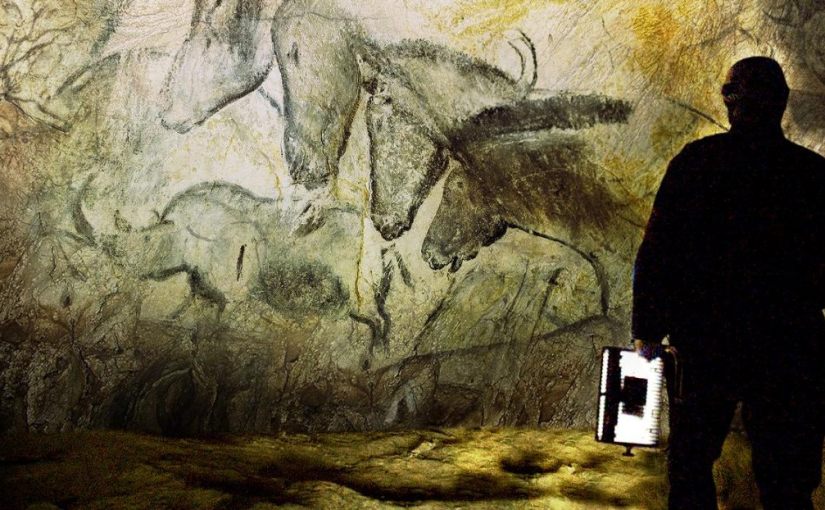
Now comes Werner Herzog’s documentary Cave of Forgotten Dreams, in which he was allowed to film inside the famous Chauvet Cave in France.  Inside are the oldest known artistic renderings of any kind on the planet.  How old?  Approximately thirty thousand years old.  To put that number in perspective, when Paleolithic humans made these paintings, the surrounding area was covered with a glacier that was so huge, when it finally melted, the ocean levels rose three hundred feet.  A hunter could have crossed what is now the English Channel by walking on dry land from coast to coast.  It’s an abyss of time that is utterly incomprehensible to me.

These paintings are indescribably cool to observe.  I’d seen photos before, but to see them on film is an indescribably stirring experience.  There are drawings of horses and wild rhinoceros that look as if they were drawn yesterday.  One animal was drawn with a total of eight legs.  A mistake?  No.  It was an attempt by the artist to convey movement or motion.  PROTO CINEMA.  Mind.  Blown.

There are handprints by some of these drawings.  Were they intended as a signature by the artist?  Perhaps so, because further into the cave are more handprints by other drawings, and we can tell they’re handprints from the same person because of a crooked pinky finger.  A maker’s mark from three hundred centuries ago.

I can’t stop.  On the floor of the cave, nearly obscured by eons of calcification and crystals, are visible footprints of a wolf and a 7-year-old child.  Was the wolf stalking the child as prey?  Were they maybe companions?  Or are the footprints separated by years, or decades, or centuries?  Near what used to be the entrance to the cave – the actual entrance was blocked by a rockslide an unknown number of years ago – is a rock with a flat top like a table, and on the table, facing the entrance, is the skull of a cave bear.  Traces of charcoal at the base hint that incense may have been burned there.  Was this a temple?  A holy place?  Or did they just think it looked badass to have a skull on a table?

This stuff fascinated me.  I found myself thinking about, of all things, a scene from Star Trek: First Contact, when Picard, having traveled back in time, is able to reach out and touch the very first vehicle to achieve warp speed.  He explains to a confused Data that touching something old is a way of somehow reaching back across the centuries and identifying yourself with the people who created it.

That’s what these cave paintings are like.  They’re a conduit back through time.  Along with the paintings, archeologists also discovered remnants of what look like flutes.  One enterprising guy recreates one of these instruments and plays it for the camera.  Using a 30,000-year-old design, this guy knocks out the first stanza of The Star-Spangled Banner.  On a flute made from BONE.

Why did Herzog even want to make this movie?  To be a social activist?  The cave is in no environmental or man-made danger.  There are only two weeks out of every year when anyone is even allowed inside the place.  He filmed it in 3-D.  Was he looking for a fast buck by capitalizing on the 3-D craze around that part of the decade?  It only grossed $5.2 million, a pittance, even by documentary standards.  (Although that was the highest box-office return of any independently released documentary of 2011…so there’s that, I guess.)

So why do this?  Because I believe Werner Herzog is one of the last remaining filmmakers who will make a film simply because he feels he must do so.  He latches onto an idea, and it will not release him until he commits it to film.  He doesn’t particularly care if it’s commercially viable or mainstream or anything.  If he gets an idea (and the funding), he finds a way to get it filmed.  It may not reach everyone, but you know what they say: “If you only reach one person, you succeeded.”

Man, did this reach me.  I was fascinated from beginning to end.  There’s one sequence that is nothing but, I think, 5 or 10 minutes of the camera simply regarding the paintings, slowly panning and tilting, just looking at them, while strange, but appropriate, music plays in the background.  Under any other circumstances, this would be boring.  Here, it was almost holy.

NOSTALGIA FOR THE LIGHT (2010, Chile)

by Miguel E. Rodriguez

Director: Patricio Guzmán
My Rating: 10/10
Rotten Tomatometer: 100% Certified Fresh

PLOT: This award-winning documentary juxtaposes the search for answers about the history of the cosmos with Chilean women searching the Atacama Desert for the remains of loved ones killed by a despotic regime decades earlier.


I am going to look at the stars.  They are so far away, and their light takes so long to reach us…all we ever see of stars are their old photographs. – Dr. Manhattan, Watchmen


If Nostalgia for the Light has one flaw, I might point to its rather abrupt ending.  It comes so quickly it almost cuts off the sentence being spoken by the film’s narrator.  Perhaps it’s metaphorical.  The film is over, but there is no resolution.  The riddles of the cosmos remain unanswered, and the bodies of cherished loved ones remain undiscovered.  If they don’t get a resolution, why should we?

The Atacama Desert in Chile is one of the driest places on earth, with an average annual rainfall of 0.5 inches.  With its virtually zero percent humidity, the skies remain remarkably clear at night, making it one of the prime spots on the planet for astronomical observatories.  From these perches, astronomers use massive visible light and radio telescopes to probe the outer reaches of the cosmos, searching for clues to the origins of life, the universe, and everything.  (Sorry, couldn’t resist.)

One astronomer points out that many times, when science finally answers a question, two more pop up to replace it.  He says some people even consider it an exercise in futility.  If every answer only reveals more questions, why bother?  You might as well ask NASA why we sent men to the moon.  Because it’s in man’s nature to know, to try to find out what’s over the next hill or what is beyond the farthest galaxy.

Another scientist explains that the calcium in our very bones literally comes from the stars.  Everything on earth today is descended in one form or another from the Big Bang.  Radio telescopes can measure the calcium levels in distant stars.  (Calcium in stars?  You learn something new every day.)  That calcium came from the Big Bang, and so did Earth’s.  As Carl Sagan said, “We are star stuff.”  We may die, and we will.  The stuff in our bodies remains, and will eventually help a tree to grow, or a vegetable, and so on and so on.  The circle of life, as it were.

All this information in the film is presented in a very straightforward without flash or fanfare, at least in terms of the narration.  Visually, the filmmakers use great editing with the interiors of huge observatory domes and the immense telescopes within, cut together with stunning vistas of starfields, including shots of our own Milky Way.  Indeed, the film’s narration informs us that, night after night, “slowly, impassively, the center of the galaxy passes over Santiago.”

But this is not simply an overblown episode of “Nova.”  Nostalgia for the Light is divided almost schizophrenically into two parts bumping into each other for the duration of the film.  It’s this second part that gives Nostalgia its heart and soul.  I’ve been thinking about it ever since I finished watching it this afternoon.

In 1974, Augusto Pinochet rose to power in Chile.  His dictatorship lasted for 17 years.  During that time, he imprisoned as many as 80,000 people in concentration camps in the Atacama Desert, killing anywhere from 3,000 to 4,000 dissidents.  To cover his tracks, he ordered his military to truck the bodies into the desert and dump them in unmarked mass graves.  It was rumored that he also had many of them thrown into the ocean.  Families were torn apart.  One young woman in the film tells how, when she was 12 months old, her grandparents were forced to reveal the whereabouts of her mother and father, using her as leverage.

For decades since then, women have come to the desert with spades and pickaxes, searching the dry ground for clues to the whereabouts of their loved ones.  The desert is enormous, and there are very few of these women.  In the film, they talk about the people who try to convince them of the futility of their actions.  Not just their friends or family, but public figures, politicians.  They are embarrassing.  They are dredging up a painful past others would prefer to forget.

One of these women wishes the giant telescopes on the distant hilltops could be designed to see through the ground instead of into space, so they wouldn’t have to dig.  They could find the secrets of their past much more quickly.  But of course, that’s exactly what the telescopes are designed to do.  They’re just pointing in a different direction, reaching to a far more distant past.

When I was younger, I was of the belief that a good documentary had to be completely impartial.  It simply documented what was happening without commentary from the filmmakers.  You could use editing to make a point, but it was against the “rules” to editorialize your subject.  And never use a narrator.  Let the audience make up its own mind, right?  The fancy word for this kind of strictly observational filmmaking is “cinéma verité.”

Nowadays, with most modern documentaries I’ve seen, the strictures of “cinéma verité” have gone by the wayside.  Instead of being a passive observer, the director is free to edit together disparate footage and interviews to make their point of view heard loud and clear.  This director, Patricio Guzmán, is using this documentary as a tool for social activism, or at least awareness.  I wouldn’t normally care for this kind of in-your-face, this-is-my-point documentaries.  I have never been a fan of Michael Moore’s films (at least not anything after Roger and Me), and I think Morgan Spurlock’s films are nothing but glorified Jackass stunts.

But Nostalgia for the Light affected me in a way I did not expect.  There is a sequence where an astronomer explains how “the present” isn’t technically real.  Light from the sun takes eight minutes to reach earth.  The light we see from the distant stars are years, decades, centuries old.  What we see in the sky is not the stars’ true position.  It’s where they were years and years ago.  It’s almost as if we’re looking at the memory of light.  This concept, which I’ve heard before, simply boggled my mind this time around.  I don’t know how to explain it.  And then when the film draws parallels between the astronomers searching for answers in the cosmos to the sad, determined women searching for closure in the desert, and the perceived futility of both ventures in the minds of so many…it’s very difficulty to put into words.  I felt that I was watching, or perceiving, something that transcended my poor abilities to describe it.

The astronomers search for answers to better our world and themselves.  The women in the desert search to bring closure to their lives and to the lives of the ones they lost.  They cannot forget, as so many in their country have willingly forgotten.

Director Guzmán also narrates the film, and I believe the crux of the entire film can be explained in one of his lines: “…those who have a memory are able to live in the fragile present moments.  Those who have none don’t live anywhere.”

THE AMERICAN

By Marc S. Sanders

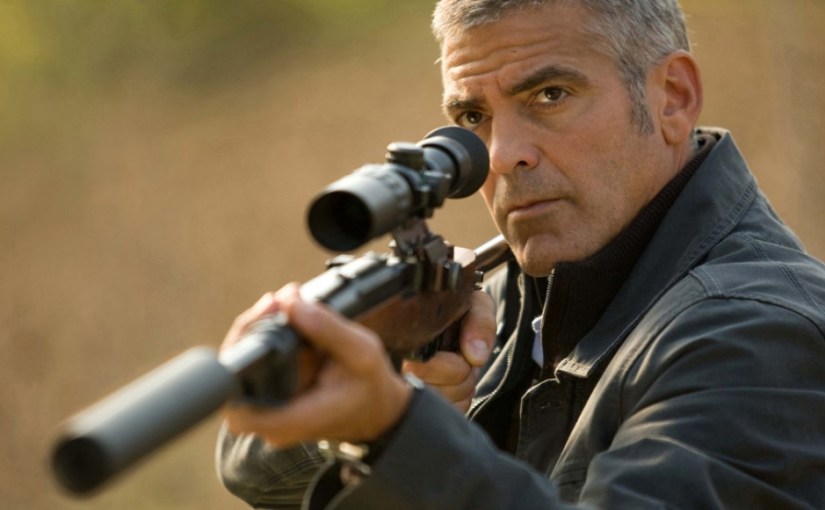
Director Anton Corbijn must have been terribly bored directing George Clooney in The American. All that his top billed star does is brood. He broods a lot, and sips coffee, reads a paper, drives his car, and constructs an assassin’s rifle for a beautiful woman.

Corbjin’s film opens with Clooney playing a man named Jack (no last name offered) who’s an assassin and about to be a target of Swedish men who share the same interest. It’s a good quiet start for a film, with an eye opening surprise to close it out before advancing the story.

Jack is instructed by his confidant to hide out in a small Italian town where a local priest encourages him to admit his sins. It’s not so easy, however, when Jack is busy bedding a local prostitute and building a dangerous weapon for pay.

I saw the ending coming. Yet, it’s a good ending. Getting there is the challenge. I think this was Clooney’s attempt to echo Matt Damon’s Jason Bourne. Brood, hardly speak, look at unusual people and cars in the vicinity, hide in plain sight without altering your appearance, sip coffee, drive a car, and brood some more. Brooding, however, begets boredom…at least for me it does.

The American drags itself slowly through an hour and forty-five minutes of countless close ups served up by Corbjin. There are so many close ups of Clooney that he obviously needed something to do besides appearing stoic all the time. So, he shifts his chin and bottom jawbone back and forth. I wanted to know if Clooney was chewing gum. That’s about all the film offers me to ponder at times. Is George Clooney chewing gum, or is he chewing his cud? Gotta go with the latter because I didn’t see a pack of gum anywhere within this town.

Yeah! That’s about all there is to say about The American. Corbjin gets some breathtaking shots of the Italian countryside, but I didn’t care about that. All I wanted to know was if George Clooney is a gum chewing assassin, or just an assassin, and because there will likely never be a sequel, I’ll never find out.

Darn!!!!

THE SOCIAL NETWORK

By Marc S. Sanders

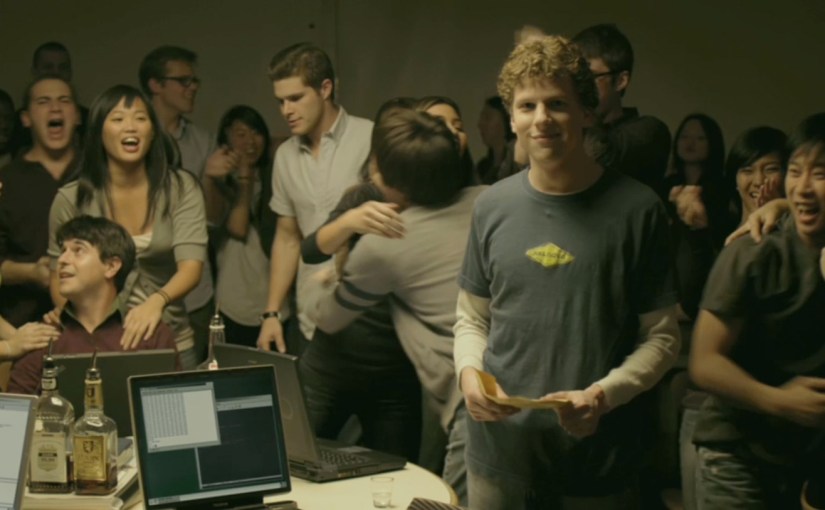
Power and knowledge can be a dangerous thing for a kid who is not necessarily as mature as his IQ would suggest. Mark Zuckerberg reinvented the way an entire planet functions from his Harvard dorm room. In the process, he couldn’t have cared less about the antagonism he was generating.

David Fincher’s The Social Network, with a brilliant screenplay by Aaron Sorkin captures kids with too much opportunity to seize, and the hubris they carry when they discover money, jealously, pride, and greed through a winning societal experiment.

The film features one of the best casts ever assembled, at least definitely within the confines of the 21st Century. Andrew Garfield, Justin Timberlake (should’ve been nominated), Armie Hammer (one of the best twin brothers’ portrayals in film), Rooney Mara, Brenda Song, and of course Jesse Eisenberg. Sorkin wrote the dialogue. It’s another thing to deliver it.

These people talk before they think, and it’s likely what caused them the aggravations of their own success and discovery. Watch the first scene between Eisenberg and Mara, as Zuckerberg and his girlfriend, Erica. Zuckerberg is already too smart for his own good. His failure with dating Erica is destined to be his undoing. He’ll never recover from this moment. Never! This is a kid with his hand on the nuclear button and he can’t stop pushing it. The other characters are all the same. Harvard geniuses with so much to gain, but how much will they lose?

Mark Zuckerberg, Cameron & Tyler Winklevoss (the self-absorbed twins of prestige and legacy), and Sean Parker (inventor of Napster) are prophets of a bigger picture. They foresaw the basic human desire for attention. People’s needs to be noticed are the commodities to monetarily profit from. These kids knew that better than anyone else. Ironically, Zuckerberg’s best friend and financial partner, Eduardo Saverin (Andrew Garfield), didn’t know it until he realized he was a large step behind. It cost a lot of money. Ironically, in the process of creating a new means of connecting with friends, it suffered the cost of a friendship, as well.

The Social Network will always be one of my ten favorite films. (Talk about huge Oscar upsets…excuse me The King’s Speech for Best Picture????) I’m always amazed at these kids with power. The knowledge they possess is bigger than anything within the confines of our historical governments, and yet they bicker and steal and betray like toddlers in a sandbox. Switch out “Facebook” for a Nerf football or a Barbie doll, and you can still apply this fast-paced wit of words. Sorkin pounced on that dichotomy. We’ve seen civil lawsuits on film with grand disputes and long speeches in front of arbitrators. We had yet to see college students dominate tables full of lawyers with crackling dialogue exchanged to prove their worth over one another. Amazingly enough, Sorkin used much of the dialogue from recorded transcripts he accessed. These guys actually spoke like this with each other. These technological pioneers gave the planet’s people the attention they wanted. Yet, what ultimately mattered to them was the credit for what they felt entitled to.

I’ll never tire of watching The Social Network, even if listening to Mark Zuckerberg is as exhausting as talking with a stair master.

One of best films ever made.

IRON MAN 2

By Marc S. Sanders

Iron Man 2 is a Frankenstein’s Monster of a film. Director Jon Favreau returns, but not with the same insight he invested into the first Iron Man. This loud, headache inducing sequel is an assemblage of cutting room floor scenes taped together to mask itself as a cohesive narrative brought to life. The movie exists. Yet it has no brain.

Six months have passed since the events of the first film, and Tony Stark (Robert Downey Jr) is ready to open his peace parade Expo in New York. The problems begin here. Stark, who redeemed himself as a born-again, eyes open martyr at the end of the first film, reverts to an obnoxious jerk full of brash, rude cockiness. Downey goes so over the top with his improvisational one liners that you can hardly stand Tony Stark, and this is all before he gets drunk and pees in the Iron Man suit.

Stark is experiencing rapid blood toxicity from the suit and he is unable to find a solution. I might have been concerned at first but after the film is over, the convenient remedy just made me feel cheated. Poor writing offers a convenient get of jail free card.

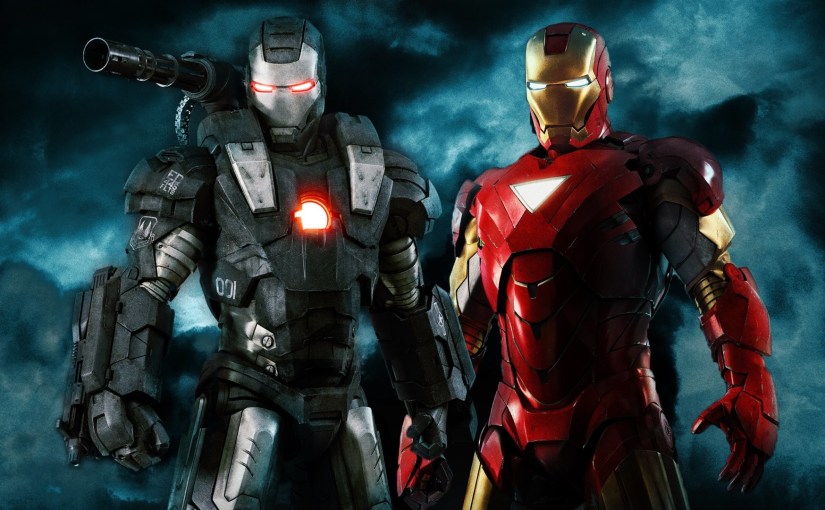
Then there is Stark’s relationship with his friend Rhodey (Don Cheadle). Cheadle shows potential in the part he resumed from Terrance Howard, but he really only serves two sole purposes, to have an armor throw down with Tony throughout the mansion (a stupid fight by the way), and to wear the new War Machine armor. That, I’ll say is pretty cool in charcoal black with red eyes and a shoulder resting machine gun.

Gwenyth Paltrow is back as Pepper Potts, and she just kvetches a lot. Paltrow and Downey’s chemistry are all but gone. Not really the actors’ fault though. More so, it’s the dumb screenplay by Justin Theroux who I guess found it adorable for the two players to squabble amid the action scenes. It’s rather annoying actually.

Theroux makes a lot of misfires here. The great Mickey Rourke appears to have fleshed out a great villain known as Whiplash. A Russian physicist with a grudge against Stark. Rourke offers a scary appearance of long hair, gold teeth and a tattooed muscular body. Oh, and he has a cockatoo as well. Mustn’t forget that. Too much of this film is devoted to this bird that does nothing. Whiplash is insufficiently written. He has a mid-film battle with Stark at the Grand Prix in Monaco, then following a prison escape, he’s harbored by Stark competitor, Justin Hammer, in a factory where he does nothing but build robots. None of this is interesting.

Sam Rockwell plays Hammer as a whiny kid in nerdy glasses and even nerdier three piece suits. He’s not a villain you ever love. He’s a Frank Burns, but his stupidity against Stark and Rourke’s character offers no humor from the stooge that he is.

Side stories focus on anticipation towards the first Avengers film with Samuel Jackson as Nick Fury and Scarlett Johansson’s Black Widow, yet not much is offered. They have nothing to do with anything else going on in this hodgepodge. Johansson finally gets a good fight scene during the climax, but it remains brief.

So there’s really nothing in Iron Man 2. It’s just a mix of things smashed together. The Iron Man suit only has three scenes, one to open the Expo (no fight there), one to have drunk Tony Stark fight with Rhodey while wrecking his house (Belushi did it better in Animal House, as well as the cast of Sixteen Candles), and then finally in a climactic ending against Hammer’s military robots and Rourke’s Whiplash who hardly participates in the moment.

Iron Man 2 is likely my least favorite of all the MCU films. (Actually, Eternals took that top honor, recently.) It offers one redeeming quality and that’s its end credit scene, maybe my favorite of that particular category.

Otherwise, Iron Man 2 is pointless, dumb, ignorant of its product, and flat out obnoxious.

Stan Lee Cameo: Was that Larry King? Really?

INCENDIES (2010, Canada)

by Miguel E. Rodriguez

Director: Denis Villeneuve
Cast: Mélissa Désormeaux-Poulin, Lubna Azabal, Maxim Gaudette
My Rating: 10/10
Rotten Tomatometer: 93% Certified Fresh

PLOT: Twins living in French Canada journey to the Middle East to fulfill their mother’s last wishes by discovering their family history.


A few years before French-Canadian director Denis Villeneuve made a big splash in American cinema with Sicario, Arrival, and Blade Runner 2049, he directed Incendies [French for “flames” or “fires”…I had to look it up].   This is one of the best films I’ve ever seen.  It’s a mystery, a melodrama, and an urgent plea for peace, all at once.  It’s heartbreaking, engaging, absorbing, and beautiful to look at.  There are two directors currently working who I believe have successfully picked up the mantle left behind by Stanley Kubrick.  Denis Villeneuve is one of them.

(The other is Alejandro G. Iñárritu [Babel, The Revenant], but let’s not get sidetracked…)

A mother dies.  At the reading of her will, her twin son and daughter receive a mission: go to the Middle East and track down their previously unknown father and brother, and give them letters in sealed envelopes.  Only then will the mother allow a headstone to be erected on her gravesite.

The brother, Simon, is skeptical, owing to the mother’s strange behavior in her later years, but the daughter, Jeanne, dutifully follows her mother’s wishes and travels to an unnamed country in the Middle East and begins the laborious process of tracking down anyone who knew her mother and father.

We also get flashbacks of the mother, Nawal, in her younger years, paralleling the daughter’s search.  We learn that Nawal, a Christian, fell in love with a Muslim, Wahab, which is a BIG no-no, to say the least.  Soon, Wahab is out of the picture, and Nawal gives birth to a son who is immediately taken from her arms and delivered to an orphanage.

So far, this is standard soap opera material, but it’s depicted with gorgeous cinematography and spot-on direction.  Director Villeneuve uses a lot of wide shots that have a stark beauty; they reminded me of some of the memorable vistas from Bonnie and Clyde and The Deer Hunter.

When Nawal gets a little older, she decides to track down her son.  This is made difficult owing to the state of war that now exists between Muslims and Christian Nationalists.  Attacks and reprisals make it nearly impossible to find accurate records.  She travels alone from one burned-out orphanage to another looking for clues.  At a key moment, she flags down a bus, but is very careful to first hide her crucifix necklace and put on a head-covering.  Can’t be too careful.

At this point, regrettably, I have to abandon summarizing the story, because the less you know about what happens after Nawal gets on that bus, the more effective those events will be.  Suffice to say it’s a life-changing event, one that sends her on a wildly careening path from activist to assassin to political prisoner.

All of this, naturally, comes as a shock to her children, Jeanne and Simon, who are starting to think this search for missing family members may be a mistake.  At one point, someone makes an important statement: “Sometimes, it’s better not to know some things.”

So…what is this movie really about?  It’s not just about the mystery of the missing family members, which is enough of an engine to make a compelling movie on its own, especially when it’s intertwined with the mother’s past.  But there is a deeper, much more profound level to Incendies that is not apparent until the movie’s final sections, when the threads of Nawal’s past converge in a moment of shattering revelations.  The movie beautifully hides its real motives along the way so you get blindsided by its true message, its true heart.

I dunno, maybe I’m getting too mushy.  But that’s the effect this movie had on me.  I’ve only experienced this kind of emotional catharsis after a precious few films.  It’s impossible to fully describe it without giving away the secrets lying at the heart of Incendies.