MATCH POINT (2005)

By Miguel E. Rodriguez

Director: Woody Allen
Cast: Jonathan Rhys Meyers, Scarlett Johansson, Emily Mortimer, Brian Cox
My Rating: 10/10
Rotten Tomatometer: 76% Certified Fresh

PLOT: At a turning point in his life, a struggling, engaged tennis instructor (Rhys Meyers) falls for an aspiring actress (Johansson), who also happens to be engaged…to his soon-to-be brother-in-law.


Watching Match Point is as exhilarating as any moviegoing experience I’ve ever had.  It’s pure soap, much like its uncredited (but obvious) inspiration, 1951’s A Place in the Sun with Elizabeth Taylor and Montgomery Clift.  But a crucial decision is made by the main character in Allen’s film that shifts everything into darker territory more comparable to Hitchcock than George Stevens.

One of the best things about the film is the editing.  It’s not a short film, clocking in at just over two hours, but everything feels pared down to the bare essentials.  The passage of time is indicated in efficient pans or quick cuts.  Unnecessary conversations are cut short.  Winter changes to spring in a single fade.  Allen wastes no time in getting to the meat of the story, and it makes for a film that hurtles along breathlessly.

The performance by the lead, Jonathan Rhys Meyers, is also a key factor.  Watching it again for the first time in quite a while, I was struck by how measured his deliveries are.  There’s nothing wrong with it on a technical level, but it always feels like he’s acting or performing.  Even when his character, Chris, interacts with his girlfriend who eventually becomes his fiancé, nothing he does feels real.  It’s almost distracting, how theatrical his performance is compared to everyone else’s.  I was thinking, “Well, I guess Rhys Meyers is the best they could get to stay under budget.”

EXCEPT…when he meets Scarlett Johnasson’s character, Nola.  Only then do his eyes and face reflect the lust in his words.  They flirt fiercely for about a minute before they’re interrupted, but the damage is done.  He’s hooked.  And it’s at THAT point I realized the “staginess” of his acting in previous scenes was intentional, because his character WAS acting.  Chris is ALWAYS putting on a performance for everyone around him, except Nola.  With Nola, we see the real Chris, the focused, hungry Chris who will stop at nothing to get what he wants.

It’s a brilliant layer to a brilliant film.  Woody Allen has created a movie that starts out exactly like so many of his previous character-driven art-house films, so much so that we never suspect the surprises in store.  For the score, he chose stock opera recordings, really OLD opera recordings that sound so scratchy I wonder if any of them were actually being played on the old Edison cylinder players.  It’s the PERFECT topping.  It creates a uniquely Allen-esque atmosphere that lulls us into the feeling that, well, I know where THIS is going.

But I assure you, you don’t.

Pay particularly close attention to the various discussions of luck peppered throughout the film.  At multiple milestones in the film, luck plays a HUGE part, not always for the good.  Are these plot conveniences?  Well, how much of our own lives are governed by luck, good or bad?  An acquaintance of mine was killed in a wreck where a truck toppled onto him from a highway overpass.  Another was killed because someone was driving at night with no headlights.  Another friend contracted breast cancer, but is now in remission.  I have two uncles who last cancer battles.  Yet another acquaintance, the daughter of a friend, beat childhood leukemia.

Luck is inextricably linked with our existence, to the degree that it’s a little frightening.  We can bitch and moan about plot contrivances in movies and convenient phone calls and the rest, but if you step back, everything in existence is a contrivance: random meetings and phone calls and stoplights that keep us from hitting that pedestrian, and missed flights on airplanes that end up crashing, etcetera.

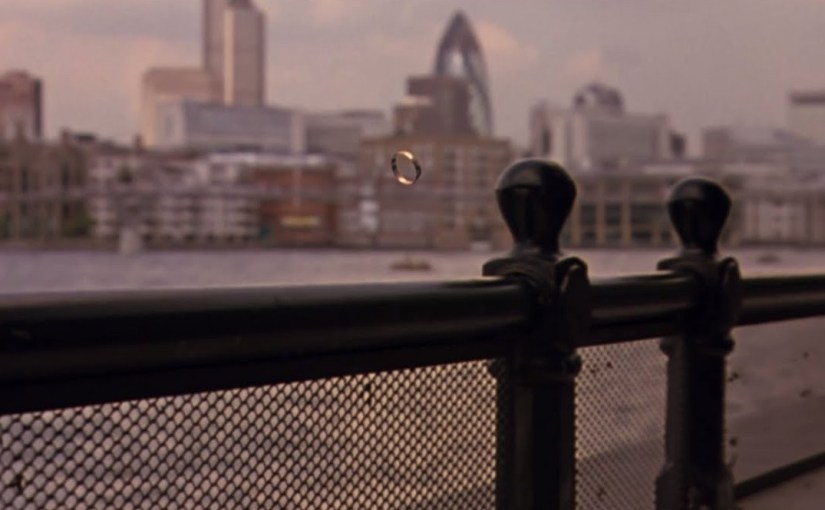
That’s REALLY what Match Point is drilling down to.  We live our lives, we play our roles, we follow the scripts WE choose…or are they chosen for us? Even without the backdrop of luck as a metaphysical discussion, the movie is an absolute top-notch thriller, one of the best of 2005, or any year, for that matter.  But it’s that next level hanging in the background that makes it my favorite Woody Allen film.
QUICK TAKE: Munich (2005)

By Miguel E. Rodriguez

Director: Steven Spielberg
Cast: Eric Bana, Daniel Craig, Ciarán Hinds
My Rating: 9/10
Rotten Tomatometer: 77% Certified Fresh

PLOT: After the terrorist group Black September kills Israeli athletes at the 1972 Olympic Games, Israel responds by sending covert hit squads after the men responsible.


Munich is an engrossing film that doesn’t pretend to have easy answers.  Anyone who comes out of the movie thinking that Spielberg has either denounced or commended Israel’s actions in the aftermath of the 1972 attack wasn’t paying attention.  The film simply portrays the aftermath in an extremely even-handed manner, presenting both sides of the argument without making a judgement call itself.  If there’s a judgement call to be made, that’s on you.

To make a movie that hinges on an attack by Arab terrorists just four years after 9/11 was a risky move.  Four years sounds like a long time, but I can assure you, it was still fresh in everyone’s minds at the time.  The film closes on an image of the New York skyline as it appeared in the ‘70s, complete with the digitally restored Twin Towers.  Aside from being an extremely effective visual statement tying the events in the film to today’s world, it was a little eerie.

Eric Bana is a mass of contradictions, a committed Israeli soldier who leads a squad of assassins, but who starts to have misgivings after a couple of close calls.  Their targets are essentially assigned via a safety deposit box.  No questions, no discussion: kill these men. But he starts asking the very questions that can’t be answered.  He wants proof that these assassinations are making a difference.  All he sees are newly vacant spots in the organization being filled by terrorists even MORE extreme than the one before.  So what’s the point?

Suffice to say, it’s one of Spielberg’s finer efforts, and it will challenge you to think critically about your deeply held views, whatever they may be.  And isn’t that a workable definition of “art?”

THE CHRONICLES OF NARNIA: THE LION, THE WITCH AND THE WARDROBE (2005)

By Miguel E. Rodriguez

Director: Andrew Adamson
Cast: Tilda Swinton, James McAvoy, Jim Broadbent, Liam Neeson
My Rating: 8/10
Rotten Tomatometer: 76% Certified Fresh

PLOT: In London, during the German blitzkrieg, four children travel through a wardrobe and discover the fantastic land of Narnia.


In the ranks of books aching for cinematic adaptations, C.S. Lewis’ classic fantasy riff on Christian symbolism surely must have been at the top of Hollywood’s list for years.  With the raging success of Peter Jackson’s Lord of the Rings and the Harry Potter films, someone must have decided it was finally time to get this on movie screens.

The only problem is, TCON: TLTWATW [it’s a mouthful] will inevitably be compared to those other immensely successful franchises.  As a result, while the movie itself succeeds admirably, I find myself thinking, “Yeah…but it doesn’t QUITE pack that Return of the King punch.”

But film appreciation/criticism/whatever is not about how a movie performs in comparison with other films.  It’s about how the movie tells its own story in its own way.  So.

This first installment in the Narnia franchise is a good old-fashioned, rollicking fantasy yarn.  Elements of the film will remind people of everything from Star Wars to Spartacus, in all the good ways.  There is, perhaps, a tendency to believe this movie is only for children, particularly due to the talking animals and the fact that the main characters are children.  (There’s also the unexplained appearance of no less than Father Christmas himself.)  But I disagree.  I think the story has a lot to offer to both kids and adults.

Take, for example, the overt Christian overtones of the story.  [SPOILER, SPOILER, SPOILER, SPOILER ALERT!!!]

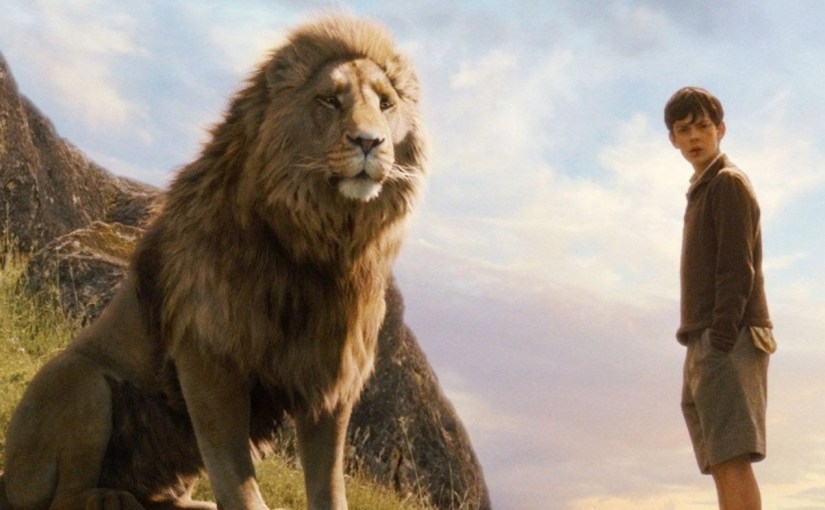
Aslan, the lion king of Narnia, sacrifices his life to redeem the life of Edmond, one of the Pevensie children who briefly turned traitor.  The White Witch murders Aslan in an unexpectedly creepy ritual featuring orcs, minotaurs, and what appear to be some kind of vampire hybrids.  But, because of the “old magic”, Aslan returns to life.  There hasn’t been a Jesus story this obvious since E.T.…or maybe The Matrix.

This might make some folks believe the whole film is some kind of Christian propaganda, but it’s not.  To me, it’s a way of simply re-framing an ancient story in a way that brings that story to life for modern audiences.  Robert Zemeckis tried the same thing with Beowulf, of which I can only say, hey, better luck next time.  George Lucas did it with Star Wars, Cecil B. DeMille did it with The Ten Commandments, and so on and so on.

If I’m going to be picky, I give it an “8” instead of a higher score because of the “deus ex machina” nature of the finale, which can hardly be surprising due to the Biblical influence of the story.  It feels a little too convenient.  And I thought the battle scenes, while entertaining, were a little too bloodless…but what are you gonna do, they needed to keep it PG, this is a Disney film, for gosh sakes.

V FOR VENDETTA (2005)

By Miguel E. Rodriguez

Director: James McTeigue
Cast: Natalie Portman, Hugo Weaving, Stephen Rea, John Hurt
My Rating: 7/10
Rotten Tomatometer: 73%

PLOT: In a dystopian future Britain, a shadowy freedom fighter, known only as “V” (Weaving), plots to overthrow the totalitarian government with the help of a young woman (Portman).


V for Vendetta is based on the single greatest graphic novel I’ve ever read, bar none.  It breaks free of the narrow term “comic book” and becomes a leaping, soaring work of fiction that should be on every serious reader’s Must-Read list.  When I heard a movie version was coming, and that it was being produced by the visionary minds behind the Matrix trilogy, reader, I will not lie…I flipped out a little.  At last, the mass market would have a chance to see what I’d been talking about all these years.

To say the movie does not exactly match up to the graphic novel seems a little unfair.  After all, I’m a chief proponent of the notion that movie adaptations of books, TV shows, et. al., deserve the chance to stand apart from their source materials.  On those merits alone, V for Vendetta works, albeit a little unevenly.

Hugo Weaving was a great choice for the title role of a masked revolutionary whose face is never fully seen, whose voice and gestures alone must carry the character for the duration of the film.  At first, one is reminded of Willem Dafoe playing the Green Goblin in the first Sam Raimi Spider-Man film.  It’s unsettling, but it works better here, due to the ambiguous nature of the mask itself, which is the traditional Guy Fawkes mask.  It’s a smiling visage, but the light-hearted nature of the face presented to the public makes it infinitely more creepy and untrustworthy.

The central story of the movie works well enough.  It’s a trope that I, for one, have always thoroughly enjoyed: the story of a man, or of people, rebelling against the dystopian forces governing their lives.  There are echoes of countless other films in this story: Equilibrium, 1984, The Matrix, Gladiator, etcetera.  In fact, although it’s set in Britain, I’d go as far as saying it’s a distinctly American story, given the history of our country’s origins.  It’s always deeply gratifying to see corrupt powers-that-be get their comeuppance by the final reel.

My reservations with the movie lie primarily with certain long stretches of expository dialogue providing vital information, particularly with the chief inspector, Finch (played by Stephen Rea), re-telling a gruesome episode involving the deaths of tens of thousands of children due to disease, and of their government’s possible role in the epidemic.  While the information is needed as backdrop for what comes later, it brings the movie to a screeching halt.  And it happens more than once.  This is the movie’s greatest flaw: the need for tons of information that is more easily conveyed in the written word than it is on film.

However, for the viewer that is not deterred by these long stretches, the movie is immensely satisfying.  It sets up a loathsome Supreme Chancellor (played with spittle-spraying gusto by John Hurt) whose primary message to his cabinet is to instill fear in the people, to “remind them why they NEED US!”  The various action scenes are expertly done, reminding me of the best fight scenes from the Bourne movies, with a little extra flair provided by V’s weapons of choice, lethal throwing knives.  And the finale is suitably spectacular…make sure your volume is turned up to eleven.

The movie contains one speech that is NOT in the graphic novel, and which troubled me greatly the first time I heard it, and is still problematic for me today.  At the opening of the film, “V” has blown up a building in London as a sign of protest, which of course parallels the face of the mask he has chosen.  Evey, a young woman who has come into his care (long story), questions him about his future plans to blow up the Parliament building:

V: “People should not be afraid of their governments.  Governments should be afraid of their people.”
EVEY: “And you’ll make that happen by blowing up a building?”
V: “The building is a symbol, as is the act of destroying it.  Symbols are given power by people.  Alone, a symbol is meaningless, but with enough people…blowing up a building can change the world.”

This was startling to hear four short years after 9/11.  Other movies had already referenced it as a historical event, but this was approaching the act itself in a deeper sense.  Here is the hero of our story talking casually, even heroically, about doing exactly what the terrorists of 9/11 were hoping to do.  In the context of the movie, he makes sense: the totalitarian villains must be sent a message that the people will be sheep no longer.  But…I couldn’t help thinking that this is the philosophy that drove Timothy McVeigh, and the 9/11 perpetrators, and the Weathermen, and Ted Kaczynski, and countless others.  Is it possible to look at this idea of “symbol-killing” in a positive light?  In this day and age, do we even WANT to find a positive spin to the idea of blowing up a building as a symbolic act?

As I said, for me it was problematic, and it cast a faint shadow over everything that came after it.  Yes, “V” is definitely the hero here, but is this line of thinking dangerous?  I dunno.  Perhaps I’m overthinking it, but there you go.

QUICK TAKE: Syriana (2005)

By Miguel E. Rodriguez

Director: Stephen Gaghan
Cast: George Clooney, Matt Damon, Jeffrey Wright, Christopher Plummer, Chris Cooper, Amanda Peet
My Rating: 8/10
Rotten Tomatometer: 72%

PLOT: A politically charged epic about the state of the oil industry in the hands of those personally involved and affected by it.


Syriana reminds me of one of those puzzles made out of twisted nails, where the challenge is to untangle them, even though it appears to be impossible.  The difference is, with Syriana, I don’t get tired of trying.  At least, not yet.

The movie is a pleasure to watch, but hard to explain.  It’s a convoluted tale that starts with an impending merger between two oil companies, detours into political and legal intrigue, and sprinkles in some religious fanaticism by the time we get to the end.  I’ve watched it five times, and I still have questions about the plot.  I JUST watched it, and I’m still not entirely sure who Christopher Plummer’s character is and why he matters at all to the story.

Normally, a movie this confusing would turn me off.  (Examples: Full Frontal [2002], The Fountain [2006], The Counselor [2013])  But when I watch Syriana, I get the sense that, underneath the twisty plot and maddeningly oblique dialogue, there lurks a great truth.  Maybe the plot is confusing because, really, the situation it’s describing is so confusing in real life.  Maybe any attempt to parse the complexities of U.S. relations with oil-producing countries is a fool’s gambit to begin with.  So the movie just jumps in with both feet and separates the watchers from the listeners.  You’ve really got to ACTIVELY listen for two hours to make ANY sense of the movie.

Maybe that’s not your thing.  Fair enough.  This is the kind of movie that I can’t defend on objective grounds.  You’re either gonna like it or not.  For myself, I get sucked into it every time I watch, even if I don’t understand it all 100%.  So.  There you go.

PRIDE & PREJUDICE (2005)

By Miguel E. Rodriguez

Director: Joe Wright
Cast: Keira Knightley, Matthew Macfadyen, Rosamund Pike, Carey Mulligan, Donald Sutherland
My Rating: 9/10
Rotten Tomatometer: 86% Certified Fresh

PLOT: Jane Austen’s immortal novel receives yet another makeover, with Keira Knightley as the headstrong Elizabeth Bennet, who finds herself reluctantly falling for the brooding, distant Mr. Darcy.


The words “sumptuous” and “painterly” came to mind repeatedly while watching director Joe Wright’s delightful version of Pride & Prejudice.  Much like Kubrick’s Barry Lyndon, the images in Pride & Prejudice appear lifted from paintings of landscapes and portraits you’d find hanging in any given museum.  The details are as stunning as anything you’d find in a Merchant Ivory film.  It’s just gorgeous to look at.

The screenplay clips along at a nice pace, and the English accents are a tad thick at times, so you’ll definitely want to be paying close attention to the dialogue.  While the cinematography is masterful, this is above all a film of words.  It’s not exactly Shakespearean, but there are times when sentence construction coils on itself like a highway cloverleaf.

Other random thoughts:

  • The casting of Keira Knightley is utterly perfect, but Matthew Macfadyen looks JUST a shade too old for her, although it’s entirely possible that was normal for the period.  Who WOULDN’T fall in love with this woman?
  • Carey Mulligan makes her screen debut in this film as one of the Bennet sisters.  Both she and Jena Malone are suitably obnoxious and giggly playing teenage girls, but they do look a little too old for the part.  Just sayin’.
  • Donald Sutherland is magnificent as the patriarch of the Bennet family.  His love for his wife and daughters is supremely evident, as is his frequent exasperation at their nattering and chattering.  His somewhat frazzled wardrobe is the perfect indicator of his inner self.
  • I just have to mention the cinematography again here.  There are one or two long takes (not Goodfellas long, but long nevertheless) that are like a master class in conveying information using minimal dialogue.  It doesn’t hurt that the costuming and production design are flawless.
  • Two words: Judi Dench.  Reportedly, the director convinced her to be in this movie by writing her a letter in which he stated, “I love it when you play a bitch.”  She delivers in spades.
  • In today’s world, I wonder what folks would think of Mr. Darcy’s actions.  He falls for Elizabeth, but she rebuffs him when she believes he ruined her sister’s prospects of marriage.  He then proceeds to assist her family enormously, but behind the scenes, and then tells her, “Surely you must know…it was all for you.”  Today’s PC watchdogs might call that stalking.  Discuss.

As a general rule, I am not a huge fan of Jane Austen adaptations.  It is a measure of the quality of this movie that I felt compelled to make it part of my collection (along with Ang Lee’s Sense & Sensibility and Patricia Rozema’s under-appreciated Mansfield Park).  As period pieces go in general, I would rank it comfortably with Amadeus and Barry Lyndon.  It’s a gem.

QUICK TAKE: Rent (2005)

By Miguel E. Rodriguez

Director: Chris Columbus
Cast: Anthony Rapp, Adam Pascal, Rosario Dawson, Idina Menzel
My Rating: 8/10
Rotten Tomatometer: 46%

PLOT: The film version of the Pulitzer and Tony Award winning musical about Bohemians in the East Village of New York City struggling with life, love and AIDS, and the impacts they have on America.


If you are not a “Rent-head”, then the long-awaited film version of the late Jonathan Larson’s massive Broadway hit is not likely to convert you.  The musical numbers are competently staged, but without a huge amount of imagination, so you’re basically getting the stage show, on a screen.  (The largest flight of fancy is the “Tango Maureen” number that briefly leaves reality when a character is knocked unconscious.)

I would not describe myself as a “Rent-head”, but I am a big admirer of the live show, so as far as me and my opinion are concerned, this counted as a fun night at the movies.  I like the slightly irregular rhythms of the lyrics, the raw vibe of the music, like Jonathan Larson slapped everything together hoping it would stick, though I’m sure the exact opposite was the case.

The story is melodrama personified.  We’re in the realm of stage musicals, where everything is bigger and brassier than real life, reality turned to eleven.  For those unaware of the plot, it’s loosely based on Puccini’s opera, La Bohème, so don’t expect subtlety or a happy ending.  (Not saying there ISN’T one, just don’t EXPECT it.)

[SIDE NOTE: Watching it again this time around, I couldn’t get away from thinking of the movie Hair, Milos Forman’s cinematic adaptation of that Broadway show.  Rent feels like Hair without the drug-trippy scenes or the hippie music.]

Make no bones about it, this movie was a passion project, from the director on down.  The filmmakers begged the MPAA to downgrade the rating from R to PG-13, to make it more accessible to teenagers.  That passion is evident in every camera swoop and exquisitely lit close-up, but it’s not quite as effective as other move musicals that take bigger strides in the world of make-believe (Moulin Rouge, Across the Universe).

I’m trying to think of a way to wrap up this review, but it’s getting late and I’m getting tired.  As musicals go, it’s no Chicago, but I liked it better than Hairspray.

HARRY POTTER AND THE GOBLET OF FIRE (2005)

By Miguel E. Rodriguez

Director: Mike Newell
Cast: Daniel Radcliffe, Emma Watson, Rupert Grint, Ralph Fiennes, Brendan Gleeson
My Rating: 9/10
Rotten Tomatometer: 88% Certified Fresh

PLOT: A young wizard (Radcliffe) finds himself competing in a hazardous tournament between rival schools of magic, but he is distracted by recurring nightmares.


[DISCLAIMER: This review will more than likely contain spoilers, as well as Potterhead references galore.  I apologize in advance.]

When I first saw this movie, I grieved over how much of the enormously entertaining book had been sacrificed on the altar of box office viability.  Why not make two films out of it?  (Which they did later on with the final book, of course.)  What happened to Winky?  What on earth is going on with the tournament scoring?  (Seriously, try to keep track of it…it makes no sense in the film.)  Where’s the subplot about how Rita Skeeter obtains her inside information?

Watching it again years later, for perhaps the 6th or 7th time, I think I’m a little mellower.  Comparing a movie to its source material is a fool’s errand.  There’s a great story about how, years ago, someone complained to Raymond Chandler how Hollywood had ruined his book, The Big Sleep.  Chandler calmly pointed to a bookshelf, and said, “Well, there’s my book right there.  Hollywood didn’t ruin it.  It still exists.”  (I’m paraphrasing, to be sure.)

So.  Movies and books, apples and oranges.  To quote Carl Weathers in Predator: “It comes with the job.  I can accept it.”

Having said all that, I think the best way to give my impression of the film of H.P.a.t.G.o.F. is to list what it gets right and what it gets wrong.

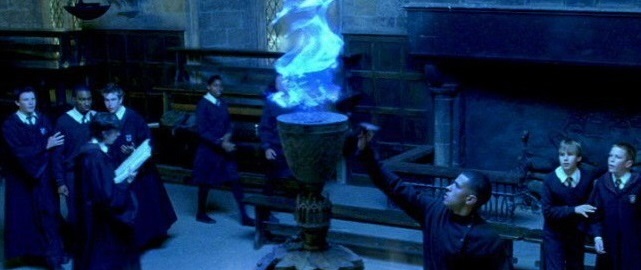
RIGHT: The second task, involving hidden treasures in the Black Lake.  I loved the look of the mermen and mermaids and the hinkypunks.  This scene managed to captured almost exactly what I saw in my head when I read the book.

WRONG: The first task, involving retrieving a golden egg.  We see FAR too little of how the other contestants fared in their attempts, jumping right past the first three just to see what Harry does.

RIGHT: “Mad-Eye” Moody.  I’ll never be able to read the books again without seeing Brendan Gleeson’s magnificent performance in my head.  That amazing enchanted eye, the facial tics, the glee with which he transforms a student into a ferret…it’s perfect.

WRONG: The Yule Ball.  As it appears in the film, it literally brings the movie to a halt.  It’s all about the interpersonal relationships between Ron, Hermione, and Harry, but nothing happens to move the plot forward.  I can’t help thinking there was a better way to stage this pivotal event.

RIGHT: The events in the graveyard.  I can recall vividly the moment when I read the words, “He was dead” in the book.  I sat up on the sofa, my eyes grew wide, and I exclaimed out loud, “Holy s**t!”  The movie gets this entire sequence right.  As I recall, the graveyard covered two or three entire chapters in the book, and the film condenses it nicely into a 10-minute sequence.  (Approximately.)  It’s the moment, in both the books and the films, when the franchise became much more than “kid stuff.”

WRONG: Snape’s role in the film.  The movie curiously omits the incredibly relevant moment in the book when, after Dumbledore observes the Dark Mark on Snape’s arm, he tells him, “You know what to do.”  And Snape nods curtly and leaves the room.  That comes into play to a GREAT degree in the latter stages of the franchise.  Ah well.

And I’ll leave it there.  I could go on.  All in all, it’s a good film, a great spectacle, and a turning point for the series.  They could have called it, Harry Potter and the Advancement of Maturity.

QUICK TAKE: Good Night, and Good Luck. (2005)

By Miguel E. Rodriguez

Director: George Clooney
Cast: David Strathairn, Patricia Clarkson, George Clooney, Jeff Daniels, Robert Downey Jr., Frank Langella
My Rating: 8/10
Rotten Tomatometer: 93% Certified Fresh

PLOT: In the early 1950s, broadcast journalist Edward R. Murrow (Strathairn) looks to bring down Senator Joseph McCarthy.


I feel eminently unqualified to discuss the historical merits of Good Night, and Good Luck.  I am no history scholar.  What I know about the Hollywood blacklist and the HUAC hearings can be traced to sources such as movie reviews, the movies themselves, documentaries, and The Manchurian Candidate.  (The original, not the remake.)

As such, all I can report is that this movie is solidly well-made, photographed in gorgeous black and white, and is an immensely satisfying experience, because a bully gets what’s coming to him, on national television.  If there are times when it lags a little, well, civics lessons can’t be fireworks all the time.

David Strathairn is not quite a dead ringer for legendary newsman Edward R. Murrow, but he’s close enough, and he’s never less than convincing, especially when delivering Murrow’s broadcasts in that inimitable deadpan that somehow sounds more informed than the average reporter.

I especially enjoyed the segment where McCarthy appears on Murrow’s program to defend himself against charges made by Murrow on a previous show.  Shortly thereafter, Murrow goes over McCarthy’s rebuttal line by line, identifying each falsehood and inaccuracy.  That took guts back then, but Murrow stood for truth, as corny as that sounds, and he wasn’t about to let McCarthy’s lies slide.

All in all, Good Night, and Good Luck is a great film, maybe even an IMPORTANT film, because of our ever-shifting political climate.  You never know if another McCarthy will rise up, and you wonder if anyone will be around, like Murrow, to put them in their place.

[TRIVIA NOTE: look fast for Simon Helberg (Wolowitz on “The Big Bang Theory”) in what amounts to approximately five seconds total screen time.]

ZATHURA: A SPACE ADVENTURE (2005)

By Miguel E. Rodriguez

Director: Jon Favreau
Cast: Josh Hutcherson, Dax Shepard, Kristen Stewart, Tim Robbins
My Rating: 9/10
Rotten Tomatometer: 75% Certified Fresh

PLOT: Two young brothers (Hutcherson, Jonah Bobo) are drawn into an intergalactic adventure when their house is hurled through the depths of space by the magical board game they are playing.


If only all family movies were like this.

Too often, so-called family films are mealy-mouthed cream puffs that appeal to the short attention span of their target audience, leaving the parents either bored to tears or fatigued from sitting through 90 minutes of explosions.  The scripts are subpar and tend to treat kids as if they’re not all that bright.

Not Zathura.  With his third film (after the forgettable Made and the Christmas neo-classic Elf), director Jon Favreau proved that he’s the real deal.  Here’s a REAL family film with something for everybody: comedy, family drama, peril, thrills, a killer robot, fearsome aliens, and nostalgia.

The nostalgia part is especially notable.  The board game at the center of the film is constructed to look like something made in the ‘50s or ‘60s, which, to the kids in the film, is practically ancient history.  But for me, I found the film nostalgic in the way it captures the kind of fun I used to have at the movies.

Not that I don’t still have fun, mind you.  It’s just that, when I was a kid, sci-fi and fantasy films felt more real, you know?  It was so easy to imagine myself as a resident of the Goondocks, or discovering an alien in the cornfield behind my house, or building a spaceship in the backyard with my two best friends.  Zathura captures that kind of feeling like few other modern family films can.  It’s a movie that has the potential to live on in the imagination after countless other films have vacated your consciousness.

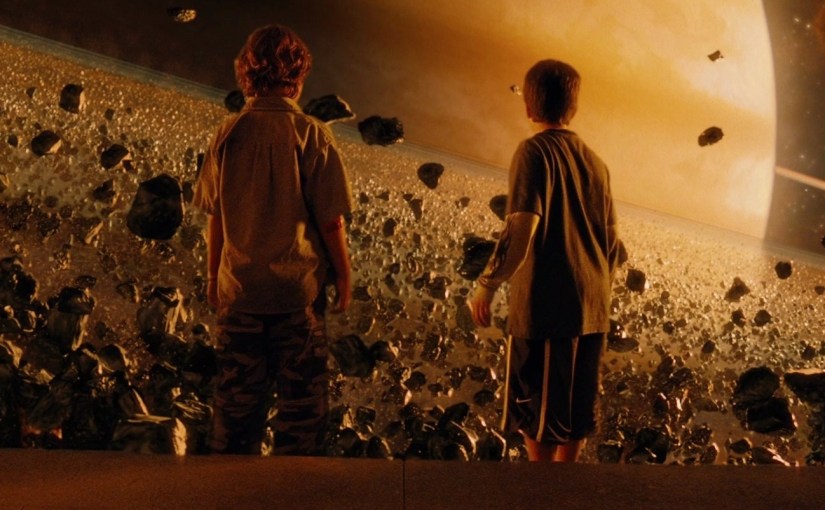
And the VISUALS.  I don’t know what kind of budget the movie had, but it looks like a $100 million movie.  The killer robot is absolutely convincing, as are the aliens.  Which brings up another great element of the film: danger.  The bad guys in this movie may occasionally look a little cartoony, but they are not to be trifled with.  That’s something a lot of kid’s movies tend to get wrong.  The filmmakers lose their nerve in creating real villains, for fear of pissing off too many parents.  In reality…dude, kids can handle it.  Give the bad guys fangs and spinning saw blades.  It just makes it that much more satisfying when the bad guys LOSE.

Zathura barely made its money back, and that’s including domestic AND worldwide grosses (okay, I looked it up).  I could be wrong, but I’ll bet too many people thought it was a Jumanji ripoff.  It IS based on a book by the same author as Jumanji (and The Polar Express, as it happens).  But it is possible, I think, to see Zathura in its own light.  It’s a fantastic movie that will please all ages.