THE WORLD IS NOT ENOUGH

By Marc S. Sanders

The 19th installment in the James Bond series is The World Is Not Enough from 1999. By now Pierce Brosnan is comfortably established in the role and an expert at pun delivery and suave debonair swagger.

Michael Apted more or less delivers a standard fare. Nothing new here, really, with the exception of John Cleese (perhaps playing the role of R) as the would be successor to exiting mainstay Desmond Llewelyn as Q, the gadget specialist. I wish Cleese could have lasted longer than just his two film internship. He’s hilarious and well suited for the super spy’s tongue in cheek universe.

The story is similar to other Bond films. The one who we eventually realize to be the main villain wants to wipe out oil pipelines so that only their pipe is the only one exclusive to the region in the European west of the world. Auric Goldfinger had a similar idea with his affection for gold. A View To Kill aimed for this with Silicon Valley. Gold, silicone and now, here the commodity is oil.

The World Is Not Enough has a lot of crazy stunts and gadgets that we are always eager to see, such as a boat chase along the Thames River, snow ski escapes from parachuting snow mobiles (a fun sequence), deactivating bombs within underground mines and pipelines, underwater heroics in and out of a submarine and another buzz saw device, only this is a big one connected to a helicopter that is not just for cutting down forestry. BMW also makes its 3rd appearance in the franchise with a spiffy convertible.

The Bond gals are also up to the task. Sophie Marceau is Electra King. A one time kidnapping victim, she has taken over her father’s oil business following his assassination, which Bond is investigating. Marceau is beautiful as expected, but she’s got a great, mysterious way about her.

Denise Richards is fine (QUIET, you haters!) as a geologist swept up in assisting Bond. Her name, Dr. Christmas Jones, is deliberately laughable but she’s works well with Brosnan because there’s hardly any approach at seduction. They’re partners more than anything else. At least, they are until the end of the picture.

I do wish there was more to do for Robert Carlyle, though, as the bad guy Renard. He is impervious to pain thanks to a bullet resting in his brain. He is rapidly heading to death without any sensory feeling, but he gradually gets stronger with each passing day. I don’t know how you diagnose that, but in a James Bond picture, you take it at face value. Carlyle looks perfectly dastardly but he’s hardly on screen and has barely any exchanges with Brosnan’s Bond. When the real villain is finally revealed, Renard doesn’t serve much purpose any longer.

Judi Dench is back again as M. She is positively one of the best casting choices in the entire franchise. Bond remains a chauvinist (early on seducing his gorgeous doctor during an examination), but Dench as M counterpoints that stance and it is more than welcome. She is given more material here as well.

The World Is Not Enough didn’t reinvent the passenger ejector seat or the exploding pen per the nature of 007 films. Yet, it has a neat twist midway. Yeah, you might see it coming, but still it’s appreciated to keep the story developments ongoing. As well, the action plays well with a very good cast.

Brosnan was 3-0 by this point with the franchise.

THE MATRIX FRANCHISE

By Marc S. Sanders

Miguel and I went to see the The Matrix Resurrections last night and honestly, when I woke up this morning, I had forgotten I’d even seen it.  That’s because, other than the original Matrix film, the subsequent chapters are about as special as cheap food court Chinese food.  When you get home from the mall, you recall what you may have window shopped, but you never reflect on what you had for lunch; well maybe your gut does later on, and that’s certainly not doing you any favors. 

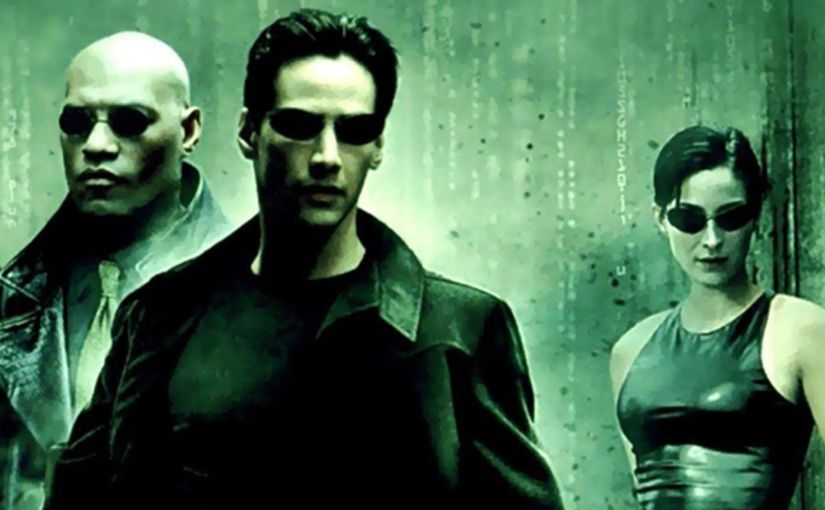
When The Wachowskis introduced the world to The Matrix way back in 1999, it was one of the biggest surprises in films.  No one saw its uniqueness coming.  Everyone was focused on the over hyped resurgence of Star Wars, or a kid who desecrated a pie, or a hand held video film that was seemingly terrorizing audiences.  Yet The Matrix arguably may have had the best longevity that year.  It seemed like a combo sci fi/super hero picture with the players looking ultra-cool in designer sunglasses and leather night club outfits.  Guns and jiu jitsu flew off the screen, but it was done in a new visual kind of way.  Bruce Lee would have likely been a part of this picture had he been alive.  When someone took a kick to the face, it was edited super cool looking sloooooowwww motion.  Bullet time became a thing with projectiles warping through the space between characters and these players, especially Keanu Reeves as the messianic Neo and Carrie Anne Moss as Trinity, would bend and twist and twirl acrobatically (again in slow motion style) to dodge machine gun fire and endless shrapnel.  The look of the film remains absolutely superb.  Nothing (other than maybe the film’s sequels) has duplicated what was accomplished here. 

As well, the original Matrix stands apart from the other three because it actually told a story and developed its protagonist and his mentor (Laurence Fishburne as Morpheus) into fleshed out characters.  It also went so far as to describe what the Matrix is, and what the world outside of that realm represents.  Like all humans, Neo, also known as Thomas Anderson, was actually under the control of a machine-like community designed to sustain a world known as the Matrix, and…well…that’s just bad!  There was solid storytelling here with setting and character development that was later accompanied by well-choregraphed action and pulse pounding club music.  When the film ended, audiences couldn’t wait for more and Warner Bros happily greenlit two more films that were shot back-to-back.  Only the train derailed from there.

Gearing up for the 2021 installment, directed by Lana Wachowski, I watched the first three films again.  Other than the first film, I had forgotten much of what occurred in the 2nd (The Matrix Reloaded) and 3rd (The Matrix Revolutions) pictures.  I realize now that I only forgot what really wasn’t there.  Substance!  Of the two films, Reloaded is likely better, thanks especially to an outstanding highway car chase involving sci fi effects of the characters bouncing off of big rig trucks, motorcycles and car roofs.  A pair of characters dressed in evil white leather with dreadlocks morph in and out of the vehicles and concrete streets as well.  The scene comes late in the film and only wakes you up from the meandering ahead of it.  Truly, it’s hard to comprehend what the hell is being explained in this second film.  The Wachowskis almost would prefer you be impressed with the monosyllabic vocabulary that’s exchanged with each character.  Dialogue doesn’t advance the story any further from where the first film left off.  All that I gathered was our band of rebels who successfully broke free from the slave-controlled Matrix are regrouping at the promised land of Zion, and the machines (squid like metal robots with countless red light bulbs) are advancing for an attack.  Morpheus, Trinity and Neo take it upon themselves to reenter the Matrix (because they look so much cooler there) and do who knows what.  Near the end of the film, Neo walks down a long hallway, opens a number of doorways and encounters the one supposedly responsible for the Matrix, an older gentleman known as The Architect.  This moment was intended to be a highlight of the film and yet it was anything but.  This architect spews out word diarrhea at an alarming rate that only clouds your mind further and further.  The guy has a great radio voice and has an antithetic appearance against the heroic looking Neo, but what in the hell are we supposed to do with any of this?  What’s the point?

On to Revolutions which begins exactly where Reloaded left off.  This is a picture that could have had a running time of thirty minutes at best.  The robots are finally attacking Zion.  One character who seems like he should be important or necessary to the Matrix storyline saddles up in a robot suit equipped with massive machine guns and The Wachowskis make the poor choice of feeding their audience a good seven or eight minutes of this guy spraying endless amounts of bullets in an upwards direction towards the infinite swarm of octopi robotic armies.  His guns never run out of ammo.  He just bellows as he continues to fire.  Where’s the story here?  Where’s the innovation that the first film offered?  Also, what goes up, must come down.  Shouldn’t some of that ammunition have dropped down in a hail storm eventually?  Reader, if I have to ask that last question then you know there’s not much to pay attention to in this film.

The wisest character of the Matrix films, Morpheus, is given very little to say or do in either film.  Fishburne stands in the background and let’s everything happen around him.  He’s not utilized to explain anything like he was in the first picture.  His skill for teaching the audience has been completely diminished.  Whatever he had to offer was exhausted following the first picture.  With Revolutions, especially, the filmmakers rely on B characters that we’ve never really gotten a chance to know or remember or adore like Yoda or Jabba or even Boba Fett in the films that followed the original Star Wars. In fact, Revolutions seems more concerned with its extras than any other film I can recall.  So much so that when a major character from the first film has a death scene, you hardly care for the loss.  There wasn’t much to expound on the character after the original film.  Revolutions only relies on the war nature of the human armies against the monochrome metallic squid race.  Beyond shooting at one another, where’s the conflict?  Ms. Pac Man and Frogger have more depth than any of this.

That’s the problem with these films.  A discovery was made with the 1999 installment and the filmmakers opted to capitalize on the effects and not the challenge of story. 

Furthermore, and this goes back to the original film when I first saw it in theatres, I was always of the mindset that I’d rather live in the Matrix.  After all that Morpheus has revealed to me, the Matrix still seems like the better place to reside.  The real world consists of living on a dirty, dreary ship and eating slop for food while wearing torn sweaters and having electrical plug orifices running down my spine.  Who wants that?  A Judas character from the first film turns on his crew by telling the evil Agent Smith that he will bring them Neo as long as in return he doesn’t know that he’s under the control of the Matrix and he can savor the taste of a juicy steak again.  Now I’m with this guy.  Aren’t The Wachowskis as well, though?  More footage and highlights take place in the computer mainframe of the Matrix than outside of it.  Thereby, more cool looking action sequences can happen and the cast appears more glamourized.  The films want us to fear the horrors of the Matrix on the humans by showing them plugged into wires while drowning in a pod like puddle of KY jelly embryonic ectoplasm.  You know what?  What I don’t know won’t kill me.  So, leave me be.  Perhaps the argument would have been more convincing had the environments been reversed.  Put the rebels as slave dilemma in the real-world areas and the utopian setting within the Matrix.  Then I might buy the problem here.

The newest film, Resurrections, is nothing special and nothing new.  It’s rather boring actually.  Revolutions was boring too.  It only kept me awake because it was two hours of headache inducing noise.  With the new 2021 film, apparently a new Matrix has been developed and thus a new Neo and Trinity have been conceived.  The antagonist is represented by Neil Patrick Harris and that’s about it.  Miguel pondered much, following the picture as to what was going on.  That’s not a good sign for a popcorn action flick, and it’s consistent with what was done with the 2nd and 3rd films.  What the hell is anyone talking about. Once again, dialogue moves to a beat of answering questions with questions. Even the allies speak to one another that way, and if it is not a question, then it is a cliché of some sort.  Don’t these people want to help one another?  If so, then speak to each other like your four years old and get to the point.  The action scenes drone on and on.  A goal of the picture is to keep Neo from finding Trinity because if they do, then the Matrix crashes.  Okay.  That’s simple enough.  Yet (spoiler alert), when they do find each other, somehow this new Matrix continues on.  Huh??????  The movie just betrayed me, and I don’t like that. 

Miguel attempted to conjure up the idea that Lana Wachowski was trying to demonstrate her transition from a man to a woman and this new picture was a representation of that.  Could that be true?  Maybe, but it never occurs to me while I’m watching the picture.  Am I watching The Matrix Resurrections because it’s the newest Wachowski film?  No.  This isn’t a Quentin Tarantino or Christopher Nolan piece.  This is leather and gunfire and sunglasses and noise, all depicted in a green DOS computer hue lens.

The Matrix was always worthy of a sequel; a subsequent follow up that explored imagination and perhaps more background.  What has Neo not yet uncovered.  Yet, the series as a whole continues to deny those opportunities and simply settles for cool looking visuals that get overly exhausted and tired.  No new skills are featured with each passing film.  Over the course of the series, the big bang, so to speak, of the first Matrix never reveals itself.  Instead, we are mind controlled viewers relegated to depend on overlong dialogue with no point and no where left to explore.  We are simply gifted with Neo punching Agent Smith and/or infinite duplicates of Agent Smith with no one getting weakened or wounded or defeated.  Look no further than an early fight scene in Reloaded.  The scene goes on forever.  The editing is amazing.  So is the choreography but after four minutes of this, it’s time to show some progress.  The Wachowskis limit their imagination to just having Neo fly away.  Scenes like this only allow me ample time to exit the theatre for a bathroom break and return having not lost out on any storytelling.  My friends, you can find plenty of bathroom breaks in this series of films.

The Matrix Reloaded, The Matrix Revolutions, and The Matrix Resurrections should never have been made.  Producer Joel Silver and Warner Bros would argue otherwise though.  Their wallets continue to get fatter, but at the cost of controlling moviegoers’ appetite for something more when all they really got was dry rice and overcooked orange chicken from the food court.

ROSETTA (1999, Belgium)

by Miguel E. Rodriguez

Directors: Jean-Pierre Dardenne, Luc Dardenne
Cast: Émilie Dequenne, Fabrizio Rongione, Olivier Gourmet
My Rating: 9/10
Rotten Tomatometer: 90%

PLOT: A poor young woman, teetering on the edge of desperation, struggles to support herself and her alcoholic mother.


The word “neo-realist” is used several times in other reviews or movie blogs where this little Belgian film is discussed. I’m not a film scholar, so I can’t claim to know precisely what that term describes. Without searching for the dictionary definition, I think it refers to a film in which the predominant theme or tone is that of real life, happening to real people. A favorite method of creating this tone is to use non-professional actors in all the key roles, so one never gets a sense of acting from a performance, only reality.

If I got that right, then Rosetta is definitely a neo-realist film, and I typically do not like neo-realist films. I have seen Bicycle Thieves (1948) a couple of times, and while I acknowledge its place in cinema history and its craftsmanship, the appeal of the film (commonly called a masterpiece of Italian neo-realism) eludes me. It’s not my favorite genre and/or time period.

But Rosetta undercut my preconceived notions of the genre and had me riveted from its opening moments to its severely unconventional ending, ninety short minutes later.

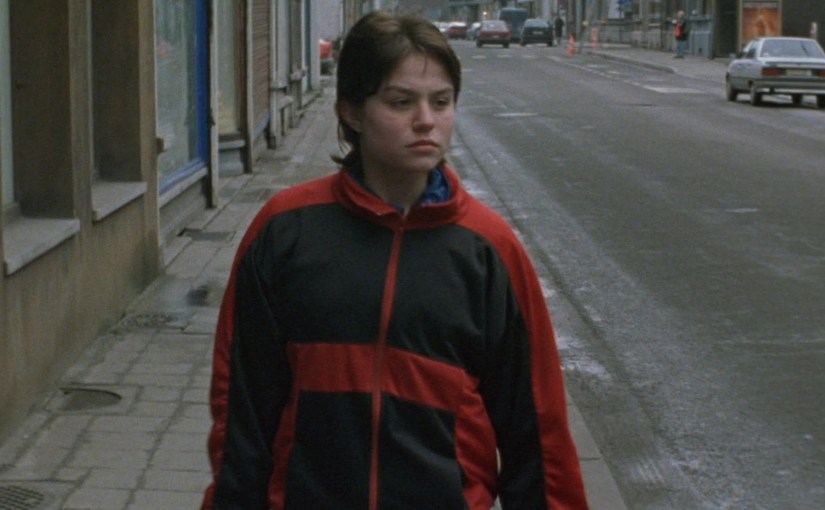
The determining factor is the camerawork, at least at first. We immediately follow this young girl, Rosetta (a gutsy, award-winning performance by Émilie Dequenne), maybe 16 or 17 years old, who is walking briskly through a factory floor, though we’re not sure why at first. As she walks, the camera follows her, hand-held, unsteady, very queasy-cam, but it lends a sense of immediacy to the shot. The camera is almost running just to keep up with Rosetta, and I was instantly curious. Where is she going? Why is she walking so fast? Is she about to punch someone out?

But no, she’s about to be fired for being late, and when her boss intercepts her, she refuses to go quietly, to a point where security has to be called and chases her through the entire building. Why so desperate? Aren’t there other jobs to be had for someone her age out there?

Apparently not. This will be a theme throughout the film: her constant hustle to get a paying job. At one point, someone offers to hire her and pay her under the table, but she refuses: “I want a real job.”

Wherever she goes, the handheld camera follows right behind her, like a paparazzo who won’t give up. We only get a handful of long shots, like when she crosses a busy street after getting off a bus. Virtually every other shot is right behind her or right next to her. The effect creates the idea that Rosetta’s life is composed mostly of sleep and hustling to make that next dollar, or franc. In between, she maintains her trailer home with her alcoholic mother, a woman who is so pitifully down the road of addiction that she demeans herself with the landlord of their trailer park to pay for their water, just so she can keep the money to pay for more liquor. Rosetta ruthlessly tries to keep her mother in check, constantly berating her for her behavior, their familial positions clearly reversed.

Rosetta is not a happy film. How can it be? It simply follows this girl’s life from one crisis to another. But I was totally engrossed in a way that reminded me, for some reason, of another movie, Noah Baumbach’s The Squid and the Whale, which was also shot and filmed in such a way that the actors (most of them recognizable and famous) didn’t feel like actors, and as such felt more real than many other films.

So…what is the takeaway from this movie? Is Rosetta a good person? She has noble intentions, I believe, but she is forced to be strong and calculating as a way of keeping her and her mother afloat. At one point, she meets a young man, might even like him, but at one point, on the shore of a small lake, he falls in and appears to be drowning…and Rosetta takes an awfully long time to decide whether to help him or not. After all, if he dies…she might be able to take his place at work.

I just watched a video essay on Netflix about how it’s not always necessary for you to like a character in a movie in order for it to be enjoyable. Overall, I’d agree with that assessment, especially with Rosetta (though What About Bob? is the CLEAR exception). This film was both dazzling and simple, a neat trick, involving a character I didn’t always agree with, but who I believed made the only choices she could make in her situation. I found myself asking what I would do in her place. Left to fend for myself with no steady job and an alcoholic parent, how would I fare in this world? How would you? Rosetta answers that question in a way that makes sense for the lead character. Her answers may differ from yours. Discuss.

TRUE CRIME

By Marc S. Sanders

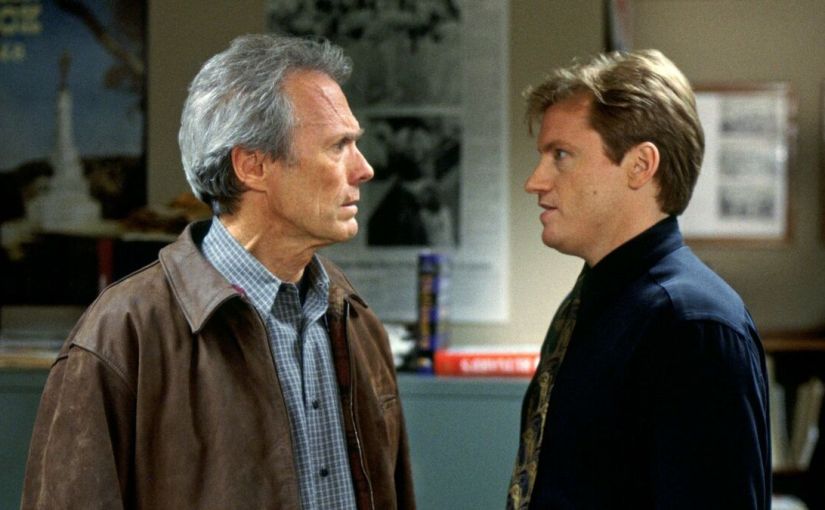
Clint Eastwood is having a pretty eventful day in the film True Crime, a picture he produces, directs and stars in. He plays Steve Everett, a womanizing journalist who is assigned at the last minute to interview Frank Beechum (Isaiah Washington) for a human interest story about the man’s last hours before he’s sentenced to death by lethal injection for shooting a young pregnant woman. Everett gets a hunch though that Beechum may be innocent and he’s quickly running out of time to prove his gut feeling. It does not help that his editor (Denis Leary) has discovered that Steve has been sleeping with his wife. It’s also inconvenient that Steve has to honor his promise to take his young daughter to the zoo.

For the simplicity in the storyline of Eastwood’s film, I still found moments that kept me engaged. Washington’s footage which begins at sunrise on his supposed last day at San Quentin penitentiary is very well detailed. I liked how the warden spells out to Beechum what to expect today ranging from requesting his last meal to ensuring direct phone lines to the governor are working properly. I got to witness how all activity of a death row inmate is strictly recorded. I found it interesting how the lethal cocktail is to be administered.

Washington has really good moments with his wife (Lisagay Hamilton) and young daughter wanting to color him one last picture of green pastures. The film doesn’t drown in sappiness or long monologues that you might expect. Like other Eastwood films he looks for the quiet moments in a person’s day; familial, but painful intimate moments of a loving family with all options exhausted.

The other storyline might be debatable for existing. Steve has to contend with his editor’s animosity towards him while also trying to balance what’s left of his family life with his current wife (Diane Venora). Opportunities are given for tough guy comebacks and insults between Eastwood and Leary along with their boss played by James Woods. There’s good timing in these lines but some might question why waste time with this material. I had no objection, however.

These are men who are not putting their lives or instincts on hold to focus just on an inmate sentenced for death. This is just routine work of the day. We don’t stop working just because we find out our spouse is a two timer. We also don’t put our personal interests in hold for a criminal we have regard except to fill a square in the news paper.

Same goes for Steve’s time sparingly spent with his daughter (Francesca Eastwood) at the zoo. Steve turns out not to be an attentive father as he also tries to stay on top of his story on Frank. My cinephile colleagues (including Miguel) took issue with most of the material that the journalist experiences. They thought it was meant for a different film other than the death row storyline. Not I, however. I found it courageous of Eastwood with a script from Larry Gross, Paul Brickman and Stephen Schiff to stay true to this portion of the film. All people have demons they live with and those setbacks don’t grant mercy in even the most desperate of times such as when a possibly innocent man has mere hours left to live. Life is never put on hold even if you’re a lousy father and husband.

True Crime stayed with me up until its last ten minutes. At that point, Eastwood takes the film in a beat the clock car chase direction. This moment is unlike anything else the film presented and I took issue with it here. I wasn’t watching an action picture before any of this. Before the end arrived, I was caught up with the different perspectives of those involved in the process of supposedly humane lethal injection. I saw the prison guards who’d make a joke out of what’s to come. I saw a self involved minister trying to egg on a confession for his own personal salvation, and I saw a warden (Bernard Hill) who actually possessed sensitivity to a prisoner’s fate; that’s something you don’t see too often in film.

Eastwood never allows the audience to empathize with his character’s personal problems. This guy made his own bed. His personal life is not wrapped up in a pretty pink bow by the film’s conclusion. Instead, True Crime told me that beyond a man’s own personal issues is the necessity to help rescue another man who is arguably in a much worse scenario. Dismiss the film’s ending, and you’ll nevertheless appreciate the structure of the rest of the picture.

TOPSY-TURVY

By Marc S. Sanders

For those that are unaware, I dabble in community theatre. I perform on stage. I direct. I produce. Occasionally, I write plays. So while watching Mike Leigh’s film Topsy-Turvy, I could not help but ask where have I heard some of these conversations before.

As Leigh’s film focuses on the making of the Japanese inspired opera The Mikado from Gilbert & Sullivan, I felt assured that the backstage tendencies of actors, composers, directors and producers has always been the same. They have egos. They are diva like. They are perfectionists, and the best ones of all catagories rehearse over and over and over again until it feels and sounds just right.

Gilbert (Jim Broadbent) is the writer. Sullivan (Allan Corduner) is the composer. Early in the film, Sullivan seeks to break away from the more playful stage escapades of Pirates Of Penzance material. He wants to do more human interest material that don’t just rely on whimsy and “magic potions” or elixirs. Gilbert finds nothing wrong with continuing on the same tract. Audiences seem to respond to it and it comes naturally to him. When the pair are recruited by a producer to write a new production for the Savoy Theatre in London, they find themselves at odds in their artistic goals.

Only after Gilbert attends an expedition featuring Japanese culture does the idea arrive for the opera to be famously known as The Mikado. Sullivan finds himself inspired as well. After all, the English are not so familiar with Japanese lifestyle. Who says films and theatre can’t teach you anything?

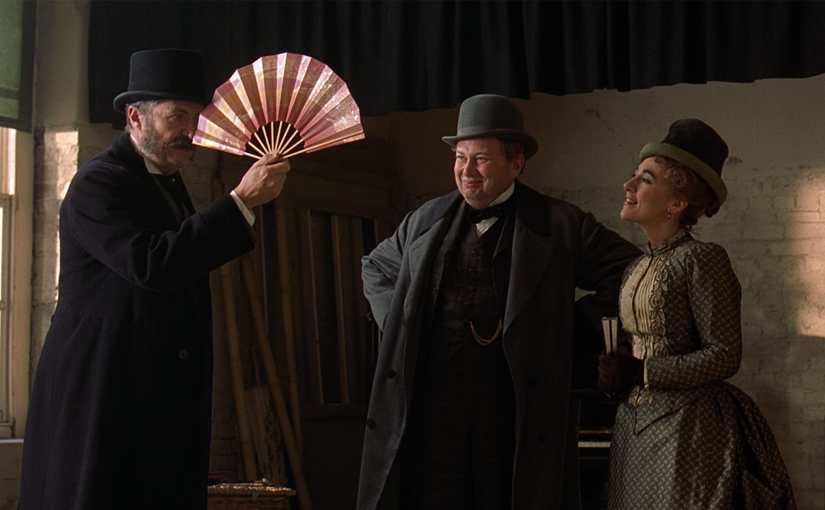
From there, Topsy-Turvy presents backstage scenes of rehearsals where there is stop and start readings from the script. Personally, I could not understand why none of the actors wrote their own blocking down, but I digress. The scene with Broadbent as Gilbert directing a portion of his cast by perfecting enunciations and staging is a joy to watch, and a lesson in the efforts to stage a perfect showpiece. It also amuses me how they dress for a backstage rehearsal. The men in their finest day wear suits with top hats. The actress in her well tailored silk gown. Somehow, theatre has diminished itself to my superhero t-shirts and shorts for a seven o’clock call on a Tuesday night.

There are costume fittings. Makeup on the Anglo Saxon performers to make them appear Asian is a constant humorous sidebar.

Dressing room banter is also on display. I love the back and forth ego trips between the lead actor, a fabulously snobbish diva played by Timothy Spall cast as the production’s Mikado, and another cast member played by Vincent Franklin. These actors are not shy about their self regarded importance to Gilbert & Sullivan’s reputable accomplishments. They are even nervy enough to question if the writer/composer still have the knack…but only discuss this backstage when no one is listening. Later, you see how an actor’s insecurity shows when Gilbert considers cutting one of the Mikado’s most popular numbers. Spall’s expressions of hurt say so much.

Another great scene is realizing that another actor questions his costume. Heaven forbid but he cannot perform on stage without an undergarment corset. It’s unheard of.

Mike Leigh’s film was one I was never familiar with. I didn’t know anything about it until Miguel introduced it to me. Technically, it’s spectacular, offering outstanding period set designs and costumes from the the early 1900s before turmoils of war and conflict invaded Europe.

The film runs a little long as it takes just a little bit of effort to get accustomed to period setting and high brow dialogue. On a second viewing I imagine it’ll leave you with a pleasing grin as you’ll feel more in on the jokes and attuned to the nature of operatic theatre. Topsy-Turvy is a well researched and a terrific examination of life in theatre. It explores the disagreements and struggles to stay relevant as a writer, composer or actor. Most importantly, it demonstrates that live theatre is never considered a hit until its one true test; the test of performing in front of a live audience.

PAYBACK

By Marc S. Sanders

Mel Gibson is Porter. No first name given. He’s just recovered from three bullet holes in the back and all he wants is the $70,000 that he was ripped off after pulling off a heist. Nothing more. Just his seventy grand.

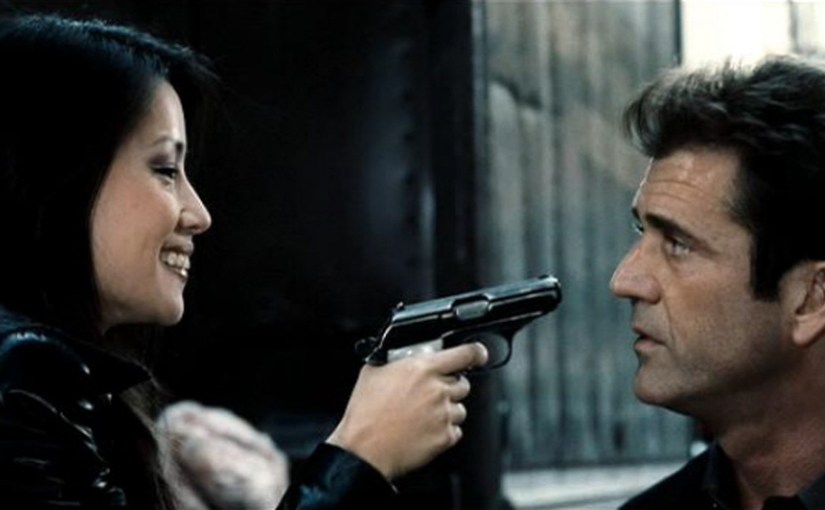
In Brian Helgeland’s film Payback, the idea is to root for the bad guy. Then again in this film, they’re all bad guys. So you are cheering for the best of the best bad guys, I guess. Porter catches up to Val (Gregg Henry), the partner who double crossed him which then leads to Val’s well established crime syndicate that he’s a member of headed by William Devane, James Coburn and Kris Kristofferson. Great surprise character actors for a picture like this. Porter also crosses paths with a professional dominatrix played Lucy Liu (credited here as Lucy Alexis Liu and primed for Quentin Tarantino material). She’s worth every penny you pay for her services.

Helgeland salutes the gritty, urban crime dramas of the seventies featuring the likes of Charles Bronson and Clint Eastwood. The language was more raw during that period. The city was filthy. The violence was even more unforgiving. The film feels quite modern but the cars don’t and the phones are all rotary dials. There’s a washed out grey hue to the cinematography of Payback, and its all very welcome. It’s a well made thriller only deliberately not as glossy.

The run on joke is that Porter is only interested in his seventy thousand dollar stake. The thugs he encounters might insist on not giving him a higher amount but as much as Porter gets tormented, he insists it’s all about just the seventy thousand. So, great responses come from that motif, especially Coburn as the fashionista gangster with the alligator skin luggage.

A film like Payback is simple in its story. The scenes are all about set up. How does Porter evade a drive by shooting? How does Porter handle a couple of dirty cops looking for a piece? How does Porter outwit a bomb in his apartment? The variety of characters that give Porter a rough time each come off like bad guys of the week in a Quinn-Martin television series. It’s just entertaining to watch Gibson as Porter get out of one situation after another.

Payback is a great Charles Bronson film, without Charles Bronson.