THE RAINMAKER

By Marc S. Sanders

Francis Ford Coppola didn’t just call his film The Rainmaker. He called it John Grisham’s The Rainmaker. I understand the significance as a large portion of the film relies on voiceover narration from its main character, Rudy Baylor (played very well by Matt Damon).

The film focuses on much of the underpinnings of the legal system within the state of Tennessee. Rudy gives insight into his position of ethical practice – he’s fresh out of law school but doesn’t have a license yet – versus the large giant sell out attorneys (a towering, sharp dressed and slick Jon Voight) that represent goliath parties like big time insurance companies. Grisham’s novel, along with Coppola’s screenplay, also leave room in the beginning of the film for the sleaze of the law practice with Rudy’s first employer who goes by the moniker “Bruiser,” played by an oily Mickey Rourke.

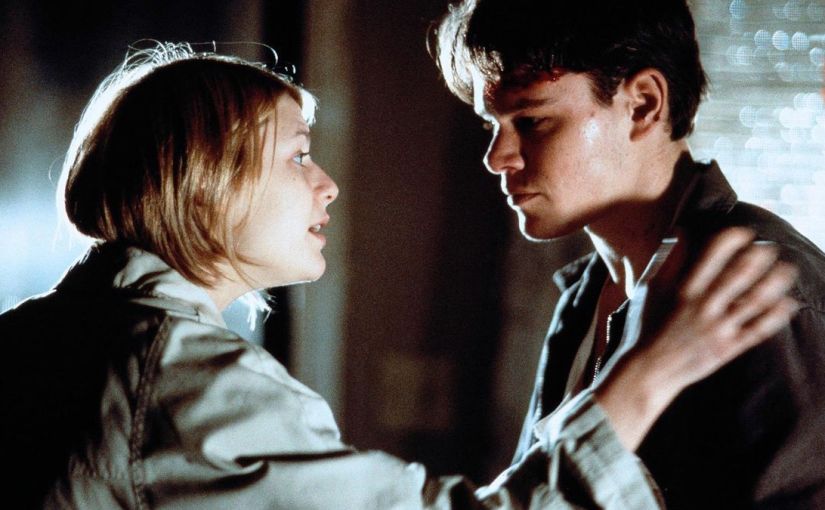
Rudy has not even passed the bar exam at the start of the film but he’s already got three cases in progress. He has agreed to completing a will for a kind old lady (Teresa Wright) who is adamant about leaving her estate to a television evangelist. He also volunteers himself to protecting a young woman named Kelly (Claire Danes) from an abusive husband. His biggest case is going after a million dollar insurance company for wrongfully denying a claim filed by one of it’s ill insured. Rudy knows the insured is justified to sue and it could be a huge and necessary windfall for him and his unlicensed, corner cutting partner (Danny DeVito), but it’s only him against a grand army of legal gods lead by the great Leo F. Drummond, Esq. (Voight).

Grisham and Coppola wanted to depict a drive for doing right by the law and the people it’s meant to protect. Damon’s portrayal of Rudy represents that ideal. His father hated lawyers and he grew up in a home life that never responded favorably to the merits of officers of the court. Rudy defies what his father frowned upon. Despite his inexperience in a courtroom and his ability to respond with objections and cited legal rules, he knows he’ll be a good lawyer simply because he can distinguish between right and wrong. He doesn’t need to sink as low as Drummond’s cronies by bugging the opposition’s office. Will Rudy’s righteousness be enough though? He’s so dang honorable in his profession that it might just be the ultimate means of his defeat.

Same can be said for Rudy’s will to protect Kelly, the young, abused wife. Precedents of law keep her husband on the streets no matter how bruised and bloody she gets time and again. This man is a monster, but no higher power is looking upon this victimized wife to legally protect her, and this man will continue to beat her until one day she’s dead. Rudy wears his heart on his sleeve for this woman and again can only serve as an honorable servant of the court. When he steps out of that line a little by risking his life to save this woman, he’s testing his own sworn code that he’s respected while others have dismissed it.

John Grisham’s The Rainmaker is one of those under the radar films not celebrated enough. I recall it being shown in limited theatre capacity, and it hardly did well at the box office, but it’s really a remarkable piece as it shows an unconventional and honorable attorney, reminiscent of Harper Lee’s Atticus Finch but set in modern day. Nearly everyone around Rudy, from his own father, that he describes to the students he attended law school with, to even the even the fool of a judge (Dean Stockwell) who swears him in as well as his own partner (DeVito in a hilarious, quick solving, underhanded role), are beyond any moral compass and yet Damon ensures Rudy Baylor sticks to his convictions.

Coppola’s film is not a legal thriller. It’s an observation of how the established perceive the law and the one fish who treads water above the bottom feeders, allegorically shown in Bruiser’s fish tank, seek out big rewards. For Rudy, the client matters. For everyone else, only the money matters.
TOMORROW NEVER DIES

By Marc S. Sanders

Pierce Brosnan’s second outing as James Bond is Tomorrow Never Dies and it is his best appearance in the series.

Bond faces off against Elliot Carver (a gleefully bloodthirsty Jonathan Pryce), a global media mogul who enjoys creating worldwide conflict for the best news headlines in print, television and the newfound medium of something called the internet. His pawns are Great Britain and China, and just like any worldwide media mogul he has his own stealth war ship for apprehending missiles and using them against the nations. This ship also has a massive drill that can penetrate a ship’s hull. Oh yeah, Carver also has the means to redirect a sea vessel into enemy territory. Bet Ted Turner or Rupert Murdoch could never do any of these things. Carver also has a big, blond bruiser of a guy called Mr. Stamper (Gotz Otto) – another in a long line of big, blond bruiser guys to face off against 007. Stamper is nothing compared to Robert Shaw in From Russia With Love, though.

Dame Judi Dench is back as M. I like how she holds her own too. As an actor, Dench has such command of any role she plays. If she is in a scene, everyone listens to her primarily. Even in a goofy Bond movie, Dench puts these films above the standard fare.

Teri Hatcher is also good in a small role as Carver’s wife Paris, and a former flame of Bond’s. M encourages Bond to “pump her for information.” Ahem!

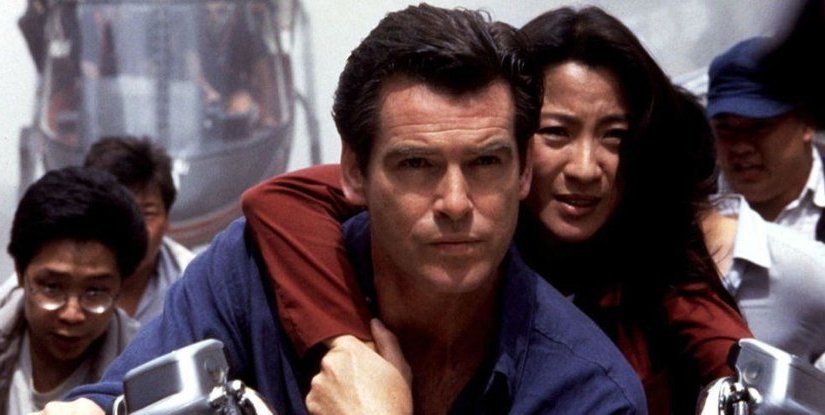
With the Brosnan entries from the 90s, the series was updating itself for a more mainstream feel. So the female stand-in is Michelle Yeoh as a Chinese agent named Wai Lin. Yeoh plays one of the best sidekicks/Bond girls of the series. This agent can hold her own while firing off two machine guns, one on each arm and offering up a great display of karate moves. Yeoh works well with Brosnan especially when handcuffed together while riding a BMW motorcycle and evading machine gun toting cars and a massive helicopter terrorizing a bustling Vietnam village. A fantastic sequence.

Before that, Bond pilots his BMW 700 series from his backseat on his cell phone pad, within a parking garage. Bazookas, guns, crowbars, sledgehammers and missiles can’t stop this luxury car though. After all, the Germans do make some of the best automobiles. Another really entertaining action scene.

I think this is a better film than GoldenEye. Brosnan appears more comfortable with the role and his humor is funnier. He rides the motorcycle through a laundry clothesline and Wai Lin tells him to go faster. Bond’s response: “Alright. Keep your shirt on!” I liked it. I was having a good time with the film.

Roger Spottiswoode was the director this time and he does a fine job. All of the action scenes are well orchestrated and edited.

I’ll also give props to Sheryl Crow for her alluringly sexy and haunting title track. I have never forgotten the song since I saw the film.

Tomorrow Never Dies is a great action film worth checking out whether you’re a James Bond fan or not.

I really like this entry.

THE GAME

By Marc S. Sanders

David Fincher is a director always focused on playing tricks with the viewer’s mind. His earliest films from Alien 3 (a poor installment in a celebrated franchise) to Se7en (an unrealistic yet frighteningly suspenseful serial killer story) to his third motion picture The Game, a movie that throws you off from the beginning of each scene to the end of each scene are best examples of this technique. It’s a little jarring, and I’m happy to watch it that way.

This film only works if you mask what’s really happening by showing you what’s fake instead. I know I sound vague but those that have seen The Game would probably agree that is the point. It’s based off a screenplay (by John Brancato & Michael Faris) that strategizes itself like a Dungeon Master setting up a Friday night in the basement with some buddies to play some role playing games with a 20 sided die.

Michael Douglas is really the only guy who could play Nicholas Van Orton, a millionaire with everything but really has nothing; no friends, no spouse (any longer), no one to care about. Beyond his fortune, all he has are a weirdly estranged brother, played by Sean Penn, and his attorney only there to ask Nicky “Should I be worried?” The film takes place during Nick’s 48th birthday. Normally, the song would go “Happy Birthday Nicky.” However, for Douglas’ cold protagonist, the lyrics are “Happy Birthday Mr. Van Orton.” A man with everything, who really has nothing.

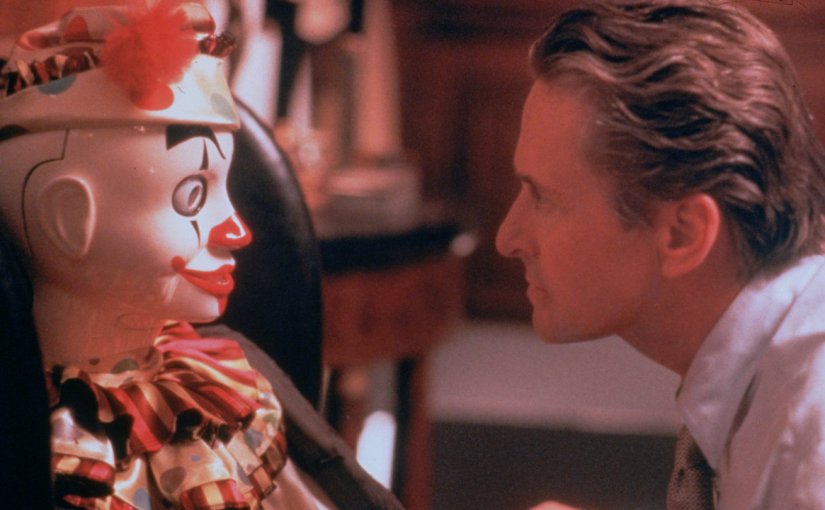
Penn gives him a card with a number to call. This is his birthday present to Nicky. Then the paranoia presents itself little by little; a wooden clown doll, a tv that talks to Nick, a leaky pen, spilled drinks, and soon Nicky’s life is threatened.

Why are these things happening? What’s with the keys? What’s with the waitress who keeps turning up, played by Debra Kara Unger so effectively that she arguably carries the riddles most convincingly? Unger is brilliant at twisting the story over and over. Another great player is well recognized character actor, the late James Rebhorn (also known from Scent of a Woman) who gets the ball rolling and then wraps up the answers later on.

Fincher plays with the mind quietly but never at a slow pace. There’s a consistent tinkling of piano keys that seem to work as puzzle pieces being matched up. It’s much more disturbing to go this route than with grand horns and bass.

When I saw The Game initially in 1997, I started to piece together how to write multi dimensional characters. There’s a past that gnaws at Nick’s psyche sprinkled with glimpses of his father committing suicide. Fincher offers up a background to Nick by means of grainy home movie footage. It all seems quick and taken for granted but it’s necessary to understand Douglas’ cold demeanor and it circles back beautifully towards the film’s unexpected ending. It works so well as a motivator for Nick that I often circle back to its presentation when I write my own scripts.

There’s a great, short scene that sets up the 3rd act. Probably Michael Douglas’ best scene ever in a film, in my opinion. Nick walks into a diner in a dirty suit with scratches on his face. He asks for everyone’s attention and offers up his last $18 to anyone who can offer him a ride. The character is humbled and changed. An arc is completing itself on the other end. It’s a scene that maybe doesn’t belong here until you realize it does. In another director’s hands, a scene like this would be cut or never shot. Fincher took advantage of Douglas’ technique for substituting intimidating power with humble gratitude to simply be able to just ask for a favor. A new character is born in a most efficient 90 seconds of film. It’s a great moment.

See The Game whether you haven’t seen it yet or to watch it again to remind yourself how all the pieces come together.

You might argue that this can’t be realistic but suspend your disbelief because that is what David Fincher always strives for. You’ll be glad you did. Trust me, or maybe…don’t trust anyone?!?!?!?

CLUELESS

By Marc S. Sanders

AS IF!!!!!

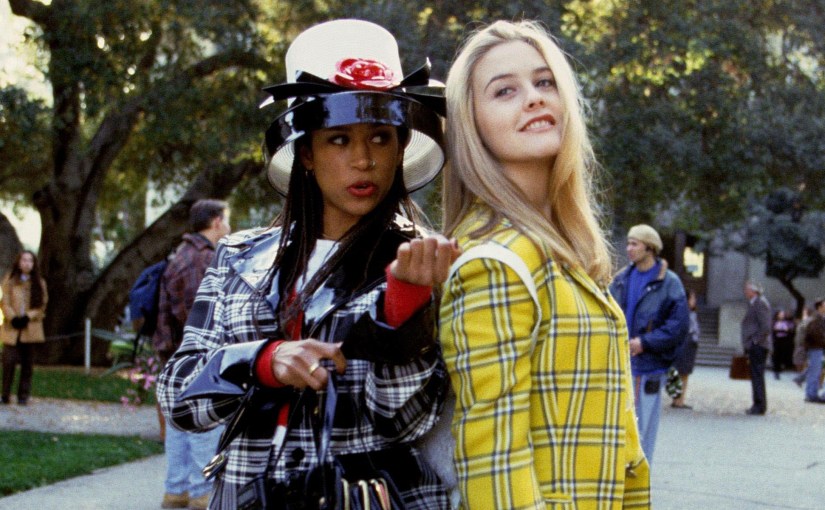
Yeah, Alicia Silverstone’s breakthrough film, Clueless, is shockingly dated, but it is so smartly constructed as it follows Jane Austen’s outline of her classic novel Emma.

You see, here is a movie where the main character goes through a nicely developed character arc. Silverstone’s Cher might be an airhead since her focus is primarily on clothes, the mall, MTV cartoons, and more clothes but as she strategizes to be a matchmaker for fellow students and teachers at her school, she loses sight of her own best interests when it comes to love.

The situations and one liners are priceless in Amy Heckerling’s film. I love how Cher can’t comprehend why her gorgeous crush never hits on her but he loves to shop, dress smart and watch Spartacus.

As director, Heckerling is also attuned enough to deliver gags by means of the extras sprinkled throughout the film. Almost every extra at school has a nose bandage because, you know, this is a Beverly Hills high school where plastic surgery is as common as getting a drivers license. Heckerling might be broadly spoofing the Beverly Hills scene of the ‘90s, but we all know what she’s trying to say with each shot of a high school hallway or classroom.

This film also delivered actor Paul Rudd closer to the main stream. It’s not a glamorous role but he’s cute nonetheless, as Cher’s step brother and maybe love interest???? It’s a long story; watch the movie. He’s the guy with sensibility that Cher doesn’t seem to account for. Rudd’s scenes with Silverstone are marvelous. Typical love/hate material that we’ve seen before, but the characters are so likable it’s hard to resist their charms.

Dan Hedaya (a very underrated actor since Cheers) is really good. He’s such far cry from his on screen daughter as an apparently brutal litigator. Every time he shouts “Cher, get in here!” I laughed.

Again, it’s hard to believe it’s already dated in its wardrobe and slang, but Clueless remains outstandingly funny nonetheless. Bitchin!!!!!!!!