ABSOLUTE POWER

By Marc S. Sanders

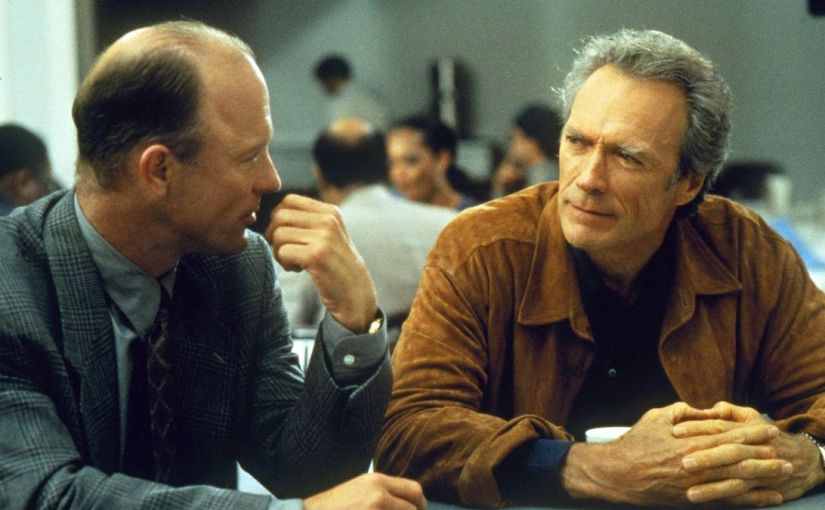
As Clint Eastwood’s Absolute Power was unfolding I started to think this plays like one of those hardcover bestseller political thrillers from the 90s that my dad would scoop up off of the neatly designed stack at the front of Barnes & Noble.  You know with the glossy book jacket that has the blood stain and a dead girl’s nail polished hand next to a bloody letter opener.  The graphics are elevated to feel the crime scene with your fingertips.  The intrigue is summed up on the inside tab.  You turn to the back of the book to see the picture of the author.  Then you buy it with your membership card.  Go figure!  William Goldman adapted the screenplay from a novel by renowned author David Baldacci. Absolute Power has an engaging set up, a who’s who of a cast, it’s directed, produced and starring Eastwood. Still, it evolves into utter eye-rolling preposterousness.

Eastwood directs his own portrayal Luther Whitney, an expert jewel thief.  He might be getting up there in age but he scopes out the mansion of a billionaire tycoon (E.G Marshall, in his final on-screen role) and locates the vault hidden behind a large two-way mirror.  Everything is going to plan as Luther bags up the valuables and a lot of cash but then a drunken couple enter with Luther hidden behind the mirror to watch their tryst turn deadly.  The President of the United States (Gene Hackman) avoids being stabbed to death by the young lady (Melora Hardin) when his secret service detail (Scott Gleen and Dennis Haysbert) enter to shoot the girl dead.  The President’s Chief of Staff (Judy Davis) arrives soon after.  Luther observes the four as they rush the Commander In Chief out of the house and alter the crime scene.  They get careless and just as Luther makes a quick exit, he retrieves evidence that will hopefully work to his advantage.  Now he’s in danger of the President and the other three as they work to permanently contain the situation.

Elsewhere is Ed Harris as the detective out to solve the murder and uncover everything we already know.  When he realizes a thief must have been at the scene of the crime, he actually approaches Luther for some guidance as to who could have been there.  Later, he will use Laura Linney, playing Luther’s daughter, for assistance as her father seems to be the prime suspect. 

The tycoon, the President’s biggest supporter, also wants to resolve his personal vendetta by hiring his own sniper (Richard Jenkins) to take out Luther. 

Absolute Power has all of these players, with recognizable actors in the roles, and yet cannot work the magic necessary to fix this outrageous conundrum.  I can believe that a President could get in more trouble than he needs with a one-night stand and a dead girl on the floor.  I can believe members of his staff will work to tie off all the loose ends, even if it means more murder and mayhem must occur. 

What is hard to swallow is how neatly the story wraps up literally within one afternoon leading into an evening.  It’s fortunate that window washers are present to throw off a couple of snipers with an inconvenient glare at the most inopportune time.  Otherwise, there will be no more movie.  It helps that a character with remorse happens to take his own life, thus exposing the conspiracy, just as Eastwood’s character is steering his own way to exoneration.  All in the same night!!!!

To ramp up the suspense, the bad guys go after Linney’s character, the one person Luther cares for the most.  She ends up in a hospital.  Message has been sent.  Luther better surrender himself along with what he knows to the President’s squad.  Yet, they try one more time to permanently eliminate her and I asked why.  What purpose does that serve to kill her now?  If you kill her, then Luther has nothing to protect or care about anymore.  He can just reveal the entire breakdown of what really happened complete with evidence and so on.

A few years earlier, Eastwood starred in In The Line Of Fire where John Malkovich played a master of disguise assassin.  Luther is also a craftsman at hiding in plain sight.  However, there’s no way I can believe that.  We are looking at Clint Eastwood here.  He’s got his own unique and very tall and square stature.  Put a white mustache and a pair of glasses on the guy, and it is still Clint Eastwood.  Put a hat and beard on him and it is still Clint Eastwood.  Wrap him up in a trench coat and have him walk the city streets in broad daylight where fifty cops are awaiting his arrival and you’ll be able to see the one and only Clint Eastwood.  It just can’t work.  James Bond can hide in disguise.  John Malkovich can hide in disguise.  Go anywhere in the world and Shaquille O’Neal and Clint Eastwood would never be hidden in plain sight. 

William Goldman (The Princess Bride, Butch Cassidy And The Sundance Kid) is one of Hollywood’s most celebrated screenwriters.  He did not think this story all the way through.  You may believe Gene Hackman (second billing behind Eastwood) would have had more of a presence in this picture but oddly enough he’s hardly there. The real bad guy roles belong to Judy Davis and Scott Glenn who are not nearly as exciting as what Hackman could have delivered.

There was a potential for a good conspiracy thriller. The problem is the audience knows too much following the first fifteen minutes of the film.  We know everything that happened and therefore I could care less about the progress that Ed Harris’ detective makes.  Absolute Power likely would have performed better had it opened after the crime had occurred.  Run the opening credits over the dead girl in the room and open the two-way mirror for Luther to enter the frame.  He makes a run for it and then the film can gradually reveal what precisely happened.  A mystery for the characters and the audiences who are watching them only works if the questions are offered before the answers are revealed.

Absolute Power offered a lot of promise with a lot of talent but it’s devoid of both.
COP LAND

By Marc S. Sanders

You need look no further than the HBO series The Sopranos to see that the state of New Jersey is often regarded as a red headed stepchild in comparison to the empires of crime found in New York.  In fact, two years before that series debuted, many of the varied cast members (Edie Falco, Frank Vincent, Robert Patrick, Annabella Sciorra, and Arthur J Nascarella) appeared in writer/director James Mangold’s second film Cop Land, which carried the same kind of regards for the two thirds of the known Tri State area.  Tony Soprano always had to surrender to Johnny Sack and his crew if you know what I mean.  There’s Jersey…but then there is New York!

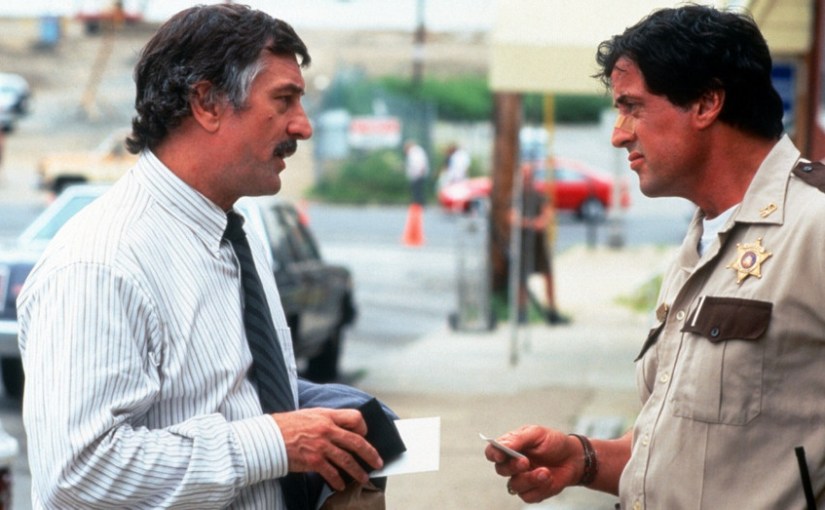
A whose who of staple actors for New York crime and corruption films take center stage including Harvey Keitel, Ray Liotta, and Robert DeNiro.  Yet, the spotlight belongs to Sylvester Stallone in what is arguably the most unsung and best role, next to Rocky Balboa, of his entire career. 

Stallone portrays the pot-bellied schlub Freddy Heflin.  He is the Sherrif of small-town Garrison, NJ where the cops who work within the city, across the bridge, reside comfortably here.  Freddy aspired to be one of those celebrated officers dressed in pressed blue uniforms, but he could not get past the physical due to a loss of hearing in his right ear.  He got that when he was kid and rescued someone from a sinking car that crashed in the river.  Perhaps Freddy wished that never happened.  Maybe his life would have been much more colorful like these New Yorkers.  I can understand the poor guy’s self-reflection.    

An internal affairs investigator named Moe Tilden (another of many convincing New York variations for Robert DeNiro) brings reasonable suspicions of corruption to Freddy’s attention.  How do these guys live so well based on the salary they earn on the police force?  Too often they have been connected with reputed mobsters, and incidents are quickly swept under the rug and kept quiet.  It stands to reason that the cover ups they commit happen in the home state of Jersey, outside of Moe’s jurisdiction.  Moe needs Freddy to quickly offer up anything he knows or witnesses. 

In particular, the leader of these guys, Ray Donlan (Harvey Keitel), might have something to do with the disappearance of his nephew Murray (Michael Rapaport) who was regarded as a young hero cop but is now at the center of a shooting incident gone wrong while driving across the bridge.  Donlan and gang fake a suicide for the kid, but with no body turning up in the river, it’s not so far-fetched to believe that perhaps he’s still alive and hiding out somewhere.

Cop Land works like an Us vs Them observation.  Freddy is the pawn for these guys to keep up appearances while this friendly town operates on other levels.  He’s the guy they can rely on to look the other way and mind his own business.  What I like about Mangold’s script is the dilemma with Stallone’s character.  Who could ever intimidate Sylvester Stallone after Rocky II?  He’s one of the biggest muscle men in film history. Yet here he is the weakling.  Most importantly, he’s utterly believable in this role that’s nowhere in the same league as Rambo or Rocky. 

The cast is as magnificent as you would expect.  Harvey Keitel looks like the family man but he’s got other nefarious ideas bubbling under his exterior.  Robert Patrick fills a role as Keitel’s heavy in a frazzled departure from his anal-retentive evilness that premiered in Terminator 2.  Ray Liotta is the second star of this picture sharing some good scenes with Stallone.  You’d think Liotta was the more seasoned actor even though Stallone came on the scene a few decades before.  Liotta is playing a guy who maybe once lived with a good soul but is now checkered and weary.  How I wish Ray Liotta had more significant screen time during his film career.

The setting works like an intimidating character here. The other supporting players flesh out the environment of Stallone’s sheep herding through a bed of wolves.  Those actors consist of Cathy Moriarty, Annabella Schiorra, Peter Berg, John Spencer and of course Frank Vincent who is a regular in these kinds of pictures.

Cop Land teeters on what Martin Scorsese or Sidney Lumet might have done with this picture.  It only falls short due to a wrap up ending with an unsurprising shootout.  What works so well as a pressure cooker crime drama devolves into blood and bullets and that is a letdown because it’s an easy way out.  In Lumet’s hands for example, the film would have taken advantage of at least an additional half hour to drive the piece into the arena of the public court system (a welcome opportunity for another all-star cameo from the likes of Al Pacino or Sean Penn.   I think the film would have been even smarter for doing so.  The avenue that James Mangold takes with his film is not terrible.  It just feels a little unrewarding or worthy of everything that was wisely executed before.

Cop Land should be seen for the dilemmas it hinges on and then for the various acting scenes among this terrific all-star cast.  Usually, actors will boast that they got to share screen time with Robert DeNiro.  I’m sure guys like Robert Patrick and Michael Rapaport place those experiences high on their mantles.  However, I bet all of these guys said what an honor it was to share the screen with Sylvester Stallone in a performance uncharacteristic of his usual criteria. 

James Mangold’s Cop Land is a terrific crime drama.

AIR FORCE ONE

By Marc S. Sanders

On the day I write this article, July 12, 2024, the new trailer for Captain America: New World Order premiered and Harrison Ford (whose birthday is tomorrow; Happy Tiding Dr. Kimble, Dr. Jones, Captain Solo, Mr. President, Dr. Ryan) is back in the Oval Office playing the President of the United States.  Don’t know what kind of Commander In Chief he’ll be this time around.  He might be as heroic as James Marshall from Air Force One. Then again he could be a challenge of hulk like proportions.  However, let’s at least fantasize that we have Mr. Marshall running for the top job this year against both the criminal buffoonery and geriatric disqualifications we are left to choose from.  Just look at James Marshall’s qualifications. 

Following an American Special Ops capture of a Russian radical, Marshall is bestowed an honor from the Soviet government. His acceptance speech insists his administration will never negotiate with terrorists.  Now that the line has been drawn, away he goes with his staff, his wife (Wendy Crewson) and pre-teen daughter aboard the most protected and safest plane in the world, Air Force One.  Yet, an element of careful process does not go according to plan and Gary Oldman’s team of Russian radicals hijack the plane with demands to free their leader from captivity.  Oldman’s screaming hysterical character, Ivan Korshunov, won’t have it so easy though because his team of men failed to capture the President.  As well, it requires the Vice President (Glenn Close) and Secretary of Defense (Dean Stockwell) who are on the ground to coordinate with Russia to free the prisoner.  Oldman’s response is to kill a hostage every half hour and if that does not work, then just blow up the plane.

This is not good.  BUT WAIT!!!!!  Is that…?  Could it be???  Is the President alive, sneaking around the bowels of the plane while taking out one terrorist at a time?  Raise your fist for Harrison Ford!!!!

‘Murica!!!!!!

There are two narratives going on with Air Force One.  One is the standard Die Hard formula action onboard the plane.  Then there is the endless debates of authority between the Vice President, the Secretary of Defense and the military leaders about if the President is in a proper state of mind to lead and act upon his aggression with a high level of threat to the country at stake, and more personally his wife and daughter in harm’s way?   None of this is nothing new.  It’s all familiar from the likes of many late 80’s and 90’s action pictures.  The politics are much more simplified than what you’d find in a Tom Clancy novel.  There’s even time for a which color wire to cut scene.  Yet, the movie is entertaining.

Director Wolfgang Peterson is best at showing the real star of the picture and that is Air Force One itself.  He’s got long shots down endless corridors and aisles. Within the underbelly, as well as the hollowed-out cockpit, there’s more for us to explore amidst the gunfire.  We see where the weapons are stored as well as the luggage and food supply.  We get to watch the football game in the President’s office too.  Heck, before the terrorists reveal themselves they are given a tour of the massive plane as their guide boasts that it is even impervious to a nuclear blast.  Color me impressed in Patriotic Red, White and Blue.

I think some of the acting is a little overdone at times. Not by Ford, but by almost everyone else.  Watching the debates within the government conference room, I’m seeing a little too much melodrama around the table.  A little too much hand clasping, pacing around the room, whispering,  and deep sighing.  On the plane, Oldman goes over the top but he’s one of our best character actors and its expected from him.  He’s the evil villain after all.  On the ground though, Dean Stockwell has done better work elsewhere, with much more complicated material. 

I like the idea of including political debates and a response to an unfathomable crisis like this, but a lot of the dialogue from guys like Stockwell, Phillip Baker Hall and Bill Smitrovitch comes off as textbook boring.  Same goes for Close, but she fits the role perfectly.  Let her be Ford’s running mate and they got my vote.  The only thing that upholds these scenes are due to Peterson’s hyper Steadicam.  So, when one more person in a suit makes a mad dash into the room, the director sweeps his camera right over there to get the latest news. 

Harrison Ford is doing his standard everyman/tough guy routine, always knowing how to stay one step ahead of the bad guys. President Marshall is much more capable than his entire trained Secret Service Squad and it’s fortunate that he gets the convenient shard of broken glass to cut the tape that binds his hands.  How often do we see that in movies?  The film definitely belongs to Ford, but it’s also nice to see some familiar faces participating like Xander Berkley, William H Macy and Paul Guilfoyle. 

The most unforgiving moment of the film occurs in the final minutes.  I don’t spoil everything by saying the plane nosedives into the sea, but this crash has to land at the top of some of the worst CGI ever assembled.  Yes, I know this was back in 1997, two years before what George Lucas accomplished with, at the time, pioneering effects on his return to Star Wars.  However, the final climax to Air Force One looks so obscurely animated and unfinished, it begs for the screenplay to find another way to wrap up its simplistic story.  It is downright terrible.  I recall it looking terrible on the big screen.  It looks just as bad on a 65” flat screen.  A toy plane crashing into a bathtub would look more convincing.

Air Force One is solid action.  Nothing more.  It’s not a thinking picture or one needing deep concentration and analysis. It does make you yearn for Harrison Ford to at least consider a run for the Oval Office, though.  He’d still be better than what will be on the ballot this year.

EVE’S BAYOU [Director’s Cut] (1997)

by Miguel E. Rodriguez

DIRECTOR: Kasi Lemmons
CAST: Jurnee Smollett, Samuel L. Jackson, Lynn Whitfield, Debbi Morgan
MY RATING: 9/10
ROTTEN TOMATOMETER: 83% Certified Fresh

PLOT: What did little Eve see–and how will it haunt her? Husband, father, and womanizer Louis Batiste is the head of an affluent family, but it’s the women who rule this gothic world of secrets, lies, and mystic forces.

[Author’s note: this review ended up being vaguer than I intended, due to a pivotal moment that, the more unexpected it is, the more effective it becomes.  Apologies in advance.]


Eve’s Bayou is one of the most self-assured, naturalistic directorial debuts I’ve ever seen.  Director Kasi Lemmons (you may remember her as Ardelia, Clarice Starling’s roommate at the FBI Academy in The Silence of the Lambs) has created a movie that feels less like a movie and more like a recreation of someone’s memories, not quite like a documentary, exactly, but it feels…real.  It’s melodramatic, but it’s not pumped up with overwrought hand-wringing and dramatic close-ups.  It’s fiction, but with a ring of truth that I usually only see in the best biopics.  I was delightfully and unexpectedly engrossed from beginning to end.

Let’s talk about that beginning, to start with.  The time is 1962, in a little Louisiana town called Eve’s Bayou.  (There may be white folk in this town, but the movie stars no Caucasian actors whatsoever, kind of like the Black Cinema equivalent of the Bechdel test; it’s just one more surprising and refreshing quality of this wonderful movie.)  Over the course of a lively evening party hosted at their house, we meet and learn a little bit about each member of the Batiste family, just like the opening sequence of The Godfather, which I didn’t realize until just this moment…neat.  There’s Louis (Samuel L. Jackson), the town doctor and rakish charmer, husband to the gorgeous Roz (Lynn Whitfield) and father to three children, 9-year-old Poe (Jake Smollett), 14-year-old Cisely (Meagan Good), and 10-year-old Eve (Jurnee Smollett [Black Canary in Birds of Prey, my GOD, I’m old!]), named after her hometown.  This opening scene establishes that very specific tone I mentioned earlier, one of matter-of-fact realism somehow combined with entertaining cinema.

There’s also Roz’s sister, Mozelle (Debbi Morgan), a woman twice widowed at the top of the film, and who later worries she may be cursed by God.  In an emotional monologue later on, she wonders why God has seen fit to bring so much misfortune to her life, and also wonders how terrible it might be to discover there was no purpose to it at all.  Mozelle has a side business in telling fortunes, and she is quite good at it.  (This will come in handy later, but no spoilers.)

In a nutshell: Eve wanders out to the toolshed late that night and witnesses her father being WAY too friendly with another man’s wife.  The protective Cisely urges Eve not to tell anyone what she saw.  A local voodoo priestess, Elzora (Diahann Carroll), tells Roz to “look to your children”, so she forbids her children from leaving the house unattended for weeks.  Louis continues his womanizing ways as the town doctor.  Roz finally lets her kids out of the house when…well, again, no spoilers.  Life continues at a leisurely pace without ever being boring.

I love how the setting is established and mined for its mood in Eve’s Bayou.  I know there have been countless other films set in and around swamps, Louisiana and otherwise.  But Eve’s Bayou is one for the books.  There is something about the way the cypress trees and dark waters and Spanish moss are photographed that made me almost smell the swamp.  Maybe the intent was to give a visual hint or cue to the secrets being kept in the Batiste family, especially later in the film.  I don’t want to get all “film theory” on this topic, but it’s just something I noticed specifically as the movie progressed.  It’s masterfully done.

I enjoyed the little details that, again, made everything feel like real memories of a real family.  What does a kid do in a large house in the early ‘60s when they can’t leave?  No Nintendo, no Netflix.  Just bouncing a ball against the wall.  Or teasing your siblings.  Or getting mad when someone won’t get out of the damn bathroom.  The Batiste house has a large spreading tree in their front lawn, and one of its huge branches grows just low and long enough for Eve to use as a makeshift hammock.  I liked that.  There could just as easily have been a bench or a chair, but no, she sits on the tree branch, and that feels exactly right.

Mirrors are put to interesting and innovative use in Eve’s Bayou.  Mozelle tells Eve a story about how she once took a lover, and he confronted her husband with a gun.  As she tells the story, she approaches the mirror, and in its reflection, behind her, we see pieces of the story taking place, all done practically with no fancy special effects.  It’s simple, and it may have been done before or since, but I can’t recall this effect ever being so…effective.  It was downright spooky at times.  At one point, she even walks into the scene that we are watching in the mirror, an elegant visual representation of someone getting lost in their memories.

The opening narration gives us a hint of what must, or may, eventually happen in Eve’s Bayou: “The summer I killed my father, I was 10 years old.”  There is a key moment later in the film when, because of that narration, the inevitable outcome of a particular situation is perhaps easy to see, but the film is so effectively constructed and edited that I was still wondering how it would happen.  That’s not easy to do.  Kudos to the screenplay and the director once again.

Eve’s Bayou was an exceedingly pleasant surprise, a movie told from an unfamiliar perspective that still feels familiar in many ways, because human emotion is universal.  When Roz and Louis fight downstairs, and Eve can hear them through her upstairs door, and she covers her head with her pillow, I was taken back to memories of my own parents’ divorce and their heated arguments, things I never really talk or even think about, but this movie captured that vibe perfectly.  While the movie does have its own mission and ultimate destination, it remembers something very important: the more specific you make a scene with its details, the more universal the appeal, regardless of your race, color, or creed.

TITANIC (1997)

By Marc S. Sanders

James Cameron’s Titanic will always remain a timeless piece.  Audiences adore the relationship between the two lovers from different worlds, Jack and Rose, who meet aboard the maiden, and final, voyage of the doomed cruise liner.  Maybe more importantly, the craftsmanship of this film is still beyond compare.  Many know that when this picture was in the making, its budget ran way over and endless rumors of waterlogged technical challenges were rampant through media reports.  Titanic was predicted to sink James Cameron’s career.  Instead, it was the grand Hollywood underdog that no one expected.

I recall seeing the film twice in theaters during the Christmas season of 1997.  I was not so enamored with the script or the fictional love story that Cameron conjured as the central narrative for the real-life tragedy that took approximately fifteen hundred lives on April 15, 1912.  The visual effects were the marvel to watch, and what I patiently waited for, during the second half of the picture.  I had to tread water through the first half though.

A hardly known, but already Oscar nominated (What’s Eating Gilbert Grape?),  Leonardo DiCaprio portrays Jack Dawson, the poor member of the ship’s steerage company who falls in love with an aristocratic young woman named Rose Dewitt Bukater.  Rose is played by Kate Winslet, who’s uncomfortable with the snobbishly wealthy first class section of people she’s forced to associate with by mandate of her possessively cruel, and supercilious fiancée named Cal (Billy Zane) and her mother, Ruth (Frances Fisher).  Call it a Romeo & Juliet love story.  Two lovers are forbidden to be with one another.  Yet, they are going to do it anyway.  It’s simple and nothing dimensional.  It seems to have parallels to Disney’s rated G interpretation of Beauty & The Beast.  Fortunately, what saves the storyline are the performances and chemistry of DiCaprio and Winslet.  These are not even the best roles of either actor’s storied careers.  Yet, they are anything but unlikable. 

The relationship they share aboard Titanic, as it makes its way from Europe to the United States, is told in flashback by a 101 year old woman (Gloria Stuart) to a marine exploration crew who have been meticulously searching through submerged remains of the ship on the ocean floor of the Atlantic.  The most important element to come from this section is a wise choice by Cameron to include an informatively brief analysis of how exactly the ship took on an overabundance of ocean water following a collision with an iceberg, and how it gradually began to sink, weigh down, and split apart before finally concluding with a straight dive down into the murky, cold depths.  I must note that film critic Gene Siskel acknowledged this storytelling device upon the film’s initial release. He hailed this sequence because it offered an early “blueprint” of what audiences could expect to happen and witness during the film’s second half.  We all know the ending to the film, but how exactly did it happen?  The quick breakdown helps.

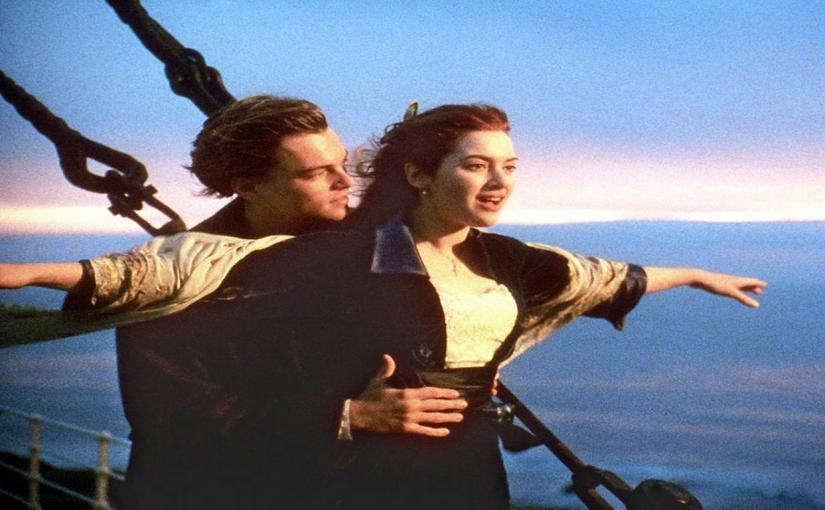
Ahead of the tragedy, Cameron and his set designers offer a grand, functioning piece of machinery that is absolutely impressive to modern audiences, even over a century later.  The decks and hallways are wonderous.  The forward and aft locations seem familiar and solid.  The CGI on this reinterpretation of Titanic is undetectable.  If this film was going to live up to its name, it most certainly has done so.  This ship looks tremendous and strong and indestructible just as the architect and engineer (Victor Garber, Jonathan Hyde) written into the script proudly lay claim to.  The famous moment of the film where Jack supports Rose on the forward bow of the ship with a sunset sky in the background is positively gorgeous.

I do have reservations with the film though.  I think both stories, the forbidden romance and the demise of the ship, in Titanic work.  However, when spliced together, the picture leaves me feeling uneasy.  James Cameron has weaved his fictional romance, appropriate for used, yellow stained paperback books, with a horrifying tragedy.  It’s what you would find in those cheesy Irwin Allen disaster epics from the 1970s.  When Cal’s anger over Jack’s intrusion comes to a boil, he pursues the couple, firing a pistol at them while the ship is continuing to sink.  Jack is apprehended and handcuffed in the lower deck and his doom seems imminent as the water level grows higher.  A priceless blue diamond serves as a MacGuffin that goes back and forth to deliver the operatic divide of these characters.  These are all cinematic inventions painted upon a well-known historical tragedy simply for the sake of adventure and suspense. 

I also found it unconvincing that the only person aboard the ship to question the contingency planning and safety measures ahead of any potential disaster is young Rose, who has no insight into mariner regulation or procedure.  Of all people, it only occurs to Rose that Titanic is not equipped with sufficient lifeboats for all twenty-two hundred people on board.  For storyline options, these avenues written by James Cameron sometimes take me out of the film. 

What I hold fascinating though is where the film depicts the eventual panicked response of the passengers and crew.  We see the captain appear helpless in his defeat against the nature of the ocean running its course over the ship he commands.  A string orchestra chooses to simply perform amid the ongoing disaster, which I have read actually happened.  Most breathtaking is how all the extras in the film react to the growing shift of the ship.  Their slant becomes steeper.  The people do their best to shuffle through the flooding, eventually having to keep their heads above water.  Helpless children are abandoned.  For an emotional punch, the steerage in the below decks is gated off from reaching the top of the ship, and giving themselves a chance at survival on a life boat.  James Cameron accounts for every response and detail that likely occurred during the sinking of the ship.  It’s captivating to witness, despite how tragic the outcome.

Though I do not care for the mix of the love story and the real-life submergence of the ship, Titanic has many strengths beyond what James Cameron achieved with the most up to date technology in visual effects, at the time.  Billy Zane is a villain that you love to hate.  Truly an underrated antagonist in the history of film.  David Warner is an intimidating henchman.  Kathy Bates is a welcome Unsinkable Molly Brown, the crass wealthy woman who sets herself apart from the pretentiousness of her lady peers.   

The exceedingly three-hour running time allows you to become completely familiar with the ship from stem to stern and again the set pieces are magnificent, whether you are hobnobbing with the wealthy up top or the steerage down below.  Every pipe or rope or stairway or hallway or chandelier serves a purpose.  The costumes and makeup designs are appropriate, including the frozen complexions on the bodies that float on the ocean surface following the tragedy.  Cameron’s use of the camera is amazing as he offers wide, expansive shots of nothing but dark ocean with hundreds of people suffering towards their demise. Thus driving home the point that there’s nowhere to find salvation and relief from the bitter cold air and sea water.  These poor people faced unimaginable challenges while competing with panicked crowds, and lack of foresight from those in charge of this newly designed technological wonder.  The movie covers everything that worked against these passengers.

Titanic is an incredible accomplishment. There’s much to see and absorb.  The last time I saw the film was nearly twenty five years ago and much of the footage never escaped my memory.  James Cameron left an indelible impression on moviegoers.  Regardless of the misgivings the film holds, Titanic has held its rightful place as an all-time landmark in cinematic achievement.

NOTE: I took advantage of seeing a newly restored 4K version in 3D at my local movie theater.  I have never been a huge fan of 3D as I often find it murky and distracting from the story.  Had Titanic been offered in standard 2D, that is what I would have gone to see.  Fortunately, this re-release is an exception to my impression with 3D presentations.  The picture is glorious, and I highly recommend the film be seen while it remains in limited release.  Titanic in 3D should not be missed.

BREAKDOWN

By Marc S. Sanders

The southwest region of the United States can be brutal.  The desert landscape is scorchingly hot and the end of the world seems like an eternity away…no matter how fast you drive or how far you go.  Worse yet could be the truckers and locals who could care less about who you are, where you came from or where you’re going.  So, you better be sure your well equipped Jeep Cherokee has enough gas in the tank and your oil dipstick comes up black.  For Jeff and Amy Taylor, though, nothing they do will matter.  Their car is destined to break down anyway.

Jonathan Mostow wrote and directed a taut thriller called Breakdown that builds on a Hitchcockian formula for a road picture.  When Jeff and Amy’s (Kurt Russell, Kathleen Quinlan) car breaks down on a long, lonesome highway in the middle of the desert, a friendly trucker stops by (JT Walsh) to lend a hand.  He offers to take them to the next stop where they can call a tow truck.  Jeff agrees to stay with the car.  Amy hitches a ride to call for the tow.  Shortly after, Jeff realizes that Amy has mysteriously disappeared.  When Jeff catches up with the trucker, the situation gets even stranger because this guy claims to have never met Jeff before or even know who his wife is.  It gets even weirder and more frightening from there.

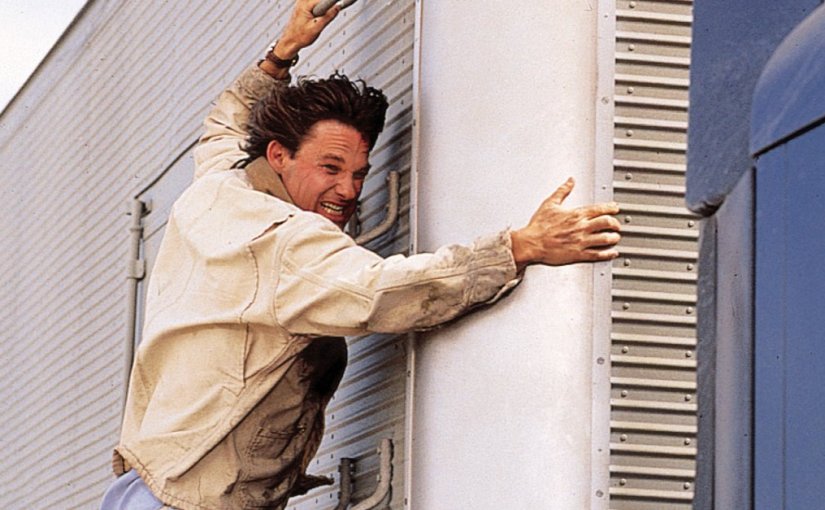
Kurt Russell is very good in a relatively simple, but effective story that only needs its ninety minutes to get your heart racing.  As Jeff learns of the conspiracy playing against him, the panic builds in Russell’s performance.  A really effective moment occurs when Jeff is forced to go to a local bank and withdraw ransom money.  While the banker is executing the money transaction, Jeff enters the restroom.  In this short moment, Mostow keeps a good close up on a very sweaty, beaten and nervous Kurt Russell.  Jeff is looking for something to use as a weapon.  Now, we’ve seen this many times before.  What kept me absorbed in the suspense of the film is how Kurt Russell evokes his thought process without having anyone to talk to.  In this bathroom, he involuntarily walks in circles, seemingly asking himself “what am I going to do?”.  Mostow never breaks the shot, allowing his lead’s performance to send home the paranoia.  I was right there with this poor guy.  What is Jeff going to do?

JT Walsh was an under the radar character actor; one of those guys that you recognize from dozens of films (Good Morning, Vietnam, A Few Good Men), but you just never knew his name.  He passed away too soon.  I’d wager eventually he’d get some kind of awards recognition.  This is a magnificent villain in Breakdown.  A good antagonist is one you can trust at first.  So that when the veil is lifted, your jaw drops a little.  Walsh accomplishes that here.  He turns on the good guy and he betrays the viewer.  He really plays a guy with two masks on.  Friendly and helpful at first.  Later, a toothless scowl is across his face as he terrorizes Jeff.  The big rig truck that Walsh drives becomes reminiscent of what Steven Spielberg accomplished with his first film, Duel.

While a Jeff Taylor character may have appeared in an Alfred Hitchcock film, as the common man caught up in an outrageous plot he was never looking for, Jonathan Mostow has modernized the method with well edited action scenes.  This is a road picture but there really are not car chases to behold.  Instead, there are moments where like any of us, we will increase our speed on long stretches of road.  When we take our eyes off the highway for a split second, we never expect what will pop out and startle us.  As well, when we try to pass ahead by cutting into the opposite lane, a head on collision may come our way.  The film goes for those pressure points first before another overly used car chase.  This is where the environment fights back against the protagonist.  

The location shoots of Breakdown are superb.  An old diner, in the middle of nowhere, has some locals who could care less about a polite out of towner, clearly concerned about his missing wife.  They just look straight ahead while nursing their beers.  The bartender has also had enough of this guy to the point of threatening him with a gun to get out of the joint.  A passing by police officer (Rex Linn of Better Call Saul, another great character actor) devotes no more than five minutes of his time to poor Jeff’s concern, and then he moves on.  The desert and the people who occupy the area serve only apathy to a helpless stranger.  The setting of Breakdown is a villain all its own.

This thriller works simply because a scenario like this could happen to any of us.  It was released in 1997, just ahead of the cell phone age, and there’s acknowledgement of that time.  Jump to today and this situation could still happen.  Technology is not always going to help us, no matter how many bells and whistles we have on a car or how many bars show on our handheld devices.  In the desert, any one of us can be a victim unto ourselves.  In the middle of nowhere, a bad guy can use an opportunity to his advantage at the expense of any persons leaving themselves unguarded.

Breakdown shows that our worst nightmare could be to drive into an endless daylight void, where any one of us can get stuck, only to later get caught.  It’s scary as a desert hell, and it’s a fantastic nail biter right until its bang-up conclusion.

KISS THE GIRLS

By Marc S. Sanders

When you’re watching a movie and one character says “Now wait here. Let me handle this!” what do ya think is gonna happen? When you’re watching a movie and one character says “Kate, we’ve covered every inch of those woods. There’s no building there!” whatcha think? You think there actually is a building there?

Let me ask you this, what do you think happens in the film Kiss The Girls?

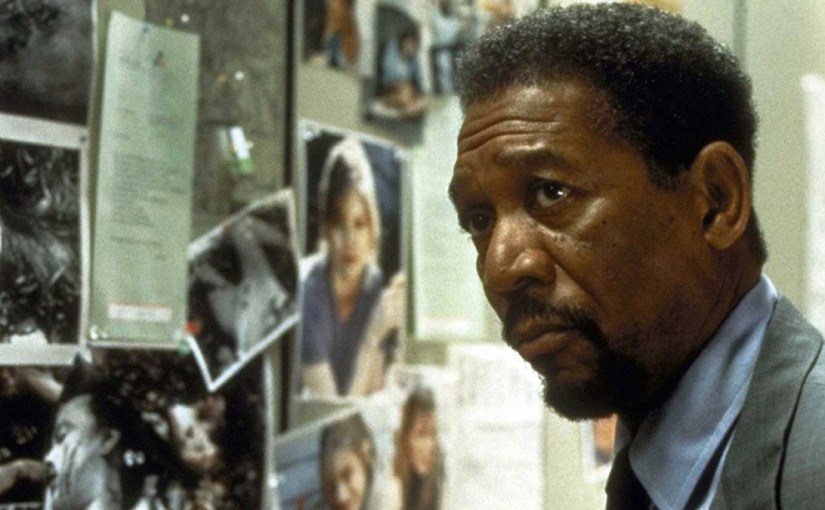
Yup! A whole lot of this nonsense and more that I could cover endlessly. Adapted from James Patterson’s best selling novel featuring his forensics detective hero Alex Cross, Kiss The Girls begins as an effective thriller focusing on the backgrounds of its two leads: dependable Morgan Freeman as Cross, and Ashley Judd as Dr. Kate McTiernan, a skilled surgeon with a specialty in kick boxing (that may come in handy later). At first, we see these characters handling snippets of storylines related to their careers. Cross defuses a suspenseful suicide situation. McTiernan has to console a family whose little girl was in a motorcycle crash. There’s good acting and emotion going on here and I was hoping the film would live up to the promise of these scenes; the characters’ expertise now being applied to Patterson’s main story. It doesn’t.

Instead, the movie just mires itself in plot holes and filler where one character insists on working alone while the other insists on not sitting idly by. This is not character development. This is ping pong volleying. Kate is kidnapped by a serial “collector” of smart, young, beautiful and highly intelligent women by someone regarded as “Casanova.” When Alex’ niece is one of the women taken, he travels from Washington DC to Raleigh, NC to join the investigation.

Soon after Kate has been taken, she manages to be the only one to escape from some hidden dungeon located in the woods. She joins Alex at every turn to find Cassanova and rescue the other captives. Okay. So that’s not a bad set up.

Where it falls apart is in the development. Kate managed to escape by jumping into a river where she’s retrieved by two kids. So wouldn’t law enforcement just sweep that entire area? I mean be really thorough, top to bottom! Surely, you’ll pick up footprints or scents from the dogs. Well, Alex says they did. Fortunately, his niece’s boyfriend finds the map. You know…the map that’s hidden in the library that no one else is aware of and shows this dungeon or whatever it is that’s there. Only one guy, ONE GUY, knows about this map????

When an hour and forty minutes has surpassed, you bet that map is gonna turn up. Remember, also when someone says wait in the car, the one thing you do is not wait. You know, this is a movie. So, Mr. Freeman, please spare me the act of surprise when Ms Judd walks into the bar you’re scoping out. This is all unnecessary, and boring and tired and old.

Kiss The Girls is another film with THAT TWIST! Was it really needed though? Just when the film apprehends the bad guy, and the ladies are recovered safely, there’s a gotcha moment in Kate’s kitchen with lots of knives and pots and pans to play with. Gary Fleder directed this 1997 disturbing thriller in a post age of The Silence Of The Lambs and Seven, which are far superior films. It’s not a film dependent on gore or torture porn, but it’s got the dark stone lined halls for haunted house creepiness. I’m good with that. It’s a thriller after all.

The film’s best assets, however, are Freeman and Judd. These are two top class actors who invest themselves in performance. If only they were working with a much more believable story.

It’s the implausibility in the script that make my eyes roll.

THE LOST WORLD: JURASSIC PARK

By Marc S. Sanders

The Lost World: Jurassic Park contains a batch of characters making a lot of stupid decisions all in the name of being stupid for stupidity’s stake.  That doesn’t make it a bad movie though.  Just somewhat…unsophisticated…and stupid.

In the sequel to the monster smash adaptation from Michael Crichton, Steven Spielberg reunites with Jeff Goldblum, now at the top of the credits list, as smarmy mathematician Dr. Ian Malcolm.  It really doesn’t matter if the guy is a doctor of any kind of specialty though.  Malcolm doesn’t utter one scientific fact or theory or observation this time around.  Whatever shred of debate regarding the resurrection of dinosaurs that existed in the first film is completely abandoned this time around.  Carnage, mayhem and outrageous ridiculousness take center stage, stage left, stage right, downstage, upstage, off stage, and over a high cliff.

In an early scene, Malcolm is summoned by wealthy entrepreneur John Hammond (Richard Attenborough, in a welcome cameo).  Hammond tells Malcolm that his paleontologist girlfriend (isn’t that a coinkidink), Sarah (Julianne Moore) is on a nearby island to the original one from the first film, and studying the behaviors of the dinosaurs that were developed there.  She will soon be meeting up with a photographer (Vince Vaughn) and another associate (Richard Schiff; I don’t recall the script explaining his specialty).  So, Malcolm sees no choice but to go after Sarah and rescue her from the island.  This is one Daring Mathematician.

One point of order, because this is a Spielberg adventure, a kid has to be involved.  Malcolm’s pre-teen daughter and gymnast extraordinaire Kelly (Vanessa Chester) stows herself away on the excursion. Thank god she’s gymnast.  That may come in handy.

At the same time, Hammond’s greedy nephew, Peter Ludlow (Arliss Howard) is leading a large expedition crew on the island to recover representatives of each breed of animal to bring back to the mainland in San Diego for show and tell.  The leader of this pack is also the best character in the whole film.  He’s a game hunter named Roland Tembo (Pete Postlethwaite).  Tembo’s price is to hunt down one Tyrannosaurus-Rex for his own game pleasure.  Aaaaand that’s where the story stops. 

I just ticked off a lot of actor names, didn’t I?  Well, this is a sequel and in a monster movie sequel there’s a demand for more casualties of course.  If that’s what you are looking for, you won’t be disappointed. 

You also won’t be disappointed in the assortment of dinosaurs on hand.  This time there are two T-Rex’s and they are used beautifully in a very daring, albeit long for the sake of maximum suspense, scene that involves our heroes dangling within a double RV trailer that has been pushed off a cliff.  When Sarah lands face first on the back windowpane of glass, try your best not to bite your nails.

Another exceptional scene is when the expedition runs into a tall grass raptor nest.  This is like Jaws on land.  With the help of much CGI, but also puppetry from Stan Winston’s imagination factory, Spielberg gets great overhead shots of fast forming black lines that quickly cut through the meadow taking out one poor soul after another where beast overcomes man. These moments occur in the large second act of the film where it’s nothing but action done with Spielberg’s skill to oversee. 

The third act is questionable, but I found a nostalgic admiration for it.  Spielberg goes for the salute to King Kong, the grand daddy of all monster movies.  Ludlow’s hubris and what remains of his expedition team trap and bring back the male T-Rex to San Diego aboard a large freighter.  In the dead of night, garbed in his finest suit, he’s ready to give a speech to a press junket that must work a graveyard shift introducing the marvelous attraction.  Naturally, we know things will not go as planned.  Now, we know this is not New York City and the Empire State Building is not nearby, but this T-Rex will naturally run amok anyway and settle for destroying a suburban dog house, about a dozen cars and a 76-gas station.  No, it is not King Kong, but the salute is appreciated nonetheless.  There’s even a wink and nod to Godzilla.  I laughed.

Pretty stupid of Ludlow to do this, right?  Well, he’s the villain.  So, let’s give him a pass.  On the other hand, the heroes are dumb as rocks.  Sarah takes a baby T-Rex away from its quarters. Ian gets up into a high area platform with his daughter as an escape to safety…but then he comes down again!!!!!  The hunters simply think they are hunting kittens no matter the stature of any of the game they are pursuing.  The telephone doesn’t get answered when it really, really should.  You’ll find yourself shaking your head and outstretching your arms at the screen (palms up) as if to say “WHY????????”. 

It really doesn’t matter.  The first Jurassic Park film never had a fully developed brain.  This installment, unabashedly, never even stops to think.  It’s as if a collection of characters in a shoebox raised their hand for volunteer slaughter. 

My wife watched this with me recently, and at times she would ask “Why are you doing this or why not just call such and such?”  I’d have to remind her it’s not that simple.  Cuz if it were that simple, then they would have picked up the phone.  We all have a destiny in life.  I truly believe that.  The destiny of the cast of The Lost World: Jurassic Park was to run and maybe or maybe not get chomped on and eaten.  This is what they were groomed for their whole lives. So, let’s not interfere with the laws of nature.

BOOGIE NIGHTS

By Marc S. Sanders

Boogie Nights was director Paul Thomas Anderson’s second feature following a very different and very quiet film debut with the gambling addiction piece Hard Eight.

Heck, it’s fair to say all of Paul’s films are very different; here is the seediness of porn while later in his career he will focus on the ruthlessness of a wealthy and angry oil man and then an obsessed dressmaker devoid of care for the models who parade his accomplishments. (See There Will Be Blood and Phantom Thread.). Paul was definitely striving for recognition with his familial depiction of life in the California pornographic film industry.

What I’ve always liked about Boogie Nights was Anderson’s intent to show the naive innocence of this large cast of characters. Filming blatantly oblivious awful porn scenarios can still be regarded as very proud efforts by its talent.

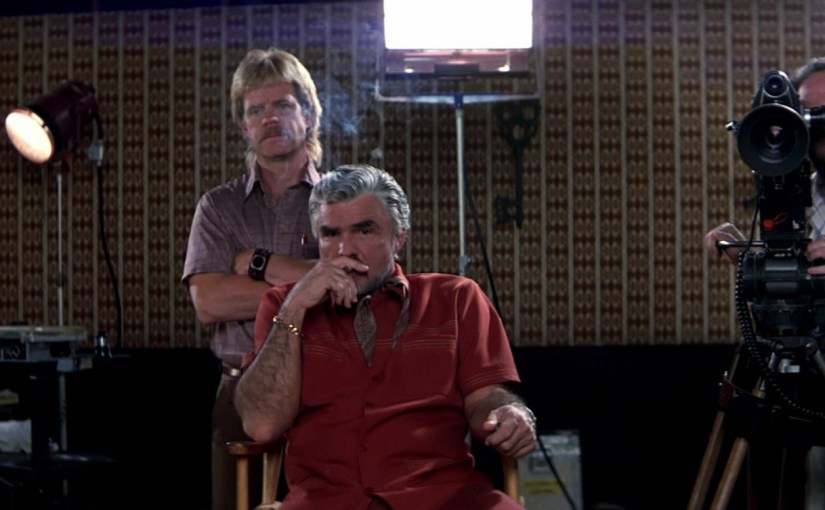
The main character is Eddie Adams (aka the amazing Dirk Diggler) played with macho pathos by Mark Wahlberg. It’ll likely be the best role of Wahlberg’s entire career. Dirk is proud of his natural talent in front of the camera. He’s even more proud of what God has gifted him. Don Cheadle is another porn star named Buck. He’s also proud of his accomplishments and simply a kind fellow looking to make country cowboy a trendy look for a black man while selling the “Hi-est Fidelity” in stereo equipment on the side. Julianne Moore is Amber Waves, the maternal porn mom of the bunch; very affectionate, very comforting and very reassuring when Dirk shoots his first porn scene. The one individual who really holds all of these misfits together is Burt Reynolds as Jack Horner, the porn film director. He’s the paternal one who believes in his artistic merits of shooting porn but with a story, and only with the integrity of film, and never the cheapness of videotape. So, Jack is like any artist who insists on a certain type of canvas. It might be smut, but he has principles, and he has pride.

Anderson is wise in how he divides up the developments. The film begins in the late 1970s during evening night life and decadence and everything seems fine and innocent and right despite the endless debauchery of reckless sex and drug use on a Disco backdrop. Wahlberg’s character is welcomed lovingly into this world, and nothing appears wrong. It all seems to stay that way for Dirk until New Year’s Eve, 1979. The 80s begin with a gunshot and then Anderson’s cast must pay for the revelry of their sins. A great moment presented on this night is where Amber Waves introduces Dirk to cocaine. Dirk has been thriving, making money, developing a following and now it is jeopardized in one moment thanks to his naivety. Julianne Moore is superb in this particular scene against Wahlberg. She’s the mentor with the peer pressure to pass on her high and keep it running.

Drug addiction, violence, sexual abuse and even changes in pop culture lead to hard times for these likable people.

It’s a hard life. It’s a complicated life. Yet it’s not all necessarily illegal. Morally, it might appear wrong, but it’s a life nonetheless.

Anderson was wise to use (at the time, relatively new) filming techniques of Martin Scorsese with rocking period music and fast edits along with savored moments of great steady cam work. One long cut especially works when the film first begins on the streets of Reseda and on into a crowded night club. This industry doesn’t sleep. So, neither will the camera that follows it. The music must also be celebrated. I do not listen to Night Ranger’s Sister Christian without thinking of firecrackers and a dangerously drug addled Alfred Molina playing Russian roulette. Though I know which came first, I also wonder if Three Dog Night’s Momma Told Me Not To Come and Spill The Wine by Eric Burton & War was written to enhance the celebratory introduction for Dirk when he attends his first party at Jack’s house. It’s another great steady cam moment from a driveway, followed by steps in and out of Jack’s house to simply a bikinied girl’s dive in the swimming pool. As a viewer I was absorbed in the California haze. Superior camera work here.

The cast of unknowns at the time were a blessing to this film. Anderson writes each person with care and attention and dimension. They have lives outside of this world like Amber’s child that we never get to meet, thanks in part to her lifestyle. She might be maternal but that doesn’t make her a good mother. Julianne Moore should have won the Oscar she was nominated for. Burt Reynolds’ own legacy seems to carry his role. His distinguished silver hair and well trimmed beard earn him the respect of every cast member and he performs with a quiet grace of knowledge, and insight, even if he will inevitably be wrong with how things turn out. Phillip Seymour Hoffman plays the dumb kid Scotty insecure and unsure of his homosexual attraction to Dirk. It’s not easy to play a dumb character when you are not doing it for laughs. Hoffman makes a huge impact with little dialogue but Anderson is wise enough to capitalize on him.

Boogie Nights offers one of the best cast of characters and assembled talents in any film ever made. An individual movie could be made about each of these people, and it’d be interesting and entertaining.

Try to avoid a blush and mock at the industry depicted because then you’ll see how another walk of life truly lives day to day. It might be porn. It might be smut. Yet, it’s still a thriving industry.

THE DEVIL’S ADVOCATE

By Marc S. Sanders

The Devil’s Advocate does not get the accolades it truly deserves, and I’ve never understood why. It is more than just a supernatural thriller or a legal drama. It’s both actually, and most films cannot lay that claim.

Director Taylor Hackford has assembled a brilliant cast that boasts a debut from Charlize Theron in the incredibly complex role of Marienne, wife to Keanu Reeves’ hot shot southern drawled, Gainesville attorney. Theron hits every pulse perfectly beginning with loose, beautiful and cocky to insecure, haunted and victimized. When I first saw the film in theatres, I left believing she’ll get an Oscar nomination. Alas, the powers that be never gave her consideration and they were wrong. Beyond a relishing Al Pacino as the lord’s most infamous fallen angel, Theron’s performance sends the script home into absolute believability. The power of Satan is executed on Marienne, and the visual and audible evidence lies in Theron’s delirious performance. She’s astonishing.

Next up, Reeves is entitled to lots of credit. The role of Kevin Lomax is his best role (Ahem…Sorry, Neo. Sorry John Wick. Sorry Johnny Utah.). He carries a disillusioned swagger that he is as good as his record of trial wins implies. Yet, is he as good as the best of the best New York City attorneys? When you are the son of Satan, maybe so. What works best though are the ongoing tests of will for Reeves’ character. His inescapable hillbilly dialect blends perfectly with a script that questions temptation against instinct, against opting for what is right. At the time of release, Keanu Reeves might have been perceived as his surfer dude Bill & Ted character not be taken seriously enough here. I never let that be an interference for me, however. Reeves doesn’t compromise and he avoids the wholesome, God-fearing kid that Kevin Lomax is meant to be. Instead, his Christian teachings seem like a nuisance for him; an obstacle to a more satisfying life regardless of sin. Reeves balances the dimensions beautifully.

Then there’s the machine behind all this. Al Pacino is John Milton, hardly disguising his true identity. He’s too proud of who he is to do that. Sure Pacino is chewing the scenery. Yet, shouldn’t he? This is Mephistopheles he’s playing here; an entity ready to undo the will of the Lord. He carries no honor for God. However, he maintains a rule book and before he accepts a disciple, he’ll make certain that it is by the follower’s choice alone. He administers the test, but he doesn’t take it. Pacino gets the best lines and the best monologues. He’s treated with an opportunity to two step along to Frank Sinatra. He’s given free reign to operate based on his legendary career. He’s my favorite devil of any and all films.

Taylor Hackford is meticulous in his direction. There’s a great moment near the beginning where Kevin is saying goodbye to his God loving and very Christian mother. He goes to her church. This is the first of many smart choices for Hackford. He does not allow Kevin to step inside the church. Rather, he paces just outside the door. Kevin does not have a relationship with God, thus opening an opportunity for Satan. Other moments are there too, such as Milton always insisting on traveling by subway…underground. Heck, there’s even a moment where a man with a box that says “Halo Industry” walks by Kevin and John; nice subtle nod. New York City is treated like a character boasting its numerous, sky-high cathedrals and angelic artwork. Pacino is the ultimate NYC resident; a creature of the concrete jungle. Hackford also recruits the notorious to boost the lair surrounding Reeves and Theron with appearances from the likes of Don King and Alphonse D’Amato. (Satan’s disciples, perhaps?)

This is one of my favorite films. It carries not one single flaw. It is richly assembled in dialogue, story, cast, set design and direction.

The Devil’s Advocate is one of those films that you want to watch over and over and delight in Pacino’s thought provoking one liners, debate with your conscience vs Satan’s own argument (he makes some good points here) and question the power of free will. It’s a fun, thinking picture.