IN THE LINE OF FIRE

By Marc S. Sanders

While watching Wolfgang Petersen’s In The Line Of Fire for about the umpteenth time, it occurred to me that good, solid action pictures work so well when there is at least one or two characters who suffer from a past trauma.  Recently, I wrote about John Rambo in First Blood where what haunts the character sets the story in motion.  In Petersen’s film, both the villain and the hero attack one another’s personal sufferings to stay ahead of a game that could result in the assassination of the President Of The United States.

Clint Eastwood is aging Secret Service agent Frank Horrigan.  He served on the team the day Kennedy was killed in Dallas.  A deranged lunatic who initially goes by the name of Booth (John Malkovich), a salute to Lincoln’s assassin, forces Frank to play hand after hand through disturbing phone calls he makes to Frank where he discusses his eventual rendezvous with death when he will finally kill the President.  Booth tests Frank mettle though.  Does Frank have the guts to take a bullet for the subject he is supposed to protect? 

In The Line Of Fire is a very effective thriller because of its lead performances from Eastwood and Malkovich – two actors of different ranges with very different personalities.  Eastwood is famous for being the quiet kind of hero in films like Dirty Harry and Unforgiven.  Malkovich is a character actor who hides within his roles, which is especially demanding of the character in this film.  It is hard to find two roles in his career that seem similar. 

Booth is a master of disguise.  Wolfgang Petersen takes more the one opportunity to show the endless possibilities of what Malkovich as Booth could do to alter his appearance.  The morphing of the digital composites-bald, hairy, thin, plump, glasses or no glasses-is a welcome disturbance.  Interestingly, the basic John Malkovich that audiences are familiar with does not even make an appearance until at least a third into the movie.  Prior to that he’s disguised as a hippie or Petersen has him concealed in dark corners where all that you are seeing are his eyes hiding behind a pair of binoculars. 

What holds your attention in a script from Jeff Maguire is that you learn more and more about the man called Booth as the story moves on, all the way to final act.  What would motivate someone to assassinate the most powerful leader of the free world?  The odds of accomplishing the act are enormous against the security and protection devoted to one person. 

You also witness the defeat that Horrigan endures as Booth stays ahead of him and torments him over his past transgressions. At first Frank is forced to recollect his past failures by what Booth brings up in one phone call after another.  Later, Frank gets the upper hand as his investigation uncovers more.  A later scene in the movie brings about a sensational exchange of dialogue between the two actors.  The agent also has to contend with a difficult supervisor (Gary Cole) and a Chief Of Staff (Fred Thompson) who carry no faith in Frank’s efforts and are more concerned with the President’s image versus saving his life. 

Clint Eastwood and John Malkovich are a terrific protagonist and antagonist. There are a few scenes the two actors share together but they arrive later.  Before those moments, much material depends on the phone calls they have.  So, they work well off each other without even being in the same room.  The characters come at one another with the demons they dig up and the responses from Eastwood and Malkovich appear very convincing.  Very effective work with script, direction, and performance.

The supporting cast is terrific too.  There’s a romantic angle that could have been filler, but thanks to a good matchup between Eastwood and Rene Russo, as another Secret Service agent, there are some humorous moments as well as tender scenes for the heroic agent who is approaching a dinosaur period.  Clint Eastwood is great to watch as a piano player in this film.  Watch as he plays As Time Goes By when Russo rejects his advances and wanders off for the elevator.   Shortly after, she succumbs and there’s a hilarious moment that pokes fun at what it takes to be an active agent.

Dylan McDermot is Frank’s younger partner.  He’s quite good, representing the fear that goes with being a man willing to take a bullet for someone else.  An opening scene presents a frightening moment for the character.  On a Clint Eastwood level, it works with the signature charm that most are familiar with, but from McDermott’s perspective it is something else entirely, helping to shape his character for the rest of the film.

The characters in In The Line Of Fire are not tough guys beyond dares.  They are conflicted.  They experience fear and hesitation.  They have pasts that haunt them as well, and the opponents use psychological warfare to weaken their enemy.

Because Maguire’s characters are so fleshed out, the suspense works nicely with Petersen’s direction and a recognizable Ennio Morricone soundtrack.  The ending is great, not just for the action and editing, but the tension is quite palpable as well.

In The Line Of Fire has magnificent performances. You get a clear picture of what is necessary to be in the Secret Service, all the way down from the department’s appearance while jogging next to a Presidential limousine while wearing a suit, to the process of preparations, and what heights Presidential protection strives for to stay ahead of endless threats that come their way.

Wolfgang Petersen’s film is thirty years old, and the technology and procedures within the governmental departments have assuredly been updated since its release, but this picture does not appear dated or out of touch.  This thriller still works.
DEMOLITION MAN

By Marc S. Sanders

In the years since the Sylvester Stallone/Wesley Snipes futuristic action picture Demolition Man came out in 1993, bloggers have been giddy to post about how brilliant the satire is, especially since much of its fictional future set in a totalitarian San Angeles (formerly Los) in the year 2032 ended up becoming real to some degree.  Okay, fine.  I’ll go with what they say.  However, Reader, this is not on the same level as Paddy Chayefsky’s prophetical film, Network, and the legacy it has bestowed.  Demolition Man remains just as stupid as it was when it first came out.

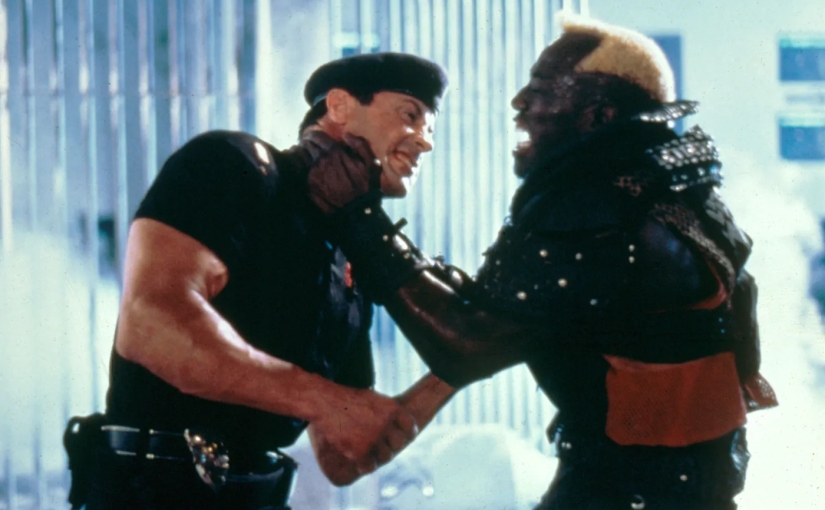
In a mid-1990s prologue of fire, gunfire, and flames, a vicious killer named Simon Phoenix (Snipes), with a happy go lucky habit of giggling through the mayhem he unleashes, is apprehended by decorated cop John Spartan (Stallone).  However, both men are sentenced to decades of cryo-freeze imprisonment because the hostages that Phoenix held had perished and Spartan was found neglectful.

The film jumps to 36 years later. Phoenix has been released and immediately returns to his old habits.  The problem is the law enforcement of this period is not equipped to contain the crazed criminal.  So, Spartan is defrosted as well to go up against Phoenix.  This future is occupied by the cute smiles and charms of Sandra Bullock, Benjamin Bratt and Rob Schneider as the cops who happily sing the melodies made famous by radio and television ads.  Guns are entirely outlawed along with drugs, alcohol, spicy food, and obscene language.  Say a curse word and a machine is nearby, quick to charge you with the offense.  Touching and the exchange of bodily fluids are forbidden as well.  A high five with no contact was an uncanny precursor and is now reminiscent of the early days of the Covid crisis when it was strongly urged that people not even shake hands.  About the only favorable improvement of this future is that toilet paper is no longer used, and people resort to solving their hygiene problems with three seashells.  Regrettably, the technique is never demonstrated.

This film invests a lot of time in its satire, and I appreciate the attempt to find its humor.  The problem is the humor is delivered by Sylvester Stallone and he’s not Bill Murray or Aaron Eckhardt (check out Thank You For Smoking).  Satire is not a wheelhouse for Stallone to reside in.  Sandra Bullock on the other hand is cute in her response.  A memorable scene could have been so much better had Bullock had a more appropriate scene partner.  Lovemaking takes on a whole new method in this 2032 future.  Head devices are used to stimulate the mind.  Oddly enough, you could say that’s the direction that virtual reality has taken.  I appreciate the intuitiveness, but Stallone’s performance doesn’t.  What was intended to be a foreign experience for sexual gratification, comes off very clunky with Stallone.  Imagine what Ben Stiller or Paul Rudd could have done here.  Bruce Willis would have been marvelous in a scene like this.

Wesley Snipes is just as good an action star as Stallone or Willis or Schwarzenegger.  Unfortunately, his Simon Phoenix is so one note as a villain.  He’s a got a bleach blonde crew cut and a giggle and nothing else.  Stallone’s character describes Phoenix as a dirt bag, and the dastardly bad guy shoots guns and does quick kicks.  There’s nothing to know or learn about this guy.  He’s just a target for Sylvester Stallone to do his typical Sylvester Stallone with a shotgun and a handgun and his signature rahhhhhhh bellow that he’s provided in Rambo and Cliffhanger and Cobra and most of the rest of his career.  (Don’t get me wrong though.  Stallone does have a good repertoire of movies.  This one in particular is what doesn’t work.)

Denis Leary lends to the thin plot for a time.  Back in ’93, Leary was known for a few MTV ads where he did his infamous ranting monologue while popping a cigarette.  Because the script for Demolition Man is so nil, the angry comedian is granted opportunity to do his schtick here…twice!  It didn’t amuse me in ’93.  Now it’s just terribly outdated.

Back to the satire, I question the response of the players.  This film takes place only 36 years after a time of violent crime and cursing and smoking and drinking and all the debauchery that we were tolerated.  When Rob Schneider and the police look shocked and terrified at Simon Phoenix’ measure of violence, they are completely oblivious to what’s occurring.  I dunno.  Should they be that gullible?  This guy is only from a time that’s just over thirty years ago.  It hasn’t been that long.  Bullock even has a poster of Lethal Weapon 3 hanging in her office.  The response was hard for me to swallow, and that’s what killed the satirical attempts.  You can’t be that dumbfounded or naïve, can you?

There was a good idea here, but any kind of semblance of thought went out the window once that was jotted down.  The right player was not inserted into the main slot.  Stallone is miscast.  That’s the biggest problem.  Demolition Man hinges on the ho hum gunplay of any Sylvester Stallone actioner and stands on a sliver of irony with how dynamics have played out since the film’s release.  That’s not enough to consider it a fun kind of popcorn flick, though.  Demolition Man needs to remain frozen in time.

CLIFFHANGER

By Marc S. Sanders

It’s an action picture.  What’s common?  Sylvester Stallone, the MacGuffin is money, and the villain has a European accent.  What’s uncommon?  The setting is a Colorado snow covered mountain. 

The movie is Cliffhanger directed by Renny Harlin.

This film deserves much praise for the photography it offers of Stallone and his sidekicks (Michael Rooker, Janine Turner) scaling steep rock formations while trying to evade brutal, but moronic, thieves who have foolishly lost their booty in midair. Now the bad guys must recover the stolen Federal Reserve bills which are scattered in three different locations within the mountain range.  When their plane crashes they force the heroes into leading them on an expedition to locate the money before they will surely kill them.  John Lithgow leads the villains.  Thanks to his slithery English dialect, he’s not bad in the part.

For a pinch of character depth, Gabe (Stallone) is haunted by the opening scene of the film where he failed to rescue the girlfriend of his buddy, Hal (Rooker).  Gabe and Hal will be awarded the opportunity to make amends thanks to this unexpected adventure.  Cliffhanger is not just a thriller.  It’s also a chick flick for guys. 

On a modern flat screen TV, it is quite discernable to recognize the CGI and handcrafted sets that make up much of the scenes.  However, the thrill of it all still holds up and as noted before, the overhead shots really look spectacular.  Stallone really is hanging from these bottomless heights with just one hand; at least that’s what it looks like.  If there is an illusion at play, then there are moments where I can’t tell if I’m being deceived.

The opening scene is the highlight of the picture as Gabe must zip line himself upside down over a wide crevice while attempting to save a hapless climber whose harness has given out.  It’s impossible not to sit still during a well edited and directed moment like this.  This is a masterful scene of terror and suspense.  Renny Harlin is certainly an undervalued director in the action genre.  (I wonder what he’s been up to these days.)

The bad guys are quite hapless though, as they freely bicker among themselves and give away how they’ll happily kill the heroes quickly, allowing one to warn the others.  They are dumb right from the start by killing the pilot of the plane they’re on before fully completing their mission and idiotically losing the money at play.  Then again, as my Unpaid Critic colleague would say, “Then there’d be no movie.”  True Mig!  Very true.

Still, the atmosphere of Cliffhanger is what works.  Blustery snow and wind come off convincingly as Gabe is forced to freeze and shiver with no layers to keep him warm while executing some daring escapes.  Rescue helicopter stunts and collisions are sensational.  There are obligatory shootouts and bloody slashes of skin from climbing tools.  There’s even a bat cave, with no superhero in sight, but it will give you the willies.

I’m hot and cold on many of Sylvester Stallone’s films.  Don’t get me started on Assassins with Antonio Banderas or The Specialist with Sharon Stone.  Those movies required some nuanced acting that the action star just wasn’t offering.  However, here the adventure makes the piece thanks to the director, and Stallone fits right into this environment where the role demands strength, stamina, and outdoor intuition.  Renny Harlin is the top hero here, allowing the marquee actor to look really good on screen.

KALIFORNIA (1993)

by Miguel E. Rodriguez

DIRECTOR: Dominic Sena
CAST: Brad Pitt, Juliette Lewis, David Duchovny, Michelle Forbes
MY RATING: 9/10
ROTTEN TOMATOMETER: 58%

PLOT: A journalist duo go on a tour of serial killer murder sites with two companions, unaware that one of them is a serial killer himself.


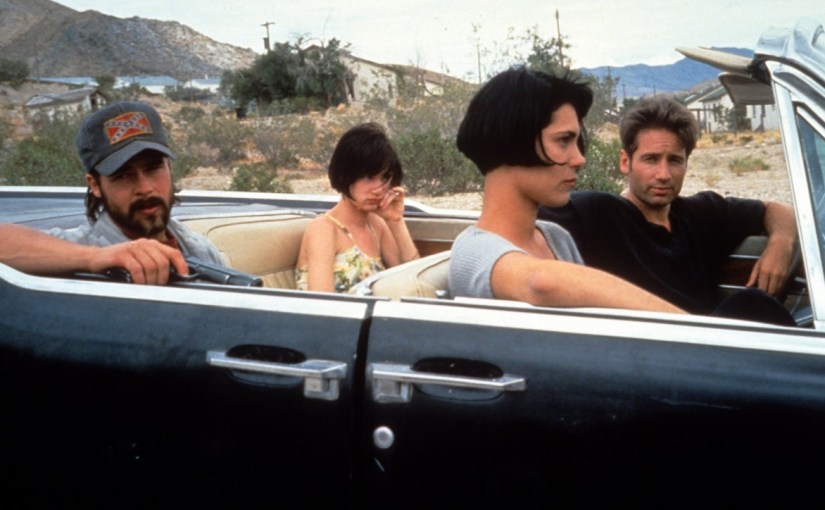
Ask any movie fan for names of actors who played memorable serial killers in film, and you’ll get a lot of obvious ones (Anthony Hopkins, Charlize Theron, Anthony Perkins) and you might get a few not-so-obvious ones (Michael Rooker, Andrew Robinson, Peter Lorre).  But I’m willing to bet no more than one person in 20 will name Brad Pitt, whose performance as the skeevy Early Grayce dominates Kalifornia, the 1993 directorial debut film of music video director Dominic Sena (Gone in 60 Seconds, Swordfish).  Pitt is so convincing and deliberately off-putting that I came close to switching the movie off and returning it to the thrift store where I found it.  Why would I want to keep watching a film where I’m repulsed by one of the main characters nearly every second he’s on screen?

Kalifornia may be predictable to some, but I was blown away by the story development.  Brian (David Duchovny) and his longtime girlfriend, Carrie (Michelle Forbes) are embarking on a cross-country road trip from Pittsburgh to California.  He’s an author writing a book on serial killers.  During their trip, he will visit infamous murder sites to gather material, and Carrie, a professional photographer, will take pictures for the book.

(The first time we see Brian, he’s mixing drinks at a party and holding forth about how the government should rehabilitate killers instead of executing them.  They are products of their environment, their upbringing, they’re not ultimately responsible for their own actions because they simply don’t know any better, and so on.  Over the course of the movie, his beliefs will be put to the test.)

Brian is short on cash until he finishes his book, so he places an ad on a university message board looking for people willing to split gas and food costs on a cross-country road trip to California.   One of the most incisive moments in the movie comes when Brian and Carrie drive to a meet-up point and spot their new travel companions: Early and his girlfriend, Adele (Juliette Lewis), a young woman whose mental development seems to have been arrested at about a 13-year-old level.  Carrie whispers to Brian, “Look at them, they look like Okies.”  Meanwhile, Adele whispers to Early, “Oh, Jesus, Early, they look kinda weird.”  The movie seems to be setting us up for an awkward odd-couple road-trip movie where, uh oh, one of them is a serial killer!  But you ain’t seen nothing yet.

During their road-trip, and in between visits to famous murder sites, Early and Brian start to bond a little, much to Carrie’s dismay.  Brian has a theory about why the Black Dahlia killer was never found, but Early has another: that he’s alive and well in a trailer park somewhere, “thinkin’ about what he’s done, goin’ over it and over it in his head, every night, thinkin’ how smart he is for gettin’ away with it.”  Ohhh-kay…

One night when Brian and Early are at a bar, Carrie and Adele get to talking, and Adele reveals that she doesn’t smoke because “he broke me of that.”  Carrie asks her if Early hits her, and her reply is as heartbreaking as it is terrifying: “Oh, only when I deserve it.”

This and several other red flags get to be too much for Carrie, and she gives Brian an ultimatum: “Either they get out at the next gas station or I do, your choice.”  What happens at that next gas station I would not dream of revealing, but it ignites the slow burn of the previous hour and turns Kalifornia into a tense, bloody thriller that rivals anything by David Fincher.

I’ve given so many establishing plot details above (I left some juicy bits out, trust me) because I’m trying to convey how this film, which starts out like a slightly amped-up basic-cable movie-of-the-week, shifts into another gear in the second hour.  Unsuspecting viewers like me, who have only heard of the movie but never even seen the trailer, will watch the first hour wondering where the good movie is.  But have patience, it’s coming.  The payoff is worth the wait.

[Author’s note: by the way, don’t watch the trailer for this movie.  It gives away WAY too many plot points that I haven’t mentioned, both before and after the gas station incident mentioned above.  Just the worst.]

Visually, I didn’t see a lot of the music-video camera pyrotechnics that director Sena would later employ in Gone in 60 Seconds, etcetera.  The movie is content to let the dread sort of speak for itself.  The various murder sites they all visit seem even creepier and uglier than they need to be.  Slick editing brings little details into focus that heightens the tension.

Ah, I can’t think of any way to explain how great this movie is without giving away more plot details, and this movie is best seen in a vacuum, knowing as little as possible.  So trust me.  If you’re a fan at all of serial killer movies or documentaries, this movie will not only entertain, it will give you a lot to chew over.  Kalifornia belongs in the serial killer movie pantheon with The Silence of the Lambs, Psycho, and Henry: Portrait of a Serial Killer.  Especially that last one.

SIX DEGREES OF SEPARATION

By Marc S. Sanders

John Guare adapted his celebrated Broadway play Six Degrees Of Separation into a screenplay directed by Fred Schepisi.  Having never seen a stage production of the show, I can still see how well it would work in live theater.  It’s a talking piece with colorful dialogue and fast paced monologues revealing the true nature of people whether they are telling the truth, exaggerating, or simply being lied to.  Can a piece of writing succeed at showing the phoniness of people while at the same time displaying the authentic nature of a con man and a liar? 

In a very early career performance, Will Smith plays a young man named Paul.  One night, he stumbles upon the Park Avenue apartment of Ouisa and Flan Kitteridge (Stockard Channing, Donald Sutherland), wealthy art dealers ready to make a multi-million-dollar deal with a South African guest, named Geoffrey (Ian McKellan).  Paul is a handsome black man in a navy blazer and college tie, with a knife wound in his side.  He has just been mugged while on his way to pay the Kitteridges a surprise visit.  They welcome him inside, clean his injury and loan him a freshly clean pink dress shirt from their son’s closet. 

Talking and interaction take effect.  Paul describes how he intimately knows the couple’s children away at college.  He segues into an insightful literary evaluation of Holden Caulfied from Catcher In The Rye, and he eventually makes his way into the kitchen where he impresses the high society people with his exquisite dinner preparation and his immense background of being the son of celebrated actor Sidney Poitier. 

By the end of the evening, Geoffrey is ready to sign the deal and the Kitteridges are over the moon with the dumbfound luck of meeting this young man, who is now going to arrange for them to be extras in the film adaptation of the musical Cats, soon to be directed by Sidney, himself.  It’s all too good to be true.  The next morning, after insisting that Paul stay over for the night, surprises abound and perhaps Ouisa and Flan don’t know everything they should have known about Paul.

The couple meets up for lunch with Larkin and Kitty, another high society couple (Bruce Dern, Mary Beth Hurt) who can’t wait to share an unbelievable story with them.  Only their anecdote is eerily similar to the experience they had with Paul.  Could these people have been duped?  The only option is to go to the police, and yet was there really a crime ever committed?  Fifty dollars was leant to Paul to get back to school, and he made off with the pink shirt, but that’s it.  All of their prized artwork and collectibles remained.  No one was physically harmed.  Nothing was stolen.  Still, the four people are insistent on uncovering the mystery of this man. 

Ouisa, Flan, Larkin and Kitty eventually catch up with their children to see how they had come to meet Paul.  The kids have no idea what their parents are talking about and are downright resentful of mom and dad.  Ouisa and Flan’s son (Jeff Abrams, as in eventual director JJ Abrams) is especially hurt they gave Paul his pink dress shirt.  The horror!  Their daughter describes them as ignorant and uncaring simply because of their wealth.

While I can’t describe the structure of the play, Schpisi’s film does a back and forth of Ouisa and Flan gleefully telling their tall tale to anyone who will listen.  While guests at a wedding reception, the crowd of listeners seem to grow around the pair, eventually to the point that the bride and groom are even listening.  Their story spreads at a funeral and dinner parties and on and on.

Later, a young couple (Heather Graham, Erik Thal) enter the frame to share their encounter with Paul after meeting him in Central Park.  Their tale is not as similar as the others, but there is enough to determine that they met the same “Paul” in their experience.

Paul’s existence seems to grow and grow, but not necessarily because of Paul.  Rather, it is because of how widespread his various intrusions become.  While making efforts to pursue the mystery, Ouisa and Flan get interviewed for the paper.  Even more people within New York City (revered for having eight million stories) reveal their own encounters. More people, especially their peers, become even more fascinated by the outrageous anecdote, and it becomes the centerpiece of dinner conversations and social gatherings.  People can’t get enough of the night Ouisa and Flan met Paul and what happened afterwards.

Guare’s script is focused not so much on dimension and character change, as it is in demonstrating what can happen when one story blossoms into a multitude of others.  The title follows the idea that every person on the planet can somehow be connected within six different people of one another.  What I took from the film is how inauthentic the ones who were duped actually are.  Flan wants nothing ever more to do with Paul, repeatedly declaring a fear that he may come back and “slash their throats.” Yet, he can’t resist sharing the story and what happened after that and then after that.  Ouisa follows along, until perhaps the end of the picture.

Stockard Channing plays the most dynamic of all the characters thanks to moments offered in the script where Ouisa begins to contemplate how fascinating it is how many people have come in contact with Paul and thus lending credence to the film’s title.  A memorable monologue towards the end earned her Oscar nomination for the film. 

Will Smith is the con man at the center of the script.  It’s an extraordinary performance and it’s an insightful character as well.  Paul is a con man.  That is the one sure thing that viewers assuredly walk away with from the movie.  It may be the only genuine fact in the film.  The people he seduces are eventually revealed to be fake for the sake of laying impressions upon their peers or for exacting aggravation, as the spoiled college age children seem to do.  Nothing that Ouisa, Flan, Larkin, Kitty or any of their high society friends and children come off with genuine affection and care for one another.  Their tales are told simply to impress and uphold relevance.  Only as the credits roll, does Ouisa perhaps have a revelation of how she behaves with her friends, and her children, particularly when in company with her husband, Flan.

Film Critic Roger Ebert didn’t care for this film as he asked what are we supposed to gain from this picture; that everyone in the world is a phony?  Maybe so.  The irony for me however, is that Paul is nothing but a con.  He never deviates from that pattern during the course of the picture all the way to his final scene when he’s alone on the street speaking with Ouisa on a pay phone. He still insists on being Paul Poitier, son of Sidney.  Therefore, let’s at least admire Paul’s consistent behavior of lying, while turning our backs as we realize how artificial the well to do folks really are.  Irony is thought provoking, and I think John Guare’s script at least succeeds in that respect. 

SCHINDLER’S LIST

By Marc S. Sanders

Oskar Schindler was a handsome, well dressed man. A man of wealth, power, and influence. A successful businessman. He was a womanizer. And Oskar Schindler was a Nazi who saved 1100 Jews from the atrocities of the Holocaust.

On a filmmaking measure alone, Schindler’s List is one of the best pictures to ever be made. Steven Spielberg’s production value is incomparable. Nothing I can recall appears as grand (not sure that’s the appropriate word here???) and authentic as Schindler’s List. How did Spielberg pull off this feat? How did he direct hundreds, thousands maybe, of extras to reenact the vilest human suffering that a generation of people could ever encounter? I’m astounded. Positively astounded.

This evening was only my second time seeing the film. I always put off watching it over the last 30 years; reluctant maybe to see a horrifying truth. The first time I saw the film was on Christmas Day, 1993 at the Hyde Park cinemas in Tampa, Florida with my father. I didn’t realize it at the time, but I was in the beginning stages of the flu with a high fever. Midway through the film, I had to leave the theatre as my illness caught up with me. I mustered the strength to return to watching the remainder of the movie, as I recall I could not go without finishing this masterpiece. I was horrified and yet amazed; amazed that this moment in world history could have ever occurred.

To see a man like Amon Goth (brutally and uncompromisingly played by Ralph Fiennes), a high ranking Nazi, excuse himself from his nude mistress’ bed and perch himself on his balcony to sniper random Jewish prisoners as a means of sport was sickening and twisted to me. Twenty five years later, it is this moment that has always stayed with me, as much of the story and scenes left my memory from so long ago. This moment as well as Spielberg’s choice to highlight a young girl in a red coat amidst a most somber black and white picture have stayed with me all these years. The glimpse of red serves as a truth to Schindler’s naivety. Spielberg is a thinking director. He never follows the manual. He chooses to think outside the box. A glimpse of a child dressed in red in a sea of black and white where mutilated corpses and possessions are aimlessly strewn about. It’s a marvelously telling moment.

Liam Neeson plays Schindler. It will likely be the greatest role of his career. Schindler is a man who even fools the audience until the very end when he reveals that the war has ended and his salvation has rescued these 1100 souls. Finally, his humanity no longer hides and he weeps to his accountant and accomplice, Itzhak Stern (played subtly and beautifully by Ben Kingsley). Schindler weeps for he could have saved more. Neeson is superb in this moment. His commanding stature crumbles, his materialism and wealth have disappeared. Neeson translates all of that clearly, and finally my tears arrive. Prior to this moment, I was numb to the Nazi tactics of gas chambers, careless bloodshed and apathetic separation of families and friends; perhaps because I’ve extensively studied it during my years in Yeshiva. Before Schindler’s List, much of the history on the Holocaust seemed like textbook fare to me. Spielberg made its terrifying and tragic reality real.

Ben Kingsley’s performance is so important as well. The architect behind the list, his portrayal of Stern is countered with contained fear and leveled sensibilities amid the senseless intentions of a dominant force of evil. His instincts kept him alive so that only he could help keep his comrades alive.

Schindler’s List won the Best Picture Oscar for 1993, only 50-52 years following the events of the Holocaust. Many survivors thankfully remained to see Spielberg’s epic premiere. People who I share this planet with experienced the most insane and heinous evil ever encountered. They were well to do people living normally until they were violently pulled from their homes, stripped of their possessions, separated from their families, suffered at the threat of murder, witnesses to other murders and hate crimes, humiliated, beaten, forced into slave labor in tightly contained ghettos and eventually thrust into concentration camps. Yet, these few survivors lived to carry on with their lives and deliver new generations, beyond this morally ugly and evil historic episode.

I’m being redundant as I’ve said it many times before, but isn’t that the point? The Holocaust and the Nazi regime only occurred around 85 years ago. This happened before. This can happen again.

Thank you, Steven Spielberg for Schindler’s List.

I don’t consider myself to be very religious anymore. Because of moments like the Holocaust, I question how a God could ever be possible. Still, for the survivors and those that perished, I can only say Baruch Hashem, and L’Chaim. 

Peace.  Progress.  Love.

JURASSIC PARK

By Marc S. Sanders

Michael Crichton’s best-selling novel, Jurassic Park, is my favorite book of all time.  I recall reading it in one Friday night a week before the Steven Spielberg adaptation was released in theaters.  It was the easiest book to breeze through and I never stopped thinking about Crichton’s approach to a what if scenario where dinosaurs are resurrected in the name of scientific discovery and profitability.  Ideas related to chaos theory and DNA experimentation were considered against the mayhem of people running for their lives in an amusement park attraction.  Amid the action, there was opportunity to think and consider.  Spielberg’s film doesn’t offer enough time for ponderance.  It starts out that way, but it doesn’t finish its thought.  That’s always been a hinderance for me.

There’s no question regarding the immense thrills the film brings, even thirty years later.  Effects and puppeteer wiz Stan Winston (how I wish he hadn’t passed away so soon) outdid himself following memorable recreations from films like Aliens and Predator.  The centerpiece of the blockbuster is of course the T-Rex.  Spielberg follows his age-old approach of not showing the monster right away, though high publicity and massive merchandising of the early 1990s never kept this cat in the bag anyway.  Oh well!  Yet, when the humungous, twenty-ton dinosaur puppet makes its grand entrance midway through the film, it still holds as a spectacular scene, especially because two fine child actors (Ariana Richards, Joseph Mazzello) with high pitched screams heighten the terror.  Look, you should know by now.  If Steven Spielberg is aiming for the rafters of box office thrills, he’s gonna put the kids in danger first and foremost.

Velociraptors are the other big stars of this creature feature and the behavior of these CGI animals is magnificent as we observe them communicate with one another.  Like the T-Rex, we don’t get an immediate first glance of them either, but their squeals and screeches as they leap in for a monster mash smorgasbord get us to jump in our seats.  When the veil is lifted on these guys, Spielberg and his effects crew go further by granting them with quick agility.  Before all this, we are told by the science experts of how they are strategic pack hunters with cheetah like speed and how they tear away at flesh as they pounce on live prey.  You wince as you imagine.  They are also smart too.  These dogs can open doors! 

Again, all good stuff here.

The best character is the sarcastic mathematician, Ian Malcolm (Jeff Goldblum), who insists resurrecting dinosaurs is a terrible idea for the modern age.  Goldblum is so good with the script written by David Koepp that my favorite scene in the picture is when the main characters sit around the dinner table to discuss what has surprisingly been thrust upon them.  I yearned for more scenes like this.  Ian Malcolm offers up a new iteration of “Matt Hooper” (Richard Dreyfuss in Jaws) that I just didn’t get enough of.  Only the surface is scratched on the argument of intelligence versus stupidity.  In Jaws, we got nearly a full hour of this welcome back and forth.

What lacks is what Jaws provided over a decade earlier.  The debates of how to live (or die) with dangerous animals begins, but doesn’t finish in Jurassic Park.  It merely gets started, and then the argument gets abandoned to allow for unending carnage.  Don’t get me wrong.  I love carnage in my movies.  However, Crichton illustrated an even amount of attention to chaos blended with intelligence (or ignorant lack thereof) when he wrote his book.  I got a textbook education from Michael Crichton.  From Steven Spielberg and David Koepp, I just got a thin dog eared comic book.

Goldblum is third in line in the cast credits behind Sam Neill and Laura Dern as Alan Grant, a paleontologist, and Ellie Satler, a paleobotanist.  They, along with Malcolm, are cordially invited by billionaire entrepreneur John Hammond (Richard Attenborough) to visit his private island that is soon to be converted into Jurassic Park, a zoo/amusement park consisting of live dinosaur attractions.  The dinner sets up the debate of Hammond versus the three scientists.  Is anyone being responsible with the potential to act upon breakthrough discoveries?

Granted, if Hollywood was going to make a dinosaur movie, then it was going to be catered to children age 10 and up.  Kids and families of four or more sell tickets.  The novel doesn’t aim towards that demographic, however.  It is darker and the Hammond character is more sinister and greedier.  He’s not a fleshed-out villain in the film.  He’s lovable.  The film simplifies itself too much as it devolves into a run and chase and chew and chomp adventure of screams and outstanding John Williams music.

I watch the film over and over again because visually it remains magnificent, but I still remind myself that it is not enough.  Steven Spielberg’s film is admired and so well regarded and perhaps it is deserving of its legacy, thirty years, five sequel films and a couple of Universal Studios attractions later.  On the other hand, I wish it allowed its brain to develop a little bit more. 

Steven Spielberg’s interpretation of Jurassic Park could’ve been as smart as a velociraptor.

THE PELICAN BRIEF

By Marc S. Sanders

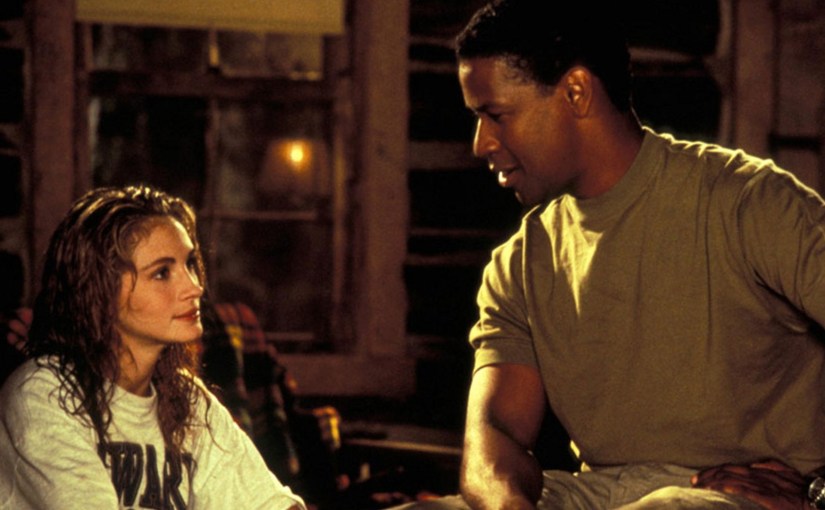
Tulane Law Student Darby Shaw (Julia Roberts) is unbelievably lucky. She can find herself being pursued by one white guy in a suit after another over the course of a two hour movie and will be fortunate enough to escape every threat by sheer chance. It’s only to her benefit when she is being chased by two assassins in a creepy downtown parking garage that someone left an angry doberman in a car to startle the killers. As well, it’s really a blessing that Darby has caught on that if an engine sputters when turning the ignition it can only mean one thing – car bomb! GET OUT!!!!!

Darby is the main protagonist of The Pelican Brief directed by Alan J Pakula, adapted from John Grisham’s best-selling novel. When the eldest and the youngest Supreme Court justices are murdered, Darby conceives of an outrageous conspiracy stretching all the way to the President and documents the whole rundown in the so-called Pelican Brief. She shares the document with her law professor who shares it with his government friend who shares with the CIA who shares it with…and so on and so on.

Pakula is an under celebrated director when you consider his better thrillers like Presumed Innocent, Klute, and especially All The Presidents Men. Here though, I think he got a little lazy with his screenplay and direction. The Pelican Brief is a little too paint by numbers.

Sure, the film has suspense. I think Grisham’s story has some convincing weight to it where wealth and government won’t stand for the platforms of environmental causes and therefore people have to die. Still, while the meat of that story eventually surfaces, we are left with A LOT of buildup before Darby gets involved. Just a lot of white guys in different office buildings walking down hallways, entering doorways and talking on the phone. Every so often we come across a DC crack reporter, Grey Grantham (Denzel Washington) who gets a phone call from a potential informant. When that guy gets scared and hangs up, thank goodness Darby just happens to call two seconds later regarding the same story. Good on you Grey for being by that telephone.

That’s my problem here. Pakula just works in the lucky conveniences to keep Grey and Darby on the trail. Neither of them ever truly escape a bind on their own. Neither of them ever truly dig the hole any deeper without something COMING UPON THEM to help them along at just the right moment.

We learn a safe deposit box belonging to a dead character exists. Darby just strolls into the bank and posing as the widow, who is not a signer on the box, is just asked for her address and phone number. No proper identification necessary. Why didn’t anyone ever tell me it’s that easy? Folks, hide your valuables because I’m gonna be robbing you blind.

Pakula will even set up a good scenario where Darby thinks she’ll be meeting someone who can help but it’s an assassin ready to kill, only suddenly the assassin is killed while holding Darby’s hand in a crowded courtyard. Wow!!! Lucky again, Darby. I’m still fuzzy on who actually killed the guy. That didn’t concern Pakula though. It’s explained in a quick throwaway line before the credits roll. Pakula only had to get Darby out of danger again. So let’s see he’s got the barking doberman for something else, the engine sputter will be used later on. Hmmmm??? Meh!!! we’ll just have someone randomly kill this guy. Now run, Darby. RUN!!!

Notice I haven’t talked about performances. Well, there’s not much to them. The Pelican Brief boasts an impressive cast of character actors like Sam Shepherd, Anthony Heald, John Lithgow, Stanley Tucci, Robert Culp and John Heard. Yet, these guys, along with Roberts and Washington are flat. Just reciting their lines when the cues call for them. There’s nothing very exciting to any of them really. Very monotone. Roberts is beautiful yet depressing even before she gets caught up in the mystery. Washington, while handsome, does not seem to have the gusto that Pakula’s reporters did when he directed Hoffman & Redford. Grey is too neat, physically fit and tailored for an always on the job, aggressive reporter looking for a scent.

There was a better movie to be made here, thanks to some convincing motivations that were started with Grisham’s novel. Unfortunately, Pakula just didn’t devote enough respect to the original author’s imagination.

SEARCHING FOR BOBBY FISCHER

By Marc S. Sanders

In a game of chess, if your queen is taken, it might mean a permanent loss of what was thought to be a god given talent. Seven year old Joshua Waitzkin does not realize that, and thus it allowed him to become the greatest chess champion in the country.

Josh (Max Pomeranc) is not a chess player. Josh is a boy who plays chess, as well as baseball. He also builds Legos, plays Clue and does just about anything else including fishing with his dad. He knows this about himself. The problem is the adults in his life only see chess, and nothing else. Writer/Director Steve Zaillian assembles a film that turns the world’s most historic board game into a means of recognizing self-worth and the limits of talent with its correlation to identity.

Josh gains influence from a cutthroat formal chess instructor named Bruce (Ben Kingsley) who doesn’t just teach chess but also offers guidance in manners of contempt and dislike for your opponent. It helps that he recognizes Josh’s talent but is Bruce coaching with the best intentions?

Contrary to Bruce is a city park speed player named Vinnie (Laurence Fishburne) who reminds Josh to always play on offense. Play the board, not the opponent. Josh’s father (Joe Mantegna) only sees victory through beautiful trophies. When Josh loses interest in champion accomplishment, his father only sees nothing but failure. His mother (Joan Allen) sees the boy losing his boyhood.

These are all good people and necessary for Josh. The conflict lies in the clash of their different ideals. I love that. There isn’t a villain here. There’s a debate.

Zaillain devotes time to footage of renowned champion Bobby Fischer who eventually went into seclusion probably due to the lack of any worthy challenger beyond himself. The worry of the film lies in whether Josh will end up with the same sad fate of Fischer. Everyone is on the hunt for the next Bobby Fischer. Does everyone want to be the cruel, cold and isolated Bobby Fischer, though; a man with talent yet also hates his talent?

Zallian films very effectively in a majority of close ups, hardly showing the surroundings of the settings. He wants his camera to maintain a tunnel vision to only allow Josh, and those that discover and observe him, per se, to see what’s directly in front of him. Nothing else. Nothing but the chess pieces on a board and how many moves until check mate arrives are all that matters.

The film edits beautifully in sound as the speed play pounds the chess pieces in an aggressive music accompaniment. Pieces are KNOCKED onto the board, and when a queen is taken it is SLAMMED on to the table. A person has ultimately been disabled and weakened. When check mate eventually comes, the king piece weakly drops over.

Josh is not proud of his ability to conquer. He’s proud of his ability to play.

THE FIRM

By Marc S. Sanders

Sydney Pollack was the first director to take a crack at adapting one of John Grisham’s best-selling books, namely the still most popular novel, The Firm. Wisely, and with a measure of risk, Pollack took the script from David Rabe, Robert Towne and David Rayfiel and maintained a true adaptation for the first hour of the film while inventing a new kind of second half that I think improves upon Grisham’s story.

Mitchell McDeere (a well cast Tom Cruise) is the most sought after Harvard law graduate in the country. A small Tennessee firm makes an offer to him that outbids any of the big leaguers. Considering that Mitch comes from a poor broken home with a brother (David Strathairn) currently in jail for manslaughter, the offer and treatment given to Mitch and his school teacher wife Abby (Jeanne Tripplehorn) could not be more enticing. A house, a car, school loan payoffs, and a near six figure salary in the first year is not something anyone would walk away from.

Once the happy, young couple are comfortable though, a curious FBI man (Ed Harris, an MVP of this stellar cast) inquires if Mitch finds it odd that this firm has four of its lawyers dead within the last ten years. The two most recent casualties perished in a boat accident.

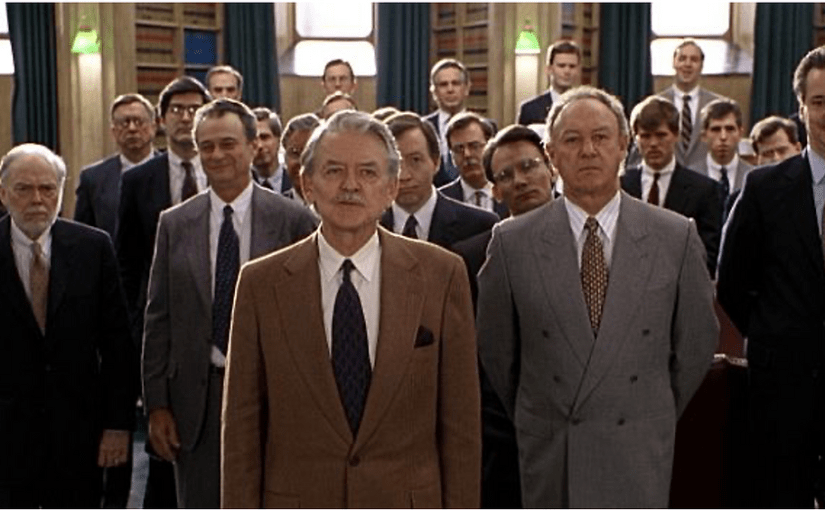
The sharp minded Avery Tolar (another welcome performance from Gene Hackman) is assigned to make sure Mitch follows the path the firm expects of him. Avery also has his sights set on Abby. For a guy who has never been regarded as good looking, Hackman plays a pretty effective flirt.

The firm, led by a seasoned Hal Holbrook with a charming Mark Twain like bow tie, and a perfect henchman villain played by Wilford Brimley (definitely on my top list of best bad guys) are involved with the Mafia and their shady dealings of money laundering, racketeering, murder and embezzlement. Now Mitch is stuck.

The FBI want to use him to uncover the firm’s activities but that risks blowing his career and maybe his and Abby’s life. If he doesn’t cooperate, then the Feds will run him in with the rest of the gang.

A second hour focuses on a complicated way for Mitch to get out of this ordeal. It means a lot of white collar work and contrived timing in the script. Fortunately though, Pollack builds suspense with foot chases and some allies on Mitch’s side, including Holly Hunter as an hourglass figured, bombshell secretary to a private investigator (Gary Busey) that Mitch went to see. His plan involves traveling to and from the Cayman Islands, and making copies of legal documents to build evidence of mail fraud against the firm.

Mail fraud???? That’s right mail fraud. It’s not a sexy crime, but the script with Pollack’s direction and a hard pounding piano soundtrack from Dave Grusin manage to keep the suspense up and alert.

Pollack directs Cruise to sprint across downtown Nashville for some great sights and hideouts in broad daylight. Your adrenaline moves with the film even if you can’t connect all the dots of Mitch’s complex plan.

In fact, it’s best to just give up on following every little step Mitch and his team take to stay ahead of the firm. What works best is the seemingly no win scenario for Mitch and Abby. Pollack follows a Hitchcock trajectory. He leaves the bomb on the table but doesn’t detonate it right away. Thus the suspense holds steady.

So, the best kind of counsel I can give is to just enjoy The Firm as it runs through its paces. It’s a solid white-collar thriller.