DANCES WITH WOLVES

By Marc S. Sanders

The western motif of filmmaking really comes alive with the 1990 winner for Best Picture, Dances With Wolves starring Kevin Costner in his astounding directorial debut. Until now, this film eluded me. I just never got around to seeing it. Watching it now is to recognize the parallels of current events in the year 2020. A Native American Facebook friend of mine recently lauded the takedown of a statue of Christopher Columbus. At the risk of sounding like I’m taking political side (I insist that I’m not!), I think understand her position a little more. I’m not saying I agree or disagree with this topic. I’m just saying I understand.

After committing what was seemingly an act of suicide, but instead is recognized as heroic in the eyes of the Union army during the Civil War, John Dunbar (Costner) is offered the pick of location for his next post. He opts for Fort Sedgwick because he wants to witness the frontier out west before it will likely be taken over by the white Americans. As Dunbar waits for fellow infantrymen to arrive, he gets the old fort into shape with his trusty horse Sisco. He also encounters companionship in a lone wolf he names Two Socks. The wolf only gradually learns to trust Dunbar, but that’s a project for the infantryman to occupy himself with. That, and keeping his personal journal.

Shortly after he’s settled in, he comes upon a Sioux Indian named Kicking Bird (an excellent Graham Greene). He and Dunbar are the first to develop trust with one another. Eventually, Dunbar’s good nature allows him the opportunity to rescue a white woman who lives with the Sioux tribe known as Stands With A Fist (Mary McDonnell). She has attempted to kill herself following the death of her husband. As the film continues, she becomes the translator between Dunbar and the other Indian leaders, allowing the story and relationships to move along.

The script by Michael Blake is fascinating simply because we are granted plenty of opportunities for the tribespeople to speak in their native tongue. Forgive me, I thought for a little about Hollywood’s most famous Indian, Tonto, and his laughably limited English. Here, language is instead limited for the white man as Costner does his best charade of buffalo to find initial common ground with the tribe’s holy man played by Greene.

Hollywood westerns seem to equate American Indians as savages, the bad guys of the films, complete with tomahawks and bow and arrows and bellowed battle cries for expression. Not here. Dunbar’s loneliness at the fort without another white man in sight does not allow for the ease of prejudice to interfere. Instead, he is a character who must learn to be accepted by the greater populace. When he is, he realizes that his true name is Dances With Wolves and not John Dunbar. That’s a fascinating character arc of change. The setting and the community within that location change the character. I was really moved by it.

As well, there is struggle and disagreements among the Indian population. Perhaps it truly is in the nature of humanity to be that way. The Sioux tribe must contend violently with the Pawnee tribe in a struggle to protect their territory and their food and supplies. Yet, that is wholly different from what drives the war that Dunbar has heroically served in. It’s not until Dunbar fights alongside his Sioux friends that he realizes he’s not an infantryman. This is another example of Costner effectively directing himself to find a new and enriching identity for his character.

A third example of character change stems from the eventual and expected love story that unfolds between Dunbar and Stands With A Fist. It’s something I’ve seen in countless other films. However, Mary McDonnell is quite good as the white woman whose English is close to being entirely replaced by the Native American tongue. She seems so indoctrinated within the Sioux tribe that when she first comes on the screen I questioned if she was a natural born Indian or an actual white woman.

Costner’s film is full of magnificent imagery. Gorgeous landscapes of the filming locations of South Dakota are like perfect paintings of open fields and endless blue sky. The blu ray transfer I watched was eye popping.

One of the greatest moments was a sequence involving a buffalo stampede. Costner with cast all on horseback ride within, as well as parallel to the animals and if ever a widescreen shot should be appreciated, this is a moment to turn to. The score moves beautifully with the pounding of the horses and buffalo stampeding across the open plains.

A personal sidenote is in regards to John Barry, the film’s music composer. I know this is an unfair criticism but at times his score is so strikingly similar to his work on various James Bond films that it was a distraction for me. Other times, Barry’s work lent well in some of the action scenes.

Nonetheless, what an incredible achievement that Costner commanded. He gives a terrific performance, but his direction is what truly stands out. Particularly, with the battle scenes and animal footage, I questioned how he managed to accomplish all of it. It’s just spectacular.

Dances With Wolves is certainly worthy of the accolades it attained and the reputation it still holds. The production value is easy to admire and unforgettable. Beyond that though, is the converse nature the film adheres to as a Hollywood western. The culture of a Native American tribe never seemed so authentic to me as it does here, accompanied with their sense of humor or even their temptation at playful gossip when observing the central love story between Dunbar and Stands With A Fist. We see what the Sioux tribe does to survive, yes. Still, we also see how they interact with one another and converse, as well as how they respond to a new neighbor, for example.

Dances With Wolves is an authentic masterpiece of a modern western. It’s a must-see film.
BACK TO THE FUTURE PART III

By Marc S. Sanders

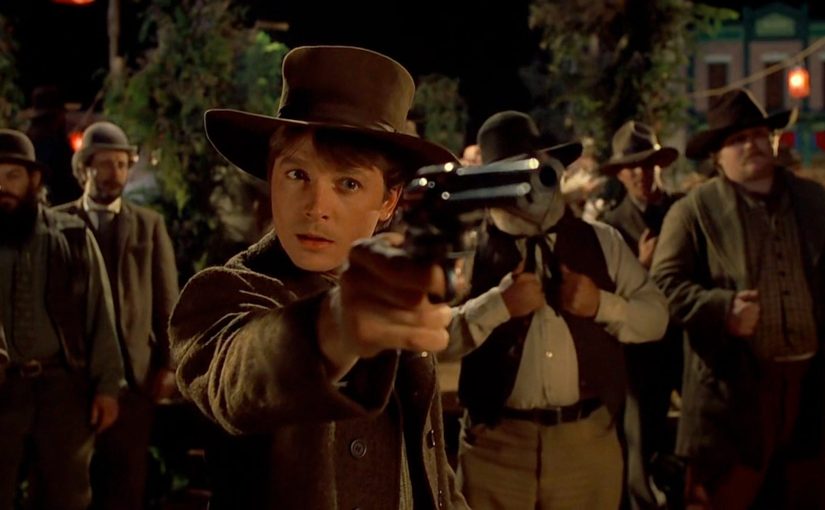
I think Bob Gale and director Robert Zemeckis forgot one thing about Back To The Future Part III. It was supposed to be a time travel movie. Sure, Marty McFly (Michael J Fox) travels back to the Hill Valley of the Old West in the year 1885, but once he gets there, there is not a lot of material for the beloved DeLorean.

The film picks up immediately where the last film cliff hanged. Marty is left trapped in 1955, and he receives a letter sent to him 70 years earlier from his present day Doc Brown companion (Christopher Lloyd) originally from 1985. You still with me? When Marty realizes that Doc gets shot in the back by Mad Dog Tannen (character actor great, Thomas F Wilson), he arranges with the 1955 Doc to send him back to the Old West and prevent that from ever happening.

From there, the film turns into a staple Western. There’s the calvary, Indians on horseback, quick draw duels in the street, a saloon, stage coach and wagons. Most importantly, there’s a steam engine to push the DeLorean to the necessary 88 miles per hour to send our heroes back to the future. That dilemma is solved quickly and early on. They now just have to wait for the train to arrive.

So the film calms down to allow a charming Mary Steenburgen as Clara Clayton, a schoolteacher, to capture the affection of the good ol’ Doc. When the romance seems impossible though, we get a depressed Doc. A depressed Doc Brown is never good for a movie. Consider this. It’d be so easy to just wait for the moment to travel back in time. However, obstacles get in the way, right? In the fantastic first film, Marty has to play guitar at the school dance to get the necessary first kiss between his parents thereby solidifying his existence. That’s fun…and then he kills it while performing “Johnnie B. Goode.” Here, the moment to time travel is approaching, but it can’t happen because Doc is depressed. What’s so fun about that?

Like Part II, Part III is watchable. It’s not terrible by any means. It’s just a little stale. The best gag, however, is Marty taking on the name of “Clint Eastwood” to build his status in the town. This allows a lot of inside jokes. What would’ve sent this film into the stratosphere is if they got the legend himself to make at least a cameo. Alas…. I can dream and wonder.

Back To Future Part III ends the film on a sweet message similar to what you get from other fantasies like The Wizard Of Oz or Willy Wonka & The Chocolate Factory. It reminds me that despite its shortcomings, the entire Future trilogy is great to share with the whole family. No doubt, there’s always something to look at and focus on.

Still, some movies that require focus specifically, takes work. The first film allowed me to wonder. Wonder if all of this could be true one day. Wonder how they thought all this up. Wonder how Marty is actually going to get back to the future.

If I have to choose, I’d rather not focus. I’d rather just wonder.

AWAKENINGS

By Marc S. Sanders

The title of Penny Marshall’s film Awakenings has at least two meanings.  The most obvious focuses on Robert DeNiro’s character, Leonard Lowe, who comes out of a near thirty-year catatonic state one day.  As well, Robin Williams plays Dr. Malcolm Sayer, the doctor who uncovers the experimental drug that awakens Leonard, along with other patients who reside in the caretaker ward located in the Bronx.  Many of the patients share the same abnormality as Leonard, due to all suffering from a wave of encephalitis that swept through the area in the 1920s. 

DeNiro and Williams are a top of their game pair together.  Both of them go against type that many audiences were accustomed to by the time this film released in 1990; DeNiro – the tough, short tempered, unhinged guy; Williams – the manic, fast talking, quick on his feet comic.  Both actors bring it down many notches to bring this story to light that was inspired by the documented experiences of Dr. Oliver Sacks.

Still, Penny Marshall has a way a bringing gentleness with touches of comedy to this film just like she did with Big and A League Of Their Own.  Okay, maybe those films were more energetic at first and then quieted down, thereafter.  Awakenings performs in the opposite direction, but Marshall’s recipe of drama mixed with humor is so appreciated.

Dr. Sayer is a shy individual with limited social skills.  He relates more to plant life than actual humans.  When he’s recruited by the hospital administration, led by the intentionally obnoxious and objectionable John Heard, to oversee the patients at the ward, he does so without any intent to make a difference.  The hospital staff is just fine with that.  Soon though, Dr. Sayer is recognizing a behavior in some of the patients.  They seem to be staring into space, open mouthed with no emotion or change in expression, but they respond to a variety of unusual stimuli.  A woman will walk across the social hall on the black squares of a checkered floor.  Leonard, and a few other patients, will catch and toss a tennis ball around.  Yet, they won’t blink or wince or smile.  Through further research, Dr. Sayer takes a pharmaceutical risk and increases the dosage of an untested prescription over time.  One night, his patient zero, Leonard, is sitting up in bed and awake.  Shortly thereafter, he’s speaking, walking, and functioning like a regular forty something man.  Thereafter, the drug is administered to the other patients who demonstrate the same outcome. 

The challenge comes first from the hospital, though.  They are not prepared to take Dr. Sayer’s methods or assessments seriously and they are stubborn to recognize some exceptional progress.  Like any standard drama, this leads to conflicted debate.  The debates Dr. Sayer has with the hospital board never took me out of the picture, but I do question if the antagonism needed to be so close minded.  After all, should such unexpected and miraculous development be so dismissed?  The challenge seems so forced at times that a scene is offered where the doctor’s support from nursing and janitorial staff gladly gives up their hard-earned paychecks to help alleviate the expense of the experimental drugs.  It puts a lump in your throat for sure, but would this really happen? 

A hint at a romantic angle presents itself when the lovely Penelope Ann Miller arrives at the ward to tend to her ill father.  Leonard becomes smitten with her.  He is not free to go about as he pleases.  Miller’s character can.  Eventually, Leonard becomes rebellious of his “incarceration” within the ward while the hospital exercises its mandated caution.  While this is occurring, Leonard’s condition is deteriorating. 

Robert DeNiro received an Oscar nomination for this role and its easy to see why.  His physical performance comes so naturally, at first in the catatonic state, later as a man witnessing daily life in the hippie of age of the 1960s and then again as his body dwindles into uncontrollable spasms, when the drugs’ positive effective doesn’t hold.  His enunciation falters, his body violently twitches and he can’t even grasp anything.  It’s a sorrowful and marvelous performance to see.

Awakenings is a picture that performs with real heart and tenderness.  Marshall’s film offers a glimpse into a short period of time when adults who hadn’t gotten the opportunity to live active lives were suddenly offered an opening.  Leonard gets to see a jet liner fly overhead and take a walk in the ocean.  He can taste ice cream for the first time in years and get a glimpse of young hippie’s derriere.  The other patients get a chance to go to dance at a swing club.  As well, Dr. Sayer’s guarded exterior gradually sheds as he persists to act beyond the administrators’ objections and also consider a little romance for himself with a nursing assistant.  (Point of fact: Oliver Sacks was actually gay in real life.  So, some liberties are taken with the film.)

It’s important to point out a forgotten performance from Ruth Nelson as Leonard’s elderly mother.  She visits Leonard every day by reading to him, dressing him, and changing his diapers like any loving mother would.  Yet, as Leonard gets more independent, Nelson is terrific as the kindly elderly woman who has to become a different kind of mother to her son.  She is an quickly awakened from being the mother of a helpless child to the elderly mother who is not as capable of controlling her son’s choices.  Mrs. Lowe is rightly uncomfortable with Leonard’s affection for Miller’s character.  She’s just not used to this dynamic that’s come about so quickly.  What an amazing character arc and Nelson pulls off the portrayal beautifully.

Tear jerking films work best when they operate like Awakenings.  You’re given many opportunities to laugh and enjoy the pleasures and quirkiness of the characters.  Later, it becomes a welcome and satisfactory cry fest when what was once celebrated is at a risk of loss.  Penny Marshall worked best with this formula on these kinds of pictures.  It’s why a simple, seemingly silly story like Big worked.  It’s also why a female baseball movie worked as well beyond the diamond.  There was more dimension than just the basic summary.  Marshall always delved deeper and she allowed her actors to go that far as well.

Awakenings is a terrific film, blessed with a gamut of emotions.

THE GODFATHER PART III

By Marc S. Sanders

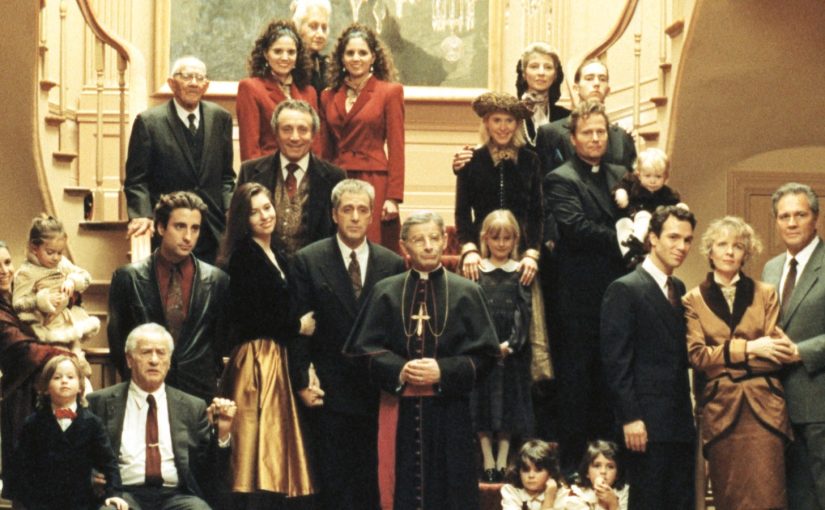
Francis Ford Coppola and Mario Puzo finished out their Corleone trilogy in 1990 with The Godfather Part III. Not so much a sequel, this third film feels more like an epilogue jumping towards Michael Corleone’s (Al Pacino) elder years as the Don of the most powerful Mafia family in the late 70s/early 80s.

Michael seems exhausted with his rule as he suffers from diabetes as well as remorse for his past sins; especially feeling the guilt of ordering the execution of his brother Fredo.

Still, he is drawn to crime, but on a more sophisticated and righteous nature by taking advantage of the Roman Catholic Church. Michael intends to purchase the powerful bank associated with the church but that’ll have to fall in line with the Pontiff’s agreement. It doesn’t help that the Pope is in failing health. The setup of all this lends to another grand opening where Michael earns a prestigious award from the church in the same tradition of an austere celebration of many guests that lend to character set ups for the film. A Godfather movie is not a Godfather movie without a grand reception to open the film.

The most interesting character is Michael’s nephew, Vincent (Andy Garcia), a fierce hot head like his father Sonny. He wants to work for Michael desperately while fending off a street hood boss (Joe Mantegna). An older don also comes into play by the great character actor, Eli Wallach. Diane Keaton as ex-wife Kay is also here but more or less to quietly bicker with Michael. Sister Connie is here, too, with Talia Shire. The Connie character always changes from each movie. Here she’s a deadly black widow. There’s also Michael’s daughter Mary (Sofia Coppola, contrary to popular opinion, I insist she’s very good in the role). Is Mary a legitimate cover for the family as the spokesperson for a fundraising effort? Is the possibility of Vincent and Mary (as cousins) getting intimate a terrible risk?

I like this film and hold it in high regard. Namely because Coppola and Puzo took an approach straight out of the news when there was an embezzlement scheme occurring within the Vatican bank. The problem for many I believe was that the plot of this grand scheme was not flashy or bloody enough, even if a participant is revealed to be hanging from a London bridge with fraudulent receipts falling out of his pockets…which actually happened in real life.

The film allows many opportunities for Michael to allow his anguish in guilt to flow. Fans grew used to a fierce Michael Corleone from the first two films. The elder Michael here would rather not get involved. Hence the introduction of Garcia’s character. He’s very good in the role. Yet there’s not much dimension to Vincent. He’s a scary violent guy, and a contradiction to what Michael seeks. Yet, thats about all there is. I would have wanted more dimension to this role; the guy destined to carry on the reign.

Sofia Coppola is fine in her part and undeserving of the lashing she received upon the film’s release. She’s Michael’s young daughter; a young adult dangerously close to the fray. The one innocent constant within the family. For me, I found a dramatic stake in her character.

The ending is very powerful. Slowly methodical as the family assembles in Sicily to see Michael’s son’s stage opera debut. There are elements that are consistent with the other films’ endings, but this violent conclusion comes with quite a shocking result. I was really moved by it.

Coppola didn’t measure up to the first two films with this effort. I agree with that. Still, The Godfather Part III is worthy of holding its place in the saga. It carries the traditions of the prior films in set up and music and operatic narrative. Be patient with its slow pace because I think the ending will grab you.

GOODFELLAS

By Marc S. Sanders

Goodfellas is my favorite film by Martin Scorsese. It’s a fast-paced roller coaster narrative of Irish street kid Henry Hill’s experience in the mob, dramatized from his real life as part of the Gambino crime family of New York.

“How am I funny?,” the Lufthansa heist, Spider takes it in the foot and then in the chest, Morrie’s Wigs, the piano montage from Derrick And The Dominos, Billy Batt’s demise followed by an early morning breakfast stopover at mom’s, and Henry’s helicopter paranoia. All of these elements are assembled to depict the perceived glamour and undoing of street level hoods, proud to steal and dress in the finest threads while bedding dames behind their wives’ backs.

Scorsese along with Nicholas Pileggi uncovered something special when they adapted Wiseguy (Pileggi’s book) for the screen. I think they struck a nerve because they showed these guys as men doing a routine living. There was a process to their deeds. Give a cut of your theft to the man above and keep the rest for yourself. Above all else, stay off the fucking phone. Get out of line and get whacked, unless you’re a “made guy.” This is all code, normal to Henry and his cohorts (Robert DeNiro as Jimmy Conway; Joe Pesci as Tommy DiSimone).

Moreover, the wives understood this behavior as well. Henry’s wife Karen (Lorraine Bracco) knew these guys were not 9 to 5 husbands and the more it occurred, the more normal it all seemed. Including when the FBI presented a warrant to search the premises. Just let them in and go back to rocking the baby to sleep while watching Al Jolson on the box.

Scorsese took the best approach by not judging the actions of these raw criminals. They dressed well, but they weren’t reluctant to draw blood if an insult was tossed their way. Pesci, in an Oscar winning best performance, represents that philosophy. Scorsese, with his regular editor, Thelma Schoonmaker, are not shy about the violence. Watch how Jimmy and Tommy beat up a “made guy.” DeNiro just stomps his dress shoes into the guy’s face over and over. Pesci pistol whips him, but before he can shoot him, he breaks the gun…on the guy’s face. The romance of gangster life quickly undoes itself in moments like this. As Henry notes, your friends come at you with smiles before they whack you.

Ray Liotta is Henry, the primary narrator and centerpiece of the film. Most of the story is from his perspective. I’m sorry that Liotta didn’t get much award recognition. He really deserved it. His voiceover narration is superb. It gives a feeling like I’m talking to Henry in a bar with his tales of Mafia code and life in the criminal underworld. His voiceover is conversational. He’s also got great expressions of disregard, anger, and intense, raging fear on screen. When Henry is at his worst, his eyes are dry red, and his skin is pale and craggily. None of that is just makeup at work. That’s Ray Liotta performing with an exhausted energy in character. Watch the scene following his 3rd act incarceration where he argues with Karen over the last of their drug supply being flushed down the toilet. It’s not so much a party anymore. The manic response couldn’t feel more real as he slams his hand against the wall and then crouches up into a weeping ball of helplessness in the corner, on the floor.

Liotta and Bracco have sensational chemistry together in scenes of their courting nature when they first meet, followed by the ongoing, bickering abuse that enters their married life. There’s a great hysteria to them. Bracco got a nomination for her role. She deserved it.

Scorsese is a master at filming basic gestures as well to show the nature of these mob guys and their crimes. A key folded in a paper is then inserted into a knob and a stash is walked off with. A blood-soaked revolver is placed in a tin box and then Schoonmaker cuts over to the customary stomping of a glass at a Jewish wedding. Every prop and detail are connected.

Even better is Martin Scorsese depicting the wise guys’ incarceration midway through the film. Watch how the head mob boss Pauly (Paul Sorvino) slices onion with a razor for dinner complete with steaks broiling, pork sauce bubbling and even lobster ready to be boiled. Scorsese and Pileggi found it important to depict how attractive this life could be, despite a stretch in the joint or the violence that might come. Pay off the right guys and you could live like kings.

The master director doesn’t stop there. His selection of doo wop and rock period music paints the historical palette of the 50s through 80s. Music was being played and life was happening all the while an underhanded way of crime and violence occurred.

One of the best blends of film and song occurs during the classic one-shot steady cam where Henry escorts Karen through the back way of the famed nightclub, Copacabana. It’s one of the greatest scenes ever in movies. The walk journeys downstairs, through the kitchen, past wait staff, cooks, bouncers, people necking and to a front and center table to see Henny Youngman’s stand-up routine. The sequence is accompanied by the song “And Then He Kissed Me.” It’s a great character description to display a young guy, proud of his gangster image, with a whole world ahead of him and everyone offering their respects while he hands out twenty-dollar bills like gift coupons. This young guy had power, and the girl holding his hand couldn’t be more impressed.

Goodfellas is one of the greatest mob movies ever made. It’s one of my favorite films. It’s genuine in its grit and language. Every F-word uttered is necessary to translate the regard for code, or the blatant disregard for the law, loyalty within a crew, or even the ethics of marriage. It astounds me that it didn’t win Best Picture in 1990, losing to Dances With Wolves. Perhaps it got cancelled out with fellow mob nominee The Godfather Part III.

Regardless, the film struck a chord and pioneered a new way of showing criminals in celebration of themselves while sometimes encountering the inconvenience of the law or the women in their lives or worse, the betrayals among themselves. At any given moment you might rat on your friend and not keep your mouth shut.

Without Goodfellas, The Sopranos might not have been as welcomed into the pop culture lexicon. Maybe even the films of Quentin Tarantino or Guy Ritchie or Paul Thomas Anderson, or even other Scorsese projects yet to come.

Goodfellas is an electrifying film of unabashed humor, realistic and shocking violence, and authentic culture within a well established crime syndicate.

Goodfellas is a must see film.

DIE HARD 2: DIE HARDER

By Marc S. Sanders

I think we’ve debated enough about whether Die Hard is considered a Christmas movie. So what about the next installment, Die Hard 2: Die Harder?

Truthfully, who cares?!?!?

Director Renny Harlin (Cliffhanger with Sylvester Stallone) takes over from John McTiernan and he does a capable job of depicting a frenetic Christmas Eve at Dulles Airport in Washington DC, sprinkled with the latest in early 90s technology like fax machines, pagers, tasers and even a reference to Radio Shack. But by golly, the film still remains modern as The Simpsons is shown on local TV.

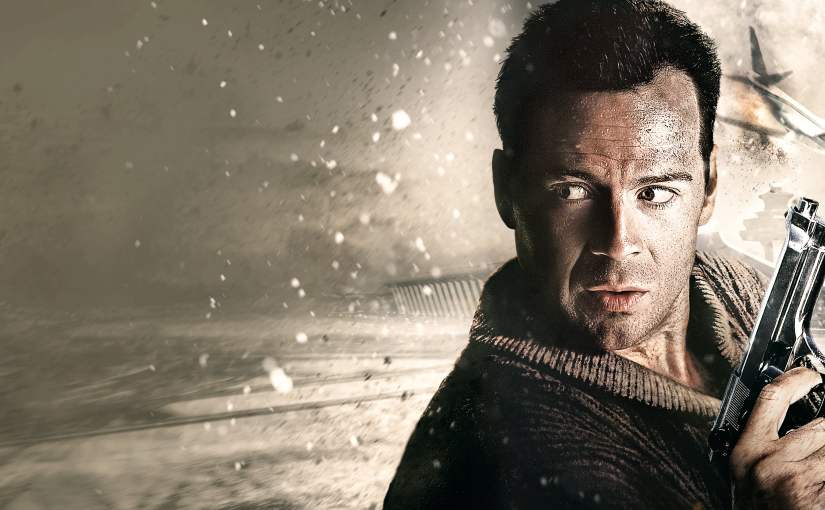
The ingredients are pretty much the same as the first film and while Alan Rickman is sorely missed, William Sadler does alright as a cold hearted Colonel on a mission to aid an escape of a powerful drug overlord. Bruce Willis’ John McClane will not allow that to happen.

Willis is maverick and defiant again though this script doesn’t allow for better one liners that the first film offered. He’s doing his same one man army schtick though with an endless supply of bullets for his service weapon, and it’s nice to return to form.

Harlin is a good action director featuring snow mobiles, shootouts, shootouts on snow mobiles and exploding planes and satellites. Amazingly enough though, a crowded Christmas airport is unaware of all these massive fires and explosions going off all over the nation’s capital and all proceeds as normal until it’s broadcast on TV in the last act of the film. Meh!!! Everyone has Christmas on their mind.

Heck…well then I guess Die Hard 2 (with the inventive subtitle Die Harder) is in fact a Christmas movie. Glad that’s settled.

Happy Holidays. Let it Snow!