MISERY

By Marc S. Sanders

The worst thing that could have happened to Paul Sheldon is that Annie Wilkes saved his life.

Rob Reiner breaks away from innocent romantic comedy to deliver a violently cruel kind of intimacy. He directs his second Stephen King adaptation, Misery.  (His first was based off King’s novella The Body, which became Stand By Me.)  With next to no prior record with horror or disturbing psychosis, Reiner achieves greatness with this film.  Much like Martin Scorsese, he focuses quite a bit on props that offer no dialogue but say so much.  A cigarette, a match, a champagne flute, a bottle, a beat-up briefcase, a clunky Ford Mustang, along with a gun, a two by four block of wood, a portable grill, a knife, a syringe, a sledgehammer, and a porcelain penguin.  Barry Sonnenfeld is the cinematographer offering brilliant clarities of color for mundane and endless discomfort.

Before leaving his mountainous Colorado cabin, Paul has smoked his cigarette and savored his glass of 1982 Dom Perignon.  He has just completed a new manuscript; a big departure from his best-selling series of novels focusing on his beloved heroine Misery Chastain.  Lady Misery is not how Paul wants to be entirely defined as an author.  

Unfortunately, on his way back down the snowy mountain, he veers off the road and lands upside down in his Mustang, buried within a blizzard.  A hulking figure carries him back to a peaceful, isolated cabin in the woods.  When he awakens two days later, he meets Annie who has already begun to nurse him back to health following two very damaged legs and a popped shoulder blade.  By his grogginess, he might have had a concussion too.  Lucky for Paul because apparently, he cannot reach a hospital or get a call out to his family or literary agent (Lauren Bacall) due to the harsh weather conditions.

It’s also convenient that Annie is quite the fan of Paul’s work, particularly his series of Misery novels.  She has a maternal bedside manner, but oddly enough she becomes irascible at any given moment.  After honoring Annie’s request to read his untitled manuscript, Paul realizes that might have been a mistake.  Annie can easily get unhinged to say the least, and that temper…

Paul Sheldon is portrayed by James Caan, and he was one name on a long list of leading actors considered for the role including Warren Beatty, Robert Redford, Harrison Ford, Robert DeNiro, and Jack Nicholson.  Any one of these guys could have done the part.  However, I can now only see James Caan.  He beautifully plays stationary vulnerability as he’s anchored to a bed for most of the film.  Ironically, for a writing master of words, Caan’s dialogue is not even half of the script that belongs to his counterpart.

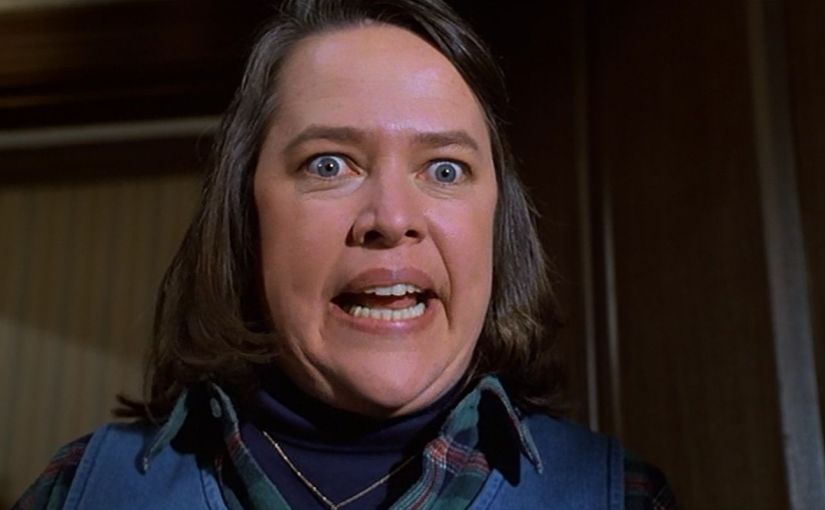
Kathy Bates was deservedly awarded the Oscar and a slew of accolades for her role as Annie Wilkes.  This role put Bates on the map.  Her portrayal is timed so authentically with changes in tempo from childlike enthusiasm to demented rage that she only makes Stephen King seem like that much better of an author than he already was at the time.  Actually, I’d argue that before Misery hit theaters, the Stephen King factory of film adaptations was churning out subpar products like Cujo, Firestarter, Christine, and his own film that he directed Maximum OverdriveMisery elevated the author’s brand back to when it was celebrated with Brian DePalma’s Carrie and Stanley Kubrick’s unforgettable interpretation of The Shining.

I believe what helps is that of all the varieties of horror the author was delivering, Misery did not hinge on the supernatural.  Annie Wilkes is a very real embodiment of capable terror and disturbing psychological handicap.  Kathy Bates effectively demonstrates byproducts of schizophrenia and obsessive, compulsive disorders.  Living alone in the woods with the subconsciousness of an author speaking to her through the pages of his fictional hardcover novels only feeds the beast that she’s become. 

I’m not a big fan of Stephen King’s works.  Often, I find his material of gore stretches too hard for shock value, and hardly ever achieving insightful originality.  To the best of my recollection, I’ve only read Misery, The Stand and It.  That’s enough for me.  I read that as he was writing Misery, he was emoting his alcoholic demons that left him obsessively challenged.  Annie Wilkes developed into that tangible, physical fiend.  This story takes a far step away from the macabre world that built his literary empire.

Rob Reiner does not go for any kind of novel inventions with his film.  He’s simply telling a story with the tools provided by celebrated screenwriter William Goldman (The Princess Bride, Butch Cassidy & The Sundance Kid, All The President’s Men) and his wise adjustments from King’s piece.  Goldman and Reiner wisely cut out a lot of King’s gory schlock.  (That foot scene, for example.  Either way?  YEESH!!!) Smart move, because Annie Wilkes is such force of power personified by the hulking physicality (by choice of Reiner’s lens) and range of Annie Wilkes.  Even though Kathy Bates is short, she is a hulking menace here. Kathy Bates is doing stage work in front of a camera.  I’d argue her performance inspired the idea of eventually converting Misery into a Broadway play that featured Laurie Metcalf and Bruce Willis in the roles.  I wish I could have seen that. 

Goldman wisely allows the picture to move on with another perspective in the form of two characters that were not part of King’s story.  A perfect casting of Richard Farnsworth and Frances Sternhagen as the local sheriff and wife advance the curiosity of Paul’s absence from the world.  They speak for the surrounding areas that don’t reveal what is beneath the blankets of snow where few clues remain, and not even a missing 1965 Ford Mustang can show itself.  They’re funny, quirky, and unusual, almost like a combination of Jessica Fletcher or Miss Marple seeking to resolve the mystery.

Props like a gun and a knife along with visuals like uncontrollable fires and fight scenes are nothing new.  However, it’s when these scenarios are paired with Kathy Bates to victimize a small, weakened James Caan that these items become well filmed properties of Rob Reiner.  So again, I focus on the inanimate objects of Misery because Reiner lends a lot of footage to all of these working pieces.  This revolver suddenly has dialogue of its own through one of Annie’s personalities.  The knife works like a guard dog for Paul.  The aluminum can of lighter fluid sadistically squirts itself to tickle or tease an extreme point for Annie.

The cigarette and champagne flute emote those small, cheating, harmless vice escapes from commitment that awards Paul. 

The sledgehammer puts its foot down.

The match plays both sides of the duality during different points of the film.

Misery is that film that works with a small cast, but with a wide population of environment, in a snug, confined space.  I describe the picture this way because like Annie Wilkes, this exploration in psychological terror operates without fair balance.  When an animal cannot control and subdue its instincts, there’s no telling what to expect, and an unpredictable Annie Wilkes might be one of the scariest personifications any one of us could ever encounter.

GHOST

By Marc S. Sanders

For a perfect blend of the supernatural, suspense, mystery, drama, romance and comedy, the first film that will always come to mind is the surprise hit film Ghost from 1990.  One of the zany Zucker brothers, Jerry to be more precise, who introduced the world to slapstick spoof (Airplane!, The Naked Gun) directed this film turning Demi Moore into a ten-million-dollar actress, placing Patrick Swayze ahead of his Dirty Dancing looks and earning Whoopi Goldberg a very well-deserved Academy Award.  Ghost was a film for all kinds of movie goers.

Sam Wheat (Swayze) is an up-and-coming New York City business executive who loves his new live-in girlfriend, Molly (Moore) even if he can only say “Ditto!” when she tells him she loves him.  Shortly after the picture begins Sam is gunned down following an evening at the theatre.  Unbeknownst to Molly and anyone else living on earth, Sam’s spirit lives on though, and he realizes that he was not the victim of some random mugging/murder.  Now, Sam must find out who arranged to have him killed and why, while also protecting Molly from becoming a victim.

Along the way, Sam crosses paths with a phony con artist, working as a medium, named Oda Mae Brown (Goldberg) who turns out to be the real thing when she can actually hear Sam’s voice and communicate with him.  Sam must recruit Oda Mae to be a go between for him with Molly and everyone else necessary to follow up on in order to resolve the mystery of his sudden death.

Ghost succeeded in every category of filmmaking.  Rewatching the film decades later, I believe Demi Moore should have gotten an Oscar nomination.  Her close ups on camera with beautiful, muted colors from Adam Greenberg’s cinematography are masterful.  Greenberg should have been nominated too.  He’s got perfect tints of pearl whites both on the cobble stone streets of New York with the outer architecture of the apartment buildings, as well as within the studio apartment where the couple lives.  He strives for an ethereal look with his lens. Gold often occupies Molly’s close ups with dim lighting.  Blues and blacks and steel glinting shines follow Sam’s trajectory. 

Look at the lonely scenes that Moore occupies in the couple’s apartment.  There’s a haunting image of isolation with no dialogue capturing the young actress at the top of a staircase when she eventually rolls a glass jar off the top and it shatters below.  It’s one of the moments that defines a sorrowful character, and not many cry on screen better than Demi Moore.  Later, Sam is engaging in a pursuit through the subway system and races down a steep blue escalator in the dead of night.  Zucker places Greenberg’s camera at the bottom of the escalator to show the depth of hell that Sam may be risking continuing his chase.  The images and transitions of this whole movie from scene to scene are stunning.

I mistakenly recall Whoopi Goldberg as just a comedienne doing her stand up schtick in this film.  Not so.  Goldberg looks radiant on film and while she starts out comically as the script calls for, she eventually resorts to sensitive fear of what her paranormal partner demonstrates as real within this fantasy.  There are so many dimensions to this character.  She’s silly.  She’s exact in her nature for what’s at stake and the dialogue handed to her from Bruce Joel Rubin’s Oscar winning script compliments the actress so well. Goldberg never looks like she’s working for the awards accolades. Yet, she earned every bit of recognition that followed her.

Patrick Swayze makes more out of the straight man role than what could have been left as simple vanilla.  His spirit character uncovers more and more about his afterlife and what happened to him as the film moves along. With each discovery, you’re convinced of Sam’s surprises and what he becomes capable of as a ghost.  Long before superhero films became the novelty, Sam Wheat operates like one who has to learn of his origin and then acquire his new talents and powers to fend off the bad guys.

Jerry Zucker, working with Rubin’s script, Greenberg’s photography and Oscar nominated editing from Walter Murch, along with haunting yet sweet scoring from Maurice Jarre, builds a near perfect film.  The narrative of Ghost shifts so often from comedy to crime to drama to romance and the various natures of the piece hinge so well off each other.  That’s due to storytelling and the editing necessary to smooth out any wrinkles.  You become absorbed in Jerry Zucker’s direction, especially with the movie’s most famous scene where Demi Moore and Patrick Swayze are sensually doing pottery together accompanied by Bill Medley’s rendition of “Unchained Melody.”  Watch that scene with someone you love or take it in on a late Saturday night by yourself with no one to distract you with cackles and eye rolls.  You’ll see how effective Zucker’s work is along with Swayze and Moore upholding the scene in a dark, empty apartment.  Take it as seriously as the scene was originally constructed.  (Then go watch Zucker’s Naked Gun 2 ½ for a chuckle.)

The mystery of Ghost works well with surprises if you are watching it for the first time.  You build trust with a character only to realize it is a ruse for something else.  I do not want to give too much away.  For viewers who have never seen the film, maybe you’ll see an early twist as soon as the film begins.  Maybe not.  Either way, Ghost performs very naturally, unlike a forced kind of twist that M Night Shyamalan too often relies upon.  I do advise that you not watch the trailer that was used for Ghost as I believe it deals out too many of the film’s secrets.

There are movies that I watch over and over again because I love to relive the special moments they offer.  Ghost has those kinds of gifts and yet I have not seen it in ages.  I’m glad.  To experience the picture again was such a treat.  While I recalled all of its secrets, this time I was able to take in the various technical achievements and the assembly of the piece, along with outstanding performances. 

I have no problem saying that Ghost possesses the best performances within the vast careers of Demi Moore, Patrick Swayze and Whoopi Goldberg.  Ghost still holds up. It deserves a rewatch and an introduction to new generations.

JACOB’S LADDER

By Marc S. Sanders

When a movie works beyond formulaic conventions, it takes risks.  A storyteller will either really impress their audience, or they will leave them feeling shortchanged.  You’ll either get a “Whoa!  Now that’s cool.” (The Usual Suspects, The Sixth Sense, but I did call that ending when I saw it in theatres.  Ask my wife if you don’t believe me.) On the contrary, you’ll arrive at “That’s it?” (The Happening, Signs or any other M Night Shyamalan reach for the rafters but come up foul kind of flick.)

A movie like Adrian Lyne’s Jacob’s Ladder is anything but standard and it asks you to trust in its ambiguity in order to arrive at its big payoff.  For most of the picture it is unclear what you’re watching.  What keeps you engaged is Lyne’s approach to atmospheric indicators, like dark tunnels, dim bulbs, distant echoes and a disturbingly scared and depressed Tim Robbins.  The creepier the film looks and the more ominous it feels, then perhaps it will lead to a conclusion that will leave you satisfied.  Jacob’s Ladder functions like an M Night Shyamalan film where you just want to arrive at the twist.  When it finally reached its destination though, I was ready to turn the car around and go home.

Tim Robbins is Jacob Singer, a Vietnam veteran.  The picture opens up with Jacob returning from the dense jungles to reunite with his squad after what was his like hundredth bowel movement, it seems.  The squad jokes about with men’s locker room talk and then a disturbing occurrence takes place.  The next scene, thereafter, has Jacob dressed in a mailman uniform awakening from a nightmare aboard a New York subway train.  He gets off at his stop, but then he cannot find his way out of the subway station and then he encounters unsettling images like perhaps a demon or two on board a train that just misses running him down.

Much of Adrian Lyne’s film sets up sequences like this where the unexplainable cannot be explained.  Jacob now lives with a girlfriend, Jezzie (Elizabeth Peña), who is growing frustrated with Jacob’s unusual behavior.  It seems he suffers from PTSD following his time in the war, but also he mourns the death of one of his three sons (Macaulay Culkin) from his first marriage.

Robbins is especially good at not going for big moments in his role.  He’s a quiet, cheerless individual working with very little dialogue.  That’s impressive but it’s also a little boring, especially considering that for most of the film it’s near impossible to decipher what is going on, nor what is the exact story to uncover in Jacob’s Ladder.  My patience was trying, up until a stand at attention moment that came from nowhere.  Still, not much arrives thereafter. 

Jacob receives a call out the blue from one of his old army buddies.  When they meet up, it dawns on Jacob that his friend is encountering similar kinds of feelings.  When he reunites with the rest of the squad it occurs to them to sue the United States government for experimental drug treatments that were administered to them while serving in the war.  They turn to an attorney played by Jason Alexander in a role far off from his Seinfeld sitcom days to later come in his career.  This lawsuit may uncover a link for Jacob.  Unfortunately, I think it diverts away from Adrian Lyne’s intended lack of clarity for another kind of movie altogether.  The movie goes in this detour with Alexander’s attorney role and then finds its way back on the main road for the third act.  Hardly any new mileage was to be gained from this rerouting though.

This new development may give a more literal understanding into Jacob’s psyche and condition. However, I think the film fails to pounce on a new opportunity to attack a topical storyline that had become suspect during the actual timeline of the war.  As the film arrives at its conclusion, the script seems to rush to the surprise ending it wanted to garner.

Frankly, an early conversation with a Jacob’s chiropractor (Danny Aiello) easily spelled out the twist for me.  Alas, perhaps that took me out of the film early on. 

There are good ideas and good performances to be had in Jacob’s Ladder.  Yet, I don’t think the film entirely works because of Adrian Lyne’s attempt to push it’s vagueness.  Demons that come out of nowhere during Jacob’s hallucinations should be scary and have a fright shock to them, but instead these moments come off like abstract art that only frustrated me. 

I always thought I knew the ending, and I was right for the most part, but why does a runaway car have to chase Jacob down an alleyway to deliver the point?  Arguably, a boogeyman like Freddy Krueger might have done a better job at disturbing a threat of death than what was ever going on in Jacob’s Ladder.

THE GRIFTERS (1990)

by Miguel E. Rodriguez

DIRECTOR: Stephen Frears
CAST: Anjelica Huston, John Cusack, Annette Bening, Pat Hingle, Charles Napier, J.T. Walsh
MY RATING: 9/10
ROTTEN TOMATOMETER: 91% Certified Fresh

PLOT: A small-time con man has torn loyalties between his new girlfriend and his estranged mother, a high stakes grifter working for the mob.


Imagine your favorite film noir from the 1940s and ‘50s.  The Big Heat, say, or Double Indemnity.  Now imagine someone remade it, set it in the modern world, retained most, if not all, of the hard-boiled dialogue and characters, threw in some gratuitous nudity, and added some Freudian subtext that would have made Oedipus blush.  Oh, and imagine David Mamet directed it.  Voila…you’ve got 1990’s The Grifters, directed by Stephen Frears and co-produced by none other than Martin Scorsese.  It tends to move just a tad slow at times, but all that simmering pays off in the movie’s phenomenal final reel.  I am going to have to tread carefully indeed to avoid spoiling some of the movie’s best surprises.  Here goes:

As the movie opens, we are introduced to three very different characters, at least on the surface.  Lilly (Anjelica Huston) works for the mob by visiting horse racing tracks across the country and laying pricey bets on long shots to bring the odds down just in case they pay off.  She also skims just enough off the top to stay under the radar.  Roy (John Cusack) is a young man pulling small-time cons of his own, like the one where he flashes a $20 bill at a bartender, then pays with a $10 bill instead, getting $20 worth of change at half the price.  And Myra Langtry (Annette Bening in her breakout role) is first glimpsed attempting a lame con at a jewelry shop that ends with her offering her body to the jeweler instead.  (I like the fact that nearly everyone calls her “Mrs. Langtry” even though no one seems to have laid eyes on her husband.)

Myra is Roy’s vivacious new girlfriend.  Lilly is Roy’s estranged mother; she had him when she was fourteen years old (yikes) and he left home at 17, as he puts it, “with nothing but stuff I bought and paid for myself.”  Roy values his independence above all else, maybe even more than the money he’s “earned” and stashed away behind the ugly clown paintings in his living room.  So, when Lilly unexpectedly drops by his apartment in Los Angeles (which she always pronounces “Los Ann-guh-leez”) on her way to the track at La Jolla, he lies about his livelihood.  The last thing he wants is a concerned grifter mother trying to partner up with him.  He learned that from a mentor years ago, seen in a flashback: “You take a partner, you put an apple on your head and hand the other guy a shotgun.”

Due to an injury sustained from a bartender who caught him in a grift, Roy winds up in the hospital, where Lilly meets Myra for the first time.  They are not impressed with each other; their introductory conversation is brief, but it plays like Bette Davis clashing with Joan Crawford.  We get a little more information about Myra’s situation when we see her go home to her apartment where she is met by her landlord, Joe, who demands payment on her outstanding bill.  Her response is to bat her eyes and launch into a patter of what sounds like a radio or TV commercial.  “You, too, could learn to dance!  All you need is a magic step!”  After some more back and forth, she lies down naked on her bed and offers Joe a choice: “Only one choice to a customer, the lady or the loot.  What’s it gonna be?”

What makes a scene like that sparkle, along with virtually every scene in the film, is the fierce individuality displayed by the characters.  They are each wholly original, not simply placeholders for foregone dialogue or plot developments.  In classic film noir, the lead character is usually a smart guy (or gal) who thinks he’s smarter than everyone else but gets caught off guard by his own desires.  In The Grifters, all the main characters are smart…and they stay that way the whole movie.  There is not one single plot development that evolves because anyone makes a dumb decision.  You can see that they all have a clear view of all the angles, and no one is going to make a stupid choice for the sake of the script.  I can’t tell you how rare that is.  The plot and the story unwind and are wound up like a precision watch.  By the time the credits roll, you can see exactly why each character made the decisions they did, leading them to the shocking finale in the last reel.

I really can’t say more about the plot without simply retelling scenes or giving away spoilers.  Throughout the film, Huston, Cusack, and Bening deliver performances that would be right at home in a Mamet film.  They’re allowed to show more emotion than can usually be found in Mamet (I’m thinking particularly of House of Games), but their pared-down, hard-boiled dialogue cuts to the heart of the matter without being flowery.  There’s a scene involving Lilly’s boss, Bobo, played by Pat Hingle with a flat-eyed menace that would make Sonny Corleone run for cover.  His deadpan dialogue with Lilly about oranges is one of the tensest gangland conversations I’ve ever seen, and he does it without ever raising his voice.  Brilliantly written.

If this review has been vague, it’s because I am trying to preserve the unexpected twists and turns about who’s who, and who’s hiding what, and why.  If you find yourself wondering why things are moving kind of slow in the first 30-45 minutes, just be patient and let your ears bask in the hum of the crisp dialogue; observe how each character behaves according to their character, not according to a script; and marvel how a movie set in modern day can still have dizzy dames and classy broads and world-weary heroes and not feel like a relic from the 1940s, but instead feels as fresh as a movie that was released yesterday.  The Grifters is nearly-buried treasure that deserves to be rediscovered.

PUMP UP THE VOLUME

By Marc S. Sanders

Travis Bickle, the character portrayed by Robert DeNiro in Taxi Driver, is arguably one of the most famous lonely men in film.  There have been other iterations of the sad, angry and depressed individual that just can’t speak to anyone and vents his frustrations only to his consciousness that an audience is meant to hear while watching a movie.  An isolated guy that stands out to me is a radio DJ known as Happy Harry Hard-On played Christian Slater in Pump Up The Volume, a sleeper hit on early 90s videotape.

Harry is a lonely, quiet high school student by day who goes by his real name of Mark Hunter.  No one takes notice of him because he doesn’t socialize, and he hardly speaks.  He just keeps to himself.  Only an English teacher impressed with his writing and another student named Nora Diniro (perhaps a salute to Robert?) played by Samantha Mathis catch his eye.  Mark’s parents really don’t even take much notice of him, other than to believe that Mark has problems adjusting.  It’s much deeper than that, as the poor kid adopts his alter ego on a pirate radio station which reaches the neighboring homes around the school. 

Pretty soon most of the student body is listening and relating to Mark’s diatribes of loneliness, depression, and the school administration’s efforts to doctor passing grades and average GPAs to enhance its image within the state of Arizona.  The school proudly boasts of a program to help troubled kids too, but Mark as well as the other kids fail to see any legitimacy in that approach.  All of it is a sham. 

The efforts behind this ongoing fraud are being committed by the tyrannical Principal Cresswood (Annie Ross).  However, Mark has access to confidential records thanks to his father who now works for the school.   Drawing no attention to himself, he can uncover some students who were expelled just for having poor grades despite having no violations.  One student was dismissed under dubious circumstances when it was discovered that she was pregnant. 

Hard Harry’s radio show airs each night at 10pm where such secrets are revealed along with some of the most perverted and filthy material imaginable interspersed with the grunge/punk music of the time (Concrete Blonde, Ice-T, Pixies, Sonic Youth).  Before podcasts and the internet, there was pirate radio in a kid’s basement. Hard Harry vents his frustrations about not speaking with anyone all day or how difficult it is for him to approach a girl.  The student body empathizes even though they can’t identify this mysterious voice of airwaves.

Pump Up The Volume never made a huge impact at the box office, but my high school pals and I caught it anyway in movie theatres.  It spoke to us.  It was much more relatable than Taxi Driver because it was modern, and it was set in an environment that we were similarly living through.  Everything that Mark/Hard Harry had to say I could understand.  I felt his anguish.  Writer/Director Allan Moyle goes for an early surprise when one listener sends in a letter saying he wants to kill himself.  Wisely, Moyle doesn’t go for the standard call where the DJ talks the kid out of it.  Mark isn’t mature or intuitive enough yet to be an effective “fast-food therapist.”  Instead, Hard Harry makes the initial mistake of not taking the letter writer seriously.  The aftermath amplifies the pirate DJ’s presence, and then the debate of his servitude comes into question.  Mark can no longer toss this personality aside.  He’s making a difference, whether some believe it is good or bad and now, with Nora’s encouragement, he must continue his crusade, even if he’s not sure what that is.

Pump Up The Volume was released in 1990 before the Columbine shootings and waves of other school violence that’s occurred since.  It was around before social media.  Though it is hardly spoken of anymore, perhaps because it lives only in the time of its original release, the context of the film speaks more openly than most of John Hughes’ films.  A variety of different students reveal the pain they are suffering, from the genius student who only appears to have it all together in the brains and beauty department to the punk kid who was unfairly expelled to even the silly kids who just want to prank Harry while he’s on the air, and the kid who was cruelly tricked into coming out.  The stress and suffering of what students endure still exists and it is perhaps more visible now due to how much further some students publicly act on their frustrations.  In that respect, Allan Moyle’s film is not outdated.  It might not be pirate radio anymore, but similar content that Harry incorporates in his nightly show continues to be seen in podcasts, Instagram and Tik Tok posts. Public actions are now performed on campuses – such as protest marches, rallies, voicing sexual interests or regrettably school violence, and suicide.

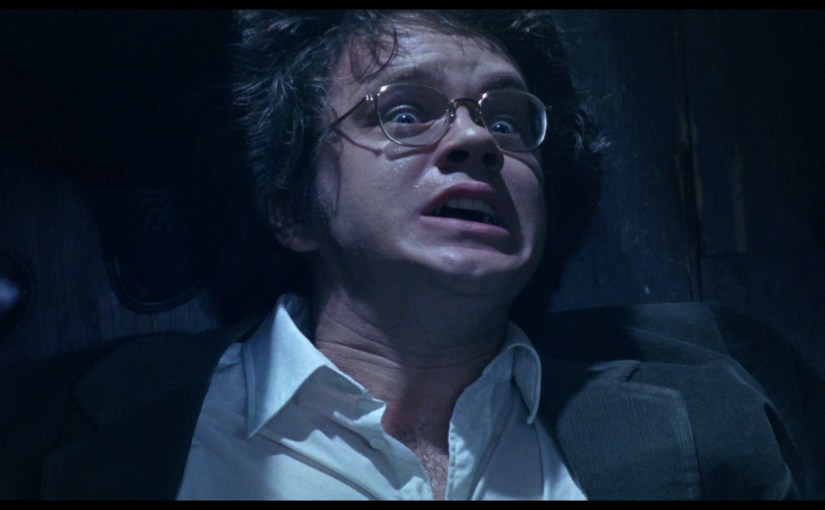
Christian Slater is perfect in this role, maybe one of his best, next to the misfit he would later play in True Romance.  Slater has a Jack Nicholson personality. He’s great with the on-air smarmy comments and adoption of his own routines such as “pleasuring himself on the air with a cock ring.”    He’s not literally doing any of this, but he keeps his listeners’ attention, the same as shock jocks like Howard Stern.  Turns out Mark doesn’t even know what a cock ring is, but everyone is curious, nonetheless.  He makes Hard Harry confrontational, as well as regrettable, when Mark feels things are going out of control.  Another angle is the quiet student that Slater is by day wearing large glass frames and keeping his head down while subtly checking out the writings of Lenny Bruce from the school library.  Slater does well with the multi-faceted character, and I couldn’t envision other actors of his brat pack age in the role.

Samantha Mathis is also sensational, a real surprise.  This was her debut screen performance.  She has the appearance of a 1990’s Winona Ryder, but she exudes complete confidence as Nora, the girl who seems to know everyone at school and what they are involved in.  Moyle writes smart, and sometimes poetic, dialogue for her character. She delivers with a personality of being seduced or moreover being the seductress.  Mathis has great chemistry with Slater. She works very well at breaking down Mark’s outer shell while encouraging him to carry on with what he has started.

Pump Up The Volume enters a third act that becomes a chase scene of sorts when the FCC is called in to find Hard Harry.  The film ends abruptly because I think Hard Harry may have run out of things to talk about.  However, I walk away from the film having seen a hero in a pirate DJ, who brought the wrongs of an administrative body to light. More importantly, he allowed attention to focus on the trials that high school youth encounter.

You’ll feel good after watching Pump Up The Volume, and you’ll understand when Harry tells you to “Talk Hard!”

Q & A

By Marc S. Sanders

Sidney Lumet is a favorite director of mine.  Maybe it’s because I simply get caught up in good crime dramas and legal thrillers, like Dog Day Afternoon, 12 Angry Men, and The Verdict.  Maybe it’s because I appreciate the genuineness of Lumet’s technique.  The man’s career seems to follow a documentarian theme throughout New York City’s boroughs, politics, courtrooms and especially the various precincts of its police force.  Corruption is the angle that Lumet looks for, and Q & A from 1990 is another such example.

The title refers to the routine transcript that a district attorney will ask a witness following an incident.  So, after the first two minutes of the picture have concluded with New York cop Mike Brennan (Nick Nolte) shooting a Hispanic at point blank range, execution style, outside a seedy nightclub, a fresh-faced D.A. named Al Reilly (Timothy Hutton) is recruited in the middle of the night to collect Mike’s statement on the incident and wrap it up quickly, as his supervisor Kevin Quinn (Patrick O’Neal) strongly urges.

Mike is a celebrated cop with tall tales to share of how he strong arms suspects.  Everyone seems to like his relaxed way of tossing around racist vulgarities in his anecdotes.  No demographic is left out with how he speaks.  In fact, the name calling is shared among the whole precinct in a very casual way.  The two detectives assigned to the shooting that Mike was involved in, Sam “Chappie” Chapman and Luis Valentin (Charles S Dutton, Luis Guzman), seem to take it in stride as well.  They guffaw with the rest of the crowd when Mike describes how he roughs up street hoods who don’t cooperate. 

Al was once a cop as well, and his father before him was a “hero cop” to the boys in blue too.  He’s more than willing to let this incident go the quick routine, but then he soon realizes how corrupt Mike is and how much of a stronghold he has on the precinct and the various walks of life within the city from the Italian mob, to the Hispanic drug runners, to the transvestite hookers and the Jewish lawyers.  They all fall under his thumb.  Nolte’s stature and bombastic voice tell you that Mike carries a large thumb no matter how blatant his crookedness may appear. 

“Chappie” may be regarded by Mike as the “whitest n—er” he knows, but he’d never even think of turning his colleague in.  That’ll be the day he quits.  He proudly announces he’s blue first and black second. Luis, the Hispanic partner regarded as a “n—er with straight hair, is scared to move forward.  He’s got kids.  Kevin Quinn needs this to just move on.  The shooting of a lowlife Hispanic is not worth risking his advancement in politics.  Al is challenged and turns to his Jewish mentor, Lee Richardson (Leo Bloomfield) for guidance, who can help him get this pushed up the ranks and nab Mike for his atrocities, while circumventing the racist and antisemitic nature of Deputy District Attorney Quinn. 

It gets more complicated for Al, as his ex-girlfriend, Nancy (Jenny Lumet, Sidney’s daughter) is now attached to an important witness to the crime.  Bobby Texador (Armand Assante) is a Hispanic drug dealer who can not only pin Mike for the crime but also incriminate others within the system.  He’s just not so willing to sing.  Al is in a difficult quagmire that circles back to pension left for his mother per his father’s prior service.  He’s also wracked with how to handle Nancy.  They broke up simply because his reaction upon learning that her father was a black man did not go so well.  Even Al, born of virtue, is corrupt of prejudice.  Perhaps Lumet’s screenplay suggests the message that intrinsically we are all at least a little too stereotypical or partial for our own good.  It comes with our sensibilities and maybe it’s a mindset we best unlearn.  The most obvious challenge for Al is that he is subjected to intimidation from his boss Quinn, and especially Mike.  You don’t want Nick Nolte in your face.  That’s for sure.

I can’t lie.  Having watched the film for the first time, I was only looking at the plot and story development of Q & A.  I wasn’t seeing the bigoted culture sewn in among the masses.  Afterwards, I watched Siskel & Ebert on You Tube and they focused on the racist themes and casual name calling among the characters.  It never occurred to me while I was in the moment of watching the movie.  I don’t know what that says about me.  Maybe I’ve grown as comfortable with racist name calling as these characters have.  I don’t talk this way.  I may laugh at Cards Against Humanity or Family Guy.  For these cops to talk among themselves, casually using prejudiced connotations for African Americans, Hispanic Americans, Homosexuals, Transvestites, Jews and Italians within the melting pot of New York City with such nonchalance is more telling of Q & A, than the corruption that unfolds over the course of the picture.  Understanding what Siskel and Ebert found within the script granted me much more appreciation for Lumet’s film, because the twists of the plot and the overpopulation of characters was becoming too convoluted for me.

The strengths of the movie come from the cast performances, especially Nolte and Assante.  Nolte has played many roles where he’s the brute.  Here though, he’s downright despicable with his slicked back hair, tall stature, his thick “I’m your buddy” mustache, and his Irish Catholic character background that announces his superiority to all others.  Armand Assante is an unusual kind of drug kingpin.  He plays Bobby Texador with much self-awareness knowing he can be killed not only for what he knows about this particular shooting but other inside information he can share as well.  He’s a guy who will rise above any threat though.  This guy might be a criminal, but he hardly needs an attorney to negotiate on his behalf.

The trio of Nolte, Assante and Hutton works because each of the men are so different from one another.  These guys wouldn’t work well on a baseball team together.  They wouldn’t even socialize at parties.  Lumet writes these characters so far apart from each other, that loyalty can’t exist between any of them.

A lot of the characteristics of the film are consistent with many other achievements within Lumet’s repertoire like Night Falls On Manhattan and Serpico.  Those are better films.  When plot details reveal themselves in Q & A, I found myself rewinding to the beginning of a few scenes to fully comprehend what was just said. After a while, I gave up interest in the twists.

There was a choice of musical style that left me unsure as well.   Ruben Blades conducted the score for the film and a pop/rock song follows the prologue over the opening credits.  It later resurfaces as things are coming to a head near the end of the film.  Especially for the seedy and unglamourous approach that I love in Sidney Lumet’s films, I wasn’t enthusiastic on this style to heighten the dramatic crescendos.   It felt a little too Miami Vice, when I believe Lumet was aiming for his audience to get mad at the corruption that overtakes a system grounded in law and order. 

Q & A is a must see for fans of Sidney Lumet.  I’m glad I finally saw it.  It’s been on my bucket list for quite a while and I could not find it anywhere on any platform or medium.  (At the time of this writing, it’s available for free on Hulu.)  It’s definitely raw in its character creatures of a New York City from the 1990s, and it’s honest how the rite of passage to be a cop is to roll with the punches of racially lampooning your ethnicity.  It’s the only way to survive among the masses.  Fortunately, the cast plows through with that ugly nature to deliver something authentic.  When the film dives into its conspiracies for the sake of the plot, however, it’s a little too muddied for me to appreciate.  Watch the film for the characterizations.  Heck, watch it for the plot developments because if you can make out everything that’s happening and why, I’d love for you to explain it to me.

THE HUNT FOR RED OCTOBER

By Marc S. Sanders

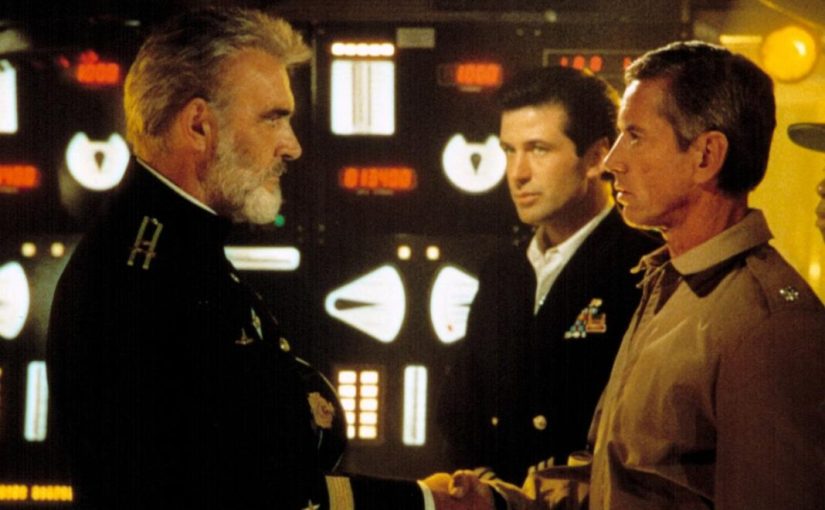
John McTiernan’s adaptation of Tom Clancy’s first bestselling novel, The Hunt For Red October, might seem dated but it’s still a crackling good thriller. It’s one of those films where you truly feel like you’re walking through the secretive hallways of DC government buildings with their elevators accessed only by an Admiral’s key. Soon you’re in a dark, underground boardroom. You’re also there on the various naval crafts and submarines with alarming lights, shiny steel and glowing monitors. The biggest treat is being in the command center of the titled sub, Russia’s Red October, commanded by their captain, Marko Ramius (Sean Connery). All in all, Terence Marsh built a convincing production design.

Clancy’s story takes a different approach than most thrillers involving Cold War politics. Ramius might have been a James Bond villain in another film as he hijacks Red October, but there’s more to him actually. Rather, Ramius wants to defect to the United States. Most of his command crew is in agreement as well. America doesn’t necessarily see it that way; a Russian, missile equipped submarine quickly approaching the eastern seaboard with other subs following him?!?!?!? Let’s not polish the tea set so quickly.

Fortunately, one man had the pleasure of meeting Ramius once and doing extensive research on the General’s background; Jack Ryan (appropriately cast with a young Alec Baldwin). Ryan is given three days to catch up to Ramius and guide him safely to the United States while avoiding getting the famed submarine shot down by either power nation.

I must point out my favorite scene and it actually takes place in that secret boardroom where it dawns on Ryan of Ramius’ true plan. Baldwin is great here. The young guy who is green when it comes to military and political protocol. McTiernan gets his company of generals and high ranking officials into a large quarrel over what to do and then he zooms in on Baldwin thinking for the close up before he calls Ramius a SON OF A BITCH. It’s at this moment, that the movie going consensus and fans of Clancy overall determined that Alec Baldwin was the best of the cinematic Jack Ryans. (No slight to Harrison Ford, who was too middle aged for the role when he took the part).

Connery at least has the commanding appearance of Ramius’ stellar reputation. He is not very exciting or charismatic. Then again, I don’t think Clancy built the character that way. Connery plays the role as silent, yet wise and experienced as implied by his well groomed, white beard and hairpiece plus his square stature. If this man is standing in your presence, you better give him an update. You shouldn’t have to ask if he wants one.

Good moments are made available to Scott Glenn, James Earl Jones, Sam Neill and Stellan Skaarsgard as well. It is the talking scenes among all these fabulous actors that really build tension. The underwater scenes…not so much. The subs look like long, black blobs weaving their way through depths and avoiding missiles coming their way. It’s forgivable because McTiernan always keeps the characters at play. This isn’t a film that relies on the dog fights depicted in Top Gun or Star Wars. McTiernan keeps his audience away from drowning in the underwater murkiness.

The makers of this yarn really are a great combination of imagination. We got Tom Clancy and John McTiernan to thank for a gripping tale from 1990 that still holds up today. The Hunt For Red October is definitely a film worth revisiting.

TOTAL RECALL

By Marc S. Sanders

Paul Verhoeven is an in-your-face director. His material regarding sex and violence goes at least a ginormous step further than other directors. For an action film like Total Recall, if someone gets shot, they don’t get shot once but hundreds of times. That way we can see more blood splurt all over the place. I especially feel ashamed how much I laugh when a tourist extra gets caught in good guy/bad guy crossfire. Once this guy is dead, Verhoeven makes sure his central nervous system is nonfunctional and none of his vital organs will qualify for donation. If Verhoeven sets a scene in a Martian adult night club, then you’ll have ample opportunity to take in an upfront view of a three breasted woman, or a little person in stiletto heels and hooker garb with the boa included.

Total Recall is a well-regarded Arnold Schwarzenegger action flick with a psychological twist to keep your attention. As soon as the film begins, you are questioning if you are watching a real-life experience for Douglas Quaid (Schwarzenegger) or is this a dream or is this all a purchased memory. A purchased memory is the new novelty of this science fiction future. If you can’t travel to a destination like the planet Mars, you can certainly buy an implant that’ll convince you were there and even living the life of a secret agent while romancing a beautiful buxom brunette.

The exposition for Total Recall really arrives in the second half of the film. The first hour deliberately leaves the viewer as confused as Quaid while he tries to uncover why he’s being pursued and shot at.

The film is full of surprising twists including another character reveal that Schwarzenegger portrays. It’s hard to trust anyone Quaid comes in contact with or who is real or even what is real.

The settings are very well constructed. When you enter a security zone before hopping on a subway, your entire skeleton appears in blue on a screen you pass by. Mars is brutally red while it tries to comfort the civilization with familiar products like a Hilton Hotel or Pepsi. All of this sensory overload is present while a brutal overseer named Cohagen (an over-the-top Ronny Cox just like Paul Verhoeven likes it) seems to disregard the alien inhabitants by hoarding their breathable air.

It all feels familiar but the product placement is a little much as well. When I first saw the film in its theatrical release, I was enthralled with this picture. The action seemed to come as fast as the various twists. However, now it’s hard not to notice the blatant commercialization of the film. Its like watching a football game and every few minutes a commercial comes on. I’m aware of you, Pepsi. I don’t think I need a reminder during a loud, violent gun fight. Look! Instead of “USA Today” there’s “Mars Today.” Ha!!!! Even if you have the means to travel to Mars, you might want to visit the local Sharper Image for the latest high tech toy.

Total Recall relies on a story from sci fi writer Phillip K Dick who also inspired Minority Report and Blade Runner. Fortunately, that’s a good strength to hinge upon. I think the weirdness of it all makes Schwarzenegger a better actor; a muscle guy who can only appear more like an Everyman in a film like this. He’s good with emoting confusion. He’s as good as always with delivering a pun, and his fight scenes are consistent with his other actioners like Predator and Commando.

Total Recall is a good picture but it’s a lot to absorb in story. It’s over inflated in its unsubtle appearance of product placement, violence and nudity. If you’ve got the stomach for it, then you’ll have a good time. It’s not Star Wars lite. It’s definitely Star Wars heavy. Prepare to be bloated.

INTERNAL AFFAIRS

By Marc S. Sanders

Internal Affairs has a promising start as we see Richard Gere as decorated officer Dennis Peck compromise a police shooting in favor of his fellow officer (Michael Beach) who has just shot a fleeing unarmed suspect in the back. Right away it’s apparent that Gere is the bad guy here and soon we will see how Andy Garcia as new Los Angeles Internal Affairs officer Raymond Avila will investigate Peck for his violations. Unfortunately, the movie from director Mike Figgis reduces itself to simply having the male characters of the film, including William Baldwin as another dirty, drug addicted cop, physically abusing the female characters around.

This film from 1990 shows its age for sure with frizzy hair sprayed dos and large lapel jackets and skinny ties, but that was not my main issue. It would not be until 2006 in the Martin Scorsese film The Departed that we would see what I was hoping for with Internal Affairs; how a dirty cop works, and how the righteous cop gives pursuit. If only Figgis’ film was smart enough to focus on the method behind Dennis’ actions of crime and police superiority. Instead, we get a Richard Gere who actually shows he can play an effective bad guy, psychologically messing with Andy Garcia’s character by giving him the illusion that he’s having an affair with his wife. What’s Garcia’s response to this? He slaps his wife, played by Nancy Travis, in the middle of a crowded restaurant. When the two clear the air about what’s going on, they slap each other again before making up.

Gere also slaps and physically threatens his own wife played by Annabella Sciorra to drive the point home that she better not talk to the Internal Affairs department. As well, Gere also slaps around his mistress, a wife of one of his criminal associates. William Baldwin’s character slaps around his wife too. You seeing a pattern here?

It’s one thing to depict domestic abuse in film. There’s room for that. Because it sadly happens all too often, it’s appreciated if it’s handled with sensitivity. Here though, the abuse against women is used as a punchline to a scene, one after the other, and the overall theme of the picture is not supposed to be domestic violence. It bothers me that Mike Figgis tosses this kind of material around like effective drama, seemingly trying to make it look sexy to smack a good looking woman around by a good looking man. About the only woman in the cast not to get abused is Laurie Metcalf as Garcia’s lesbian mentor and partner. She gets referred to as a “dyke,” by both the villain and the hero of the film. This is just a very cold, thoughtless picture that runs short on imagination.

How does Garcia get the idea to investigate Gere’s character? He just has a sneaky feeling about the guy. That’s all that’s necessary to move things along here. In a better police film like The French Connection, the cops were displayed with step-by-step surveillance tactics that first put them on to a low rent street hood that ultimately leads to something bigger. We saw a method to their instincts that led to something tangible and proof worthy. I wish Mike Figgis, with a screenplay by Henry Bean, delved more deeply into what made the Dennis and Raymond characters so good at what they do. Films like Heat and Dirty Harry explore those backgrounds. Internal Affairs just takes the cheap shots of beating and dominating the women in these characters’ lives, while never showing the drive for what they do. Ultimately, the film comes up short sighted, and especially very, very insensitive. This is just an abusive film.

REVERSAL OF FORTUNE

By Marc S. Sanders

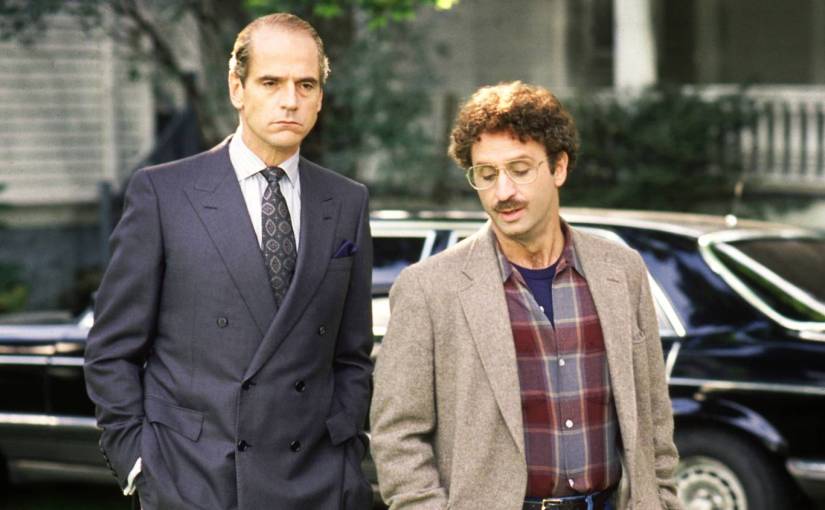
Claus Von Bülow was not a well liked man. In the 1980s he was put on trial for the attempted murder of his wife Sunny Von Bülow and was found guilty in a courtroom within the state of Rhode Island. However, even guilty men need a lawyer. Alan Dershowitz accepted Claus’ invitation to be his appellate attorney and successfully won the case with the assistance of the best students to come out of his law school classes. Reversal Of Fortune directed by Barbet Schroeder documents the month and a half that Dershowitz had to make a case for overturning Claus’ conviction. The film is based on Dershowitz’ book Reversal Of Fortune: Inside The Von Bülow Case.

Jeremy Irons won the 1990 Best Actor Oscar for portraying the cold and cavalier Claus. He plays the part as if he looks so completely guilty that it’d be foolish to actually think he committed any sort of crime. It’s too obvious to seriously jump to that conclusion.

Glenn Close is Sunny, Claus’ wife. She serves as a narrator from her permanent, seemingly brain dead comatose state. She also appears in flashback moments that account for either her perspective, or Claus’, or the suppositions of Dershowitz (played very effectively by Ron Silver) and his young legal team. Sunny’s voiceover asks the viewer early on “What do you think?”

Sunny was hooked on various pills, chain smoked, ate an abundance of sweets and drank very heavily. She preferred to stay in bed for most of her days. One instance seems to show her in a comatose state lying next to an unalarmed Claus. The maid is disturbed by the nonchalance of the aristocratic husband. A doctor or the police have yet to be phoned. Sunny comes out of that episode but a year later falls into another comatose state. Flashbacks hint at the theory that perhaps Claus was poisoning Sunny to obtain her fortune and keep up with his extra marital affairs. Following her second coma, Sunny’s children hire a private investigator to obtain evidence that was eventually used against Claus in his trial. As an honorable servant of the law, this infuriated Alan Dershowitz who believed this private investigation was biased from the start. Schroeder uses a debate scene with a student (a young Felicity Huffman) for the lawyer to justify his choice to fight for such a hateful man’s appeal. Why were private investigators permitted in the trial? Where’s the public investigation? It also helps that Claus agrees to a large fee to help Dershowitz fund the defense of two brothers on death row for a crime they did not commit.

Schroeder’s film does not make its own claim on the case or the circumstances that accompany it. Rather, he shows you a process. Dershowitz knows that Claus Von Bülow is a “very strange man.” Claus responds to him by saying “You have no idea.” Yet, that doesn’t add up to guilt. A victim can be a victim by means of numerous possibilities and a court of law is fallible. Dershowitz wants to be sure.

Jeremy Irons’ performance is that of a gentleman of an aristocratic and well dressed nature. He finds the humor in being considered the villain. Irons plays the role with determined vagueness. Vague does not account for guilt.

Glenn Close is very good too. Her intoxicated episodes are so delirious that it seems to work in favor of Claus’ innocence. Yet her voiceover narration is sober and clear, but not necessarily accusatory. So it’s hard to know what to believe.

Ron Silver as Alan Dershowitz only focuses on the law and commanding a team of the best legal minds he ever taught. He turns his two story home into a headquarters where his students are compartmentalized into different aspects of the case from the drugs that Sunny took to the background of the Von Bulow’s turbulent marriage. As a means to keep them alert, the departments have basketball tournaments in his driveway. Dribbling the ball and slam dunking while still weighing evidence and legal precedents. Dershowitz is only interested in seeing if there is a case that shows Claus could have been innocent beyond a reasonable doubt. The case swept the nation and in the court of public opinion this creep was found guilty. Ironically, the one who is closest to him now is the one who does not see guilt, despite disturbances in his client.

Reversal Of Fortune is a different kind of mystery caught up in possible outcomes and nothing else. Barbet Schroeder with the help of Dershowitz’ case notes, book and public records made certain to offer all avenues for what really led to Sunny Von Bülow’s vegetative state.

The only concrete fact that this film does offer is that Claus Von Bülow was an untrustworthy creep draped in elegance and formality. There’s no crime in that. Is there?