YOUNG GUNS

By Marc S. Sanders

In the late 1980s a novel idea hit the screens.  An MTV interpretation of the Old West with a rock anthem soundtrack of electric guitars and drums. A far separation from Ennio Morricone’s unbeatable spaghetti western approach.  

The film was Young Guns, featuring handsome stars like Emilio Estevez, Kiefer Sutherland, and Lou Diamond Phillips.  They were each different kind of gunslingers in their own right while delivering stand out personalities.  The film has some problems in editing, and some sequences do not work.  Yet, it remains stylish with impressive set designs, props, costume wear, and an especially appealing array of performances from the whole cast.  

Billy The Kid aka William H Bonney is one of the most notorious outlaws in American history.  Emilio Estevez brilliantly turns the gunslinger into a quick draw joker with an addictive cackle and an adorable smile.  William is taken in by the mentoring John Tunstall (Terence Stamp) who already oversees a collection of orphaned young men.  He’s teaching them to bear responsibility on his farm while they learn proper manners at the dinner table and how to read.

A neighboring industrial enemy, L.G. Murphy (Jack Palance) commissions his men to gun down Tunstall.  Billy and the rest of the gang are then deputized by the local Sheriff to issue warrants for the arrest of the killers.  However, Billy repeatedly exercises his own form of justice by killing one guy after another with his pair of six shooters.  Soon after, the boys are on the run by horseback while creating a whole bunch of mayhem.

I never considered Young Guns to be a perfect film, but I like it a whole heck of a lot.

There are moments that serve no purpose, like when the men get high on peyote, introduced by the Navajo, Chavez Y Chavez (Lou Diamond Phillips).  It’s not amusing.  It’s not quotable and the scene runs too long as we watch the cast walk and talk while in daze.  Frankly, most movie scenes of just watching people get high are boring.  Often, they go nowhere and I’m not sure how to respond. It’s like I’m the designated driver fiddling with my car keys at a drunken binge fest. This is no different.

As well, there seem to be gaps within the body of the story. I know it is inspired by the Lincoln County War, but it’s never entirely clear why Tunstall and Murphy are at odds with each other.  We just have to accept that the two elderly men of equal proportions are against one another.  Still, Palance versus Stamp is a very inviting conflict to look at. (Supposedly, the real John Tunstall was only in his mid-20s.)

Young Guns has a very cool polish.  These cowboys are downright attractive, sexy like Hollywood movies tend to offer, and I love how they handle each other, their horses and their pistols.  Every time a six shooter whips out of a holster and clicks, the movie becomes more alive.  The guys look well-worn within this environment, close to the Mexican border of the 1870s.  The image is just as effective as Clint Eastwood appears in his various assortment of westerns.  

Billy The Kid, over this film and its sequel, is Emilio Estevez’ best role of his career.  The actor has such a cocky, nervy way about him and his over-the-top laugh is impossible to forget.  A favorite scene in all of movies emerges when Billy toys with a bounty hunter in a saloon.  Estevez delivers much fun before gunning the guy down. I never tire of watching that moment.

Kiefer Sutherland is second in line with a graceful sensitivity as the educated and poetically romantic Doc Scurlock.  You worry about him and his courting affair with a young Chinese concubine that is owned by Murphy.  Lou Diamond Phillips specializes in knife throwing as Chavez, the token Navajo.  His presence belongs here as an unpredictable sidekick.  

The best surprise is delivered by Casey Siemaszko as the virginal, boyish illiterate Charlie.  Some gunslingers were afraid to ever become outlaws.  Charlie is ugly and dirty, bumbling and sweet, reminiscent of Fredo in The Godfather films.  Siemaszko never became as established as the others in the cast, but he’s a good performer who delivers panicked fear and brings the glamour of Young Guns down to a semblance of reality.  

Young Guns is a style over substance product.  It has potential for a stronger storyline, but the dialogue works and the cast is stellar, which also includes Dermot Mulroney, Terry O’Quinn and Charlie Sheen.  The sequel is actually better as it commits closer to the intrigue of Billy The Kid.  

Not perfect, but this is a fun escapist western experience.
SCROOGED

By Marc S. Sanders

Bill Murray with director Richard Donner delivered their contribution to the Charles Dickens assortment of A Christmas Carol iterations with a modern update called Scrooged.  Until now, this movie eluded me.  Yet I can’t deny it has all the ingredients for a sure-fire green light to make the movie.  Bill Murray? Doing Ebenezer Scrooge?  Stop everything people!  Get this ready for December.  STAT!

Unfortunately, it misses the mark.  

Now, I’m supposed to like this miser by the end of the story, right?  So then why is Murray’s personification so annoying and unappealing by the end? If I was his nephew, I’d rescind my invitation to come over for Christmas dinner.

The best and most hilarious part of Scrooged occurs in the beginning following the easily recognizable Danny Elfman instrumentals.  Santa and his elves are happily making toys when suddenly terrorists attack the North Pole and Lee Majors jumps out of nowhere ready to bear arms with ol’ St. Nick and his crew.  I was sad to realize this was only a TV commercial for the station programming that Murray’s character oversees.  If there is a God, he’ll reveal the location of the lost film for The Night The Reindeer Died.  Earlier this year I saw Lee Majors needlessly squandered away in the terrible Fall Guy adaptation.  It crushes me that he got this same kind of treatment over thirty years prior.

Bill Murray is the uncaring and thoughtless Frank Cross.  When we meet him on Christmas Eve day, he’s firing an executive (Bobcat Goldthwaite) for simply disagreeing with him.  Also, in typical overplayed Bill Murray fashion, Frank insists that his assistant Grace (Alfre Woodard) ignore the needs of her family during the holiday and get work done with him.  Grace of course filling in for the Bob Cratchit role.  

Following a few other gags to parade the comedian’s antics around, Frank is encountered with the Jacob Marley stand in, played by John Forsythe.  At this point I’m still with the picture even if the breadcrumbs are easy to follow.  Forsythe, in his grotesque makeup, works well against the clown who leads this movie.  (Not a bad scene together between Charlie and Bosley. “Hello Angels!”).

It’s when the follow up ghosts make appearances that my mind ponders what I’ll be writing about in this review.  Ghosts of Christmas Past (David Johansen) and Present (Carol Kane) enter on cue and right away I grew bored and uninterested.  

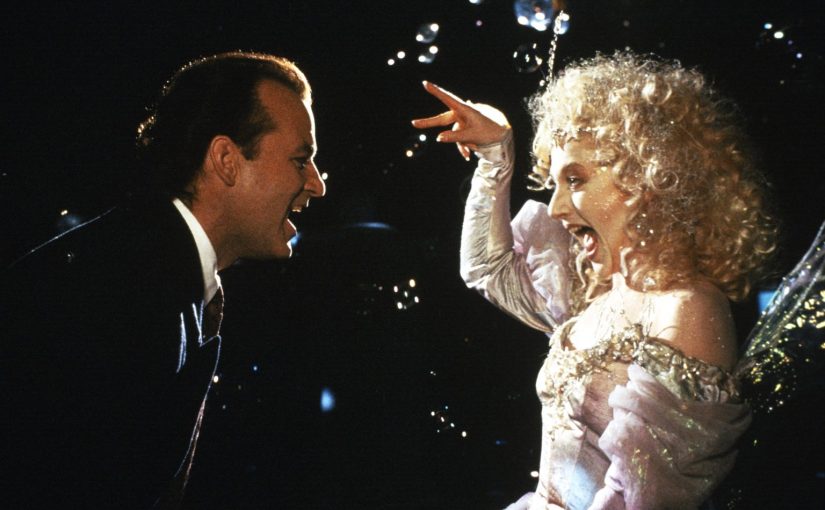
Johansen is a cabbie, or just another screeching screamer like Murray.  He’s laughing at Frank’s demise and past missed opportunities, but I’m not seeing what’s funny or even heartbreaking.  Neither theatrical mask of comedy or tragedy is functioning.  Carol Kane does her typical schtick with the high-pitched baby talk voice, dressed in a fairy get up.  Beyond that familiar routine, she commits every kind of Three Stooges smack and painful tug on Frank’s face that you can imagine.  Why of all things does she rely on a toaster to upper cut the jerk in his face?  I mean why a toaster???? If the comedy works, then I should not be wondering why a toaster or a pie or two by four or an anvil.

There’s nothing wisely written here.  The screaming and the smacking get old very fast and it gets in the way of a potential love story passed by that the script was promising for the Frank Cross character and his crush Claire (Karen Allen, whose smile always lights up a room).  I never felt like Bill Murray was ever listening to Karen Allen in the scenes they share.  Did they even rehearse this stuff?  Too often, Bill Murray seems to just be winging it, and it wouldn’t make a difference if Karen Allen even memorized her lines.

Scrooged starts out with fresh, quality made National Lampoon material but then waddles into the same typical chapters of Dickens’ holiday story.  However, while it hammers the familiar story beat by beat and you tell yourself there’s the Fred character and there’s the mute kid covering for a crippled Tiny Tim and there’s Yet To Come, you got Bill Murray who was granted too much artistic license to improvise, and has thus squeezed out all of the sensitivity and spirit that we expect from A Christmas Carol.

I’m sorry but I think I liked this Frank Cross a whole lot more before he was visited by the ghosts.  This is one Scrooge who should’ve been allowed to sleep through Christmas.

PS: If anyone can find a DVD print of The Night The Reindeer Died, I’m ready to review it.

HOTEL TERMINUS: THE LIFE AND TIMES OF KLAUS BARBIE (1988)

by Miguel E. Rodriguez

DIRECTOR: Marcel Ophüls
MY RATING: 9/10
ROTTEN TOMATOMETER: 100% Fresh

PLOT: A documentary about Klaus Barbie, the Gestapo chief in Lyon, France, and his life after the war.


There is so much to unpack in Hotel Terminus, Marcel Ophüls’ epic documentary, that I am hesitant to even try to write about it.  In terms of the craft of filmmaking, there is nothing to critique aside from the skillful editing, which surprisingly makes its 4.5-hour running time fly by.  In terms of content…I mean, where could I even begin?  Here’s a summary I found online: “Marcel Ophüls’ riveting film details the heinous legacy of the Gestapo head dubbed ‘The Butcher of Lyon.’ Responsible for over 4,000 deaths in occupied France during World War II, Barbie would escape – with U.S. help – to South America in 1951, where he lived until a global manhunt led to his 1983 arrest and subsequent trial.”

Wait, what?  The United States intelligence apparatus smuggled a brutal Nazi officer out of Europe?  Six years after the Nuremberg trials?  Yes.  Ophüls interviews various players from US Army Counterintelligence – known as the “CIC” in the 1940s – who state flatly on camera that Barbie had connections and information regarding Russian communists, so it was in America’s best interests to keep Barbie alive and out of prison and get him to South America.

So, at the very least, today I learned something.

This sprawling documentary also features eyewitnesses to Barbie’s atrocities in Lyon, France, where he was stationed.  I don’t want to recite a laundry list of these terrible acts, but the film does key on two specific events during his tenure: the arrest and execution of Jean Moulin, a French Resistance leader, and the deportation to Auschwitz of 44 Jewish children from an orphanage in a town called Izieu.  Ophüls interviews scores of people who were in the room when Barbie arrested Moulin.  Many of them disagree who was to blame – a rat or someone with loose lips – but they all remember who made the arrest.  The stories from witnesses to the deportation of the children are beyond belief.

What is the point of a documentary like this?  Why should it be important for a filmgoer, or just an average Joe, to block out nearly five hours to watch a series of talking heads tell story after shocking story about the inhuman tactics of a monster?  Well, for one thing, that’s not the whole story.  Hotel Terminus actually has an arc, because Barbie was discovered living in Bolivia in 1972.  In 1983, he was extradited to France where he was convicted on numerous crimes against humanity and sentenced to life in prison, where he died in 1991.  The filmmakers didn’t know that in 1988, of course, but it felt good to throw that factoid in there.  Another interesting factoid: America apologized to France in 1983 for helping him escape to Bolivia in the first place.  Better late than never, I guess?

So, it’s good to know while watching that the man in question will eventually get his just desserts.  But there are times when it almost feels like the “A-story” of Barbie’s eventual arrest gets overwhelmed by the “B-story,” which is the paradoxical attitudes of many of the people interviewed.  One man wonders, what’s the point of it all?  Barbie committed his crimes forty years earlier, and France has a statute of limitations of twenty years, so just let the man grow old and die in obscurity.  Another theorizes that stirring up old memories of the war when many would rather move on actually created more civil unrest in France and Germany.  Barbie’s defense attorney at his war crimes trial (a Eurasian Frenchman) wonders why Barbie is being tried for crimes against humanity while France’s own acts of torture and horrific imprisonment during the Battle of Algiers are discreetly ignored.

And always Ophüls has rejoinders for each of these statements with stories of families separated, men and women tortured, family members whisked away and never seen again.  One woman recalls being tortured as a girl by Barbie, while her mother was told, “This is YOUR fault; if you would just talk, we would stop.”  And so on, ad infinitum.  But I am compelled to point out again how compelling this was.  These and so many other stories like them did not depress me or lower my spirits.  Instead, I was riveted.  I can’t explain why.  For myself, I felt like this was something I needed to hear, and other people needed to hear.  Here was a record of something that really happened, to real people in a real place in a time that was not so long ago, in the grand scheme of things.

There was also a section that really made me take notice.  Many, MANY people said on camera that, in his old age, Barbie was “a good man.”  He was friendly to his neighbors – even some Jews! – and a loving father.  His daughter-in-law is interviewed, and she states that he always had a kind word for her and always tried to include her in his family circle, even after her husband (Barbie’s son) died.  It made me think about the driving force behind last year’s brilliant Zone of Interest: the banality of evil.  Perhaps among many others, Barbie was living proof that evil will not always wear a black hat and have glowing red eyes.  Evil is just as capable of engaging you in friendly conversation as the next man.  (I was also reminded of a line from David Fincher’s Se7en: “If we catch John Doe and he turns out to be the devil, I mean if he’s Satan himself, that MIGHT live up to our expectations.  But he’s not the devil.  He’s just a man.”)  Is that one of the lessons of this film?  That evil is not supernatural or some kind of horrific aberration, but just a small person with delusions of grandeur?  Discuss.

There are echoes of Schindler’s List in the details of these stories, but Ophüls notably never uses any archival footage of concentration camps or of the Holocaust itself.  He apparently felt that audiences had, regrettably, become accustomed to the gruesome imagery of those events.  Instead, he relies on the viewer’s imagination to provide all the necessary details.

He also, tellingly, never provides answers to the stickiest questions that surrounded Barbie’s trial, especially the one about France being willing to charge him with crimes against humanity while ignoring their own history in Algeria.  I thought about that one a lot in relation to America.  Our country is great for a whole host of reasons, but it’s not perfect.  We rise up in vocal disapproval when a foreign country commits genocide, or when a country’s citizenry is threatened by totalitarianism…while ignoring (for the most part) the fact that our country exists because of genocidal practices against indigenous Americans.  Am I suggesting that perhaps Ophüls is wrong to focus on Barbie and not France’s history?  Absolutely not.  Barbie was a monster and got what he deserved, belatedly or not.  But I am suggesting that the film raises questions that deserve further discussion.

Ultimately, I’m glad I saw Hotel Terminus, and I would unhesitatingly recommend it to anyone who asks.  The visceral nature of the stories told by some of the subjects is enough to make it compelling, even without the overarching structure of following Barbie to his downfall.  It’s a challenging watch, to be sure, but I promise you’ll never be bored.  Trust me.

DISTANT VOICES, STILL LIVES (United Kingdom, 1988)

by Miguel E. Rodriguez

DIRECTOR: Terence Davies
CAST: Freda Dowie, Pete Postlethwaite, Angela Walsh, Dean Williams, Lorraine Ashbourne
MY RATING: 10/10
ROTTEN TOMATOMETER: 80% Certified Fresh

PLOT: A brief family history told in two parts. Distant Voices focuses on the father’s role, while Still Lives follows the children into adulthood and marriages of their own.


About a year-and-a-half ago, I was challenged by a friend to compile a list of my 100 favorite films.  If I were asked to do it again today, Terence Davies’ masterpiece Distant Voices, Still Lives would be on that list.  Here is a movie that is not even ninety minutes long, but it encompasses as much emotion and history as any epic by Bertolucci or Bergman.

The film’s strategy of dividing itself into two distinct sections is crucial.  The first half, Distant Voices, gives us the fragmented, free-associative memories of three children remembering their abusive father and long-suffering mother.  The second half, Still Lives, follows the children as they mature, marry, and cope with their buried emotional issues.

I’m going to attempt to describe how the film works, but it’s a miracle and a mystery to me why it works.  It does not lend itself well to a verbal description.  It’s something you have to see for yourself.

First, music and song play a huge role in both sections.  The movie is by no means a musical, but I’ll bet there aren’t five minutes strung together in the movie where someone isn’t singing or listening to a song on the radio.  Music is either a trigger for distant memories or a catalyst for creating new ones.  I could say the same thing about myself and movies.  Ask me when or where I met some of my oldest friends and I may not remember accurately, but I can tell you exactly when and where I saw Star Wars for the first time, or what my first R-rated movie was (Fort Apache: The Bronx) and who I saw it with.  Distant Voices, Still Lives taps into the mystery of memory and employs an editing strategy that brings it beautifully to life.

In the first section, Distant Voices, time shifts freely back and forth between the ‘40s and ‘50s, between when the three siblings – Eileen, Tony, and Maisie – are young children and adults.  A shot will show the three of them and their mother dressed as if for a wedding.  One of the daughters wishes her dad was here.  The next shot shows a hearse pulling up outside.  It’s the father’s coffin.  The family solemnly piles in.  The next shot we’re back to the wedding preparations as one daughter thinks to herself, “I don’t.  He was a bastard and I bleedin’ hated him.”  Then we flash back again to the past as the father (Pete Postlethwaite) viciously torments her and beats her with a broom.  Then forward again, and back and forward, and so on.

By that description, I worry that some readers will think the movie is chaotic and impossible to follow.  Not so.  It follows the same kind of free-associating logic as our own memories.  I was blessed to have a mother and father who never abused me in any way, but they weren’t perfect.  As I sit here, I am remembering all the good things and bad things that happened years ago, and if you think those memories are streaming through my consciousness in any linear way, you’re fooling yourself.  Memory only takes a linear form after careful editing.  When you’re in the actual process of remembering, everything is jumbled, out of order, but you always come back to yourself in the present.

That’s what this movie evokes, better than any other movie I can remember: the simultaneous juxtaposition of good memories on top of bad ones.  One brilliant sequence shows the three kids sleeping in bed on Christmas Eve as their father tenderly places their meager presents in a stocking at the foot of the bed.  The very next shot appears to be the following morning, the three children sitting nervously at the breakfast table, a meal spread out, and the father sitting at the head of the table, his hands trembling with rage before he pulls the tablecloth to the floor, plates, food and all, and yells off camera, “CLEAN IT UP!”  What a loathsome man.

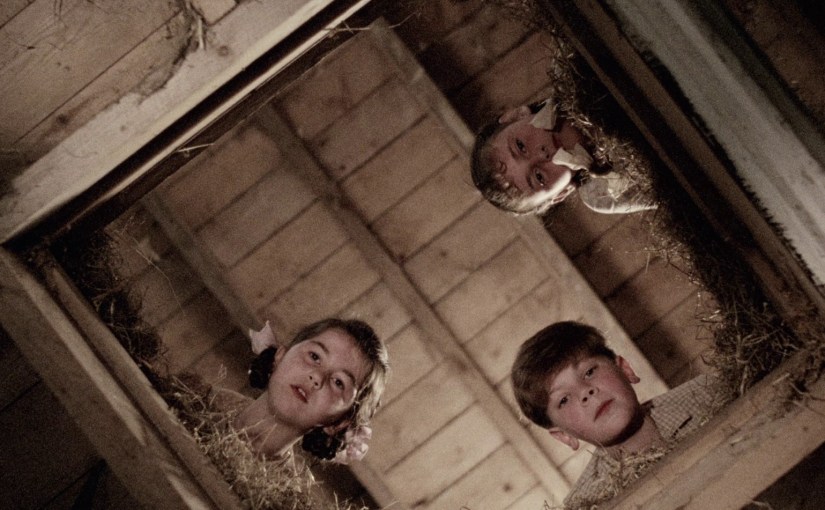
Another brilliant scene: the father sings softly to himself while grooming a horse.  The three young children quietly climb to the hayloft and watch him silently from above.  What’s going through their heads?  I can remember doing something similar when watching my father work under the hood of his beloved Coronet 500, or when he was stretching before his daily runs.  It was a glimpse of a man at peace with himself when he thinks no one else is watching.  The attention to detail in each little scene is meticulous and absolutely accurate.

All these scenes and more build up a precise image of the man who will loom large in the memories of all three children and their mother during the second half of the movie.  A daughter marries and has a child.  The other daughter marries and is happy at the ceremony, but her husband reveals himself to be a selfish man.  The son fends off marriage as long as he can.  A baby’s baptism and the ensuing celebration at the local pub becomes the focal point of the story as memories and flashbacks branch off to flesh out their personal lives.  A moment occurs that is worthy of comparison to Scorsese or Coppola, but I don’t even want to hint what it is because of its immense visual power.

And always, in at least every other scene, are people singing: gospel tunes, hymns, drinking songs, Broadway tunes (“Buttons and Bows”), Bobby Darin, children’s songs, until it gets to the point where a scene feels almost incomplete when someone isn’t singing.  I may be exaggerating a tiny bit, but not much.  It’s almost like the songs release any tension that existed in the scene before it.  It’s one of the best uses of music in a non-musical that I’ve ever seen.

And what of the mother in all this, whom I just realize I’ve barely mentioned?  Despite all the abuses heaped upon the children by the father, she is clearly the one who suffers most of all, both physically and emotionally, but you’d never know it.  When the angry adult son demands to have a drink with his father, and his father refuses, the mother’s voice tenderly urges him to do so.  When her adult children ask her why she married such a man in the first place, she says, “He was nice.  He was a good dancer.”  She suffers in silence, never saying a bad word about her monster of a husband, not even to her children, and when she sings, any happy words are tinged with regret.

When this film was over, I felt like I had watched an epic miniseries.  I don’t mean that in a negative sense.  I mean that, through the economic storytelling and direction, I felt like I knew every sibling, the mother, and most of their friends inside and out.  I may not remember all their names, but I remember their faces, their personalities, their hopes and dreams, their regrets, and how their father’s memory affects them even now.  For eighty-four minutes, they were people as real as you or me.

One of the last shots of the movie shows the son, on the brink of marriage, standing in the pub’s doorway, weeping.  We do not get a contrived scene where a sister or the mother comforts him and asks him what’s wrong and he tells us.  The static camera shot just shows him as he weeps while behind him, in the pub, people sing and sing.  There is more emotional depth in his silent weeping than in fifty monologues.  Distant Voices, Still Lives is one of the best family dramas I’ve ever seen.

ANOTHER WOMAN (1988)

by Miguel E. Rodriguez

DIRECTOR: Woody Allen
CAST: Gena Rowlands, Mia Farrow, Ian Holm, Blythe Danner, Betty Buckley, Martha Plimpton, John Houseman, Sandy Dennis, Philip Bosco
MY RATING: 8/10
ROTTEN TOMATOMETER: 59%

PLOT: Facing a mid-life crisis, a woman becomes drawn to the plight of a pregnant woman seeking psychiatric help from the shrink next door.


Woody Allen’s Another Woman is the first movie I can remember that compelled me to do a little background research before writing about it.  It is moody, somber, theatrical, and by far the least funny of Allen’s films that I’ve seen (and I’ve seen Blue Jasmine).  It falls in that part of his career when he was delving into more dramatic fare; September had been released the year before, and Crimes and Misdemeanors would come a year later.  There is none of the charm and lightness of his earlier comedies, which may account for why I’ve never seen it mentioned alongside his other films whenever his filmography is discussed.  And yet, I was curiously drawn into this story to such a degree that when two revelations arrive almost on top of each other, I gasped.

Another Woman tells a brief chapter in the life of Marion (Gena Rowlands), a middle-aged woman married to Ken (Ian Holm).  Marion is Ken’s second wife; she was literally the “other woman” that caused Ken to divorce his first wife, Kathy, played by Betty Buckley in a single devastating scene that vividly showcases the guilt that Marion and Ken have both learned to live with in different ways: Ken gently accepts Kathy’s “condemnation”, while Marion buries the guilt deep.

Marion is a professor of philosophy at a local university.  To work quietly on a new book, she rents a small one-bedroom flat nearby and uses it as her office.  However, through a trick of acoustics, she realizes she can hear voices coming from the flat next door through an air vent on the floor.  It’s a psychiatrist’s office, and she is suddenly privy to intensely personal conversations with his patients.  (I was reminded for a minute of Rear Window.)  One such patient is Mia Farrow, playing a character whose name I won’t reveal because it’s barely mentioned in the film for a reason.  She is pregnant, and during her sessions, she reveals doubts about her identity and/or purpose in life.

For Marion, who has always been sure about everything and everyone in her life, Farrow’s confession strikes a nerve, and the rest of the film consists of Marion’s struggle to reconcile her perception of herself and her well-constructed life with how everyone else truly sees her.  Throughout the movie, people are telling her how wrong she is about her relationships with her divorced brother, with an old friend, with her own husband, with her best friend, even with the Mia Farrow character.  Has she been deceiving herself her entire life?

Okay, so this subject matter isn’t exactly a barnburner.  But consider how the movie looks and moves, and the performances from Gena Rowlands and her supporting cast (it’s Rowlands’s movie to win or lose).  Look at the warm, yet subdued lighting schemes, shot by Ingmar Bergman’s favorite cinematographer, Sven Nykvist.  (Allen is a huge Bergman fan – indeed, this film is actually a loose reinterpretation of Bergman’s film Wild Strawberries [1957].) Interiors look, not sad, exactly, but…lived in.  Bright sunlight is only ever seen from inside through a window.  Exteriors look as if Allen specifically waited for overcast days to shoot.  Everything matches Marion’s internal gloom as she re-examines her life.

At the center of the film is a dream sequence that feels more like a foreign film than anything I’ve ever seen from an American film.  Marion dreams she is in an old stage theater, where figures from her circle of family and friends are rehearsing a play based on moments in her life.  Is this self-indulgence from Allen?  Maybe.  The dialogue in this sequence is so formal and, I guess, elliptical at times that it almost feels as if it were something translated into English from another language.  Vincent Canby of The New York Times called this out, saying, “The rounded sentences sound as if they’d been written in a French influenced by Flaubert, then translated into English by a lesser student of Constance Garnett.”  I’ll probably understand this criticism more when I learn who Constance Garnett is, but I get his point.  However, while it was noticeable, I did not find it distracting.  I thought it was a fair interpretation of how our dreams rarely follow strict logic.  Marion’s dream is structured, but the content is skewed.  I was fascinated by it.

Do I think this is a movie you need to see?  Who can say.  I’m glad I saw it, at least.  It shows a side of Allen’s directorial psyche I had never seen before, even though I had read about it from many other sources.  And it inspired me to do a little introspection of my own, which is something, I guess.  The movie’s final scene includes a beautifully loaded question: “…I wondered if a memory is something you have or something you’ve lost.”  Marion has been asking herself this question the whole movie without realizing it.  I wonder if my answer would be the same as hers.  Or yours.

TALK RADIO (1988)

by Miguel E. Rodriguez

DIRECTOR: Oliver Stone
CAST: Eric Bogosian, Ellen Greene, John C. McGinley, Alec Baldwin, Michael Wincott
MY RATING: 8/10
ROTTEN TOMATOMETER: 82% Certified Fresh

PLOT: A rude, contemptuous talk show host becomes overwhelmed by the hatred that surrounds his program just before it goes national.


Oliver Stone’s Talk Radio is entertaining and, at times, mesmerizing without being an altogether enjoyable experience.  I salute the craft of the film and the bravura performance by Eric Bogosian, reprising the role he created on Broadway, but despite my high score, I’m not quite sure to whom I would recommend this film.  I believe it’s an important placeholder in Stone’s filmography, coming as it does after Wall Street and before Born on the Fourth of July.  It shows immense faith in the material and portrays its characters with brutal honesty.  The closest comparison I can make is to the Safdie Brothers film Uncut Gems.  Both films are fraught with tension, featuring unlikable fast-talking main characters who tend to step on or over or around the people closest to them to achieve their goal, or sometimes just to get their own way.  They’re fascinating to watch and listen to, but I would not want to be stuck in an elevator with them.

Talk Radio centers on a Dallas radio shock jock named Barry Champlain.  Bogosian’s look and performance seems so closely modeled on Howard Stern that I’m surprised Stern didn’t sue the filmmakers for not obtaining his permission to do so.  (In fact, the Barry character is modeled after real life talk show host Alan Berg, who was gunned down by an ultra-right-wing group in 1984.)  The whole first “act” of the film takes place in and around the broadcasting booth where Barry holds court, listening to and berating callers from all walks of life on topics ranging from “I Love Lucy” to the war on drugs to Holocaust deniers to one dude who eats dinner with his cat every night.  If nothing else, this sequence boosted my respect for anyone in Barry’s line of work.  To be able to take calls from random folks with random issues, and to somehow spin their questions or problems into a mini-monologue or diatribe that manages to entertain or offend – usually both – the caller or the listening audience – usually both – is a skill I will never possess.  (Bogosian’s voice is tailor-made for the role, a nice sweet-spot baritone that sounds as if he’s been doing radio for years.)

Mixed in with the calls are the ones from clear-cut racists, warning Barry that they know where he lives, that they know “Champlain” is not his real last name, calling him Jew-boy and “f—-t”, sending him packages in the mail and claiming they’re bombs.  One loathsome item is sent to him wrapped in a Nazi flag.  Other callers don’t seem to have any affiliation at all aside from their utter hatred of Barry Champlain.  There’s a scene where Barry has been invited to a public event to introduce someone.  The moment he takes the stage, there are a few cheers that are eventually drowned out by a sea of boos and jeers in concert with a hailstorm of food and garbage thrown by the audience.  Barry has the nerve to look a little shocked.  I remember thinking, “How can you not expect this kind of reception?”

But then I remember thinking, about the audience members this time, “Well, if you hate him so much, why are you listening to his show?”  The movie is making a statement about the bizarre relationship between the general public and entertainment celebrities that they “love to hate.”  It seems to me their lives would be infinitely happier and less angry if they just switched over to NPR or smooth jazz once in a while.  No one forces them, or anyone, to engage with a TV show or movie or radio show or anything else they don’t like.  But with Barry, and presumably many other shock jocks in real life, people seem to need them, to use them as an excuse, I guess, to get riled up, to feel fueled by righteous anger.  The shock jocks are handy targets, especially because the callers can remain anonymous, much like social media.

There is a long rant from Barry himself about this phenomenon late in the film.  There was a plan for his show to go national, but it has been derailed for nebulous reasons, and so a broadcast intended for the entire country is still confined to the Dallas area.  After an ill-advised guest appearance by a stoned idiot (Michael Wincott!) and a couple of calls that go completely off the rails, Barry loses it and tells his listeners:

“You’re happiest when others are in pain.  That’s where I come in, isn’t it?  I’m here to lead you by the hands through the dark forest of your own hatred and anger and humiliation.  I’m providing a public service. … I come in here every night, I tear into you, I abuse you, I insult you, you just keep coming back for more.  What’s wrong with you, why do you keep calling?”

In another movie, that kind of rant might skew towards comedy.  Here, it serves as a painful peek into the psyche of a man who has a job that he’s good at, but there’s a part of him that despises himself for it, and that self-loathing has overflowed the boundaries of his own soul onto and over his listeners.  Even he can’t understand what his audience is thinking. I found myself wondering if any other shock jocks out there might feel this way.  I wonder if this might be one of Howard Stern’s favorite movies, or if it was one of Don Imus’s favorites.  I have never listened to either one of their shows because…well, because that’s my right as a human being.  But I wonder, nevertheless.

As I said before, I admire the craft of the film.  Stone and his collaborators (especially cinematographer Robert Richardson) do a great job with creative camera angles, lighting, and editing for those long stretches of the film where we simply sit and listen to Barry Champlain talking to that endless stream of callers.  Most of those calls end threateningly or are threatening throughout.  This has the effect of creating tension almost out of thin air, a tension that suffuses the entire film.  Are we going to get a maniac who takes Barry hostage on the air?  When Barry unwisely invites a listener to come down to the station and appear on the air, we’re thinking, “You idiot, he’s going to kill you!”  Even if none of that happens, we’re worried about it the entire time.  While this method is an effective use of cinema, as I said before, I cannot honestly say I had a “good time” watching it.  When the ending comes and the final credits roll, I will carefully say that there was a sense of relief, not at how it ended, but just relief that it ended.

Talk Radio is a well-made film featuring a stellar performance from Eric Bogosian.  If you sit down to watch it, I believe you will feel exactly what Oliver Stone meant for you to feel.  Just don’t expect it to tickle.

THE VANISHING (Netherlands, 1988)

by Miguel E. Rodriguez

DIRECTOR: George Sluizer
CAST: Bernard-Pierre Donnadieu, Gene Bervoets, Johanna ter Steege
MY RATING: 9/10
ROTTEN TOMATOMETER: 96% Fresh

PLOT: A young couple, Rex and Saskia, stop at a service station during a road trip.  Saskia vanishes without a trace, prompting a years-long search by Rex…while an unassuming family man monitors his progress.


[WARNING: This review contains unavoidable spoilers.  If you have any plans to see this movie, trust me…stop reading now.]

I went into The Vanishing absolutely cold.  I knew nothing about it aside from the name of the director, the bare outlines of the plot (a young woman vanishes while on vacation), and the fact it was a critically acclaimed foreign film, remade in America with Jeff Bridges and Kiefer Sutherland, which I never saw because it was, quote, “laughable, stupid and crude” (Roger Ebert).

With absolutely no gore, no unnecessary side plots, and no clichéd final chase between the killer and the cops where the outcome is a foregone conclusion, director George Sluizer has crafted one of the most compelling, creepiest abduction films I’ve ever seen.  By not showing the actual abduction when it happens, by focusing on the boyfriend’s frantic attempts to track her down immediately afterwards, and by abruptly shifting gears twice in the first hour, the viewer is kept constantly off balance (in a good way).  If she was abducted, how did the kidnapper accomplish his task in broad daylight?  WAS it even an abduction?  We get a good look at the person who most likely committed the crime, but his process looks almost comic…how did he pull it off?

We first meet Rex and Saskia as they’re driving to France to do some cycling.  After Saskia relates a recurring nightmare to Rex (she dreams of being trapped inside a golden egg floating through space), there is an early crisis when their car runs out of gas in the middle of a long tunnel.  We get an early, incisive look at their relationship when Rex elects to walk back for gas, while Saskia stays behind frantically looking for a flashlight she insists they will need.  Later, at a crowded service station, they kiss and make up.

This scene at the service station looks entirely mundane at first, but it is interrupted by a sequence in which we are shown the man who pretty clearly is about to commit a kidnapping.  When we cut back to Rex and Saskia, their interactions become charged with tension.  They talk and tease and kiss, while we are suddenly hyper-aware of their surroundings.  Director Sluizer fills the background with extras, and we start scrutinizing them to see if any of them might be the kidnapper.  Or perhaps there will be a clue later, a Hitchcockian callback which relies on our recall of the crowd scenes.  Rex takes a random Polaroid as a blue semi rolls past the lens, obscuring the front of the store.  Sluizer’s camera lingers on the semi, and we immediately wonder if there is any significance.  (There both is and isn’t.)

The creepy effect of these scenes cannot be overstated.  I can easily imagine some people watching this movie and immediately changing their travel habits.  Never go into a crowded store alone.  Carry mace.  If you must separate, stay in touch with your cellphone until you meet up again.  Stanley Kubrick knew what he was talking about when he told Sluizer that The Vanishing was the most terrifying movie he’d ever seen.

After Saskia’s disappearance, there are the nominal scenes of Rex searching the store and grounds for her, asking if anyone has seen her, giving her description, and so on.  Interestingly, we never get a scene of Rex being interviewed by the police as the day drags on.  Looking back on it now, I get the feeling that Sluizer perhaps thought those scenes would be way too familiar for audiences who have sat through any number of police procedurals in the movies and on TV.  Better to stay with the matter at hand and keep the story moving.

It’s at this point that the movie makes its first abrupt shift in tone and focus.  With no warning, we suddenly spend a good 20-30 minutes, not with Rex’s search, but with the apparently happy family life of the man we got a good look at earlier in the film, the man who appeared to be prepping for a crime.  These scenes are even creepier than the earlier scenes at the service station because we are pretty sure this is the kidnapper, but his home life seems stable: a wife, two daughters, a well-paying job as a chemistry teacher, and the financial wherewithal to buy a large farmhouse in the country…where we discover, in an INTENSELY creepy moment, that no neighbors will hear any screaming.

The decision to focus on this man was jarring and disturbing to me, but in that good way achieved only by the best crime thrillers.  We get more details about his life and his “preparations” that I won’t spoil here.  The film almost seems to have forgotten all about Rex and Saskia; this man is now the primary character.  (In fact, this actor gets top billing in the credits).  He has the kind of forgettable face and unimposing persona that would fly under anyone’s radar.  By showing us the fact that he has two sides to his personality, we come to the uneasy realization that evil could easily lurk behind the cheerful facades of just about anyone we meet.  This concept is far more terrifying to me than a slasher wearing a mask.

But The Vanishing has two more tricks up its sleeve.  It takes yet another dramatic shift when we abruptly jump forward three years.  Saskia is still missing.  Rex has a new girlfriend, but he still posts flyers asking for any information on Saskia.  He makes appearances on local news programs, pleading for the perpetrator to step forward, promising not to press charges; he just has to know whether Saskia is alive or dead.  He craves closure more than anything else.  It has consumed him.  And…he has received several anonymous postcards from the kidnapper asking to meet in a public place, but whenever Rex arrives, the kidnapper has never shown himself.

This creeped me out even more than I had already been.  But the screws get tighter still.  At one point, the kidnapper offers Rex a choice: turn me in, in which case you’ll never find out what happened to Saskia, or I show you what happened to her…by going through the same ordeal she did.

This has all SORTS of psychological implications that I don’t feel fully qualified to sort out.  I have to wonder about those families and friends who have suffered through the disappearance of a loved one.  (I looked up the statistics on missing persons on a whim…they are horribly depressing.)  I can only imagine what those people would do to finally get closure on what happened.  Would they accept this kidnapper’s offer?  Even if it means they might possibly die?  What price would they be willing to pay to finally get an answer after years of searching?

I hope I never have to answer that question.  Rex goes back and forth in agony before finally making his choice.  His decision leads to an ending that was probably inevitable, but which still took me by surprise.

In an interview with the actress who played Saskia (Johanna ter Steege), she states that when the movie was finally released, she was deeply disturbed.  She went to George Sluizer and asked him, “What is the point of this movie?  What do you achieve by telling this kind of disturbing story?  What are you trying to tell the audience?”  If I had to answer that question, I would say that the first motive was to make an entertaining crime thriller, which it is.  But perhaps there’s also a deeper statement about the banality of evil.  One does not have to wear a black hat and twirl his mustache to be the bad guy.  Sometimes you just have to blend into the background.  The film opens and closes with shots that include a praying mantis, a creature that relies on stealth and speed to capture its prey.  The kidnapper in The Vanishing has learned that lesson in spades.

BEETLEJUICE

By Marc S. Sanders

On Friday night, we watched Beetlejuice the movie.  On Saturday afternoon, we watched Beetlejuice the musical, and as soon as the curtain was pulled on the stage and the performance began, I knew exactly what the movie did wrong and what the play did so right.

I saw Tim Burton’s much beloved spooky comedy for the first time just last year with my Cinemaniac pals, which includes the other Unpaid Movie Critic.  The guys were laughing and laughing until it hurt.  I was off to the side thinking how I remember seeing that scene while flipping channels on occasion.  Cute, but ultimately boring.  That’s how I feel about Burton’s second film, following a hilarious debut with Pee Wee’s Big Adventure and just ahead of his blockbuster accomplishments with the first two Batman films.  Beetlejuice is full of big ideas but devoid of content, and I mean that literally, because the title character brilliantly played by Michael Keaton is scarcely in the film.  When he is not on screen, the remaining cast are quite bland or unwelcomingly weird.

Adam and Barbara (Alec Baldwin, Geena Davis) happily reside in a three-story Connecticut home.  Adam indulges in making a scaled model of their picturesque hometown and Barbara…well I can’t recall what she does.  On an errand trip, they haphazardly die and suddenly return to the house.  Yet, they realize quickly that they have expired and what is even less convenient is that they cannot leave the house lest they end up in a kind of limbo threatened by a monstrous sand worm and other unusual experiences. 

Shortly after, Charles and Delia (Jeffrey Jones, Catherine O’Hara), appearing with the typical Tim Burton flavor, move into the house along with his suicidal daughter Lydia (Winona Ryder) and their quirky interior decorator Otho (Glenn Shadix).  They plan to refurbish the house in their own way with Delia’s ugly art sculptures and Charles looking for a reading room.  Adam and Barbara want them out so they can roam free and avoid being contained within the attic. 

Upon discovering that Lydia can speak with them and following an entrance to the Netherworld, they get an idea to scare the new owners away.  Only whatever efforts they set out to make fails miserably and they consider reciting the name of the “ghost with the most” three times to carry him over to their side to do their bidding.

Great storyline.  Sounds great on paper.  So why didn’t it work for me?  Well, Lydia is resigned to her mostly miserable suicidal self and that is neither funny nor empathetic to me.  More importantly, conflict works best when different worlds clash and what I find lacking in several Tim Burton films is that the characters on both sides of the coin are not different enough from one another.  The ghosts or souls or comforts of the Netherworld do not look far enough apart from how Charles, Delia, Lydia and especially Otho behave.  Everyone is weird.  Where is the normalcy to ruin or undo or disagree with? 

Beetlejuice himself is a character to behold though.  Keaton is doing Jim Carrey better than Jim Carrey does and long before that guy was ever discovered.  The actor is working in the area of Robin Williams material, particularly as the Genie from Alaadin.  The issue I have is that Michael Keaton is seldom in the film.  It is a long first act with Baldwin and Davis not doing much of anything before they finally encounter Beetlejuice to have a couple of funny exchanges.  Then they leave him to have mundane conversations with everyone else in the film, particularly Winona Ryder who has nothing to do except dress in her signature, depressing black.  When Keaton finally is summoned, he takes possession of a dinner party with the beloved Calypso tune “Dayo.”  However, we don’t see Keaton in this popular sequence.  Instead, we get Jones and O’Hara with David Niven doing odd contortions to the music with some butt shaking and grotesque facial and body expressions.  I would rather have seen Keaton doing his funny best in a lip sync routine.  What’s in the final cut is just not funny enough for me. Kooky, yes.  Funny, no.

Eventually, the black and white striped suited ghost with green hair is called back for the final act and we get to see him pull all the tricks out of his hat.  However, it’s not enough.  Just as the routine is getting started, it’s over, and then the movie is over. 

There are some inventive sight gags.  Not enough though.  I particularly loved the shrunken headed ghoul with the googly eyes and the pink skinned prostitute whose legs are separated from her torso.  I love when Beetlejuice’s head gets shrunk, and I like when Adam and Barbara’s faces are contorted into odd shapes of gigantic beaks or zany skulls beneath their facial skin.  These are the highlights of this film’s Netherworld and the distance I travel to see it all is smaller than Rhode Island.  In the original Star Wars, I experienced what felt like thousands of alien races.  In Ghostbusters, New York is haunted by one different kind of afterlife from another and another.  In any episode of The Muppet Show, I get to see one breed of silliness before another ridiculous set up is put into play.  The Netherworld setting of Beetlejuice is simply not vast enough.

The stage musical makes up for the shortcomings I have with the film.  The spine of the story is what the two pieces have in common.  After that, the stage play takes more risks.  The musical numbers are absolutely winning.  More significantly though, all the characters are granted more depth and dimension.  The root cause of Lydia’s anguish is explored.  We see the snobbery of Charles just like in the film, but he is also a loving father who recognizes Lydia’s suffering following the loss of his wife/her mother.  Delia also has a desire to connect with her stepdaughter Lydia.  All the elements are given enough attention amidst the craziness offered by Beetlejuice himself who occupies the story from beginning to end.  The character works like a great two-hour stand-up routine with his unlimited imagination of ghoulish trickery and fun.

Burton’s film was released in the late-1980s when updated stop motion effects of the puppet kind were new to the medium of film.  The imagination was there, though it does not hold up as it is very outdated.  Still, Tim Burton was showing his gift for macabre creativity that he has become known for ever since.  Nevertheless, he did not go far enough with the vision of his film, and he did not award any of his characters enough ingredients to let them be unique.  It is not enough that they all speak weird and look strange.  It is better if we can know why they are so uncompromisingly odd.  Beetlejuice the film lacks its variety. More specifically, it lacks its Beetlejuice.

THE DEAD POOL

By Marc S. Sanders

Sometimes five is too much.  It was for Clint Eastwood as Inspector Dirty Harry Callahan.  The Dead Pool was the fifth and final entry in the famed crime drama series.  Eastwood moves slower this time.  He does not come off as much of a rebel any longer.  Most notably, the story doesn’t have the feel of a Dirty Harry film.  The cop who was infamous for questioning the laws set in place seems to be just slotted into this film. 

The Dead Pool is directed by Buddy Van Horn, who had a long career as a stuntman and assistant director for many of Eastwood’s films, and other actors like Charlton Heston and Henry Fonda.  He does a ho hum job with the picture.  I don’t need to be treated to inventive shots or camera angles to enjoy a movie.  I have yet to visit San Francisco, but at least Buddy Van Horn provides enough locales to feel like I’m getting a serviceable tourist view.

A twisted game is being played in the underground scene.  People are making lists and betting on local celebrities they expect to die soon.  One name includes a heavy metal rock star played by James Carey, later to be known as Jim.  There’s also a snobby film critic who is a deliberate inspiration of Pauline Kael.  (Kael’s reviews were not too kind to many of Eastwood’s films over the years, particularly the original Dirty Harry.)  At the bottom of the list is Harry himself, who is surprisingly favored by the police department officials – first time that has happened – for putting away a powerful mob boss.  A side story consists of the boss giving orders out to his crew to take revenge on Harry and provide some escapist shootouts to move the film along. 

The police department want Harry to cooperate as their hero poster boy.  Harry doesn’t care for fame, though.  It’s not his style.  Yet, a persistent television reporter (Patricia Clarkson) wants his story.  A little romance is implied but Harry is not one for gossip fodder.  Unfortunately, Eastwood and Clarkson are really lacking chemistry here.

The rock star and the movie critic are murdered.  Harry must be next, and a horror film director (Liam Neeson) seems like the prime suspect because his dead pool list had included all three names. 

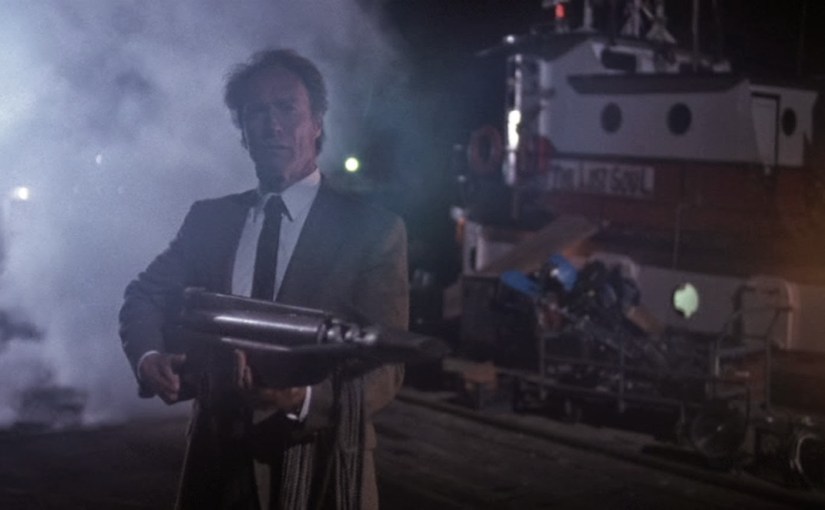
The Dead Pool is not a terrible movie, but it does not live up to other Dirty Harry installments. Primarily because it does not follow the character’s familiar mantra against the bureaucrats and the flawed system of prosecution and law enforcement that he’s always been challenged with.  At times, I’m looking at Eastwood and I’m asking myself who is this guy?  Sure, he’s got a few one liners of dry wit.  The famed eyebrow stare is there too, and the .44 Magnum as well.  However, Harry doesn’t seem to stand apart so much from everyone else as he did in the other films.  Beyond the giant gun, that is what made Harry Callahan so famous on screen. 

The investigation that Harry is assigned to with a Chinese American cop (Evan C Kim) is very bland.  We hardly get to know any of the victims or what they stand for, and when the true killer is revealed, it turns out to be a last-minute introduction of someone we’ve yet to see.  There’s no surprise to the culprit behind all of this. 

The series is also well known for the partners that Harry is forced to work with.  In The Enforcer, Tyne Daly brought out Harry’s regard towards women working in his dangerous field that demonstrated his initial frustration followed by his reluctant acceptance.  In the first movie, Remi Santori came about when it was okay to say that Harry took issue with all kinds of demographics, including Mexicans.  A chumminess nicely developed between those two guys as they tracked down the killer, together.  The second film, Magnum Force, offered a partner to also care about.  These are good side performers that colored in much of the Harry Callahan lore.  In this movie, Evan C Kim has one standout moment in the first ten minutes where he surprises everyone, especially Harry, with how he disarms a robber by use of martial arts.  It’s a great scene.  After that, though, he’s given nothing to do.  This actor had promise for more interactions with Eastwood.  It just never delivered.

The series started in the gritty times of 1971 when political correctness was not ever considered.  By the time the last two films were released in the 1980s of Ronald Reagan, who famously adopted “Go ahead.  Make my day,” for Gorbachev, there was a new wave of sensitivity abound.  I like to believe with the prior installment, Sudden Impact, Harry Callahan learned something new about himself with regards to the rights women had or were denied of while still applying his own code.  With The Dead Pool, the writing seems reluctant to go anywhere near a potential debate, and so it drips itself into a stale slasher movie with the cop ready to fire his six shooter.

The grand highlight of the film is a car chase on the hilly streets of San Francisco, which is the best place for a car chase, always.  What separates this one from the others is a little remote-controlled car that pursues Harry and his partner, ready to activate its equipped detonator at just the right moment.  The editing of this sequence is really fun, and it’s a great salute to Bullitt and other gritty, urban cop films, particularly the Dirty Harry movies.  This toy car flies over fruit stands and careens through sidewalks and over sewer holes.  Meanwhile Harry screeches down one hill after another trying to evade this pesky rapscallion.  It’ll definitely put a smile on your face while the moment lasts.

I recall being eager for another Dirty Harry movie.  I grew up loving many of Clint Eastwood’s films.  Dirty Harry is a favorite character of mine.  Yet, I also remember feeling really let down when my dad and I walked out of the theatre.  The Dead Pool just doesn’t have the same flavor as the other Eastwood products.  Again, it’s not the worst picture.  It’s standard cop fare coming in at a lean ninety minutes.  Eastwood and the rest of the cast are okay with what they’re doing.  I just would’ve changed the name of the main character listed at the top of the cast list.  He could have been Dirty John Doe for all I care.

COMING TO AMERICA

By Marc S. Sanders

Now Coming To America is a special kind of film. It’s rare movie where you’ll find a G rated story wrapped in R rated material and ultimately that is what Eddie Murphy and director John Landis brilliantly achieved.

Murphy plays Prince Akeem living a privileged life in the country of Zamunda where he has his own personal butt wipers and concubines who ensure him the royal penis is clean. He is now of the age where he is ready to meet his bride who has been groomed since birth to accommodate every need and preference the Prince has. However, Akeem is mature enough to realize that he wants to be married to someone who likes him for who he is, and not his wealth and stature. So with his best friend Simi (Arsenio Hall) in tow, they travel to Queens, New York under the guise of poor, humble people to find Akeem’s true love.

The story is Disney like and very simple. The gags are what has allowed Coming To America to hold on to its beloved longevity over thirty years later. It is one of Murphy’s last great films before he resorted to a lot of silly kiddie tripe like Daddy Day Care. This is a film that does a 180 flip on the Beverly Hills Cop storyline. In Cop, Murphy was the loudmouth offensive stranger in strange land. In this film, he remains a stranger, only this time the setting is full of loudmouths; this is Queens after all. Akeem is a lovable guy with good intentions and sensitivity. When he meets Lisa (Shari Headley) the daughter of a McDonald’s rip off franchisee (a hilarious John Amos), he becomes enamored and approaches with care despite her dating a jerk (Eriq La Salle) who inherited his family’s “Soul Glo” hair product enterprise.

The best attraction of the film however are Murphy and Hall’s various other characters they portray like Murphy as Randy Watson, lead singer of the band Sexual Chocolate (you know him as Joe the Policeman from the What’s Going Down? episode of That’s My Momma) and Hall as Reverend Brown who believes “There is a god someWHERE!!!” Not to mention the barbers who hang out beneath their apartment. Murphy and Hall are such a skilled pair of chemistry together. Why didn’t they do more films together? Harlem Knights? Ahem…let’s just not talk about that.

Landis was a good comedy director, a staple of the 1980’s films who would let the talents play for the camera and not try to reinvent the wheel. His approach here is the same as when he directed Murphy with Dan Aykroyd in Trading Places, or when he helmed Michael Jackson’s legendary Thriller music video. He knew these guys knew what they were doing. So, he just positioned the camera and let them go. Coming To America does run a little too long in some moments. I’m impressed by Paula Abdul’s choreography of tribal dancers, but I didn’t need to see all three minutes of it. A few of those moments run long, when all I want to do is get to the next gag or story development.

Still, if you are not a prude, I recommend Coming To America for a family viewing with your pre teen kids. I showed it to my daughter who is at the age when the sheer utterance of a curse word is hysterical; that’s a rite of passage in childhood as far as I’m concerned. The film contains no overt sexually active scenes, but there is some female nudity, and so what? My daughter knows what she is looking at. Bottom line Coming To America is a sweet Cinderella story that kids will love and adults will laugh at, over and over again until they know every line by heart.