MOONSTRUCK

By Marc S. Sanders

Moonstruck has to be one of the most delightful romantic comedies of all time thanks to an outstanding cast, an intuitive director (Norman Jewison) and a script full of brilliant dialogue and set ups from John Patrick Shanley.

Loretta Castorini (Cher in her Oscar winning role) is a 37 year old widow. Her husband of two years got hit by a bus. So, naturally when her father, Cosmo (the hilarious Vincent Gardenia), hears the news that Loretta got engaged to the boring schlub Johnny Cammareri (Danny Aiello), he knows this is a bad omen and she should not get married again. Sure, her husband got hit by a bus, but that can only mean that marriage is no good for Loretta. When they wake up Rose (Olympia Dukakis in her well-deserved Oscar winning role), Loretta’s mother, to share the news, she just opens her eyes and asks, “Who died?” This is an adorable Italian family living in Brooklyn and somehow an Irishman wrote the script which was then directed by a Jewish mensch, and everyone is working on all Italian cylinders.

Two minutes into the film and I’m laughing. I’m laughing at Johnny’s wimpy proposal in the local Italian restaurant. I’m laughing at Rose and Cosmo who’ve seen enough of life to know that you don’t get married for love anymore. Rose is for Loretta getting married though. Cosmo doesn’t wanna spend the money.

Just after Johnny proposes, he flies off to Sicily to be by his dying mother’s bedside. He requests that Loretta invite his brother Ronny (Nicholas Cage), who he hasn’t spoken to in five years, to the wedding. Ronny is upset with Johnny. Ronny got his hand chopped off in the bread slicer at his bakery when Johnny was talking with him and Ronny looked the other way.

When Loretta approaches Ronny, before you know it, they are sleeping with each other. Ronny then invites Loretta to see La Boheme at the Met that night. Loretta knows it’s wrong and can’t keep this up. It’s a sin. She goes to confession, but then she also goes to buy a new dress and dye the greys out of her hair.

As well, Cosmo is stepping outside of his marriage, only Rose is not so stupid. She knows what’s going on. When Rose is dining alone, a college professor who strikes out with one attractive student after another joins her table. Rose isn’t gonna do anything. Instead, she asks the question on everyone’s mind “Why do men chase women?” Then she answers it. “Because if they don’t, they think they’ll die.” But they’re gonna die anyway. Right?

It sure looks like my column is just summarizing the film but my breakdown of Moonstruck simply celebrates all that’s good about it. Here’s a film that doesn’t stereotype a New York Italian family. Instead, it shows how they regard one another as well as the people within the neighborhood from the eager to please waiter in the restaurant to the mortician that Loretta works for. The mortician spills butter on his tie. Loretta takes the tie off of him and says she’ll get it cleaned.

Life in the home of Castorini family is shown beautifully with natural humor to display its atmosphere. Cosmo’s quiet elderly father with five yappy dogs on leashes is only a part of every passing day. Like I’ve made claim on other films, the best movies offer smart characters. Everyone has a way of carrying themselves in Moonstruck, and they’re not dumb. They might be cheap like Cosmo or wimpy like Johnny or a little dim like Ronny, not dumb, but they’re all wise to how they handle themselves.

This might seem like a relatively easy, untechnical little New York comedy. Norman Jewison, however, uses a great approach that makes each setting feel like you’re watching the most alive stage play you’ve ever encountered. I’m actually surprised this film has yet to be adapted for the stage. Maybe, just maybe, Moonstruck hasn’t made it to live theatre yet because it’d be damned near impossible to recapture the harmony of this magical cast.

I love Moonstruck.

FATAL ATTRACTION

By Marc S. Sanders

When Adrian Lyne’s Oscar nominated film hit theatres in 1987, apparently men thought twice about having an extra marital affair. It wasn’t enough that a man could violate the marital bond of commitment. No. Now he could get his loving wife and child killed.

Fatal Attraction works as a great psychological study for its first three quarters of film. Then it slogs its way into a slasher/horror fest of burned bunnies and gutting kitchen knife hysteria. The ending was an insult to the intelligence of everything we had seen before.

An unstable woman who knows she’s destroying a man’s happy home life is doing even worse by destroying herself. Mentally she cannot control what she commits and what she obsesses over. She is ill. This unstable woman is played by Glenn Close, and it is evident that she has done her research in psychopaths. Close is great at simply changing the inflection in her voice. In the beginning of the film, she has a relaxed whisper about herself as she exudes seductiveness.

Later, her tone is sharp, accusatory, patronizing, and intimidating. By the end, a new whisper of a psychotic personality threatens. The role is played by Close as if she is changing from one number to the next on a musical instrument.

The man in this scenario is worse. He gets his rocks off and tries to move on unaware of the collateral damage he leaves the woman with, and beyond presumption of how his break in trust will wreak havoc on his loving wife and young child. His moral crimes are nowhere near as apparent as the obsessed woman’s. At least she has evidence of a psychological symptom. He’s just an ignorant jerk when it comes down to it. Michael Douglas was just right for this role of a very successful lawyer with good looks and brash silliness with his friends and wife, while also being an attentive father. Yet, he’s also good at letting his guard down, foolishly assuming he can put it back up again once his weekend fling is over.

The film really is a duel in the aftermath of adultery. Disturbing phone calls, the demand for contact to stop, the nagging need for ongoing affection. It’s all orchestrated very well. Then, comes the crazy person who boils a bunny to generate a frightful scream from its audience followed by knives and blood and the last minute (SPOILER ALERT) “she’s not really dead” shocker. The delicate nature of a common and sensitive scenario is exploited for sudden jumps and terror.

James Dearden’s screenplay is so well thought out until it is executed desperately for box office returns in its last five minutes. Granted, Dearden had a different ending in mind, more appropriate to earlier references to Madame Butterfly. Hollywood decided to nix that plan and go with a more satisfying comeuppance for the villain, or rather one of the villains. What a shame.

Personal note: I’d seen Fatal Attraction before, but this is the first time I’m watching it in well over 11 years. I could never get myself to watch a late scene in the film where Close’s character takes Douglas’ daughter for a day of fun on a roller coaster. It was too real. Too disturbing. It was too easily done, and as a father it was too nightmarish for me.

THE LAST EMPOROR

By Marc S. Sanders

Finally, I invested myself in watching Bernardo Bertolucci’s Oscar winning Best Picture The Last Emperor. Honestly, as breathtaking as the undertaking to make this sweeping epic is, it was the first and likely last time I will ever watch the film.

This three hour plus biographical picture focuses on a young child named Puyi, plucked from nowhere to become the next Emperor of China. He is destined to reside in Peking, The Forbidden City amid rich tapestries and deep Chinese culture at the start of the twentieth century. Oddly enough, the would be Emperor is a prisoner of his own surroundings for nearly his entire life. He is forbidden to go beyond the walls of Peking. Later in his adult life, he is a political prisoner and war criminal in the now regarded People’s Republic of China. Puyi was never granted an opportunity to think for himself or act upon his devices. He is forced to become an adaptable symbol to ongoing representations of the country that harbors him.

I watched this film with my wife. The next day we discussed it with my colleague Miguel who regards the picture as one of the best films he’s ever seen. I can not dismiss his viewpoint, but personally the depth of Betolucci’s efforts for maximum authenticity pushed my interest away from the film.

I embrace character arcs in films. It’s what keeps each passing moment of a movie refreshingly interesting. I do not deny the change in the Emperor’s story arc. Puyi changes as his country changes on both a political or militaristic platform. Yet, the film has vague segues in its changes as well.

Characters appear and disappear. Moments in history occur with no build up or explanation. It was challenging to follow who is who, and what has just happened.

Early on, we see how Puyi as a child interacts with his younger brother, Pujie. Much later in the film, Pujie reappears when they are adults. I am not going to pretend I’m a sophisticated enough moviegoer to realize this is the brother we saw as child over an hour earlier in the film. It took some time to realize who this guy was.

I’m also not going to pretend I know enough about Chinese history and culture to comprehend the traditional customs and ceremonies that occur, or China’s relationship that developed with Japan, or China’s significance during World War II.

That’s my problem with the film. Was I supposed to take a college course on Chinese history before watching The Last Emperor? The film is expository for sure, but it presumes the viewer will recollect at what point in history this moment or that moment occurs.

The film flashes forward and back to when Puyi was a prisoner of war in 1952. In prison, he eventually becomes reformed, but it became frustratingly complicated to understand exactly why he was even sentenced.

Following the film, I referenced Wikipedia to grasp the sequence of events. The historical change of this one man certainly merits a film to be made, much like Malcolm X or Born On The Fourth Of July. However, those films had a more comprehensive narration for me and the ongoing changes that the central figures experience are more well defined as the years pass and the people around them change.

The Last Emperor felt unclear to me in its storytelling while still immersing me in a land I’d imagine is unfamiliar to most viewers. For centuries “The Forbidden City” was not open for a public to encounter. If that’s the case, I believe Bertolucci needed to define what he captured much more clearly. Who’s to know what we are looking at, or what significance this setting has if most of the world population has yet to see what is here?

The Last Emperor requires a high threshold of patience and focus to grasp what it presents. It should be seen for the locales that are filmed, which were completely unseen by me personally. You’ll also get some tidbits of Chinese history, for sure.

All I can recommend is not to be so hard on yourself, when you find yourself lost at times in the film.

THE UNTOUCHABLES

By Marc S. Sanders

Brian DePalma directed the very loose cinematic adaptation of Eliot Ness’ squad of treasury agents during the 1930s prohibition era. The movie is The Untouchables, based on the famed TV show starring Robert Stack. It’s a gorgeous picture with incredible set designs, props, and Georgio Armani costume wear. It’s also bloody as hell.

Kevin Costner solidified his leading man status as the righteous Eliot Ness who swears by the law he promises to uphold, while making efforts to topple Al Capone’s (a convincing looking Robert DeNiro) massive Chicago empire that thrives on the buy and sell of illegal alcohol. Capone controls the city on all levels, from government officials down to the police force. His power is unlimited, but he has not filed his tax returns in four years. It’s crazy, but that just might bring him down.

Ness teams up with veteran beat cop Jimmy Malone played by Sean Connery, in one of the most celebrated and winning roles the Academy Awards ever bestowed. Malone knows where the underground liquor operations are located. He knows who accepts the bribes and kickbacks too. The question is how involved does he want to get. He’s the grizzled Irish mentor for Ness, and his timing is perfect for David Mamet’s script.

Memorable additions to the team also include a young and tough Andy Garcia and nerdy Charles Martin Smith as the IRS agent happy to pick up a shotgun for the cause.

DePalma’s film carries the epic look. There’s much splendor in the art direction of the film. It’s a glamorous piece of film, but it’s also just a movie.

Mamet’s script takes lots of liberties against the actual occurrences that came through historically. I do not recall hearing that The Untouchables ever took down a deal while riding horseback alongside the Canadian Mounties, for example. A villainous henchman for Capone is Frank Nitti (a happily slimy Billy Drago), always dressed in bad guy white and putting on the bad guy charm. His demise in the film never happened and most certainly not so adventurous or violently, but DePalma and Mamet clearly don’t care. This is lean entertainment for action sequences set in a gorgeous gangster period. The Untouchables is a slick looking gangster flick and nothing more.

A real star of the film is the Oscar nominated score of the film from The Maestro, himself, Ennio Morricone. His opening piece of drum beats with quick piano keys during the credits will get your pulse going. He also has great horn sections that capture the four heroes in tight shots of shining cinematography from Stephen H Burum. For me personally, this is my favorite soundtrack of Morricone’s massive career.

Costner is well cast. He has the handsome hero look to him. Garcia became a well-known and sharp looking tough guy. Smith did not move on to more celebrated material beyond this. He was remembered comedically here, just as he was in American Graffiti. He also directed since this film. As a team though, Costner, Garcia, Smith and Connery have wonderful chemistry together.

DeNiro actually took a step back from the spotlight here. His Al Capone is not so much a character as he is an every so often antagonizing appearance with a couple of well paced lines from Mamet’s famed dialogue. He’s got a memorable moment with a baseball monologue that convinces you of Capone’s strong arm, but his villain does not get too personal with the hero.

The Untouchables holds a special place in my heart. It was the last film I saw before my life changing move from New Jersey to Florida in 1987. Because the move was hard on me from a teenager’s perspective, I found great escape with this film as I memorized the lines of the enormously colorful characters along with getting absorbed by the violence and emotional variety of tones in the score. Having watched the movie many times since it was released, it’s become a kind of therapeutic experience for me. I take in the gorgeous craftsmanship of the film, the humor and the surprise moments many of the beloved characters face.

The Untouchables is not a perfect film I thought it was at age fourteen. It’s almost proud of its admitted inaccuracies, but it remains a favorite and very personal piece for me. I still love the film, all these years later.

THE LIVING DAYLIGHTS

By Marc S. Sanders

The Living Daylights is one of the best James Bond films. It’s more than just a Bond film with gadgets, and henchmen with unusual scarring or kill techniques. It’s actually a film that plays on the Cold War instead of loosely being inspired by it like say Dr. No or You Only Live Twice.

A Russian agent wants to defect and is eternally grateful for Bond’s assistance. The mission goes as planned but then twists fall into play and maybe there’s more to this Russian agent than was foreseen. Who is his beautiful girlfriend? What does an American arms dealer have to do with all this? How does opium and diamond smuggling become involved? There are travels to Czechoslovakia, Tangiers, beautiful Vienna and ironically Afghanistan. Yes. In 1987, James Bond could rely on Afghan rebels for aid and weaponry. Any chance this film will be remade today?

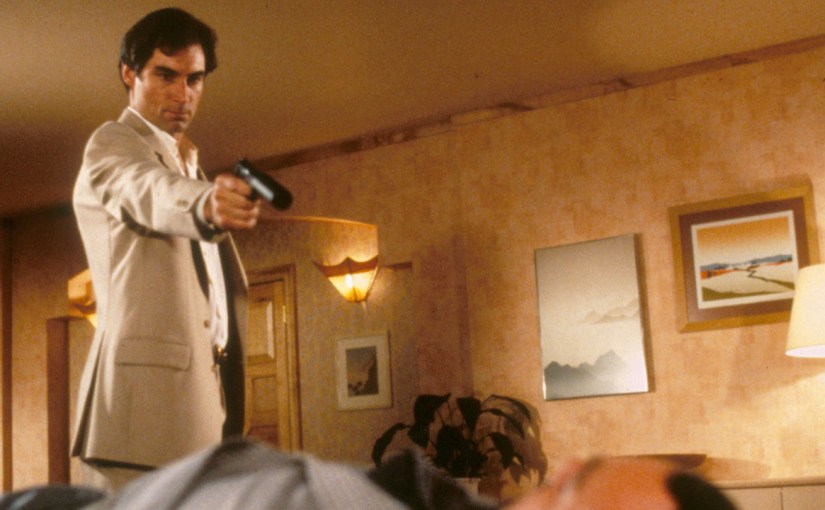
Maryam d’Abo is a beautiful concert cellist and she’s great in the film. Her character is Kara Miloviloy (no innuendo that I could find in that name; this is more spy thriller than sexual schtick). Timothy Dalton makes his first of two appearances as Bond. He’s more serious than audiences were accustomed to, putting his sharp wit and intelligence ahead of his sarcasm like Connery or Moore before him. Dalton and d’Abo have great chemistry together. Jerome Krabbe is the dubious defector playing to whatever side will help him profit, and Joe Don Baker is the redneck arms dealer with an affection for history’s greatest battles only recreating them on his play sets to his own liking.

The film also boasts one of my favorite Bond openings; a runaway Jeep full of explosives careening down the Rock of Gibraltar with 007 hanging on to the roof. It’s a great set piece because it seamlessly looks like stunt work with minimal effects and it lends to the movie’s story.

Another great action moment occurs towards the end with Bond and an intimidating muscle man dangling from the netting of the back of a plane. I’d swear Dalton was doing his own stunts.

Regular Bond director John Glen made a great film of adventure, romance, action and Cold War politics. The Living Daylights is definitely one of my favorites in the Bond series. It’s worth a look, and then another look.

PLANES, TRAINS AND AUTOMOBILES

By Marc S. Sanders

The Tuesday Before Thanksgiving Tradition blazes on for another year as Steve Martin and John Candy travel from New York City to Wichita, Kansas and then who knows where all while trying to reach their final destination of Chicago, Illinois in time for Thanksgiving dinner.

Despite the fact that Planes, Trains & Automobiles was made in 1987 before the age of cell phones, personal navigation systems, Priceline .com and Ubers, it remains a timeless classic of inadvertent comedy. Travel is still as frustrating, maybe more so now, and family kinship is still treasured.

Martin plays Marketing Executive Neil Page, forced to succumb to the unwanted company of Shower Curtain Ring Salesman Del Griffeth (Candy). One inconvenience after another delays Neil from getting home to his family for the holiday. Del wants to be helpful, yet he is anything but.

The roles are perfectly cast. One of the best on screen couples of all time. I imagine had John Candy not passed away so young, he would have been paired up with Steve Martin at least one more time.

Writer/Director John Hughes is a master at taking simple circumstances (detention on a Saturday, skipping school, traveling) and blossoming it into episodes of relatability amplified in both comedy and drama. His knack for dialogue is a huge factor in his scenes. Consider the best scene in the film between Martin and favorite character actor Edie McClurg where 19 F- bombs are tossed over the mix up of a rental car. It happens all the time to any one of us, and Hughes took advantage of the frustration and built comedy that comes from it. Its not funny when you are in the moment. It’s funny when you recall the moment later on. It’s a brilliant scene.

Nut grabbing, taxi races, ride hitching in 1 degree weather, bed sharing with what you think are pillows, burning cars, wrong way driving, encounters with death and the devil, “The Canadian Mounted,” and a perfect excuse to use Ray Charles’ rockin’ “Mess Around” all point to a reason for a climax that arguably (on the first time any of us saw the film) we never expected or considered. If you don’t choke up, you have no soul.

Hughes was all too familiar with the meaning of Thanksgiving when he wrote Planes, Trains & Automobiles. I like to think those that see the film are even better for having watched it.

It’s a very funny movie, but it’s very special movie as well. Give thanks, offer what you can, when you can, and Happy Thanksgiving. 

LETHAL WEAPON

By Marc S. Sanders

The opening scene to Richard Donner’s 1987 film, Lethal Weapon, always intrigues me. Following an opening credit flyover of Los Angeles at night played to the tune of “Jingle Bell Rock,” a beautiful young, topless woman snorts some cocaine, steps out on a balcony and leaps to her death. It was a great hook for the beginning of a script written by Shane Black. How does a random suicide jump connect to heavily armed mercenaries with an interest in heroin shipments? Two cops at odds with one another will find out.

Mel Gibson and Danny Glover hit the payload of a new and long lasting cinematic franchise playing suicidal cop Martin Riggs and by the book family man Roger Murtaugh; one of the very best on screen pairings since Neil Simon’s “The Odd Couple.” Riggs is ready to die at any given moment following the loss of his loving wife. There’s an effective dramatic moment where Gibson plays a very drunk Riggs, and loads a bullet into the chamber of his Baretta. Donner gets one unsettling take of a man in despair biting down on the weapon, holding it to his forehead and under his chin. It’s pretty frightening. Gibson is great in this moment, red faced and uncontrollably tearful.

The first of the four films remains the best as Black’s story is continuously pealing back layer after layer. There’s something new to the main plot in nearly every scene. A banker is involved. A nightclub as well, and a prostitute’s house is detonated and of course there’s the girl who dove off her balcony. Shane Black seamlessly connects all the dots.

More so, there’s something to the cops relationship in nearly every scene. We see Riggs & Murtaugh begin with a major divide in working together. Riggs has a cavalier attitude of nothing to lose. Murtaugh is content with turning 50, but might not get to enjoy his new year at the expense of his new partner’s reckless behavior. How does Riggs rescue a suicide jumper? Not the way you’d expect I imagine. Efficiently, a trust is built among the two men with Donner doing a fine job of escaping the main storyline for a nice family meal. It’s humorous and charming but necessary to really appreciate these characters. Then the ribbing among the two guys happens. Jokes about Roger’s wife’s cooking and a contest of target practice at the shooting range allow the audience to feel like they just made two new best friends.

On the other side are two worthy villains played by Mitchell Ryan, and more prominently Gary Busey. They play ruthless shadow company soldiers from the Vietnam era ready to eliminate anyone who interferes with their drug dealing venture. Busey is especially good and ruthless. It’s a shame that gossip magazines and a crazy lifestyle have mostly dominated his public life over the years. He’s so good in this role. He had already been an Oscar nominee by the time this film was released. You have to wonder why did it all go so wrong for him. Gary Busey might have been a top billing movie star.

Richard Donner had already been a well established director with Superman The Movie, The Goonies, and The Omen. His action film was even more a testament to his skills. Action scenes are so well filmed in “Lethal Weapon” whether they take place in a Christmas tree lot, a desert outskirt, a nightclub or on Hollywood Boulevard. Credit should also go to Michael Kamen’s music, adventurously dramatic with an air of mystery at times. He works in accompaniment with Eric Clapton too.

I take one issue with Lethal Weapon. The final scene, a jiu jitsu fight between Gibson and Busey in front of the entire police force abandons the story. Nothing new is left to happen. Ever since I saw the film in theaters I asked myself why is this here. Two tough guys just punching the hell out of each other. There’s no development here. There’s no way a moment like this would ever occur. In addition, the editing is choppy at times and I can’t tell who is hitting who. It’s not a terrible violation, but it’s not all that interesting either.

Barring this ending scene, Lethal Weapon is just a well assembled film of action, humor, drama, suspense, and story. At the time, Shane Black was paid a record sum for his script. I still believe it was worth every penny.

MATEWAN (1987)

by Miguel E. Rodriguez

Director: John Sayles
Cast: Chris Cooper, Mary McDonnell, David Strathairn, James Earl Jones
My Rating: 9/10
Rotten Tomatometer: 94%

PLOT: The (mostly) true story of a West Virginia coal town where the local miners’ struggle to form a union rose to the pitch of all-out war in 1920.


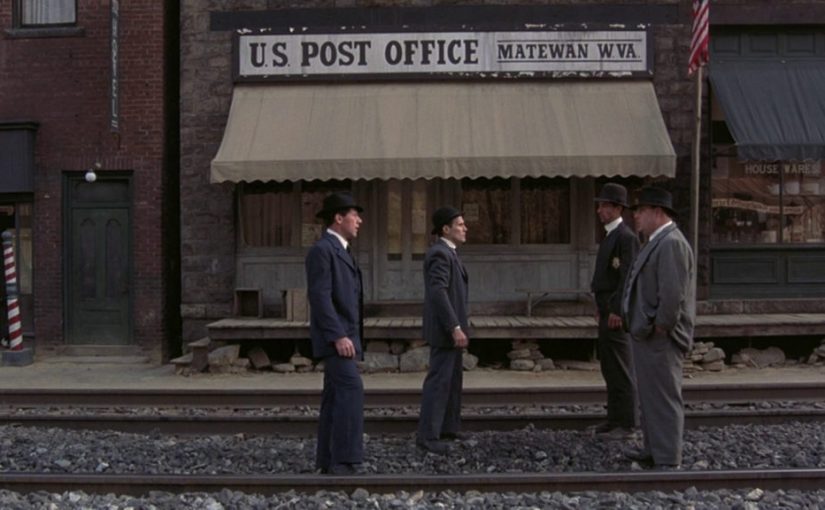
A few nights ago, I watched Matewan for the first time.  I haven’t seen many of director John Sayles’ films, but I’d venture to say it’s one of his best.  With loving authenticity and a keen ear for dialogue and music, Matewan depicts a nearly forgotten chapter of American history when coal miners in 1920 West Virginia attempted to unionize, the big corporation that owned the mine attempted to suppress and intimidate the workers, and everything came to a head one fateful day on the train tracks leading in and out of town.

I can’t pin down exactly why, but I haven’t been able to stop thinking about this movie.  When I was watching it, I tried to stop so I could go to bed and finish it in the morning.  But when I tried to sleep, my mind wouldn’t stop racing, thinking about the film, its message, its look, the SOUND of it.  I had to get back out of bed and finish it to the end before I was finally able to sleep.

The plot is nothing new, at least in broad strokes.  Small town locals take on corporate America and show them what for.  Seen it once, seen it a hundred times.  But for some reason, when this film showed scenes of company men evicting miners from their homes, or humiliating dinner guests at the boarding house where they’re staying, or spreading lies about union organizers, even employing a spy…I got mad.  I wasn’t just upset at the bad guys in a knee-jerk way, like disliking Nazis in a World War II film.  I was genuinely angry.  And I stayed angry for days whenever I thought about the movie.

Maybe it’s the thought of this particular kind of injustice depicted in Matewan that fueled my anger.  Here are people, poor people, desperate people, who lost their land, their homes, their dignity, and their lives so other men hundreds or thousands of miles away could report a six percent increase in profits at the next stockholder’s meeting.

There’s a powerful but terrible scene when the mining boss is introducing a group of new employees to the mine and its rules.  They are presented with tools…but they’re loans from the company, and their cost will be deducted from their first paycheck.  Miners can sharpen the tools with the company’s tool sharpeners…for a monthly fee.  The company provides a doctor…for a monthly fee.  The train ride to the mine was provided by the company…cost to be deducted.  The men are paid in company “script”, redeemable only at the company store.  Purchase any items available at the company store from an outside merchant…and you’re fired.

I remember thinking, this is literally slave labor.  How could anyone live like that, day after day, going down into a hole in the earth where the very real possibility of death, sudden or protracted, loomed over you every moment you’re down there?  And then to hear that the company could make conditions safer, but it’s just too expensive?  No WONDER they wanted to unionize.

Anyway.  Like I said.  It stuck with me.

Leaving aside the story, the film is extremely well made, especially considering the filmmakers were working within an extremely limited budget.  They employed the services of Haskell Wexler, one of the gods of movie cinematography, whose credits include Who’s Afraid of Virginia Woolf? (1966), In the Heat of the Night (1967), and One Flew Over the Cuckoo’s Nest (1975).  He employed a lot of low-light and natural-light photography, and as a result, even though Matewan was released in 1987, the movie looks and feels like a classic ‘70s movie.  It’s so precisely of a particular time and place that it’s a little jarring to see contemporary actors like Chris Cooper and Mary McDonnell in scenes that look like something out of Barry Lyndon or McCabe & Mrs. Miller.

The music choices are also out of this world, especially in a scene where musicians from three separate ethnic communities start riffing on each other’s music.  It’s an eloquent symbol of the kind of community and camaraderie that was needed for the miners to succeed in their task.

The story moves onward.  The miners first rally around Joe Kenehan (Chris Cooper), who came to town with the specific goal of unionizing the mine.  Then things go sour when company enforcers arrive.  The local sheriff (David Strathairn) makes a bad first impression, but later reveals his true nature in immensely satisfying style.  Guns are fired.  Lives are lost.  A spy is discovered.  And everything leads to a final showdown between powerful men with the might of corporate America backing them up and a few desperate miners who just want to be treated like men instead of so much dry goods.

If you’re anything like me, Matewan will stay with you long after it’s over.  Maybe not for the same reasons, but its memory will definitely linger.

BEST SELLER

By Marc S. Sanders

It’s kind of sad when two very good actors are provided with really subpar material.  The writing can naturally make the performers look bad.  Two things can happen.  The actors might try too hard or they may not try hard enough.  A perfect example of that is John Flynn’s crime drama Best Seller with James Woods and Brian Dennehy.  Woods tries too hard.  Dennehy isn’t trying at all.

Brian Dennehy is Dennis, a Los Angeles undercover cop.  Following a department robbery in 1972, he writes about the experience and then he is on his way to also being a best-selling crime novelist.  Fifteen years go by.  He’s still working the streets and chasing bad guys while also writing.  Though now he’s got writer’s block. 

James Woods is Cleve, a professional hitman, who enters Dennis’ life and convinces him to write a book about Cleve’s experiences.  Cleve’s motivation for this is to expose a crooked politician that he used to do jobs for and at the same time, the book will become a best-selling true crime novel for Dennis. So, Cleve escorts Dennis around various parts of the country from California to New York then back west to Oregon.  Cleve shows Dennis a bedroom in New York where he successfully executed a man with details about where the victim fell to how he did it, step by step.  There’s not a shred of dialogue or discovery in this scene.  A real estate agent giving a tour of an empty model home is more eye opening.  Cleve also brings Dennis to his parents home for a sleepover where he can gain some background material on Cleve’s upbringing.  Having just seen the ninety minute film, I can not recall one thing that was discussed at the dinner table with mom and dad.  Dennis never looks interested.  Dennis doesn’t even have a tape recorder or a pad to write on.  Dennis isn’t even necessarily convinced that Cleve is the hitman he says he is.  I was convinced, however.  Ten minutes into the film, Cleve saves Dennis’ life by shooting a criminal that was about to kill Dennis and he had pretty good aim with his silencer hand gun.  What more do you need to know?  If Dennis is such a good cop, why can’t he realize what is in front of him?  Was that the dilemma of Best Seller?  To see if Dennis believes Cleve is an expert hitman? 

The story is utterly ridiculous.  It doesn’t help however that James Woods carries himself like a nut job when Flynn directs him in cool postures adorned with stylish Ray Bans and knitted 1980’s suits.  He gets hyper in front of people he’s threatening and prefers unusual sexual positions with women he just met.

Brian Dennehy hardly looks like he’s in character.  His dramatic moments have no impact.  He seems undisturbed by this weird guy he’s travelling the country with.  Wouldn’t a seasoned cop even keep his guard up while with this likely hitman?  Not even a couple of near misses on killing them both seem to faze his Dennis character.  The men make a quick escape from a bomb laced taxi cab and they hardly discuss or consider who is behind the attempt on their lives. 

I’m not sure what was to be accomplished with this film.  It doesn’t explore anything remotely interesting. It’s mostly as boring as Brian Dennehy seems in his role.  Both of these actors have had better material to work with in their careers and they work best as supporting character actors like Woods in Casino and Hercules, or Dennehy in First Blood and Presumed InnocentBest Seller was not a box office hit or even a sleeper hit.  It’s not hard to see why.

EDDIE MURPHY’S RAW

By Marc S. Sanders

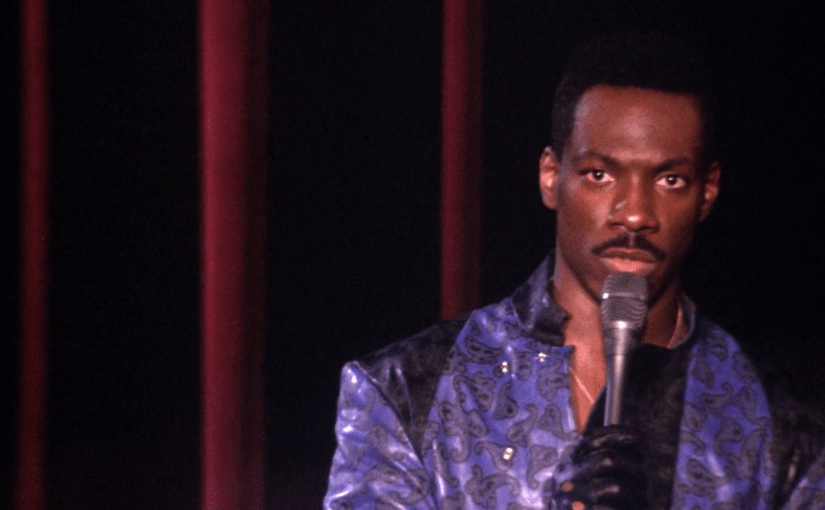
There is no way.  NO WAY that Eddie Murphy’s Raw would ever be produced today.  Nearly every sentence is of the highest caliber offense of any modern day societal belief.  Still, Murphy’s expressions and delivery are lightning in a bottle.  You can’t help but at least grin at his close ups and physicality.

This guy is so incredibly bright that only his comedic stand up monologues could actually feel like you are learning from a college professor who offers up what guys like Bill Cosby, Michael Jackson and Mr. T are really like.  At the same time, he’s somewhat frank with how men and women communicate. It’s comedy.  It’s terribly exaggerated like comedy needs to be, but I can’t deny at least some truth in what Murphy talks about.  If there wasn’t even a fraction of validity in his material, then it would never have been funny, and Eddie Murphy’s career would have ended well before the 1980s came to a close.