FERRIS BUELLER’S DAY OFF

By Marc S. Sanders

I’ve said before how John Hughes had an instinct for making interesting stories out of the mundane. Sure he might broadly exaggerate, but the storylines stem from relatable anecdotes like cross country traveling, forgotten birthdays or school detention. Thankfully he also explored a day in the life of faking illness and skipping school with Ferris Bueller’s Day Off.

Matthew Broderick memorably plays the title character with an answer for everything and the means to outsmart his naive parents, his pesky sister Jeannie (Jennifer Grey), as well as the dim witted victim of staged slapstick, school principal Ed Rooney (Jeffrey Jones). Hughes teams Ferris up with his beautiful girlfriend Sloane (Mia Sara) and his troubled best friend Cameron (Alan Ruck) for a romp through downtown Chicago.

Ferris Bueller… is simply a party to watch. The tempo of its comedy thankfully gets very familiar, very quickly. There’s gag after gag to celebrate the inventiveness of Ferris. With Cameron, he manages to get Sloane out of school, alter his absent days in the school system, arrange for a high-end fancy lunch thanks to the “Sausage King of Chicago” and actually pilot Cameron’s father’s prized, rare Ferrari convertible. There’s nothing Ferris can’t do, nor won’t do. There’s nothing Ferris can’t get away with. The guy can even hop on a downtown parade float to get the entire city engaged in a rousing rendition of “Twist & Shout,” arguably one of the most fun scenes to ever be filmed. Hundreds of extras crowd the streets to remind any one of us how fun life can be. What a joyous pleasure life is.

As expected with most of Hughes’ films though, this picture has a heart. Life should always be celebrated, but that does not mean we don’t have episodes where we suffer. Alan Ruck as Cameron is not well with his home life. Parental discourse and the lack of a loving home weighs upon him. The storyline is embraced very sensitively. A touching moment occurs as Cameron tours the Art Institute of Chicago and maintains an engrossed stare with the painting called A Sunday Afternoon on the Island of La Grande Jatte. Cameron is a product of loneliness lacking the ability to cry for help unlike the child in the painting. It’s another one of those treasured moments in film where dialogue is not needed to describe a character’s pain.

Jeffrey Jones makes for a good foil in a Three Stooges style storyline as he attempts over and over again to catch Ferris in the act. It never works well for him and leads to hilarious moments with the house dog and every other unfortunate circumstance imaginable such as getting his car towed and his foot stuck in the mud. Hughes pieces these cheap gags together to make them really feel much more valuable than they should be.

Lastly, John Hughes creates good inside gags within his setting. The city of Chicago works as a character concerned with Ferris’ supposed illness, including well wishes from his classmates, to the faculty, and even the police department much to the chagrin of his sister.

Let’s just say it’s imperative we all do our part to Save Ferris!

STAND BY ME

By Marc S. Sanders

I’m not embarrassed to say it.  I’ve experienced a mid-life crisis.  Last night, I watched Rob Reiner’s Stand By Me, and I absolutely broke down in tears when it finished.  As I approach age 50 later this year, the most recent viewing of this film alerted me that my childhood memories are further away than I ever realized before. 

Reiner lifts this coming-of-age story from Stephen King’s novella entitled The Body. Four boys spend the long and hot dog days of summer in Castle Rock, Oregon (it was Maine in King’s story) in their tree house smoking cigarettes and discussing important topics like Annette Funnicello’s breast size on The Mickey Mouse Club and the recent disappearance of a twelve-year-old kid.  Yackety Yak and Lollipop play on their transistor radio in the background.  The wimpiest one of the pack, Vern (Jerry O’Connell), overhears the location of the kid’s body is off the side of the railroad tracks, about twenty miles away.  Teddy (Corey Feldman), along with best friends Chris (River Phoenix) and Gordon (Wil Wheaton) decide to embark on the search for the body and get their picture in the paper, labeled as heroes.  It’ll take them the Labor Day weekend to carry out their quest.

During their long journey across the railroad tracks into the woods, the four boys will discover what concerns them, like figuring out if Goofy is a dog and who could win in a fight; Superman or Mighty Mouse.  As well, they’ll uncover what gives them anxiety ahead of their entry into adulthood.  Gordon lives with being unloved by his parents both before and following the accidental death of his older brother (John Cusack).  Chris lives with being unfairly labeled as a young hoodlum.  Teddy endures the aftermath of an abusive military father currently living in the looney bin.  Vern suffers from a hesitancy to live for adventure and risk due to ongoing fear. These boys had a future that awaited, but for some it seemed like there was no escaping the destiny the locals of their small town had already mapped out for them. 

In the last few years, I reconnected with a childhood friend by means of social media.  Visiting New York City annually over a three-year period, I got to see Scott in person and recollect on our times together.  It had been over thirty years since we had seen or spoken with one another.  We reminisced about tormenting the substitute teachers, and our first crushes.  We reflected on favorite movie scenes that we acted out in between classes.  We are different now, though.  Nowhere near the same as we were at age 12.  We have families and careers and responsibilities.  Yet, our memories of trading comic books, talking dirty, going to movies, and acting out cops and robbers shoot outs in the backyard all remain. 

When Stand By Me opens, a present day adult (Richard Dreyfuss) is shown reflecting in the distance following reading an article about a lawyer who was killed in a restaurant.  This narrator then flashes us back to the year 1959 when this adventure between him and his three friends occurred.  One of those friends was the lawyer who was killed.  A piece of his history has ceased to live and continue on.  That terrifies me personally.  Friends, and family, and people I’ve encountered over my half century will leave my presence, never to be seen or spoken to again.  I’ll never get the opportunity to reflect with them again, much less make new memories.  I’m now living in an age where Facebook comments seem to weekly consist of saying “very sorry for your loss.”  Friends are losing their parents.  Some are passing away themselves.

Stand By Me might not be altogether realistic.  The boys are getting overpowered by a sinister Kiefer Sutherland, who’s not afraid to use a switch blade and cut one of the kids’ throats.  King’s story also feels like an elevated Hardy Boys or Tom Sawyer kind of adventure.  I don’t know of anyone who went looking for a mutilated corpse during my summer days living in Wyckoff, New Jersey.  The adventure conceived by Stephen King serves as a thrill that you imagine as you read it off of the page.  My upbringing consisted of play dates and sleepovers with Scott, Star Wars toys and Saturday morning cartoons.  Yet, the connections that thread the main story together are what’s to treasure in Rob Reiner’s film.  The friends we make in grade school before becoming interested in high school, alcohol, sex, and career planning, are the most important people we know and first encounter in our lifetimes.  It’s impossible to forget them or the impact they had on our lives.  Scott certainly had an impact on my life.  I credit my sense of humor to him, and his carefree attitude to the ugliness of this world.  Sometimes that’s all we have to survive.

King and Reiner use the body that is being sought as a device to drive the characters.  What’s going to bring these boys together with no outside influence?  How can young Gordon deliver his revered sense of imagination as the writer he’s to become?  The best way is to put the boys around a camp fire.  Gordon can then entertain his pals with the story of an incredibly fat kid who got his revenge on the locals during a pie eating contest that results in a massive “Barforama.”  It’s silly and sophomoric and childish fun, but for 12-year-olds, it’s the best thing imaginable.  Teddy dreams of being an army hero storming the beaches of Normandy like his father was rumored to have done.  His sleeping bag is his machine gun mowing down an oncoming train.  Vern’s favorite food?  Watch the movie to find out.  Chris might be regarded as the outlaw, but he’s also the most mature, and perhaps the mentor to Gordon who suffers from the loss of the brother he loved, as much as he suffers from the neglect of his mother and father.  At age 12, in 1959, Chris was all that Gordon had.  I may have had more than Gordon at that age, but whenever I was with Scott, he’s all that I had.

Ultimately, Stand By Me is not an adventure or a silly comedy about boys being boys.  It’s a character study of kids just outside of their formative years.  It’s a film that captures a single moment before friendships inevitably expire.  It’s a reminder to embrace those you’ve treasured over your lifetime, because we cannot be twelve years old forever.

A VIEW TO A KILL

By Marc S. Sanders

A View To A Kill marks Roger Moore’s final outing as James Bond 007, and it’s more or less a near complete failure. Quite possibly my least favorite film of the entire series, regardless of an awesome song, compliments of Duran Duran and composer John Barry.

The inspiration for invention is expired in this film. Action set pieces rely on outside elements that do nothing to spice up the scenes. Bond manages to surf away along the snow covered Swiss Alps, in place for Siberia, while evading the Russians. The surfing is one thing, but when accompanied with a lame cover of The Beach Boys’ “California Girls,” you earn every right to roll your eyes and shake your head.

An unnecessary sequence involves Bond dangling from the ladder of a fire truck while the San Francisco police are pursuing him. It’s slapstick, but it’s not funny slapstick. You just wanna yell at the screen “WHAT ARE YOU DOING?????”

A View To A Kill plays like a poor remake of What’s Up Doc? with Barbra Streisand & Ryan O’Neil. Bond eventually partners up with a former “Charlie’s Angel” and hijinx ensue. Tanya Roberts plays the Bond girl this time and her dialogue mainly consists of screaming “James!” as if she is in terrible, helpless fear. She hangs and runs and screams and stands and sits while keeping her flimsy white dress and heels spotless. There’s nothing adoring, funny or attractive about her. She lends nothing to the film but dead weight. A scene involving an elevator fire had me wishing Bond would leave her to perish. The term “dumb blond” must have been coined when Tanya Roberts came on the Hollywood scene. Her character, Stacy Sutton, appears unaware of any of her surroundings and more importantly Roberts, the actress seems to be that way as well.

Roger Moore carries almost no chemistry with any of the fellow actors, certainly not with Roberts, and I think it’s because he gave up trying by the time he got to his seventh Bond film. He moves slow. He looks out of breath as he climbs the stairs of the Eiffel Tower. His delivery carries little wit. He is found hanging from the the Golden Gate Bridge and utters the line “There’s never a cab around when you need one.” Moore seems to show that even he doesn’t think any of this is fun anymore.

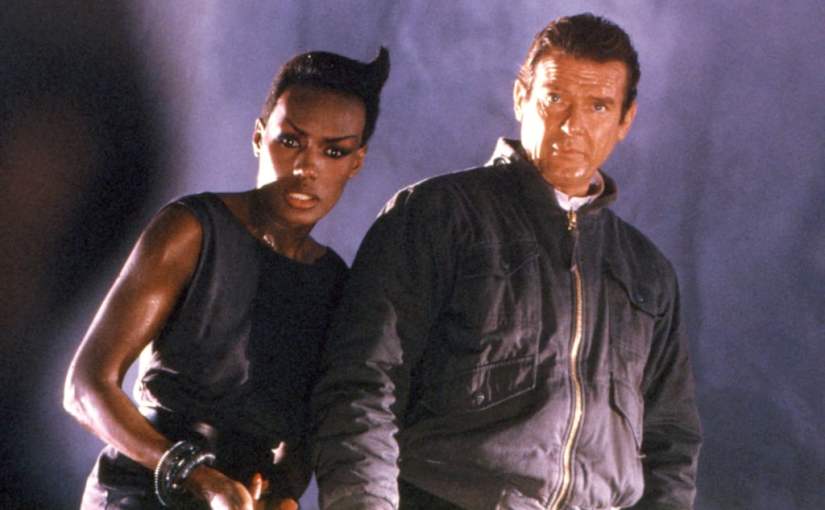
Perhaps the one redeeming quality goes to Christopher Walken as the psychotic Max Zorin. It’s funny to watch Walken play this part all these years later as he shows qualities that movie goers would love in his later films like True Romance, The Rundown, and even Catch Me If You Can. Walken deserved better material than this (especially following his recent Oscar winning status at the time). Instead, he’s given a well-toned Grace Jones as an accomplice who falls nowhere near the ranks of Oddjob or Jaws.

Richard Maibum wrote the unclear script involving Zorin’s desire to wipe out Silicon Valley, and monopolize on the micro chip industry. At least that’s what I think the film was about. The story mires itself in an overlong side story involving drugging race horses snd I could never make the connection. Bond is given the opportunity to photograph various suspects involved with Zorin and then later in quick conversation they’re all explained of their purpose. Yet, I was just more confused and unsure of what was going on and how it’s all bridged together. I don’t think the plot was complex or confusing. Rather, I think the film was cursed with plot holes and little regard for coherence.

Roger Moore notoriously regretted doing this film. He had overstayed his welcome in the franchise by 1986 with A View To A Kill. Albert Broccoli with his new producing partner, Michael G. Wilson (his stepson and a co-writer) were getting stale with the series. At this point the Bond series was no longer relying on crafty, well edited and witty filmmaking.

Moore’s last film was just processed for another buck at the box office with little respect for the franchise.

007 was due for a change.

THE DELTA FORCE

By Marc S. Sanders

In the 1980s, a small production company named Cannon Films was started by an Israeli named Menachem Golan.  It churned out at least a dozen Charles Bronsan cheapy crime dramas and gave longevity to his Death Wish series of films.  Cannon also provided another franchise called American Ninja with action star Michael Dudikoff.  Dudikoff, nor any of his films won an Oscar, much less a Golden Globe or even an MTV Movie Award.  The poor guy with twenty bottles of mousse in his hair didn’t even get turned into an action figure. 

While I did see Death Wish 3, ahem…five times in the movie theatres (I mean there’s an outstanding final thirty minutes of a wall to wall shootout action in that film, and it was all a 13 year old boy yearned for at the time), Golan’s best product that I have at least seen to date is The Delta Force, featuring Chuck Norris, Lee Marvin and a host of stars most recently having been featured in every disaster film to crank out of the 1970s; Shelly Winters from The Poseidon Adventure, Robert Vaughn from The Towering Inferno and George Kennedy from every Airport movie under the sun.

Golan directed this film that was inspired by the 1985 hijacking of a TWA flight heading for Athens, Greece and he pretty much directed two different kinds of films in one.  The first hour focuses on the Libyan hijackers, led by an unrecognizable and terrifying Robert Forester, and their hostages.  A plane carrying mostly Americans is taken captive in midair and is diverted to Beirut.  Like the real-life event, a German born American stewardess is forced to select the Jewish passengers (Winters, Lanie Kazan, Joey Bishop and Martin Balsam) and separate them for an unknown fate.  An American Navy serviceman is also brutally tormented and later, an airline pilot (Bo Svenson) is interviewed by the media from the open window of the grounded plane’s cockpit, complete with a gun to his head.  All of this happened during that harrowing event.  Golan does a very good job of capturing these moments with heartbreak, fear and genuine terror.  The Jewish selection process is a scene that I take very personally, and it is not overdramatized as it glaringly hearkens back to the atrocities of the Nazis who sent millions of Jews to certain death, torture and concentration camps.  Remember, this film was released only 40 years after those terrible events.  Golan’s filmmaking makes certain the Holocaust is never forgotten.

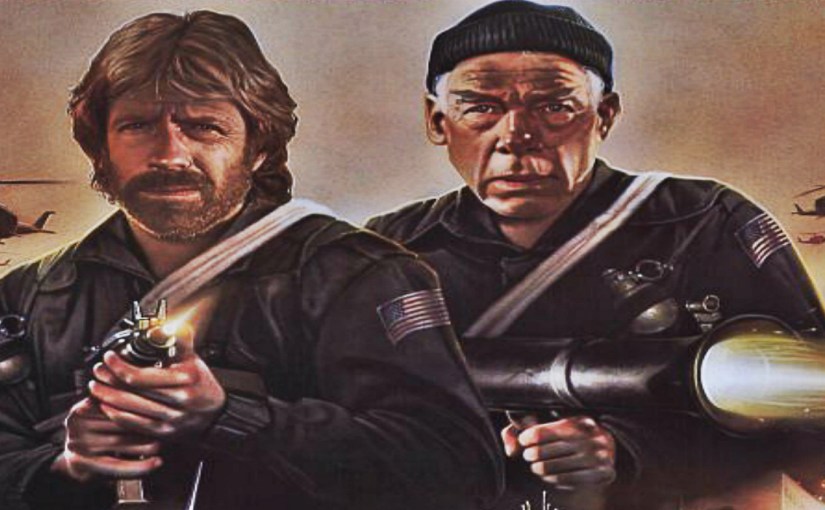
Sprinkled throughout these first hour scenes are bits and pieces of the American strike team known as The Delta Force, led with gruff command by Lee Marvin and silent but deadly Chuck Norris.  These guys gear up, dress in black uniforms, load their aircraft carrier with motorcycles and armed dune buggies, listen to Marvin’s instructions and wait and wait and wait.  There’s something to appreciate in the wait of these skilled snipers and specialists.  Golan doesn’t rush the action.  Material is depicted showing Marvin, Norris and company exploring the options they have for taking out the terrorists and rescuing the hostages.  This is not a typical Rambo movie of destroying the village just to save it.  However, once the action starts, it doesn’t stop and Golan lets Norris do all the things he’s known for while arguably inspiring how POWERFUL Chuck Norris is compared to…well…anything else.  Don’t forget!  Inside Chuck Norris’ chin is ANOTHER FIST!  Also, Superman wears Chuck Norris underoos!  Chuck Norris can unscramble an egg!  Chuck Norris made a snowman out of rain!  It’s hard not to deny these claims when the film boasts a strike team consisting of 20-30 members, but Norris seems to do all the work and heavy lifting. 

It’s hard not to get caught up in The Delta Force.  You wanna see these terrorists get blown up real good.  You also wanna see Chuck Norris ride an agile moped equipped with an endless supply of missiles and ammunition ready to overturn enemy vehicles and bloody up a bad guy until he screams and turns on one foot before dropping dead with his eyes opened.  You also may get a jolt of energy from Alan Silvestri’s rah rah theme music that quickly stays embedded in your subconscious.  I read that his music was used for a time when the Indy 500 would air on TV.  That does not surprise me at all.  Its symphonic themes are as memorable as the Monday Night Football tune.

Unlike, other Norris films this crowd pleaser doesn’t just rely on him and his roundhouse kicks.  There’s a little bit of that schtick for the fans, but I gotta say I was truly touched by the cast as whole.  Lee Marvin (in his final film) echoes George C Scott’s portrayal of Patton.  The collective hostage cast are not overdramatized here.  Golan managed to capture a history to them.  While I thought Shelley Winters was a such joke for fodder in Poseidon, here she is truly sorrowful as she is separated from her husband played by Balsam.  Kazan and Bishop are equally touching.  Reader, this Jewish guy originally from New Jersey, who attended ten years of Yeshiva education, recognizes these folks when they are spirited vacationers early on, and then later tormented prisoners who’ve faced horrors like this before.

I know that Cannon Films also produced another favorite called Runaway Train with an Oscar nominated performance from Jon Voight.  As I write this column, I’ve yet to see that film.  It’s on my radar.  That being said, I have to wonder if Golan and company had stayed on this trajectory of genuine drama like he mustered in portions of The Delta Force, what powerfully impactful films might he also had up his sleeve.  Unfortunately, we were left with too much excess like American Ninja, I’m afraid.

Still, after watching The Delta Force you’ll absolutely believe that Chuck Norris can see things that don’t exist and that he counted to infinity…twice!

UNDER THE CHERRY MOON

By Marc S. Sanders

Prince!  The vanity on this guy!!!!!  Watching his second film, Under The Cherry Moon, is to indulge in Prince’s pride, Prince’s ego, Prince’s conceit, Prince’s vanity.  The Purple One, of which I’m an admitted fan of his music, directs his own picture here in beautiful black and white cinematography, compliments of Michael Ballhaus.  That is where the accolades end though.

The film is set along The French Riviera.  Prince never speaks French in the film, nor does anyone else.  So why are we in France again?  He plays a kid named Christopher and along with his best pal, Tricky (musician Jerome Benton) spend their days glorifying Christopher (or Prince as Christopher) and swindling wealthy heiresses as they continue to live a life decadence in outrageous outfits, high heels and a modicum of makeup to especially keep Prince-I’m sorry-Christopher looking gloriously sexy, pretty and handsome.  At night, while putting on music acts in various drinking establishments, they seek out their female prey. 

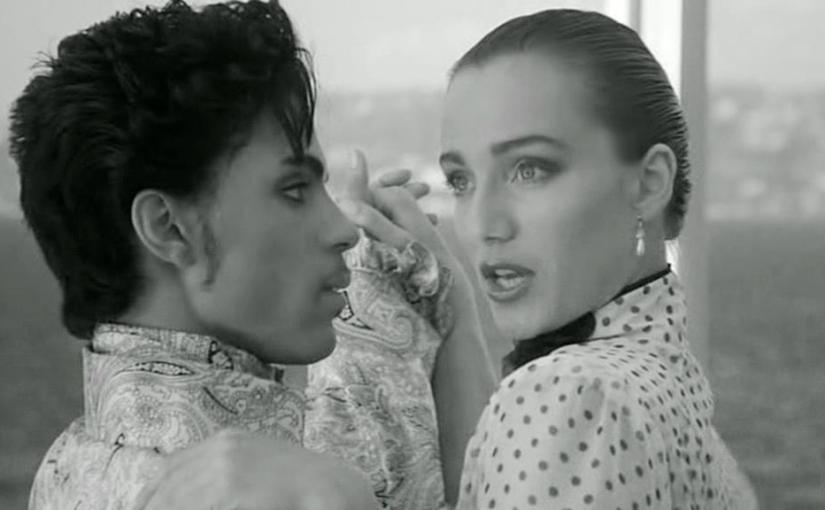
When Christopher notices Mary (Kristin Scott Thomas, in her feature film debut), he and Tricky go to work.  Somehow Tricky falls instantly in love with Mary.  (I think.  The two hardly have a scene alone together.  Prince monopolizes most of the space.)  Chris plays the “Prince Adonis” with teasing flirtations, ridiculous get ups and so on.  Later, he will fall in love with Mary.  We are supposed to believe Mary falls in love with Chris too.  But let’s come down to reality here, please.  Tricky grows angry and blah blah blah.  You’ve seen this tripe in better fare from the minds of Looney Toons shorts.  A side story character is Mary’s wealthy possessive father, Isaac (Steven Berkoff, playing the same kind of villain he did in Rambo and Beverly Hills Cop).  What do you think he’s here for?  Right!!!!!  He disapproves of Christopher and refuses to let Mary see him.

Beyond the terrible acting of this piece with vomit inducing kissing scenes involving Prince and Thomas, the film is an annoying, pesky love letter from Prince to Prince.  It’d be impossible for me to count how many close ups he does of himself.  Prince is a poet and a brilliant lyricist as well.  However, the script is littered with expressions and slang that feels like they popped into Prince’s head at one time or another.  He must have jotted it down on napkins, and then he passed it all on to the credited screenwriter, Becky Johnston,  instructing her to work this stuff into the dialogue.  Things are uttered out of nowhere, for no reason.  Conversations don’t make sense at times.  Certain words feel like the have a good rhyme.  So, make it work Becky! Mmmkay!

On other occasions, Prince and Kristin Scott Thomas will share scenes together just sitting there with nothing to say, as if it is a director’s (Prince’s) own artistic choice.  Prince is no Terrance Malick.  The gaze and the pose (of Prince!) says it all.  Calvin Klein commercials have more depth.  A phone call scene between the two goes on for a good three minutes.  They never speak into the phone.  They just hold it to their ears.  The edit goes back and forth on them and again…they don’t speak!  Prince makes it exciting by chewing on a cracker.  In another film, this would’ve been cutting room floor material.  You would think this is behind the scenes stuff and the actors were waiting for the sticks to snap and “Action!” to be called out.

Samples of Prince’s music are peppered throughout the movie.  The sounds are good for the most part, but that’s all they are.  Just random sounds.  Most of the music is not complete and seem like samples that were experimented on in a kid’s garage.  The music does not cue up anything.  None of it heightens any developments or drama or comedy.  At times the tunes will obnoxiously interrupt a scene, much like a mariachi band may intrude on an intimate dinner at a quiet restaurant.  Prince loves his music though.  So, he wakes up and tells his film/sound editors to put this and this and this into the film.  Context man.  Context!!!!!!!  What about the context?????

Under The Cherry Moon is an immature film, made by an immature filmmaker with a very mature photographer (Ballhaus).  It’s tripe of the most shamelessly vain kind.  It’s been three days since I saw the picture, and I have yet to think of another film more ridiculously conceited and egotistical.  My Cinephile colleague, Anthony, is a proud Prince fan.  He has a wealth of knowledge on the famed musician.  He’s learned to be forgiving of this film’s shortcomings.  I assured him when we sat down to watch this that I was going in with an open mind, especially when the gorgeous black and white shows up on the screen.  When the movie was over, however, I explained that this might have become something with an admirable B movie cult following, had Prince at least agreed to welcome another director to oversee the picture.  Someone needed to be watching the one in charge and humble the poor guy because if I want to look at various captions of Prince, all I need to do is lay out his album covers on my bed and pick up a Rolling Stone magazine.  I did not have to subject myself to Under The Cherry Moon.