CLUE

By Marc S. Sanders

The players:

Mr. Green – Michael McKean

Mrs. Peacock – Eileen Brennan

Miss Scarlett – Leslie Ann Warren

Colonel Mustard – Martin Mull

Mrs. White – Madeline Kahn

Professor Plum – Christopher Lloyd

With Wadsworth the Butler (Tim Curry) who “Buttles!” and Yvette the Maid (Colleen Camp).

The roles and who portrays them are the most important thing to follow in the film adaptation of the board game Clue. After that, it’s the ridiculous farce. Motivations and vague connections among the characters are spit out with rapidity by Curry’s zany Wadsworth, the buttler Butler. He’s the real star of the show but every actor makes their own variation of hilarity.

All of them have been summoned for dinner on a dark and stormy night at Mr. Boddy’s mansion. They have been specifically instructed to identify themselves by the colorful moniker documented in their invitations. None of them know each other or Mr. Boddy. Or do they????? Hmmmm!!!

Once they are there, dinner is served accompanied by Yvette’s physical attributes that express themselves quite well in her French Maid’s uniform. Soon after, the board game’s well known weapons (lead pipe, candlestick, revolver, wrench and so on) present themselves and then Boddy turns up dead in the library. Naturally, the players must explore the other well known rooms in the creepy mansion including the kitchen, the billiard room and conservatory to uncover what’s happened…even though he’s dead in the library already.

Eventually, and because the film is fast approaching it’s 90 minute mark, Wadsworth begins to manically explain who the murderer is and how and where it was done. Oh yeah! Other unfortunates have turned up dead as well, including a policeman and a singing telegram.

Clue is on the zany level of Airplane! and The Naked Gun. John Landis co-wrote the film with director Jonathan Lynn and honestly, they could not do anything wrong with the picture as long as they kept everything completely stupid for the sake of comedy. All of the players lend to that ridiculousness going so far as to even pose with the dead corpses to mask the fact that they are truly expired. No matter that the cook has a dagger in her back.

The famous board game is rightly honored even with the square tiled floor in the hall and the secret passages that connect the rooms. Agatha Christie mysteries are targets though too. The assembly of these legendary comedians, who were all pretty much established by the time Clue was released in 1985, know how to find one of Christie’s personality suspects and springboard off of that for great gags.

Look, best I can tell you is don’t pay much attention to whatever motives are rambled about. The visuals are what’s important. Watch how ridiculous Tim Curry gets as he tries to keep this game all in order. Though a sense of order should never be expected. You’ll realize that early on after the Butler accidentally steps in dog poop, and the most important thing over the next five minutes is watching each player sniff for what is that awful aroma. It sounds silly. It sounds immature, but that’s what is specifically fun about the film.
TO LIVE AND DIE IN L.A.

By Marc S. Sanders

William Friedkin is the director of one of the greatest automobile chases ever put on film with the 1971 Best Picture The French Connection. In 1985, he tried to up his game with the counterfeit caper called To Live And Die In L.A. He just about tops himself.

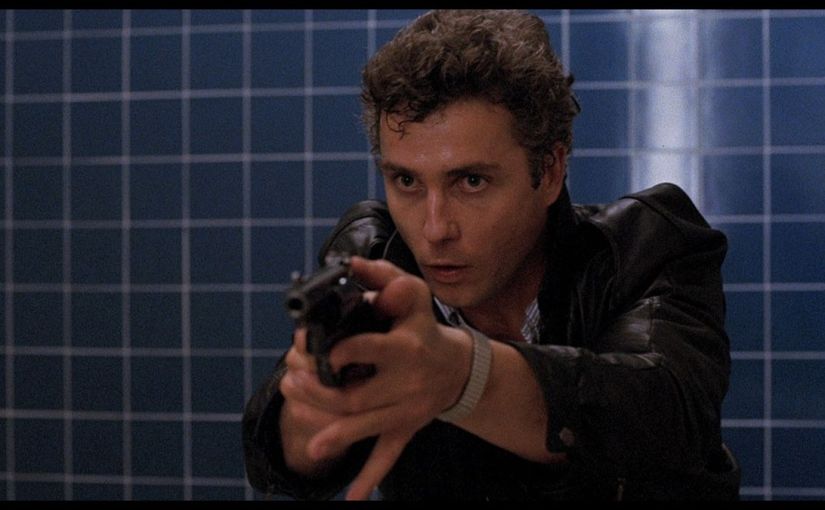
It is a dated flick with a Wang Chung soundtrack, popped up shirt collars, black leather jackets, and skinny ties. Friedkin goes Miami Vice and it more or less works but his lead player, William Peterson, is no Don Johnson. He’s more like a contestant on the dating show Love Connection.

Peterson plays a Secret Service agent with the last name of Chance; Richard Chance to be more precise. Kind of apprapo as he seems to always test his fate like bungee jumping off bridges (long before bungee jumping was ever a thing) and taking his tactics over lines that should not be crossed.

Chance is on the trail of nabbing counterfeiter, Rick Masters (Willem Dafoe), who killed Chance’s partner with only three days left until retirement. The cop who gets killed early on always seems to have three days left until retirement. To get at Masters will require Chance to…well…take some chances. He’ll blackmail a prostitute informant. He’ll also pressure his new partner (John Pankow) into circumventing policy. As well, like any movie cop or agent, he’ll go against the instructions of his supervisor. Chance might even rip off a diamond dealing exchange.

The acting is nothing special here. Peterson looks more athletic than fierce or driven. He’d never be Gene Hackman. Dafoe’s weirdly youthful appearance with his Benneton ‘80s outfits look…just that…well…weird! He’s an artist (like with actual paintings) while also printing fake money.

Friedkin’s film carries on its longevity through the years with an effective car chase; one of the best on film. From what I can tell he mounted a camera on the hood of the car. The camera can pivot 360 degrees. So we can see Peterson driving the car and then the camera can swoosh and turn to give a point of view as to where the car is driving. So now the viewer can see where the cars are careening and turning and speeding towards. It gets especially hairy when the car goes the wrong way up the freeway exit ramp into rush hour traffic. No CGI work here. This is in your face material.

To Live And Die In L.A. is worth the watch. A surprise moment towards the end also gets your attention by going against the typical cops and robbers formula film. The shoestring budget is apparent here with quite dull, very dull, cinematography and no big stars at the time (Peterson, Dafoe, Pankow, John Turturro, Dean Stockwell). However, William Friedkin does his best to make every moment worth it, and I can’t deny it, this 80s raised kid thinks the Wang Chung soundtrack is so friggin’ cool.

WITNESS

By Marc S. Sanders

Recently, I viewed The Last Emperor and one issue I had was that it was challenging to comprehend the in-depth culture of the people it depicted. I really wanted to learn and pass the final exam with flying colors. Sadly, this was an AP class that I just wasn’t qualified for.

Now that I have watched Witness for the first time in many moons, I can honestly say there is an approach where you can get absorbed in a thrilling crime drama while also appreciating the core values of the community the film focuses on, namely the Amish who reside in the state of Pennsylvania. It’s a much easier film to learn from. That’s for sure.

Peter Weir directed Harrison Ford to his only Oscar nomination to date. Ford plays police officer John Book, opposite Kelly McGillis as Rachel Lapp, a widowed Amish mother traveling by train from home to visit family. At a layover stop in Philadelphia, her young son Samuel (Lukas Haas, in one of the best child performances I’ve ever seen, so bright, observant and wide eyed) witnesses a murder committed by a decorated narcotics police officer (Danny Glover). When Book gets wind of who the cop is, all three of their lives are in danger and they are forced to flee and hide back at the Lapps’ home among the Amish community. Book, however, has taken a gun shot wound following an attempt on his life. The Amish see no choice but to heal him, especially at Rachel’s insistence.

Weir, with a marvelous script by Earl & Pamela Wallace and William Kelley, shows the intersection of two extremely different ways of life where an “Englishman’s” belief in aggressive tactics conflicts with the peaceful nature of people looking to never get involved with any other culture. A romance may seem inevitable between the two leads but it’s a difficult one to embrace. It’s truly forbidden, not simply by the elder Amish and their respective code, but both Book and Rachel know it can’t happen either.

Because we are aware of this forbidden romance that seems to break through anyway, there’s a terrific dance scene at night lit only by headlights within the barn. Ford and McGillis really shine through in this scene as it is the first escape from the fear they have for their lives and the code they honor and are reluctant to violate. It’s the best scene in the whole film. It presents possibilities for different people to interact despite the barriers that prevent such feelings and actions. They laugh and swing naturally. It’s a different kind of moment for Harrison Ford, unconventional when compared to a large majority of the action film roles he’s widely recognized for.

With a biting soundtrack of suspense from Maurice Jarre, Peter Weir also focuses on the theme of intrusion. When the climactic and certainly expected shootout sequence on the farm is to begin, it’s frightening and disturbing to actually see men in suits holding shotguns amid an unarmed society. There’s a masterful shot at dawn of the three men marching down the hill quickly approaching the farm. These aren’t cops being covert. These are cops storming a palace of peace and tranquility. It’s hard to watch because of the stain it leaves.

Josef Sommer is the lead dirty cop and he plays a great villain, truly an uncelebrated bad guy character, as the years have gone on. He’s a decorated officer who comes off with an intent that looks like it’s noble, until nobility will no longer work and intimidation has to set in. Weir shoots Sommer at a lower angle to give him an imposing height.

Ford is terrific. You see some of the Han Solo vibe in the character. He’s a tough cop after all, but then he transitions into an awakened man healed by the more primitive methods of the Amish and their drive to simply build and nurture. Another good moment occurs when Book contributes to building a barn with the other men. He shares lemonade with them. Assists with lifting the framework and hammering along. Two communities are no longer clashing. They are now blending.

McGillis is also very good in her role. She is determined to honor her background, but questions if she is capable of sin and defends her position later.

Witness gives an in depth look into the daily life of the Amish, literally how they farm, build and dress. Book wakes up with them before sunrise to milk the cow and he experiences what they endure from pesky tourists looking for photo ops. It makes for some funny moments as well as an opportunity to cheer for the stand he eventually takes.

Another funny moment is when Ford dons the Amish attire for the first time; it doesn’t exactly compliment him well at first. Book’s adaptability to his new community is awkward to grasp.

Witness presents a bird’s eye view into a very private way of living, and I saw a very large picture.

Beyond that, it’s also a crackling, good thriller.

WEIRD SCIENCE

By Marc S. Sanders

John Hughes, as a writer, stretched his imagination far at times. Really far!!!!! You’d have to, to build up your confidence to make a ridiculous comedy like Weird Science come to life. The movie is blatantly absurd, outrageous, a little crude and outright nonsensical. It’s Frankenstein meets Pretty In Pink. It’s alive!!!!!

Double, maybe quadruple, Uber Nerds Gary and Wyatt (Anthony Michael Hall, Ilan Mitchell-Smith) spend their Friday night in front of the computer to create the hottest woman ever. With the help of a Barbie doll and some Playboy centerfolds, nothing on earth will compare to this creation for the XX chromosome community. They give her a brain as well by scanning in photographs of Albert Einstein, of course. From there, “Lisa” (Kelly LeBrock), with the toned body that SCREAMS SEX, plots out the boys’ weekend at a blues club, then the mall and later a party at Wyatt’s house where the boys’ reputations are enhanced almost as well as Lisa’s chest.

Lisa helps Gary and Wyatt overcome their insecurities with their popular girl crushes and teaches Chet, Wyatt’s idiot green beret brother, to lay off. Chet is played by Bill Paxton. Can you imagine anyone else playing Chet?

There’s a cuteness to Weird Science. However, the slapstick gags are what really wins. Either you like this silliness or you don’t. I get amused watching all the furnishings of Wyatt’s house, including the Baby Grand piano, get sucked out the chimney along with a half-naked girl. I love it when Lisa freezes the blue blood grandparents in the pantry closet or when she erases the memory of Gary’s father. I also like how Chet is reduced to a big blob of literal shit. Then there’s the nuclear missile that rises out of the floor, up through the roof.

Take off your cap of sophisticated maturity, and just appreciate silly, sophomoric comedy for a change. It’s all harmless, anyway. Lisa makes sure everything is back in its place by the end, only now it’s better and funnier than before.

JUST ONE OF THE GUYS

By Marc S. Sanders

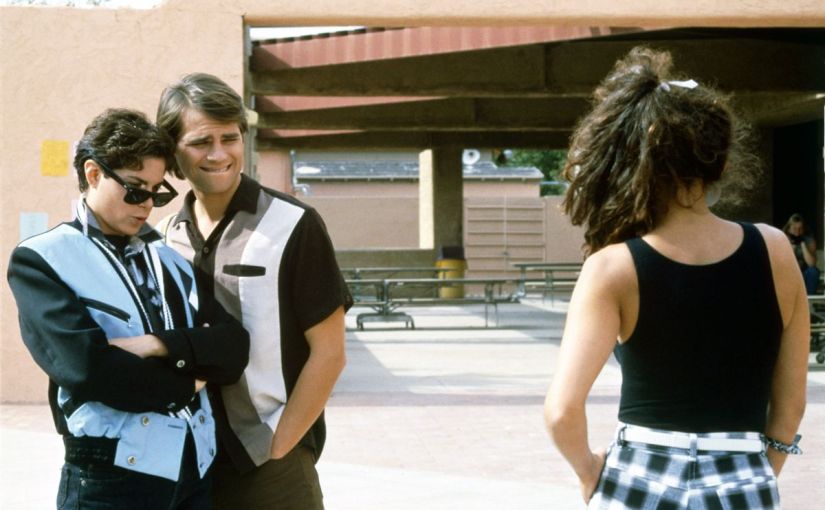
Okay. Okay. No need to throw darts my way. Sorry, but I love the 80s teen comedy Just One Of The Guys.

People please!!!!! Please understand my position on this subject. It’s Joyce Hyser!!!! One of my top three crushes from adolescence – Joyce Hyser. Joyce Freakin’ Hyser!!!!!

Now the irony is that while I have-yes, still have, and my wife has accepted this-a crush on Joyce Hyser the point of this film directed by Lisa Gottlieb is that lead character Terry needs to prove that she is more than just good looks. Terry is not just a hot chick. Terry has a brain, and to prove that she has the potential to be a fantastic journalist, she will register in another local high school where she will submit her article that’ll award her a summer internship at the Sun Tribune newspaper. Only thing is to keep her looks from getting in the way, she’ll have to register as a male student.

All the trappings of comedy cross dressing occur like using boys bathrooms and avoiding jock strap inspections from the gym teacher. She also has to put up with keeping her sex starved brother Buddy (Billy Jacoby) from teasing and revealing her secret. As well, her studly college boyfriend can never find out. An unwelcome crush (Sherilyn Fenn) on her male persona is trouble too. Oh yeah, and the typical 80s cinematic bully, actor William Zabka, has returned for the millionth time. There’s a lot packed into this cute flick that’s a loose adaptation of Shakespeare’s Twelfth Night.

Gottlieb’s film also steals elements from Jane Austen. The confused romance angle occurs. Terri decides to make Rick Morehouse (Clayton Rohner) the subject of her article. He’s a James Brown loving guy with no style and a crush on the bully’s girlfriend. Terri transforms him while she becomes Rick’s best guy pal. Only problem is that while Terri is working on finding a prom date for Rick, she’s also falling for him.

There’s a sweetness to Just One Of The Guys that always touched me as a teenager. Joyce Hyser as Terry is written more down to earth than characters from other teen 80s comedies. She has ambition and the movie stays with that theme. It’s important that Hyser is positively appealing in the looks department because it’s the Achilles heel of her character. Too often people are judged by their appearance. Her journalism teacher even suggests that she should pursue modeling with next to no shot at being a journalist. Interesting to see this scene in 2020 following the changes that sprung from “Me Too.” Frankly, the scene seems to have more impact today. It’s unfair to think that way about women. Just One Of The Guys with a script from Dennis Feldman & Jeff Franklin knew that well enough from the mid 1980s.

The film also has great side characters. It does really well in the geek gag department. One loves tiny reptiles, that he keeps housed in his pockets. Two others seem to share the same brain on a B movie science fiction level. They’re especially hilarious. Plus, the film boasts a zippy soundtrack that is one of my favorites.

I’ll also proudly say that the infamous topless scene that comes at the end actually seems necessary here, and not exploitive. It almost has to be done when the reveal is finally dawned upon Rick.

That and one of the best film ending on screen kisses make Just One Of The Guys one of my favorite 1980s byproducts.

OUT OF AFRICA

By Marc S. Sanders

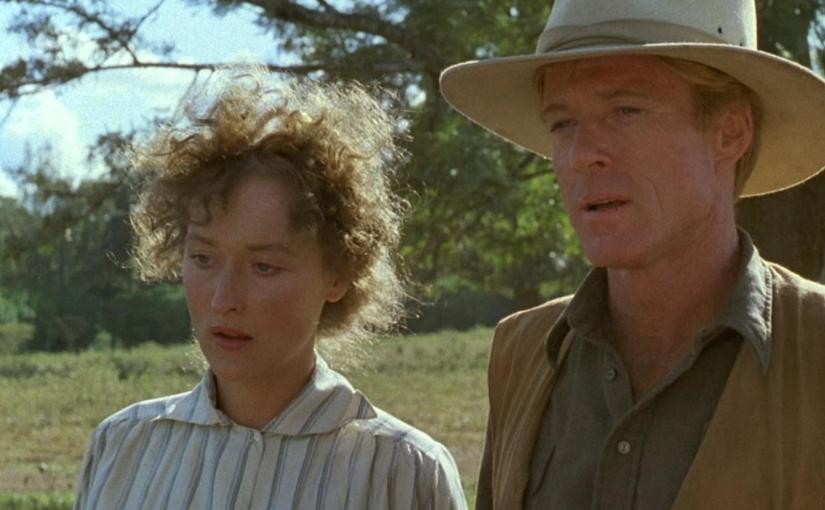
Sydney Pollack’s Out Of Africa might seem like a whirlwind romance if you’re only looking at the top billed names of the cast, Robert Redford and Meryl Streep, but it’s much more than that. It’s an education of the African continent beginning in 1913 when World War I was on the brink, and the British monarchy appeared to become territorial of its lands.

Karen Blixen (Streep) is a Danish Baroness who marries a Swedish nobleman, Baron Bror Blixen (Klaus Maria Brandauer) out of simple convenience. She plans to begin a cattle farm outside of Kenya to manage with Bror. To her unfortunate surprise, Bror has invested her monies in harvesting coffee on the land, which is much more difficult to produce at the altitude where they settle. Bror is also not so concerned with growing to love Karen and would much rather hunt on safari and be a womanizer, while welching off of Karen’s enterprise.

Karen grows to love Africa with its wildlife, as well as the local people whom she does not object to them squatting on her property. She provides medical aid and schooling for the children, too.

Karen also encounters the dashing adventurer, Denys Finch Hatton (Redford). Denys comes in and out of her life where he welcomes her on expeditions that are up close with lions and rhinos. He also takes her in his biplane to get God’s perspective of the lush scenery, a major centerpiece of the film. Denys, however, is not concerned with offering the full commitment Karen seeks. He’s happy to carry on with his safari treks only to return on occasion.

Clocking in at nearly three hours, Pollack’s film gives plenty of time and footage to absorb gorgeous landscape views of Africa from above and across the plains. The cinematography is on par with some of the best I’ve ever seen in a motion picture, compliments of David Watkin. The colors of sky with green, brown and yellow landscapes are breathtaking. Sunsets are spectacular with Redford’s silhouette in the foreground. Herds of cattle consisting of oxen, gazelles and lion feel so up close and personal. The production design of Karen’s home and coffee farm are also noticeably authentic. The home feels comfortable.

Out Of Africa is based on the stories told from Isek Denisen, Karen’s pseudonym. Like many of these sweeping epics, I find that I need to get accustomed to the nature of the film first. Dialects, when done authentically like Streep always strives for, are challenging for me to understand initially. The African people are hard to understand at times. As well, this is a period picture in a territory that I’m mostly unfamiliar with. So, I find that I have to adjust to the habitat and culture of the characters. Frankly, the first half hour or so was a little tough for me to stay with the picture. Once I got my footing with the film, though, I could not get enough. I felt terrible for Karen when she contracts syphilis. I was truly annoyed with how the Baron treats Karen with such disdain. It’s also heartbreaking when Karen and Denys are in disagreement with one another, simply because I loved the chemistry between Redford and Streep. Later setbacks feel tragic, especially as you feel like you’ve traveled through the progress and impactful differences that Karen affectionately made for Africa and its people.

Out Of Africa is an outstanding piece of filmmaking. It’s another example of a film where the setting is as much a character as the leads who carry the story. Sydney Pollack and his crew, which includes grand horn and string chords from Oscar winning composer John Barry present a captivating story that also feels rich in a documentarian point of view. A restored copy of the film on a large flat screen TV is a must see.

BACK TO THE FUTURE

By Marc S. Sanders

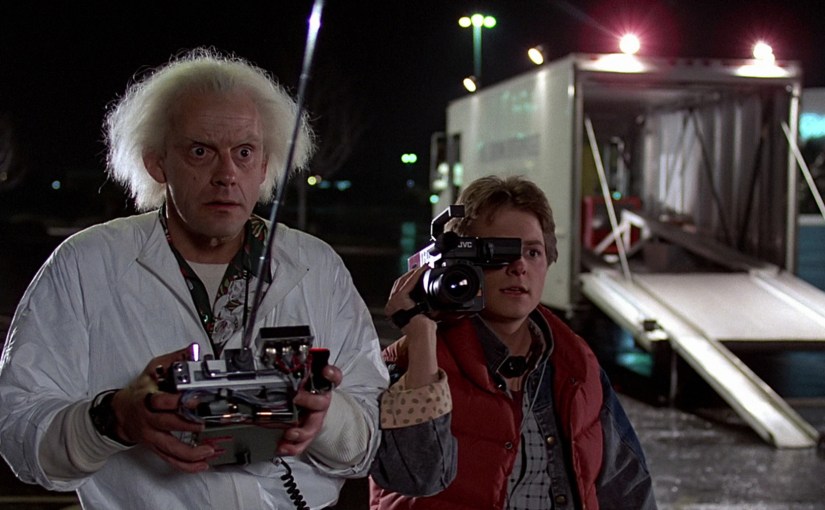
One of the best fantasy films of all time is Robert Zemeckis’ Back To The Future. No matter how many times I see it I’m astounded by the imagination and attention to detail that is invested in its script penned by Zemeckis and Bob Gale.

First, there is the set that stands in for the town of Hill Valley, California. To set up the film which took place in the film’s present shooting period of 1985, everything appears modern from Pepsi Free soda to Huey Lewis and the News and Marty McFly’s (Michael J Fox) parka vest.

Through a set of circumstances, when Marty travels back in time to November 5, 1955, suddenly the hit song is “Mr. Sandman” and his vest is mistaken as a life preserver. But look at Hill Valley!!!! Twin Pines Mall is now Twin Pines Ranch belonging to a farmer. A exercise workout locale is the corner diner where the future mayor is a waiter, and Marty’s domestic subdivision isn’t even built yet. Zemeckis and his crew are religiously faithful to observing the “science” of time travel.

His minister so to speak is Doctor Emmett Brown (a should have been Oscar nominated Christopher Lloyd; absolutely brilliant in his bug eyed, crazy hair, fun loving role). Doc’s time machine comes by means of a DeLorean automobile – perfectly sci fi like. Marty recruits the younger version of Doc to get him back to his present day, or Doc’s future.

Complications occur when Marty interferes with how his parents originally met thereby causing his mother, (Lea Thompson also superb and maybe should’ve been nominated as well) a teen at the time, into falling in love with Marty. Now Marty is at risk of being erased from existence, while his mother has the hots for him.

Complications are compounded endlessly in Back To The Future, and it’s easy to learn all that is at stake. That’s only the skeleton of the nominated screenplay. The dialogue works beautifully as well. Imagine telling someone living in 1955 that Ronald Reagan is President in 1985, and see how he’ll respond. The conservative culture of 1955 vs the free liberal lifestyle 1985 clash so well in the film’s comedy.

Outstanding performances make up one of the greatest casts of all time. It’s difficult to believe that Eric Stoltz was originally cast as Marty. Michael J Fox is so perfectly natural in his hysteria and cool, yet panicky, swagger. Crispin Glover is hilarious as Marty’s ultra-nerd dad, George McFly, and Thomas F Wilson is one of the top ten on- screen bullies of all times as the towering buffoon Biff Tannen.

Without question, Back To The Future is one of the most imaginative films ever made. It has wonder, comedy, suspense, song (yes…we even learn how Chuck Berry came to play “Johnny B Goode”), and brilliant characterizations. It is wholly original in its creativity. It’s fast moving, and it’s great fun.

Credit also goes to Alan Silvestri’s catchy orchestral soundtrack. It is magnificent in accompanying the adventure and misunderstandings that occur. You see the film once, and you never forget Silvestri’s music.

Back To The Future is a magnificent film that every kid should eventually see.

THE COLOR PURPLE

By Marc S. Sanders

Steven Spielberg’s production of The Color Purple, adapted from Alice Walker’s novel is an absolute triumph of the human spirit. It is evidence that physical and mental beatings cannot break a person’s determination to live her life to the fullest.

The film takes place over roughly forty years during the early part of the 20th century in the rural plains of Georgia. The community consists of African Americans who own property farm lands where men feel justified in requesting possession of young girls. Celie, along with her sister Nettie, are two of those girls. Both girls were molested by their father. Celie was forced to give up the two children she carried.

A landowner named Albert (Danny Glover) takes Celie to live on his property as a means for endless housework and upkeep, and to use as a disposal for his sexual gratification. Albert also violently forces Nettie off his land when she refuses his advances. The sisters are separated from that point on.

Celie in her teen years through adulthood is astonishingly played by Whoopi Goldberg, and this must rank as one of the greatest all time debut performances on film. Like most of Spielberg’s heroes, Goldberg looks perfect in the director’s signature close ups of light. Watch as Goldberg gives a radiant smile or a wise look from behind her glasses. Spielberg’s camera is owned by the protagonist.

Beyond that, is Goldberg’s performance. There are so many reactions to play with here. She is a victim to Albert’s cruelty. She only will address him as “Mister.” Yet, she’s also denied the right to any kind of personal value or confidence. Albert pines for a traveling lounge singer named Shug (Margaret Avery) who drunkenly calls Celie ugly when they first meet. That’s more crushing to Celie than Albert’s beatings. Perhaps because the observation comes from another woman of color and not a blatantly obvious cruel man. Later, Shug finds the undeniable warmth within Celie and in a tender moment together demonstrates the personal worth that Celie has, as well as how to feel treasured in a sexually intimate moment. It’s a major turning point for Celie who eventually builds up her own strength to fight back against Mister’s oppression, and declare her independence.

Contrary to Celie’s plight is Sofia (Oprah Winfrey in her own magnificent debut role). Sofia is introduced as nothing but solid strength. Nothing will topple her spirit. Not even Albert when he objects to Sofia’s marriage to his son, Harpo (Willard E Pugh), a weak man who only knows to resort to Albert’s ways with treating women. Albert learned his own means of abuse from his father. Sofia won’t tolerate any of that, and leaves with their son. Later, upon telling the prejudiced white mayor and his wife to go to hell with a punch, she is sent to jail for a number of years, blinded in one eye. Afterwards, she is forced to degrade herself as the personal servant to the mayor’s unaware and over the top, ditzy wife. This once immovable object to outside forces is absolutely broken.

In this rural south, Celie ascends from weakness to strength, while Sofia takes a very surprising and heartbreaking descent.

Spielberg offers gorgeous landscapes of wide open fields and grassy plains, particularly areas of purple flowers for the sisters to escape to and dance together. The flowers may have been delivered by God whom Celie resorts to writing to since she has no idea where her loving sister is located. Albert is cruel enough to hide Nettie’s letters from Celie. Spielberg has a few breathtaking shots of a perfectly round and orange sun, choosing even to close his film on that sun in the background of his final shot. His treatment of the sun in this particular film reminded me of his famous decor of a full moon in E.T. The Extra Terrestrial. There are a few parallels with both films. Broken homes and personal connections or the want for personal connection are thematic in both pictures. Celie is denied to be with her loving sister Nettie, or even to know her whereabouts. Elliot in E.T. is eventually denied his bond with his new alien friend. Through an earthly environment within nature do the pairs of characters within each respective film eventually get their personal moments together. When they’re torn apart from one another, it’s absolutely crushing. Spielberg has a way of putting you in the place of Celie and Elliot, where you can almost imagine those perfectly quiet and treasured moments you’ve experienced with your loved ones, and then the heartache of being torn apart from them. When those characters can be reunited at last it is an absolutely rewarding experience. It’s a moment when you cry tears of joy.

The Color Purple is inspiring for anyone suffering from loss or weighed down by what seems like the most insurmountable obstacles. There are thrilling scenes within this film that’ll make you applaud at Celie and Sofia’s will to lift themselves up and declare their freedom. It couldn’t be more evident during one of the best dinner table scenes I’ve ever seen. There’s a force of genuine power and might in that scene.

There are also great opportunities for laughter. Spielberg reminds you that humor and music, compliments of Quincy Jones and company, are part of what keeps us alive.

These women are told they are nothing and worthless. Their only purpose is to serve the men forced into their lives and to be used for unconscionable abuse. Yet Spielberg demonstrates with Menno Meyjes’ script that each time they are reminded of their lack of self worth, they are only made that much stronger.

Again, The Color Purple is a triumphant film.

AFTER HOURS

By Marc S. Sanders

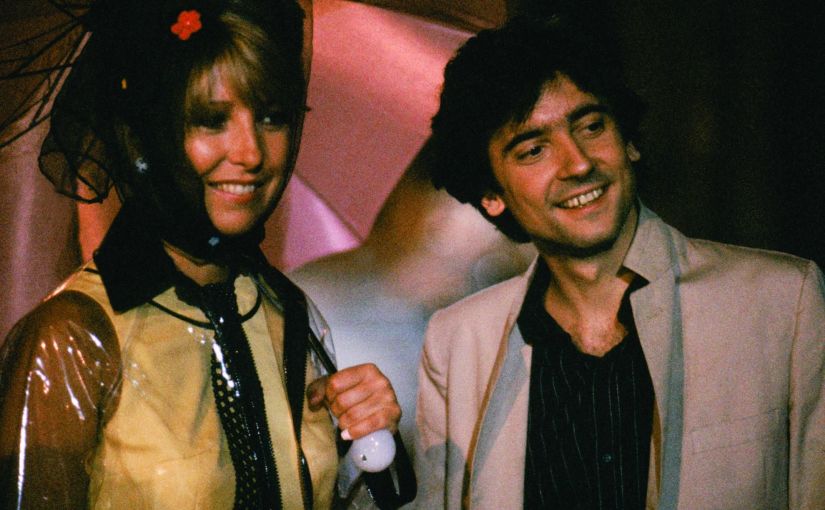
If L. Frank Baum’s classic fantasy The Wizard Of Oz were adapted in a setting of say 1985 New York City in the So Ho section, beginning sometime after 11:30 at night, then it would be a fair argument to change the name of his story to After Hours.  The story would no longer be whimsical. Instead, it would be screwball, with a disturbingly demented narrative from the brilliant but unsettling camera work of Martin Scorsese.  The protagonist would be a lonely yuppie named Paul (Griffin Dunne) who encounters one odd woman after another when all he intended to do was meet up with a kind and attractive young lady named Marcy (Rosanna Arquette) who offered the opportunity of obtaining one of her roommate’s specialty crafts of Parisian bagel & lox paperweights.  (Yes.  You read that description correctly.  Don’t overthink it.)  Unlike Dorothy from Kansas though, the oddballs that Paul meets up with become challenging to him even if they insist on welcoming him into their arms.  These women are not the comfort conveniences of a scarecrow, tin man or lovable lion.

How odd that this film from Scorsese would follow his masterpieces, Raging Bull and Taxi Driver; a major departure from themes of mental disturbance exhibited by characters like Jake LaMotta and Travis Bickle.  Here, the disturbance hinges on paranoia that eventually develops; not seeded in place at the start.  The film relies on absurd situations where Paul inadvertently gets in over his head when all he wants to do is return home and sleep. It quickly dawns upon Paul that it is likely not a good idea to go out after hours when a whole other kind of community is awake, that is uncustomary to his lifestyle.  I was waiting for the film, written by Joseph Minion, to tell me it’s all a dream.  My foolhardy mistake though.  Scorsese would never resort to such a tired, cliché.  If he is going to direct a film of the utmost ridiculous, then he’ll make certain Paul’s unfortunate outcomes are believable…even if they are hard to be believed.

If you’ve seen at least three of Scorsese’s films prior to After Hours, you’ll likely just fall in love with this picture based on his craft with the camera partnered with his always trusty editor, Thelma Schoonmaker.  Cinematographer Michael Ballhaus has his first collaboration here with Scorsese (before Goodfellas and Casino).  Conversations in offices or diners or apartments or bars occur, only they are more exciting than countless other exchanges of dialogue. You will be watching a film that does not sit still and always strives for your attention.  So, while Arquette’s character describes an ex-boyfriend’s obsession with the film adaptation of Oz, your director at play startlingly zooms in on her performance monologue and then circles back to Dunne, her listener on the other side of the table.  No standard quick cuts.  The camera circles and surrounds the players.  A set of keys dropped from a balcony straight down directly towards Dunne’s waiting face below gives an eye opening zoom thanks to Ballhaus’ techniques.

The developments that quickly fall upon Paul are not fair for him.  He loses his only twenty bill that he can rely on, gets caught in torrential downpours of rain, uncovers a suicide, becomes trapped in a punk rock club that wants to give him a tortuous mohawk, and a modern-day pitchfork mob equipped with flashlights and an ice cream truck are hungry for his head because they believe he’s a serial neighborhood burglar.  The poor guy can’t even make a phone call because a ditzy Catherine O’Hara revels in breaking his concentration to remember a phone number.  Teri Garr also appears with a bee hive hairdo as a waitress at an all-night gay diner vying for attention that Paul just can’t afford to give at three o’clock in the morning.  Paul just wants some basic help from anyone who can offer a simple gesture. None of it is that simple however, and the problems build upon one another until they are compounded upon his shoulders so much so that at one point, he literally cannot move out of the physical circumstance he ends up in.  Forgive my vagueness, but I wouldn’t dare spoil what that literally means.  You owe it to yourself to watch the film and find out for yourself.  My first instinct was to go “Come on!!!  Really!!!” Yet, then I remembered this is a film of daring escapes.  Still, Minion’s script and Scorsese’s film turn those breathless escapes into deeper depths of a So Ho hell, as the film proceeds to its inevitable sunrise.

After Hours might have been a subpar John Hughes comedy, only vaguely remembered from the decade of excess, the 1980s.  In Martin Scorsese’s hands though, it’s comedy pathos and yet frightening at times.  Only Scorsese can show us funny, yet bleak.  That’s okay.  It’s different.  I’ve seen the standard slapstick unfortunate circumstances of School Principal Ed Rooney in Ferris Bueller’s Day Off, and countless copycats thereafter.  Scorsese offers up a different, inventive, and very twisted approach for a typical victim of circumstances beyond his control.  

My recommendation for a double feature:  watch Neil Simon’s The Out Of Towners with Jack Lemmon and Sandy Dennis.  Then watch After Hours.  You may begin to understand how New York City can be a vicious and unforgiving beast with enough chutzpah to attack you, even if you never deserved any kind of punishment.  If you’ve ever found yourself in any kind of metropolitan city throughout North America, you’ll likely nod your head at what this poor guy encounters, and you might not feel so singled out.

PALE RIDER

By Marc S. Sanders

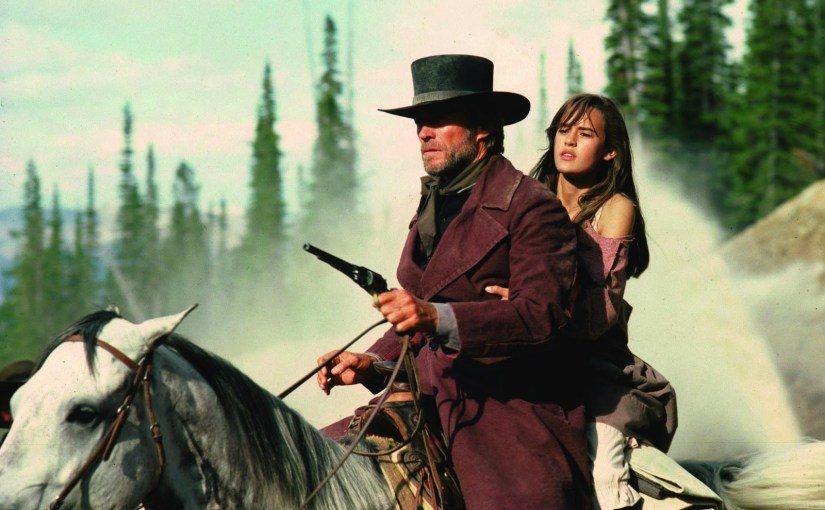
Clint Eastwood’s Pale Rider is more or less a simple western film with a storyline you’ve seen countless times before.  It’s an old west tale that has the The Magnificent Seven (or Seven Samurai) feel, but this might as well be called The Magnificent One, perhaps.

Pale Rider is nothing special in its assemblage to be another Hollywood western.  However, it’s delivery from Producer/Director Clint Eastwood is what kept me engaged.  Seeing it for the first time, nearly forty years following its theatrical release, I took great pleasure in recognizing the tough and intimidating persona that Eastwood became famous for in his spaghetti westerns and tough cop films.  The scowl and squint across his chiseled face are here along with his imposing height, with his black hat resting perfectly atop his head.  Eastwood knows how to capture himself on camera better than most any other actor/directors.  He capitalizes on his foreboding and intimidating presence.  He does it very well in Pale Rider when he points his camera at a distance down the dirt road where he’s saddled perfectly still upon his steed.  He does a shot like this as well in his Dirty Harry film, Sudden Impact, where he positions his silhouette against bright carnival lights in the background with his loaded gun held at his side.  This guy makes himself scarier than Freddy Krueger in moments like these, and in film history, the images are iconic.

Again, Pale Rider has all the trappings of what audiences used to love in Hollywood Westerns.  It has reminders of Shane and High Noon.  Yet, it’s a bit more brutal, because 1980’s cinema allowed that, and this film falls in the tradition of Eastwood’s continuous violent work at the time.  Still, that’s not why you watch an updated picture like this.  You take in Pale Rider as a Clint Eastwood vehicle.  The familiarity of Eastwood’s unnamed dangerous man that bad guys should’ve walked away from was treasured long before he thankfully segued into his anti-violent themes of films yet to come (Unforgiven, A Perfect World).  The point is that I recommend the film because…well…I’ll never tire of that scowl and squint.