THE TOWERING INFERNO

By Marc S. Sanders

The kid who played Bobby Brady of TV’s The Brady Bunch and Gregory Sierra (Julio from Sanford and Son) star alongside OJ Simpson and an Oscar nominated performance from Fred Astaire in The Towering Inferno. This is one of the best films to be churned out of the Irwin Allen disaster machine of 1970s movie making.

William Holden is the proud builder of a beautiful new skyscraper in the heart of San Francisco. Paul Newman is the sensible architect who manages to acknowledge what’s wrong the construction of the building. Namely, a jerky Richard Chamberlain, as the building’s electrician, opted for faulty, less expensive wiring that conveniently overheats on the eve of the building’s grand celebration that includes a Senator (Robert Vaughn) and the Mayor with his wife in a loud, baggy Pepto Bismol colored dress. Seriously, it’s never hard to make this woman out among a sea of formally dressed extras who are celebrating on the grand opening located on the building’s promenade floor. Floor number 135 to be more precise. Because it’s so high up, we are treated to a scenic, outside elevator that’ll eventually not make it to the ground allowing a couple of screaming extras to be held in treacherous suspense. Good stuff here, for sure.

Steve McQueen’s coolness eventually arrives as the main fire chief leading the high rise charge against the blazes. His Thomas Crown Affair co-star, Faye Dunaway, is here to cue the romantic rhythms of John Williams’ score, and to hop into bed with Newman for some afternoon delight.

The story is that Newman and McQueen were at odds for who was getting top billing. Watch the very beginning of the film for the inventive compromise for the name placement in the credits.

The real stars of this who’s who cast are the special effects. Now I truly mean this. Nearly fifty years later, and the visual effects of the massive fires, explosions, helicopter sequences, and enormous heights still hold up. There’s lots of good footage that burns up, crushes, floods and drops a handful of extras for a fast paced three-hour epic disaster flick.

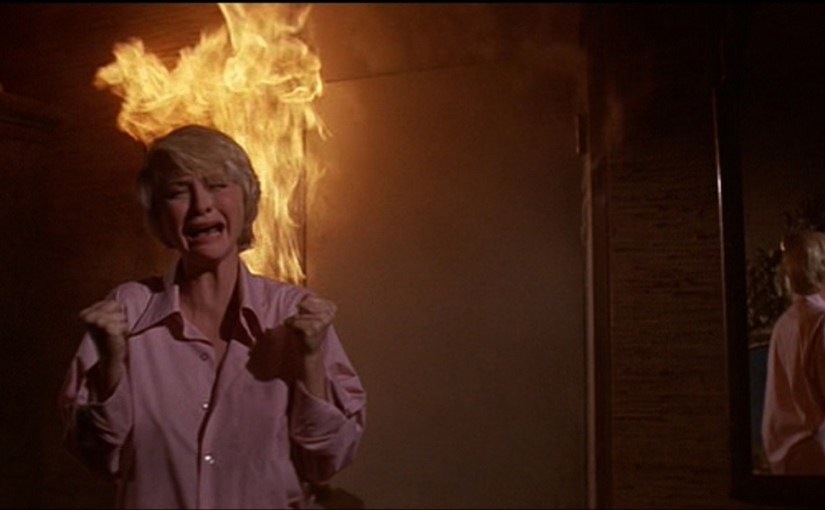
Astaire might have been the sole acting nominee but I just can’t get over how the debonair, prime for a Love Boat appearance with no hair out of place Robert Wagner didn’t get any recognition. This man puts just a damp washcloth on his head, promises his half naked sweetie that he’ll “be back with the whole fire department,” and sprints straight into the flames for the grandest death scene in film history. It’s a glorious scene for sure when Wagner buys it. I cheer every time I see it. The dude just face plants into the flames. Doesn’t even bend down or kneel to pray. This guy just topples over like a Jenga tower, with the washcloth remaining on his head.

The Towering Inferno amazingly did not beat out The Godfather Part II for Best Picture. I know. I’m stunned as well, reader. Uh huh! Nevertheless, it’s still worth a watch all these years later. If anything, you get to see some pretty eye-popping visual effects and action scenes directed personally by Irwin Allen. You also get to familiarize yourself with the best talent in Hollywood that was working at the time. There are also lots of great moments amid the soapy cheesiness of the script.

Most of all, and this is where I finally get sincere, it’s a film that does not make light of our country’s firefighters who continue to risk their lives everyday so that any one of us can survive. Not enough films embrace the proud men and women who stand between us and danger. The Towering Inferno salutes that immeasurable bravery.

ALICE DOESN’T LIVE HERE ANYMORE

By Marc S. Sanders

Martin Scorsese was destined to be a great director. No doubt about it. Look at 1974’s Alice Doesn’t Live Here Anymore. Not only does it offer an Oscar winning performance from Ellen Burstyn as Alice, but this early career film contains skilled tracking shots.

Scorsese uses his camera like a musical instrument. He times it to move on a certain cue. Near the end when Alice needs to pick up her 12 year old son Tommy (Alfred Lutter, well played here) from a police station, Scorsese is clearly on foot positioned behind the police counter. When the time is right, he walks it behind the cop and extras in a crescent step by step over to behind Alice. We are in the scene. It didn’t take much imagination, but Scorsese is economical for an engaging payoff. The camera continues to follow a young Jodie Foster as Tommy’s rebellious pal, Audrey and then after she’s quickly escorted out by her mother, it peers into the room where Tommy is waiting. It’s an unbroken steady cam moment that predates his classic tracking shot of the Copacabana in Goodfellas, or the bloody overhead outcome from Taxi Driver.

The story is decent, though nothing big. Alice is forced to flee following one set back after another with the men she encounters in her life. First she’s unexpectedly widowed from her unappreciative and cruel husband, next she encounters a charmingly young Harvey Keitel who sheds his first impression quickly. Then she comes across Kris Kristofferson but is he right for her?

The second half of the film inspired the basis for the classic TV show Alice, featuring Linda Lavin and Vic Tayback who plays Mel the cook in the film as well. Scorsese uses the diner sequences for some good laughs of confusion and slapstick with side characters Flo (scene stealer Diane Ladd) and Vera (Valerie Curtain, another scene stealer).

These are good characters here. You want Burstyn’s Alice to be happy and succeed as a mother to Tommy and become the singer she dreams about. She’s adoring. She tries, and she always works hard. Burstyn has some great moments of various range whether she’s feeling like a pestered mom driving the long highways, having anguish and fear with the men who cross her path, or when she’s singing Gershwin’s “I’ve Got A Crush On You” at the piano of a seedy bar. I loved her in the role.

This is not really a special movie. Yet, it’s an important one in cinematic history. See this film to see the master director when he was merely a pupil, exceeding what was likely minimally ever expected of him to accomplish.

Martin Scorsese is just a great director.

THE SUGARLAND EXPRESS

By Marc S. Sanders

Steven Spielberg’s second film, and first full-length theatrical release, is The Sugarland Express.  It’s inspired by real life events that consisted of a convict couple making their way to the Sugarland estate, located in Texas, to reunite with their toddler child living with foster parents.  Goldie Hawn played the mother, Lou Jean, who easily springs her husband, Clovis (William Atherton) from a pre-release penitentiary.  Clovis only had four months to go before a full release.  Once they’re out, they hijack a police car with the deputy driving and make their way across the state for Sugarland.  The rest of the police force, along with out of state authorities, are hot on their tail.  Pitifully speaking though, this becomes a long, drawn-out slow car chase.  It’s a pretty dim-witted story, but because it’s based on fact, well, some thought it’d make for an interesting two hours on film.

Unlike Spielberg’s first film, Duel, I didn’t find much inventiveness with The Sugarland Express.  If anything, it was likely green lit following what the director accomplished so well, at such a low expense, with his first film.  Car crash/car chase movies were also becoming trendy in the early ‘70s with Steve McQueen’s Bullitt becoming such a pioneering film of incredible automobile stunt work.  The French Connection would go on to win Best Picture a few years later with a centerpiece car chase to hang its hat on as well.  The Sugarland Express however is quite silly and very inferior to those pictures, though.

I was impressed with the infinite number of cars at Spielberg’s disposal and many of them get bashed up and crashed up in so many ways.  Yet, I grew tired of the novelty too.  The stakes didn’t seem so high with this film.  It is perhaps a film of its time.  After so many on the run pictures that were made with much better sophistication in the decades that followed, Spielberg’s film often feels unconvincing and unintentionally silly.  A funny moment occurs when Lou Jean needs to finally pee following miles and miles of endless driving.  The outlaws force the police led by Ben Johnson, in a nothing role with a big cowboy hat, to bring in a port o potty in the middle of an open field.  Cop cars are everywhere.  It’s clear as day outside.  Yet no one takes the opportunity for aggressive action.  Lou Jean gets to relieve herself.

As the pursuit carries on, Lou Jean and Clovis become celebrities, and crowds of townsfolk approach the car they occupy to lend them money and good wishes and even a pet pig.  Silly stuff mostly, but just not very amusing to me, and Goldie Hawn, who is normally a natural and adorable comedienne, is not very endearing here.  Lou Jean mostly screams in her redneck dialect and as a former beautician, styles her hair in the back seat applying endless amounts of hair spray to irritate Clovis and the deputy.

I didn’t find much camera work to impress me from Spielberg either.  I appreciated one moment in time however.  As the characters manage to hide out in an RV parking lot overnight, they watch an outdoor screening of a Roadrunner cartoon short out their back window.  Wile E Coyote falls victim to one of the Roadrunner’s tricks, and Spielberg captures a close up of Atherton with a foretelling expression of doom cross over his face.  It’s a nice moment that brought me back into the film, but then the ongoing themes of the film return thereafter.

I don’t care if it’s a true story.  I don’t care how ridiculously absurd it all amounted to.  The Sugarland Express was just noise for me.  Other absurdist stories of the 1970s, approached their subject matter better.  Films like Dog Day Afternoon whereas the ordeal continued to prolong, so did the mental exhaustion and desperation of the characters.  I’m afraid Spielberg just didn’t capture any of that here.

THE GODFATHER PART II

By Marc S. Sanders

The first film to use the number 2 (or Roman numeral II, in this case), in its title and the first sequel to win Best Picture is Francis Ford Coppola’s continuous adaptation of Mario Puzo’s Corleone family legacy in The Godfather Part II. It is worthy of all of the accolades it collected as an individual film. Yet, it does not best the first film.

Unlike the 1972 classic, Part II does not provide much character arc for anyone. We’ve already seen Michael (Al Pacino, silently ferocious here) change from good college boy and war hero to the evil puppet master Mafioso he eventually became. This film shows him exercising his threateningly murderous deeds as he works in conjunction with a sly Nevada Senator, a Jewish Miami mob boss (an excellent performance from Lee Strasberg) from the time of his father’s reign, and another mob guy from New York (Michael V Gazzo). We get a whiff of all these guys early on during a commencement celebration for Michael’s son. Coppola keeps this a running theme of grand openings in all three films. It’s a great method of introductions each time.

Following the party, an assassination attempt is brought against Michael. But who did it? Problem is this is where the foundation of the film is not so strong. It’s never really made clear who betrayed Michael. That’s a little bothersome.

Coppola depicts another storyline altogether with the early 20th century origin of Vito Corleone flawlessly played by Robert DeNiro who hardly speaks any English while communicating in a Sicilian variant of Italian. Young Vito immigrates to America following an escape from the Sicilian Don that murdered his family. In New York we witness his rise to power. Famed Cinematographer Gordon Willis washes out these flashback images to enhance a pictorial history accompanied by Angelo P. Graham’s art direction of early brick and mortar architecture and the muddy streets of early Little Italy, New York. It’s a time travel back to a historical age. It’s magnificent.

Back in the 1950s, Puzo and Coppola bring authentic fiction to real life history as Michael considers a go at a business enterprise in Cuba. However, will the rebellion uprising interfere with his plans, and what will it cost him? As well, there’s a great sequence where he has to testify before a congressional hearing in response to suspicion of criminal activities. Coppola used the infamous McCarthy hearing footage as inspiration for this predecessor to what C-Span would eventually look like.

Yet, there’s another story to become involved with as Michael must contend with his dim witted older brother Fredo. John Cazale is superb as the guy who wanted more but was limited by the influence of competing factions and his loyalty to his brother. Pacino and Cazale always had great chemistry together. A great conversation moment occurs in the third act following a terribly surprising twist. One of the best scenes in the film occurs on the porch of the Corleone compound.

More story elements come into play as Michael attempts to balance his married life with Kay (Diane Keaton). She’s pregnant again. Yet, what will that mean for the future of the family?

The sequel to The Godfather assembles another stellar cast. So good, that the film garnered three Oscar nominations in the Supporting Actor category alone (DeNiro, Gazzo, Strasberg) as well as a nomination for Pacino as Best Actor and Talia Shire (Supporting Actress) as Connie, Michael’s sister. That nom left me a little dubious only because there’s not much material for Shire to play with here.

Coppola’s detail is at the top of his game again. The film, like the first, feels like a true life biography.

Puzo offers heartbreaking moments, most especially in the film’s shocking end which leads to a flashback assembly of characters from the first film. That scene alone plays as a great reminder of what Michael once was before becoming the hideous monster that closes the story. Puzo’s whole Godfather franchise hinges on well defined, crushing tragedy.

The Godfather Part II is nothing short of mesmerizing and wholly engaging. You can watch it over and over again. It’s layered in rich storytelling and narratives that provide endless amounts of material for a family meant to be mired in secrets, deliberately hidden in the dimly lit rooms that Willis photographed.

It’s a treat to be the fly on the wall wherever Michael and his family move to next.

THE MAN WITH THE GOLDEN GUN

By Marc S. Sanders

Bond. James Bond going Mano y Mano against Francisco Scaramanga, also known as The Man With The Golden Gun.

Regarded as one of the least successful films in the franchise, Roger Moore’s second outing as 007, with Guy Hamilton directing his fourth installment, is really fun and devious.

Scaramanga (Christopher Lee) is former KGB who lives on his own island where he takes pleasure in carrying out gun duels with anyone up to the challenge. Professionally though, he works independently charging a million dollars to anyone requesting an assassination by means of his golden gun with accompanying golden bullets. Though it seems now the expert marksman is reaching out to Bond as a worthy competitor.

Bond doesn’t even know what Scaramanga looks like. So, he jets off to Beirut, then Thailand, Taiwan and eventually the villain’s own private island located in the seas off the coast of China. Also, there is Scaramanga’s latest toy, consisting of unlimited solar energy, a device he could sell to world powers globally for the highest bid while also bankrupting the oil industry.

Bond has encounters with a quirky henchman again. This time it’s a deadly midget named Nick Nack (Herve Villacaize, Fantasy Island). He’s a lot of fun as he teases both Bond and his boss, Scaramanga, in a fun house obstacle course as they carry out their best efforts to survive.

Two Bond girls (Maud Adams and Britt Eckland) allow Moore to balance the ladies in a hiding game within his hotel room while trying to keep them from running into each other. It’s light farce.

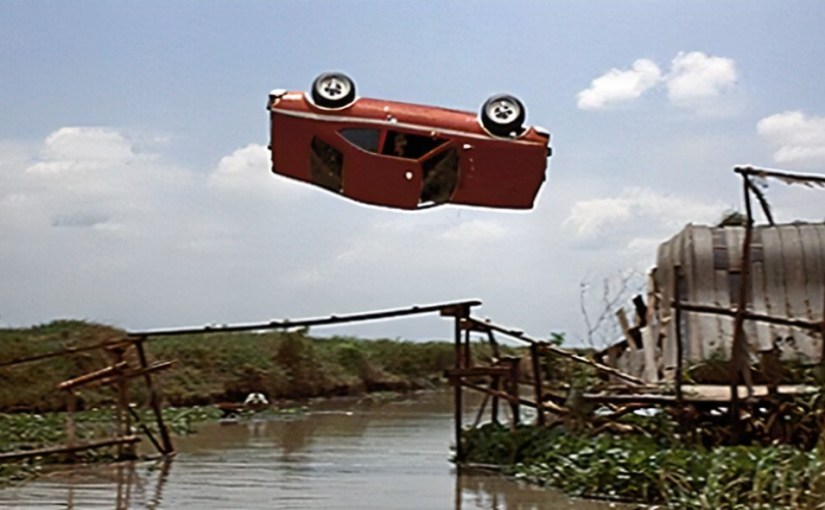
The Man With The Golden Gun also features one of the greatest automobile stunts ever captured on film, an alleyoop flip over a ravine with a broken bridge. Needs to be seen to be believed.

What keeps this film from highest of regard though is the return of Clifton James as Louisiana Sheriff J.W. Pepper for some cheap laughs that didn’t work when we saw him the first time in Live And Let Die. He’s a pest who’s contrived to show up in Taiwan of all places and coincidentally run into Bond again. Really? Seriously? There’s no reason for this annoyance to be here.

Still there’s lots of good moments including Bond vs two sumo wrestlers as well as fighting his way out of a deadly dojo with the assistance of some karate skilled school girls. Then there’s Scaramanga’s flying car which is extra cool.

007 embarks on an adventure that still holds up. Christopher Lee is loving his villainy and Roger Moore continues with the part well. He’s a sharp guy.

The Man With The Golden Gun is a film worth revisiting.