
MEAN STREETS

By Marc S. Sanders

I must not be that much of an intuitive movie watcher because I can not comprehend what is so fascinating about Martin Scorsese’s Mean Streets.

Robert DeNiro was hardly known at the time but he is certainly a scene stealer here as Johnny Boy. He’s the wild one with no concept of the danger he puts himself and his best friend in. Charlie is the much more respectable and well-dressed hoodlum. Charlie is played by a young strait-laced Harvey Keitel. Keitel & DeNiro are the strengths of the film.

Beyond the headline cast, the structure of Mean Streets is a very loose patchwork of random events that circulate around Little Italy, NYC. The soundtrack comes from side street buglers, transistor radios, and jukeboxes consisting of The Rolling Stones, The Sherrills, The Ronettes, and samplings of Italian opera. It lends to the setting as another character. For a Scorsese film, that’s all part of the plan. The setting talks back to you, or it’ll take your hand and lead you on. Martin Scorsese is a prophet of New York. He uses the grime and steam of the streets to his advantage (even if some of this film was actually shot in Los Angeles).

Still, I just don’t get this picture. It moves slow at times. Random meet ups occur and I found myself asking if we have met this character and that character already.

I give Scorsese credit, in one respect. He testifies that although the film is fiction, it is a direct representation of what he experienced during his own upbringing. I believe all of that. Again though, why couldn’t it all be pieced together a little more tightly? Had it been, I’d probably have taken more of an interest in the setting and the dangerous exploits of Charlie & Johnny Boy.

It’s okay though. I’m glad I watched it, nonetheless. I had seen it many years ago and I was excessively bored then as much as I am right now. Scorsese was destined for better things. MUCH BETTER THINGS.

THE STING

By Marc S. Sanders

Find me a better combination of script, cast, direction, score, art direction and costume and I guarantee it’ll take you some time and effort.

The Sting, directed by George Roy Hill and written by David Ward, is the kind of movie where you uncover something new every time you watch it. It’s because the film is all in the minute details to assemble the beginning to the middle to the end. The film is wisely edited in step by step chapters; The Set Up, The Wire, The Shut Out and eventually on to the satisfying The Sting.

The audience is even set up but you’ll have to watch to see how. I dare not spoil it.

Cars, trains, drug stores, diners, a carousel, dames, gangsters, Bunko Cops, Grifters; all are elements needed for the best confidence men superbly played by Robert Redford and Paul Newman, along with a supporting cast like no other, Eileen Brennan, Harold Gould, Charles Durning, Ray Walston, Jack Kehoe and the best villain, or rather “mark,” Robert Shaw.

This is one of my favorite movies. When I first saw it, I was probably age 10 or 12. I understand next to nothing of what was going on. It was the music that drew me in first followed by the sharp suits designed by the legendary Edith Head. The movie’s script is its greatest asset but visually it is just as fun. The 1930s Chicago setting is a character in and of itself. Newman cheats beautifully at poker against a temperamental Shaw, and gets him!!! “You owe me 15 grand pal.” When I first saw it, I didn’t know what he was doing or how he did it. How did he switch hands? I was enamored with the hands that were dealt and the poker chips on the table, but I loved it when the better cheat won out.

The second iteration of the Hill/Newman/Redford trifecta (following “Butch…& Sundance…”) is just plain fun. It was the fun that earned it a Best Picture Oscar.

No other film has come close to duplicating it. Maybe the Clooney/Pitt/Damon version of “Ocean’s 11”? I don’t know. However, if you love that film, you owe it to yourself to watch “The Sting.”

The Sting is…”the quill!”

LIVE AND LET DIE

By Marc S. Sanders

I dunno. For me, the suave sophistication with the tongue in cheek persona of James Bond doesn’t mix well with the ‘70s cinematic themes of Blaxploitation and island voodoo rituals with snake bite human sacrifice. Live And Let Die was never a favorite of mine in the series. Still, it has some merits; even pioneering moments that set the standard for the next 20-25 years of 007. The gadgets are getting cooler (like a handy Rolex watch with a super magnet and buzz saw) and better, more natural looking action.

Harry Saltzman & Albert Broccoli present a film where the action scenes are the most authentic yet. A car chase with a double decker bus doesn’t feature the background film scroll seen in the rear window of an automobile, like prior films.

There’s a particularly long sequence featuring a boat chase through the Louisiana bayou. Great stunts and well edited footage here, although it features one of the most annoying characters in the whole series, redneck Sheriff GW Pepper (Clifton James, who always played the same role like in Superman II and even The A Team). This scene is an absolute blast of fun as Bond commands a speed boat while trying to evade a handful of bad guys in pursuit. Cars are wrecked. Boats are wrecked, and a bride to be wails aloud as her wedding is ruined. It’s just fun.

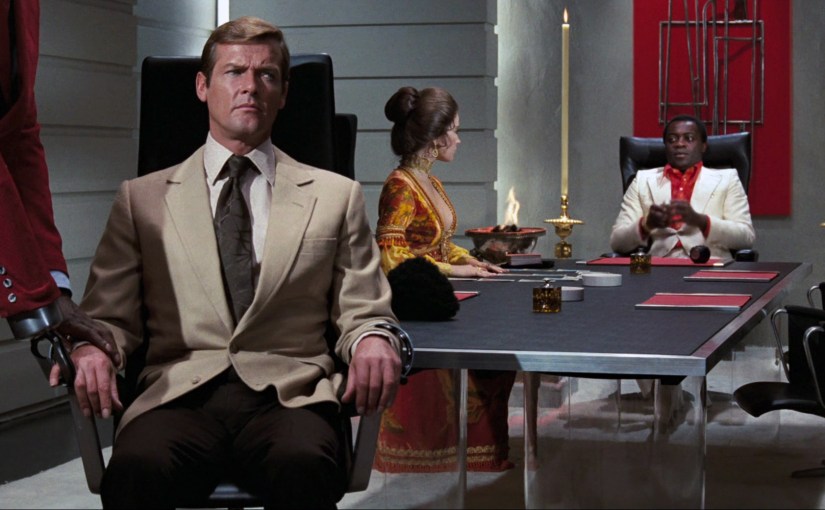
Roger Moore slips comfortably into the role of the Britain’s most celebrated secret agent. He’s handsome, for one thing, and his humor is dry enough that even in the face of death a pun is well delivered.

Yaphet Kotto plays Kananga, a far cry from the Cold War villains of Blofeld and Goldfinger. Turns out this guy just uses a couple of bars as a front for his heroin dealing enterprise while he dons a neighborhood crime boss image of “Mr. Big,” looking more like a villain of Shaft. He’s nevertheless good. Though he starts out the role quite subdued, he gleefully comes alive in the second half of the film when Bond intrudes on his secret lair.

Tom Mankiwietz’ script is lacking though. The pre title sequence gets me curious why three agents are inventively killed, but then the story mires itself in Kananga relying on Tarot card reading from the first virginal Bond girl, the High Priestess known as Solitaire. (Jane Seymour’s first screen role.) This offers no suspense or substance. We wait for cards to literally be turned over. Not exactly nail biting. Seymour is beautiful, but the intelligence and sex appeal of the character is flat.

There are also scarecrows and Caribbean island voodoo that are hardly threatening and belong in a horror film, not a Cold War era Bond adventure.

All of this weird material was twisting the series a little too far off course.

Live And Let Die does add a great henchman to 007’s rogue gallery; that of the imposing Tee Hee with enormous height and his steel lobster claw arm. He’s a fun bad guy that happily deserts Bond in a hungry alligator swamp.

Director Guy Hamilton’s third Bond film is not a total bust. It’s well cast in villains and Roger Moore is a perfect successor. Location shots of New Orleans and Jamaica (subbing for Kananga’s Caribbean island) are cool to see. The Harlem, New York footage really doesn’t belong here, though. It also has one of the best, most often played songs in the whole series, compliments of Paul McCartney & Wings. Again, it suffers however from a short sighted script.

Bond will be better served in missions yet to come.