A CLOCKWORK ORANGE

By Marc S. Sanders

What is Stanley Kubrick attempting to demonstrate with A Clockwork Orange, arguably the most controversial and shocking film of his career?  The film is considered an almost precise adaptation of Anthony Burgess’ novel.  I never read the book, but the sources I found on Wikipedia and IMDb are consistent with their claims.  Kubick’s vision is never not odd or strange.  It’s almost always repulsive and I have to believe the director is proud of the finished accomplishments left in every caption and scene.  Yet even Kubrick was disgusted by some copycat attempts that spawned from what the story’s protagonist troublemaker executes within this context.  Regrettably, in 2025, it would be easier to ask what did you expect Mr. Kubrick?

In a dystopian future of England, young Alex (age 17, but 15 in the book) relishes on walking the streets each night, accompanied by his three droog companions, committing the worst atrocities imaginable.  They beat up a homeless beggar, engage in gang brawling, and brutalize and rape a wealthy couple in their own home to the celebrated tune of Singin’ In The Rain.  I’m curious how reminiscent A Clockwork Orange is to people who only wish to watch the cheerful and innocent fare of Gene Kelley.  Is their subconscious intruded by Malcolm McDowell as naughty boy Alex with the one eyelash, bowler hat, protective jock strap and erection mask?

Mayhem is the specialty of Alex and his degenerate friends.  However, Alex who is the leader of the pack is challenged to uphold his command on the gang of four, and once the others betray him, the poor boy is sentenced to a militaristic, concentrated prison where he must don an academy uniform while studying the gospel of the Bible.  

What happens though if the student sees himself more as the Roman with the harsh whip, and less as the savior willing to die for our sins?  Are people like Alex only inherently wicked, vile, and perverted?  Can nothing change their insatiable appetites for harm and evil doing?

I thought about One Flew Over The Cuckoo’s Nest while watching A Clockwork Orange.  McMurphy fakes an impression of insanity to be institutionalized. He operates under the presumption the circumstances will be more accommodating than a jail cell.  Alex campaigns to be a guinea pig for a new kind of therapy believed to eliminate all temptations of violence and cruel sexual escapades. This could be a means to free him from a forty-year prison sentence. I never believed he wanted to be liberated from his appetite of rape, torture and murder, though.

Following an abundance of sickening, visual exposition, Stanley Kubrick is ready to test some possible outcomes by forcefully prying open the subject’s eyes to witness footage of violence, extreme rape, harsh pornography, and Nazi propaganda.  Will this overexposure repulse Alex away from being the monster he used to be?

I’m not sure A Clockwork Orange provides any definitive answers but the weirdness of this off scale and ugly England is nothing but apparent.  Nothing is normal looking or relatable in this film.  Everything from the colors to the costume wear to the slang verbiage of the dialogue and even the furniture is completely twisted.  Kubrick would offer a similar approach in The Shining. No director is louder and more offensive with colors in a film. A green bedroom ceiling or a blue typewriter or even a glass of milk and stark white sexually posed mannequins used as furniture pieces in a hangout joint are so much more than discomforting.

Even the infamous rape scene is uncharacteristically done.  The Droogs happily sing while brutalizing this couple.  Before Alex commits his “push in, push out” he scissors the woman’s red jumpsuit around her individual breasts before cutting her out of the fabric to be entirely nude.  I’ve seen plenty of staged rape scenes but then there is what Kubrick envisions. Not to mention, how notoriously redundant he is with repetitively shooting his scenes over and over again. Kubrick is an auteur filmmaker but his desire for perfection in his shots are as twisted as many of his films.

A woman is brutally killed by being pummeled with a sculpture of a penis/taint/anus piece. (I don’t know what else you call this!) A typical baseball bat, stick or hammer is not the bludgeoning weapon of choice. Stanley Kubrick wants to ensure this perverted item of art owned by a wealthy woman is used to commit the crime. A mix of sinful natures ranging from sexual to violent.

Why go to all of these lengths to be so unusual?

A Clockwork Orange is deliberately shocking and thus everything on display is disorienting.  With all the movies and TV shows I’ve watched, on top of some of the most unusual fetishistic material I’ve witnessed, I imagine I’m like most viewers where I’ve grown accustomed to the violent and sexual debauchery on display.  I’ve seen so much I am practically desensitized to it all.  When I read about another school shooting in the news, regrettably and with sick sarcasm, I’ll think to myself, “Huh!  Must be a Tuesday.”  It feels so wrong but there is truth in this ongoing epidemic. Stanley Kubrick, back in the early 1970s, had to work that much harder to grab the attention of the viewer.  Nothing can prepare you for an initial viewing of A Clockwork Orange. Back in 1971, I’d argue no one was prepared for this film’s content. It’s a pioneering document of extreme violence and sexual perversion. Filmmakers, like Martin Scorsese, David Lynch, and Brian DePalma hereafter would push their own limits while bridging these activities with the natures of their challenged characters.

Is there a confidence to seeing if a heathen like Alex can be cured of his original nature? Can he be returned to a society where his once menacing threat is nonexistent?  Plus, can Alex live a peaceful and nurturing life?

Alex is not the only villain to this piece.  While we do not get to know his parents well enough, how sadistic are the individuals behind his therapy process? Alex’ “recovery” becomes politicized and treated like scientific doctrine at the expense of his own humiliation. He is used to prove a point by beating him up publicly and forcing him to lick the bottom of a man’s shoe and exposing him to a naked woman, as well. Those that he encounters again, like former victims and fellow Droogs, following his therapy are not perfectly complimented to this new Alex. Scenarios that re-introduce him to society imply that Alex’ conditioning process might have overlooked what was to come following his release. Were they truly “healing” their patient?

A Clockwork Orange is never a refreshing film.  It’s always alarming right down to its final frame.  The picture certainly does not endorse the merits of psychotherapy or psychological reform.  Maybe, that’s why I believe that anyone specializing in the field of mental health should watch the picture. See what works and what doesn’t. Kubrick is uncompromising with getting his cast to do what he wants, no matter how off putting the material is. If anything, I wonder if this movie is more relevant today. Can anyone who traps themselves in an impersonal and isolated environment of social media influence attain the capability to shed their destructive proclivities for a natural desire to live, care and cherish fellow human beings?

Like most of Kubrick’s films, A Clockwork Orange is not an easy watch.  I know a friend who describes the movie as a comedy.  I know what she’s talking about and why. Still, how can anyone allow themselves to guffaw at someone who is an agent of death, torture, destruction and chaos? 

I don’t know what else I can say about A Clockwork Orange.  I do not recall asking so many questions in one review as I demonstrate here. Watch the film on mute or with Alex’ voiceover against an assortment of classical music as Kubrick intends simply because Alex’ only friend, only ally, is “Ludwig.”  No matter how you observe the piece, it is likely your jaw will drop, and your eyes will wince.  You will cringe and you will unquestionably test your tolerance.  You may just turn the movie off.

Regardless of how you respond to the picture, be assured that Stanley Kubrick successfully completed what he set out to do.
KLUTE

By Marc S. Sanders

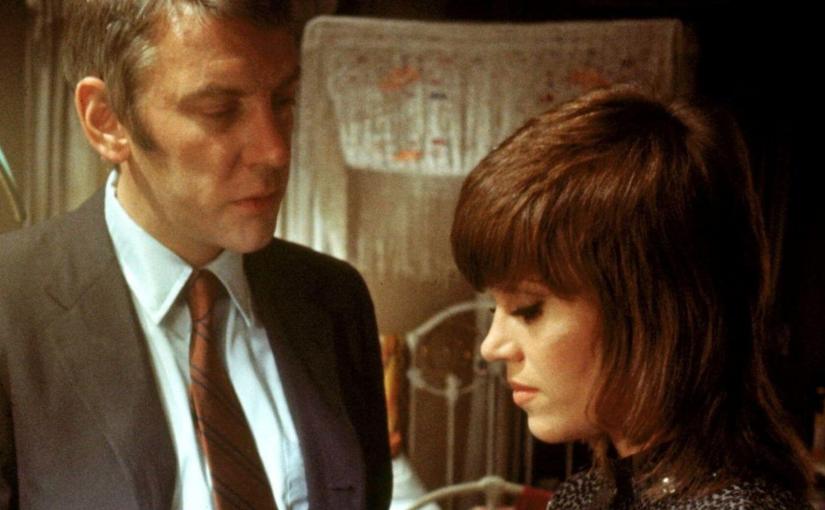
Perhaps Klute, directed by Alan J Pakula, was one of the earliest erotic thrillers to hit the cinema.  In 1971, with Jane Fonda portraying a call girl who briefly goes topless on screen, the daringness of the picture likely garnered a lot of attention.  I bet it was perceived as controversial and elevated the common murder mystery to a grittier more forthright and sleazier height.  Even John Klute, the investigator, played by Donald Sutherland, did not possess the theatrical disposition of a Sam Spade like Bogart or even a Jake Gittes that was just a few years away.  The case at hand in Klute felt real and disturbing.  The actions of the characters were unmentionable and unfathomable.

A highly respected married man named Tom Grunerman turns up missing.  The most unusual clue into his disappearance are letters found in his desk that were written to a New York City prostitute named Bree Daniels (Jane Fonda).  According to his wife and the CEO of his company, the letters seem out of character for a man like Tom.  Six months go by and there is still no sign of the man.  So, John Klute voluntarily goes to New York to investigate for himself while becoming acquainted with Bree.  

Bree is a very high-priced call girl who estimates she does between five hundred and six hundred calls each year.  She’s trying her best to step away from this lifestyle and work as a professional actress and model.  Yet, to uphold her means of living and to make up for the various rejects at auditions, she can’t help but return to what she’s best at.  Occasional visits to a therapist help her justify why she maintains this seedy occupation.  Various recordings of Bree’s observations and conversations with her Johns are about her regard for the profession. She claims that she is capable of catering to any particular vice a man might have. Most impressive is that she does not get turned on by the trysts she shares with these men. She also does not cast much judgment on whatever niche her various clients are into.  She’s positively cold to the demands of her job. Tom does not sound familiar to her, but he might have been the guy who beat her up a year earlier.  

I like the slow burn wait of this story.  A picture like Sea Of Love with Al Pacino works this way.  That’s a better movie though.

Donald Sutherland has significantly less dialogue than Jane Fonda.  He’s got a disturbing expression with large eyes and closed lips, not to mention a tall stature, that allows him to seem alert as an observer and a listener, particularly to Fonda’s character who is protective of herself even if she has much to say.  So, while the two get to know one another with Bree offering some possible leads for Klute to follow, there is an eerie and deliberately meandering pace to the story.  I knew I had to keep up my patience with Klute because an unexpected payoff would eventually arrive.

What bothered me though is that the twist of the mystery is revealed midway through the movie.  You brought me my steak before I had time to finish my salad.  Now, for the rest of the story I’m smarter than the characters and I’m only watching everything unfold. That left me feeling unchallenged through the whole second half of the film. Klute became boring and less inviting.

In 1971, this was a bold kind of picture though, not a common 1990’s erotic thriller like Basic Instinct or Color of Night.  It was seedy, unheard of and therefore fascinating.  At the time, the intrigue for a picture like this must have been off the charts.  Pakula even shows off how novel a tiny tape recorder was in 1971. Imagine what this recorder is capable of!

Had Klute been released today, I’m certain many would take issue with its final edit of story development.  I would also argue that a young Jane Fonda would never be accepted in a role like this.  Frankly, twelve years after this film, Jamie Lee Curtis was more convincing to me as a call girl in Trading Places.  Fonda’s inflection and voice of maturity just did not work for me in this role.  I did not find her alluring in the part, and I think she was too organized and educated to be Bree the call girl.  I was surprised to read afterwards that Jane Fonda won the Oscar for Best Actress for this film because I considered her miscast. Fonda’s voice always sounded overly patronizing to me.  I read later that the actress’s moments with the therapist were primarily improvised by Fonda, shot after the bulk of the picture was completed. Pakula honored her wish to shoot the therapist scenes later because Fonda wanted to have more of a grasp on this call girl character. The therapist scenes definitely look unpolished, particularly for the woman portraying Bree’s counselor. I could detect the improv going on before I knew that it was so. I was watching Jane Fonda, the actress, making a case for the research she collected to prepare for this role.  I wasn’t convinced Jane Fonda was playing the role, though.

The film provides moments where Bree is catering to a couple of clients.  Pakula is honest with his staging.  One client breathes heavily with nervousness about the trouble he’s about to indulge in and then there is the awkward business agreement between Bree and the man followed by the necessary construction of turning the hotel sofa into a bed. It’s weird and unromantic. All this business interrupting this guy’s ultimate fantasy. Very good direction by Alan J Pakula.

Another client hires Bree to pose like a woman from a pre-World War I era where she simply narrates a scenic moment from his past. He does not touch her. He does not undress. This old man from the city’s fabric district simply takes it all in, allowing Bree to do the heavy lifting while he remains stoic in his chair surrounded by the darkness provided by famed cinematographer Gordon Willis (The Godfather).  Still, Fonda seems out of place in these episodes.  Even her fear of a possible killer on her trail left me unsatisfied.  This woman always looks like she has it altogether. She arrives on John Klute’s doorstep in the middle of the night because she’s apparently haunted by what he’s pursuing and also, she’s getting prank calls at odd hours. Nevertheless, I’m still not convinced that Jane Fonda as Bree the call girl is truly shaken by any of this. Jane Fonda is just too put together and hardly evokes any convincing weakness.  

It is ironic the film is named after Sutherland’s character, Klute.  The story begins with his perspective.  I liked his detective.  Almost like the guy could’ve branched off into other stories, like Sherlock Holmes or Sam Spade or Mike Hammer.  The fact that the picture is called Klute leaves me wondering if a series of mysteries would have been paved for this character.  To my knowledge, I do not believe that ever came to be.  I’m sorry the trajectory of the movie veers off into Fonda’s character primarily when she enters the story.  Little is revealed about John Klute.  I only know his experience as a detective is limited, and he’s actually never visited New York City before.  Some interesting challenges for this guy, but none of this hardly becomes obstacles or factors for the rest of the film.  Much is learned about Bree Daniels, but hardly anything is absorbed about the title character, John Klute.

Klute starts off with a lot of promise.  I was excited to tag along with a new kind of brooding investigator who is impervious to influence and looks like he could not get easily overwhelmed. The mystery to uncover why a man went missing but not murdered is very intriguing.  My curiosity was there from the start.  Unfortunately, my interest dwindled as the picture carried on.  Jane Fonda talks a lot with not much to say and when the real culprit is unmasked at the midway point, my attention span is no longer demanded by the film.

Klute was likely a risky, pioneering kind of picture at the time of its release.  A sexy thriller.  Nowadays, it’s like any Saturday night midnight kill thrill of the week where the tempos are foreseen several minutes before they come to life.  Klute just loses its lust–ahem–sorry luster.

GET CARTER (United Kingdom, 1971)

by Miguel E. Rodriguez

DIRECTOR: Mike Hodges
CAST: Michael Caine, Ian Hendry, Britt Ekland, John Osborne
MY RATING: 8/10
ROTTEN TOMATOMETER: 87% Fresh

PLOT: When his brother dies under mysterious circumstances, London gangster Jack Carter travels to Newcastle to investigate.


While watching 1971’s Get Carter (Caine, not Stallone), I was reminded of so many other later films that I began to wonder what gangster/crime films weren’t influenced by Get Carter.  Throughout the picture, I could see hints and whispers of Bugsy, Beverly Hills Cop, Carlito’s Way, and the John Wick franchise, among others.  I probably missed some.  Maybe I’m wrong.  Maybe those films weren’t paying homage to the best British film ever made (according to a 2004 poll), at least not consciously.  But its DNA is there for anyone who knows where to look.

(To be sure, Get Carter was itself influenced by earlier authors and films.  In very broad strokes, the plot of Get Carter resembles The Big Sleep.  In both films, a hard, cynical man tries to get to the bottom of a mystery that no one else is particularly interested in solving.  They both even involve pornography, though to be sure that was more implied in the older film, while in Get Carter we are left in no doubt.)

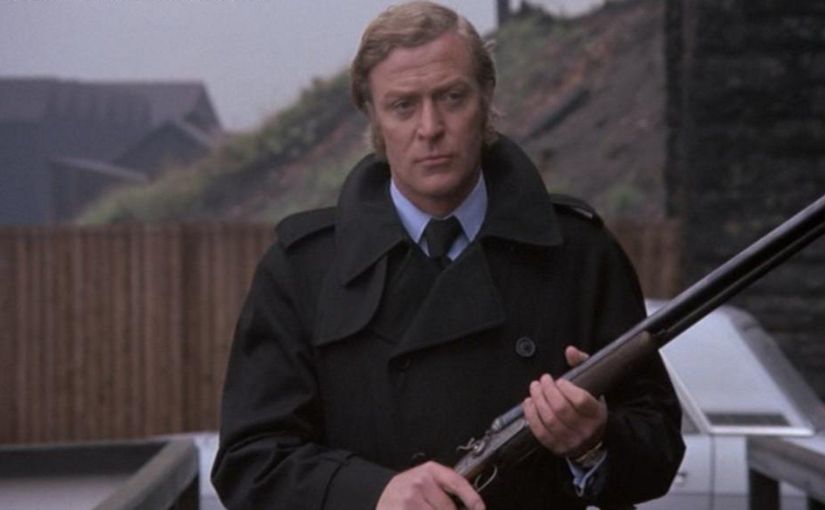
The tone of Get Carter matches its protagonist: cold, flat, uninflected, violent only when it has to be.  Michael Caine’s performance is a masterpiece of understated, simmering viciousness.  He only gets really angry a few times in the film, and he doesn’t smile, not genuinely, until the very end.  I read on IMDb that Caine’s intention was to show a more realistic, less sensational kind of violence than had been seen in earlier gangster films, “never using thirty punches when one would do.”

This is also an echo of a French film, Le samouraï, in which a professional killer shows absolutely no expressions the entire film, even with a gun in his face.  Carter is equally cool under pressure, as in the scene when he is surprised in the act of “lovemaking” (love has nothing to do with it) by two gangsters.  He registers surprise and little else, pulling a double-barreled shotgun from under the bed and, while stark naked, marching his would-be attackers out of the flat at gunpoint.  In a movie with little to no humor, there is a welcome double-take from the nosey next-door neighbor, not to mention the children’s parade taking place down the street.  (In this scene, there is something very Bond-like about Carter, mixing deadly danger with borderline slapstick.)

1971 was not a year for shrinking violets at the movies.  It saw the release of Dirty Harry, A Clockwork Orange, and The French Connection, among others.  Into this mix comes Get Carter with its casual violence and frequent female nudity, profanity, and so on.  Even so, there were a couple of moments that got a little shock out of me.  One was when a car is disposed of while Carter knows what precious cargo is in the trunk, but the bad guys do not.  Watch Carter’s utter impassiveness; he could have raised a warning, but he doesn’t.  There’s cold, and then there’s cold.  Another shocking moment is when Carter absentmindedly turns on a film projector and watches the amateur porn film displayed on the wall.  Watch his face again as he slowly realizes the identity of one of the actresses in this tawdry film.  A tear rolls down his face.  Because of what we already know about Carter, that tear doesn’t just mean he’s grieving.  He’s so boiling mad that I feared for the life of the woman in the next room.  It’s a great moment because of how rarely we see emotion on his face.

Get Carter is classic noir, just in color and with more adult situations.  Carter may not be a cop, but he has a code, nonetheless.  He absolutely will not stop digging until he solves the question of his brother’s death.  He defies his own bosses in London, ignores many warnings, survives several attempts on his life, but he just can’t help himself.  His obsession trumps everything else, just like Bogey in The Big Sleep or William Hurt in Body Heat.  There are hints of tragedy at every turn, but Carter presses on, whatever the cost, even if he thinks he might not like what he finds.  These are the qualities of any great noir hero, and Carter exemplifies them all.

***SPOILER ALERT AHEAD, YOU HAVE BEEN WARNED:***

I feel obligated to mention my reaction, at least briefly, to the film’s ending.  At first, I threw my hands in the air, much as I did at the ending of…well, another very different film from the late ‘60s.  But as I thought back to the events of the film leading to this moment, I had to shrug and say to myself, “Well…it’s not like they didn’t warn him.”  At least it’s motivated by something, and not just random fate.  I can accept it.  It’s not something you would see in a conventional Hollywood film today, that’s for sure.  Look at John Wick.

PLAY MISTY FOR ME

By Marc S. Sanders

Before Fatal Attraction and countless other stalker/possessive lover thrillers that continue to monopolize all kinds of entertainment mediums, there was Clint Eastwood’s directorial debut, Play Misty For Me.  Watching it for the first time in modern day, I can say that it pushes all the standard buttons of this kind of thriller formula.  The over enthusiasm of the mentally disturbed stalker, the uninvited appearances at inopportune times, the late night phone calls, and of course the knife wielding.  Nevertheless, I remain impressed with Eastwood’s interpretation.

Eastwood also headlines the cast as a late-night disc jockey named David.  Each night he gets a call from a devoted fan named Evelyn (Jessica Walter) requesting he play the jazzy tune, Misty by Erroll Garner.  Included in Dave’s regular programming are stanzas from poetry that he reads to his listeners and endorsements of favorite hang outs and bars that he frequents within the breezy coastal town of Carmel-By-The-Sea, California.  (Years later, Clint Eastwood would be elected Mayor of this community.)  Naturally, Evelyn shows up at one such regular hangout and the two have a one night stand under the presumption of no strings attached.  Of course, there would not be much of a film if Evelyn adhered to that policy.  Thus, the pattern begins.

Evelyn follows Dave around town.  She shows up uninvited at his house ready to prepare a steak dinner.  She’s knocking on his door in the middle of the night, naked under an overcoat.  There are phone calls along with disturbing, unexpected outbursts as well.  Complicating matters for Evelyn is that Dave is on his way to rekindling a romance with a former flame named Tobie (Donna Mills).  Then, it really gets frightening.

For a first time director, Clint Eastwood really shows some expert skill in Play Misty For Me.  The film opens with an overhead shot above the cliffs adjacent to the coastline, and then the camera circles around through the sky and finally zooms in on Eastwood standing on a veranda looking out to the sea.  It’s a glorious scenic shot and the director carries this theme throughout the course of the film.  A locale that impresses me is The Sardine Factory.  It is where Dave and Evelyn first meet, and Eastwood’s friend, mentor and often director, Don Siegel makes an appearance as a bartender.  The Sardine Factory is still there to this very day. 

Eastwood seems to offer a tourist guide and a photographic devotion for this quiet little town, and it contrasts well with the disturbing storyline.  Carmel-By-The-Sea seems like a comfortable and trusting area to live.  Therefore, it is all the more easy for an intruder to lay claim within the unguarded setting.  This film might be from 1971, over fifty years ago, but it makes me want to go visit.  We are treated to live footage at the Monterey Jazz Festival, and it does not overstay its welcome.  Eastwood’s film work is gorgeous throughout the whole picture. Particularly during a midway music sequence featuring Roberta Flack’s The First Time Ever I Saw Your Face, playing over footage of Dave and Tobie spending time and making love together. 

Jessica Walter is especially good in her role as the menace to this man’s livelihood.  She’s alluring and relaxing with her first encounter with Dave.  Then, she’s upended by the disruption and unwelcome halt of her romantic tryst and outbursts come from out of nowhere.  Eastwood lives up to the thriller characteristics of the film by the way he shoots Walter in close ups that appear with no build up.  He includes shots of her face and brunette hair in nothing but darkness with an agonizing scream.  It’ll shiver you.  It just makes Evelyn’s appearances even more shocking. 

The film that comes to mind when I watch Play Misty For Me, is Adrian Lyne’s Fatal Attraction from 1987.  I think that would be the go-to response for most viewers today.  However, it would be unfair for me to say I know what happens next.  Yes, I did know where everything was leading to.  However, Eastwood’s film is the pioneering installment, released years ahead of the other film.  I’ve always had mixed feelings about Fatal Attraction honestly.  I can’t take my eyes off it, especially because of the performances from Michael Douglas, Glenn Close and Anne Archer, but I frown heavily on the slasher ending that was pasted on to film.  Glenn Close did too.   Now that I’ve seen Eastwood’s movie, it astounds me how much Lyne’s picture lifts from the 1971 thriller.  Both films incorporate references to Madame Butterfly.  There’s a suicide attempt for attention.  There are phone calls and knocks on the door in the middle of the night.  There’s another lover who may be in harm’s way.  There’s an abundance of similarities in both films.

I have to wonder.  Should I now go back and revise my review of Adrian Lyne’s film? 

DUEL

By Marc S. Sanders

Duel – Steven Spielberg’s first full length film which he directed in 1971.  While it was originally a television movie in the United States on the ABC network, the feature made its way to European cinemas after Universal requested that Spielberg shoot additional scenes to bring the running time up to at least ninety minutes.  The final product still holds as a tight and intense depiction of nail biting, paranoid suspense.

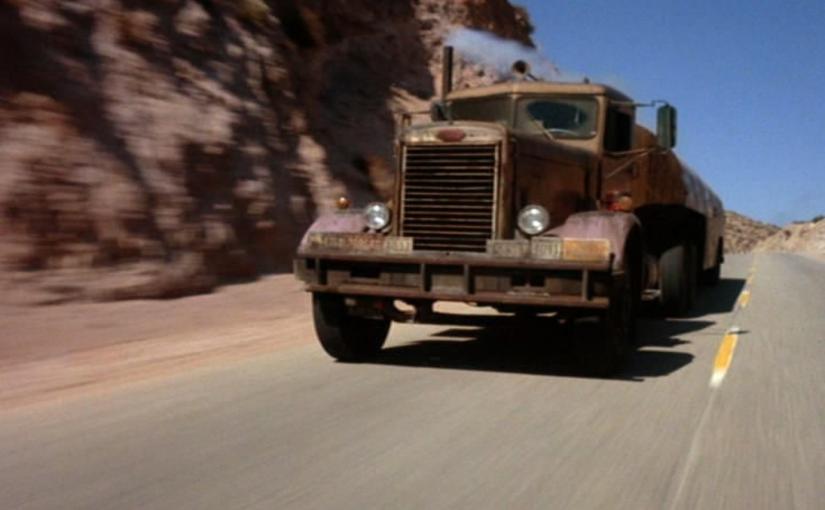
The story couldn’t be simpler.  A sales man (Dennis Weaver) driving a red Plymouth sedan across a never ending California highway comes up behind a grotesquely, offensive looking, smoking oil tanker.  He takes it upon himself to pass the truck on the left to continue his journey to his next appointment, and either a road rage from the unseen truck driver, or just a need to play cat and mouse begins.  No matter how fast and far the man’s car goes, the hulking, angry truck is terrorizing him to no end.  The truck will tailgate the car, or cut it off, or even just wait silently up ahead as the car continues on its path.  The salesman cannot understand the madness behind this unexpected scenario. 

As a film lover, what’s most fun about Duel is easily recognizing Spielberg’s attempt of building fear within his audience.  Steven Spielberg always has a unique approach to thrilling audiences.  He believes that what you don’t see is scarier than what you look at plain as day.  Like his eventual third feature film, Jaws with the submerged great white shark, along with Close Encounters Of The Third Kind and the unknown aliens that are blinded out by colorful light, or the hidden dinosaurs of Jurassic Park, and even Saving Private Ryan with the gear, grinding, at first unseen, German tank that occupies the final act of the film, with Duel you may get a look at the monster at play but you never get to meet the mind of the monster.  At best all that you see of a sinister truck driver is his left arm waving out the window or his cowboy boots.  Soon we learn that left arm is only baiting the salesman to drive into oncoming traffic destined for a violent collision.  (The shark’s fin in Jaws teases its hunters into similar kinds of danger as well.)  Otherwise, this mysterious truck driver has no dialogue, and expressions of evil come through close up and advance shots of the “face” the front of the truck seems to have with a long snout like extended hood for a nose/mouth and the dirty windshield for its eyes.  This approach alone is what keeps you glued until you reach the picture’s climax.

After the man is driven off the road the first time, Spielberg depicts the protagonist’s fear with a long hand-held camera that follows him walking from his crashed car into a diner across the street, past folks eating lunch, into the wash room and then back out again, only to end the shot on the enemy truck resting outside the restaurant as if it is waiting for its new found prey.  This truck is as scary as Spielberg’s shark or his dinosaurs.  The film was made long before the age of Steadicam, and this moment serves as a masterful sequence.  The poor guy is a stranger in an even stranger situation, and because none of us have seen what this terrorizing truck driver looks like, we are no wiser than this guy who is being victimized.  A voiceover of his thoughts plays out where he tries to reason with himself if what he did is so bad, or perhaps it’s all over and this crazed driver will let him go on his way now, or which one of the men sitting at the counter could possibly be the driver of this rusted, greasy, metal monster.  Even if he wanted to, the salesman can’t reason or negotiate with his new found enemy.  The paranoia is very real. 

Reading up on the background of Duel, many film critics and admirers seemed to have found certain symbolism with the film ranging from comparisons of status symbols of the car vs the truck, or between the two drivers.  The salesman’s name is David Mann. Is this biblical perhaps, like David vs. Goliath? Plus his last name is so simple – Mann. Observers even took note of a small early scene where the salesman has a tiff with his wife over the phone.  When he hangs up, the wife is long gone from his mindset and he’s left on his own to survive anything that comes his way.  I, however, didn’t regard the picture with much depth other than that Spielberg shot a taut film in just 12 days.  I didn’t need to look for much else.  My heart was racing.  My curiosity to see the truck driver stayed hungry and my need to know how or if this poor guy was ever going to escape this daylight nightmare persistently held strong.  

As well, I was amazed at the camera work on display.  No two shots of the vehicles appear the same.  Spielberg positions his camera on a low moving motorized crane (first used in the film Bullitt) to keep pace with the truck for upward facing perspectives.  He’s got overhead shots, perspectives from the rear and the sides and then of course the front with zoom close ups to bring a visual, frightful roar to the big rig.  The Plymouth also has its own blend of camera work that’s very effective.  Dennis Weaver as the salesman is seen looking in the rear-view mirrors.  Spielberg captures paranoia from inside the car underneath the steering wheel looking up and next to the actor from the passenger side or from the back seat.  He’s got close up shots of Weaver in sweat inducing paranoia.  For a car chase picture, every sequence looks new and different from what you see earlier in the film.  A young Steven Spielberg was always reinventing himself.

Though the film was made 50 years ago when the term “road rage” was not even thought of, the situation seems all too real and quite possible when watching it now.  The man relies on telephone booths or stops at gas stations to try and help his situation.  Not much good comes from that though.  Had Duel been made today, the car driver would use his cell phone and he’d likely drop it by accident or the battery or signal would die.  The point is at given moments in life, we are all left to our own devices and completely alone.  On a lonely, endless highway help is not necessarily something to count on.  Police cars are not to be found at any given moment.  The man finds opportunities to see if locals or another passerby could help, but no one is so inclined.  How often do you help a stranger that comes upon you on a desolate road?  So, you are left to fend for yourself where a vicious beast need not concern itself with the boundaries of law or morals.  The second half of Jaws would follow this theme as well.  Out in the middle of nowhere with no one around, what do you do when it only comes down to you and the terror that hunts you?

I believe Duel is essential viewing for any film lover.  More than standard schlock slasher films, Steven Spielberg’s film offered the new wave of presenting an effective thriller like Alfred Hitchcock had built his reputation on.  There’s nothing supernatural in this film.  This could happen at any given time.  People face insurmountable bullies or challenges that are never welcome and the strength of ourselves is tested when we realize we need to overcome these obstacles alone, without a hand to hold or a guide to steer us to safety.  It happens when we lose a loved one.  It could happen in a boring office job when the work is piling on or during finals week in school or while driving on a lonely stretch of highway.  When the challenge does occur though, and you are unfairly never given all of the facts, how will you react?  What will you do?

THE FRENCH CONNECTION

By Marc S. Sanders

Popeye’s in town.

“You been picking yer feet in Poughkeepsie?”

One of the first gritty crime dramas.

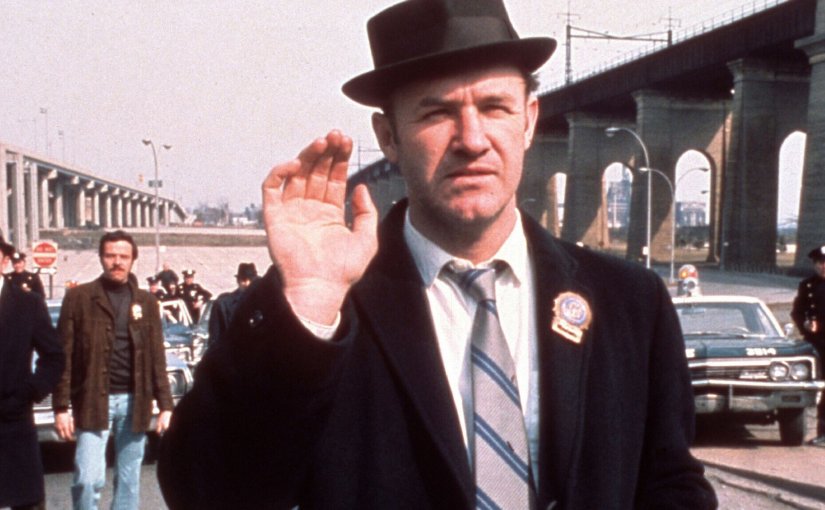
With modern cinema offering huge bravura performances a la Daniel Day Lewis or Christoph Waltz these days, it’s any wonder that today’s generation of movie goers would be puzzled that Gene Hackman won the Best Actor Oscar for this film, The French Connection, which also happened to win Best Picture. His character has no big monologues, no huge crying scenes. In fact for most of the film, he’s slamming guys up against a wall or following them up and down the dirty Brooklyn streets. Yet, his accolades were nothing short of deserved.

Watch as Hackman’s Popeye Doyle gradually exhausts himself in pursuit of “Frog 1.” His character starts out as a thrill seeking detective only to find his limits pushed against a better cat and mouse player. Dialogue isn’t sophisticated here to show his state of mind, but rather his expressions offer everything. Simply look at his close up following the extensive car search (an incredibly satisfying scene for me as a viewer).

If that’s not enough, the car/foot chase through Brooklyn is one that still has not been matched. See how it was done before CGI.

A simple drug deal is plotted perfectly from Marseille to New York, and best of all, it is all true (well mostly).

What’s most curious is the film provides one of the oddest and most unforgiving endings in a film ever. Perhaps you’ll agree (????). But, remember…THAT IS HOW IT HAPPENED!!!!

This was a film from 1971 that was raw in its language, gritty in its setting, spiteful and unafraid of the image it would leave, and that is why it won Best Picture, Best Director and Best Actor.

Bottom line, it would never have been made today. Never!

(Word of advice, ignore the sequel. A prime example of Hollywood shamelessly cashing in.)

THE LAST PICTURE SHOW

By Marc S. Sanders

Peter Bogdonovich’s classic adaptation of Larry McMurtry’s The Last Picture Show is a display of the ends of things that perhaps at one time had life.

The film opens on the main street of the fictional town of Anarene, Texas in November 1951, just as the Korean War was occurring.

A strong gust of wind blows while a mute, mentally handicapped boy fruitlessly sweeps a dusty street, and a junky pick up truck careens down carrying Duane Jackson (Jeff Bridges) and Sonny Crawford (Timothy Bottoms); both on the brink of adulthood with no future in sight. Anarene is a town that has a past and only a few remnants of a present represented by a pool hall, a diner and movie house. All three are owned by Sam “The Lion” (Ben Johnson in an Oscar winning performance). Sam is old and wise. The town speaks through Sam, who is well aware nothing of promise is offered here anymore. So it’s no surprise that all the remaining townsfolk can occupy themselves with are their televisions and sexual conquests.

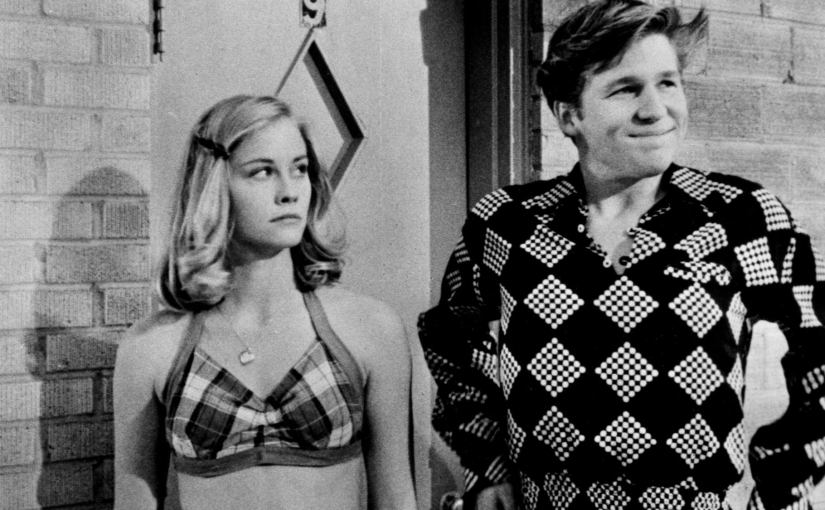
Variations of perspectives that are sexual in nature continue to symbolize what is dying in Anarene. Cybill Shepherd in her very first role portrays Jacy, the pretty girl. Her innocence will be lost as soon as she gives away her virginity. It matters little to her how that happens. Bogdanovich offers a great scene where Jacy attends a swimming pool skinny dip party. Jacy is pressured into standing on a diving board to undress in front of the revelers. I looked at this moment as a teetering balancing act. Jacy is bordering saying goodbye to her youth forever. She does undress all the way only to almost trip off the board. For the moment, Bogdonovich saves the character’s present state as she narrowly avoids falling in the water.

Later, on a whim during New Year’s Eve, Sonny and Jackson go off to Mexico with little money in their pockets and no plan in mind. When they return, an unexpected turn of events has occurred. The fate of this town is withering away with the breeze that’s always intruding. The mute boy will occasionally sweep the street again but accomplish nothing from it.

The films in the movie house represent those that were once celebrated but are now almost never noticed as these families are becoming more glued to the next common household appliance, the television with variety hour shows.

The music never changes or grows up. Hank Williams Sr, occupies the minds of folk who maintained this town at one time and are slowly dying off. The next generation does not have much appreciation for it.

I could go on. Every scene in The Last Picture Show brings about another example of an ending. Bogdonovich was meticulous in his symbolic method of McMurty’s story.

I love that the film, released originally in 1971, was shot in black & white because it shows the story in a historical context; this is what’s left of what once was. The sexual situations don’t hold back in nudity. It’s wise as I thought the nudity clashed with the black & white; it was almost intrusive. The nudity is overcoming the home life heartland that small towns like Anarene used to be remembered for. Sadly, the characters have a hard time accepting this fate.

Cloris Leachman portrays Ruth Popper, the wife of the high school coach who she suspects of being gay. She engages in an affair with young Sonny and her big moment comes when she frustratingly throws a coffee pot at the wall in a rage. She’s terrified that Sonny could never retreat to her pace of life. He’s apt to move on from her. She’ll be stuck with a closeted gay husband in an unstimulating environment. Time has become stagnant for Ruth within the confines of a lifeless marriage and a dead town.

A new way of life awaits. Destiny for Jacy, Sonny and Duane do not include Anarene in their plans.

Eventually Sonny and Duane attend a showing of John Ford’s “Red River” featuring John Wayne. The next morning, after the movie house has closed forever (no one buys tickets anymore), a new fate awaits, maybe even death. Worse yet, maybe for one of them, there is no fate. Maybe, for one of them all that’s offered is an absence of life while residing in Anarene, Texas.

I didn’t realize how much material I absorbed until after The Last Picture Show was over. Peter Bogdonovich provided more for me to think about then I was aware of. The initial slow pace of the film seems mundane at first until you understand that people like Ruth and Sam have memories they experienced but will never carry forward. It’s sad. Their history had meaning at one time. The legacy of their past, however, has no future.

The Last Picture Show is on AFI’s 100 best movies from 2007. It deserves to be as Bogdonovich deftly shows how a past withers away from a nowhere future. His set pieces and direction of characters show the suffering they endure with an unsure end they can not escape.

I haven’t stopped thinking about The Last Picture Show since it ended.

DIRTY HARRY

By Marc S. Sanders

The very first R rated film I ever saw was Dirty Harry. I was probably 7 or 8 when my brother introduced me to it, and it eventually led to my first R rated film to see in the theatres, Sudden Impact, the fourth film in the series.

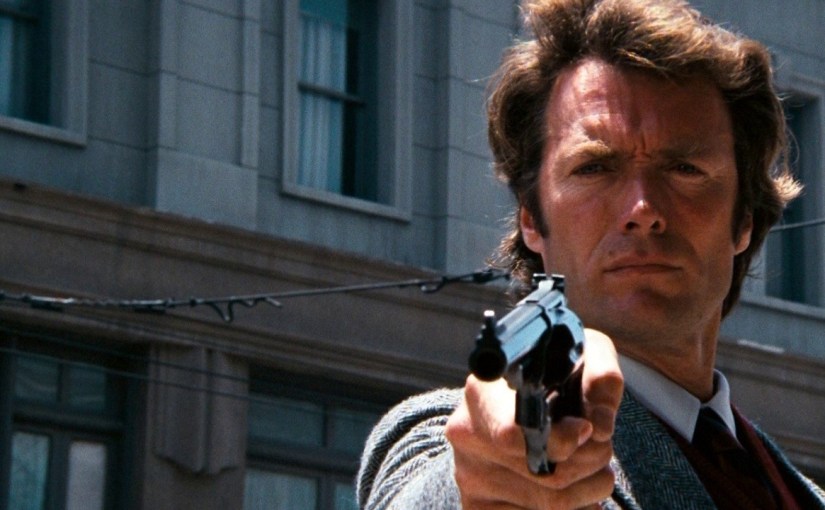
The original installment had such an influence on me, and it remains as one of my favorite films. I did not necessarily understand at the time the complex, albeit simplistic summary, of the law and the barriers Harry Callahan breaks to get the bad guy. I was more impressed with the 44 Magnum he carried and sociopathic behavior of the serial killer, Scorpio.

All these years later, followed by numerous viewings, and I’m just grateful director Don Siegel’s film was actually made. Had it been considered today for a treatment, it would have never come to light. The film is too candid and frank in its liberties of racist undertones and the underworld of a seedy San Francisco during the 1970s. Harry just didn’t care about the sensitivity of any demographic. He also just didn’t care about what was at stake to capture a hardened, dangerous, apathetic killer. Arguably, and only in the fictional world of film, audiences were probably grateful for that. Cut the bullshit. We all know who the guilty party is. Let’s get him off the streets, regardless of what is mandated to avoid any further loss of life. At least through the first 4 of the 5 Dirty Harry films that has been the common theme. (I’m especially fond of Magnum Force for challenging Harry’s own code of law enforcement. There are great debates to think about in that film.)

Dirty Harry is a deliberately ugly film. Siegel shows the worst of people at times, including Harry. Yet, there are sick people on the streets like actor Andy Robinson’s Scorpio killer that treat murder, mayhem and extortion as a twisted game of insane pleasure. Robinson was perfect in this role, a precursor I thought for Heath Ledger’s Joker many years later. Only a guy like Dirty Harry Callahan is right to nab a guy like this.

The film offers great moral questioning on the rights of men whether they are clearly the culprit or not. Miranda and several amendments are appropriately referenced and questioned. Is it ever appropriate to exercise brute force on a suspect? Can a near impossible scenario justify any actions of that measure? “Well then the law’s crazy,” Harry says. Even by today’s standards you can’t help but wonder if Harry is right.

What would be Harry’s opinion of today’s ongoing theme of domestic abuse among NFL athletes? Fair trials, and innocent until proven guilty are necessary but (at least this is how I feel) the circumstances of these stories make it abundantly clear that the guy did it. He beat his girlfriend into oblivion. The evidence is so much easier to uncover these days. It’s easy for me to say this from the comfort of my own home and not on a jury box. What would Harry think? He always knew to see beyond the bullshit. Heck, if I ever got a chance to interview the guy, all he’d probably tell me is get out of here. He’s got work to do. Harry Callahan was never up for sharing anyway.

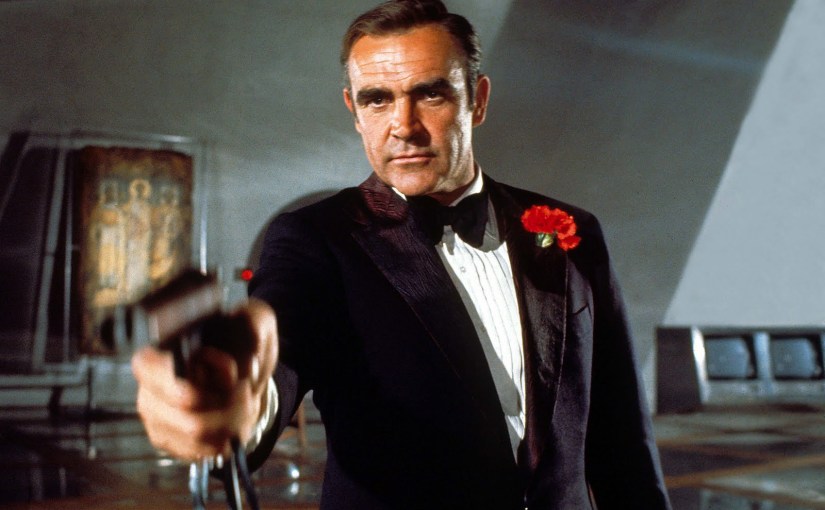
DIAMONDS ARE FOREVER

By Marc S. Sanders

Director Guy Hamilton (Goldfinger) returns to helm Sean Connery’s final portrayal of 007 in the EON Productions series with Diamonds Are Forever. Unfortunately, this film doesn’t even come close to measuring up to Hamilton’s prior effort.

Little regard is offered to the shocking ending of the prior installment, On Her Majesty’s Secret Service. A quick opening has Bond tossing Blofeld (head of SPECTRE, here played gleefully by Charles Grey) into a lava pit. Following Shirley Bassey’s pretty good theme song, 007 is assigned to acquire diamonds that are getting smuggled from the mines of South Africa and intercepted by a beautiful American red head named Tiffany Case (Jill St. John, who is pretty fun in the role). Only problem is that nearly every person the diamonds pass through ends up dead by the homosexual henchmen Mr. Kidd & Mr. Wendt. Considering the sexual tête-à-tête the Bond films became known for by the 7th film, Hamilton and company play up these guys like a weird joke in their inflection with one another, and even the fact that they hold hands at times. The music resorts to a mischievous note on the saxophone. In 1971, this might have held for a good laugh. In the PC era, it really doesn’t feel appropriate to imply these assassins are disturbing simply because they’re gay.

Eventually, the pursuit of said diamonds moves to Las Vegas where some silly Smokey & The Bandit (which was not even close to being released yet) humor occurs. Bond pilots a moon buggy through the Nevada desert while cars that are chasing him fall apart and flip over against the sandy terrain. More silly car chases happen in the heart of Vegas. The sheriff and his men are turned into Keystone Cops. It’s a little too much slapstick actually.

Still, why the need for the diamonds and what does a mysterious, unseen, wealthy man named Willard Whyte (Jimmy Dean) have to do with it?

Bond films work best when the villains work. There’s not much given from a powerhouse villain here like there was in Goldfinger. The necessary shootout ending occurs on an oil tanker this time, and Bond is hardly threatened or under much duress. Thus, killing any kind of suspense.

Connery is fine but you can also tell his commitment is hardly in the role. He’s working just enough for a paycheck-reportedly collecting a record million dollars to return to the role one more time.

By the time the film ends, you feel ready for a drastic change in the franchise. The ‘60s camp is over with. Disco seventies is here. So you wish that 007 can make a smooth transition to the changing cultural times. We would have to wait and see what producers Harry Saltzman & Albert Broccoli could do next to reinvigorate the franchise.