
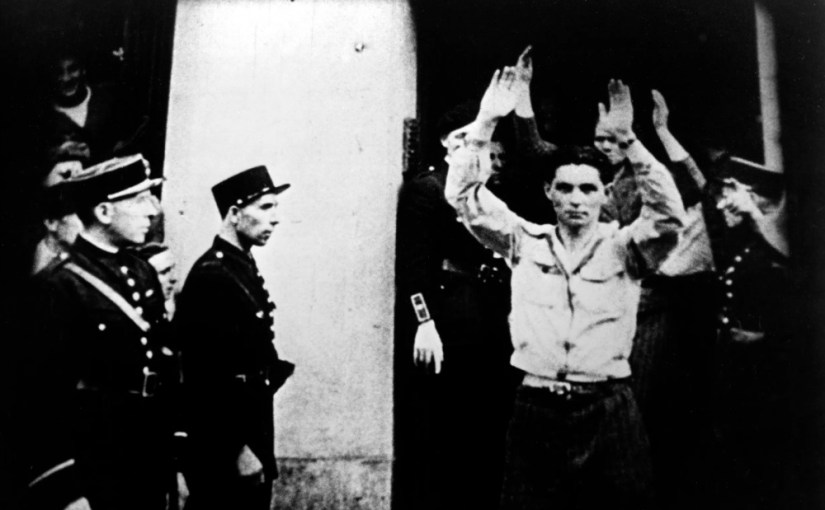
THE SORROW AND THE PITY (Switzerland, 1969)

by Miguel E. Rodriguez

DIRECTOR: Marcel Ophüls
MY RATING: 8/10
ROTTEN TOMATOMETER: 100% Fresh

PLOT: An in-depth exploration of the various reactions by the French people to the Vichy government’s acceptance of the German invasion.


When writing this review, I initially tried to provide a background to the film’s topic, attempting to summarize what Vichy France was, who General Petain was, and how bitterly French resistance fighters resented Petain and others who believed that acquiescence to the conquering German army was key to survival and avoiding further destruction.  That attempt at a “brief” summary ran to two full pages.  So, rather than teach a history lesson, I thought it better to just review the film and assume that readers will have an even better grasp of history than I do.  So here goes.

My enthusiasm for The Sorrow and the Pity, another sprawling film from documentarian Marcel Ophüls, is tempered slightly by my tenuous grasp of French history during World War II, and by the fact that, at least at FIRST, I did not feel I could pass judgement on the people involved.  One English interviewee says exactly that, in response to a question about whether he felt Petain’s life sentence after the French Liberation was unfair: “It is not my place to judge whether or not people’s anger was justified.  We haven’t been through it, so we cannot say.”

After watching the complete film, I have changed my tune a bit.  Under Petain’s leadership, Vichy France did indeed escape total destruction, but since they were essentially under German rule, they did end up deporting approximately 76,000 Jews to concentration camps during World War II.  Only a small percentage survived.  French Resistance fighters attacked when and where they could with immense dedication, believing it was better to fight and die than to live under the thumb of Nazi Germany.  Pro-Vichy Frenchmen denounced anyone they believed was a member of the Resistance.  In the documentary, the bitterness felt by surviving Resistance fighters towards surviving collaborators is palpable.

This documentary was (I believe) the first from a French filmmaker to openly discuss, on a world stage, the conflict between the Resistance and the collaborators.  Up to that time, it had been a virtually taboo subject, something swept under the rug or kept in the basement.  The attitude was one of, “Why bring up such a painful subject?  Why go over something so historically embarrassing?  Let’s just move on.”  This attitude reminds me of the thinking behind those who are in favor of redacting your kid’s history textbook or banning certain books from the school library.  The people interviewed in the film – people on both sides of the debate, mind you – demonstrate clearly that a national policy of polite silence on the matter is unacceptable.

In this way, The Sorrow and the Pity functions less as a film, an entertainment, and more like a historical record, the kind of thing you might see at a museum or on a college campus as part of a homework assignment.  I can’t promise watching this film will be as gripping as a typical Hollywood war film, but I can say I was never bored during the film’s running time.  I found myself intrigued by the fact this film was released in 1969, just 25 years after the end of the war in Europe, so the people appearing in the film were not just experts or college professors.  They literally lived through the events they were discussing.

A woman who sided with Petain was tortured by Resistance fighters after the Liberation; she still holds to her belief that Petain was a good man.  A Resistance member who was denounced and sent to prison returns and is told by a friend that he knows who denounced him and he will avenge him with a nod of the head.  The man refuses to allow that to happen, even though he knows who the denouncer was; in fact, he still lives around the corner from him.  “It’s something you can’t forget.  But what can you do?”

A former Nazi soldier is interviewed at his daughter’s wedding reception.  (I would LOVE to hear how Ophüls managed to wrangle this particular interview.)  Ophüls asks why he still wears his military medals when many Germans refuse to wear them because they were awarded by a Nazi state.  The former soldier says the only people made uncomfortable by them are men and women who never fought.

Another former soldier (now apparently a waiter in a pub) makes this startling statement: “We’re not stupider than anyone else, and yet we lost the war.  Nowadays we have to wonder if we’re not better off like this.  After all, if we had won, Hitler may have continued, and where would that leave us today?  Perhaps we’d be occupying some country in Africa…or America.”  It’s hard to tell whether his statement is remorseful, grateful, or wistful.

The Sorrow and the Pity is a remarkable record of a time when a nation had to choose between subservience or resistance.  That some chose resistance is not hard to fathom for Americans, whose existence is founded on resistance to tyranny.  That some chose to collaborate is perhaps unthinkable, but if I look inward, can I say with certainty I would have chosen differently?  I’d like to think so.  I hope so.

Just recently I was looking at a bookstore’s window display with a “banned books” shelf filled with novels that have recently been banned by school libraries in several states.  A woman walked by, noticed the display, and said as she walked away, “This store is degenerate.  I can’t believe they’re glamorizing this shit.”  I found myself wondering how many of those volumes she had read herself.  I wondered which side she would have taken in France when Nazi policies banned certain texts.  It never occurred to me to start an argument with her right there in the street.  Will there come a time in this country when it becomes our duty to openly oppose those who support totalitarian policies?  I don’t know, I’m not a political Nostradamus.  But The Sorrow and the Pity argues that, if that time does come, sitting on the fence should not be an option.  And the world will not soon forget those on the wrong side of history.
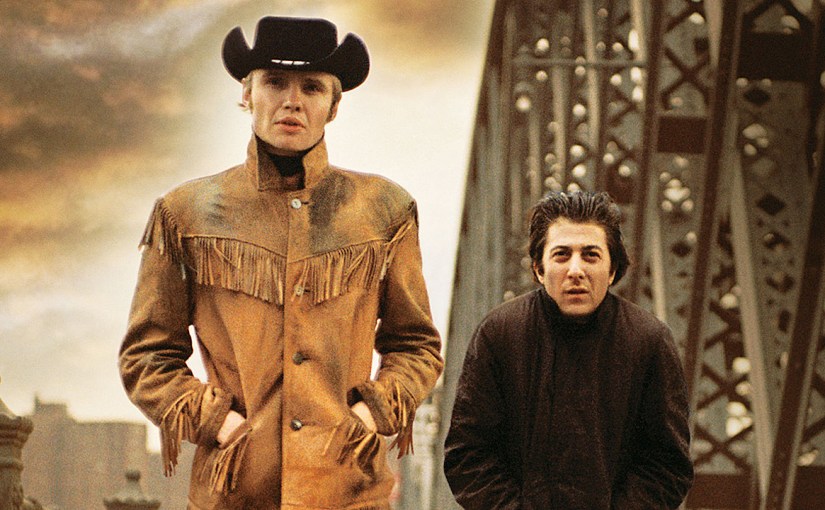
MIDNIGHT COWBOY

By Marc S. Sanders

There’s an irony to John Schlesinger’s Midnight Cowboy.  At first, the film centers on a Texas bumpkin eager to relocate to New York City and succeed as a hustler.  Upon his arrival though, he could not appear any more virginal.  The cowboy’s name is Joe Buck, portrayed by Jon Voight in his Oscar nominated breakthrough role.

The first act of the film follows Joe on his long cross country bus ride.  He’s dressed in his finest country western shirt, stitched with floral patterns.  He’s got his black leather cowboy boots and of course the cowboy hat.  His origin bred Texas twang completes his image.  He meets a variety of comers and goers on the bus and then finally he reaches his destination. 

Schlesinger’s camera follows Voight as he treks through the city.  A man is passed out (heck, maybe he’s dead) on the street in broad daylight.  My Cinemaniac pals that I watched the film with noted how it’s funny that the streetwalkers don’t take one look at the poor fellow.  Rather they’re looking at Joe’s get up as he clearly stands out among the masses. Joe is the only one looking at the guy on the street.

Interspersed within Joe’s travels and entry into the city are quick flashbacks to where he stemmed from.  It does not look like a favorable upbringing spent with his grandmother.  There are flashes of Joe being victimized by possible sodomy.  There also appears to be a gang rape that he might have participated in.  None of it is made completely clear.  Though, it is evident that Joe has been trying to escape that environment for good. 

Eventually Joe encounters a sleazy, squat fellow who calls himself Rico Rizzo (Dustin Hoffman), addressed by others as Ratso.  Joe is so naïve that he’ll trust Ratso to get him some action where he can earn some money.  In exchange, Joe is completely willing to surrender the cash in his wallet.  He’ll learn from that mistake once he’s drained of everything but a few coins, locked out of his hotel room he can’t pay for and denied of his cow skinned suitcase that contains his possessions.  Eventually, he has no choice but to live in a condemned tenement building with Ratso. Joe Buck is about to lose a second virginity as he experiences how hard it is to live within the city.  He’ll also realize the value of friendship as he sees no choice but to take care of Ratso who is very sick.  Hoffman’s appearance shockingly changes as Ratso’s health submits to a harsh, unknown illness.  The sweat all over his face is palpable.  The chilling, sickly feeling he exudes is clearly felt.

Waldo Salt’s award-winning script, based upon a novel by James Leo Herlihy, explores the good nature found within two different walks of life despite the dodgy pasts that follow them. Ratso and Joe are one of the oddest couples in cinematic history.  There’s no way these two would want to be together unless one was trying to take advantage of the other or one was left with his guard down, open to being taken for and deceived.   Jon Voight has a tall youthful stature, a handsome man.  Dustin Hoffman is scrawny and significantly shorter with greasy hair, an uneasy limp and a weird squawk to his voice.  The often-times method actor seems to make himself increasingly hideous. 

Perhaps I needed to see Midnight Cowboy at the time of its release.  It surprises me the film merited the prestigious accolades it collected, including Oscars for Best Picture, Director, and Screenplay.  The two actors also received Oscar nominations.  It remains an honest film of its time in the year 1969.  Yet, it is disturbing and ugly too as it captures the seedy side of New York with experimental drug use and Joe’s victimization for sex.  He gets ripped off by who he thought was a kind woman (Sylvia Miles) looking for an intimate evening with his hustler capabilities.  Later, he’ll surrender himself to a man looking for oral pleasure in a movie theatre.  It’s not the typical glamourous epic of a Hollywood yesteryear.  In fact, for a time it was the only film to be recognized for winning Best Picture with an X rating.

The celebration of Midnight Cowboy’s achievements falls upon the relationship between Joe and Ratso.  Had Joe not been so naïve to how lowlifes operate and had Ratso not become so ill, yet welcoming to Joe when he needed a place to stay, then a friendship would not have gradually developed. 

The ending to Schlesinger’s film is touching, though sad.  As the story began, it also ends on a bus heading towards a new destination – another new way of life, different from what Joe experienced in small town Texas or New York City.  The two characters sit together in the back seat and the other passengers eventually observe them like they had on Joe’s first journey.  Either individually or together Ratso and Joe are simply strange to any sort of environment.  Yet, they’ll learn from each other and that’s where Midnight Cowboy triumphs.

ON HER MAJESTY’S SECRET SERVICE

By Marc S. Sanders

Director Peter Hunt was awarded the opportunity to take the James Bond franchise in a double curve ball direction with 1969’s On Her Majesty’s Secret Service. For the first time in the Eon Productions series, helmed by Harry Saltzman & Albert Brocolli, the role of Bond is recast with George Lazenby. Plus-what’s this? 007 falls in love????

Lazenby is serviceable in the role, seeming to have a taller and more slender appearance than his predecessor (Sean Connery), and not a huge departure in looks. Still his tongue in cheek pun delivery is no match for the original Bond.

OHMSS is a bit hit and miss. The fight scenes look great as the film starts off with Bond fending off a couple of thugs on the beach and a later downhill ski chase is exhilarating and well edited. Telly Savalas also works as a different kind of Blofeld (replacing Donald Pleasence as the cat loving villain). I just wonder why the long middle act was so cheesy, almost like a bad episode of “Batman” or “Star Trek.” The swinging ’60s might have been coming to a close but James Bond was not ready to put it behind him.

After the first third of the story establishes a love story between Bond and Tracy (Diana Rigg as the daughter of Draco, a competing criminal mastermind of Blofeld & SPECTRE), the super spy is off to Piz Gloria, a lodge located on the highest snowy mountain of Switzerland.

Bond goes undercover as a genealogist (I really don’t know why) while looking not the least bit macho in a ruffled shirt with a kilt and knee high socks adorned with red bows. It’s hard to accept James Bond in this image. I couldn’t imagine Connery adopting this get up.

At the lodge Bond uncovers a stupid plot orchestrated by Blofeld where he’s brainwashing a group of swinging girls to, I think, poison the world populace with makeup kits, or maybe bomb the population. I’m not sure exactly.

Eventually, and thankfully, Bond makes an escape in a well shot ski scene while being pursued by Blofeld and his men. It’s a fun sequence.

This film takes some odd turns. Per the prior entry, “You Only Live Twice,” Bond and Blofeld come face to face. Here, it is as if they never met before. Why the neglect for what’s already been established?

It’s also a bit curious to see Bond fall in love and (SPOILER ALERT) marry Tracy, especially when the franchise is breaking in a new actor for audiences to get used to. Were they thinking new actor means new kind of Bond?

No question OHMSS stands out from the rest of the franchise for the change in casting but also the odd story turns it takes. Not to mention, it has the most somber ending of all Bond films.

It’s worth a look even if it is not the best in the series.

I’ll be interested to see what Lazenby does in future films with the role…oh wait…. Nevermind.