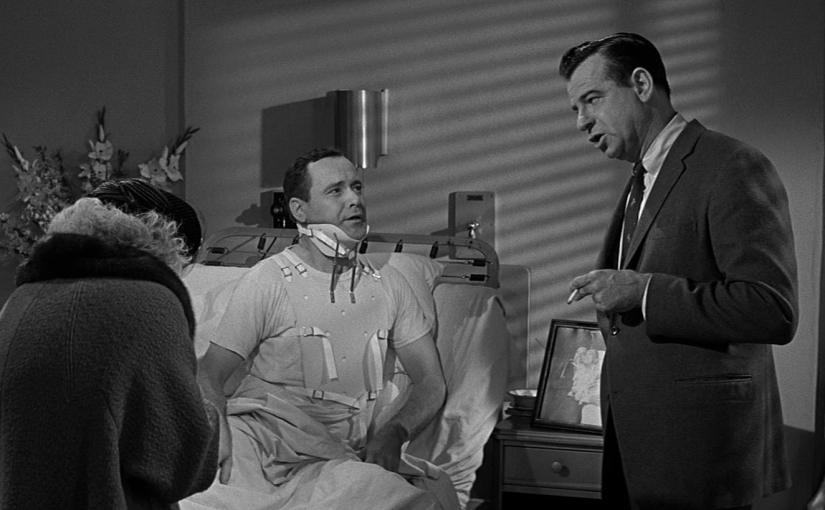
THE RUSSIANS ARE COMING. THE RUSSIANS ARE COMING.

By Marc S. Sanders

Farce works best when the serious explodes into the outrageously absurd.  When Jonathan Winters is a lawman who insists to Brian Keith “We gotta do something! I mean we really gotta do something!” you should know that whatever needs to be done has got to be out of unreasonable paranoia.   Yet, the desperation and nonsensical fear is something you can empathize with because if I were told the states were being invaded, I’d surely think twice as I reach for the tennis racket in the back of my closet to use as a weapon.

Norman Jewison set aside his penchant for intense drama, socially reflected in films like In The Heat Of The Night, to direct a madcap satire imagined from the very real threats of The Cold War of the 1960s.  At a time when submarines were being used for silent spying and espionage, a Russian sub gets stuck on a sand dune within the shallow ocean waters just beyond the New England town of Gloucester.

Alan Arkin as Rozanov leads a squad expedition off the vessel and intrudes upon the vacation home of Walt and Elspeth Whitaker (Carl Reiner, Eva Marie Saint).  With a pistol pointing at the family of four, all that is really needed is a boat to nudge the helpless submarine back into the water.  Yet, as word spreads of who has arrived, that’s not what the townsfolk will have you believe.

Before the age of the internet, hysteria still managed to catch fire with word of mouth.  Reader, perhaps you heard of what happened when Orson Welles aired his radio show of H.G. Wells’ The War Of The Worlds.  Yes!  Apparently, an alien invasion was really happening.  What amuses me about Jewison’s film is that only a very few people even get an opportunity to see the Russians in person.  Still, the fear overcomes everyone in town.  The battle crazed old codger named Fendall (Paul Ford) dons his sword, and because he carries said sword, he seems most fitting to lead the charged brigade.  

The Russians Are Coming. The Russians Are Coming. works like a pre-cursor picture to what the team of ZAZ would later do with Airplane! and The Naked Gun.  The town switch board gets overrun.  The men take hold of their rifles, but stop at the bar for a belt first. Two of the wives board a motorcycle with a side cab waving a poster that says “Alert” in front of their faces so they can’t see where they’re going.  What’s anyone supposed to gather from saying “Alert,” anyway?  It’s ridiculous, but the palpable tension of these fine folks is convincing when they come alive on this sleepy Sunday morning off the northeast coastline.

As comedic as Jonathan Winters always was, he takes it seriously as a deputy who does his best to lead while wearing his badge.  Brian Keith is great at just being Brian Keith, the grump who tries to keep things in perspective but can’t because everyone else is ready to take up arms.  Carl Reiner doesn’t have to do anything but occupy the screen and he’s funny.  He’s the antsy father to an eleven-year-old boy who he chooses not to believe.  In all seriousness, are we ever to take Carl Reiner seriously when he tries to offer a sound explanation for the Ruskies’ arrival?

Alan Arkin is just lovably speaking fluent Russian at times while trying to navigate his team around the island with no idea of what to do or what to say.  He might be the most sound character of the whole picture. He’s lovable and hilarious.

The film takes place in one day and it’ll leave you curious with how it all gets resolved among the two misunderstood factions.  Just when Norman Jewison ably reaches the highest summit of intensity, the oddest occurrence happens to shift the tide of the film’s characters and comedy.

Like other satire, particularly Sidney Lumet’s Network, The Russians Are Coming.  The Russians Are Coming. stands prophetically.  It was released in 1966, at the height of The Cold War with very fearful circumstances occurring in the news such as The Bay Of Pigs invasion.  Earlier this year, a sense of nervousness arrived when it was announced that Russian submarines have docked themselves outside of Cuba, seemingly lined up with Florida.  Anything could suddenly turn into a sad reality.  Still, how we respond to scary possibilities is how we live through these moments.  

You can laugh at The Bay Of Pigs crisis now.    Could you do it back when it was actually happening?  I wouldn’t know.  Yet, that doesn’t mean we shouldn’t make light of the situation.  Hogan’s Heroes, The Three Stooges, Mel Brooks, Charlie Chaplin and even the Looney Tunes ably served the purpose of needing to self deprecate our innate fears that would get all of us into nonsensical tizzies.  The Russians Are Coming.  The Russians Are Coming. was one of the best films to accomplish that feat.  

We gotta do something! I mean we really gotta do something!
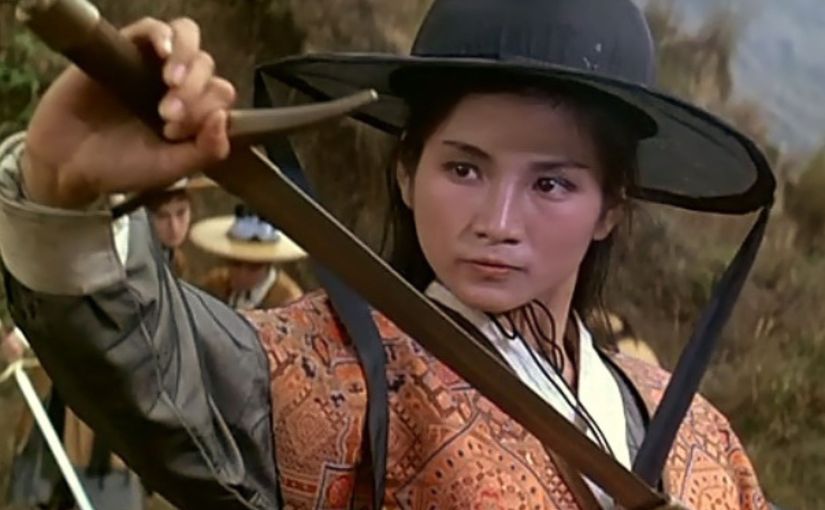
COME DRINK WITH ME (Hong Kong, 1966)

by Miguel E. Rodriguez

DIRECTOR: King Hu
CAST: Pei-Pei Cheng, Hua Yueh, Chih-Ching Yang
MY RATING: 8/10
ROTTEN TOMATOMETER: 100%

PLOT: A highly skilled martial artist (Pei-Pei Cheng) is dispatched to rescue her own brother from kidnappers.


King Hu’s Come Drink with Me feels like a multiverse version of Ang Lee’s Crouching Tiger, Hidden Dragon, and no wonder: Lee, like so many of his countrymen, is a huge fan of the wuxia genre of films that have been around since the 1930s.  Come Drink with Me created the template that was faithfully followed by many other films in the succeeding years, and while I cannot claim to have seen them all, it is plainly visible that this film was their prototype, much like Halloween laid the groundwork for countless other slasher films.

Right from the opening scene, the focus is clearly on action above all else.  We watch a caravan taking prisoners to jail, in the traditionally accepted timeframe of what looks like medieval China.  The caravan is stopped by a lone figure who announces himself as the leader of the bandits known as The Five Tigers.  The gang’s name alone evokes scores of kung-fu films aired on Saturday afternoons on Channel 44. A furious battle ensues in which the prisoners are freed, and a government official is kidnapped by the bandits and ransomed in exchange for the release of another one of their comrades.  Rather than pay the ransom, the government sends a lone warrior, Golden Swallow (Pei-Pei Cheng), to rescue the captured man. (If Golden Swallow looks familiar, that’s because she played the villainous Jade Fox in Crouching Tiger, Hidden Dragon, further enhancing the idea that we’re in some kind of wuxia multiverse.)

That’s all in literally the movie’s first five-to-ten minutes.  Everything that happens afterwards is one action sequence after another, with only two breaks for a breather.  There is a bar brawl that looks curiously similar to the one featured in Crouching Tiger, Hidden Dragon, complete with some impossible acrobatics from the heroine as she leaps from a wall to the upturned legs of a table to the other side of the room.  Granted, it’s not as technically sophisticated as the newer film, but the influence is undeniable.

There is a chase across the rooftops at night, another element clearly appropriated by Crouching Tiger.  Golden Swallow fights off wave after wave of enemy thugs, most of them wielding swords, but some of them hurling wicked needles and darts, one of which finds its mark and lands Golden Swallow in the care of a man, Fan Ta-p’I, who she thought was a drunkard, but who turns out to be a skilled martial artist himself.  These two will eventually cooperate to accomplish their mission, along with a second mission that reveals itself organically.

I must say I wasn’t altogether thrilled with this secondary plot element because it takes the spotlight from Golden Swallow, who dominates three-quarters of the movie.  However, I immediately let it slide when it provided the opportunity to showcase one of Fan’s hidden skills: the ability to manipulate and focus the air so it flows from his hand and can part the cascading stream of a nearby waterfall.  That’s right out of comic books, man.  Or “Avatar: The Last Airbender.”  Take your pick.

To say Come Drink with Me is inferior because it is not as technically sophisticated as modern martial arts films is to overlook its relevance.  Yes, there are a lot of quick cuts used to hide some otherwise impossible-to-perform maneuvers.  Yes, a lot of the dialogue (what little of it there is) is either hammy or overly expository, or both.  Yes, the fight choreography, on close inspection, is not as polished as we’ve come to expect after seeing The Matrix or House of Flying Daggers.

But as an artifact of where today’s martial arts films began, Come Drink with Me is incredibly valuable and still entertaining, even in its relative crudeness.  I loved being able to draw straight lines from specific scenes in this movie to Crouching Tiger, or even all the way to the John Wick franchise.  The last John Wick film featured a scene where Wick fights off an almost literal army of henchmen on a long staircase.  I laughed at the audacity and absurdity of the situation…but I rolled with it, because that’s just what John Wick does: he fights, and he endures.  Why?  Because if he didn’t, he wouldn’t be named John Wick.  Same thing applies to Jason Bourne and James Bond.

And the same thing with Come Drink with Me.  The obviously overmatched Golden Swallow picks off the hordes of attackers one by one because they’re foolish enough to only attack her one or two at a time.  Why?  Because the story demands it.  It’s tradition, even when it looks goofy and unrealistic.  It took me some time to grasp that core concept, but when I did, my enjoyment of these older swordplay films deepened considerably.

THE FORTUNE COOKIE (1966)

by Miguel E. Rodriguez

Director: Billy Wilder
Cast: Jack Lemmon, Walter Matthau, Ron Rich, Judi West
My Rating: 5/10
Rotten Tomatometer: 96%

PLOT: A crooked lawyer persuades his brother-in-law to feign a serious injury.


Billy Wilder’s The Fortune Cookie reminds me of what it might be like to watch Jerry Lee Lewis play “Chopsticks.”  You sense it’s being done as well as it possibly can be done, but you wonder why it’s being done at all.  C’mon, man, let’s hear “Great Balls of Fire!”

Notable for being the first of twelve films Jack Lemmon and Walter Matthau starred in together, The Fortune Cookie tells the story of a hapless TV cameraman, Harry Hinkle (Lemmon), who is covering a Cleveland Browns football game from the sidelines.  A burly punt returner accidentally runs him over during a play and knocks Harry out cold.  While he recuperates in a hospital bed, his thoroughly unscrupulous brother-in-lawyer, Willie (Matthau), concocts a very modern-sounding plan: Harry will fake serious injuries in the hospital so Willie can work his magic with the insurance company and get a big payout.  Harry demurs at first but is enticed to go along when he finds out his ex-wife, for whom he still carries a torch, is very interested in assisting with his recuperation from his “serious” injuries.

Meanwhile, the poor football player who knocked him down, Luther (Ron Rich), is wracked with guilt over the damage he thinks he’s caused.  He pitches in to buy Harry a motorized wheelchair and offers to assist with his rehab back at home.  This gnaws at Harry’s conscience.  Things don’t get any better when he’s brought a lunch of Chinese food at the hospital, and the fortune inside his fortune cookie bears a grim warning…

There’s nothing wrong with The Fortune Cookie that a rewrite or some editing couldn’t have fixed.  That might be considered sacrilege, considering the script was penned by Wilder himself and his legendary writing partner, I.A.L. Diamond, but in watching the film, I was struck by how many scenes involved a semi-static camera just watching people talk, and talk, and talk.  I don’t mind a lot of dialogue in a scene when the characters have something to say, or when the story is being driven forward.  But here, we usually get a five-minute scene when a two-minute scene could have done the job just fine.

Take one scene in particular that almost had me literally nodding off, when Harry’s ex-wife, Sandy (Judi West), has returned home to help with Harry’s rehab.  Harry is still feeling guilty about the sham he’s perpetrating, but he’s so besotted with Sandy that he’s willing to keep up the pretense just to keep her around.  They catch up a little, blah blah blah, he says he never threw away his ring, blah blah blah, she dumps out her purse looking for her ring, blah blah blah, he puts on a little music, he’s happy, she’s happy, and <snoorrrrrrre.>

I could list any number of films, including some of Wilder’s other films, where other characters talked for even longer than Harry and Sandy, but they were so much more interesting!  What happened here?  What went wrong?  Even in the scenes where Willie, the huckster, is rattling off his grand plans and needling the insurance company attorneys, Matthau just comes off as a two-bit hack that no sane person would pay any attention to.

I’m not saying he must be likable, that dreaded word.  There are movies that are very, very good and that contain nothing BUT unlikable characters. (Anyone wanna watch The Godfather?) But here, something is off with the tone.  When I wasn’t bored, I was inflamed with distaste for what Harry was being forced to do, both by Willie and by his own hormones.

The movie does have one saving grace.  The comeuppance, when it, er, comes up, is brought about with the kind of shock comedy scene that Mel Brooks might have loved.  I don’t want to spoil it, but it features the kind of language that would have been right at home in Blazing Saddles.  When I got over the shock of what I had just heard, I sat back in admiration and smiled, and thought to myself, a little ruefully, “Now what would this movie have been like if it had been this nervy all the way through, instead of just here at the end?”

But The Fortune Cookie even mucks up the ending with an “epilogue” scene that’s so gratuitously manipulative, I wouldn’t be surprised if it had been tacked on by the studio who demanded a happy ending, or at least a happier ending.  If the movie had earned it, I’d have been on board, but everything that came before was so humdrum that it felt super-cheesy.

Billy Wilder’s résumé reads like the Pixar catalog: one hit after the other with only a couple of rare misses.  Double Indemnity.  The Lost Weekend.  Sunset Boulevard.  Ace in the Hole.  Stalag 17.  Sabrina.  Witness for the Prosecution.  Some Like It Hot.  The Apartment.  Even One, Two, Three, which may not exactly be his finest moment, but at least it had James Cagney to liven things up.  I ask again: what happened here?  Where is the dynamite chemistry between Lemmon and Matthau that would become legendary in later films?  Where is the zaniness of Some Like It Hot or the earned pathos of The Apartment or the edginess of Ace in the Hole and Stalag 17?

According to the trivia section on IMDb, the opening football game sequences were filmed during an actual Vikings-Browns football game, which the Browns lost, at home, 27-17.  After watching this movie, I felt like those Cleveland fans must have felt: always glad to see my boys play, but man, it would have been WAY cooler if they had won.

THE GOOD, THE BAD AND THE UGLY

By Marc S. Sanders

Sergio Leone closes out his Dollars trilogy with the epic The Good, The Bad, & The Ugly, respectfully portrayed by screen legend Clint Eastwood, tough as nails Lee Van Cleef and one of the great scene stealers, Eli Wallach.

It’s clear from the start that Leone had at least triple the budget he had when he made A Fistful Of Dollars. This installment offers broad landscapes, gutted out old west towns, locomotives, and an infinite amount of extras to capture an extraordinary Civil War battle over a bridge.

For the three main characters, the Macguffin is $200,000 buried in a grave, yet each one knows a different piece of information relative to its location.

Eastwood’s quiet temperament takes a back seat to Wallach’s boorish ugly bandit and the film stays on a fast pace trajectory because of it. Wallach is given great moments whether he’s hanging by a noose or taking a bath (“If you’re gonna shoot, shoot. Don’t talk.”) It is one of the all time great roles.

While Van Cleef was a huge attraction in a For A Few Dollars More, he surprisingly isn’t given much material here. That’s okay though. He makes the most of what he’s given and again he plays the man in black as cold and calculating. I’d like to uncover more films with Van Cleef. Such an interesting guy with as great a voice as say James Earl Jones or Morgan Freeman. Fortunately for him the Dollars films revived his career following a bout with alcoholism.

Eastwood just does his thing, and it’s great entertainment to see him in a standoff followed by a twirl of his pistol back in his holster. He just has such a presence. The legend he’s become was truly recognized with The Man With No Name.

Leone recruits Ennio Morricone to compose what has become one of the most recognized scores in film history. The whistle harmonica that pursues the three players is as familiar as Monty Norman’s James Bond Theme or John Williams Jaws opening. Morricone is fortunately still working and he is partnering up with Quentin Tarantino again (first time with The Hateful Eight) on his upcoming film Once Upon A Time In Hollywood. It makes sense really. The Good, The Bad & The Ugly is one Tarantino’s favorite films.

Leone made a gorgeous looking film. It’s any wonder that his resume consists of only 9 films altogether.

Sergio Leone was an inspiring master filmmaker and it’s easy to recognize elements of his films that appear to have inspired some of the greatest box office hits of present day. Funny, but whenever I see Eastwood blow an outlaw away with no questions asked, what comes to mind is Han Solo taking out Greedo in an off the map, lawless cantina. Those that know me, know what a high compliment that is for Leone’s efforts.