BREAKFAST AT TIFFANY’S

By Marc S. Sanders

Holly Golightly.  

Name sounds almost whimsical with a noun, a verb and an adverb.  Holly go lightly!  Puts a smile on my face.

Actually, the creation of this character from Truman Capote might follow the advice that her own name implies, and Audrey Hepburn portrayed the young self-inventive socialite – well let’s be honest as it is no longer 1961 and say “call girl” – with an enthusiasm for living better than anyone expected or could have imagined.  Hepburn was self-conscious of her portrayal.  Capote insisted on casting Marilyn Monroe.  None of it matters as Audrey was endearingly perfect.

Blake Edwards adapted Truman Capote’s novel Breakfast At Tiffany’s, and while I never read the source material I can recognize the director overstepping for sight gags, slapstick and exaggeration before he gains focus with a need to conclude his film on a turned character arc. 

I’ve had mixed feelings on Edwards career.  Days Of Wine And Roses was a rare drama for the filmmaker and yet I believe Jack Lemmon soars way over the top in his alcoholic performance.  The Great Race? Let’s just say there always needed to be “More pies!  More pies.”  I have tried multiple times to get through Victor/VictoriaThe Pink Panther was where Blake Edwards was most suitable.  However, with Breakfast At Tiffany’s he initially shoots for the silliness of Holly Golightly’s carefree life. She lives off of other people’s money while they obtain an increase in social stature for just being in the same room as her.  Holly was one of the pioneers of social media influencers.  Before a single Kardashian was ever born, there was Holly Golightly.  In an updated time, Holly would be on every reality show with countless podcasts, and a talk show hosted out of her own apartment where she’d lift her Tiffany blue sleep mask and wake up just as you turned to your Instagram account or Facebook string.

Paul Varjak (George Peppard) is Holly’s new neighbor who is on the brink of being a successful novelist with a little help from a middle age wealthy man’s wife who pays him for favors in return.  For Paul, Holly appears so foreign to him, and yet he’s living by the means he earns from what others leave on his night table.  Holly and Paul’s trajectories are quite paralell.

Capote’s film adaptation is appealing because of how air headed the picture seems at first.  Later though, it makes way for a sincere account of a young woman lost with no direction and full of lonely despair within the very large city of New York.  It makes sense that Holly Golightly finds simple solace from her need to tread in social gatherings and in the arms of wealthy men by visiting the window displays of the Tiffany jewelry store on 5th Avenue. 

We don’t yet know why but as the film begins with Henry Mancini’s Oscar winning Moon River (one of cinema’s greatest songs), Holly exits a cab in front of Tiffany, just as the sun is rising to consume a pastry with her cup of coffee.  The honest girl hides behind her thick sunglasses, a done-up hair do and a little black dress.  It’s an iconic scene in film, maybe the greatest that Blake Edwards ever shot, but what does this introduction truly mean?  Even Holly Golightly yearns for isolation from a crowded metropolitan city of eight million people, and the window display at Tiffany is her hiding spot. It is only for her to occupy all by herself on a brisk morning after sunrise.

A far cry from this opening scene soon occurs.  Holly crams at least fifty people into her apartment shortly after Paul arrives.  He witnesses the silly swinging attributes of the people who are welcomed to this social gathering of drinking and joyfulness.  He is puzzled that no one takes notice of Holly’s cigarette setting a woman’s hair on fire (typical Blake Edwards silliness) only to be put out by Holly when she is unaware she spilled her drink and doused the flame.

Later, an honest past comes back to haunt her, and Paul begins to see through the charade of her proud debauchery.  Further on, tragedy strikes and the gleefulness of life is no longer realized.  Misfortune will come upon all of us no matter how Holly Golightly we could ever be. 

Breakfast At Tiffany’s seems like a film meant to be light as a feather.  Yet, it’s not so easy to grasp the story’s purpose right away.  Capote, however, wrote an insightful observation of a young twenty something character occupying a world and a past that is much larger than she could ever handle at her young age. Turns out she is on her own with no financial means or purpose in life to show for her identity.  Holly will host a crowd in her tiny apartment, but she dresses in her bed sheet.  Fashionably dressed of course, but why a bed sheet?  She takes in a cat, but the cat has no name.  It’s just called cat.  Holly Golightly is devoid of depth or basic means, but she’ll still celebrate herself among the masses while trying to live off the wealth of others.

I appreciate what’s gained from watching Breakfast At Tiffany’s all the way to its ending. Holly appears to be crumbling beneath the weight of life that she’s ill-prepared to accept.  Just ahead of the epilogue, new and unexpected problems arise. There’s little option for escape.  Her one true blessing is Paul, the man who also evolves to grow up before Holly is ready to do so. Part of his maturity, progressed very well by the actor George Peppard, entails guiding his darling friend Holly along the way.

Holly Golightly is a tragically lost character.  Yet she’s a lot of fun thanks to Blake Edwards and Truman Capote, and most especially to the enormously engaging talents of Audrey Hepburn.

NOTE: Sadly, a terrible stain exists on Breakfast At Tiffany’s final cut, due to arguably the worst casting decision and worst written character in film history.  Mickey Rooney as Holly’s frustrated Japanese upstairs neighbor Mr. Yunioshi.  This is where Blake Edwards once again oversteps in his need for unnecessary slapstick.  It’s not enough that the character serves no purpose to any of the storylines.  He repeatedly bookends scene changes with unwelcome goofiness as Yunioshi endlessly bumps his head, startles himself or pratfalls in his bathtub, complete with overexaggerated buck teeth sticking out from beneath his upper lip.  These are unfunny Three Stooges gags. 

What’s way worse is that a Caucasian well loved character actor of legendary status was cast to invent buffoonery that apparently exists within Japanese culture.   A truly insulting and unfair representation of an entire people.  Poor Mickey Rooney. The existence of this character along with who occupies the role is the most egregious of film appearances ever put on screen.  Politically speaking, we are much more attuned and sensitive to all races and nationalities today.  Yes, many still have a lot to learn, but even in 1961 this was a horrible slap in the face taking pop culture back to the ill-conceived material that might have been found in Amos N Andy routines or even a Little Rascals Buckwheat personalization. 

I guess Blake Edwards and screenwriter George Axelrod must have thought the Japanese were due for a stooge.  Boy, were they ever wrong!
THE HUSTLER

By Marc S. Sanders

To get inside the turmoil that Fast Eddie Felson feels requires witnessing his highs and lows, all within a forty-hour time span, which equates to about thirty minutes in movie time.  Fast Eddie is The Hustler, and he was famously portrayed by Paul Newman, arguably his breakthrough role as a top billing super star.

Felson is a cocky, hard drinking pool player.  He’s got talent, but no matter how much he wins he’s always the loser because he has no discipline.  Eddie and his partner Charlie (Myron McCormick) travel from town to town, entering pool halls and setting up a bait and catch for some quick cash.  Charlie keeps his cool and treats the act like a profession.  Eddie has no subtlety.  Because he’s so how high on his expertise and what it earns him, he now only has his eye on dethroning the best in the country.  Eddie wants to take on Minnesota Fats (Jackie Gleason, in his only Oscar nominated role).

Fats sure looks intimidating.  Gleason handled his extra weight beautifully throughout his whole career, whether it be with his outrageous Ralph Kramden comedy, or when he was just being stand up Gleason for a live audience.  As well, his large frame appears kingly when he enters the pool hall.  He’s dressed to the nines with his hat, overcoat, silk tie, cuffs and studs, a cigarette in his hand, and the red carnation confidently tucked in his lapel.  The movie is in black and white, but that little flower had to be red if adorned by Minnesota Fats.  No question about it.

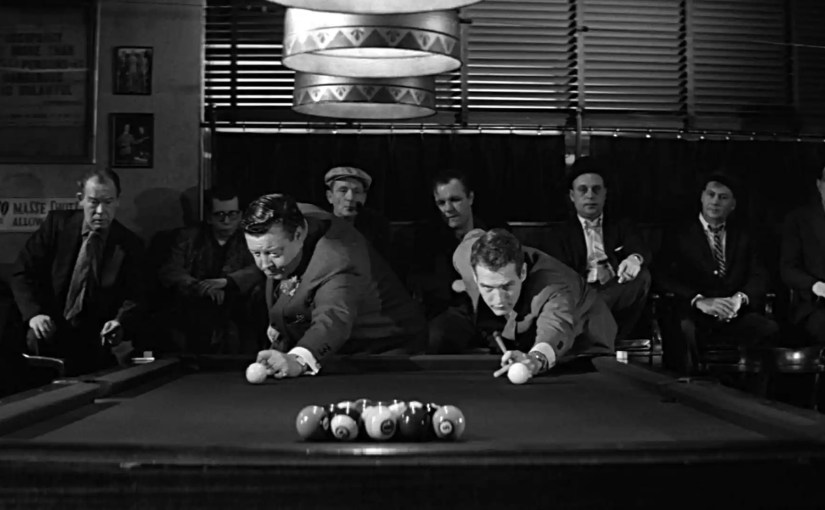
Newman versus Gleason in the first section of Robert Rosen’s drama is stunning to witness.  Like the actors who portray these characters, the antagonist was already a legend, while the up and comer was on the brink of higher class.  Both are the best of the best at pool, but as this scene progresses, with the regulars at Ames Pool Hall watching with their burning cigarettes and stained whiskey glasses in hand, the competition becomes a fierce and eerily quiet test of endurance.  Fast Eddie can keep on winning and winning, round after round, hour after hour, taking thousands of dollars out of Fats’ pockets, but if the fat man doesn’t surrender, has anyone really won or lost?

The Hustler isn’t so much about pool playing as it is about being a hustler or a con man who has no way to be genuine with himself or others in his life.  After the showdown between the two has finally concluded, Eddie gets acquainted with a woman who frequents the nearby bus depot.  Her name is Sarah (Piper Laurie), another hard drinker and someone who is not looking for love or companionship but will get trapped in Eddie’s charm.  What’s at play though is if their relationship, based initially on sex and booze, has anything more substantial to uphold their quick connection.  That is about to get tested by another member of this cast.

Bert Gordon (George C Scott) is the high stakes investor ready to front Eddie with a lot of money to go on the road and clean up on other wealthy players at the table.  Bert recognized a thoroughbred when Eddie went against Fats.  Now he wants to use him, but will Sarah serve a purpose or become a distraction in Bert’s plans for himself first, and Eddie second?

There’s a lot to think about when summing up The Hustler.  It’s not a typical sports film with the standard training montages.  The protagonist doesn’t necessarily get a beat down, only to triumph by the end.  Rosen’s film goes deeper than the pool playing that rests on the felt table surfaces.  Rosen co-wrote this script based on a novel by Walter Tevis, about a man overcoming the demons pecking at his attributes and skills.  When he’s not the trickster, he must ensure that he’s not getting tricked.

I was first introduced to Fast Eddie Felson with Martin Scorsese’s follow up picture called The Color Of Money, released twenty-five years after this film.  I like the coolness and rhythm of that film, but it’s mostly an exercise in Tom Cruise machismo.  It was only later that I saw The Hustler per my dad’s advice.  I didn’t care for it the first time I saw it.  Once the first act was over between Newman and Gleason, I found the picture to be slow moving and devoid of much energy.  I could not relate to the long sequence of Eddie getting involved with Sarah.  Unlike Scorsese’s film, Rosen does not rely on much music and quick edits to keep you alert.  It felt more like a movie drowning in the characters’ own drunken stupors.

Now that I have seen the film for a second time though, many years later, I can’t help but recognize the themes that carry over to The Color Of MoneyThe Hustler works better than its sequel because it functions as a character study in maturity and endurance.  The Color Of Money sets itself up that way for the Cruise character. Yet, I’m not sure it reaches a conclusion to any of the arcs or transitions for either an older Eddie Felson or for the hot shot 1980s kid, Vincent, the Tom Cruise character that Eddie mentors.

The Hustler has triumphs, but it has some shocking heartache for several characters as well.  Eddie has much to overcome internally as well as physically throughout the course of its narrative.  This fictional story had to be captured within this certain section of time (six months to a year, I think) to show how these appealing, yet cursed, individuals forever change one another.  After the film has closed, Rosen brings up the closing credits in the quiet pool hall allowing his characters to pack themselves up and walk out of frame.  There is something open ended to when the film chooses to stop. The viewer may think for a while after it’s over.  Rosen allows the viewer to take his last gulp of whiskey or bourbon and put out his cigarette and throw on his overcoat before stepping out into the cold late hours on the wet sidewalk below.

There are many impressive pool shots on display, thanks especially to the professional Willie Mosconi.  Shots are also done beautifully by Newman and Gleason.  Absolutely amazing to watch what they accomplish with a cue stick.  However, you don’t watch The Hustler for just trick billiard shots.  Rather you look at this intense drama to see a man struggling to be a winner or remain a loser.  What you realize very early on is that the outcome is never measured by how much money is wagered or what lines a man’s pockets.  Instead, The Hustler is assessed by what these people choose to do next.  Play or not play.  Bet or not bet.  Hustled or not get hustled.

THE GUNS OF NAVARONE (United Kingdom, 1961)

by Miguel E. Rodriguez

DIRECTOR: J. Lee Thompson
CAST: Gregory Peck, David Niven, Anthony Quinn, Anthony Quayle, Irene Papas, Richard Harris
MY RATING: 8/10
ROTTEN TOMATOMETER: 92% Fresh

PLOT: A team of Allied saboteurs is assigned an impossible mission: infiltrate an impregnable Nazi-held Greek island and destroy two enormous long-range field guns preventing the rescue of 2,000 trapped British soldiers.


The Guns of Navarone is a “message” picture cleverly disguised as a World War II action-adventure/thriller.  No surprise there since the screenwriter was Carl Foreman, who also co-wrote 1957’s The Bridge on the River Kwai, another stirring wartime adventure with a strong anti-war message buried inside.  I found it interesting that, in the multiple behind-the-scenes documentaries on the Blu-ray, not one of them mentioned the one movie which I feel most resembles The Guns of Navarone: 1967’s The Dirty Dozen.  In both films, teams of men mount insurmountable odds to accomplish an insanely difficult mission, incurring casualties while ultimately succeeding.  In both films, there is a buried, or not-so-buried, subtext about the futility of the mission and/or war in general, while still gluing audiences to their seats.  However, given the timeframe of the release of The Guns of Navarone in the early 1960s, I find it to be the more surprising of the two, despite the foregone conclusion of the movie.

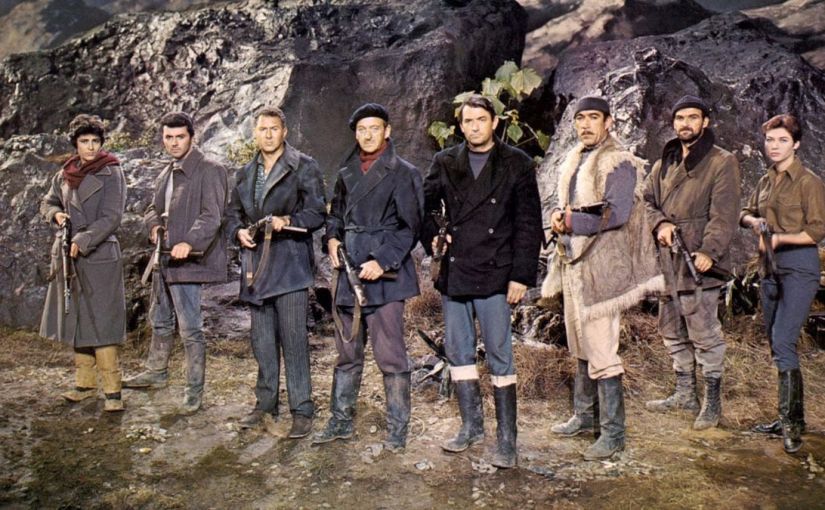
The movie’s narrated prologue tells us everything we need to know.  (Forget for a moment that there is not, and never was, a Greek island called Navarone.)  In 1943, two thousand British soldiers marooned on the island of Kheros must be evacuated before Germany convinces Turkey to join the Axis.  But the only sea lane to Kheros is defended by two massive German guns built into the sheer cliffs of the island of Navarone.  The guns must be knocked out of commission by a team of Allied saboteurs before any rescue attempts can be made.  This team will be led by Captain Mallory (Gregory Peck), Corporal Miller (David Niven), Colonel Stavros (Anthony Quinn), and Major Franklin (Anthony Quayle).  Along with the rest of the team, they must sneak on to Navarone, scale a steep cliff at night, and sneak across the island to the guns, hooking up with Greek resistance fighters along the way.  These details are laid out with admirable brevity, during which we are given just enough information about each of the three primary characters to understand their actions once the mission is underway.

The Guns of Navarone may be constructed almost entirely out of war movie cliches regarding desperate men behind enemy lines on a secret mission, staying undercover, close calls, and unexpected setbacks.  However, I enjoyed how much Navarone sort of “leans into” the material.  It’s almost as if the filmmakers said, “Okay, so this is a cliché, right?  We might as well embrace it and do it up right.”  For example, we find out that one of the squad commanders has a nickname: “Lucky.”  In the history of movies, any character in a war picture named “Lucky” has been anything but.  You know this, I know this.  Even so, as events transpired, I found myself thinking less and less about the most cliched material and just admiring how it was executed.  It’s a tribute to the director, J. Lee Thompson, that he found a way to present everything in such an uncomplicated fashion that its very directness pushes aside our suspension of disbelief.

That’s not to say there aren’t a couple of surprises.  Capt. Mallory devises an ingenious method of dealing with a man so injured he may have to be left behind.  A clandestine trip to a local doctor turns into something quite different, offering Anthony Quinn the opportunity to perform some amazing off-the-cuff histrionics that would make Nicolas Cage envious.  The Greek resistance fighters turn out to be two women who offer much more to the story than mere eye candy or comforting shoulders.  (One of them, played by the great Irene Papas, may even be the strongest member of the squad…discuss.)  David Niven’s character, Corporal Miller, is given two remarkable speeches that would have stopped a lesser film in its tracks, considering their anti-war and possibly even anarchic sentiments, including this exchange:

Mallory: And if Turkey comes into the war on the wrong side?
Miller: So what!  Let the whole bloody world come in and blow itself to pieces.  That’s what it deserves.
Mallory: And what about the 2,000 men on Kheros!
Miller: I don’t know the men on Kheros, but I do know the men on Navarone!

Was that kind of dialogue or sentiment even possible in a war movie made in the ‘50s?  (Aside from The Bridge on the River Kwai, of course.)  A war movie made in 1961, just fifteen years after The Greatest Generation rallied to defeat the worst dictator in history, and one of the main characters seems to be advocating desertion in order to survive the night?  Wow.

In my eagerness to describe how, I guess, subversive The Guns of Navarone is, I have yet to mention the action.  It’s top-notch.  Find it in your heart to forget how some of the effects are clearly matte paintings and models and miniatures and remember that this was top-of-the-line production values in 1961.  In fact, Navarone won the Oscar for Best Visual Effects that year.  There’s an impressive shipwreck sequence, attacks from dive-bombing airplanes, massive formations of tanks and troops (provided by the Greek monarchy), and the titular guns themselves, full-size props that dwarfed the actors and belched real fire when activated.  No expense was spared to provide audiences with true spectacle.

Is The Guns of Navarone perfect?  I mean, I personally could have done without the sequence where one of the soldiers sings along at a local wedding.  The story itself is ageless, but the film doesn’t quite feel timeless, despite its anachronistic tendency towards liberalism in the middle of a war zone.  There are one or two story decisions that I found questionable.  (One character’s death looked as if he was basically committing suicide, and I found no reason for it story-wise.)  But there’s no denying it’s a thumping good yarn.  And come on, who doesn’t enjoy watching Gregory Peck and Anthony Quinn tear up the screen for two-and-a-half hours?

WEST SIDE STORY (1961)

By Marc S. Sanders

The musical answer to Romeo & Juliet will always remain as one of my favorites.

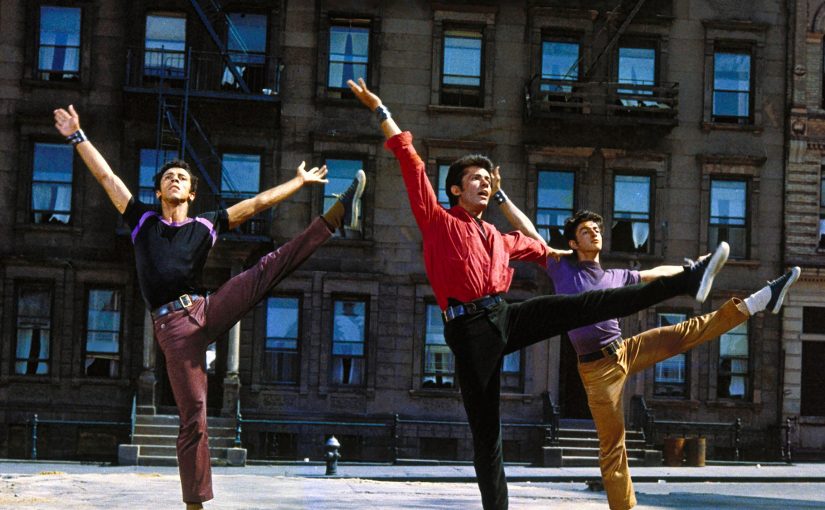
West Side Story crackles with energy as soon as the 6 minute overture begins and segues into overhead shots of New York City accompanied by its frequent whistle calls. Then it zooms in for something new, fresh, and eye popping; precise choreography from Jerome Robbins to represent street fighting by means of heart racing ballet. You simply can’t take your eyes off the screen.

Young love and pride carry Robbins’ film with partnered direction from Robert Wise. It’s sadly amazing that the prejudices that shape the story are arguably more evident and profound nearly 60 years later. Tony & Maria must never be together. Change the names today, and the logic behind the societal law will often mirror the reasoning found in the film.

Am I focusing too much on that message though? There’s so much to cherish in West Side Story. A film that boasts numbers like “America,” “I Feel Pretty,” “Tonight,” “Stay Cool Boy,” “When You’re A Jet,” “Maria,” and my favorite “Officer Krupke.” It does not get much better than this.

The dancing lunges at the camera. The dialogue may be dated, yeah, but the cast is so genuine to the setting (even if Natalie Wood is lip syncing her songs).

Steven Spielberg has remade the film, to be released in December, 2021. I’ll go see it, sure. Yet I don’t believe it’ll compare to the original 1961 winner for Best Picture as well as the other 9 Oscars it was recognized for.

Go back and catch up with West Side Story. It should be seen by anyone who ever wanted to watch a great film.