INHERIT THE WIND (1960)

by Miguel E. Rodriguez

DIRECTOR: Stanley Kramer
CAST: Spencer Tracy, Fredric March, Gene Kelly, Dick York, Harry Morgan
MY RATING: 9/10
ROTTEN TOMATOMETER: 93% Fresh

PLOT: In 1925, two great lawyers argue the case for, and against, a Tennessee science teacher accused of the crime of teaching Darwin’s theory of evolution.  (Inspired by the real-life Scopes Monkey Trial.)


I have known about the movie version of Inherit the Wind for many years now, but it has taken me this long to get around to finally watching it.  One of the first shows I ever did in community theater was Inherit the Wind.  I played E.K. Hornbeck, probably one of the best-written characters I’ve ever performed.  I hesitated this long to watch the movie, or any of the other various TV/cable versions, because I feared it could never live up to the power of the stage play.  Boy, was I wrong.  Stanley Kramer’s film of the award-winning play is anchored by two of the greatest performances ever to grace the silver screen, courtesy of Spencer Tracy and Fredric March, both 2-time Oscar winners.

It’s 1925, and in the Bible-belt hamlet of Hillsboro, Tennessee, a young teacher, Bertram Cates, has been imprisoned.  His crime?  Teaching Darwin’s theories in high school.  In Hillsboro, you see, it’s against the law to teach anything but Biblical creationism in the classroom.  The arrest makes national headlines, most of them negative.  Example: “Heavenly Hillsboro: Does It Have a Hole in Its Head, or Its Head in a Hole?”  The despairing town fathers rejoice when they discover that the great Matthew Harrison Brady, lawyer extraordinaire and 3-time Presidential nominee, will volunteer to prosecute the case.  Brady is played by Fredric March with gusto, although I almost wish March had dialed it back JUST a touch every now and then.  He comes VERY close to becoming a parody of a character instead of a real person.

Covering the story in Hillsboro is E.K. Hornbeck (Gene Kelly!), a reporter from Baltimore.  Hornbeck is loosely based on the legendary newspaperman H.L. Mencken.  The screenplay reduces Hornbeck’s presence a tad as opposed to the stage play, but Kelly delivers the goods with all the appropriate flair and panache.

Hornbeck’s Baltimore paper uses its influence and checkbook to lure another skilled, big-city attorney to Hillsboro to defend Cates.  This is Henry Drummond, played by Spencer Tracy in arguably the best performance of his lengthy career.  Drummond is a shambling, good-natured fellow whose twinkling eyes disguise a sharp legal mind and a passion for the truth.  It’s a tribute to Tracy’s abilities that we get to see both sides of Drummond’s persona and there is never a sense of any disconnect between them.

After the first half-hour or so of exposition, the remaining bulk of the film takes place in the sweltering Hillsboro County Courthouse, as a jury is selected, witnesses are questioned, and both sides present their case to the judge (Harry Morgan).  In between court sessions, we get short scenes with Bertram Cates’s fiancé, Rachel, who just happens to be the daughter of the town’s religious leader, Reverend Brown (Claude Akins); a prayer meeting where Reverend Brown essentially damns his own daughter to hell; and pleasant interludes where Drummond and Brady sit on a front porch and reminisce how they used to be great friends, fighting for the same cause once upon a time.  But now Brady has combined his faith with his political ambitions, and Drummond dreams of a day when reason and science are not equated with heresy.

I won’t give you a play-by-play of the courtroom scenes here.  But if I were a film director, and I found myself directing a courtroom thriller, I would sit down and watch Inherit the Wind at least ten times before shooting a foot of film.  The scenes where Drummond and Brady butt heads and cross-examine and make objections are simply spellbinding.  I would be remiss if I didn’t mention the camerawork by the great Ernest Laszlo, moving around the courtroom and around each attorney, pushing in, tracking backwards.  I know great camerawork is supposed to become invisible while watching a film, but this was different.  Laszlo’s camera sometimes calls attention to itself, but it never, ever distracts from the story.

Of course, beautiful camerawork only works when it’s photographing something worthwhile, and Spencer Tracy and Fredric March do not disappoint as Drummond and Brady.  For nearly 90 minutes, they bicker, trade jabs, and put on a double-act of Hollywood professionalism and technique that would not be matched until the films of Newman and Redford.  Tracy is especially fascinating to watch.  It’s impossible to catch him acting.  There’s never a moment when he looks anything but authentic.  His speech patterns give the impression of a man whose mouth is just barely keeping up with his brain.  When he occasionally stumbles over a word, the odds are 50-50 whether it was a real slip up or if he just threw it in as a flourish.

If Tracy’s performance is a triumph of realism, or at least naturalism, Fredric March’s performance is one of the last great displays of old Hollywood, full of facial tics and vocal mannerisms and speechifying that would have made even Charles Foster Kane say, “Dude…dial it down.”  It’s still a powerhouse performance, but it’s a good thing Tracy didn’t try to match March.  Otherwise, the whole movie would have become a cartoon.  Because we have two such contrasting performances, the movie achieves a nice balance that makes time pass much more quickly than it might have with two other actors.

Regarding the TOPIC of the film…well, to be honest, if I started to write about all the things I felt while watching the film, about how so many people today, not just random folks, but people I know personally, would have felt right at home in 1925 Hillsboro, asking God to rain hellfire on the non-believers, chanting about hanging the accused teacher from a “sour apple tree”…I’d still be writing this review three days from now.

Besides, I believe the film makes its point much more eloquently than I ever could (especially when it comes to the discussion of how long that first day of Creation was, exactly).  One of my favorite lines from the movie comes when Brady accuses Drummond of attempting to destroy everyone’s belief in God and the Bible.  Drummond replies:

“That’s not true, and you know it.  The Bible is a book.  It’s a good book.  But it’s not the ONLY book.”

Inherit the Wind is not anti-Christian or anti-God or even anti-religion.  It is a plea for tolerance.  The fact that it was released over sixty years ago does not diminish the power of that message.  And even if it did not have that agenda, it would still be one of the most exciting, crackling courtroom dramas I’ve ever seen.

(Fun fact: A quick internet search reveals that, while all US states currently teach evolution, there are some that voluntarily pair it with creationism.)

ELMER GANTRY (1960)

by Miguel E. Rodriguez

DIRECTOR: Richard Brooks
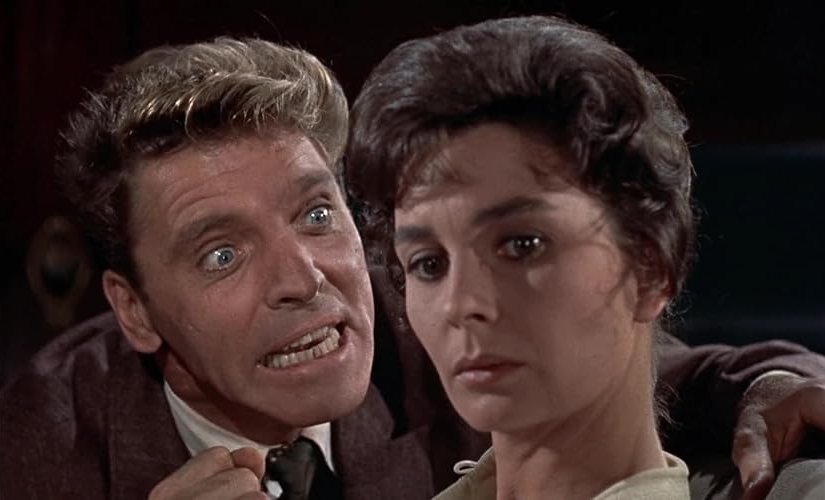
CAST: Burt Lancaster, Jean Simmons, Arthur Kennedy, Shirley Jones
MY RATING: 9/10
ROTTEN TOMATOMETER: 94% Fresh

PLOT: A fast-talking traveling salesman convinces a sincere evangelist that he can be an effective preacher for her cause.


Elmer Gantry pulls a double, then a triple-fake.  It’s a good thing they stopped at three because you can only subvert an audience’s expectations so many times before they hold it against you.  It starts as a tired (but well-executed) formula, then it turns that formula on its head, and then, just when you think you’ve gotten a stereotypical Hollywood ending, it pulls one more rabbit out of the hat.  In a way, it reminded of The Blue Angel (1930) in the way it presents a clearly hypocritical man to the audience, warts and all, and gets us to feel a little sympathy for him at the end, despite his wicked ways.

The film is also the most intelligent film I’ve seen about religion and Christianity since Robert Duvall’s The Apostle (1998).  It contains the best scene/exchange on the topic I’ve ever seen, between a fire-and-brimstone preacher and a non-believing newspaper reporter.  Both sides score points, but in the end, neither one wins, which I believe is just as it should be.  But I’m getting ahead of myself.

We first meet Elmer Gantry (Burt Lancaster) as he’s telling a dirty joke to some prospective clients in a bar, sometime during the Prohibition era.  The impression he gives right away is that of a huckster, a fast-talking, fast-thinking heel who’ll do whatever it takes to make a sale.  His conversation is interrupted by two nuns soliciting donations.  As a lark, he grabs their collection plate and exhorts the bar patrons to give all they can.  He’s pulling a cynical prank, but his words are surprisingly effective.  And no wonder: we later learn he was expelled from a theological seminary some years ago.  He knows the words, but not the music, but that’s enough for folks to turn out their pockets for him.  No one is more surprised by this outcome than Elmer himself.

Later, after visiting a Negro church service and hoboing around on a train, he visits a traveling revival led by Sister Sharon Falconer (Jean Simmons).  He is immediately smitten by her beauty – because, hello, it’s Jean Simmons – and realizes the only way to get to her is through her vocation.  With some of his trademark fast-talking, he flirts with one of Sister Sharon’s followers and uses what he learns to get closer to Sharon.  He agrees to deliver a mini-sermon at one of her very well-attended revival services to prove his good intentions, but something unexpected happens: the crowd responds to his words as if he were a bona-fide preacher.  Soon he’s touring with Sister Sharon from town to town as crowds get larger and larger.

Meanwhile, we get to see the inner workings of the business side of this religious venture.  We watch as various preachers and pastors debate the merits of inviting Sister Sharon and Gantry to a “big” city, Zenith.  (I learn from Wikipedia this city name is fictional, created by the author of the book on which the film is based…didn’t know that.)  Committee members are uncertain whether Sharon’s and Gantry’s message will increase church rolls in a metropolitan area as opposed to their previous, more rural locales.  I loved this scene because it feels authentic.  Whether it’s realistic or not is not for me to say.  But I can easily imagine well-intentioned religious leaders (and maybe some NOT so well-intentioned) sitting around and discussing, not just the spiritual expectations of such a revival, but also the FINANCIAL expectations, as these men do in the film.

Elmer Gantry is filled with scenes and dialogue that held my attention for the film’s duration.  Growing up as I did in a Christian church environment and graduating from a Christian college, I recognized virtually all of Elmer’s tactics, as well as Sister Sharon’s tactics, in using exactly the right words, gestures, and tone to play a congregation like a fiddle.  The difference is, Sister Sharon genuinely believes she’s been touched or called by God to this vocation, while Gantry is expertly going through the motions as a means to an end.

 (On a personal note, I should mention that Burt Lancaster’s mannerisms and speech patterns as Elmer Gantry strongly reminded me of the pastor of the Southern Baptist church I attended for many years, from his physical appearance to his, pardon the expression, shit-eating grin.  But that’s another story…)

There is one scene that I must specifically mention and dissect.  A Zenith newspaper reporter, Jim Lefferts (Arthur Kennedy), writes an article in which he expresses his skepticism of Gantry’s and Sister Sharon’s motives, as well as of revivals in general.  He writes:

“What qualifies someone to be a revivalist?  Nothing.  Nothing at all.  There is not one law in any state in the Union protecting the public from the hysterical onslaught of revivalists.  But the law does permit them to invest in tax-free property, and collect money, without accounting for how it is used.  What do you get for your money?  Can you get into heaven by contributing one buck or 50?  Can you get life eternal by shaking hands for Jesus with Elmer Gantry?”

(The Lefferts character is asking questions in this article that are as relevant now as they were in 1960, or 1920, or even going back to ancient times when Jesus whipped the moneylenders from the church.  To put it another way, as one dissenting church elder says in the film, “Religion is not a business.  And revivalism is not religion.”)

Sister Sharon and Gantry show up at the newspaper office to officially protest the article to Lefferts and his editor.  Sharon objects to the article’s implications about misusing collection money.  Lefferts calmly asks if Sister Sharon is ordained.  She is not, in fact, sanctioned to preach by any church body.  She points out that neither was Peter or Paul or any of the apostles.  Lefferts retorts:

“Ah, but they said that they lived with the Son of God, were taught by Him, were sanctified by Him.  What gives you the right to speak for God?  …How did you get His approval?  Did God speak to you personally?  Did He send you a letter?  Did you have a visitation from God?  A burning bush, perhaps?  Where in the New Testament does it say that God spoke to anyone except His Son?”

Then Lefferts quotes First Corinthians to show how the Bible says it’s shameful for women to speak aloud in church.  I’m watching that scene, and I’m going, BOOM, game, set, and match to Lefferts.  I remember asking these very same questions when I was younger and having normal doubts about the way church was structured.  Not about women speaking in church, I knew that was archaic and outdated, but I would always hear preachers and evangelists say, “God spoke to me.”  And I wanted to ask, “Well, what did His voice sound like?  Did He have an accent?  Did He speak English?”  But we weren’t SUPPOSED to ask those kinds of questions, we just had to take their word for it because, after all, they’re up there in the pulpit, and I’m down in the pews just listening.

But here’s where Elmer Gantry shows its colors as a film that may SEEM like it’s taking sides, but it really isn’t.  Lefferts finishes his takedown of Sister Sharon, but Elmer has a trick up his sleeve.  He turns Lefferts’s argument against itself by asking why he quoted the Bible if he doesn’t really believe the Bible is factual.  If Lefferts doesn’t believe in the six days of Creation or in the miracle of the loaves and fishes, then how can he use the scripture against Sister Sharon?  It’s a rather brilliant argument that almost feels lifted from Inherit the Wind (released the same year as Elmer Gantry.)

My admiration of this scene stems from the fact that both sides make excellent points, and the scene ends in a kind of stalemate where Lefferts won’t retract the article, but the newspaper offers to run a response to the article.  (Naturally, Gantry wheedles it up to a series of radio broadcasts instead.)  It would be tempting in a movie that is predominantly anti-religion to portray religious proponents as Bible-thumping, spittle-spraying zealots without a brain in their heads.  While Elmer certainly takes cues from that behavioral playbook, he is clearly not a moron, and that is refreshing.

Those who have seen the film before may note that I haven’t even touched on the one Oscar-winning performance from the film.  Shirley Jones plays a prostitute named Lulu Baines, and she has the film’s most unforgettable line as she recounts how a young man once took advantage of her behind a church pulpit one Christmas Eve: “He rammed the fear of God into me so fast I never heard my old man’s footsteps!”  What part she has to play in Elmer’s story, I will not reveal, just in case anyone’s reading this who’s never seen the movie.  She reveals unexpected depths and makes unexpected choices in the last couple of reels that seal both Elmer’s and Sister Sharon’s fates.

Whew!  This was another long one.  Elmer Gantry by its very nature engenders discussion and debate.  There’s even an opening title crawl advising patrons that, while the filmmakers believe that “certain aspects of Revivalism” demand further scrutiny, everyone is free to worship as they please, and patrons should prevent impressionable children from watching the movie.  Perhaps they were afraid children would believe that all religions and evangelists proceed from secular motives, which would lead to all kinds of uncomfortable conversations with their parents, churchgoing or otherwise.  In my opinion, those kinds of conversations can only benefit both the children and the parents.  I believe Elmer Gantry is one of the finest treatments of religious beliefs and activities I’ve ever seen, specifically because, by the time we get to the end credits, I’m still not 100% sure whose side the movie is on.  I think it’s up to us to look at the movie as a whole and make our own decisions.

ROCCO AND HIS BROTHERS (Italy, 1960)

by Miguel E. Rodriguez

DIRECTOR: Luchino Visconti
CAST: Alain Delon, Renato Salvatori, Annie Girardot, Claudia Cardinale
MY RATING: 8/10
ROTTEN TOMATOMETER: 90% Fresh

PLOT: An impoverished family from rural southern Italy moves north in search of a better life in Milan, a “big city” that puts their familial bonds to the test.


Movies like Visconti’s celebrated Rocco and His Brothers are much-needed reminders that films need not provide explosions or alien invasions to be interesting or exciting.  I won’t say it’s perfect (several scenes could have been trimmed and still been effective), but I was as absorbed in the story as I am when reading a particularly good novel.  (For some reason, I was reminded of my headspace while reading Donna Tartt’s The Goldfinch; the story and style grabbed hold of me and had me riveted the whole time, despite the fact my preferred tastes run to Crichton, Clancy, and King.)

Since I make no claims to be a historian, filmic or otherwise, I cannot vouch for the verisimilitude of Rocco and His Brothers in terms of Italy’s social and demographic picture in the late 1950s/early 1960s.  I seem to remember reading something somewhere about how this period reflected to some degree the Dust Bowl era in the United States when displaced midwestern families flocked to the West coast in search of better lives.  In the world of this film, we are led to understand that families like the Parondis, faced with financial hardships, were migrating north to Milan and other larger, modernized cities.  Some folks were able to adjust, others were not, and that was that.  The Parondis – Mamma Parondi and her five sons – are determined to make the move work no matter what.

The tone of constant struggle is set near the beginning when the Parondis arrive in Milan and, ominously, no one meets them at the station.  The eldest brother, Vincenzo, was supposed to be there, but he was distracted by a gathering of his girlfriend’s family.  When the Parondis arrive unannounced to the gathering, they are initially met with open arms, but innate prejudices about “country folk” get the better of everyone and they leave in a huff.  They find cheap lodging and the brothers make their first bits of money by shoveling snow.  A revealing scene shows the mother rousing her sons out of bed in the middle of the night at the first sign of snowfall so they can beat everyone else to the jobs.  Rocco and his brothers are reluctant at first, but they rally together and stay positive because, well, they must.  These strong ties will be tested as never before by the time the credits roll.

The film is broken up into sections, one for each brother.  The first section, “Vincenzo”, shows how his life seems to have changed for the better after relocating himself to Milan some months before the rest of his family, but their sudden arrival puts a crimp in his personal life when he is obliged to move in with them.  The next, very lengthy chapter focuses on Simone, a handsome, outgoing fellow who is spotted by a boxing coach and achieves local fame by winning a high-profile match soon after he begins training.

Shortly after this win, the family gets entwined with a local prostitute named Nadia who arrives unexpectedly on their doorstep in need of some clothes.  Before long, she becomes involved romantically with Simone, but tells him outright that she’s not interested in anything long-term, despite his obvious desire to be near her whenever possible.  The affair ends, and Nadia leaves town after having a crucial conversation with Rocco.

The third chapter, “Rocco”, follows Rocco after he serves a brief tour of duty in the military, after which he fatefully reconnects with Nadia after over a year.  They fall in love, and Nadia surprises herself by truly falling for Rocco despite her previous wishes not to be involved in anything permanent.  But when Simone discovers their relationship, events are set in motion that are as devastating as they are unexpected.

(The last two chapters, “Ciro” and “Luca”, focus on the fallout of the previous three sections.)

Rocco and His Brothers feels like it was adapted from an Italian opera.  It wouldn’t surprise me in the slightest if I learned that someone had turned it into an opera.  There are emotions and reversals and shocks and tragedies on display here that rival anything on American daytime television, but it rarely feels like soap opera.  Yes, there are some moments when the characters and the filmmakers take the time to deliver speeches that don’t seem to spring out of any true motivation other than to pound home the point the director is trying to make at that stage in the film.  (I’m thinking especially of Ciro’s final scene.)  But I am inclined to forgive these momentary lapses in momentum because, in retrospect, they lend emotional weight to the characters.  Novels can achieve this with a paragraph or two detailing the inner thoughts of their characters, but in film, the characters have to tell you what they’re thinking, verbally or nonverbally, or the audience gets lost.

I have hinted only vaguely about certain tragic aspects of the story.  This is because Visconti and his editor took great pains to allow them to arrive organically in a way that took me completely by surprise, so it would be wrong of me to give those surprises away.  For those of you who have seen the film, you know what I’m talking about.  It’s these moments that elevate Rocco and His Brothers into something more than a mere soap opera.  Some of the acting will strike modern audiences as exercises in histrionics, especially as exhibited by Mamma Parondi and Nadia.  To that I would say: “What do you want from opera, subtlety?”

Rocco and His Brothers is one of those elusive films that I’d heard and read about for some time now, and I’m grateful that I’ve finally seen it.  I’ll be honest, it’s not exactly a film I’ll take down and rewatch multiple times in a year, but it’s worth seeking out if you’re looking for a good old-fashioned family drama that’s not quite a tear-jerker, but it’s certainly no bed of roses, either.  Martin Scorsese once deemed it one of 39 foreign films every moviegoer should see before they die.  And if you can’t trust Marty, who can you trust?

EYES WITHOUT A FACE (France, 1960)

by Miguel E. Rodriguez

DIRECTOR: Georges Franju
CAST: Pierre Brasseur, Alida Valli, Juliette Mayniel, Edith Scob
MY RATING: 9/10
ROTTEN TOMATOMETER: 97% Certified Fresh

PLOT: A surgeon goes to extreme lengths to give his daughter a new face, which was disfigured in an accident he caused.

[NOTE: This review contains mild spoilers.]


I have become a fan of many of the new breed of horror films released in the last ten years or so – Under the Skin, The Babadook, Get Out, Hereditary, Doctor Sleep, and Saint Maud, just to name a few.  Despite their cosmetic differences, these movies all accomplished the same thing: they got under my skin.  They were genuinely unsettling as their stories unfolded, and they can still creep me out to this day.

Imagine my surprise when I sat down to watch George Franju’s Eyes Without a Face, a French horror film released over sixty years ago, during a time when most mainstream American horror films (Hitchcock aside) were exercises in jump scares, cheesy special effects, and outrageous premises.  I was not prepared for how effectively this movie grabbed me from the outset and, except for a brief middle passage, did not let go.  When a movie from 1960 begins with a woman dumping a corpse into a river…a corpse with a clearly, hideously disfigured face…I don’t know about you, but I sat forward a little in my seat.  Where is THIS going?

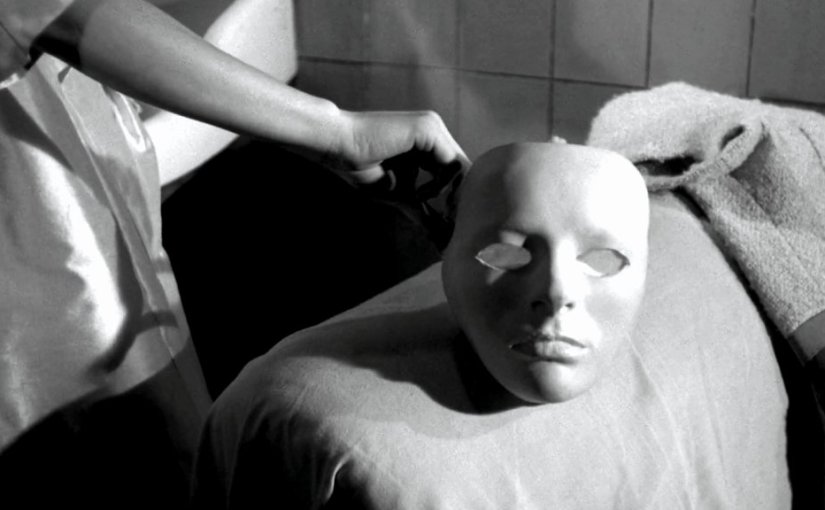
When the body is discovered, the esteemed Dr. Génessier (Pierre Brasseur) solemnly identifies it as his daughter, Christianne.  There is a funeral, Christianne’s fiancé is distraught, and the police are satisfied.  When the good doctor returns home to his large, gothic estate in the country, he goes upstairs to a room where we find his actual daughter, still alive and so disfigured the camera dares not show her face.  The doctor’s assistant, Louise (Alida Valli, still exotic-looking 11 years after The Third Man), brings in a simple but disturbing mask for Christianne to wear.  “Get into the habit of wearing it,” says the doctor.

Who was the girl in the opening scene?  What happened to Christianne’s face?  And why does Louise start searching the nearby city for young unattached women with blond hair and pretty faces?  Why, indeed?

Eyes Without a Face may not have a particularly inscrutable or complicated story, but that doesn’t matter.  The movie unfolds like a modern-day Grimm’s fairy tale, poetic, with princesses locked in tall towers, an evil father figure, and unspeakable violence hinted at but never quite seen.  Except this time, in an unforgettably shocking scene, we witness one of the doctor’s operations.

In most films of this era, shockingly violent acts were tactfully carried out offscreen.  I am thinking, for some reason, of Lawrence of Arabia, where Lawrence must execute a man in order to keep the peace between two Arabian tribes.  Lawrence pulls his gun, we see the bound man try to escape, and we cut to Lawrence as he fires his gun, once, twice, several times.  It’s a shocking scene, but we never see the carnage of those bullets.  It’s left to our imagination.

In Eyes Without a Face, we watch as the doctor gently draws a grease pencil outline around his anesthetized victim’s pretty face.  (“I must try removing it in one large section, not in pieces as before.”  Yikes.)  Then Louise hands him a scalpel, and the camera stays on Louise’s face, and I expected it to stay there for several seconds as the horror of what the doctor was doing was left to our imaginations.  But no.  We cut back to the scalpel piercing the skin as he gingerly follows his outline around her face.  Some excess blood drips down, and Louise dutifully sponges it away.

This is already pretty strong stuff for 1960, at least when I compare it to other films I’ve seen from that era (again, Hitchcock aside).  But I was doubly shocked when the movie didn’t stop there.  The face must still be removed, but to do that we need clamps, more incisions (taking care around the eyes, of course), and we watch this process in several long takes which must have had some audience members fainting in disbelief.

When the doctor is finished, another body must be disposed of, Christianne has a new face, and all seems to be well.  (The doctor reminds his daughter: “Smile.  Smile.  …not too much.”)  What makes this movie great is that there is still so much more to the story, but I’ll leave that for you to discover.

This is the kind of gothic stuff that screams for a remake today, maybe by del Toro or Ari Aster.  Although perhaps they are already fans and have made the decision that the film is too perfect as it is.  I can’t blame that viewpoint.  Eyes Without a Face has just about everything a modern horror fan could desire.  Franju plays many of the film’s creepiest scenes with no score, creating a deeply unnerving mood like in The Blair Witch Project.  It doesn’t shy away from disturbing gore.  Christianne is not just a shrinking violet, but prone to heartbreaking philosophy.  (“My face frightens me.  My mask frightens me even more.”)  To say the resolution of the story is satisfying is an understatement; it takes “poetic justice” to a whole new level.  There is Hitchcockian – or, perhaps more accurately, Clouzot-esque – suspense when Christianne’s fiancé begins to suspect there is something fishy about Dr. Génessier’s clinic and tries to set up a sting operation with the help of local police.

And so much more.  Eyes Without a Face is, for me, one of those buried treasure movies that I normally do not seek out, but when they turn out to be more than worth my time, I can’t help but share it with others.  It holds its own with modern horror films, and then some.  The fact it was made in 1960 still boggles my mind, and that just makes it even more fascinating.

[P.S… According to IMDb, John Carpenter once suggested that the selection of the mask worn by Michael Myers was influenced by Christianne’s mask from this film. I believe it.]

PSYCHO

By Marc S. Sanders

To watch Alfred Hitchcock’s Psycho today is a blessing and a curse.  You can’t take your eyes off the craftsmanship of the film.  Yet, you know all the surprises and plot twists.  There’s only so much blood you can draw from the stone. 

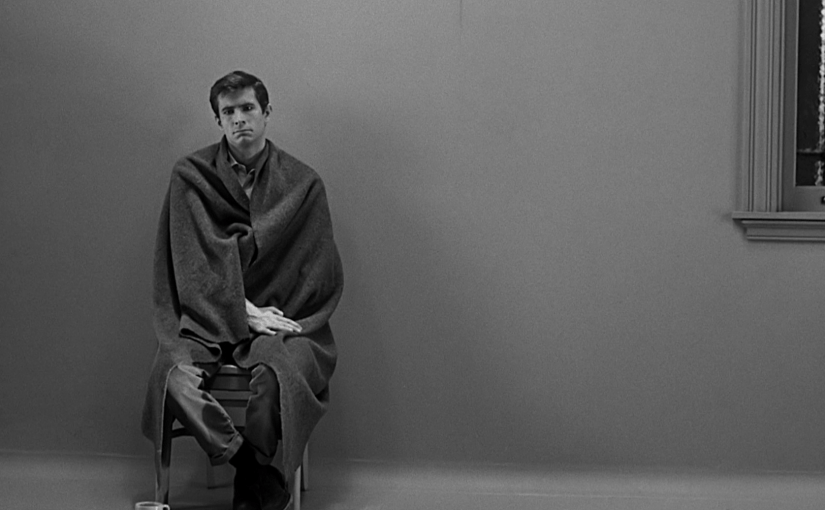
Recently, I told my fourteen-year-old daughter, who doesn’t like scary movies, that she needs to watch the film.  If only because she knows absolutely nothing about Psycho.  She has no idea what’s to come of Marion Crane (Janet Leigh). She’s never heard of the shower scene.  She doesn’t know about the true relationship between Norman Bates (Anthony Perkins) and his chastising mother.  Imagine, assuming you have seen the movie and/or know all its secrets already, watching the movie with someone who is seeing it for the first time with a completely blank canvas to go on.  Oh, the reactions you’ll get to see!!!

Hitchcock’s film, with a screenplay from Joseph Stefano, works under a lot of different dimensions.  It’s classified as the first “slasher movie.”  That may be true.  However, it’s much more intelligent than a typical Jason or Freddy Krueger fright fest.  Psycho begins as one story with a central character, seemingly innocent, carrying out a crime.  Later, it turns on itself and becomes something else altogether.

Marion Crane makes off with $40,000 in cash from a chauvinistic, obnoxious client of her real estate boss.  She hits the road, heading towards her lover’s home in nearby California.  Her impending doom is never implied.  Stefano and Hitchcock focus only on Marion’s scruples with the crime she’s committed.  She gets haunted by a curious police officer.  She certainly wonders what her boss must think when he’ll discover that she never deposited the money in the bank.  Is the used car salesman going to follow up on her after she urgently trades in her car for a new one with new plates?

Soon though, none of that will matter when she has no choice but to pull off the road for the evening to stay at the Bates Motel, currently with twelve cabins and twelve vacancies.

For the one or two readers who have never heard of Psycho, I’ll stop there with the narrative.  However, what I appreciate about the second half of the film is that the new central character, now young, quirky, altogether strange Norman Bates, seems to respond with avoidance when a private investigator named Arbogast (Martin Balsam), and then later Marion’s lover Sam (John Gavin) and her sister Lila (Vera Miles) start questioning him about Marion’s whereabouts.  Arbogast is on the trail of a thief who went off with $40,000.  Sam and Lila are also curious about the theft that seems unheard for Marion to commit.  Yet, there’s something else leaving them curious.  Norman, on the other hand, knows nothing as to what Marion was up to.  In his eyes, the only odd thing about her is that she checks into the motel under a different name.  All of these characters are coming in conflict with one another, but not for the reasons they think they are.  The fun part is that we are the only ones who know the hands that each player is holding.  Even more fun is when we uncover a secret that Norman has been hiding from the audience all along.

Hitchcock tricks his audiences with Psycho.  With its first story, we are in suspense of one criminal.  Will she get away with the theft? Rather, how and when will she get caught?  With its second story, we are unnerved by someone far worse and frighteningly mysterious.  Following the infamous shower scene, it’s a little nerve wracking to watch as Norman tries to hide the evidence in the trunk of a car that he pushes into the nearby swamp.  Any storyteller would just have the car simply sink.  Hitchcock brings in shadowed close ups (with his wise idea of black and white photography) of Norman chewing gum, and then becoming completely still when the car actually stops sinking midway through its descent.  As a viewer, your jaw drops.  What is Norman going to do if the car doesn’t fully submerge?

Later, it’s a wonder how Norman is going to circumvent around the unexpected visits form Arbogast, Sam and Lila.  Then, we are in suspense of their safety.  They’re just looking for the missing money while tracking where Marion went off to.  Unbeknownst to them, they have can’t even fathom her demise.

I was talking with one of my Cinephile brothers about Psycho, explaining how it follows a similar dynamic that the second half of Vertigo moves upon.  In Vertigo, the main characters, Scottie and Madeliene, are both in love with one another.  Yet, it’s for different reasons that they can’t explain to each other.  In Psycho, the characters are all under suspicion and even paranoid of each other, yet for all different reasons.  Norman never knew of Marion’s crime.  Though the other characters suspect that he does.  In both pictures, only we, the audience, know almost everything at play.  According to various documentaries I’ve watched, Hitchcock wholeheartedly trusted his screen writers to flesh out the stories.  He concerned himself more with constructing the film with a faithfulness to the script.  What’s commendable about the films Alfred Hitchcock chose to make is that he sought out these conundrums where his chess pieces are left bewildered or unaware of why they are sharing the stage with the other players.  The director had a way of channeling into deceiving his characters against one another, allowing the viewers to relish in their trickery.  Going a step further though, Hitchcock reveals other twists never suggested in the film to turn the audience on their ear in shock.

You can’t take your eyes off Psycho, even with knowing all the goodies that Hitchcock provides. 

Anthony Perkins especially is a tense and unnerving menace.  He has a boyhood innocence to him that should not appear threatening to Janet Leigh’s Marion Crane.  It’s in his relaxation with the role that it feels all the more terrifying to the viewer.  Simply look at the way Arbogast pulls up to the motel and Perkins is sitting calmly on the porch eating his bag of candy.  Watch how he casually shares with Marion how he relishes in stuffing the birds he has mounted on the parlor walls, or even how he casually offers cabin number one for Marion to occupy so that she can be close to everything.  Norman Bates hides himself very well in his virtue.  A wolf in sheep’s clothing.

The Bates Motel and the large house poised behind it on the hill were set up on a Universal back lot.  It remains one of the most famous settings in film history.  When you see the silhouette of Norman’s mother in the window from afar or young, slender Norman standing in front of the house, the images of the chilling locale stay with you whether it is on a dark and stormy night or even during a sunny afternoon.  Hitchcock opted to shoot the film in black and white to taper the goriness of the piece.  Outside of the gore elements though, the black and white lends a foreboding feeling to this destination.  Even before we realize that Marion is in danger, we feel uneasy with just arriving at this place.

The shower scene of course is one for the ages.  I’m not here to discuss all of the mechanics of film’s centerpiece.  The assembly of the scene’s elements are masterful though.  Can you imagine the scene without Bernard Hermann’s shrieking score?  Hermann was to Hitchcock like John Williams is to Steven Spielberg.  The aftermath is brutally shocking as well.  The camera does a zoom out on Janet Leigh’s eye as the soaking head of her corpse lays down on the bathroom floor.  I notice the eye does just the slightest twitch.  For me, that’s all the more disturbing than just a very still open eye.  It implies the last bits of life leaving her body and consciousness.  Later, when Norman cleans up the bathroom, Hitchcock shows his process with a mop and neatly wrapping Marion in the torn shower curtain and disposing of anything belonging to her, including a newspaper that isn’t just a newspaper.  Norman is methodical.  Perhaps this strange man has done something like this before.

I do have one grievance with Psycho.  The air is kind of sucked out of the film in its last few minutes before that delicious last close up on Norman.  Stefano’s script offers up a psychological explanation for what Norman Bates seems to suffer from.  It’s as if we are given a scientific description for what ails him. This is all painfully boring.  I dunno.  Maybe in 1960, when Psycho was a pioneering kind of horror film, and moviegoers were not as familiar with the genre that seemed far scarier than Boris Karloff, and vampires and mummies, they needed a summation like this.  Sixty years later, naturally this is not necessary.  We know all to well that there are disturbed people who live among us.  We know, sometimes, to be cautious of folks like these.  For someone as reputed as Hitchcock was, being identified as the “Master of Suspense,” this long monologue, spoon fed diagnosis from the psychiatrist kills all of the horror we’ve bared witness to over the last two hours. 

Psycho was the first slasher movie.  It was the first movie to feature a toilet and have it flush on film. It has one of the most famous characters in all of film history.  It has one of the most famous scenes of all time.  It was directed by one of the greatest directors of all time.  Yet, it also has one of the worst conclusions of all time.  If ever a scene should have been cut from a finished product, it is the second to last scene of Psycho.

Now, go find someone who has never heard of Psycho, knows nothing at all about Psycho, and watch them watch Psycho.  Of course, as the famous marketing campaign for the film insisted, by all means do not start the movie or walk in the middle, and never reveal any of its secrets.

THE APARTMENT

By Marc S. Sanders

You ever come across a film that begins as sweet screwball, and then segues into serious sensitivity?  If you have, then maybe you have seen Billy Wilder’s classic film The Apartment.  Beyond the film being an Oscar Best Picture winner, Wilder’s film demonstrates that there is a screwball mentality in all of us, but we also know when the party must end.

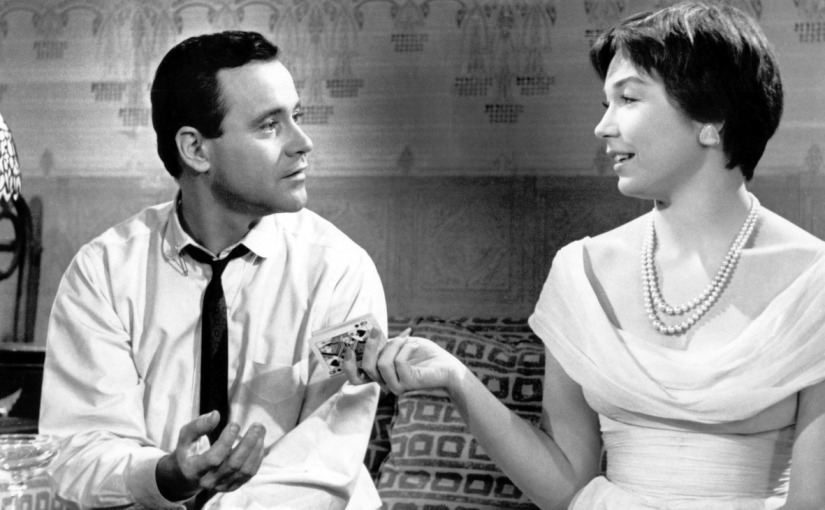
Jack Lemmon plays C.C. Baxter, one of over 31,000 people who works for Consolidated Life in a Manhattan high rise.  He’s a likable fellow who happily does his work with a typewriter amid a sea of other desk jockeys on a floor that seems to expand beyond the architectural limits of the building.  When his eight hour day comes to a close, he’s normally the last one to leave for home because it is likely his apartment located outside of Central Park is occupied with one of the company big wigs that liberally uses his pad to entertain a lady friend beside their respective wives.  Baxter has been relegated to a door mat who holds out hope that any one of these ranking supervisors may one day promote him to an executive position with a private office and a view of the city.  Promise finally opens up when the President of the company, Jeff Sheldrake (Fred MacMurray), summons Baxter to his office to commend him on the positive feedback from the other men in the office and to request some time with the apartment himself.  Sheldrake would like to have some time away from his wife and children to host Fran Kubelik (Shirley MacLaine), the building’s elevator operator.  If Baxter had the availability to his own apartment and a little bit of bravery, he may have asked Fran for an evening out together on another occcasion.

The Apartment begins almost like a farce or sitcom as the revolving door of Baxter’s apartment welcomes one new executive after another.  You may be expecting confusion and misunderstandings that’ll lead to outrageous laughter.  However, poor Baxter is the victim to all of this coming and going by even surrendering his home to Joe Dobisch (Ray Walston) who calls unexpectedly at eleven o’clock at night requesting the place for an hour.  Baxter takes shelter on a park bench in the December cold. The humor of this arrangement is not so funny any longer.  After Sheldrake’s regard for Fran is more apparent, then it’s more clear that these characters are not spawned from the happy home life scenarios of 1950’s television programming.  Sheldrake is only charming to an adorably likable woman like Fran for as long as he cares.  Some might say he’s not terribly cold hearted though.  After all, though he forgets to shop for a Christmas gift for Fran, he offers her a hundred dollar bill from his wallet instead.  Up until this midway point, Shirley Maclaine has been so good at maintaining a cheerful disposition that suddenly her self worth seems a whole lot less than a hundred dollars following Sheldrake’s latest disregard.  Surprisingly, Fran overdoses on a bottle of sleeping pills.  When Baxter discovers her in his bed, he races to revive her with the aid of a doctor neighbor.  Baxter does not give up on helping Sheldrake make this right, while tending to Fran’s recovery on Christmas Eve.  Yet for Sheldrake, this is all an inconvenience and now without even looking for a better way to live, Baxter finds an opportunity to allow his own personal strength to come through against the executives at the office, as well as Mr. Sheldrake, and most importantly with the woman he cares for, Fran.

Jack Lemmon has a energetic method to his performance, as I find he does with most of the roles in his career.  He plays men who never break to sit and breathe.  They are always on the go.  They almost never sleep.  So, his fast paced delivery and flirtation with Shirley MacLaine let Wilder’s film perform at a fast pace.  The range of both Lemmon and MacLaine really work for The Apartment, because they can be naturally funny and intensely serious when the moment calls for it.  Lemmon can sell me as a guy who will use a tennis racket to strain his spaghetti while at the same time standing up for his convictions when life can not allow humor for a moment.  MacLaine can portray a woman with a menial job like an elevator operator and yet still be considered valued and recognized as genuinely hurt when disregarded.  For Fred MacMurray, I think it’s fair to say he actually makes for an effective villain, someone you love to hate, with his portrayal here.  I knew of MacMurray with his television program My Three Sons before I ever saw The Apartment.  What a departure the two roles are.  Here, he is a charming fellow on the outside with a hollow mentality inside.  He’s a man who only cares for his immediate needs.  He can not be inconvenienced with someone else’s feelings whether it is Baxter’s inconvenience or Fran’s despair.  Nothing else matters.  No one else matters.

The film may be called The Apartment, but office politics seems more at play here. Billy Wilder’s film is surprising but it’s honest too.  I doubt many of us would ever surrender our own home night after night to the more powerful and influential.  However, many of us, with a drive to climb a corporate ladder likely have compromised our ideals to get to a higher plateau at one time or another.  Personally, I have to shamefully admit that I have committed such an act.  The Apartment questions when enough is enough.  What’s special about Wilder’s film is that C.C. Baxter must discover if he lives to work or works to live.