THE INCREDIBLE SHRINKING MAN (1957)

by Miguel E. Rodriguez

DIRECTOR: Jack Arnold
CAST: Grant Williams, Randy Stuart, April Kent, William Schallert
MY RATING: 8/10
ROTTEN TOMATOMETER: 83% Certified Fresh

PLOT: After being exposed to an ominous mist, Scott Carey starts to shrink in size, baffling medical science and subjecting him to unanticipated dangers.


I appreciate the seemingly endless string of 1950s sci-fi/monster movies in the same way I appreciate the short films of Georges Méliès: I acknowledge their place in movie history and their influence on the films of today, but I have no overwhelming desire to hunt them down and watch them.  If that makes me a dilettante, so be it.  I remember watching some of those ‘50s films as a boy on Saturday afternoons, although the titles elude me.  (One of them was in 3-D, requiring a trip to the local 7-11 to get a pair of those funky cardboard glasses.)  As young as I was, I could already see that these were not exactly Hollywood’s best films.  The plots were creaky and repetitive, the special effects were barely passable, the scripts were hammy and the acting even more so.  The ideas behind the stories were more compelling than the movies themselves.

Imagine my surprise, then, when I sat down to watch 1957’s The Incredible Shrinking Man, directed by Jack Arnold, the man behind a few of the most famous entries in the sci-fi/horror craze at that time: It Came from Outer Space, Creature from the Black Lagoon, This Island Earth, and Tarantula.  Even though Shrinking Man appears on the National Film Registry as well as the invaluable list of 1,001 Movies You Must See Before You Die, I was prepared to be mildly bored with cheesy effects and overwrought acting.  Instead, I was genuinely thrilled by the adventures of Scott Carey, an everyman whose body inexplicably starts to shrink and shrink, until one day a housecat poses a mortal threat and a household spider – well, a tarantula – becomes as symbolic as anything from Hemingway.

A plot summary seems mildly superfluous: while boating one day with his wife, Scott Carey unwisely remains topside as a mysterious cloud of mist passes over their boat, leaving his body coated with somehow ominous glitter.  Six months later, he starts to notice his clothes aren’t fitting as they should.  His wife, Louise, barely has to stand on her tiptoes anymore to kiss him.  Doctors are baffled, but promise to do whatever they can, spouting pseudo-scientific nonsense about phospholipids and a “deadly chemical reversal of the growth process.”  There is some unintentionally (?) suggestive dialogue as Scott expresses his concerns to Louise: “I’m getting smaller, Lou.  Every day.”  And: “You love Scott Carey.  He has a size and a shape and a way of thinking.  All that’s changing now.”  Not exactly Michael Crichton, but I rolled with it.

One of the things that sells the movie and the story is the ingenious production design that kicks in when Scott reaches about 36 inches in height.  As he walks around his living room, everything has become larger than life.  When he sits in an easy chair, his head doesn’t even reach the top of the back.  A pencil is larger than a baseball bat.  He despondently visits a diner, where a cup of coffee is as big around as a beer barrel.  This aspect of the film seemed reminiscent of, say, a Disney movie.  It seems obvious at first, but it’s done so well that I was drawn into the illusion completely.  Some clever trick photography manages to put the shrunken Scott in the same frame as the full-size Louise many times.  Even my experienced eyes couldn’t see the “splice” without a lot of searching.

Scott eventually shrinks to just a few inches tall and must resort to living inside a literal dollhouse, another triumph of production design.  This sets up the first major set piece of the movie as their housecat sees the tiny Scott as a tiny morsel and attacks the dollhouse.  Scott winds up in the cellar, Louise comes home and assumes the cat has eaten her beloved husband, and Scott, unable to climb the now-inaccessible staircase, must navigate the menacing wasteland of a dimly lit cellar in search of food and water.

This central portion of the film is what sets it apart from most other similar films of its era.  The screenplay was written by Richard Matheson, based on his book.  Matheson also wrote I Am Legend, and in both stories, there are long passages where a solitary character is alone with his thoughts and must solve life-or-death problems with no one to talk to.  The silence of Shrinking Man during Scott’s adventure in the cellar is striking.  The film started with narration, and I expected it to last throughout the cellar sequences, but the filmmakers wisely decided to keep it minimal and focus instead on Scott’s actions, allowing the audience to think along with him instead of telegraphing what he was thinking.  I was reminded of Cast Away (2000), although poor Scott never gets a Wilson.  Instead, he’s stuck with the resident tarantula that becomes his nemesis.

I should mention the subtext of the story, even though it’s not something that occurred to me while watching.  I’m told in various documentaries that Matheson wrote his novel The Shrinking Man in 1956 during a bout of depression and insecurity as a new father.  Scott’s shrinking reflected Matheson’s own sense of insignificance under the responsibilities of a father and husband in an age of accelerating technology and the fears of the Cold War.  This is something that might have been far more obvious to audiences of the time than it is to a member of Generation X, but in hindsight, it’s an intriguing added level to a story that is compelling enough on its own.  If I wanted to, I could connect this story with Michael Crichton’s Jurassic Park with its ravenous dinosaurs paired with a warning to the scientific community about the dangers of unchecked progress.  Pretty neat.

As fascinating and, at times, terrifying as the cellar sequences are, what really sets Shrinking Man apart from its contemporaries is the ending.  In virtually every other ‘50s monster film, the story ends on some kind of positive resolution where the threat is removed due to some new scientific discovery or an unexpected ally (the germs in The War of the Worlds come to mind) or, like Godzilla, it just disappears into the sunset.  This movie sidesteps that cliché by presenting the audience with an existential statement about the vastness of the universe on both a cosmic and an infinitesimal scale.  I know that sounds dry as hell, and the final monologue flirts with hokeyness, but listen to it carefully, and the ideas in it are grand and mystifying.  It mentions “God” here and there, but if you think of God, not as THE God, but as the unknowable engine of fate and/or the cosmos, the sentiments expressed have thought-provoking implications.  Scott’s last words in the film may sound simplistic, but they’re loaded with meaning, and can be applied to his own situation or to anyone struggling with the meaning of their own existence.  Pretty heady stuff for a sci-fi/special effects genre movie.

Where other films of its kind attempt and fail to ascribe grand themes to their kitschy stories and rubber-suited big-bads, The Incredible Shrinking Man actually made me think.  That’s an accomplishment.
THE BRIDGE ON THE RIVER KWAI

By Marc S. Sanders

David Lean’s The Bridge On The River Kwai commits to a common theme.  The purpose of war means nothing to the pawns assigned to execute its actions.

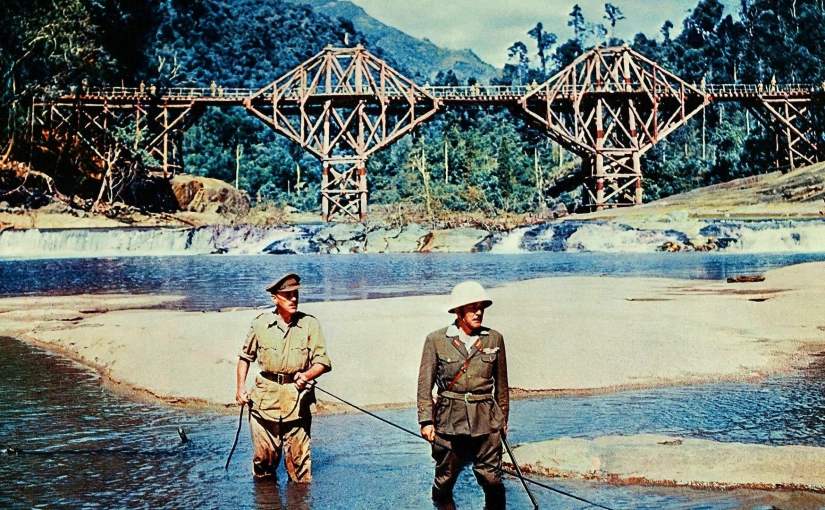
The film primarily takes place in Japanese occupied Burma during World War II.  A prison has just acquired a British platoon of soldiers, and the Japanese have mandated this squad to construct a railway bridge that will run over the Kwai river benefiting the Axis efforts in the war.  Colonel Nicholson (Alec Guinness, in a celebrated early career role) respects the rules of war that come with his battalion being held as prisoners of the Japanese enemy, and he is prepared to have his men begin construction.  However, as his copy of the Geneva Convention Agreement dictates, his officers are not obliged to join in the assignment.  

This is a far off deserted jungle however, that does not even need to be fenced off because an attempted trek to escape is bound to fail.  Therefore, the Geneva Convention Agreement has no value of authority out here in this bug infested, stilted and sweltering heat with minimal resources of food, clothing or medicine.  The Japanese commander Colonel Saito (Sessue Hayakawa) does not hesitate to swat Nicholson’s copy in the Englishman’s face.  Now, since the politics of war are no longer a factor, the stamina of these two men are what’s at stake.

Saito forces Nicholson into a cramped, isolated hot box with next to no food or water.  He’s lucky because his remaining officers are forced to share the other box together.  Saito will force them to comply, or he may just have to kill himself.

The Bridge On The River Kwai explores how productivity, leadership and endurance thrive, but at a startling cost of madness.  Before you realize it, none of these characters are speaking of their respective war efforts or even the mandates of war.  As Nicholson persists in his stance as a defiant leader, a remarkable tide turns within this prison camp.  Soon, the question arises as to who is running this camp and overseeing this bridge project. The enforcers or the prisoners? 

A separate storyline involves an American prisoner named Shears (William Holden) – one of the last men in his platoon to survive, and now only here to bury his fallen comrades.  He’s introduced to describe the harsh reality of what Nicholson and his men can expect.  Yet once Shears escapes the camp, he is caught in a twisted irony, being forced to return to the prison camp where he must destroy the bridge under the command of a British special forces leader named Warden (Jack Hawkins).  Warden goes through his own form of madness.  A badly injured foot becomes something worse than a bloody stump and still he insists on leading his small brigade into the jungle.  

Meanwhile, as Nicholson develops more control over the camp, with Saito realizing his own pitiful ineptitude, a faction of the British are now likely to engage with Nicholson’s newfound achievement as a leader over his own squad, as well as the human Japanese resources he’s also recruited to complete this solid foundation.

David Lean had a reputation for never settling for less on his pictures and The Bridge On The River Kwai is a perfect example.  I recently watched the film, for a second time, with my fellow Cinemaniacs.  Thomas and Miguel assuredly pointed out that one less than sturdy bridge was constructed by Lean’s crew to demonstrate its weaknesses and the lack of engineering the Japanese possess, before Nicholson fully takes over.  That structure collapses on film and thus lends to the next plight in the story, when Nicholson proves to Saito that he is more capable than his enemy counterpart.

Later, the actual bridge is finished leading to a nail biting ending that elevates in suspense as an oncoming Japanese train is heard approaching with its signature whistle and chugging overheard as Colonel Nicholson proudly walks across his success, newly minted with a plaque carved with his name.  Elsewhere in the area are Stearns and Hawkins.  What began with Japanese antagonism has shifted to one side likely to do battle with itself.  

Who is fighting who?  More importantly, what are they fighting for?  War or persistent, delusional madness?

The Bridge On The River Kwai is a magnificent adventure produced with sensational filmmaking.  The investment and risk that David Lean took to assemble this picture is astounding.  It was filmed within the actual jungles.  (Miguel said somewhere around Sri Lanka.) The costumes worn by the thousands of extras are tattered dirty scraps that certainly does not invite the sex appeal you’d expect in a modern film of this kind.  Moreover, the audacity of the filmmaker at least matches the nerve of the story’s cast of characters.  

The cast is marvelous, but it is Sessue Hayakawa and Alec Guinness who serve the impact of Lean’s film.  The movie comes close to a three-hour running time.  The first half of the film has Hayakawa positioned as the leading antagonist, but the second half has Guinness filling that spot.  They almost seem to mirror one another as their character arcs move in parallel but opposite directions working to accomplish their goals, while shedding any kind of humane concern for their underlings or the countries they serve.  

I consider this film to be groundbreaking.  It’s a spectacle, but it allows much to be examined in mental acuity, military allegiance and endurance.  The Bridge On The River Kwai tests how effective war can be for any side that participates.  My Cinemaniac comrade, Thomas,  informed me that the story, adapted from a novel by Pierre Boulle, is entirely fictional.  Still, I believe it garners an important message.  Are we supposed to truly embrace “rules of war?”  This is not Risk the board game.

These men might carry the titles and rankings issued to them by their governments. However, isolate them in the middle of nowhere and who is going to uphold any semblance of regulation?  War functions on efforts of violence.  When was the last time anyone had respect for violence?

GUNFIGHT AT THE O.K. CORRAL (1957)

by Miguel E. Rodriguez

DIRECTOR: John Sturges
CAST: Burt Lancaster, Kirk Douglas, Jo Van Fleet, John Ireland, DeForest Kelley, and a young bit player named Dennis Hopper
MY RATING: 8/10
ROTTEN TOMATOMETER: 87% Fresh

PLOT: Lawman Wyatt Earp and outlaw Doc Holliday form an unlikely alliance which culminates in their participation in the legendary Gunfight at the O.K. Corral.


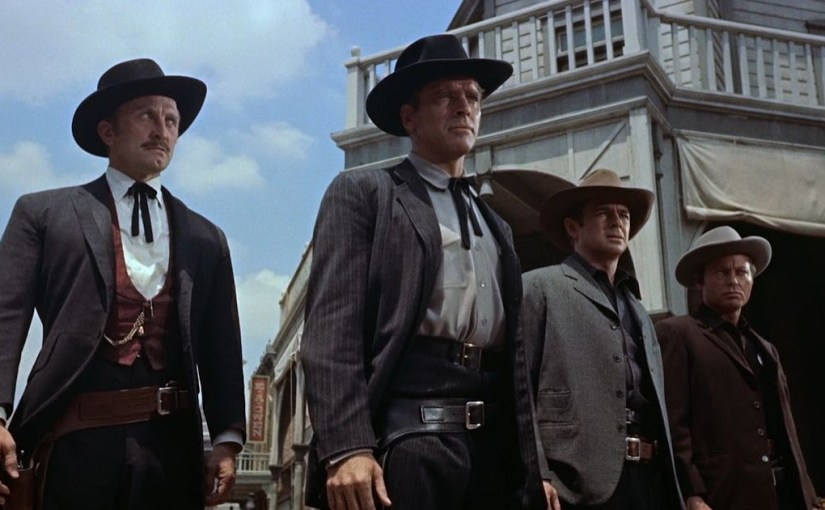
In real life, the legendary gunfight at the O.K Corral in the frontier town of Tombstone lasted thirty seconds, but what kind of movie would that be?  (Kill Bill: Vol. 2 springs to mind…)  A 1950’s Western requires a long-to-medium shot of the good guys – Wyatt Earp, his brothers, and Doc Holliday – striding down the street to meet the challenge of the dastardly Clantons, who had gunned down Wyatt’s youngest brother in cold blood.  We need a gunfight, not too long, but longer than 30 seconds.  And we need to make sure the ratio of surviving bad guys to good guys is just right: 0 to all.

John Sturges’ Gunfight at the O.K. Corral delivers the goods in a remarkably mature film for its time, free (for the most part) of cheap sentimentality and distractions from the main plot.  That’s a double-edged sword, though: we rarely leave the side of either Wyatt Earp or Doc Holliday, but the result is we get little to no information about Earp’s brothers until the final reel, nor do we get many details about Earp’s romance with the lovely Laura Denbow, a high-class gambler who knows enough about cards to beat the men at their own game.  We only find out they’re engaged as an afterthought, it seems.

As for Doc Holliday’s relationship with Kate Fisher (Oscar winner Jo Van Fleet), the word “dysfunctional” is woefully inadequate.  Loosely based on Holliday’s real mistress, referred to only as “Big Nose Kate” on Wikipedia, she seems to exist only to serve as Holliday’s psychological punching bag when required.  Her emotional yo-yoing gave me whiplash: she pledges her unending devotion in one scene, tries to stab him in another, helps him escape a lynch mob, takes up with the loathsome Johnny Ringo after yet another fight, begs to be taken back, and eventually tells him, “I’ll see you dead!”  With friends like these…

But even that kind of sordid melodrama is not enough to derail the throughline of the film, which is focused intently on establishing the rocky relationship between the morally good Wyatt Earp (Burt Lancaster) – who nevertheless wears a black hat the entire film – and the morally chaotic Doc Holliday (Kirk Douglas), a professional gambler who leaves a string of dead bodies behind him, all killed in self-defense, of course.  Earp also helps get Holliday out of town before a mob can lynch him, so Holliday decides to stick around until the debt is paid.

I think the essence of their relationship is summed up in a scene where Earp is forced to deputize Holliday when no other options are available.  Earp reluctantly walks up to Doc, tells him to raise his right hand, and says, “Do you solemnly swear to uphold…oh, this is ridiculous.  You’re deputized.”  Doc: “Wait a minute, don’t I get to wear a tin star?”  Earp: “Not on your life!”  Both men are torn between their philosophy and their sense of honor.  Holliday is no hero, but he’ll help Wyatt until his debt is paid.  Earp despises Holliday’s moral code, but he’s the best gunslinger in town.  What can you do?

All of this is handled in dialogue that seems mostly uncluttered by the hokey clichés I’ve heard in so many other films of the 1950s, even some of the great ones.  This may perhaps be due to the fact the screenplay was written by Leon Uris, a novelist who would eventually go on to write, among many others, Exodus, Topaz, and QB VII.  Listening to the characters talk, it was interesting to hear how natural they sounded, compared to the overblown melodrama of so many other westerns and dramas of that era.  The dialogue was clearly written by someone with a writer’s ear, who wants to get to the point of every scene with a minimum of fuss or flowery exposition.

As I mentioned, however, this quest for directness means we spend all our time with Earp and Holliday and almost no time at all with the Clantons or Earp’s brothers or anyone else.  By the time we hear Wyatt’s brother, Virgil, is in trouble, we’ve almost forgotten he HAS brothers.  As far as the Clantons go, we hear everything about them secondhand until we finally meet them in Tombstone.  We never even see Wyatt propose to Laura; we barely even see them courting (their courtship appears to consist of one false arrest and one kiss in the moonlight).

And I would be remiss if I did not mention…that song.  I learn from IMDb that the song, “Gunfight at the O.K. Corral,” that plays over the opening and closing credits, and which also plays over any transitional scene as Earp moves from one town to the next, was one of the inspirations for the theme song for Mel Brooks’s parody Blazing Saddles.  Brooks even got the original artist, Frankie Laine, to sing for his own movie.  It is so corny and earnest, juxtaposed against the gritty characters and scenery, that any sequence featuring that song loses all credibility.  If the filmmakers had just ditched that song, I might consider this one of the greatest Westerns of all time.  (see also Rio Bravo with Ricky Nelson’s crooning.)

But…having said all that, I must report that Gunfight at the O.K. Corral was entertaining from start to finish.  By avoiding the temptations to give in to melodrama and hokeyness, we are presented with a surprisingly solid Western drama that culminates in a decent (for the late ‘50s) gun battle.  It’s not as flashy as anything from one of Eastwood’s spaghetti westerns, and it’s not quite as thrilling as the one at the end of 1993’s Tombstone, but it’s satisfying, nevertheless.

(And for the record, when it comes to memorable lines, against Val Kilmer’s immortal “I’m your huckleberry”, I would gladly put Kirk Douglas’s venomous, “You slut!” …you have to see it in context, trust me.)

12 ANGRY MEN

By Marc S. Sanders

This film lives up to its reputation.

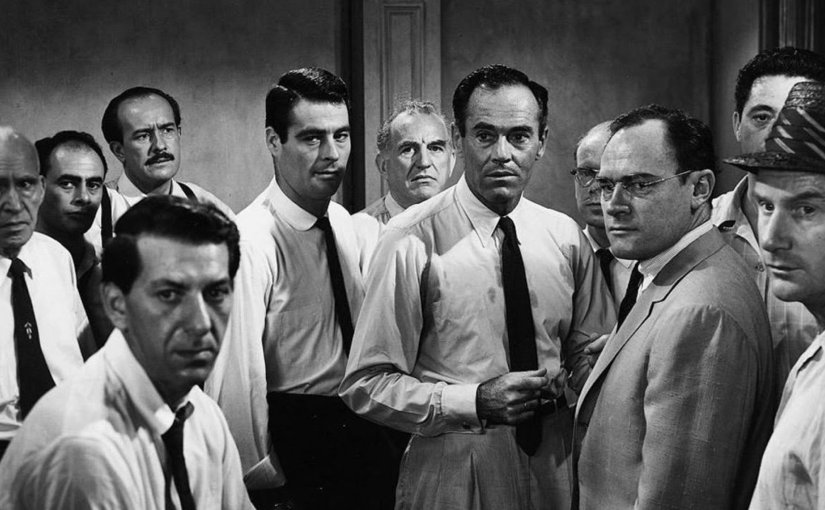
This was the great Sidney Lumet’s first theatrical film, and for a project limited mostly to only a claustrophobic and hot room, it boasts a lot of talent; Henry Fonda, Martin Balsam, Lee J Cobb, Jack Klugman, Jack Warden, EG Marshall.

For a black and white picture Lumet and his crew are effective at showing tiny details like sweat on brows and shirt stains, a broken ceiling fan, and the mental exhaustion of limited breathing space as twelve citizens debate over the guilt or innocence of a young man on trial for killing his father by stabbing. Lumet’s camera (just like when I watched The Verdict) is constantly traveling, even if it’s in a tiny confined space. He zooms in when he needs to and he changes angles to get the most of 12 different perspectives. Lumet keeps it interesting by changing up his use of lens. As the afternoon proceeds into early evening, the camera navigates more closely to the table they sit at. The men are uncomfortable, frustrated with each other, more impatient and more concerned with their consciences about sending a man to death. The actors do well with translating these factors, but Lumet sends the message home.

What I found most interesting is the different variations of how each juror eventually comes to changing his mind. Almost all of them arrive at that point in a new or different way. Credit goes to screenwriter Reginald Rose for that. Additional credit for the different variations of how the jurors repeatedly cast a vote; raising hands, notes, anonymously, not anonymously and so on. Rose changes it up each time to keep the viewers’ attention.

Rose’s script will only tell you so much. The attorneys don’t appear in the film, deliberations are done, we only get a close up of the defendant but there’s not enough material for a viewer to cast judgment. The film opens with the judge giving a boring routine instruction as to how the jury should proceed. He might as well be telling them how to complete an SAT exam.

Yet what we are treated to are the faults and overcomings of the human spirit. Ed Begley is a juror who gives a brilliant monologue that stereotypes the defendant’s ethnic background, though we never know what race or ethnicity he is. As he continues to rant, every other juror steps away from the table. Begley seems to get more ashamed of his thought process as he carries on, but he doesn’t stop until he’s ordered to by another juror. Amazing!!! In 1957, when Jim Crow and McCarthyism were on the horizon or rampant, this film was not having it. It’s the best scene in the film.

Henry Fonda is great as the one who only asks for sensibility. He adds weight to the case they are deliberating over that the others are sadly failing to recognize. A man’s life is in their hands.

I’d argue that the facts of the case and evidence presented carry very little complexity to what a real murder trial might offer. I’d also argue that what serves as a fulcrum to sway each vote is maybe a little too convenient (presuming the time it takes for one witness to walk or whether a witness wore glasses), but that doesn’t matter. What’s most important is whether each of these men can live up to the demand of recognizing reasonable doubt; the necessary requirement for a trial by jury. In that sense, 12 Angry Men succeeds.