FORCE OF EVIL (1948)

by Miguel E. Rodriguez

DIRECTOR: Abraham Polonsky
CAST: John Garfield, Beatrice Pearson, Thomas Gomez, Marie Windsor
MY RATING: 8/10
ROTTEN TOMATOMETER: 100% Fresh

PLOT: A crooked lawyer working for a numbers-running “combine” nevertheless tries to get his older brother to quit the racket himself when an even bigger combine tries to move in.


On the surface, Force of Evil looks and feels like a B-movie: low production values, populated by talented bit players elevated into larger roles [John Garfield being the exception, naturally], and looking like it was shot on the fly by a television crew.  Of course, reading that sentence back to myself, I realize I could also be describing Hitchcock’s Psycho [1960], but Force of Evil feels even more low rent than that.  There are shadows present in brightly lit rooms that could only be caused by stage lights behind the camera.  Oddly timed edits draw attention to themselves and threaten to take the viewer out of the movie.  The female roles are literal representations of the so-called “Madonna-Whore” complex, limited to expressions of fluttering tension or full-on seduction.  The dialogue, at least near the beginning, is filled with legal and financial jargon that had me rewinding a couple of scenes to try to digest what the characters were saying.

And yet, Force of Evil exudes a strange power through its unique use of language and the borderline-Shakespearean nature of its tragic story, involving a crooked lawyer (John Garfield) who works for a numbers racket, but nevertheless tries to convince his older brother to quit the business when a larger “combine” threatens to take over.

John Garfield, God love him, was no Brando or Bogart, but in this movie, the screenplay provides him and everyone else with dialogue that feels lifted out of a stage play that was translated into English from some foreign language.  Here’s a line from Leo Morse (Thomas Gomez) to his younger brother, Joe (Garfield):

“Do you know what that is, Joe?  Blackmail!  That’s what it is!  Blackmail!  You’re crazy!  You’re absolutely crazy mad!”

Another example:

“All right.  I am sensible.  I am calm.  I’ll give you my answer calmly and sensibly.  My final answer.  My final answer is finally NO.  The answer is no – absolutely and finally no, finally and positively no!  No, no, no!  N – O!”

To call that kind of language “stylized” is an understatement.  The repetitive words, the broken-up clauses…tilt your head and it could almost read as poetry.  In fact, in Martin Scorsese’s introduction on the Force of Evil Blu-ray, he relates a story where a critic watching a screening of the film exclaimed, “My god, it’s written in free verse!”

While I acknowledge the screenplay’s poetic form, I found an even more contemporary comparison: David Mamet.  I semi-recently watched his film Homicide [1991] and wrote in my review that “…Mamet’s signature word choices…suggest an almost Shakespearean construction, as if the words are being shoehorned into a buried structure or pattern that operates subconsciously…trying to create a mood reminiscent of Greek tragedy…”  Those words apply equally well to Force of Evil’s screenplay by director Abraham Polonsky and Ira Wolfert.  I got a distinctly Mamet-esque vibe from the dialogue in this 1948 film, with just a dash of Aaron Sorkin, perhaps.

(Ebert once said that Pulp Fiction [1994] is a movie that he could watch with the picture turned off, just so he could listen to the crackling dialogue.  Force of Evil could just as well fit that mold, in my opinion.)

There’s even a Mamet vibe to Garfield’s acting style, as he rarely cracks a smile or any other expression for the entire film; we only sense changes in tone by the volume of his voice, not by the expression on his face…much like the lead actors in Mamet’s House of Games [1987].  That stylization sets Force of Evil apart from many of its film-noir counterparts.  To be sure, other noirs have their share of stylized dialogue and characters, but this movie sets some kind of stylization bar that must be heard to be believed.

The story can be summarized easily (see the top of this review), but it is powerful in its simplicity, at least when it comes to the interplay between Joe and his older brother.  As for the female characters, they are sadly stuck in placeholder roles that are there either as eye candy (Marie Windsor, a film-noir regular in her first major role) or as the young woman, Doris (Beatrice Pearson), helpless before the wiles of a wicked smooth-talking man like Joe Morse.  No Ida Lupones or Barbara Stanwycks or Lauren Bacalls here.  However, there is an interesting conversation between Joe and Doris that gives us an interesting insight into Joe’s character, as well as hiding a discussion of moral relativism in plain sight.

Joe is doing the ‘40s film equivalent of “putting the moves” on Doris, telling her baldly that she WANTS him to be wicked to her, “because you’re wicked, really wicked…you’re squirming for me to do something wicked to you – make a pass for you, bowl you over, sweep you up, take the childishness out of you, and give you money and sin.  That’s real wickedness.”  In so many words, he’s telling her that she’s ASKING for it.  This is not a nice man.  He goes further.  He tells her:

“If I put my hand in my pocket and gave you a ruby, a million-dollar ruby for nothing, because you’re beautiful and a child with advantages and because I wanted to give it to you without taking anything for myself – would that be wicked?”

In Joe’s mind, charity isn’t just for suckers, it’s downright evil.  Doris mounts a good defense, telling Joe how she hasn’t been fooled by magicians or smooth-talking men since she was a little girl.  Joe keeps following his path of logic, but an interesting thing happens.  He incriminates himself, and at the end of the scene he seems to realize it:

“To go to great expense for something you want, that’s natural.  To reach out to take it, that’s human, that’s natural.  But to get your pleasure from not taking, from cheating yourself deliberately like my brother did today, from not getting, from not taking…don’t you see what a black thing that is for a man to do?  How it is to hate yourself and your brother, make him feel that he’s guilty, that…that I’m guilty?”

There’s that free verse in action again, with those repetitive phrases.  His own amoral code trips him up, and the camera lingers on Joe’s haunted face for a moment before we fade into the next scene.  I mention this exchange because it’s so atypical of even some of the greatest noirs, which are usually full of hard-boiled dialogue about heaters and button men and glamorous dames.  In Force of Evil, we’re invited to turn inwards with our anti-hero and compare our definition of evil with his, as Doris does later in the film.

The film ends with several scenes of shocking violence, including a murder that looks inspired by Battleship Potemkin [1925] and a three-way shootout in a darkened office.  There is a remarkably evocative shot as Joe hurries down a staircase, and it appears as if he is making his own descent into hell.  Force of Evil has recently been critically re-evaluated; after years of being dismissed as nothing more than an assembly-line noir thriller, it was recently restored by UCLA and the Film Foundation and was also selected to the National Film Registry.  It’s not the greatest film noir I’ve ever seen, but if you’re a fan of the genre, you owe it to yourself to hunt down a copy and give it a look…or more appropriately, a listen.
THE SNAKE PIT (1948)

by Miguel E. Rodriguez

DIRECTOR: Anatole Litvak
CAST: Olivia de Havilland, Leo Genn, Celeste Holm, Natalie Schafer [aka Mrs. Howell on Gilligan’s Island…how about that?]
MY RATING: 8/10
ROTTEN TOMATOMETER: 100%

PLOT: A young woman’s life is torn apart when she suffers a mental breakdown and is admitted to an institution.


For much of its running time, The Snake Pit remains firmly in the realm of reality without succumbing to melodrama, as was symptomatic of so many film dramas of the 1940s.  That’s what makes it mildly disappointing when, in the last reel, we get a nice little summation of the origins of our heroine’s dilemma, and she bravely makes a series of decisions that result in a happy ending.  Naturally, that was the case in real life, as well.  The film is based an autobiographical novel by Mary Jane Ward, who spent eight months in a mental institution after a nervous breakdown.  I don’t begrudge the happy ending, you understand.  I just wish it didn’t feel as rushed as it does.

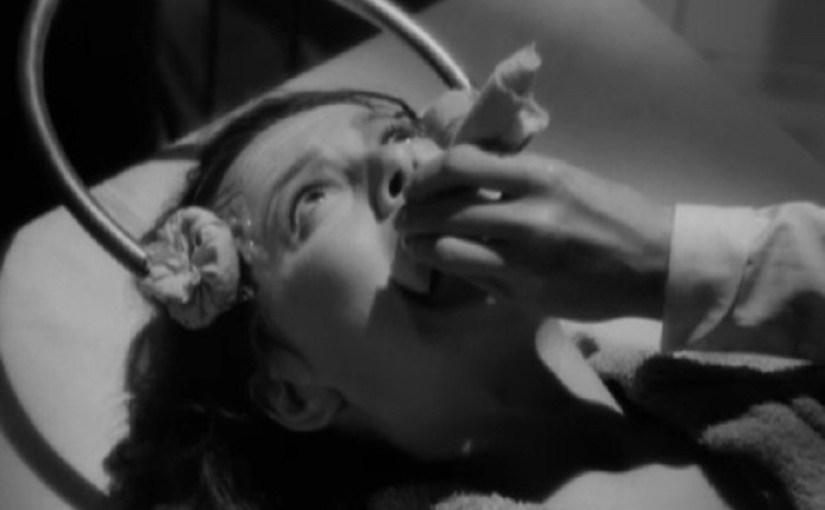
But I’m quibbling.  This is a fine film.  The Snake Pit was another in a series of Daryl F. Zanuck productions intended as “message pictures”, movies that addressed real issues in contemporary society.  The Grapes of Wrath (1940) dealt with the Dust Bowl and harsh labor conditions.  Gentleman’s Agreement (1947) was one of the first films, if not THE first, to openly condemn casual anti-Semitism in “polite” society.  The Snake Pit is said to be the first mainstream film to realistically depict conditions in America’s mental institutions at the time.  If so, the filmmakers really went for the jugular in their first at-bat.  In its own way, this is as harsh and unforgiving a film as One Flew Over the Cuckoo’s Nest.  There’s even a sequence involving shock treatments that are as effective as anything else I’ve seen along those lines.

The story begins intriguingly, as we open on the lovely open face of Virginia (a deliberately un-made-up Olivia de Havilland) as she wonders mentally what she’s doing outside on this bench.  A man we don’t see asks her a series of questions, and she has little mental conversations with herself before she answers.  Then the camera pulls out, and there is no man, just another woman telling her it’s time to go back inside.  Inside where, she wonders?  Then she’s herded with a bunch of other women back into the main hall of the Juniper Hill State Hospital.  She starts to panic.  What is she doing here?  Is she crazy?  She doesn’t feel crazy.  The reasons for her stay provide the central mystery to the film.

(Incidentally, Stephen King apparently saw this film on TV as a youngster…which may account for the numerous appearances of the Juniper Hills psychiatric facility that appears in many of his novels and stories, including It, The Dark Half, and Needful Things.  When you win on “Jeopardy”, I’ll let you know where to mail my half of the winnings.)

De Havilland’s performance is extraordinary.  Her talent is undeniable, but it’s notable that one of the silver screen’s great beauties went without makeup, wore clothes two sizes to big, and even dropped some weight to make her look more fragile.  This was my first time watching the movie, and I was astonished at her appearance.  When she flies into rages, or pleads for mercy, or desperately tries to remember her past, you really believe it.

In a series of flashbacks, we discover that Virginia Stuart was a frustrated author who met her future husband in Chicago, in the offices of the company that had just rejected her manuscript.  There was a whirlwind romance that ended when she simply ran out on him and disappeared, only to show up six months later in New York, where he had moved…six months previously.  (I don’t know about you, but that’s red flag territory in my mind, but whatever.)  Their romance picked up where it left off, there was a ceremony at City Hall, and they enjoyed married life…for about a week.  At which point Virginia behaved erratically, declaring that she will never love any man, that no man can love her, and flatly denying that today is May 12th, no matter what it says on the newspaper.  Virginia’s husband admits her to Juniper Hill, and it’s here where her troubles REALLY begin.

The film’s depictions of life on the various wards of the asylum are tame by today’s standards, but they are no less disturbing.  There are the usual cast of off-kilter characters wandering the halls, mumbling to themselves or being unreasonable, but there is something indefinably…I don’t know, squirmy about seeing this kind of behavior in such an old movie.  At least for me.  When it’s played for real and not for laughs, in black and white, in 1948, something about that place and those people became much more real to me, at least as real as McMurphy’s fellow travelers, or maybe even more so.  I’m unable to put it into words.  When someone in Cuckoo’s Nest dances by themselves in a corner or wants his cigarettes, it’s kinda funny.  In The Snake Pit, when a woman dances by herself, or another covers her face with her hair and paces around muttering that it’s her right to cover her face…it was creepy.  Is it the black-and-white cinematography?  Is it the shortage of comic relief?  Is it because they’re women instead of men?  Discuss.

(There’s even a head nurse who seems like the prototype for Nurse Ratched: a no-nonsense, by-the-book authoritarian who makes no bones about disliking Virginia.  When Virginia is given a typewriter for therapeutic reasons, the nurse reminds her: “Don’t go thinking you’re better than the rest of us just because you’re a writer.”  Talk about terrible bedside manner, geez…)

Interestingly, I didn’t find Virginia’s behavior all that “crazy.”  She has problems with her memory, she tends to fly off the handle at trivial matters, and she once bit the finger of an arrogant doctor who was waving it in her face unnecessarily.  Frankly, that sounds like something I would do on a bad day.  Virginia’s conversations with her doctor, Doctor Kik (Leo Genn), are the only things that keep her tethered to reality.  These conversations are handled extremely well.  I found myself thinking of another famous movie about psychiatry in the ‘40s: Hitchcock’s Spellbound (1945), which was not so concerned with legitimate psychiatry as it was with making sure Bergman and Peck wound up together at the end.  In that film, the conversations between doctor and patient are full of double-speak and heavy-handed metaphors.  In The Snake Pit, I found it interesting that, whenever Dr. Kik makes a small breakthrough with Virginia, he never pushes the matter.  He simply calls it a day and picks it up tomorrow, armed with new information.  I’m no doctor, but that seems way more realistic to me.

I went into The Snake Pit expecting a semi-watered drown treatment of insanity and mental institutions.  Instead, I got a film that is remarkably effective and powerful, containing a performance from Olivia de Havilland that might seem like a lot of histrionics at first, but which is the very definition of someone completely at the mercy of mood swings beyond her comprehension.  They say that only the insane never wonder if they’re crazy.  If that’s the case, Virginia is as sane as they come, wondering over and over again why she does what she does, why she’s been thrown into this place.  She comes across as someone who desperately wants someone to listen to her.  Thankfully for her, someone does.  If everyone were as lucky as she is, maybe there’d be a lot more happy endings in the world.

THE BIG CLOCK (1948)

by Miguel E. Rodriguez

DIRECTOR: John Farrow
CAST: Ray Milland, Charles Laughton, Maureen O’Sullivan, George Macready, Elsa Lanchester, Harry Morgan
MY RATING: 10/10
ROTTEN TOMATOMETER: 100%

PLOT: A harried magazine editor finds himself in the unique position of trying to track down the person who murdered his boss’s mistress…when all the clues lead back to him.


I have been a fan of 1987’s No Way Out since first seeing it on cable umpteen years ago.  The marvelous twists and turns in the script – yes, including that improbable ending – kept me guessing from the moment of the murder to the final pull-away shot.  Having seen it multiple times, I always noted the fact that it was based on a book with an odd title: The Big Clock.  Since No Way Out takes place mostly at the Pentagon, I always wondered what the story has to do with a clock, but I wasn’t motivated enough to track down the book, so I just let it go.

Imagine my surprise when years later, I discovered that No Way Out is not just based on a BOOK called The Big Clock, it’s also a reboot of an earlier film-noir from 1948, also called The Big Clock.  For years I had never been able to track down an affordable copy of the movie until recently.  I just finished watching it a couple of days ago, and wow.  It has all the snappy pacing of a Howard Hawks screwball comedy, the witty dialogue of a Thin Man film, and the coiling suspense of Hitchcock at the height of his powers.  The Big Clock is a forgotten film that deserves to be rediscovered by the public.

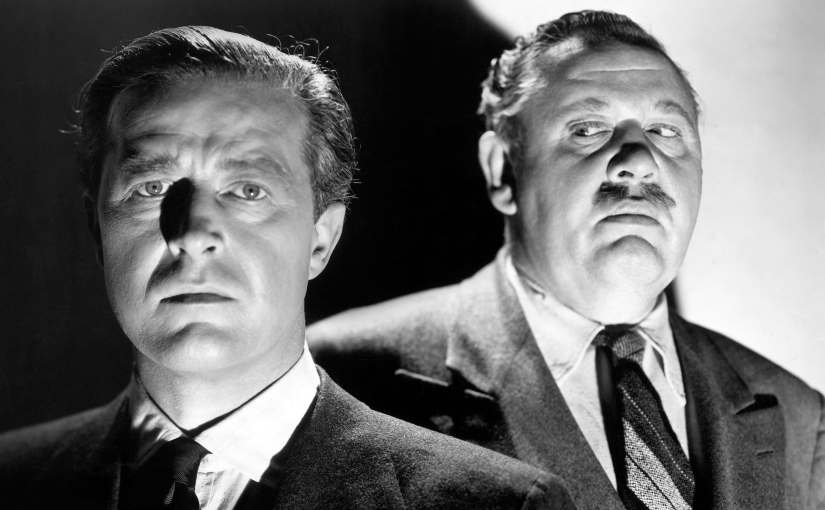
The story opens in typical noir fashion with our hero, George Stroud (the dour-but-likable Ray Milland) avoiding security guards before hiding inside a giant mechanical clock located in the lobby of the office building where he works.  His voice-over narration wonders how he got into this mess and tries to figure out where it all began…and we’re on our way.  So far, pretty stereotypical, not very promising.  But once the prologue ends, the surprises start rolling in.

George’s boss is Earl Janoth (Charles Laughton), a clock-watching, penny-pinching tyrant who doesn’t hesitate to fire an employee who leaves a light on in a broom closet, for example.  George is the editor of a magazine called Crimeways, one of many magazines in Janoth’s publishing empire.  Crimeways specializes in investigative reporting like tracking down murder suspects, allegedly to assist law enforcement, but mostly so they can publish attention-grabbing headlines about captured criminals to boost circulation.

Through a series of events too circuitous to list here, George winds up missing a very important train (he was supposed to finally give his wife a long-delayed honeymoon) and spends a drunken night carousing with Pauline York (Rita Johnson), a blonde bombshell who also happens to be Janoth’s mistress.  He winds up passing out on her couch at her apartment (having NOT slept with her, mind you), but is forced to skedaddle when Janoth unexpectedly shows up.  Janoth catches a glimpse of George in the hallway but cannot see his face.  When Janoth confronts Pauline, things get heated, and Pauline winds up dead.  Instead of going to the police, Janoth confides in his second-in-command, Steve Hagen (George Macready, whom you may or may not remember as the slimy general in Paths of Glory [1957] who charges three men with treason for not following a suicidal order).  Hagen returns to the scene of the crime, “amends” the crime scene, and comes up with a brilliant plan: use the magazine’s considerable resources to track down the mystery man Janoth saw outside Pauline’s apartment.

And who better to lead the investigation than George himself, whose investigative skills are second to none?

There is a delightful thrill of suspense when George receives his assignment and realizes that he cannot reveal the truth of his whereabouts without implicating himself, but he is compelled to lead the investigation as thoroughly as possible.  There is an amusing but highly-charged moment when an investigator reaches a witness on the phone and starts dictating the suspect’s vital features…and they match George almost to a T.

The beauty of the film is the head-fake.  We are shown the details of the drunken night George spend with the dead woman, but we are never tipped off that what we’re watching will eventually come back to haunt him.  Green mint martinis.  The hunt for a green clock.  A sundial.  An antique painting.  An eccentric painter.  A radio actor.  All disparate elements that are almost thrown away while they’re happening, but all of which come back to neatly bite George in the ass at just the wrong moments.

I cannot stress enough how ingeniously the screenplay is constructed.  One of the greatest joys of watching The Big Clock is admiring how airtight it is, how George is forced to fly by the seat of his pants from one moment to the next, putting on a show of doing his job while simultaneously trying to find a way to sabotage the investigation without showing his hand in any way.  I won’t give away how he manages this high-wire act, but it’s brilliant screenwriting.

Eventually, the building gets locked down with George still inside and two or more witnesses who can identify him prowling the hallways, including one who is drawing a sketch of his face.  At this point, even though I’ve seen No Way Out many times, I was 100% sucked into the story: “How can this guy possibly get out of this?”  The answers will be just as unexpected to you as they were to me.

(I should mention a small role played by an impossibly young Harry Morgan.  It’s one of the most sinister performances by a mute character that I’ve ever seen.  One shot in particular feels out of time, like it was shot in a movie from the ‘60s or ‘70s.  Creepy stuff.)

The Big Clock deserves a place among the great noirs like The Maltese Falcon, Out of the Past, and The Big Sleep.  It’s filled with great performances, the visuals are suitably moody and shadowy when necessary, and the plotting is impeccable.  What more can you ask from a great film noir?

THE NAKED CITY (1948)

by Miguel E. Rodriguez

Director: Jules Dassin
Cast: Barry Fitzgerald, Howard Duff, Dorothy Hart, Don Taylor
My Rating: 7/10
Rotten Tomatometer: 85%

PLOT: In almost documentary-like fashion, New York City cops investigate the brutal murder of a young woman.


It’s that narration.

If The Naked City hadn’t included that cockamamie narration, I might have given it a “9” instead of a “7.”  Here is a police procedural ahead of its time, a pre-television-era herald of popular entertainments from Dragnet to Law and Order to CSI.  The story is absorbing and engaging from beginning to end, even if some of the acting is not especially Oscar-worthy.  There are enough twists and turns in the search for a cold-blooded killer – or killers – to keep your attention all the way through.  And over it all, intruding where it’s not wanted, is a Disney-esque narration from the film’s producer, Mark Hellinger, who also produced a superior prison film a year earlier, Brute Force (1947), also directed by Jules Dassin.

Imagine a scene where foot-weary detectives are pounding the streets, making inquiries at jewelry stores, hairdressers, pawnshops, looking for leads.  As we watch the scene progress, we hear the narrator: “Are your feet tired, detective?  Not to worry, only 400 more jewelry shops to go.”

Or another scene where a detective looks wearily through a window at the city laid out below, pondering where to go for the next clue.  Cue the narrator: “There’s your city, Halloran.  Take a good look.  Jean Dexter is dead, and the answer must be somewhere down there…”

I hated the narration in this movie.  It reduced what I was watching to the level of one of those Disney animated shorts where Goofy is playing some kind of sport and the narrator describes the action while Goofy screws it up spectacularly.  Another example, as morning comes to the city: “The city is quiet now, but soon it will be pounding with activity.  This time yesterday, Jean Dexter was just another pretty girl, but now she’s the marmalade on 10,000 pieces of toast.”  Give me a break.  I fully understand how future TV shows made use of this kind of narration, but not to this degree.  It made a crime story sound like an industrial video.

So let us stipulate that I hated the narration.  The rest of this review will discuss the film as if the narration didn’t exist.  It’s best for you, it’s best for me…it’s best for us.

The Naked City opens with the murder of a young woman, Jean Dexter.  The rest of the movie details the police investigation and search for her killer.  In broad strokes, that’s pretty much it.  In its own way, it reminded me a little bit of All the President’s Men (1976) in that we’re focused exclusively on the process of investigation with very little cutting away to other participants.  The lead figures are a very Oyrish Lieutenant Muldoon (Barry Fitzgerald) and the dependable Halloran (Don Taylor).  The chief suspect is Frank Niles (an impossibly young Howard Duff, whom you may recall as Ted Kramer’s attorney in Kramer vs. Kramer [1979]).  Niles raises so many red flags that I started to think he was an obvious red herring.  Under questioning, he lies and lies and lies again, even “forgetting” to tell the police he’s engaged to the dead woman’s best friend.  Can this guy be for real?  We have seen so many criminals in so many TV shows and movies who are so much better at lying to the police…but he’s so bad at it that he must be innocent by default, right?

The investigation continues.  Clues and leads are chased down.  Another murder occurs.  False confessions are heard and dismissed.  The dead girl’s parents come down to the mortuary to identify the body.  (That particular scene was notable for being filmed at an actual New York City mortuary, a first for its time.  In fact, the vast majority of The Naked City was filmed on location in the Big Apple, one of the first major Hollywood productions to do so.  It’s hard to conceive of now, but this caused a minor sensation upon the movie’s release.)

While the mystery of the murder is the real meat of the story, I got the impression that the goal of the film was to bring these mundane police procedures to the masses, to show audiences that, while you work and eat and play and raise your families and go to baseball games, the good guys are on the case whenever something goes wrong.  And this is what they do for just one murder case.  In a city like New York, who knows how many murder cases are being worked on at once?  As the closing narration famously says, “There are eight million stories in the naked city.  This has been one of them.”  (Okay, that’s the one bright spot in the narration, let us never speak of it again.)

I can even draw a direct line between The Naked City and The Silence of the Lambs (1991).  In The Naked City, Halloran uncovers a possible connection between the second murder victim and the prime suspect in the first murder.  (It’s complicated.)  He gets permission from Muldoon to chase it down, despite how unpromising it is.  As he’s following his nose, Muldoon chases down a lead of his own, getting closer to the true mastermind behind this case.  In this way, there is a direct parallel in The Silence of the Lambs where Crawford takes a task force to a suspect’s house while Clarice follows a nearly invisible trail to Jame Gumb’s doorstep.

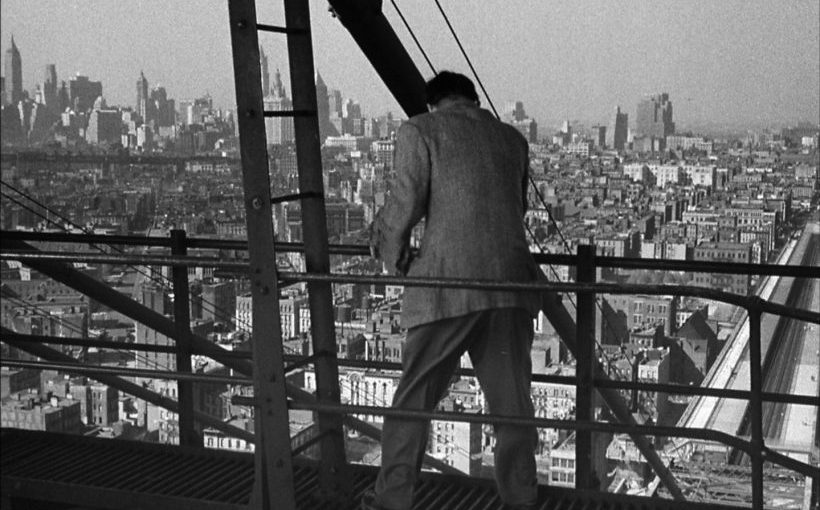
Everything comes to a head with a foot chase that leads to the Williamsburg Bridge, scenes that must have been a little mind-blowing for 1948 audiences as the camera seemingly defies gravity, climbing higher and higher into the scaffolding with the fleeing suspect.  (It should also be noted that the film perhaps romanticizes inner city life to a degree…as the suspect flees across the bridge, he breaks up a group of children skipping rope on the footpath.  Not the kind of thing I’d expect to see today, for sure.)

The Naked City is about as good as crime dramas in the ‘40s could get without resorting to the darkness and shadows of film noir.  This is, after all, a film about the good guys, not the bad.  Watching cops interrogate witnesses and compare notes about stolen jewelry isn’t quite as “sexy” as watching Bogie draw down on some hoodlums, but hey, that’s the kind of thing that really happens in the big bad city.