NOTORIOUS

By Marc S. Sanders

In 1946, Alicia Huberman (Ingrid Bergman) is numbing the shame of her father being convicted for treason by drinking herself silly at a party she’s hosting.  We see the back of the head of a nameless guest, eventually revealed to be a man named Devlin (Cary Grant).  Once Alicia is sobered up, she awakens to the handsome image of this man entering her room with her point of view turning like a clock in a hundred- and eighty-degree direction.  This mysterious fellow is about to escort her into a dizzying labyrinth that will test the limits of her loyalty to him and the patriotism she has for her country.

Devlin is an American agent who has been assigned to recruit Alicia as an insider to an associate of her father’s.  His name is Alexander Sebastian (Claude Rains) and he’s likely a Nazi stooge with a deadly plot ready to set in motion.  Alicia is tasked with reacquainting herself with Alex and uncovering who he is working with and what they all have in mind.  Devlin will check in with her on occasion.

Complications ensue however because just before Alicia begins her mission in Rio De Janerio, she has fallen in love with Mr. Devlin.  Normally, I would not be able to buy into the quick whirlwind romance of Alicia and Devlin.  I never liked it when Sydney Pollack would wedge a love story into his thrillers (Absence Of Malice, Three Days Of The Condor).  However, this is Ingrid Bergman and Cary Grant we are talking about here, and they are being directed by Alfred Hitchcock in the classic film, Notorious.  The famous three-minute kiss in the picture seals the argument.  

Standard film practice of the time would not permit a kiss lasting longer than three seconds.  The actors though expand on this romantic moment with inserted dialogue, none of which is altogether memorable, and focus on a prepared chicken dinner to have on the balcony overlooking the coastline.  This scene occurs early in the film just after the exposition of Alicia and Devlin’s assignment is established.  I still don’t know either of character very well.  So why do I care about them?  Well, it’s how Hitchcock films the script by Ben Hecht.  There’s disturbing shadows and ominous mystery to the world that Alicia is seduced into entering after her drunken binge has ended.  As well, Devlin is warned that he will have to keep his distance from her so as not to alarm Alex or any of his Nazi associates.  Now, I’m genuinely nervous for Alicia’s safety.

Once Alicia is ingrained in Alex’ world, a new romance arrives, and she willingly marries the German aristocrat to uphold her ruse while making efforts to uncover the Nazis’ plot.  Devlin enters and exits her life to collect whatever information and access Alicia can supply.

As Notorious played out for me, sadly the first thing that came to mind was that Tom Cruise’s second Mission: Impossible film is nearly a scene for scene remake of Hitchcock’s classic, minus the over-the-top stunts and rock climbing.  Yet even before that thought popped into my head, I thought this is a film that could be remade into a wonderful modern update, but only in the hands of select filmmakers like Martin Scorsese or Christopher Nolan.  Keep the guns and blood and car chases out of it though.  Notorious succeeds without a single punch, gunshot, curse word, or ball of fire.  It’s the characters and Hitchcock’s use of brooding light, mood and shadows that maintain the suspense.  Select props and costume wear are scarier than Godzilla or The Birds.

Nearly twenty years before he made Psycho, the director was terrifying audiences with a maternal element already.  Madam Sebastian (Leopoldine Konstantin) is such an intimidating force within the castle like estate she shares with her son Alex, who easily falls in love with the beautiful Alicia.  The Madam is upholds a watchful eye on all activity. Bergman’s fear of this foreboding mother is just one of the dynamics she brings to her portrayal.  

Suspense is what Hitch relies on.  Sometimes I felt like I could not trust Mr. Devlin.  The name Devlin bears a sinister reminder of a beast within its spelling. Cary Grant is at first aloof with how Devlin regards Alicia’s potential for self-harm.  Hitchcock eerily introduces Cary Grant in the picture.  First, by only shooting him behind his head, not revealing his face. A little later, I felt reluctant to trust his upside-down appearance as Alicia awakens from her drunken stupor.  Thereafter, he will take a measured risk with Alicia riding horseback and never attempt to rescue her.  He leaves it to someone else to save her. He’s a tricky sort of fellow.

Conversely, Claude Rains as Alex, the supposed Nazi, is utterly charming and attentive towards Alicia.  Despite what he might be involved with, he’s ready to begin a newly loving and glamorous life with her.  I trust Alex.  He maintains a genuine affection for Alicia and it’s hard to presume he is anything else, especially of the sinister sort.

Ingrid Bergman is captivating as soon as she appears on screen, exiting her father’s courtroom sentence.  In fact, she resembles her most famous portrayal as Elsa from Casablanca that easily can be part of this cinematic universe.  With Claude Rains on screen with her again, could this have been a sequel of sorts?  I have much more experience with Meryl Streep’s career and therefore Bergman gives me a lot to reminisce about Streep both when she’s a strong and confident person or a fearful subject.  Either way, the bravery of the character upholds.

There are eye opening camera tactics of Hitchcock working here.  I’m amazed at a zoom in that lowers its focus from a great height at Alex’ mansion down to the grand foyer below where Alicia stands with a vital prop key hidden in her fist.  Amidst all of the traffic of an evening party, this tiny key is what’s most important.  A teacup is given greater scale to enhance a monstrous threat of what’s inside the drink.  A wine bottle suddenly becomes a mystery.  Some elderly, petite men dressed in perfectly tailored tuxedos spell a likely outcome of doom.  The darkness of rooms shot in black and white feels inescapable.  The absolute final shot of the picture is unforgettable.

For years, the adventurers of North By Northwest with Cary Grant in his beautifully fitted blue suit held the crown as my favorite Alfred Hitchcock picture.  That title has now been surrendered to Notorious.  It is signature Hitchcock with twists in character, reasons for mistrust, a MacGuffin (that item that drives the story, yet bears hardly any importance), motherly instincts of fear, obscure camera angles, shadows and dim light which is particularly chilling when shot in black and white.  All of these elements add up to the director’s expert craft at suspense.  

Notorious is a hundred percent perfect example of why Alfred Hitchcock remains celebrated as one of the best directors to ever film a motion picture.  

NOTE:  I am surprised that neither IMDb trivia, nor Roger Ebert in his Great Movie review, ever acknowledged that the story of Notorious begins on April 20, also known as Adolf Hitler’s birthday. A curious date for a spy thriller centered around Nazi espionage.

NOTE: I want to also draw attention to a move that Cary Grant does in the film.  Following Alicia’s drunken party, several guests are passed out on the sofa.  Devlin finishes a drink and rests the glass on the upper torso of a passed-out woman where it balances perfectly.  We may be going after dangerous Nazis, but Grant and Hitchcock still found opportunities to make audiences smirk at their mischief.

IT’S A WONDERFUL LIFE

By Marc S. Sanders

I have finally righted a serious wrong and watched Frank Capra’s It’s A Wonderful Life, and what a pleasurable experience it has been.  Reader, if this movie lover who gets hopped up on science fiction gobbley gook with laser swords and spaceships can watch an old black and white movie feeling sorrow for its main characters, and elation when the film finishes, then it’s easy to understand how timeless and impressionable Capra’s classic film truly is.

I recall when I had finally seen It Happened One Night, originally released in 1934 and arguably the pioneer of the romantic comedy genre.  I could not help but connect certain moments and pieces of dialogue to the films released while I was growing up, like When Harry Met Sally… and Bull Durham.  Those films took inspiration from Capra’s comedy with Clark Gable and Claudette Colbert.  Capra pioneered storytelling once again with It’s A Wonderful Life.  As my wife and I watched the movie late last night until nearly two in the morning, I said to her this is like Back To The Future.  My wife said A Christmas Carol.  Both true statements.  So perhaps while Capra was revolutionary with his own storytelling, he might have been adopting some inspiration from what came before as well.  Regardless, I applaud his approach.  Frank Capra is a tremendous gift to the cinematic medium.  If there was a Mount Rushmore for filmmakers, Capra would most certainly be sculpted alongside the likes of Hitchcock, Chaplin and Disney.

George Bailey (James Stewart) has big dreams of leaving his sleepy little town of Bedford Falls and building grand designs of skyscrapers while also exploring the world, beginning with Europe and Alaska and whatever else needs discovering.  Like any of us, our yearning for adventure and the destinies we wish for get interrupted. Before you know it, we ask ourselves if life has passed us by.  It takes a guardian angel named Clarence (Henry Travers) to remind George that life has been with him all along; maybe not the life he envisaged, but certainly a life of purpose and significance beyond just himself.

George watches as his high school chums go on to grand accomplishments that pay off in enormous amounts of wealth.  His younger brother Harry (Todd Karns) goes to college, gets married and becomes a celebrated war hero.  However, George remains in Bedford Falls offering loans to his fellow townsfolk that he can’t afford to honor with a business he inherited from his father.  To lend and support comes involuntary to George.  He’s just a good man. 

On the other end of the spectrum is the mean, wealthy miser Mr. Potter (Lionel Barrymore).  Barrymore plays Potter like one of the worst villains in the history of cinema.  An unforgiving, jealous wretch of a man.  His cruelty is long and unmatched, even if he is relegated to a wheelchair.  He knows how destitute George is, despite his unending generosity, but Potter won’t tolerate the admiration George receives.  To squash George’s stature, he’ll buy out his business.  He’ll make every effort to silence George Bailey’s influence.  Potter will even try to take George under his wing where he can maintain complete authority as a big fish in the small pond of Bedford Falls.  Yet, Potter’s never-ending wealth cannot crush the love for George’s humbleness and giving nature.

A favorite device of mine in movies is when the filmmaker can turn the story’s setting into a character all its own.  Examples of this are shown in pieces like Spielberg’s Schindler’s List where the use of thousands of extras and piles of rubble bring testimony to the atrocities of the Holocaust.  In James Cameron’s Avatar (which I just watched as a refresher for the just released sequel), an imaginary neon glowing planet awakens our senses, and we learn that its inhabitants form a symbiont circle with the plant life and animals that dwell there.  In many films, the time and place speak to the viewer.  Bedford Falls is a main character to the story.  Capra makes wonderful use of the Main Street where each business building quickly becomes very familiar as if we have walked into these small town structures a hundred times.  It hearkened me back to my time in Fair Lawn, New Jersey where I would accompany my grandmother on her daily errands to the bank, the kosher deli and the Woolworth’s.  Wherever she went, everyone knew Helen.  In Bedford Falls, the pharmacy with the soda jerk doesn’t look new to me.  It appears like I’d seen it a hundred times before.  Martini’s, the bar, felt like I knew every hob knobber in the joint.  I could smell the ink and feel the creak of the wooden floors in Bailey Building and Loan. 

The townsfolk are also assembled wisely by Capra.  An old man sitting on his porch at night takes in the flirtations that George and soon to be wife Mary (Donna Reed) exchange with one another.  This man represents Bedford Falls taking stock in what’s to come next for our protagonist.  The people in this town have a rhythm to their gatherings.  Capra offers a magnificent shot where the camera is overhead behind George, wearing his overcoat and hat, and the townspeople are facing him at the other end of the sidewalk.  They expect of George, but does George have anything left to give?  I can only see the back of Jimmy Stewart, but I know all too well the expression he’s sending to the people opposite him.  Look at the scene where they march over to George Bailey’s business demanding their monies back.  How one delivers a line followed by another is perfectly timed to James Stewart’s despair.  The ending is beautifully cut as these same folks come into George’s home to offer their sense of giving during a desperate hour of need for George. 

I always knew the story of It’s A Wonderful Life.   Years ago, I saw a stage production where Miguel portrayed George opposite his girlfriend in the role of Mary.  Yet, I was not familiar enough with the surprises that Capra’s film offers.  I just didn’t realize how much fantasy is embedded in the movie as Clarence is meant to be a naïve angel who has yet to earn his wings.  Seems a little too childlike for me on the surface.  I’ll admit I didn’t take to the angels represented as blinking stars early in the picture.  That’s hokey!  However, when Clarence is personified in the latter half of the film, Henry Travers brings a sense of clarity to the purpose of life when he forces George and maybe anyone watching the movie to imagine what things would be like had they never been born.  Reader, I think I’ve seen story adaptations like this on episodes of Family Ties and The Golden Girls.  In this movie, it becomes frightening as we realize the actions we take carry impacts with them.  Had George not rescued his brother Harry from a skating accident, what would have happened to a squadron of soldiers during the war?  Had George not had the nerve to dance with Mary at his high school dance, what would have happened to her?  Had George not existed, then he wouldn’t be available to lend monies to people and what would have happened to a beautiful collection of new homes that would never be erected?  These questions are incorporated into roughly a thirty-minute last act that remind you to appreciate all that you saw earlier in the film.  I want to say its cheesy, but Travers and Stewart really don’t make it that way.  The sequence comes through with forthright honesty from Travers, never going big or outlandish, and genuine anguish from Stewart who convincingly appears like he’s lost everything when earlier he felt like he had nothing. 

I read that Jimmy Stewart did this film shortly after returning from serving in World War II.  He was suffering from PTSD and much of the torment and agony that George exhibits was coming through naturally on film.  This has to be one of the all-time greatest performances on screen.  Jimmy Stewart’s timing in practically every scene of the picture is perfection.  He’s a wide eyed optimist with big enthusiasm to get his life going.  Then he transcends into a teasing flirt with the girl he was not expected to hook up with.  When George tells Mary he wants to throw a lasso around the moon and give it to her, I really believe he could do it.  We have Jimmy Stewart to thank for that.  Later, he’s unexpectedly frightening as he is on the verge of being charged with fraud and penniless.  Stewart is uncompromising in front of Donna Reed and the young actors playing his children.  When he kicks over the table with the train set and gifts, on Christmas Eve, it’s terribly shocking.  Sadly, it’s relatable.  A film from 1946 presents personal problems and struggles that exist today.  That is why It’s A Wonderful Life is such an important piece.  We struggle to live with our struggles.

Frank Capra’s film is necessary to remind each of us to never give up, no matter how hard it gets.  We have value.  We have importance to ourselves and to others.  We are loved.  Yes, it’s only a movie and it conveniently solves itself in its made-up fantasy.  However, those that enrich and occupy space in our daily lives are real and they are folks who depend on us for their fulfillment and happiness.  We are necessary to making their lives better and sustainable.  Reciprocally speaking, they are just as important to mine and your satisfactions.  It might be drippy to claim that Frank Capra’s film is a “feel good movie,” but I prefer to believe that the writer/director, along with Stewart, Reed, Travers and the rest of the company served a higher purpose. They demonstrate that we have all been blessed with an enormous gift filled with the riches of love and friendship that life absorbs and treasures. 

Happy Holidays!!

THE KILLERS (1946)

by Miguel E. Rodriguez

Director: Robert Siodmak
Cast: Burt Lancaster, Ava Gardner, Edmond O’Brien (and William Conrad in a small role…and yes, he was a big fella even then)
My Rating: 8/10
Rotten Tomatometer: 100%

PLOT: An insurance investigator tries to get to the bottom of a strange case involving a man who waited calmly for two men to find him and kill him.


Over the last several months, I’ve been digging a little more into the film noir genre, specifically going back to the ‘40s and ‘50s, and I’ve discovered some gems.  Pickup on South Street (1953), for example, featuring one of the most violent fight scenes to be found outside of a Tarantino film.  Or The Killing (1956), an early Stanley Kubrick film depicting the kind of ruthless behavior that I didn’t think was permitted at the time.  I’m discovering that, for the adventurous moviegoers back then, there were films available to see that might have made their parents or grandparents gasp in horror.

Take the movie I watched today, The Killers (1946), the film noir that introduced Burt Lancaster to the world.  It’s based on a short story by Ernest Hemingway that was also adapted into a film in 1964, starring Lee Marvin, Angie Dickinson, and, in his last film role, Ronald Reagan.  [Watch this space for a review of that film, coming soon.]  At the beginning of this movie, we’re introduced to two thugs who walk into a small town, cloaked in the kinds of shadows and light that only film noir can get away with.  After terrorizing the patrons of a small diner, they walk to a nearby boarding house and up the stairs to a room occupied by Ole Anderson, aka “The Swede” (Lancaster), who has been alerted to their arrival but makes no effort to escape or call the cops.  He simply awaits his fate.

And what a fate.  The two thugs burst into the room and obliterate the Swede in a hail of gunfire that goes on for quite a long time, even by today’s standards.  (Later, the coroner describes the Swede’s body as being nearly “cut in half” by the barrage…yikes.)  This being 1946, we don’t see any of the actual carnage, but the implication is there.

The movie proceeds in a series of flashbacks.  An insurance investigator named Jim (Edmond O’Brien) tries to find out two things: why the Swede named a kindly hotel maid as beneficiary of his life insurance policy, and what happened to the $250,000 payroll that the Swede helped steal from a hat factory.  Now that I think about it, The Killers is almost like a thick-necked, brass-knuckles, gun-toting variation on Citizen Kane.  We never see anything about the Swede that wasn’t directly observed by someone Jim tracks down, and as Jim continues to dig, things just get mysteriouser and mysteriouser.

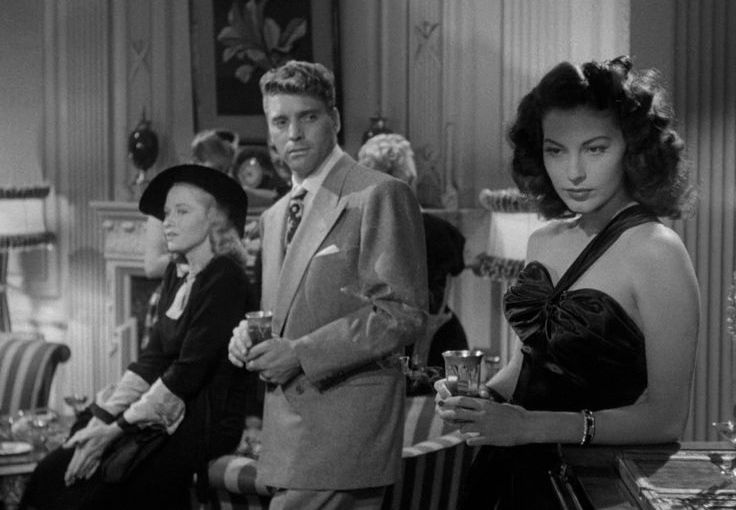
Figuring prominently in the Swede’s backstory is Kitty Collins, played by the ravishing Ava Gardner.  This was not her first film, but The Killers is the movie that put her on the map for good.  We first see Kitty when the Swede goes to a fancy party with his girlfriend, Lilly.  Alas, Lilly is no match for the sultry Kitty, who is wearing the kind of stunning black gown that inspires poetry when it isn’t simply driving men crazy.  How crazy?  At one point, when Kitty is caught by a cop wearing shoplifted jewelry, the Swede claims responsibility, slugs the cop, and winds up doing three years in jail for her.  Talk about being Kitty-whipped.

Naturally, as Jim, the insurance guy, meets more people, the Swede’s story comes more sharply into focus, but there’s still the mystery of what happened to all that money.  The robbery was indeed pulled off by the Swede with three other guys, but none of them have the money, and the Swede doesn’t have the money, so where is it?  As it turns out, the hat factory they stole from is insured by the same company that provided the Swede’s life insurance policy, so it’s in Jim’s best interest to get to the bottom of everything and recover the money, even if it means getting involved with the same kinds of thugs who killed the Swede in the first place.  That’s okay, though.  Jim is prepared.  He carries his own piece, and he comes up with a cool plan to get the guilty parties to confess as much as possible before they wind up dead…or he does.

The Killers is an example of a film that helped define, or at least refine, the relatively new film noir genre.  Similar films centering on crime, criminals, and punishment had been around since the ‘30s, but the real granddaddy of them all, The Maltese Falcon, had only been released five years earlier in 1941.  Since then, World War II came and went, and as dark as noir had been, it got even darker and more violent than Bogey was when he slapped Peter Lorre around.  With this film, director Robert Siodmak turned everything up to eleven.  The shadows aren’t just dark, they’re black, which of course makes the periodic pools of light that much more striking.

And the characters mean business, too.  Among the bad guys, there’s one named Colfax who doesn’t look like much – sort of like a moderately well-built school principal.  But when a genuine thug threatens to fight him, he doesn’t posture like a bully.  He just sits back in his chair and calmly tells the thug: “You’ve got quite a reputation yourself.  You’re supposed to be a troublemaker.  Okay.  Make some.”  And you just know that if the thug so much as lifts a finger, he’ll get it broken for his trouble.  It’s an interesting scene that reminded me of Goodfellas: “Paulie may have moved slow, but it was only because Paulie didn’t have to move for anybody.”

(I should also mention the flashback involving the payroll robbery.  In today’s films, when we marvel at long takes involving complicated camera moves, it’s good to be reminded that, three-quarters of a century ago, The Killers gave us a heist sequence that starts at ground level, follows the robbers up a staircase, shows the actual robbery, follows them back down into their getaway cars, and even provides a small-scale shootout as they drive away – all in one uncut take, using a camera about the size and weight of a SmartCar.)

While I thoroughly enjoyed The Killers, I wouldn’t quite put it in the same weight class as, say, Out of the Past or The Big Sleep, but it’s got all the right ingredients, it tells a good story well, it gives us Ava Gardner in that gown, and it provided a great springboard for the films that came after.  Good film noir is fine; GREAT film noir is better.  This is one of the great ones.

[P.S.  The scene near the beginning of the film where the two thugs terrorize the people at the diner reminded me strongly of the scene in No Country for Old Men when Anton Chigurh quietly tells the store clerk to “call it.”  They were just as calm and serene and tightly coiled as Chigurh.  Pretty creepy.]

GREAT EXPECTATIONS (1946, Great Britain)

by Miguel E. Rodriguez

Director: David Lean
Cast: John Mills, Valerie Hobson, Jean Simmons, Martita Hunt, Alec Guinness
My Rating: 8/10
Rotten Tomatometer: 100%

PLOT: A humble orphan boy in 1810s Kent is given the opportunity to go to London and become a gentleman, with the help of an unknown benefactor.


Before moving on to full-blown epics like Lawrence of Arabia and Doctor Zhivago, Sir David Lean’s reputation was already assured with his small-scale masterpieces like Brief Encounter [1945], Oliver Twist [1948], and Summertime [1955], one of the finest Katharine Hepburn films you’ve probably never heard of.  Among these little gems is another Dickens adaptation, Great Expectations [1946], co-starring an impossibly young Alec Guinness.

Having never read the source novel nor, in fact, seen any of the other adaptations (there are at least five others, according to IMDb), I was able to go in “cold” with no preconceived notions or, ahem, expectations of my own.  What I found was a surprisingly engaging melodrama full of gothic overtones and the kinds of coincidences and contrivances that are rife in Dickens’ literature.  Yet they do not feel like contrived literary devices.  They feel like the kinds of coincidences, large or small, that populate our ordinary lives.  (I’ll bet the narrator at the beginning of Magnolia LOVED Dickens.)

The movie opens with a young boy, Pip, visiting the graves of his mother and father.  These opening scenes set the tone: dark skies, bare trees creaking in the incessant wind, and an unexpected encounter with an escaped convict who demands food and a file, for the shackles still hanging from his wrists.  Pip is terrified and complies.  Later the convict is captured and has the opportunity to give up Pip as one who aided a criminal, but in an oddly moving scene, he merely says he stole the food with no one’s assistance.

Later, Pip is introduced to the lovely young Estella (Jean Simmons in one of her earliest roles), who lives in a sprawling, decaying mansion owned by the eccentric old Miss Havisham (Martita Hunt).  Miss Havisham has summoned/hired Pip because it amuses her to watch children play, but more importantly because it also amuses her to watch Estella flirt with and continuously berate Pip as being a commoner, a blacksmith’s son, and someone who is otherwise unworthy of Estella’s affections.  The reasons for Miss Havisham’s cruel games may be guessed at by the dilapidated state of the wedding dress she wears day and night and by the crumbling, molding wedding cake sitting on a cobwebbed banquet table.  (Miss Havisham’s mansion is one of the creepiest gothic locations I’ve ever seen.  I half-expected the story to take a macabre turn, a la Edgar Allen Poe, with a deserting bridegroom rotting away under the floorboards or something.)

Time passes, and in the first of those melodramatic contrivances of which Dickens is so fond, Pip is granted the chance to go to London to become a gentleman.  His livelihood will be sponsored by a handsome annual stipend from an anonymous benefactor through a corpulent attorney named Mr. Jaggers.  (Dickens has some of the greatest character names in literature: Jaggers, Magwitch, Herbert Pocket, Uncle Pumblechook, Mrs. Whimple…I love it.)  Pip enters this new stage of his life assuming, as we all do, that his anonymous benefactor is none other than Miss Havisham.  Makes sense, right?

Through the course of this second act, Pip falls in love with the beautiful but heartless Estella, who warns him she has no heart and only seeks to conquer and discard her many suitors.  This is her way of expressing genuine affection for Pip.  Would Pip rather she do the same to him?

He also meets and befriends his London roommate and business partner, Herbert Pocket, played by an inconceivably young Alec Guinness in his first major screen role.  This was, as they say, the beginning of a beautiful friendship, leading to collaborations between Lean and Guinness on The Bridge on the River Kwai, Lawrence of Arabia, and Doctor Zhivago, not to mention Guinness’ very next role as the odious Fagin in Lean’s own version of Oliver Twist.

The rest of the story, involving Jaggers’ mysterious maid, a test of Pip’s loyalty, the identity of his benefactor, and the wholly unforeseen fate of Miss Havisham, I leave for you to discover.  It all ends, it seemed to me rather abruptly, but it is satisfying.

To fans of Lean’s more ambitious films, a small film like this one hardly seems as if it were made by the same director.  In today’s terms, it might be like watching a small character-driven film made by the Russo brothers (Avengers: Endgame, Captain America: Civil War, etc.).  In his Great Movies Review for this film, Roger Ebert points out the difference between these two stages of Lean’s directing style:

“[Lean] was an editor for seven years before directing his first film, and his career stands as an argument for the theory that editors make better directors than cinematographers do. …What the earlier films have is greater economy, and thus greater energy, in their storytelling.”

Indeed, Great Expectations hurtles along breathlessly, not as quickly paced as a Marx Brothers comedy, but certainly without wasting a single moment on anything that is not necessary to move the story along, or at least provide just a small dash of character or color to the proceedings.  (One of my favorite small touches was the gruesome death masks hanging on the wall of Mr. Jaggers’ office.  For me, it was a kind of foreshadowing, alluding to the possible fate of the convict Pip encountered at the beginning of the film.) In his later epics, Lean’s pacing slows down in favor of presenting the viewer with grand desert or mountain vistas, so instead of watching a play, it feels like we’re at a museum. This isn’t a bad thing. It’s merely a different style of storytelling.

There is another, perhaps more famous, adaptation of Great Expectations out there, by the famed Mexican filmmaker Alfonso Cuarón, starring Ethan Hawke, Gwyneth Paltrow, and no less than Anne Bancroft as Miss Havisham, renamed Ms. Dinsmoor in this version.  It was updated to present day, some other character names were changed, and it is supposedly drenched in atmosphere.  I have yet to see it.  Until I do, Lean’s early masterpiece will remain my favorite version of this timeless tale, abrupt finale and all.