MRS. MINIVER

By Marc S. Sanders

To watch a classic film, usually reserved for Turner Classic Movies, is to get a history lesson while realizing that people’s perceptions have hardly changed.    In the early 1940s as World War II was occurring, happiness in many corners of the world was still moving forward.  Presently, I believe that happens today.  For example, Israeli hostages are only now being released from Hamas.  Until the conflict is over though, a childhood friend of mine chooses to run every Sunday morning.  He declares that he runs because they can’t.  This friend is not a soldier bearing arms.  He is acknowledging a violent and frightening conflict that persists.  On the side, he’s a devoted New York Yankees fan.  In 1942, when William Wyler’s Oscar winning film Mrs. Miniver was released, the well to do characters were performing comparably as Europe was in the thick of staving off the Nazi militia.

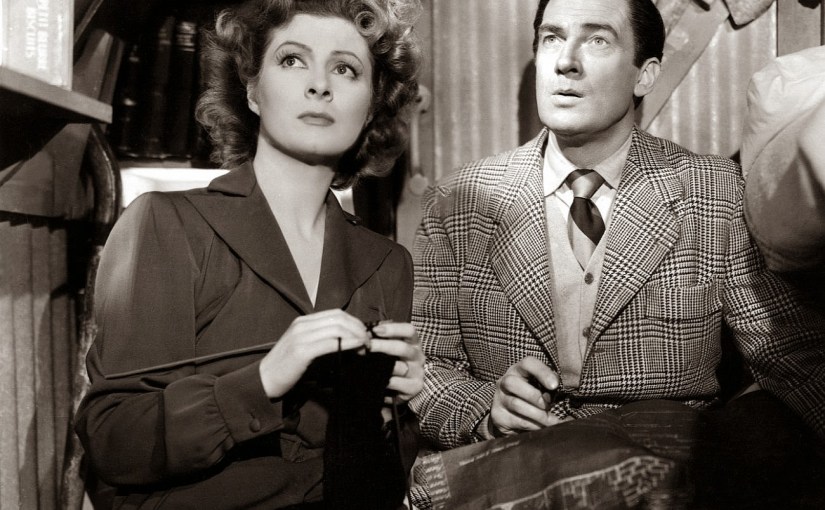
Mrs. Miniver opens on a bustling metropolitan district in England.  The title character, Kay Miniver (Greer Garson), is in a mad rush for something.  She hops on and off the double decker bus and weaves her way through the crowd.  Finally, she arrives at the destination.  The glamorous hat she’s had her eye on is still available to purchase.  Her only dilemma now is what will her husband think when he learns of the extravagant purchase.

Upon her arrival home, Clem Miniver (Walter Pidgeon) hides from his wife in a brand new convertible.  When she goes in the house, he makes a decision.  It’s expensive, but he must have the car and so he buys it.

In this tranquil part of England, the most immediate concern among these well to do people is deciding whether or not to treat themselves to gifts that will bring them joy.  Talk of a German invasion seems like a possibility, but the Minivers, with their two young children and their twenty-year-old son at Oxford, insist on living comfortably and happily.

Lady Beldon (May Whitty) is the elderly and intimidating aristocrat who suffers a terrible dilemma.  It seems the bell ringer, Mr. Ballard (Henry Travers), has grown a beautiful rose that looks like no other.  He cherishes it so much that he names the flower “Mrs. Miniver.”  The real person is honored for the personal recognition.  Yet, Lady Beldon’s concern is her yellow rose will not win this year’s prize trophy cup at the village flower festival.  Her granddaughter Carol (Teresa Wright) gracefully asks Kay if she’ll convince Mr. Ballard to withdraw his entry so that her grandmother can win once again.  She’s elderly, she’s accustomed to winning each year, and it would mean the world to her.

This request will also lead to a romance for Carol with the Minivers’ son Vin (Richard Ney), who has just enlisted in the Royal Air Force so he’s ready to fight the Axis forces of World War II.

All of this seems frivolous during the first half of Mrs. Miniver.  These people live comfortably but gradually grow a little more unsettled as they soon hear planes flying overhead their homes while the sounds of battle play off in the distance.   The possibilities of war coming to their front door seems to be an unlikely scenario.  The battles and bloodshed are out of sight, but only partially out of mind. 

I appreciate the editing of this film.  Clem is woken in the middle of the night to join the other neighboring husbands at the local saloon.  They are being requested to join the historic small boat rescue at the battle of Dunkirk.  The men down a drink and sail off without hesitation.  No one gives protest or stands behind their wealth or stature.

Midway through the picture, Kay is reading a bedtime story to her children in a dimly lit room.  We never see the entirety of this cramped space.  The scene simply begins with no transition.  The walls appear to be made of aluminum and then I realize the Minivers have taken shelter in an underground bunker.  Soon, they will be living through one unimaginable night of shelling and bomb dropping. Director William Wyler never turns off the camera through the extended sequence.  The bunker shakes and rattles.  The children cry in fear.  Dirt rains down them.  Books and belongings fall among the family. The pounding explosions carry on outside.  It seems to never end and the concern over a lady’s fashion hat or a beautiful new automobile are distant memories.

When Vin and Carol arrive home from a honeymoon, the Minivers home is wrecked.  So is Clem’s boat following the Dunkirk incident.  However, they happily remain living there with the youngest child playing a welcoming number on the piano.  

Amid all of these episodes, the people of this small English town uphold their positivity, but they never lose sight of what is nearby.  It’s just a house.  The Minivers are surviving and remain together.  Their biggest concern is that one day Vin won’t return from battle. Yet, time and again he does with hugs and kisses for everyone.

I’ve provided a lot of what occurs in Mrs. Miniver because I was not entirely sure of the purpose of all of these happenings until the final act is served and surprising outcomes arrive.  For much of the film, William Wyler delivers an impression of life away from the front lines.  These people live with a devotion to help their country and abandon comfort when necessary. Flower festivals, gleeful children, young romance and materialistic tranquility will carry on regardless of terrible interruptions of war.

Amid turmoil in our present state with political divides, unjust prejudice, natural disasters, and a resurgence of Cold War threats, I can’t help but wonder if many of us live like this family.  I believe we do, and I see nothing wrong with that.  We have to escape and live happily no matter what terrible future might befall us because otherwise what is the purpose of living?  Still, we choose to remain alert and especially empathetic and ready to aid our fellow neighbors when the need arises.

Visually, a shocking set design for the final scene of Mrs. Miniver sends a message that is only enhanced by a sermon delivered by the town minister.  I learned later that this speech was written at the last second by William Wyler and the actor portraying the minister (Henry Wilcoxon).  It perfectly demonstrates the overall purpose of the entire film.  Mrs. Miniver is the story of a fight for ongoing freedom; an independence to live and to treat oneself happily and lovingly.  People perish during the course of the picture.  The minister explains with convincing validity why they had to die so undeservedly and unexpectedly.  It’s an ending that really touched me, and upon the movie’s conclusion a message appears urging Americans to buy war bonds.  

This speech had such an impact at the time that it circulated in propaganda films and on radio airwaves as a means to deliver a shared triumph among the Allied masses.  It reminded people that simply because you live at home, does not mean you are exonerated of the fight for continued freedom.  The fight is not exclusive to hoisting a rifle or dropping bombs from planes.  A unified front of country must be upheld.  

Mrs. Miniver begins as a romanticized film of people living glamorously and happily but it effectively segues to a reality of uncertain times.  I went from questioning what is its purpose to an understanding of a reason to live and to strive.  
THE MAJOR AND THE MINOR (1942)

by Miguel E. Rodriguez

DIRECTOR: Billy Wilder
CAST: Ginger Rogers, Ray Milland, Rita Johnson, Robert Benchley
MY RATING: 9/10
ROTTEN TOMATOMETER: 100% Fresh

PLOT: A frustrated city woman disguises herself as a 12-year-old girl to get a cheaper train ticket, but her plan backfires when she winds up befriending a very adult Major on the train.  Risqué hilarity ensues.


Billy Wilder’s The Major and the Minor, contains big laughs, true love, and comic/cosmic misunderstandings – in other words, it’s a classic farce from the fledgling career of one of Hollywood’s true legends.  However, there are certain plot elements that I suspect would make this movie virtually unfilmable today, at least not without tinkering with the structure here and there.  I think the plot points in question will be glaringly apparent to any reasonable viewer, so if I acknowledge them with only the occasional eye roll in my review, I hope readers will forgive me.  It is not my intention to prepare a compare/contrast treatise on prevailing attitudes towards women during the 1940s versus today.  You don’t need me to tell you that the very concept of an adult male bunk-bedding with a strange 12-year-old girl he just met (among other plot devices) raised my eyebrows.  It is firmly a product of its more innocent time. But the whole endeavor is so breezy and carefree that I think it would be a shame to give this film a pass without hearing more about it.  So, here goes.

Ginger Rogers plays the lead, Susan Applegate.  Having only seen Rogers in the occasional dance film with Fred Astaire, I was bowled over by how naturally comic she is.  Based on this movie alone, she could have given Lucille Ball or Rosalind Russell a run for their money.  Anyway, Susan Applegate is fed up with living in NYC.  Tired of being besieged by lechers at every turn, she quits her job – her 25th in a year! – and tries to buy a train ticket back home to Iowa.  When she finds herself short on cash, she dresses up as a 12-year-old girl to get a ticket at half price.  Her real troubles begin when the train gets underway, as the conductors are not movie-dumb enough to fall for her act.

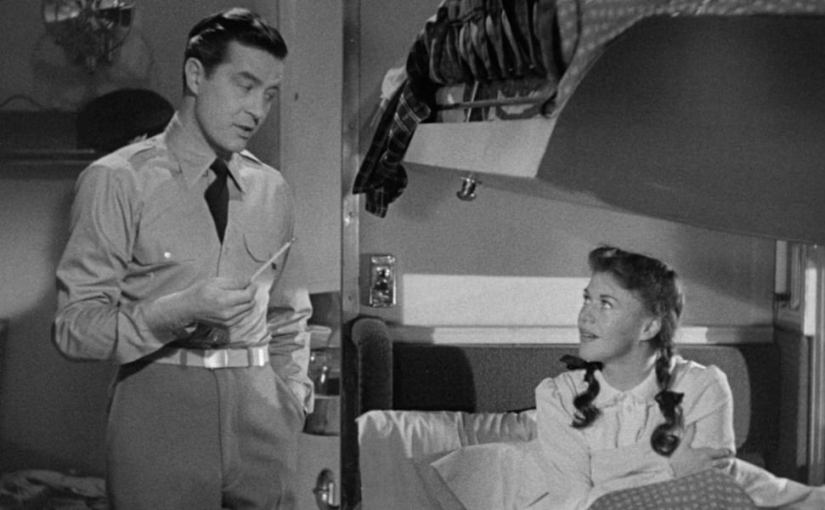
She winds up hiding in the compartment belonging to Major Philip Kirby (Ray Milland in a mildly uncommon comic role).  Because he has a bum right eye, he falls for Susan’s story (she calls herself Su-Su to complete the façade) and takes it upon himself to be her impromptu guardian.  Through an unfortunate series of events – a blocked train track, the unexpected arrival of Kirby’s beautiful fiancé, Pamela, and some ill-timed misunderstandings – “Su-Su” finds herself being whisked away to a military school with Major Kirby promising to get her on the next available train back to Iowa.  Trust me, it all makes sense, I’m leaving a lot of details out, otherwise we’d be here all night.

The rest of the film involves Su-Su’s misadventures on the military school campus, surrounded by three hundred school-age boys who are inexplicably attracted to this girl who somehow has the presence of an adult woman.  They like her, but they’re not quite sure why.  The same phenomenon begins to afflict the Major himself, which makes him extremely uncomfortable (understandably so), which makes things more complicated for Susan because SHE’S beginning to fall in love with HIM, and meanwhile Kirby’s future sister-in-law sees right through Susan’s disguise and wants Susan to help her break up the impending marriage, and 20 different cadets show up to escort Su-Su to the school dance, and so on and so on and so on.

This was only Wilder’s second film, but already we can see ideas and situations that he would return to in some of his future films.  The woman disguising herself as a girl is a funhouse-mirror version of the men disguising themselves as women in Some Like It Hot.  We get the reverse situation, a girl becoming a woman, in Sabrina.  The idea of how tough it is to live in the big bad city is echoed in The Apartment.  And if you really squint, you might even see an early forerunner of Norma Desmond in Major Kirby’s beautiful but devious and controlling fiancé…it’s a stretch, but I think it’s valid.

The performance by Ginger Rogers in this movie was a revelation to me.  I had absolutely no idea she could play this kind of character.  She plays everything so believably, whether she’s Susan or “Su-Su.”  In scenes where she’s near Major Kirby, her longing for him is palpable, but her outward reactions are perfectly subtle: a slight pause before a reply, a constant gaze, only occasionally a little mugging when he’s not looking at her, and always making sure to keep her brassy voice in a higher register to sound more girly.  I learn from IMDb that she was anxious to play this role because she was able to draw from her own experiences: as a younger woman, when she toured vaudeville halls with her mother, she would often make herself appear younger to get cheaper train tickets.  Who knew?

Ray Milland had a trickier time of it in this movie.  He manages to pull it off, but imagine the minefields he had to navigate.  He plays a grown man who is the self-appointed guardian of a 12-year-old girl who, by his own admission at one point, looks like a full-grown woman in the right light.  There’s a scene where he feels compelled to at least try to explain the facts of life to Su-Su so she’ll understand why all the cadets are attracted to her like a moth to a light bulb.  (In one of the less-enlightened moments of the film, he advises her: “Maybe if you made yourself a little less attractive…”  HUGE eye-roll.)  Now, we as audience members know there’s really no problem with his mild flirtations because, of course, Su-Su is really Susan.  But HE doesn’t know that.  Wilder has the good sense to pull everything back from the brink before anything unsavory occurs.  It’s one of the best high-wire acts I can think of in a comedy.

(I’m itching to relate all the hilarious Wilder-esque bits peppered throughout the movie, like finding the occasional burnt end in a delicious brisket, but I am anxious to avoid spoilers.  There’s the tap dance, the Veronica Lake look-alikes, “the Maginot Line”, the cigarette on the train…oh, too many to list.  They’re wonderful.)

As with the best farces, a crisis occurs and it seems as if all is lost, but fear not.  Wilder is not known as a genius for nothing.  If you think this romantic comedy from the early forties is not going to have a happy ending, you need to see more movies.  The Major and the Minor is a delight from start to finish.  And if the last line doesn’t quite come up to the standards of “Well, nobody’s perfect!”…well, I mean, what does?

[Note: It’s also interesting to know that The Major and the Minor was filmed and released in 1942, it’s set very specifically in May of 1941, before Pearl Harbor.  Here and there are in the movie are references to Kirby’s desire to be stationed abroad in case war breaks out.  There’s a moment when he confesses that no woman would want to marry a military man stationed overseas, only getting a letter from him once every two weeks.  The reply he gets is very direct, clearly indicating where Wilder stood on the matter: “I think you underestimate us, Mr. Kirby.  Perhaps all a woman wants is to be a photograph a soldier tacks above his bunk or a stupid lock of hair in the back of his watch.”  Sexist?  Or patriotic?  Discuss.]

CASABLANCA

By Marc S. Sanders

I’ve always struggled with Casablanca.  It just does not have that hold on me that so many cinema lovers acquire upon viewing the celebrated film.  In the past, I’ve called it overrated, a bore, underwhelming, and plenty of other negative connotations.  Don’t worry reader.  I’ve been stabbed in the heart, back and eyes a thousand times over with the eyerolls, the verbal gasps, and the room exits from friends when I contribute to a discussion on this overall favorite.  I’ve tried.  Believe me, I’ve tried to love Casablanca.  Now, on this fifth viewing, or call it the sixth because I had to stop in the middle when my mind was wandering last week, I sincerely developed a semblance of appreciation for the picture.  Now be patient with me.

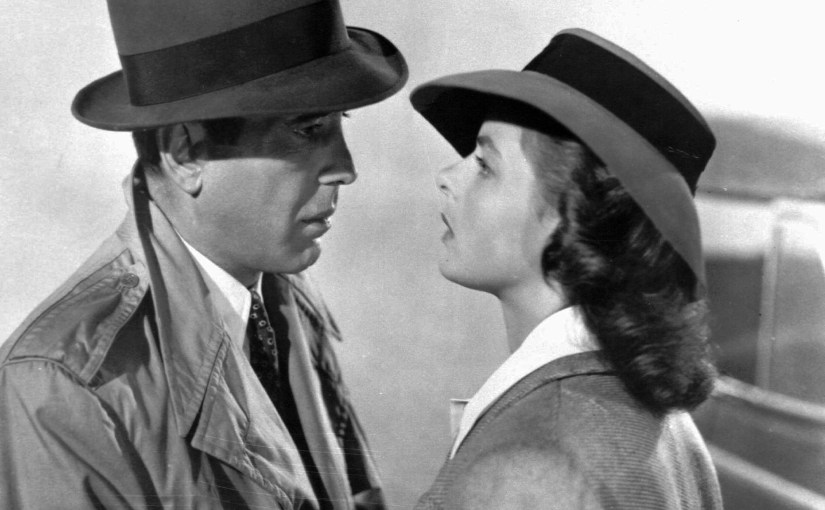
To absorb the classic film about Rick Blaine (Humphrey Bogart), the saloon keeper who keeps to himself, crossing paths with his long-lost love Ilsa Lund (Ingrid Bergman), I allowed myself to envision watching it in a movie house in 1942, when World War II was occurring on another side of the world and people were being forced to relocate or suffer captivity at the hands of the vile Nazi regime.  Casablanca, Morocco was the last hopeful exit to Lisbon, and then on to the Americas.  I had to embrace the setting and the time period in order to relate to the Oscar winning film. 

Rick runs the Café Americain near the airport of Casablanca.  All walks of life come through the doors each night to drink, gamble, smoke, flirt, and sing along with Sam the memorably charming piano player (Dooley Wilson). Most importantly, some patrons hope to score the necessary papers for passage out of this tiny desert port area that has yet to be Nazi occupied.  Rick is the expatriate who runs this gin joint and he has no interest in aiding anyone with an escape, nor with assisting the Nazis in rounding up their usual suspects they believe are enemies of the state.  He could care less about anyone’s cause or politics.  He just wants to run a respectable bar.

However, the past circles back on Rick when Ilsa arrives with a wanted Frenchman named Victor Laszlo, great name, played by Paul Henreid.  Victor has escaped the concentration camps and he is making efforts to reach the states so that he can continue his underground campaign of exposing the treachery and threats of the Nazis.  Rick has already been warned if Victor should make an appearance he must not be permitted to leave Casablanca.  The bar manager would rather not be involved.  Yet, it’s hard for him to resist thinking about his past love, Ilsa. Flashbacks soon reveal their time spent in Paris when they fell madly in love only for her to suddenly abandon him as they were trying to board a train exodus before the Nazis seized the territory.

Casablanca has a very simple plot and that lends to the strength of its finished product.  The love triangle of three good people, Rick, Ilsa and Victor, is where the complexity lies and there is no denying how memorable the main players are in their roles.  However, I can only surmise that the legendary status of the film tainted my open mindedness for an admiration of the piece.  The hype has always been too much for me, I guess.

Reader, I don’t think I am a big fan of Humphrey Bogart.  I’m very sorry.  It could be The Big Sleep or The Maltese Falcon.  Too often, I think he is quite bland in his signature, unforgettable caricature. No matter which film he’s in, Bogart is unique.  There is still no one like him with his chiseled face, dark hair and deep voice.  I’m not sure that’s even a fair description.  It’s hard to find the right adjectives for Bogie.  He was one of a kind.  However, there was little range to the star.  (I know.  I’ve seen The African Queen; great movie.) Rick is so closed off and predominantly on the same plane of emotions whether I am seeing him at the beginning of the film or at the end when he delivers his final speech to Ilsa before the plane departure.  He’s too one note for me. He’s just a boring guy and if I was at a table drinking alongside him, I would have to excuse myself very quickly.  Even to play chess with Rick would be excruciating.

Paul Henried is charming though.  He plays Victor as the adventurer or the daring swashbuckler, aware of his threat to the Nazis, but fearless in whatever he faces.  He just knows he serves a greater purpose to the world.  The loose knit, white suit and hat compliment his relaxed stature.  Even the scar over his right eye seems to tell a story.  In Casablanca, I find myself more concerned with what will happen to Victor Laszlo than anyone else.

Ingrid Berman is strikingly beautiful.  You can just recognize her exuberance through the black and white photography.  She was an actress that the camera loved and her performance is sensational as the woman caught in the middle, who mourned what she thought was the loss of a husband, only to find new love. Then the unexpected interfered with her desire for a promising new future.  Her best scene is when she stands up to Rick, no matter the stakes, to get him to help her rescue her husband Victor.  If it is not pleading, then she will use other means.  Frankly, I had forgotten what she tried next in this scene, which I will not spoil.  So, when the camera cuts back to her following another speech from Rick, my eyes went wide.  Ilsa is not just some pretty dame.  She knows she must be more than that, even more than a one night stand or some gentleman’s true love.

For so many years, I would hop on The Great Movie Ride at Disney/MGM studios and come across the famous final scene.  I heard Rick’s speech so many times, a hundred times more than I have watched Casablanca.  Take a scene like that out of context, and it waters down the power of the celebrated film.  What a difference it makes after you learn why Rick and Ilsa could not stay together following Paris, and why you learn their fates are destined for different paths perhaps.  “Here’s lookin’ at you kid!” has a deeper connotation when watching the film as a whole.  I know I’m pointing out the obvious.  Yet, I embraced Bogart’s improvised line that much more in addition to so many other well-known pieces of dialogue.  Other films have those special moments where you can isolate a scene on a work break and just take it in.  I know snippets of Casablanca are viewed that way, but there’s an emptiness to watching these scenes in that fashion.

In 1942, following the Japanese attack on Pearl Harbor, as Jews and gypsies and every other race or nationality or demographic were being bullied at the hands of an unforgiving Nazi regime, audiences must have regarded Victor, Ilsa and Rick as heroes.  True heroes!  They must have been considered the heroes who don’t amount to a hill of beans in this crazy, mixed-up world, but must therefore sacrifice what they hold so dear and personal.  It makes me wonder if Michael Curtiz’ film would have had the same kind of impact if it was released at later time in the century like the 1960s, long after the war was over and the Axis armies, particularly the Nazis, were wiped out.  In 1942, perhaps I would have had more of an appreciation for Rick and Ilsa if I watched the film then. 

My attention especially perked up during the competitive nature of the French and Moroccan patrons singing the anthem La Marseillaise against the Germans’ rendition of Die Wacht am Rhein.  It’s a scene that demonstrates promise during a very frightening and confusing period in time.  I imagine audiences applauded and cheered during this scene.  On the other hand, maybe they were afraid and apprehensive to do so during such a confusing time.  The fiction found in the Oscar winning script from twin brothers Julius and Phillip Epstein was daring enough to defy the power of Hitler’s fast rising influence.  Modern films from the likes of Spike Lee and Adam McKay attempt to circumvent their stories to present day crises and dare to footnote their films with real life news footage.  It’s admirable at times.  Sometimes their efforts are divisive.  Yet, they do not feel as meaningful as what the Epstein brothers and Curtiz accomplished.  For me, this moment near the conclusion of Casablanca is my favorite scene of the picture.  The slaphappy regulars of Rick’s Café  Americain were enthusiastic to join Sam for a rousing rendition of Knock On Wood, but when reality intrudes upon their escapism, another dimension to the people does not hesitate to stand up for a purpose.

So, it’s always been tough to win me over with Casablanca.  Still, I marvel at the picture for the absorbing settings of Rick’s Café along with the crowded Moroccan streets occupied with refugees and pickpockets under the authority of a party who threatens to stake its claim.  Sam turns the bar into a regular evening atmosphere to bond and escape while the drinkers yearn to be on the next plane to safety and freedom.  Tricks are turned where travel papers are the most sought-after commodity, and ultimately, beyond Rick Blaine, there are people who may strive for safe passage and will also unite against a tyranny if enough will take up their swords, people like Victor Laszlo. This is what I treasure from Casablanca

The cast consists of a colorful bunch including Claude Rains, Sydney Greenstreet, Peter Lorre and Conrad Veidt.  Plus, Rick and Ilsa will always have Paris, but that was always a tough relationship for me to connect with.  What is more meaningful is the harbor that Casablanca and Rick’s Café Americain offered those who were fleeing, hiding and surviving amid their desperations.

This will not be the last time I watch Casablanca.  For a film to have this much staying power after more than eighty years, there must be something else I have yet to uncover, and I cannot wait to find it.

I’ll play it again for old time’s sake.