THE 39 STEPS

By Marc S. Sanders

I propose you try an experiment.  Watch one of Alfred Hitchcock’s earliest, British produced films, The 39 Steps, and then have a look at Andrew Davis’ The Fugitive with Harrison Ford and Tommy Lee Jones.  You’re likely to recognize how inspiring Hitchcock’s film is towards modern thrillers almost sixty years later.  In particular, Hitch explored the thrill of the chase.  All he needed was the simplest of reasons for the pursuit to begin.  Then, he had the framework for his entire motion picture.

The 39 Steps is a loose adaptation of John Buchan’s novel.  Hitchcock’s film invented so much more than the book offered.  When the film was previewed for Buchan, midway through, the author reportedly told the filmmaker how he was wondering how it was going to end.  I took a film studies course in college and one of my assignments was to read the book and then document how it compares with the movie.  The nationality of the hero is different, a potential love interest appears in the film that is nonexistent in the novel, and even the actual 39 steps is entirely something else in the film.  Some books are challenging to deliver on a visual medium.  Alfred Hitchcock knew what needed to be altered to make for an adventuresome thriller.

The film opens in a European theater where one of the most astonishing people has taken the stage.  He is Mr. Memory (Wylie Watson) and he claims that his mind contains an infinite number of facts.  So much so, that any reasonable question pertaining to math, science, geography, sports or history can be answered by him instantly.  He won’t be able to tell a lady where her husband is spending his nights, and while he knows how old Mae West is, because he’s a gentleman, he will never reveal a woman’s age.

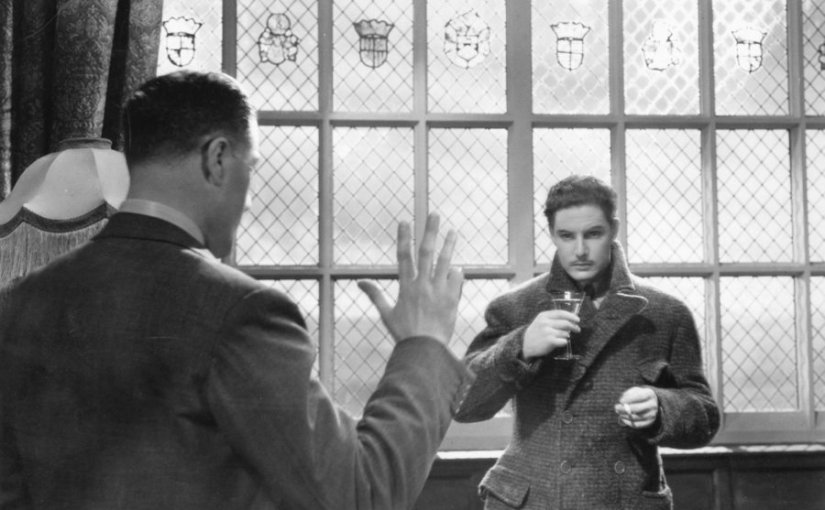
A Canadian gentleman named Hannay (Robert Donat) is in the audience and after a riot breaks out within the crowd and some gunshots go off, he’s escorting a mysterious woman back to his flat.  She hides from the windows, away from the light and is fearing for her life because of what she knows about The 39 Steps.  She also accurately points out two men down below on the street who have been following them. When she awakens Hannay in the middle of the night with a knife in her back, he is suddenly on the run, trying to make it to Scotland with what few clues she has shared with him.  However, he’s also become a prime suspect in her murder.  The police are after him. These two men are following him and who knows who else is on his tail relation to the 39 steps. This foreigner is now up against an entire country that offers no friends and only suspicions. Alfred Hitchcock relishes in drowning his characters within whatever can be sinister.

Though I have not seen the picture in decades, I’ve never forgotten the secret of The 39 Steps. This recent viewing (on a superb Criterion print) offers moments that are near copies of films that had yet to come.  

Ian Fleming declared that without the invention of the suave, well dressed and sarcastic Mr. Hannay there would be no James Bond.  A woman’s scream upon discovering a murder victim is reminiscent of a scene transition from Spielberg’s The Lost World: Jurassic Park.  Black Widow and Captain America evade secret agents the same way Hannay does with a woman named Pamela (Madeleine Carroll) who he inadvertently encounters on a train.  How many times have you seen two characters handcuffed together while on the run? Plenty, right?  (The Defiant Ones and I’m sure there’s an episode or two from Moonlighting or Starsky & Hutch). Here’s where the idea of such an inconvenience first took place.  Of course, there’s Davis’ thriller with so many near identical scenarios like a foot chase through a chilly countryside to blending within the crowd of a town’s marching parade.  The one-armed man from The Fugitive franchise of TV and film is seen here as a character with a deformity on one of his fingers. Both films even boast nail biting train scenarios, and pursuits that take to the air while the escapee flees down below on the ground.

Alfred Hitchcock tricks his viewer time and again.  He will make you believe that the focus of his pictures carries an overwhelming weight.  Often, they do.  However, it’s of no consequence to reveal what must remain secret or concealed.  Instead, his themes are to make sure his protagonists survive and evade.  The 39 Steps is one of his first efforts he thematically became known for about an ordinary man getting entangled in undeserving threats of danger.  

I directed a stage adaptation of The 39 Steps and the script, published in 2005, pays deliberate tributes to some of the most famous films from Hitchcock such as North By Northwest, Rear Window and The Man Who Knew Too Much.  (Liberally, I incorporated my crew into the play and called them The Backstage Psychos.) The play is notable for its broad spoof treatments and the fact that only four actors are intended to play every character, and some props and pieces, within the story.  It may teeter on satire, but it’s also a salute to Hitchcock’s career.  Before any of his most famous films were conceived, The 39 Steps created some of the director’s most well-known set ups.  While Hitch is a direct, or indirect, inspiration to modern filmmakers, he was also laying groundwork for what audiences would accept as shocking and eye-opening beginning with something as simple as a knife in someone’s back.  

I was also impressed with the director’s use of the camera.  The audience’s questions for Mr. Memory come at him fast, and Hitchcock moves his camera from row to row in a zig zag trajectory with a new extra ready with a demanding query as soon as the camera arrives on every face.  You’d think this was Steadicam work, but this is nearly fifty years before that option was available.  Alfred Hitchcock was daring enough to work beyond simplicity.  

Wide shots of a small Hannay silhouette stumbling across the mountainous Scottish terrain allow for the pursuit to appear overbearing.   The police close in, while a flying machine above is ready to bear down on the hero.  Close ups during a dinner sequence at a farmer’s home are provided with alarming looks and eyes widening to spell doom and fear. Hannay’s need for caution while containing his paranoia uphold the suspence. 

The 39 Steps is a picture that any film enthusiast should watch.  When you see a Marvel movie or an Indiana Jones adventure or even an episode of Murder, She Wrote, you are apt to uncover staples and tropes you have become all too familiar with.  Yet, what about when these ideas were fresh and new? 

The 39 Steps is nail biting entertainment from the early twentieth century, ninety years ago.  Despite its grainy black and white footage, its pursuit moves at a brisk pace with new encounters to overcome while a man tries to hide in plain sight. Again, it seems of utmost importance to discover the answers to a conspiracy wrapped in murder and secrecy.  Actually, it’s the struggle to stay ahead and alive that hold you until the end.

You have watched movies like this before, but have you watched one of the first of this kind?

PETER IBBETSON (1935)

by Miguel E. Rodriguez

Director: Henry Hathaway
Cast: Gary Cooper, Ann Harding, Ida Lupino
My Rating: 9/10
Rotten Tomatometer: No rating

PLOT: A successful architect who longs for the love of his childhood friend is delighted to discover that the Duchess who just hired him is in fact his long-lost beloved.  This being melodrama, there is of course much more to the story.


[SPOILERS FOLLOW]

Peter Ibbetson plays like a long-lost Dickens novel, full of melodramatic flourishes and convenient plot contrivances designed to play the audience like a grand piano.  Is it shameless?  Yes.  Is it maudlin?  Yes.  Do I normally like movies like this?  No.  But there is something about this film and its story that got around my defenses and into my heart and soul.  I’ll try to elaborate on that as much as I can, but I don’t know how well I’m going to do.  Good luck.

The story opens, as the title card helpfully explains, in the middle of the last century, which would make it somewhere around the 1850s.  Somewhere in a well-heeled French countryside, two children from neighboring British families play and quarrel with each other, Mimsey and Gogo.  (I am not making that up, though why parents felt the need to inflict those names on their children is utterly beyond me.)  Gogo, the boy, cruelly teases the girl, Mimsey, who nevertheless gives as good as she gets.  Unfortunately, Gogo’s mother dies after a long illness, and when a distant uncle arrives to take Gogo back to England, he realizes he doesn’t want to leave his precious Mimsey.  Together they try to run away and hide, but it’s no use.  The sight of poor Mimsey weeping in the branches of a tree as Gogo is finally taken away was one of the scenes that started to chip away at my armor of cynicism.

Time passes, and Gogo changes his name to Peter and takes his mother’s last name, Ibbetson.  He becomes a successful architect and a valuable asset for his employer.  (In a very Dickensian touch, Peter’s employer is blind…wholly unnecessary to the plot, but that specificity makes it feel even more realistic amid all the other melodrama.)  Peter is successful, yes, but he is unhappy.  He is a bachelor, and when a very pretty girl more or less hits on him at a museum back in France, he takes her for a drink as a matter of courtesy, not out of any real attraction.  His heart still belongs to the lost love of his childhood, you see.  Mimsey is the touchstone of his past, his Rosebud, his green light at the end of the pier, and she will not be easily eradicated.

Initially, I was unsympathetic to the adult Peter.  How can anyone get on with their life if they’re stuck in the past?  It didn’t work for Kane or Gatsby.  If there’s anything the last thirty or so years of my life has taught me, it’s that the past will only weigh you down if you let it.  I’m not suggesting one should literally forget history, but had I been one of Peter’s associates in the film, I would have been constantly reminding him about being grateful for the present rather than bemoaning the mistakes or regrets of the past.  That way lies madness.

Before I get into more story details, I should mention the style of the film and the acting, which is so mannered and stylized that it feels as if it were a silent film that had a soundtrack added as an afterthought.  Gary Cooper may be a legend, but in this film…let’s be blunt, he is no Cary Grant.  Every sentence feels as if it’s been dragged out of him by way of torture.  His charisma is based solely on his imposing height and his dashing good looks, NOT his speech.  (Sorry, I calls ‘em like I sees ‘em.)  The women are not much better acting-wise, though the Duchess of Towers does have some interesting moments.  However, one of the movie’s highlights are the cinematography and subtle visual effects, especially in the late stages of the film.  Look at that scene involving the peculiar qualities in the bars of the jail cell and explain to me 100% how that was accomplished.  It’s so understated and effective that it took me completely by surprise.  I believe it would raise eyebrows with TODAY’S audiences.

I mention all of this about the style and my mindset because I believe that it all contributes to the reaction I had to the film, at which I’m still perplexed.

One day, Peter is contracted to rebuild the stables of an aristocratic family, the Duke and Duchess of Towers.  When Peter first meets Mary, the Duchess, he experiences an unexplainable connection.  His contract requires him to live in the Towers house for several months.  One day they share a conversation and discover that they shared a dream.  This isn’t a case of two people dreaming about the same thing coincidentally.  They actually shared a dream, Inception style, but without the machinery.  How can this be?

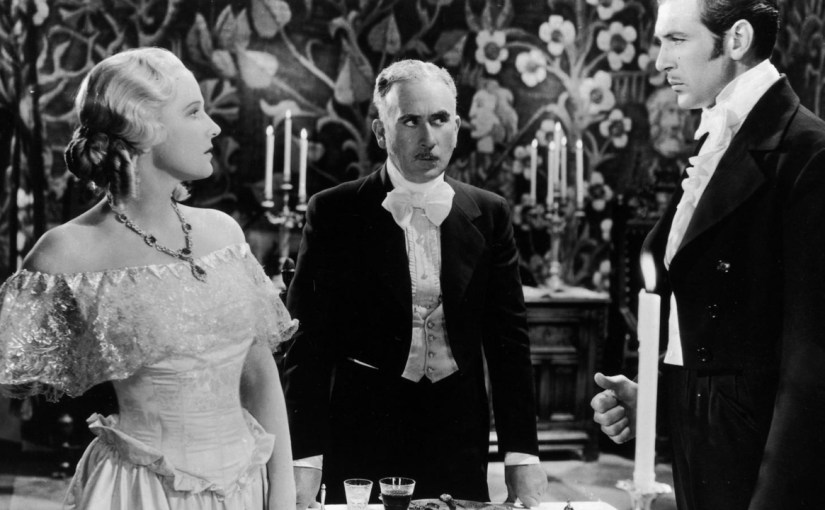
By now, any breathing audience member has already deduced that the Duchess is Mimsey and they are destined for each other.  Alas, Peter and Mary are not as quick on the uptake as we are, and their moment of recognition is delayed until after the peevish Duke confronts them at the dinner table, in a conversation laden with Hays-Code-era double-speak.  “Well, Mr. Ibbetson, are you to be congratulated again?” the Duke asks.  Later, during a second confrontation, the Duke points a gun at Peter and Mary and explains that they will not make love behind his back.  He raises his gun and says, “Get into your lover’s arms.”  Whoa.  Daring stuff for 1935.  It’s during this second confrontation that something goes horribly wrong, and Peter is sent to jail for life.

MORE melodrama?  Hasn’t this movie already had more than its fair share?  Children tearfully separated?  An equally tearful reunion?  Outrageous coincidences?  Shared dreams, for crying out loud?  Oh, you ain’t seen nothing yet.

It’s in the film’s third act, when our hero is in prison, that Peter Ibbetson really started to get to me at some primal level.  Peter and Mary, after being reunited against all odds, are now separated even more cruelly than before.  Peter is so distraught he goes on a hunger strike, chained to his “bed,” which is little more than a wide wooden beam.  (Look at it from a certain angle and he might almost appear to be on a cross, but don’t worry, it’s not that kind of movie.)  When one of his fellow prisoners makes a joke at Mary’s expense, Peter goes a little crazy and starts to throttle him.  Miles away, at the same time, Mary suddenly senses something is wrong.  In the jail, guards use force that’s a tad too excessive to restrain Peter, and at the same exact moment Mary screams.  The two are connected in a mystical way that transcends walls or distance.  They continue to share dreams in which they laugh and walk and talk as if nothing bad had ever happened.  In one dream, he points to a castle in the distance that he has built for his beloved.  I was reminded instantly of the scenes in Inception where Cobb and his wife Mal build entire cities for themselves in their own shared dream.

I’ve already given away too much, far too much than I usually care to.  As much as I want to, I can’t describe the one scene that got me to literally yell, “NO!” at the TV screen.

What fate eventually befalls Peter and Mary, I leave for you to discover.  What remains for me is to try once again to summarize how I felt after the movie was over.  Intellectually, I can see its shortcomings.  The acting is wooden, despite some pretty sharp dialogue.  The music is overwhelmingly romantic and dramatic, commenting on a lot of action unnecessarily, as was the custom back then.  There are one or two odd cuts.  But on an emotional level, the experience of watching Peter Ibbetson was like watching one of Shakespeare’s tragedies.  The only other movies that ever made feel these precise emotions, although not to the exact same degree, are The Remains of the Day and Atonement.  If you know those movies, you know what I’m talking about.

The movie’s final shot is as shamelessly manipulative as these things get.  It’s unabashed romanticism at its best AND its worst.  But you know what?  This movie earns it, and it works.