THE VERDICT

By Marc S. Sanders

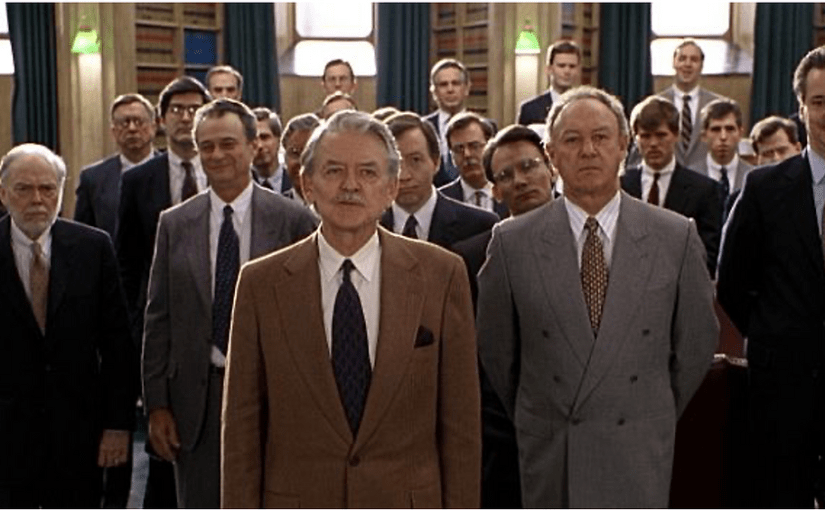
Sidney Lumet is a master filmmaker at shooting predominantly talkie films. In The Verdict by David Mamet, his best special effect is, at least, the just as legendary Paul Newman as washed-up alcoholic attorney Frank Galvin. Lumet opts to shoot Newman for the screen talent he is. Occasionally, his camera points up at Newman, who looks as if he will fall over. Lumet also makes Newman look great as he runs down a hallway, or with a stare of his familiar blue eyes. The chemistry of camera and performance are blended rhythmically.

Alcoholism has been depicted countless times, but Newman’s interpretation ranks at the top of the list. He can’t function without his drink whether it’s gaining a high score on pinball, flirting, reading a brief or even getting a fast protein fix by dropping an egg yolk in a beer. Paul Newman makes you wonder if Frank Galvin is going to pass out or fall asleep even while he’s barely practicing legal brilliance. He toes the line beautifully between coming undone and barely squeaking by. This is one of his best roles ever.

Frank is given a chance to salvage himself as goes up against the Boston Archdiocese and the hospital it owns in a case of medical negligence, who are represented by a conniving antagonist in the form of James Mason with his limitless resources, power, strategies and army of lawyers. If this were a silent film, I’d buy it with Mason twisting a handlebar mustache. He’s absolutely a man you love to hate.

The dialogue crackles against simply the inflection of vocals from Newman, Mason, an unexpected Charlotte Rampling as Galvin’s sudden love interest, a difficult judge played by Milo O’Shea, and Frank’s assistant played Jack Warden. The delivery of lines, the twisty double crosses, and conflicts play to the precision of great Shakespeare. So much so that when on the rare occasion these characters curse or the ominous cue of music steps in, it’s all shocking and applauded.

The settings are great for atmosphere too. Worn in leather chairs, polished cherrywood tables and courtrooms with their squeaky floors. This is a well-worn Massachusetts backdrop of legal reputation and intimidation.

Every member of the filmmaking team from Lumet to the cast, to the composer,Johnny Mandel, and David Mamet’s fantastic script have been thought out and measured to completion.

Some will say this film is dated (rotary phones, ladies’ hairstyles, wardrobe; year of release was 1982). I say its themes are still significant. Power is something that must always be overcome by a weak, flawed protagonist. Whether or not Frank Galvin can do it, matters not. It’s the struggle that’s important to follow in a film like The Verdict.

THE FIRM

By Marc S. Sanders

Sydney Pollack was the first director to take a crack at adapting one of John Grisham’s best-selling books, namely the still most popular novel, The Firm. Wisely, and with a measure of risk, Pollack took the script from David Rabe, Robert Towne and David Rayfiel and maintained a true adaptation for the first hour of the film while inventing a new kind of second half that I think improves upon Grisham’s story.

Mitchell McDeere (a well cast Tom Cruise) is the most sought after Harvard law graduate in the country. A small Tennessee firm makes an offer to him that outbids any of the big leaguers. Considering that Mitch comes from a poor broken home with a brother (David Strathairn) currently in jail for manslaughter, the offer and treatment given to Mitch and his school teacher wife Abby (Jeanne Tripplehorn) could not be more enticing. A house, a car, school loan payoffs, and a near six figure salary in the first year is not something anyone would walk away from.

Once the happy, young couple are comfortable though, a curious FBI man (Ed Harris, an MVP of this stellar cast) inquires if Mitch finds it odd that this firm has four of its lawyers dead within the last ten years. The two most recent casualties perished in a boat accident.

The sharp minded Avery Tolar (another welcome performance from Gene Hackman) is assigned to make sure Mitch follows the path the firm expects of him. Avery also has his sights set on Abby. For a guy who has never been regarded as good looking, Hackman plays a pretty effective flirt.

The firm, led by a seasoned Hal Holbrook with a charming Mark Twain like bow tie, and a perfect henchman villain played by Wilford Brimley (definitely on my top list of best bad guys) are involved with the Mafia and their shady dealings of money laundering, racketeering, murder and embezzlement. Now Mitch is stuck.

The FBI want to use him to uncover the firm’s activities but that risks blowing his career and maybe his and Abby’s life. If he doesn’t cooperate, then the Feds will run him in with the rest of the gang.

A second hour focuses on a complicated way for Mitch to get out of this ordeal. It means a lot of white collar work and contrived timing in the script. Fortunately though, Pollack builds suspense with foot chases and some allies on Mitch’s side, including Holly Hunter as an hourglass figured, bombshell secretary to a private investigator (Gary Busey) that Mitch went to see. His plan involves traveling to and from the Cayman Islands, and making copies of legal documents to build evidence of mail fraud against the firm.

Mail fraud???? That’s right mail fraud. It’s not a sexy crime, but the script with Pollack’s direction and a hard pounding piano soundtrack from Dave Grusin manage to keep the suspense up and alert.

Pollack directs Cruise to sprint across downtown Nashville for some great sights and hideouts in broad daylight. Your adrenaline moves with the film even if you can’t connect all the dots of Mitch’s complex plan.

In fact, it’s best to just give up on following every little step Mitch and his team take to stay ahead of the firm. What works best is the seemingly no win scenario for Mitch and Abby. Pollack follows a Hitchcock trajectory. He leaves the bomb on the table but doesn’t detonate it right away. Thus the suspense holds steady.

So, the best kind of counsel I can give is to just enjoy The Firm as it runs through its paces. It’s a solid white-collar thriller.

GUARDIANS OF THE GALAXY VOL. 2

By Marc S. Sanders

James Gunn continues his Looney Tunes odyssey helming Guardians Of The Galaxy Vol. 2. The silliness is grander, the story is weirder and the characters are now comfortably fleshed out.

Vol 2 is probably not better than the first installment. However, it is more inventive as Gunn takes his film along the hanging thread left over from before. Peter “Star Lord” Quill (Chris Pratt) meets his father at last in the persona of Kurt Russell who goes by the moniker Ego. This is all enthralling to Quill, though his love interest, Gamora (Zoe Saldana) sees beyond the facade.

Ego has invited them to his planet that he created. It pops with colors, serenity and cheer. This plays for a good story; maybe as a better and more developed Star Trek episode.

What differentiates this film from other Marvel films comes out in the third act. This does not consist of just space battles, laser swords and shootouts. The end is something else, something new, entirely. Thus, you are given the film’s greatest strength. I found it to be very imaginative.

Gunn however falls a little bit into his own trap along the way. There are too many relationships and characters that work as filler for side stories. Gamora vs her bitter sister Nebula. Drax (Dave Bautista) with a new, weird antenna on the head character named Mantis and Rocket Racoon and his big mouth with Yondu (Michael Rooker, in a bigger more significant role this time). Oh yeah! There’s also Yondu vs Sylvester Stallone (huh? why? how?) and Yondu vs his mutinous army, The Ravagers. It’s all a little too much for an already busy looking film.

I found it funny that The Ravagers reminded me of the motorcycle gang, The Black Widows, from Clint Eastwood’s Every Which Way… bare knuckle comedies. Those guys were much funnier than these Ravagers. Gunn overstays their welcome as they randomly cackle and heckle poor Baby Groot, the toddler tree thing. That gets old quickly.

Gunn approaches a special kind of humor here. Repeatedly, because these are outer space characters, it’s apparently funny to lend them explaining the punchline of a gag. So if Drax realizes that Peter has the hots for Gamora, he’ll belly laugh and explain literally how Peter feels and do it bigger and louder. Variations of that gag occur quite often among most of the characters. Sometimes it works. Sometimes it gets old.

GOTG Vol 2 is a fun watch. I don’t foresee this installment carrying the legendary status the first one did or even standing out among the best of the Marvel series, but I will give props to the outcome of what Ego truly is and what his intent depends on. (I won’t spoil that here, of course.)

The cast is great. Saldana is one of the stronger female characters in the MCU. She captures a background to Gamora that is blatantly absent from other Marvel ladies. Bautista has become a great character actor as well. He’s a smart guy with good timing. With his extensive child and adult film resume Kurt Russell is perfectly cast as Pratt’s father. Their personalities lend to some good chemistry.

James Gunn owns the Guardians films. No one else can capture his blend of humor and pop culture salutes. Yet, he overreaches a little trying to incorporate so much story and so many gags into one film. His vision is well defined, though.

Plus, Gunn stages another dance scene for Pratt and Saldana, and it’s great. As I noted in my Vol 1 review, that’s how you get to a viewer’s heart. Everyone loves to dance.

As well, Gunn accompanied his sequences with some tunes both fresh and familiar from Fleetwood Mac, Electric Light Orchestra and George Harrison to name a few.

James Gunn was always going to make sure never to take his films seriously. So, when you see a baby tree groove along while trying to detonate a bomb, I defy you to be so serious as well.

THE SHINING

By Marc S. Sanders

Stanley Kubrick’s The Shining has become a legendary film that set the standard for haunted house films. It’s a spooky story with a musical soundtrack never destined to be played at weddings or bar mitzvahs.

The whole movie is unsettling, beginning with a long winding road drive through the Colorado mountains as the title and credits unconventionally roll up the screen, one at a time. Kubrick was never typical. Here he was frighteningly weird.

The film, based of Stephen King’s bestseller, consists of four characters. Three of them are novelist Jack Torrance (Jack Nicholson), his wife Wendy (Shelley Duvall) and their son Danny. He’s one effed up kid with a mop top haircut. I think I’d be disturbed if I uncovered what Danny grew up to be hereafter.

The fourth character is the main attraction, the isolated Overlook Hotel; left empty during the harsh winter months to take advantage on reviving its morbid history of harsh violence by means of ghosts, bleeding elevators and hacked up innocent looking, pig-tailed, young girls. Don’t ask me to explain the guy with the gold lion mask about to go down on a happy partygoer. No. I also can’t explain what exactly happened in Room 237. Perhaps King’s book covers all of this. Kubrick opts not to and focuses on the naivety of Wendy while Danny and his imaginary friend Tony talk to the consciousness of the hotel only to understand it is gleefully influencing Jack into an obsession of murderous incentive, eventually leading him to charge his ax through some doors.

I once visited the Louvre in Paris. I couldn’t fully enjoy or appreciate it. It was too big and too overwhelming. I didn’t know where to start or where to end. I had a panic attack, but I didn’t know it at the time, and I was eager to leave. Kubrick works on that anxiety during the long exposition of the film. Effectively disturbing tracking shots are provided that shoot deep hallways, vast ballrooms, large furniture pieces, and loud colors of reds, browns, yellows and whites along with emerald, green in the bathroom of room 237. The pastel blues of the young girl’s dresses and pigtail ribbons are also deliberately garish. Colors are normally cheerful for me. Here, they are unwelcome and intrusive and when I say loud, I mean to say the colors scream at you,

You just want to get away with Danny on his Big Wheel that he pedals around the property, softly on the carpet and thunderously loud on the tile and wood.

The character of the setting continues its disturbing details by means of a maze. Kubrick offers a great transition when Wendy and Danny enter the maze while Jack overlooks (pun intended) on a small-scale model. The hotel’s haunts have its prey in sight by means of its possession of Jack. Kubrick clearly shows that with his camera work. There are wide shots both overhead and facing Jack, and narrow, trapped captions of Danny and Wendy lost in the labyrinth.

I won’t say The Shining is a favorite of mine. I think this is only the second time I’ve seen it. I’ll watch horror movies, but they often bother me; leaving me distraught and stressed, unrelaxed. Occasionally, while Kubrick is vague with his imagery, Nicholson is blatantly obvious in his urge to terrify; maybe a little too blatant. He is in direct competition with John Belushi in the facial expression department. He’s disturbing even before the hotel’s influence is available to take hold, and so I didn’t necessarily get a good character arc from him. Same with Duvall or the boy. This family is downright weird all on their own from the moment you meet them until the film’s cold, wintery end arrives. Kubrick gets you curious about what this hotel is capable of. Then he shows you. Then the end literally tires the story out.

The Shining is best when you have an urge for fear and frights. A house of horrors tale where a cat or bird will not suddenly fly into focus for a cheap jump-scare. Rather your vision and hearing will still feel shocked, leaving butterflies in the stomach, and shortness of breath. Repeat viewings will leave you awake at bedtime, and worried and agitated. There’s so much to explore, but do we really want to know what’s in that room, or down that hall or around that corner, or even how that photograph of a July 4 celebration from the 1920s ever came to be?

YOUNG ADULT

By Marc S. Sanders

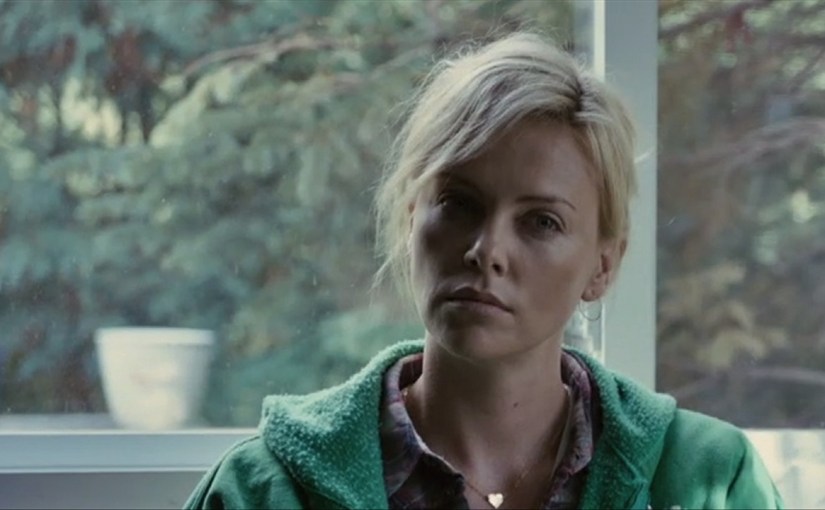
Charlize Theron is always an actress who impresses me. Ever since I saw her in The Devil’s Advocate, I’ve been taken with her on screen presence. She simply has a natural way of bringing a character to life, and usually it is with unhinged and complicated women who never escape and overthrow what’s tormenting them. Her Academy Award winning turn in Monster as serial killer Aileen Wuornos is a perfect example, and her role in Jason Reitman’s film Young Adult is a close second best.

Young Adult was written by Diablo Cody (Juno, also directed by Reitman) and depicts Theron as Mavis Gary, a once successful author of a series of novels aimed at pre-teen and teenage girls. When she receives an email baby announcement from her former high school boyfriend Buddy Slade, Mavis wearing her sweatpants and worn-out t shirt packs up her puppy dog and leaves her one-night stand in her Minneapolis apartment and heads back to her small Minnesota town. She’s not there to see the newborn bundle, however. Mavis is under the delusion that she can win back Buddy who is now happily married.

This isn’t going to go well for Mavis, especially while she’s drowning in one bottle after another.

Patton Oswalt plays Matt, a former classmate, who comes upon Mavis’ arrival. Matt knows immediately that Mavis doesn’t have it altogether. She has not endured as well as he has following a terribly violent hate crime experience in high school when he was mistakenly taken for being gay. Mavis recalls this moment but with great insensitivity. She laughs as she reflects on the incident. Her take equates to maybe Matt being victim to a wedgie or being trapped in a locker. It was much worse than that. Matt’s legs and genitals were smashed in the beating.

Oswalt is very good in his role. Matt doesn’t need to have any regard for Mavis, the once popular prom princess. However, he can’t help but see her pitifully make a fool of herself as she attempts to intrude upon Buddy’s life.

Buddy appears naive to Mavis’ sloppy advances. Buddy sees the image of a successful author prim and proper. Matt sees the ugliness of Mavis beneath her makeup and dress clothes that never hang well on her intoxicated stature.

Cody’s screenplay takes place over three days. In that time, she allows her main character to come to the realization that she’s not a happy person and most certainly is alcohol dependent. A baby welcoming party makes evident of this conclusion. It is an event that will be remembered but for all the wrong reasons. Theron is astonishing in this scene. Not a likable character and yet so well performed.

Reitman is a good director with simplicity. He is simple at showing what likely eats at the good, published writer Mavis used to be. When Mavis drives back into town, Reitman shows her car pass by franchise businesses like Chili’s or Staples. There’s no imagination in these locales. No history or depth. There’s no stimulation. It’s all corporate. Just my theory, but I’d say that could drive a successfully imaginative writer into a depression. No wonder Mavis left town. Problem is she moved on with no constants in her life. Consider the fact that Mavis doesn’t even share with her parents that she’s come back into town.

Juno is the better film from Reitman and Cody. There was a broader scope of the characters at play, beyond just Juno herself. Theron and Oswalt are the only ones with multi dimensions in Young Adult. It’s a benefit that the film clocks in at only just over 90 minutes. Any longer and I’d have grown tired of this film. I can’t expect Mavis to overcome her demons in this short period of time. So, we are reserved to seeing how she further undoes herself and nearly destroys the family and people (not friends) she once knew. Basically, Young Adult shows a woman arrive at rock bottom. Therefore, I applaud Reitman and Cody for keeping this film condensed. The high school popularity is but a memory. Success is gradually moving away from her. Despair and depression and the illness of addiction is all that is left for her.

FANTASTIC BEASTS: THE SECRETS OF DUMBLEDORE

By Marc S. Sanders

That’s it.  I’ve had it.  Enough already.  After three unnecessarily long movies, if you can’t get it right then what’s the point anymore?

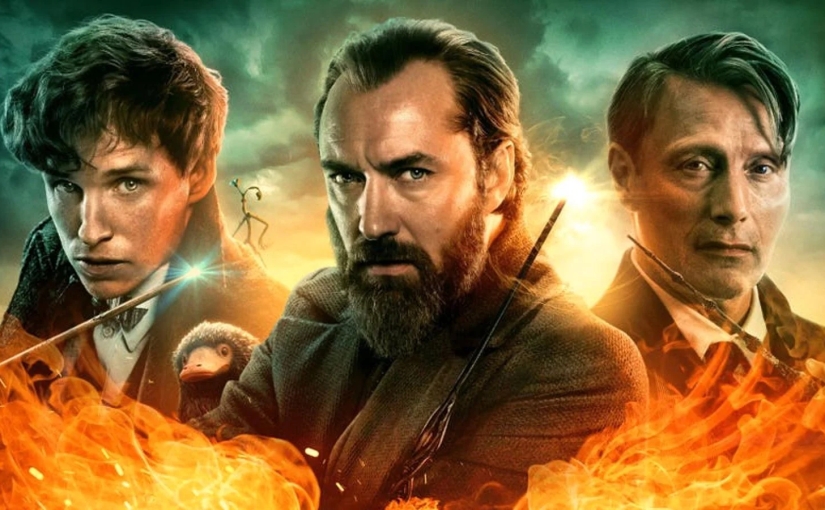
Fantastic Beasts: The Secrets Of Dumbledore, the third film in the Harry Potter prequel series, is an absolute failure beyond any magical or Muggle measure of comprehension. It operates with the same handicaps that crippled the prior installment, The Crimes Of Grindelwald, and maybe picked up an additional dozen or more problems along the way.

I don’t understand it Warner Bros.  Following the abysmal reviews of the prior film and the tepid overall assessment of the first, why, with all the monies at your disposal, would you settle for a boring piece of production work like this, all over again? This new film’s main attraction is simply men in dull grey wool suits and overcoats speaking to one another in quiet English whispers.  Every so often they do something quirky like pull a wand out of their pocket.  Fleetingly, they use them.  How novel. 

It boggles my mind that this world from Rowling’s colorful imagination was at one time intended for pre-teens and young adults.  I’ve seen political debates or Sunday morning commentary programs with more flair.

The fault in these films holds primarily with the creator, J.K. Rowling, and David Yates, the director that’s helmed the last four Potter films and all of the Beasts films up to date.  I’m so exhausted in saying it.  ROWLING NEEDS AN EDITOR!!!!!  There is so much fat on this meat that is impossible to swallow.  Someone needs to speak up and advise her to save this scene and that scene for the DVD extras.  One curse that this film suffers from is the exact same thing that the second film dealt with.  A background story is told, with a majestic fade up and fade down and fade up again flashback.  It takes a good five minutes to tell this tale, and then someone else chimes in and says hold on, that’s not how it happened at all.  Then a new character starts from the beginning and apparently tells us the real story as it truly occurred.  Why in the hell should I trust this new character if you’re now telling me not to believe the lies of the former?  Fodder like this stretches this fantasy towards a distant two- and half-hour mark, though it feels like four.

David Yates has always been a problem.  Look, I know nothing about a camera or the most up to date technology in filmmaking or digital making, but I’ve seen enough special effects laden films in my time.  The prologue to this film commits the same visual atrocity as the prologue to the prior film.  Here, our main hero, Eddie Redmayne’s Newt Scamander – a magic zoologist – is observing a magical deer like creature deliver her offspring.  Suddenly, some other magic figures come upon the sight and attempt to zap the creature and Newt with their wands.  It’s the middle of the night amid a dense forest/jungle of thick plant life and trees.  We see flashes and blurs.  We hear ear piercing sound effect swishes, and the music from James Newton Howard (which is quite good) carries to a high volume.  Just like the last film, though, action scenes like this are murky.  It’s like the lens is covered with the bottom of a soda bottle filled with vinegar.  I can’t tell who is chasing who or who is zapping who, who dies or who lives.  Yates is not doing any favors for what bills itself as fantastical adventure.  When he isn’t shooting action scenes like this, his direction seems to perform on cruise control at a top speed of 15 mph.  There’s little drama or interest in any of the speaking scenes that drag on and on.

The movie’s story picks up with whatever cliffhangers were left from the last time.  It’s really not necessary for me to recap.  They hold little relevance here. 

Basically, Grindelwald (Mads Mikkelson, now taking over from a controversial Johnny Depp) is getting his bearings together with the troubled young man Credence (Ezra Miller) who we were told earlier is the brother to the Albus Dumbledore (a well-cast Jude Law).  Once again, Dumbledore recruits his former prized pupil Newt Scamander to locate the criminal Grindelwald and defeat him.  Newt assembles his brother, his assistant (neither of which we hardly get to know; so why should I disclose their names) and his Muggle baker friend Jacob Kowalski (Dan Fogler). Two more new characters round out this fellowship.  However, if you are looking for a real, solid fellowship, go back to those movies where the characters go after a plain gold ring.  That is fantasy at its finest.  This is the back story of a National Geographic issue found in your grandmother’s attic.

A whole lot of nothing happens for long stretches of time.  Grindelwald has managed to get the criminal charges against him dropped, and arranged to become a viable candidate to be elected the head of the magical world.  That spells trouble though, as he believes in complete genocide of the entire Muggle/No Maj population.  Dumbledore, his former lover, stands on the other side of that debate.  What does this have to do a with a magic deer that was delivered many moons ago when this movie started?  Well, you find out……….eventually, but your patience will be shot to hell.

Only one good scene in the film works on a sort of mischievous Spielberg direction (like the Cairo sequence in Raiders) where a “shell game” with various suitcases is passed around through a small village.  This turns up in the third act and finally we see some fun magic arrive.  Wands are lit up that trap one wizard in a transparent brick wall.  Props are turned into glass globes to trip over, and the characters smirk at one another through the hijinks.  This one scene provides some welcome reminiscence of Quidditch and other prop pieces from earlier Potter films. Until this moment, no one is enjoying themselves in this movie.  There’s next to no humor or cuteness from Newt’s assortment of magic wildlife. There’s no discovery from any magic spells.  Dumbledore doesn’t even have any secrets to disclose, save one. 

Yates and company fail as well with the details.  When we get to visit Hogwarts, it’s terribly boring and dull.  There’s no interesting Easter eggs or wonderment to savor.  No new rooms or tunnels to uncover.  No silly spells or magic props or ghosts to engage with. 

A glaring part of this new series is also conspicuously missing.  Tina (Katherine Waterston), puppy love interest of Newt, is hardly seen nor acknowledged.  Her role was a large part of the first film, minimized in the second film and only welcomed this time as a close up with no more than four words of dialogue.  Maybe not even that much.  Why establish this romance angle for the hero, if she’s hardly to be used?

The one error that really stands above all else is Grindelwald played by Mikkelson.  This is such an underrated character actor destined to be in every popular film franchise.  He’s done Marvel, James Bond, Star Wars, now Potter, and he’ll be in the new Indiana Jones film.  I welcome him to have this role in the Beasts series.  Yet, he looks nothing at all like Depp’s appearance.  Mikkelson just wears a grey wool suit and tie with an overcoat.  Depp had bleach blond hair and pale white skin for a foreboding albino characterization.  I’m not suggesting a complete duplication of what was formerly seen, but there’s a huge difference in looks between the two actors who have now occupied this part.  Reader, when there’s an absence of story, mundane dialogue and distorted visuals to settle for in a big budget movie, this is where my mind is going to run off to.  Mikkelson looks like he’s showing up for a read through rehearsal before the full-dress performance.  At the very least, couldn’t you dress the guy in the same unusual silk vests and fabrics that the other guy wore?  Put the different colored lenses in his eyes?  It truly makes me wonder if there was a stipulation in Mikkelson’s contract – he’ll do the role, but he refuses to look like a clown.  You just can’t not see how far apart this is from what’s been traditionally shown already.

Two more films are promised to be released in this prequel series.  Really? Another two more near three hours pieces of tripe?  Well, according to my Potter versed daughter, it has to be that way.  These films take place near the end of the 1920s.  There’s the climactic showdown that must be depicted between Dumbledore and Grindelwald though, and according to Rowling’s timeline, that occurred in the late 1940s. 

So, we got another twenty or so years of this.  Friends, watching these three films, I feel as if I’ve gone about sixty.

FANTASTIC BEASTS AND WHERE TO FIND THEM

By Marc. S. Sanders

I really do like the Wizarding World of J.K. Rowling.   The attention to detail is marvelous.  The landscapes she has painted over eight best-selling books that follow the adventures of a boy wizard, are limitless.  A new kind of fun vocabulary was invented thanks to her colorful imagination.  Still, she needs an editor!  Even if it is not a novel, her recent screenplays that follow the escapades of another magical protagonist, Newt Scamander, and his small, distressed suitcase drift off into so many side stories, it is difficult to focus on a central plot at play.  While some might appreciate the assortment of distractions, for me it grows a little frustrating.

Fantastic Beasts And Where To Find Them (great title) is the first of what will become five new films that focus on an earlier time before the famous boy who lived was ever born.  Rowling takes the magic to New York City for the odd, but adorably likable Newt (Eddie Redmayne) to accompany his suitcase that carries the most unusual creatures that any other fantasy has likely ever introduced.  There’s a platypus duck thing that has a penchant for stealing jewelry and coin; perfect for stuffed animal merchandising at Universal Studios.  There’s a purplish-blue mosquito that twittles around.  There’s a dragon and an elephant/rhino combo thing.  There are bright green grasshoppers that hide in Newt’s jacket pocket.  It’s an encyclopedia of Rowling wildlife.

Newt arrives in Depression era New York and some of the creatures flip the buckles on the suitcase open, and before you know it, he’s chasing them through the streets.  Soon after, he gets his bag mixed up with another one belonging to a lovable baker “No Maj” (American term for “Muggle” or non-magic person) named Stanley Kowalski (Dan Fogler).  From there, a partnership is forged, and the men are pursuing the missing animals through the city bank, the zoo, tenement buildings and jewelry shops.  Romantic angles serve the men by way of magical sisters, Tina and Queenie (Katherine Waterston and Alison Sudol).

Parallel to all of this are concerns of a magic criminal known as Grindlewald who is making headlines for his various worldwide offenses.  The North American magic congress is disturbed by these events and rely on a man named Graves (Colin Farrell) to investigate.  As well, there is a No Maj woman (Samantha Morton) leading a chorus of city folk and politicians (including Jon Voight) in the hunt for what are believed to be witches and those that are committing crimes of witchcraft.  This woman serves also as a foster mother to numerous children, two of which are known as Credence and Modesty (Ezra Miller and Faith Wood-Blagrove).  These two in particular are curiously quiet with a dark way about them. 

So, yeah!  There’s a lot going on here.  There are a lot of stories to explore and a lot of characters to meet. As well, there are a lot of animals to learn about.

David Yates has become the go to director for the Harry Potter franchise and he takes up the mantle here as well.  This first film in the new series is gorgeous to look at with its period piece art design and the CGI special effects blend nicely with the human actors. 

However, the film loses itself over and over again with the different avenues it takes.  One moment we are supposed to feel the tension of Grindlewald on the loose. Then we are getting into madcap mischief with two other characters chasing down silly creatures seemingly inspired by a Jumanji theme.  We are also treated to an opportunity to literally step down into the suitcase for a whole other world of different settings where these animals are meant to be housed.  It’s wonderous for sure and Yates simply allows time for observation and nothing else.  Intermittently within the film, we also end up following these two dark children who are altogether disturbing, and we wonder why.  How and when do they come into play?  Rowling’s script is more concerned with painting broad strokes of new environments, rather than staying focused on one trajectory.  At times, I’m asking myself, where did we leave off with this storyline or that storyline.

Eddie Redmayne is adorably quirky, but maybe a little too much.  He has the “Willy Wonka” palette to his wrangler occupation. Though, his dialogue gets swallowed in his modified English accent and it is difficult to comprehend what he is saying.  He’s deliberately mumbling his words to build upon the oddities that come with Rowling’s character.  Newt has a name for each creature in the film, but there’s no way I could understand what he calls them.  I don’t even think his acting partner, Dan Fogler, understands everything being said to him.  On this latest viewing with my wife, we opted to turn the subtitles on our 4K player.

The characters are suitably atmospheric for the dark and unusual that stems from Rowling’s imagination.  Colin Farrell always plays well as the handsome, yet brooding man of mystery.  Ezra Miller seems to come from the cloth of a Tim Burton iteration.  Fogler’s character is the best though.  His expressions of stare at the amazements he’s witnessing for the first time represent the audience.  He’s not the bumbling fool that other storytellers might depict him to be.  He truly can’t believe his eyes at first, but eventually builds an affinity for the fantasy in front of him.

The ending somehow brings all of these characters together. It is engaging for sure with an action-packed encounter with a black cloud blob within the underground subway tracks. Then it is concluded with a celebrity cameo that teases of what’s to come. 

Fantastic Beasts And Where To Find Them is not unwatchable, but it requires extra attention so that you can recall where one story leaves off and then later resumes itself.  Often, I found myself asking how did I get here, and then my mind would wander and I’d get distracted from the continuing narrative. 

There’s no doubt of the kind of power and influence J.K. Rowling has.  If only someone would be brave enough to offer her a little constructive criticism, though.  The Fantastic Beasts series was originally meant to be a trilogy of films.  Then her contract with Warner Bros expanded to five films.  You know what?  With all that Rowling has to share with us, I think she might need ten or twelve films.

HOUSE OF GAMES

By Marc S. Sanders

David Mamet is one of the most renowned writers of the last fifty years.  The first film he directed was for his script, House Of Games, with his wife at the time, Lindsay Crouse, and Joe Mantegna.  It’s also important to point out that he recruited well known con artist and card trick player Ricky Jay to consult on the film and join the cast.  When you are constructing a film about the confidence game, a guy like Ricky Jay, who is widely known for his slight of hand and scam artistry, is important to ensure your story remains solid and airtight. (Note: seek out videos of Ricky performing eye popping card tricks and magic on You Tube.  He’ll make you believe that you’ve never seen a card trick before because not many come close to his mastery with a deck in hand.)

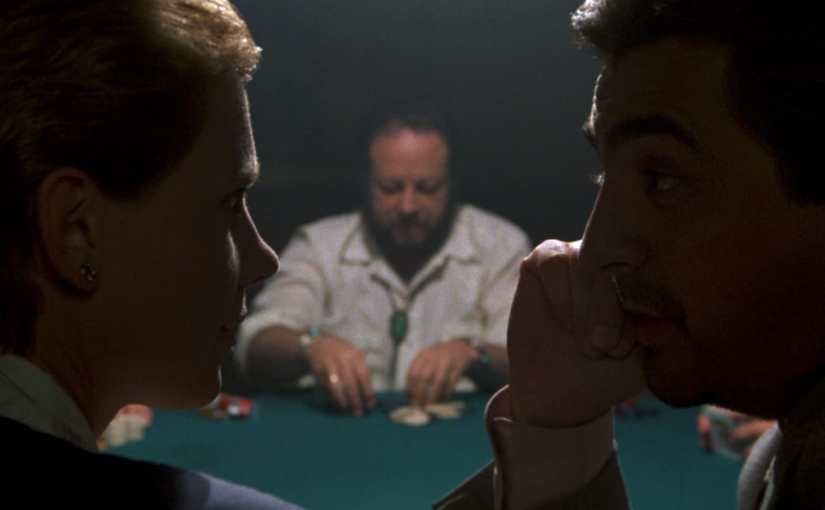
House Of Games plays like an instructional or “how to” video demonstrating how to be a successful con artist.  Crouse portrays a psychiatrist with a best-selling book titled “Driven” that focuses on obsessive behaviors.  One of her clients reveals that his compulsive gambling habits have put him $25,000 in debt with a card shark.  Crouse takes it upon herself to confront the card shark (Mantegna) on behalf of her frightened client.  Shortly thereafter, he’s got her acting as his wife to determine if the guy at the other end of a poker table is bluffing.  Then he’s introducing her to his con artist buddies, and she is becoming enamored, not only with him, but with the art of the con and the steal.  Her mundane life gives her the urge to see more.

The other Unpaid Critic, Miguel, recently reviewed this picture.  At the time of this writing, I have not read his review, but he forewarned me that the performances are stripped down to nothing.  Mantegna and Crouse are left bare to just delivering Mamet’s dialogue.  Miguel hadn’t liked this film the first time he saw it many years ago.  On my first viewing, this past week, I was engrossed.  However, I could foresee the ending as quickly as the film began.  I dunno.  Maybe it’s because I’ve seen several con artist films before like The Grifters and the granddaddy of them all, The Sting.  Films that focus on the best liars seem to always move towards a twist where even the viewer is scammed.  It’s fun to participate in the activity.

With House Of Games, the sequence of events move step by step.  Following the two characters’ introductions to each other, Mantegna is caught in the middle of doing another con but now he’s reluctantly forced to include Crouse in on the game.  This time it is seemingly much more complex and grander than the first time they worked together at the poker table.  It also gets all the more confusing when an unexpected murder is involved.  This con spells out a long night for the couple who are also falling for one another. 

Miguel is right.  The performances are most definitely stripped down and often the dialogue is wooden.  Crouse and Mantegna are deliberately flat.  I don’t even think they laugh or smile if I remember correctly.  It is likely because Mamet wants the viewers to follow along and pick up on how a successful con job is meticulous in its methods.  A con artist is not going to make waves with loud, angry monologues or passionate seductions and outrageous silliness.  What’s important is that everything that plays out seems convincing with no distractions that lead to doubt.  So, when the only African American in the cast (extras included) leaves a key on a hotel counter, you notice it.  It happened for a reason.  Later, when the characters come upon a BRIGHT RED Cadillac convertible, you are going to remember it.  A Swiss army knife with tropical artwork on the handle.  A gun metal briefcase with a large amount of cash.  A gun.  A murder.  Props and scenarios guide Mamet’s picture. Not the characters. 

Fortunately, the film remains very engaging.  As well, while I could figure out what was being played here during the entire course of the picture, as a viewer I had no choice but to feel proud of myself for uncovering the puzzles and riddles at play.  For me, watching House Of Games was like answering “Final Jeopardy” correctly when none of the contestants on screen had a clue. At least I was smiling by the end.

HOUSE OF GAMES (1987)

by Miguel E. Rodriguez

Director: David Mamet
Cast: Lindsay Crouse, Joe Mantegna, J.T. Walsh, Ricky Jay
My Rating: 8/10
Rotten Tomatometer: 96%

PLOT: A psychiatrist is led by a smooth-talking grifter into the shadowy but compelling world of stings, scams, and con men.


I’m sitting here trying to figure out how to summarize the story of David Mamet’s House of Games without giving away plot points, and it’s virtually impossible.  Mamet’s screenplay is composed almost entirely of double-crosses, triple-crosses, short cons, long cons, and the kinds of surprises that are greatly diminished in their description.  Remove one surprise, and the whole thing collapses like a house of cards.

A distinguished psychiatrist, Margaret Ford (Lindsay Crouse) pays a visit to a handsome con artist, Mike (Joe Mantegna), on behalf of one of her clients, who is distraught because of how much money he owes to Mike.  Dr. Ford is unexpectedly intrigued by Mike’s business methods, Mike senses this, and takes her to a back room where he and some other gentlemen are playing poker.

(These men don’t talk much, but when they do, it’s almost exclusively in poker patter.  “A man with style is a man who can smile.”  “Damn cards are as cold as ice.”  “The man says you gotta give action to get action.”  “Everybody stays, everybody pays.”  It’s like they learned how to talk from watching endless episodes of the World Series of Poker on ESPN2.)

Mike makes a deal with Margaret: if she helps him beat the hot player (Ricky Jay) at the table, he’ll tear up her patient’s marker.  The hot player has a tell when he’s bluffing.  Mike will go to the restroom.  If the hot player shows the tell, Margaret will tell Mike, and Mike will beat him because he’ll know he’s bluffing.  Mike goes to the bathroom, the hot player reveals his tell, and Margaret tells Mike when he comes back.  The hot player raises the pot, but Mike can’t cover it.  Margaret comes to the rescue: she’ll stake Mike with her own money.  But, uh oh, turns out the hot player wasn’t bluffing…and now Margaret owes $6,000 to a total stranger.

And that’s where I have to stop. If you think I’ve given too much away, you’ve got to trust me – I haven’t.  That’s barely the preface.  What follows is a character study of a woman who suddenly realizes that, after a lifetime of helping patients, she needs some kind of release, a change in routine.  Mike can provide this much-needed change.  The fact that it involves conning innocent people out of their hard-earned money is incidental.

Her fascination lies in Mike’s method.  For a great con to work, you can’t take someone’s money.  They have to give it to you.  They have to trust you to do the right thing.  The trick is working out how to gain the other person’s confidence without them realizing what’s happening.  We are shown two or three examples, and they’re all brilliantly sneaky.  At one point, Mike tells Margaret the cardinal rule of the con: “Don’t trust nobody.”  After watching this movie, I can’t say I agree 100% with this credo, but a healthy dose of skepticism never hurt anybody.

So how does Margaret square that credo, or anything about Mike’s lifestyle, with her profession?  She helps people for a living.  Her livelihood depends on getting strangers to trust her, but not to take their money…although let’s not forget she is well paid for her services.  Is her fascination with Mike an acknowledgement of the similarities between the two of them?

The screenplay doesn’t provide easy answers.  When we get to the final shot of the film, we can clearly see the choices Margaret has made, but it’s still unclear as to why she made them.  This is one of those movies where the complexities only really come alive during lively discussions afterwards.

Before watching it for this review, the last time I had seen House of Games was over thirty years ago.  At the time, I was unimpressed.  I originally gave it a 2 out of 10 on the IMDb website.  It was slow, the actors looked like they were giving bad performances, and nobody talked like real people talked.

Since then, I’ve had the opportunity to see not one, but three films by a French director named Robert Bresson.  (Bear with me here, I do have a point.)  Bresson, who was active mainly in the ‘50s and ‘60s, was famous for his method of shooting scenes over and over again, take after take, until all emotions had been drained from the actor.  His philosophy, in a nutshell, was that, in a film, the story isn’t everything, it’s the only thing.  If a screenplay couldn’t carry an emotional impact just by virtue of the story alone, if he had to rely on someone’s specific performance to make the movie work, he wasn’t interested.  The results are films that are curiously compelling, despite their utter lack of anything modern audiences might recognize as a typical acting performance.  His films are routinely included on the most prestigious lists of greatest films ever made; seven of them made it onto the 2012 critics’ poll by Sight & Sound magazine, a feat unequaled by any other director.

Sitting down to watch House of Games for the first time in three decades, after having seen Bresson’s films for the first time, I think I see what David Mamet was going for, in this, his directorial debut.  The actors aren’t quite dead-panning the entire time, but their performances (with one or two necessary exceptions) are pared down to the bare minimum of emotion.  Vocally, they’re angry, curious, flirtatious, what have you.  Facially, they’re ciphers.  Which, if you’re a good con man, that’s exactly what you want to be: a blank slate for the unlucky mark to interact with, then forget immediately.

I think back to those poker players and their mournful aphorisms, always said in nearly monotone.  And then I think to the film’s finale when Margaret believes she might be able to turn the tables on Mike (long story), and as the frantic words come out of her mouth, there’s not a smidgen of emotion on her face.  Like…a poker player.  Neat.

MOONSTRUCK

By Marc S. Sanders

Moonstruck has to be one of the most delightful romantic comedies of all time thanks to an outstanding cast, an intuitive director (Norman Jewison) and a script full of brilliant dialogue and set ups from John Patrick Shanley.

Loretta Castorini (Cher in her Oscar winning role) is a 37 year old widow. Her husband of two years got hit by a bus. So, naturally when her father, Cosmo (the hilarious Vincent Gardenia), hears the news that Loretta got engaged to the boring schlub Johnny Cammareri (Danny Aiello), he knows this is a bad omen and she should not get married again. Sure, her husband got hit by a bus, but that can only mean that marriage is no good for Loretta. When they wake up Rose (Olympia Dukakis in her well-deserved Oscar winning role), Loretta’s mother, to share the news, she just opens her eyes and asks, “Who died?” This is an adorable Italian family living in Brooklyn and somehow an Irishman wrote the script which was then directed by a Jewish mensch, and everyone is working on all Italian cylinders.

Two minutes into the film and I’m laughing. I’m laughing at Johnny’s wimpy proposal in the local Italian restaurant. I’m laughing at Rose and Cosmo who’ve seen enough of life to know that you don’t get married for love anymore. Rose is for Loretta getting married though. Cosmo doesn’t wanna spend the money.

Just after Johnny proposes, he flies off to Sicily to be by his dying mother’s bedside. He requests that Loretta invite his brother Ronny (Nicholas Cage), who he hasn’t spoken to in five years, to the wedding. Ronny is upset with Johnny. Ronny got his hand chopped off in the bread slicer at his bakery when Johnny was talking with him and Ronny looked the other way.

When Loretta approaches Ronny, before you know it, they are sleeping with each other. Ronny then invites Loretta to see La Boheme at the Met that night. Loretta knows it’s wrong and can’t keep this up. It’s a sin. She goes to confession, but then she also goes to buy a new dress and dye the greys out of her hair.

As well, Cosmo is stepping outside of his marriage, only Rose is not so stupid. She knows what’s going on. When Rose is dining alone, a college professor who strikes out with one attractive student after another joins her table. Rose isn’t gonna do anything. Instead, she asks the question on everyone’s mind “Why do men chase women?” Then she answers it. “Because if they don’t, they think they’ll die.” But they’re gonna die anyway. Right?

It sure looks like my column is just summarizing the film but my breakdown of Moonstruck simply celebrates all that’s good about it. Here’s a film that doesn’t stereotype a New York Italian family. Instead, it shows how they regard one another as well as the people within the neighborhood from the eager to please waiter in the restaurant to the mortician that Loretta works for. The mortician spills butter on his tie. Loretta takes the tie off of him and says she’ll get it cleaned.

Life in the home of Castorini family is shown beautifully with natural humor to display its atmosphere. Cosmo’s quiet elderly father with five yappy dogs on leashes is only a part of every passing day. Like I’ve made claim on other films, the best movies offer smart characters. Everyone has a way of carrying themselves in Moonstruck, and they’re not dumb. They might be cheap like Cosmo or wimpy like Johnny or a little dim like Ronny, not dumb, but they’re all wise to how they handle themselves.

This might seem like a relatively easy, untechnical little New York comedy. Norman Jewison, however, uses a great approach that makes each setting feel like you’re watching the most alive stage play you’ve ever encountered. I’m actually surprised this film has yet to be adapted for the stage. Maybe, just maybe, Moonstruck hasn’t made it to live theatre yet because it’d be damned near impossible to recapture the harmony of this magical cast.

I love Moonstruck.