HOMICIDE (1991)

by Miguel E. Rodriguez

DIRECTOR: David Mamet
CAST: Joe Mantegna, William H. Macy, Ving Rhames, Rebecca Pidgeon
MY RATING: 8/10
ROTTEN TOMATOMETER: 88% Fresh

PLOT: A Jewish homicide detective investigates a seemingly minor murder and falls in with a Zionist group as a result.


Homicide is one of those movies where the lead character experiences just one damn thing after another until he winds up in a situation that is not even barely hinted at in the film’s first half hour.  If I didn’t think it was being a little pretentious – and maybe if I understood the term just a little more – I’d call it Kafkaesque.  It reminds me a bit of Martin Scorsese’s After Hours, where that lead character is drawn unwittingly into the unexplored jungles of New York City at night.  Likewise, Detective Bobby Gold (Joe Mantegna) starts the film on a manhunt, searching for a wanted killer, and thirty-six hours later winds up begging Zionist activists to let him be involved in blowing up a storefront suspected of printing Nazi pamphlets.

In other hands, the events of the film leading up to Gold’s digression into racial/social activism could come off as comic.  First, he’s put on the manhunt case, searching for a man named Randolph.  Then a weirdo booked for killing his family wigs out at the station and attacks Gold, ripping the strap off his holster, and giving him a bump on the head that’s visible for the rest of the movie.  (I was unavoidably reminded of Jake Gittes’s nose in Chinatown.  Both wounds serve as constant reminders of either the odds the characters face or of the unpredictability of the world they inhabit.)  On their way to interrogate Randolph’s mother for his whereabouts, Gold and his partner, Sullivan (William H. Macy), randomly run into what looks like a hostage situation which turns out to be a cop cornered by a vicious dog in a candy store.  In the store is a dead woman.  The commanding sergeant arrives at the scene and gives Gold the dead woman case.  Turns out the dead woman is Jewish.  Her family shows up at the scene, learns Gold is Jewish, and insist he be their personal liaison for the case.  Meanwhile, Sullivan has to carry on with the Randolph case on his own.  A recurring theme will be how Gold keeps missing out on important events with the Randolph case while babysitting the family of the dead woman, a case he considers unimportant.

What happens next unfolds so naturally and surprisingly that I will not spoil it for you.  What I will say is that Mamet turns a standard police procedural into a searing character study of a man who has never really considered who he is in terms of his heritage.  At one point, he speaks with a Jewish scholar who shows him a page of Hebrew text.  Gold says, “I can’t read it.”  The scholar tells him, “You say you’re a Jew and you can’t read Hebrew.  What are you then?”  This is a question that Gold will try to answer for the rest of the film.

On a personal note, that bit of dialogue resonated quite a bit with me.  I’m full-blooded Puerto Rican on both sides of my family.  Yet my knowledge of Spanish is barely passable.  When faced with reading Spanish text, I can sound out the words, but my comprehension level is probably only 60 to 70%.  My conversation with fluent Spanish speakers is halting, at best.  I just never took the time to learn it as thoroughly as my parents or my sister did.  Does that make me any less Puerto Rican?  I don’t think so, and I might feel resentment towards a stranger telling me that I’m not Puerto Rican just because I don’t speak Spanish.  I know who and what I am, and my identity is not tied to what language I speak.

But things are different for Detective Gold.  Earlier in the film, he talks to his partner, Sullivan, on the phone and talks about how the Jewish family he’s now working for, or with, are high-strung, crying wolf (they claim someone is shooting at them from the building next door, but there are no bullet holes to prove it), how they saved ten bucks a week by letting the old lady work at the store herself, how they’re “not MY people, baby.”  Only after he realizes he’s been overheard does he feel immense guilt and obligation to help the family.  Not to just solve the case, but to “find the killer.”  So, he’s experiencing all sorts of new emotions that may or may not be interfering with his ability to do his job impassively.

The people in Homicide sound as if they are speaking in subtext only, using Mamet’s unique writing style to bypass what we think of as “normal” speech and deliver lines that are almost poetic, even when laced with racial epithets and curse words.  This makes the overall tone of any Mamet-scripted film seem hyper-stylized, as if the characters are one level removed from reality, but not in a bad way.  It elevates the film somehow.  I’m at a loss to describe it more accurately.

One bit of dialogue exemplifies what I’m talking about.  Gold is being thrown out of a building.  The gentleman at the door tells him, “Don’t bother to return.  The next time you come, there’ll be nobody here.”  Don’t bother to return?  That’s unnecessarily decorous.  “Normal” conversation would be something like, “Don’t bother coming back.  If you do, we won’t be here.”  However, Mamet’s signature word choices here suggest an almost Shakesperean construction, as if the words are being shoehorned into a buried structure or pattern that operates subconsciously.  Based on what happens with Gold throughout the film, I could theorize that Mamet is trying to create a mood reminiscent of Greek tragedy, and the actors are reciting dialogue that has been translated from Greek or some other language.

But that’s just me.

The experience of watching Homicide will never be quite as exciting or kinetic as other superlative crime dramas like, say, Heat or The Departed, movies that also examine their characters in detail, sending them on similar journeys of self-discovery.  Those other movies are defined as much by their action as by their intelligence.  In Homicide, any “standard” action scenes are purely incidental, or sometimes accidental, intended not to thrill but to move the plot forward with a minimum of fuss.

In any event, the action is not the linchpin of this film.  We watch Homicide, not to see who Gold kills or who tries to kill Gold, but to see if he is capable of resurrecting the person within himself that he thought he had killed long ago, a sacrifice he made on the altar of being a good cop.  He has a painful conversation where he realizes that everything he’s done to suppress his own self has been, “Not for me.  All for someone else.”  He must decide whether to act in service of his conscience or his sworn duty as a cop.  The choices he makes have consequences he never anticipated, as with all good tragedies.  Homicide reminds us of that inescapable fact, not with a bang or a whimper, but with the calm, flat gaze of an impassive Greek god who lets us draw our own conclusions.

CLEAR AND PRESENT DANGER

By Marc S. Sanders

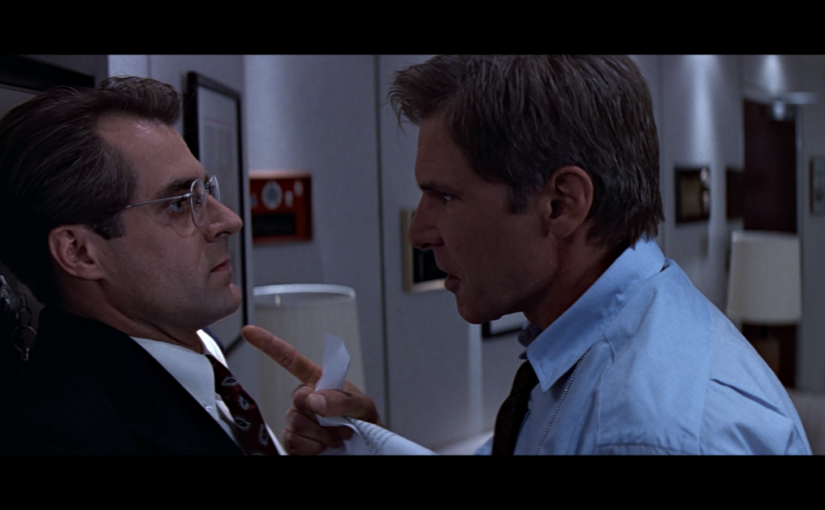
Tom Clancy’s Jack Ryan finds himself in an inadvertent private war between the United States and Colombian drug kingpins in Clear And Present Danger.  Harrison Ford returns as the heroic government operative. I like this film for much of the same reasons I liked the prior Jack Ryan pictures.  These movies give an inside view of internal politics within Congress, the CIA and inside the hallowed halls and Oval Office of The White House.  The Clancy adaptations are not just about action set ups and shootouts.  Though we are treated to plenty of that material as well.

The film opens with a luxury yacht being raided by the Coast Guard. They uncover Colombian killers that have murdered a wealthy American and his family for reasons of a failing partnership with drug dealers.  The incident can be bridged to the President played by Donald Moffat, a terrific character actor who also shared the screen with Ford in Mike Nichols’ Regarding Henry. He secretly initiates a retaliation for what has occurred while also insisting on collecting over six hundred and fifty million dollars he feels the US is entitled to, following his friend’s murder.  Henry Czerny, playing a carbon copy of his role in Mission: Impossible, headlines the covert plot and recruits a mercenary named John Clark (Willem Dafoe) to place a clandestine militant team into the South American jungles to take out the drug runners one by one.

The suit and tie formal dynamics fall on Jack Ryan when he swears testimony on the legitimacy of the country’s response.  However, the President’s armament exercises are unbeknownst to Jack.  When it finally dawns on him what has been occurring, into the field Jack Ryan goes to clean up the mess.

A lot of spinning plates structure the storytelling of Clear And Present Danger which is on par with Clancy’s thousand-page novels.  There’s an abundance of characters to address, betrayals to happen and even the mechanics of various weaponry and policy decisions that need exploring, despite the innate complexities of it all.  It can feel overwhelming.  However, with this film, as well as with The Hunt For Red October and Patriot Games, I feel included.  If you’re patient through the exposition and set ups, then these fictional controversies become very absorbing, and you feel like you’re there.  

There’s a great scene between Ford and Czerny racing to download vs delete some suspicious files on a computer.  These guys are in their boring offices, dressed in their boring suits and they’re clicking on the mouse pad and typing away on the keyboard.  Director Phillip Noyce gets nail biting back and forth closeups on each guy as they are off to the races trying to get ahead of each other.  Then it becomes a yelling match in the hallway with threats of prosecution between both men, and I feel I’m in on the whole thing.

There is also a good amount of internal conversations between the main drug czar (Miguel Sandoval) and his top henchman (Joaquim de Almeida).  Almeida’s role is written very well as we witness how smart and resourceful he is while protecting the best interests of his employer.

For the most part, the action is nothing special.  However, the highlight of the whole film involves an SUV convoy getting ambushed by Colombian terrorists mounted on rooftops firing missiles at the government vehicles below.  Harrison Ford prefers to do as much stunt work as possible and it definitely helps the ten-minute sequence.  This is an outstanding part of the picture with perfect editing of sound and photography. Later on, we see Ford leap on to the landing gear of an ascending helicopter. Very impressive. Harrison Ford always does his best to invest himself in his movies.

I also admire many of the explosions that went into the Special Forces’ continuing storyline of sabotaging the drug lords’ laboratories and various locales. Nothing is miniaturized here, and the resulting blasts are really big and eye opening. This movie did not shortchange on anything it was attempting to accomplish.

The film adaptation of Clancy’s fourth book takes some major liberties.  In the novel, the story is primarily focused on John Clark and his mission, with Jack Ryan not appearing until after the midway point.  However, at this stage of Harrison Ford’s career there was no way he’d accept just a supporting role.  The notable changes hold well within the screenplay though, and a showdown between Jack Ryan and the President is one for the ages.

Overall, Clear And Present Danger was a successful picture at the box office. Critics and Clancy fans alike had favorable responses to the picture.  So, it’s disappointing that producers decided to try numerous reinventions of the Jack Ryan franchise subsequentially.  Those other movies, along with a TV show, would prove well.  Yet, it is regrettable that Harrison Ford, or at least this interpretation of the hero, did not move on through Tom Clancy’s ongoing stories transcending within other areas of government and espionage.  If you have read the books, then maybe you recall the unbelievable ending to Without Remorse.  Boy, would I have loved to see what Harrison Ford did with the cliffhanger that closed out that book. Care to know? Then this Unpaid Movie Critic suggests you pick up a book.

NOTE OF TRIVIA: James Horner conducts the music for this film and he includes samples that were used in the beginning of Aliens. Interesting to catch this as the music works for both a science fiction piece, as well as for a political thriller.

CHINATOWN

By Marc S. Sanders

Forget it Jake!  

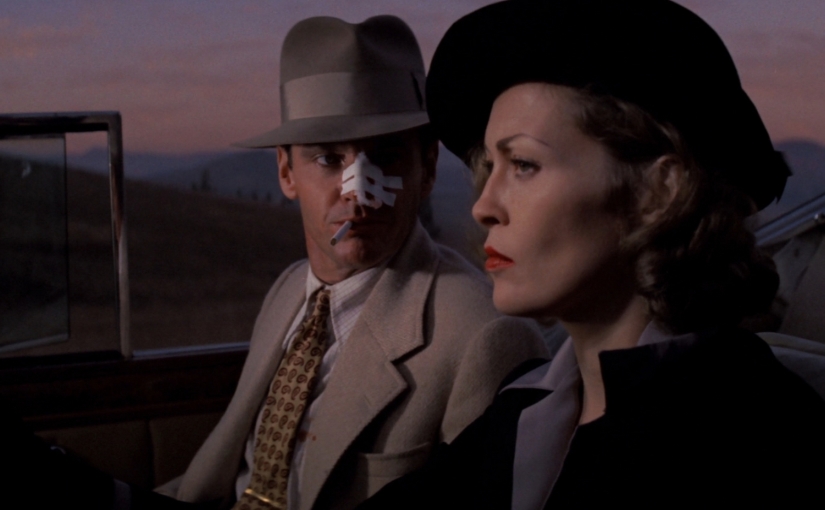
Roman Polanski turned Robert Towne’s page turning script into a noir mystery for the ages.  Practically every scene in Chinatown turns whatever you learned before off its axle.  The mystery of what Jake Gittes, a private dick played so well by Jack Nicholson, is attempting to uncover seems to repeatedly take the guy back to square one.  

Towne’s Oscar winning original screenplay, one of the best ever written, begins with simplicity in motion.  A Mrs. Mulwray insists on hiring Mr. Gittes to find out if her husband is having an affair.  The husband is in charge of the water supply within the surrounding areas of Los Angeles.  Despite Jake’s encouragement for her not to go down this path and recuse herself of heartache, he accepts the case charging his regular fee plus a bonus should he turn up anything that points to something illicit.

Just before meeting with the wife in despair, Jake wrapped up a case, handing over photographs of a wife to her bruiser husband (Burt Young).  The poor guy understands that his spouse was messing around.  None of it is shocking to Jake.  He’s seen the same results many times before and he’ll likely come upon the same situation with Mr. Mulwray.  However, as he follows her husband, it does not seem to be just an affair that is transpiring.  Jake finds himself driving out to a dried-up reservoir and then he’s adjacent to a drainpipe by the ocean shore.  The more he sniffs out, the more likely his nose is going to pay for what he gets closer to.

It’s hard to write about Chinatown as I reflect on the film for a review.  There’s just so much to spoil, even beyond what is now considered to be one of the all time great twists in film history.  I would dare not give anything away.  Some of the luckiest people today are those that have never seen the picture.  To watch Chinatown with a blank slate.  If that’s you…Wow!!! You are blessed of the experience that awaits you.

The cast is a bevy of recognizable faces; character actors who went on to popular television shows and movies (Higgins from Magnum P.I. and Miss Collins from What’s Happening!!!).  Faye Dunaway though is maybe the most unforgettable.  Jake is smart enough not to trust the famed actress’ character (I don’t even want to share the name of who she portrays).  Long before Sharon Stone hammed it up with a less creative eye rolling commando cross legged sitting, Faye Dunaway was best at being sexy, alluring and especially enigmatic.  With her Hollywood glamor appearance in costume wear from Anthea Sylvester, she has that classic noir dame appearance with a smooth inflection in her voice.  Word is that Polanski wanted Dunaway to reflect his own mother’s appearance.

Then there is the celebrated filmmaker John Huston representing old money, a lot of it, in a rare acting appearance.  He plays Noah Cross, a great name to be associated with water.  His gravelly voice and hulking mass lend to what he’s earned demonstrating his power over a commodity resource that everyone cannot live without.  Per Jake Gittes’ experience, he knows it’s best to seek out a motive long before he can uncover a crime.  Gittes’ perusal of some photographs on an office wall will allow him the gumption to go up against a titan like Cross. 

It’s a welcome setting to see late 1930’s L.A.  There is a drought going on and coincidentally Jake is perhaps tailing the guy responsible, but only because of a likely affair.  Still, when his pursuit takes him to the most unexpected places, something more sinister may be happening.  When someone turns up dead by drowning, Chinatown becomes more deliciously complex. Why would Dunaway’s character pay Jake, and later why would Noah Cross double the fee to hire the detective, as well? Jake’s clients may be playing against one another, but he’s the one being tossed in several different directions.

There has to be over a dozen twists in Chinatown.  Thankfully, none of them are contrived or thought up out of the blue.  New depths await further down the rabbit hole.  

I love how Jake Gittes functions.  He might be accused of being sleazy in his profession, but he drives a nice Pontiac classic convertible and dons a stylish wardrobe to go with his fedora hats, designer sunglasses and sterling silver cigarette case.  He’s also quite sharp.  He’s got methods to easily prove how long someone has been at a certain locale and how to follow another car at night.  All of it makes perfect sense.  

Jack Nicholson is great in his role. He does not go all looney like in other pictures, but he’s quiet with his tone, reserved of any kind of shock to the discoveries he finds.  Yet, this particular case might challenge the detective’s sense of acuity into another realm.

Polanski, Towne and Nicholson also thought it best to apply a crudeness to Gittes.  He’ll happily tell an off color joke to his colleagues.  When Dunaway, sneaks up behind him, Gittes is not quick to apologize.  Instead, he gives an annoying scowl for her being there when a prim, genteel woman has no business listening in.  When he gets a phone call, he’ll tell his partners in the room to “shut the fuck up.”  Sam Spade never talked like this.  

The production value is great.  Nothing in or on top of a desk, for example, looks out of place.  From the cars to the interior furnishings of the homes and offices, it’s a Technicolor transport back in time with the dialogue uttered like characters of the ‘70s and ‘80s might deliver.  Humphrey Bogart could never occupy the role of Jake Gittes.

I recently watched The Offer on Paramount Plus which explores how The Godfather made it to the big screen.  Chinatown was next on the horizon, but executives were left confused by a boring middle section about – excuse me, water???? Plus, there was an unsavory plot twist that is hard to even fathom.  The script’s first draft doesn’t even have a scene set in Chinatown.  So what’s with the title? Casting was also unsatisfying.  Now producer Robert Evans wanted you to see more and identify with the chutzpah of the ultra-powerful and wealthy, because only the super-rich are the ones who can get away with murder.

Despite the movie’s welcome yet perplexing surpises, it’s all incredibly satisfying.  Who is doing what to whom, and why?  The best mysteries are the ones that make perfect sense yet can’t be figured out until someone finally starts telling the protagonist the whole shocking truth.  In Jake’s line of work, nothing is shocking. However, the greater the secret, the bigger the liability for everyone involved. 

I’m sorry reader.  I know I’m being vague but therein lies the delight in watching Chinatown.  As you watch, you may throw your hands in the air.  Now what?  You’ll find yourself in disbelief and that would be the best compliment you can give to Roman Polanski, Robert Evans and Robert Towne.

Chinatown is the best example of a film noir pot boiling thriller.  It’s the reason movies continue to thrive; to witness a scene chewing villain, pine after a beautiful, lustrous woman who is not telling us everything, and follow a gumshoe detective who thinks he knows everything but actually could never fully comprehend anything until he makes it all the way back to Chinatown.

PATRIOT GAMES

By Marc S. Sanders

You may remember Patriot Games as a tense thriller featuring the favorite hero Jack Ryan doing the wherewithal action that is demanding for the adaptation of Tom Clancy’s best-selling novel.  Harrison Ford (taking over the role from Alec Baldwin) plays the guy who will thwart an assassination attempt on the Royal Family or punch out a terrorist thug invading his home or on a speed boat during a dark and stormy night.  Only a small bit of the action sequences are flawed, but that doesn’t take away from what makes the picture truly special.  In the follow up to The Hunt For Red October, Jack Ryan goes back to the CIA to investigate who wants revenge against him and who was responsible for that assassination attempt.  What the picture serves as the covert halls of the Central Intelligence Agency is what is especially convincing and most fascinating.

On the surface, the Irish Republican Army appears to be the scapegoat for attempting to murder members of the Royal Family as they are pulling out of the front gates of Buckingham Palace.  Jack Ryan is in London vacationing with his wife Cathy (Anne Archer) and daughter Sally (Thora Birch) when he comes upon the incident just in time to foil the crime.  In the process, Ryan takes a bullet to the shoulder and kills the younger brother of the most dangerous squad member, Sean Miller (Sean Bean).  A quick trial puts Miller behind bars and Jack is recognized as a hero.

However, Sean Miller escapes with his surviving comrades and vows revenge on Jack and his family.  An attempt is made on the Ryans’ lives and Jack insists on getting back into the CIA to locate Miller and his team.

The revenge plot is the main thread and its pretty ho hum.  We’ve seen all that many times before.  However, what branches off are the conflicts within Irish politics and how Jack Ryan gradually uncovers who and where this small faction of terrorists may be.  Cold War commentary is delivered by an under the radar performance from one of my favorite character actors, Richard Harris.  He attempts to deny responsibility of these attacks and offer an olive branch to Ryan.  Ford and Harris have three good scenes together, two of which are minimal on dialogue but effective in sending their messages to one another. 

As well, Harrison Ford occupies another great heroic role.  I agree with a majority who believe he was too old to play the novice Jack Ryan described in Clancy’s early novels.  Many insist casting Baldwin was perfect.  It was. Yet, I am able to look past that as the character does not have the rookie appearance or regard in this picture.  With Harrison Ford, Jack Ryan is now at a point where he looks seasoned and experienced like the character eventually becomes in the book series.

Director Phillip Noyce is good at using the mysterious and quiet orchestral accompaniments of James Horner to follow Jack as he studies photographs or reflects on the day of the assassination attempt in order to piece together random clues.  In other films, this might get boring and tedious.  However, the director captures good closeups of Harrison Ford and quick flashbacks are edited to help identify what were important blink and miss it moments necessary to assemble the puzzle.  A simple visit to the restroom for Jack Ryan and a glance at a woman’s ponytail lead to a solid conclusion.

Sean Bean has the physical and quiet intensity to his role.  He’s the muscle of the terrorist group, not the leader (played by Patrick Bergen).  Bean serves the revenge element and his physique and weapon handling work well as a nice threat to the hero of the picture.

As the story progresses, the audience follows along with Ryan.  Satellite photographs are studied and zoomed in seeking some semblance of an image in a blur.  Sometimes Jack Ryan is moving in the right direction but in other times he’s unsure.  Even though we always know how the bad guys are doing and where they are, we empathize because Harrison Ford’s character does not.  Still, it’s a thrill to witness him eventually make his discoveries.

A nice approach occurs when the CIA sends in troops to what they believe is an enemy base camp.  We watch Jack Ryan and all of the government officials stare with intensity on a big screen as little black pixels drop down and move at a running pace from an overhead satellite shot.  We don’t have to endure one more machine gun battle.  This kind of intensity is much more interesting where lives are taken as a means of protection, but still a principled man like Jack Ryan does not feel good about what has to be done.

Patriot Games works well with its plays on espionage, spy activity, traitors, and government relations between America, Great Britain and Ireland.  The select action scenes are done well and hold their suspense for quite long.  However, the final sequence is challenging to sit through. 

As the enemy prepares a covert attack on the Ryans’ Virginia home where the Royal Family are guests, there is much running around upstairs and down, in the basement, and outside the roof and so on.  It’s pouring rain with the standard thunder and lightning in the middle of the night as well.  Once the villains and the hero make their way to some getaway boats, the film unravels.  The picture shakes like crazy against the waves and rain.  There’s little light on any of the shots as well and the sound goes loud due to the boat engines and the storm setting.  All of these elements make it challenging to get absorbed in the movie’s climactic ending. 

Hollywood pictures fall back on this approach often in films like Ang Lee’s Hulk and the first installment of The Hunger Games.  It’s dark and wet and shaky and rainy. So, it is hard to decipher who is hitting who and who is shooting at who and who is driving which boat and where are they now.  It’s a shame really because Patriot Games is a taut thriller that holds your attention for nearly two hours, but then you give up in the final few minutes to simply rely on your instincts for how the story is going to wrap itself up.

Jack Ryan’s second adventure is worth watching but oddly enough, maybe wait for your restroom break until the last ten minutes of the picture.

JOE KIDD

By Marc S. Sanders

Joe Kidd is not one of Clint Eastwood’s best westerns.  In fact, it might be his weakest of the sort.  The film arrived at the tail end of director John Sturges’ (Bad Day At Black Rock, The Magnificent Seven) career and through my research it seems that Eastwood did not get along with him.  Sturges was rumored to be an alcoholic providing limited focus on the film in question.  I’m apt to believe that theory.  Joe Kidd, which was scripted by Elmore Leonard who would go on to write Get Shorty, is full of enormous plot holes. 

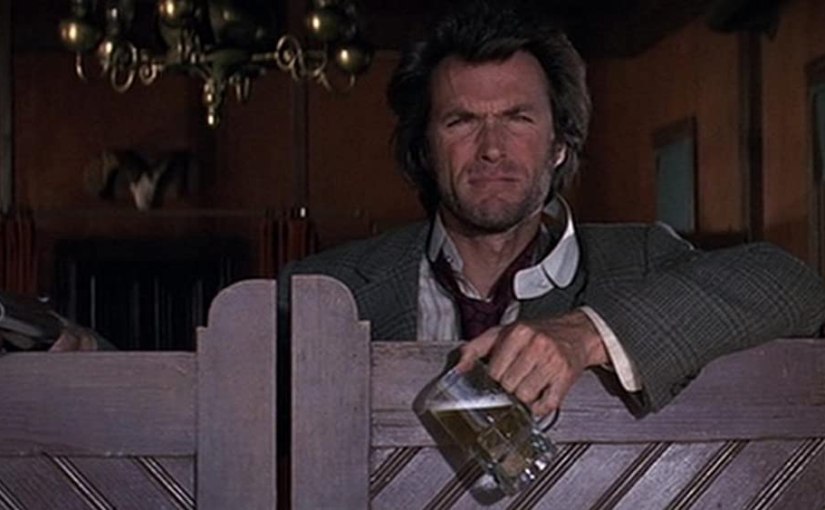
Eastwood is a welcome sight at first, handcuffed in the Sherrif’s jail until he’s unlocked to attend his court hearing.  Before leaving, in typical quiet, tough guy style, he demonstrates to an annoying cellmate that he won’t be intimidated by splashing the guy’s stew in his face and then denting the pot over his forehead.  It’s a great introduction for a title character.  I laughed.  I clapped.  After that, however, the movie fell apart.

The structure of Joe Kidd seems to start in the middle of a story that opted not to go back to the beginning.  A Mexican rebel leader named Luis Chama (John Saxon) causes some ruckus in the courtroom and around town, and then he flees into the nearby mountains.  Joe manages to shoot one gang member who enters the saloon.  Thereafter, a wealthy landsman named Frank Harlan (Robert Duvall) arrives and after paying for Kidd’s bail, he hires the ex-bounty hunter to accompany his posse and bring back Chama and his squad.  According to Harlan, Chama is occupying a large chunk of valuable land and therefore has to be taken out of the equation.  Okay.  Simple enough.

However, the narrative zig zags from that point.  First, Joe declines the offer from Harlan.  Then he discovers that Chama has tied up one of his ranch hands in barbed wire.  So, he dons his perfect tough guy cowboy duds (his hat looks great on his head) and off he goes with Harlan.  Midway on their journey through the mountains, they set up camp at a Mexican church.  Harlan announces into the wide expanse, for Chama to hear, that he will kill five people in the church if he does not surrender himself.  After a period of time, he’ll kill five more until the Rebel gives himself in and so on and so on.  Joe Kidd does not agree with this arrangement, gets fired by Harlan and eventually sidles up with Chama.  What’s going on here?  Didn’t Joe want to even a score with Chama after what he did to his ranch hand?  In a short ninety-minute running time, set ups occur only to be undone minutes later, and I’m starting to question my ability for basic comprehension. 

To date, of all I’ve seen in Robert Duvall’s illustrious career, this is hands down the weakest character he’s portrayed.  He’s not a terrible actor here.  He just has nothing to do except look like a greedy landowner with a mustache and a six shooter on his hip.  He’s not given any dimension of material to play with, and thus comes off like a bad guy of the week on an episode of The A-Team.  John Saxon actually guest starred a few times on that show as a variety of different bad guys.  The only new thing I see from him in this picture is his unconvincing Mexican accent. 

Clint Eastwood is playing his typical westerner.  He looks great with the hat and stature and the gun in his hand.  Yet, the novelty looks tired here.  As if we’ve already seen him in other classics like the Dollars trilogy, and High Plains Drifter.  There was nothing new to offer with Joe Kidd.  A diversion occurs early on where Kidd is about to take advantage of Harlan’s girl.  That goes nowhere and serves no purpose.

I imagine there was a better and more fleshed out script here that never materialized.  A friend of mine recently asked me if it would make sense to remake films with potentially good ideas that were poorly executed.  Seems logical to me, and then he asked me to name some examples.  On the spot, I could not come up with one.  Howard The Duck? Never!  Green Lantern?  Yeah, that’ll likely be done eventually anyway.  However, I think I have come across a good one to consider.  How about remaking Joe Kidd

You know what?  Wouldn’t work.  There’s a tone to the piece that seems a little prejudiced and not appropriate for present day. More importantly, on another try, it wouldn’t have the main attraction. 

Has anyone remade a Clint Eastwood picture? 

My point exactly!

THE GAMBLER (1974)

By Marc S. Sanders

James Caan is Axel Freed, The Gambler, and when the film starts it shows the main character figuratively at the bottom of a very deep hole.  From this point on, he’s always looking at its great endless height above; a depth so low or a height so high, that there’s no crawling out of this trap.  No matter the opportunities that rescue Axel from a $44,000 debt to some bookies, he’ll never allow himself to be saved.

The autobiographical inspiration of James Toback’s first screenplay is hardly entertaining, but it held my attention all the way through.  Axel is a well-educated literature professor and an expert on Dostoyevsky but he’s entirely foolhardy.  A parallel inspiration comes from the author’s novella The Gambler.

I dunno.  Whether it’s 1974 or 2024, if I’m told I owe forty-four grand to someone who will otherwise break my legs and then who knows what else, I’d be terrified with fear.  Axel Freed seems to brush off his dilemma as he cruises through the city in his Mustang convertible.  To him, this is just the current setback of the week.  Nothing big.  He’s been in worse situations.  At least that’s what he tells himself. Axel swallows some pride and asks his mother (Jacqueline Brooks) for a loan, and she has to go through her own hoops to scrounge up the funds.  Look for an early appearance from James Woods as an unsympathetic banker.  Once mother’s monies are in hand though, Axel opts for a different route than to wipe his debt clean. Therein lies the anchoring burden of gambling addiction.

Toback’s script, directed by Karel Reisz, is not so much about a story as it is about living with overwhelming compulsion.  He writes good dialogue performed with apathy by Caan.  It’s not about winning.  It’s about the thrill of possibly losing the money he’s got in hand. 

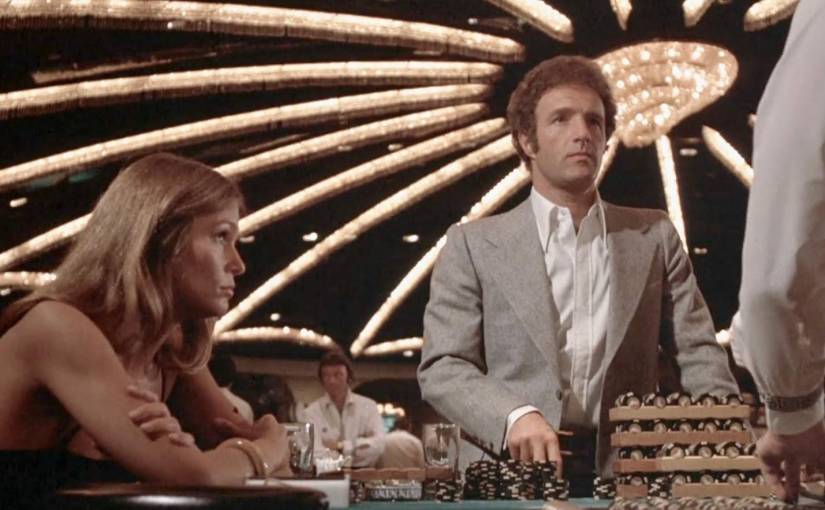
Once Axel obtains money, he ventures off to Vegas feeling sure that he will double what he’s got and still manage to pay off this huge debt.  The brilliance of the film is that it had me tricked as Axel marathons through victory at every table while also feeling confident on three college basketball games that seem to be moving in his favor.  I was not sure if I was looking at a hero or a despairing loser during this sequence.  Reisz convinces me that it can go either way for Axel with his girlfriend, Billie (Lauren Hutton) in tow.

As many films, books, and programs that I’ve encountered focusing on gambling and the addiction it musters, I feel confident I know the outcome of the piece.  What sets The Gambler apart though is the realistic nature of what this kind of craving does to a person.  It depicts the victim as in denial, rejoicing when he dodges bullets, thinking he’s invincible.  The film demonstrates how those close to Axel Freed respond to his mounting dilemmas, but also how they are affected.  It’s inclusive not only of his Billie, his mother, his self-made millionaire grandfather, or even his main bookie (Paul Sorvino), but an admiring student of his as well. 

There are scenes that I could see how they are going to play out as soon as they begin.  I’m sorry but when I see tough guy character actors like Burt Young and Vic Tayback enter a story like this, I know something, or someone, is about to endure some damage and walk away feeling terribly threatened.  Still, I’d be complaining if Toback excised moments like this from his screenplay.

The ending left me feeling a little perplexed as to if it really belongs here.  It’s not a happy ending but seemed to come out of nowhere and I questioned its relevance against everything else that was seen before. 

The strength of The Gambler lies in the honesty of James Toback’s script and the performance of James Caan.  The film belongs exclusively to Caan and his character, with the others entering the frame when they are called upon for a cause and effect of Axel’s actions and decisions.  There’s nothing to celebrate in a hard drama like this, but I applaud the film’s will to uphold a genuine truth of how gambling addiction leaves behind a crippling life for those caught in continuing temptation.

AUGUST: OSAGE COUNTY

By Marc S. Sanders

Once the dead are buried, the secrets come out.  Some mourn the loss.  Others mourn the reality of what existed.  Tracy Letts’ Pulitzer Prize winning play August: Osage County was adapted into a very well-cast film in 2013.  Letts’ screenplay is just as biting as his original source. Perhaps that is because of the performances of not just Meryl Streep and Julia Roberts, but also the entire collection of actors.

Dysfunctional is not a strong enough word for the Weston family of the sleepy, lifeless area of Osage County, Oklahoma.  The patriarch, Beverly (Sam Shepard) hires Johnna (Misty Upham) a Native American housekeeper/helper, for his pill popping, cigarette smoking wife Violet (Streep) who is also stricken with cancer of the mouth.  Shortly after, Beverly disappears.  The family comes home to the dusty shelves of books and old black and white family photographs and learns that Beverly has committed suicide.  The opportunities flood in for Violet (or Vi) to unleash every ugly, harsh truth that her three daughters Barbara, Ivy and Karen (Roberts, Julianne Nicholson and Juliette Lewis) have encountered along with their partners.  There’s also Vi’s sister Fannie Mae (Margo Martindale), her husband Charlie (Chris Cooper) and their son Little Charlie (Benedict Cumberbatch) to revisit the revelations of the Weston family.  Barbara’s estranged husband Bill (Ewan MacGregor) and her daughter Jean (Abigail Breslin) have their own drama to contend with as well.

It’s best not to spoil too much of what is revealed in the movie directed by John Wells.  The centerpiece of the picture is the afternoon family meal following the funeral service.  This must be one of the most intense and captivating dinner scenes caught on film in recent years.  Wells positions his cameras perfectly, so you know where every family member is seated at the table and the trading of barbs that go back and forth between the different combinations of arguments.  I would say the scene lasts at least twenty minutes and Wells manages to seat the viewer next to or right in front of every person at the table.  At one end of the table is Charlie.  Chris Cooper is a reluctant fill in to the void left by Beverly, the original patriarch.  The instigator is Vi. Meryl Streep is placed at the other head of the table where her drug addled eye contact can be had with anyone seated in her presence.  I’d love to have seen Meryl Streep while shooting this scene because even when the camera is not on her for a close up, I can still see that she is there in the dining room.  I’d argue she never turned off this persona during the making of this film. 

The most agonizing relationship is clearly between Vi and oldest daughter Barbara.  The first pairing on screen for Meryl Streep and Julia Roberts.  Why didn’t it happen sooner?  Moreover, why hasn’t it happened again since this film?  Perhaps because it is rare to find material of this dramatic weight to justify what can come from these two incredible actors.

The dinner scene is left discomforting to say the least, but the timing and delivery of Tracy Letts’ dialogue is functioning with high energy.  At age fourteen, Jean is the youngest member at the table, and she is questioned as to why she doesn’t eat meat.  According to her, you are consuming an “animal’s fear.”  The Westons are only adoring when they are cruel to one another.  One of the rare times that the rest of the family will unite with the antagonizing Vi is when they can mock and chortle at young Jean’s philosophy for “claiming” to be vegan, which is also undone by her parents when they reveal what she eats back home in Colorado. 

A hip middle aged Florida man named Steve (Dermot Mulroney) in a Ferrari has accompanied Karen to Osage.  Karen is the flighty one with her head in the clouds.  Steve has been married three times and takes a liking to teenage Jean’s curiosity to try pot.  Vi expresses disdain for the jerk with another welcome facial expression from Streep, but Tracy Letts does not have his character lash out or protest Karen’s choice to marry the guy.  For Violet Weston, it is better that Karen does marry this letch.  It gives Vi more purpose to criticize and belabor upon one more poor decision made by another daughter.  Violet thrives on bellowing out the shortcomings of her children, her dead poet/author husband, her sister, and anyone else within her presence.  It’s how she lives and overcomes her cancer while an unkempt wig conceals her chemo remaining grey hairs.

On the side, a relationship is brewing between first cousins Little Charlie and Vi’s middle daughter Ivy.  They know it’s wrong, but they can’t help hiding their affections much longer.  Cumberbatch goes against type here as a nervous, insecure young man who has not matured from his boyhood nature.  Julianne Nicholson appears to be the most held together of the three daughters as she has never ventured out of Osage while living with her parents.  She is now ready to give up that lifestyle, and she’s leaving it in Barbara’s lap to figure what’s to come of Vi. 

Barbara is the most unhinged.  She is married to sweet natured but boring Bill and it’s likely that the past demons she clung to from her upbringing left Osage with her when she relocated to Colorado with her husband and daughter.  Bill might be having a tryst with one of his college students but is he the worst one in the marriage?  Barbara Weston might be Julia Roberts’ best role since her early career film introduction in Steel Magnolias and her Oscar winning turn in Erin Brockovich.  In films like these, Julia Roberts doesn’t look like the starlet she once was in the 1990s.  In August: Osage County she has downed her appearance with no makeup, unwashed hair, and wrinkled clothes while carrying an emotionally exhausted physique.  However, she’s perfect to play the eldest daughter who somehow must be the one responsible for picking up the shattered pieces of dishware that hit the floor on numerous occasions and fractured connections left behind in the family dynamic.  This is a commanding performance by Julia Roberts; one that needs to be seen.  Incidentally, she never does clean up the broken plates.  I only assume it would be her who must do so.  However, the quiet Johnna is around somewhere. She will make everything disappear.

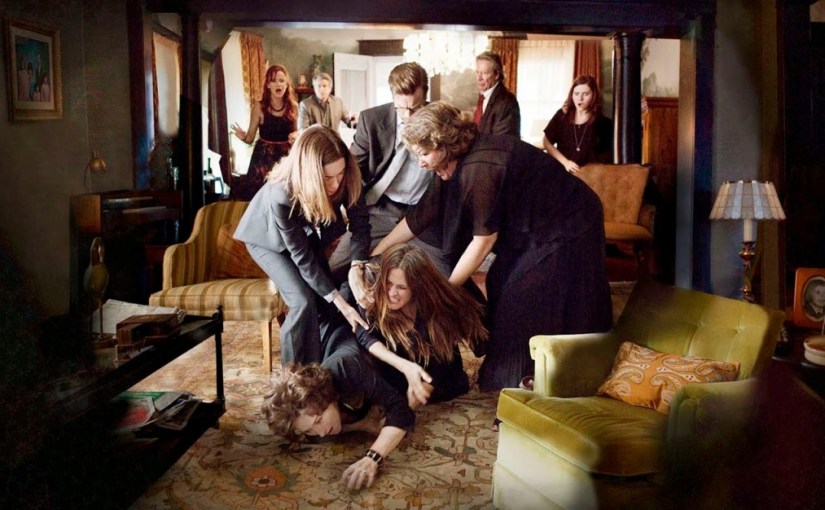
Memorably, a physical altercation ends the dinner.  The day passes into the next mid afternoon and more secrets are uncovered.  Some are quite horrifying, considering the circumstances that some members of the family have themselves in.  Just when you think that this script is ending with a debate of which daughter will look after mother now that daddy is gone, there’s more troubling truth to grapple with as well.

August: Osage County is a movie hinged on the acting chops of its cast with a smart, unforgiving script for the damaged characters depicted.  It falls in the same category as David Mamet’s Glengarry Glen Ross or Sam Shepard’s True West.  We may be witnessing the abnormalities and sins of these people, but it would be more unusual had these folks possessed genuine happiness and solid affection for one another.  The quietly muted Native American Johnna enters the household of people who replaced her own people, who occupied this land long before the early generations of Westons ever arrived.  It’s telling that Tracy Letts demonstrates the original occupants still survive in peace while the ones that took over can’t find a way to live happily among themselves.  Watch the film or see the play.  Then come back and tell me if the white folks of the Weston family truly belong in the once occupied Native American Osage County, Oklahoma.

MISSION: IMPOSSIBLE FALLOUT

By Marc S. Sanders

Mission: Impossible Fallout is the best of the so far seven films in the series.  It is carried not only by the stunts that Tom Cruise insists on risking his middle-aged self to perform, for the sake of his fans. As well, the film’s casting and the puzzle twisting script from Christopher McQuarrie, writing with inspiration from his famed Oscar winning screenplay for The Usual Suspects is a treat for the eyes and mind.  If this were a novel, I’d quickly be turning each page to see what comes next.  Like McQuarrie’s well-known invention of Keyser Soze, this movie questions Who is John Lark?  Is Ethan Hunt (Cruise) John Lark? 

Hunt chooses to accept the mission of locating this unidentified Lark who is interested in purchasing enough plutonium to wipe one third of the world population, likely in and around Pakistan and China.  However, the CIA doesn’t trust Hunt’s cavalier instincts and insists he partners up with a hulking Henry Cavill playing an agent named Walker.  Benji and Luther (Simon Pegg, Ving Rhames) are back for hacking, field work and some clever mask trickery.  Ilsa Faust (Rebecca Ferguson), the dubious British MI6 agent from the prior film (Rogue Nation) is a welcome surprise and just as perplexing with her actions.  The big bad, Solomon Lane (a snake like Sean Harris), also returns.

Like all the M:I films, Fallout operates with the same kind of formula.  We have to accept the promise that there’s a world ending MacGuffin.  Ethan and the team are assigned to find who has it and who wants to buy it and can use it.  All of this is written outside of the lines of planning out the action scenes these pictures are recognized for.  It’s as if Cruise, with his producer hat on, sketches stunts with skydives, cars, motorcycles, trucks and helicopters and then assigns his writer/director to apply words for the donut filling within the movie.  Mustn’t forget a reason to include a running sequence for Ethan to perform on rooftops.  Fortunately, all of it works best here, more than in any of the other films.

What sells these pictures, and again Fallout is the best example, is the photography and editing applied to these scenes.  Two sequential car/motorcycle chases occur throughout the streets of Paris.  (Look!  I see our honeymoon hotel, The Hotel Regina located across from the Louvre, as Ethan races by in a BMW!!!!!)  A smashing three-person fist fight in an impeccably white men’s room is a brawl for the ages. 

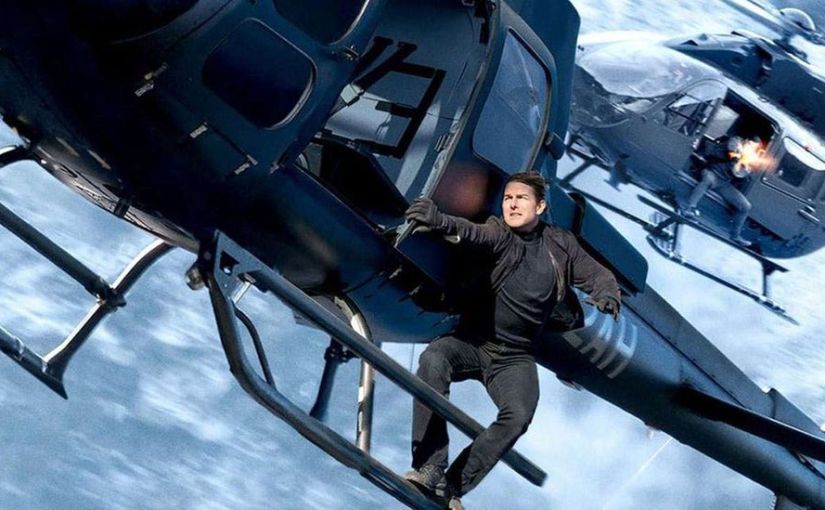
The highlight of this installment is a helicopter chase above and within a mountain valley that first focuses on Tom Cruise himself climbing a rope up, up, up to a chopper and swinging his legs onto the railing to get a foothold.  There’s time dedicated to him falling and inching his way back into the vehicle.  Then it becomes a chopper chase followed by a collision that ends with the remains wedged within a narrow mountain crevice.  What a set piece this is!  Absolutely outstanding camera work.  The wide and close editing, sound and visuals work so perfectly in sync with one another.  I don’t want to watch the making of documentary for this picture.  The trickery of McQuarrie’s camera crew is such a treat.  I’d rather savor the finished product on repeat viewings.

Juxtaposing against this chopper fight are two other scenarios involving Ethan’s teammates.  This is where I’m especially grateful for Christopher McQuarrie’s writing.  Two bombs are rigged in line with each other, and a detonator also must be retrieved by Ethan.  The whole team has to work cohesively, otherwise it is sayonara to much of the Asian continent if both devices explode.  McQuarrie’s “impossible mission” is orchestrated beautifully with suspense cranked way up.  His imagination for adventure allows a magnificently edited third act.  To date, I consider the stakes here to be the highest in the entire series.

The presence of this collection of actors is marvelous with recognition deserving of Henry Cavill donning an untrusting mustache and looking like a brutal, blunt instrument against the superspy Ethan Hunt.  Cavill also plays CIA agent wisely.  He’s got a stoic expression for most of the film but that is because he trusts the audience will assume what a dangerous threat he can be.  Cavill occupies one of the best characters in the seven films.

Mission: Impossible Fallout is truly one of the most thrilling pictures you’ll find.  What’s most important is the action serves the story.  Action just for the sake of action is tiring like in the Fast/Furious films.  There has to be a cost and a tangible feeling to the speed, obstacles and pain that good action scenes serve their characters and the story as a whole.  When Ethan falls from a helicopter or has to jump out a window, I grip both arm rests and let out a collective bellow with the audience.  Films with the grandest of adventure must draw out responses like that.  Otherwise, it’s all just a ho hum journey to the end credits.  Fallout is anything but a stroll.  It’s an absolute balls to the wall, explosive crowd pleaser.

MISSION: IMPOSSIBLE DEAD RECKONING PART 1

By Marc S. Sanders

The object of the Mission: Impossible films is not to wow its audience with thought provoking questions of politics or Cold War intrigue or even daring and uncompromisingly evil villains (apart from Phillip Seymour Hoffman).  The elements of espionage coursing through the TV series are non-existent in the film adaptations.  I’m not watching a film based on a John LeCarre spy novel.  By the time the seventh installment has arrived, titled Dead Reckoning Part 1, the goal of the film series is to sketch out the set ups for one action piece after another.  Only they must be bigger, bolder, and seemingly that much more impossible to overcome for their hero, Tom Cruise (playing a guy named Ethan Hunt).  The action is once again top notch.  The glues that bind these displays of bravado together, you know where the characters have to talk and give us a semblance of a plot, is as nil as the scotch tape that assembles a stretch of film reel into a running time length of nearly two hours and forty-five minutes.

The locales are as grand as any travel getaway. We go through a labyrinthine airport.  A techno night club works as a meeting place for a bunch of characters. There are journeys to the Arabian Desert, Rome, Venice, and a beautiful ride along the famed Orient Express.  Shot on digital, this movie is a gorgeous travelogue.

Let’s get the problems out of the way, though.  The MacGuffin that Ethan Hunt and his trusty pals Benjy and Luther (Simon Pegg, Ving Rhames) have been assigned to recover is two parts of a specially designed key.  One part is supposedly with the disavowed MI6 agent Ilsa Faust (Rebecca Ferguson).  The other half is questionable as to who possesses it, but a thief known only as Grace (Hayley Atwell) may be significant in finding it.  Put the two halves of the key together and it will unlock something that no one seems to know of, or where it is located.  Here’s my first issue.  The audience does know what the key unlocks because it is shown in the first three minutes of the film.  So, while the cast of characters act dumbfounded, we know all along.  So, there goes any curious interest I may have for wanting to follow through with this. 

The other problem is that the same conversation happens over and over and over again.  Lines like (and I’m paraphrasing here, or maybe I’m not) “If this key gets into the wrong hands…” and “Whatever this does unlock, Ethan, could spell the end of the world…” or “It’s important that both halves of the key are not put together…”  or “Whatever this does unlock…”  (See?  Even I just repeated myself in this write up.) Except, we know what it unlocks!!!!!  The same exchange of dialogue occurs over and over.  The redundancy exhausts itself.  It occurs so much in fact that it’s writer/director, Christopher McQuarrie, relied upon the repetitive dialogue to stretch this next M:I chapter into two films instead of one (Part 2 is scheduled to be released in 2024).  I don’t recall the context of any of Ving Rhames’ lines going further than what I have presented here, for example.

The film is also a little too character heavy.  I never understood why two agents (Shea Wigham, Greg Tarzan Davis) are constantly pursuing Ethan.  Just was not clear for me. Heightened suspense?  That’s the best excuse I can think of.  The White Widow from the prior film (Vanessa Kirby) also appears.  Not much purpose to her.  Cary Elwes is the deputy director, there at the beginning and later towards the end, but again I was not entirely certain of his contribution to the story.  Even Ilsa Faust does not seem to have much value, except to work as a step in Ethan’s ongoing trajectory for the key.  I think Rebecca Ferguson had no more than five lines in the whole picture.

Finally, Ethan Hunt seems to be up against an omnipotent enemy, an AI program known as The Entity.  The humans doing the bidding of this phantom program consist of a goatee wearing Esai Morales and his henchwoman, played by Pom Klementieff.  She looks straight out of a James Bond picture and makes for a good car chase through the stone cobbled streets of Rome in a tank like Hummer.  Morales is as boring as most of the other the M:I villains.

What works for the film is what Tom Cruise really wants to impress you with though.  Riding a speeding motorcycle off a mountain and parachuting his way down.  That’s actually a near sixty-year-old Tom Cruise performing that feat.  Very impressive.  The car chase with a handcuffed Cruise and Atwell in a puny yellow Fiat versus an unbeatable Hummer and an army of Italian police vehicles is fun on the level of Roger Moore’s Bond films.  Most impressive for me is the final act where the famed Orient Express train tumbles off a bridge with a gap in the middle, car by car with all the furnishings, piano included, pouring out while Ethan and Grace hold on for dear life. 

It’s the high stakes stunts that work.  Whatever smidge of a story there is fails though.  The script by McQuarrie and Erik Jendresen lacks so much that the cliffhanger the film ends on doesn’t leave me yearning for more because it only hearkens back to the beginning.  The characters catch up to what the audience has known for the last three hours.  So, I’m not losing sleep wondering with what happens next.

Of course, I’ll go see the Part 2 installment.  Tom Cruise won’t let me down in whatever daredevil achievements he’s dreaming of doing next.  However, am I going to these movies to watch Mission: Impossible, or to watch an aggressively updated version of Circus Of The Stars?

MISSION: IMPOSSIBLE ROGUE NATION

By Marc S. Sanders

Mission: Impossible Rogue Nation is as stunt filled as its predecessor. Perhaps even more.  The difference for me though, is that it is better than Ghost Protocol.  The stunts and action are at least equal in both films, but Rogue Nation also plays with its characters while not stopping at certain points to explain what must happen next.  Sure, the movie talks, but it speaks with developments and surprise, rather than starting the story all over again from square one (a shortcoming for me with the prior film).  Much of that is thanks to a new character, a disavowed British Intelligence Agent named Ilsa Faust played with perfect unsurety and mistrust by Rebecca Ferguson.  She’s the actress keeping me interested beyond the magnificent action scenes because I want to uncover what her game really is all about. 

Rogue Nation opens soon after Ghost Protocol ended.  A hearkening back to the original TV series has finally introduced the nefarious and clandestine organization known only as The Syndicate.  No one has been identified as heading this mysterious group.  A face or name has yet to be linked.  None of the major governments, including America, even believe they exist.  Tom Cruise as Super Spy Ethan Hunt is the only one certain that this Syndicate is responsible for a series of terrorists’ attacks and government overthrows occurring throughout the world.  By the way, I always call him Super Spy, because nothing gets past Ethan Hunt.  Not only can he run fast enough to hop onto a cargo plane taking off a runway, but he even has a talent for drawing as well as reading lips in various languages. Amazing!!!!  Incredible!!! Astounding!!!! ETHAN HUNT – SUPER SPY!!!!!

Don’t ask how we get there, but Ethan recruits his trusty pal and computer hacker Benjy (Simon Pegg) to attend an opera in Vienna where the leader of this shadowy Syndicate may be.  Complications and fistfights, along with sniper rifle assassination attempts ensue backstage during a performance, and now Ethan has convinced Benjy that his hunches must be true.  Ilsa is also there, but is she trying to kill Ethan or just fend him off, or is she working alongside of him?  Ferguson plays the role with a perfect poker face, and it helps keep the movie running along while wanting to find out more information.

Every Mission: Impossible film has that one especially heightened action set piece.  This time, Ethan has three minutes of inhaled oxygen while he enters an underwater vault to hack into a “safe deposit box.”  Benjy gleefully sees the simplicity in this.  “Well you can do that!”  As an extra bonus, we are treated to a kinetic motorcycle chase through Morocco.  The sound editing alone with revving engines and cars screeching, machine gun fire, and horns blasting is impressive enough.  Accompany it with well placed camerawork (nothing is blurry or shaky like in many other action films) and you have a set piece that’ll keep you alert.  Who needs dumb Fast/Furious junk when this stuff tops it?  Kudos to writer/director Christopher McQuarrie.

There are some standard motifs to Rogue Nation.  Once again, there’s a government official or two who does not trust Ethan Hunt’s intentions and thus he’s number one on the Most Wanted list.  How many times has this guy saved the world, already?  Give him a break! Also like before, most recently in the last installment, the IMF team has been shut down.  That does nothing for me anymore.  I wouldn’t expect anything less.  No IMF team, but Ethan and Benjy still get a hold of the most inventive gadgets and tricked out cars they can find.  So what’s the big deal if the IMF is on the chopping block?  Still, I like how this picture wraps its storyline up and defeats the villain.  It’s different and a welcome surprise.  Ilsa Faust’s character arc tidies itself up nicely as well.

Amazing stuff happening in this fifth chapter of the film franchise.  As long as Tom Cruise and company get more daring and aggressive with the impossible missions that need to be overcome, the staying power of these films holds.  Mission: Impossible Rogue Nation is a fantastic piece of filmmaking.