MISSION: IMPOSSIBLE THE FINAL RECKONING

By Marc S. Sanders

The blessing behind Mission: Impossible The Final Reckoning is that it opts not to follow the uninspired routine that was settled for with the previous entry, Dead Reckoning Part I.  With myself included, that film was poorly received overall (look for my review on this page). It performed way below box office expectations as well.  After its release, writer/director Chrisopher McQuarrie and producer/star Tom Cruise were in a quandary.  The hanging thread of a magical key/MacGuffin and the answer to destroying the omnipotent Entity were left unresolved.  A new film had to be made, despite an empty storyline.  Money had to be spent.  So, the guys needed to invest it wisely.  For the most part, the finances were used quite well as the pair learned what worked. More importantly they steered away from what didn’t.

What this movie improves upon is a hearkening back to some of the favorite elements of almost all of the prior films in the series, now on its eighth chapter.  Naturally, some citations cover what occurred in the last film to drive the continuous thin story of Final Reckoning. There are references made to the mysterious Rabbit’s Foot from the third picture, a favorite of mine.  Most notably, is the return of a long-lost character that no one would ever expect to turn up again. The best thing is that he truly serves the mission.  He’s not just a cameo blink and miss it.  Ghostbusters: Frozen Empire repeated that terrible grievance over and over.  The return of this particular guy actually makes you smile, laugh and cheer.  Yes, believe me when I tell you that marketing for Final Reckoning thankfully do not share every detail.  There’s more here than Tom Cruise running and running some more. 

Miguel and I took advantage of an IMAX presentation, and for two guys who normally favor Dolby, this action/adventure should only be seen on IMAX.  Probably the best film I’ve ever seen in this medium and I saw Dead Reckoning Part I this way, but that did not measure up to what’s offered this time.

Tom Cruise is absolutely nuts.  He’s over sixty and he’s doing some of the most daring stunts he’s ever accomplished.  The insurance bill to cover his safety must be at least half the budget to make the movie.  The famed biplane scenes that you likely caught in trailers, even on the marquee poster, is so much more impressive on IMAX.  You are seeing every limb of the actor’s body stretch to their breaking points to hang on to first a red plane and later a yellow plane.  Cruise’s facial muscles stretch against the G-force that is giving him resistance at ten thousand feet in the air.  McQuarrie makes sure to cover every inch of these flying machines from the cockpit to the wings and the tail rutters and the landing wheels underneath.  Cruise’s superspy, Ethan Hunt, has to climb all over these things as they go up and down and upside down and right side up on top of bursting into flames.  This scene is not even over in ten minutes.  It feels like a good twenty-five minutes and it looks like it’s no easy feat for Mr. Hunt.

Midway through the film finds Ethan Hunt deep sea diving to a shipwrecked submarine.  This sequence might rely more on set design, but I was convinced the entire time that Cruise was actually that deep below the surface of the water.  Memories of James Cameron’s The Abyss come to mind, but McQuarrie’s craft of this middle sequence within his three-hour film is so well edited and designed.  On IMAX you feel yourself submerged with the weight of the ocean above you.  The film will cut to the outside of the sub to show it drifting as Ethan Hunt shifts from one side of the interior to the other.  Whatever action the guy takes, the sub works against him leaving you wondering if the vessel is going to topple over an ocean floor cliff to even greater and unescapable depths. 

I will never like this movie as much as when I saw it in the IMAX screening.  It’s impossible to feel the same way on a large in-home flat screen.  This is a giant movie.

Grand set pieces with the sub or the planes had me thinking that Christopher McQuarrie should get a Best Director nomination.  I know it won’t happen but not everyone can accomplish what’s offered in Final Reckoning.  Could Martin Scorsese or Francis Ford Coppola?  I question that, because this is an altogether different kind of beast.

McQuarrie must have done a polish on the violations he committed with the last film.  The story remains to be nothing but a chase with countdown digital clocks and the urgency for all of these tasks to be accomplished by Ethan and his team at the exact same second (a repeat M:I staple), but the dialogue does not drive in literal circles of similar vocabulary this time.  Terms like “the key” and “the entity” are not so exhaustingly uttered over and over in this film.  Esai Morales, as the conniving Gabriel, is much more interesting.  In the last movie he was terribly boring.  No charm.  No anger.  No brattiness.  Here, he at least gleefully laughs at Ethan’s demise.  He’s still far from a great villain and totally forgettable, but at least he’s given something more to do than just stand menacingly behind Tom Cruise. Morales is not just donning a dark tan and a salt and pepper goatee. 

Most of Ethan Hunt’s team is given something to do, particularly Ving Rhames as Luther and Simon Pegg as Benji, always reliable.  Hayley Atwell was the best feature of the last movie and she’s great here too as the pickpocket, and now supposedly a quick learning kick ass superspy.  Kind of—No-VERY ridiculous but I stopped asking questions.  Atwell deserves a franchise series of her own.  She’s charming and lights up the screen.  Great actor too.

Pom Klementieff as the dangerous assassin Paris is now a good guy and other than speaking eloquent French she’s regrettably become a ho hum element.  There are other unnecessary characters including Kittridge (Henry Czerny) and those two guys who were chasing Ethan in the last movie.  One carries a stupid secret that’s more like an unwelcome surprise.  The other joins Ethan’s team to shoot a gun and look panicked. 

It will only frustrate you to follow when Ethan or Gabriel has the upper hand.  Christopher McQuarrie fleshes out his overly long three-hour picture playing games like that, and I stopped trying to pass his impossible SAT exam.  The attractions are a few of the characters who work with Ethan and the great feats of strength that the hero attempts to overcome. 

It is not the best in the series.  It is a huge improvement over the last picture, though.  What’s most significant is that Mission: Impossible The Final Reckoning is a gorgeous, mind blowing and breathless visual opus.

SEE IT ON THE IMAX before it self-destructs on your flat screen in five seconds.
MISSION: IMPOSSIBLE FALLOUT

By Marc S. Sanders

Mission: Impossible Fallout is the best of the so far seven films in the series.  It is carried not only by the stunts that Tom Cruise insists on risking his middle-aged self to perform, for the sake of his fans. As well, the film’s casting and the puzzle twisting script from Christopher McQuarrie, writing with inspiration from his famed Oscar winning screenplay for The Usual Suspects is a treat for the eyes and mind.  If this were a novel, I’d quickly be turning each page to see what comes next.  Like McQuarrie’s well-known invention of Keyser Soze, this movie questions Who is John Lark?  Is Ethan Hunt (Cruise) John Lark? 

Hunt chooses to accept the mission of locating this unidentified Lark who is interested in purchasing enough plutonium to wipe one third of the world population, likely in and around Pakistan and China.  However, the CIA doesn’t trust Hunt’s cavalier instincts and insists he partners up with a hulking Henry Cavill playing an agent named Walker.  Benji and Luther (Simon Pegg, Ving Rhames) are back for hacking, field work and some clever mask trickery.  Ilsa Faust (Rebecca Ferguson), the dubious British MI6 agent from the prior film (Rogue Nation) is a welcome surprise and just as perplexing with her actions.  The big bad, Solomon Lane (a snake like Sean Harris), also returns.

Like all the M:I films, Fallout operates with the same kind of formula.  We have to accept the promise that there’s a world ending MacGuffin.  Ethan and the team are assigned to find who has it and who wants to buy it and can use it.  All of this is written outside of the lines of planning out the action scenes these pictures are recognized for.  It’s as if Cruise, with his producer hat on, sketches stunts with skydives, cars, motorcycles, trucks and helicopters and then assigns his writer/director to apply words for the donut filling within the movie.  Mustn’t forget a reason to include a running sequence for Ethan to perform on rooftops.  Fortunately, all of it works best here, more than in any of the other films.

What sells these pictures, and again Fallout is the best example, is the photography and editing applied to these scenes.  Two sequential car/motorcycle chases occur throughout the streets of Paris.  (Look!  I see our honeymoon hotel, The Hotel Regina located across from the Louvre, as Ethan races by in a BMW!!!!!)  A smashing three-person fist fight in an impeccably white men’s room is a brawl for the ages. 

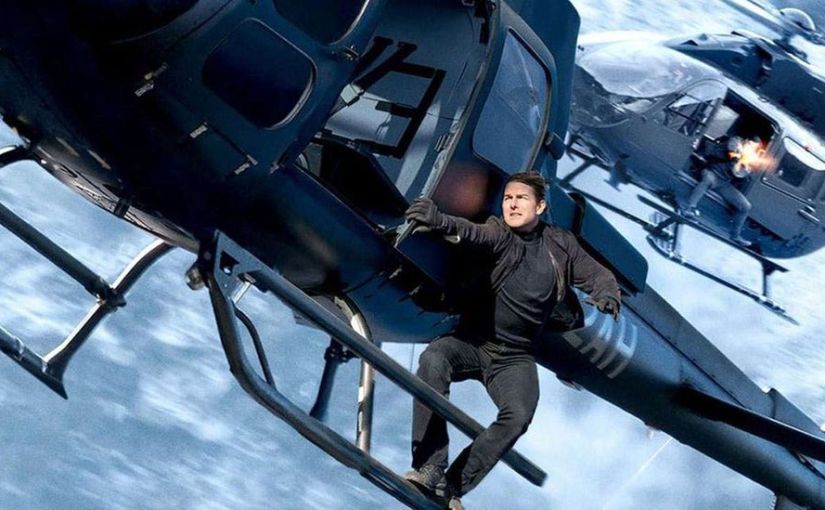
The highlight of this installment is a helicopter chase above and within a mountain valley that first focuses on Tom Cruise himself climbing a rope up, up, up to a chopper and swinging his legs onto the railing to get a foothold.  There’s time dedicated to him falling and inching his way back into the vehicle.  Then it becomes a chopper chase followed by a collision that ends with the remains wedged within a narrow mountain crevice.  What a set piece this is!  Absolutely outstanding camera work.  The wide and close editing, sound and visuals work so perfectly in sync with one another.  I don’t want to watch the making of documentary for this picture.  The trickery of McQuarrie’s camera crew is such a treat.  I’d rather savor the finished product on repeat viewings.

Juxtaposing against this chopper fight are two other scenarios involving Ethan’s teammates.  This is where I’m especially grateful for Christopher McQuarrie’s writing.  Two bombs are rigged in line with each other, and a detonator also must be retrieved by Ethan.  The whole team has to work cohesively, otherwise it is sayonara to much of the Asian continent if both devices explode.  McQuarrie’s “impossible mission” is orchestrated beautifully with suspense cranked way up.  His imagination for adventure allows a magnificently edited third act.  To date, I consider the stakes here to be the highest in the entire series.

The presence of this collection of actors is marvelous with recognition deserving of Henry Cavill donning an untrusting mustache and looking like a brutal, blunt instrument against the superspy Ethan Hunt.  Cavill also plays CIA agent wisely.  He’s got a stoic expression for most of the film but that is because he trusts the audience will assume what a dangerous threat he can be.  Cavill occupies one of the best characters in the seven films.

Mission: Impossible Fallout is truly one of the most thrilling pictures you’ll find.  What’s most important is the action serves the story.  Action just for the sake of action is tiring like in the Fast/Furious films.  There has to be a cost and a tangible feeling to the speed, obstacles and pain that good action scenes serve their characters and the story as a whole.  When Ethan falls from a helicopter or has to jump out a window, I grip both arm rests and let out a collective bellow with the audience.  Films with the grandest of adventure must draw out responses like that.  Otherwise, it’s all just a ho hum journey to the end credits.  Fallout is anything but a stroll.  It’s an absolute balls to the wall, explosive crowd pleaser.

MISSION: IMPOSSIBLE DEAD RECKONING PART 1

By Marc S. Sanders

The object of the Mission: Impossible films is not to wow its audience with thought provoking questions of politics or Cold War intrigue or even daring and uncompromisingly evil villains (apart from Phillip Seymour Hoffman).  The elements of espionage coursing through the TV series are non-existent in the film adaptations.  I’m not watching a film based on a John LeCarre spy novel.  By the time the seventh installment has arrived, titled Dead Reckoning Part 1, the goal of the film series is to sketch out the set ups for one action piece after another.  Only they must be bigger, bolder, and seemingly that much more impossible to overcome for their hero, Tom Cruise (playing a guy named Ethan Hunt).  The action is once again top notch.  The glues that bind these displays of bravado together, you know where the characters have to talk and give us a semblance of a plot, is as nil as the scotch tape that assembles a stretch of film reel into a running time length of nearly two hours and forty-five minutes.

The locales are as grand as any travel getaway. We go through a labyrinthine airport.  A techno night club works as a meeting place for a bunch of characters. There are journeys to the Arabian Desert, Rome, Venice, and a beautiful ride along the famed Orient Express.  Shot on digital, this movie is a gorgeous travelogue.

Let’s get the problems out of the way, though.  The MacGuffin that Ethan Hunt and his trusty pals Benjy and Luther (Simon Pegg, Ving Rhames) have been assigned to recover is two parts of a specially designed key.  One part is supposedly with the disavowed MI6 agent Ilsa Faust (Rebecca Ferguson).  The other half is questionable as to who possesses it, but a thief known only as Grace (Hayley Atwell) may be significant in finding it.  Put the two halves of the key together and it will unlock something that no one seems to know of, or where it is located.  Here’s my first issue.  The audience does know what the key unlocks because it is shown in the first three minutes of the film.  So, while the cast of characters act dumbfounded, we know all along.  So, there goes any curious interest I may have for wanting to follow through with this. 

The other problem is that the same conversation happens over and over and over again.  Lines like (and I’m paraphrasing here, or maybe I’m not) “If this key gets into the wrong hands…” and “Whatever this does unlock, Ethan, could spell the end of the world…” or “It’s important that both halves of the key are not put together…”  or “Whatever this does unlock…”  (See?  Even I just repeated myself in this write up.) Except, we know what it unlocks!!!!!  The same exchange of dialogue occurs over and over.  The redundancy exhausts itself.  It occurs so much in fact that it’s writer/director, Christopher McQuarrie, relied upon the repetitive dialogue to stretch this next M:I chapter into two films instead of one (Part 2 is scheduled to be released in 2024).  I don’t recall the context of any of Ving Rhames’ lines going further than what I have presented here, for example.

The film is also a little too character heavy.  I never understood why two agents (Shea Wigham, Greg Tarzan Davis) are constantly pursuing Ethan.  Just was not clear for me. Heightened suspense?  That’s the best excuse I can think of.  The White Widow from the prior film (Vanessa Kirby) also appears.  Not much purpose to her.  Cary Elwes is the deputy director, there at the beginning and later towards the end, but again I was not entirely certain of his contribution to the story.  Even Ilsa Faust does not seem to have much value, except to work as a step in Ethan’s ongoing trajectory for the key.  I think Rebecca Ferguson had no more than five lines in the whole picture.

Finally, Ethan Hunt seems to be up against an omnipotent enemy, an AI program known as The Entity.  The humans doing the bidding of this phantom program consist of a goatee wearing Esai Morales and his henchwoman, played by Pom Klementieff.  She looks straight out of a James Bond picture and makes for a good car chase through the stone cobbled streets of Rome in a tank like Hummer.  Morales is as boring as most of the other the M:I villains.

What works for the film is what Tom Cruise really wants to impress you with though.  Riding a speeding motorcycle off a mountain and parachuting his way down.  That’s actually a near sixty-year-old Tom Cruise performing that feat.  Very impressive.  The car chase with a handcuffed Cruise and Atwell in a puny yellow Fiat versus an unbeatable Hummer and an army of Italian police vehicles is fun on the level of Roger Moore’s Bond films.  Most impressive for me is the final act where the famed Orient Express train tumbles off a bridge with a gap in the middle, car by car with all the furnishings, piano included, pouring out while Ethan and Grace hold on for dear life. 

It’s the high stakes stunts that work.  Whatever smidge of a story there is fails though.  The script by McQuarrie and Erik Jendresen lacks so much that the cliffhanger the film ends on doesn’t leave me yearning for more because it only hearkens back to the beginning.  The characters catch up to what the audience has known for the last three hours.  So, I’m not losing sleep wondering with what happens next.

Of course, I’ll go see the Part 2 installment.  Tom Cruise won’t let me down in whatever daredevil achievements he’s dreaming of doing next.  However, am I going to these movies to watch Mission: Impossible, or to watch an aggressively updated version of Circus Of The Stars?

MISSION: IMPOSSIBLE ROGUE NATION

By Marc S. Sanders

Mission: Impossible Rogue Nation is as stunt filled as its predecessor. Perhaps even more.  The difference for me though, is that it is better than Ghost Protocol.  The stunts and action are at least equal in both films, but Rogue Nation also plays with its characters while not stopping at certain points to explain what must happen next.  Sure, the movie talks, but it speaks with developments and surprise, rather than starting the story all over again from square one (a shortcoming for me with the prior film).  Much of that is thanks to a new character, a disavowed British Intelligence Agent named Ilsa Faust played with perfect unsurety and mistrust by Rebecca Ferguson.  She’s the actress keeping me interested beyond the magnificent action scenes because I want to uncover what her game really is all about. 

Rogue Nation opens soon after Ghost Protocol ended.  A hearkening back to the original TV series has finally introduced the nefarious and clandestine organization known only as The Syndicate.  No one has been identified as heading this mysterious group.  A face or name has yet to be linked.  None of the major governments, including America, even believe they exist.  Tom Cruise as Super Spy Ethan Hunt is the only one certain that this Syndicate is responsible for a series of terrorists’ attacks and government overthrows occurring throughout the world.  By the way, I always call him Super Spy, because nothing gets past Ethan Hunt.  Not only can he run fast enough to hop onto a cargo plane taking off a runway, but he even has a talent for drawing as well as reading lips in various languages. Amazing!!!!  Incredible!!! Astounding!!!! ETHAN HUNT – SUPER SPY!!!!!

Don’t ask how we get there, but Ethan recruits his trusty pal and computer hacker Benjy (Simon Pegg) to attend an opera in Vienna where the leader of this shadowy Syndicate may be.  Complications and fistfights, along with sniper rifle assassination attempts ensue backstage during a performance, and now Ethan has convinced Benjy that his hunches must be true.  Ilsa is also there, but is she trying to kill Ethan or just fend him off, or is she working alongside of him?  Ferguson plays the role with a perfect poker face, and it helps keep the movie running along while wanting to find out more information.

Every Mission: Impossible film has that one especially heightened action set piece.  This time, Ethan has three minutes of inhaled oxygen while he enters an underwater vault to hack into a “safe deposit box.”  Benjy gleefully sees the simplicity in this.  “Well you can do that!”  As an extra bonus, we are treated to a kinetic motorcycle chase through Morocco.  The sound editing alone with revving engines and cars screeching, machine gun fire, and horns blasting is impressive enough.  Accompany it with well placed camerawork (nothing is blurry or shaky like in many other action films) and you have a set piece that’ll keep you alert.  Who needs dumb Fast/Furious junk when this stuff tops it?  Kudos to writer/director Christopher McQuarrie.

There are some standard motifs to Rogue Nation.  Once again, there’s a government official or two who does not trust Ethan Hunt’s intentions and thus he’s number one on the Most Wanted list.  How many times has this guy saved the world, already?  Give him a break! Also like before, most recently in the last installment, the IMF team has been shut down.  That does nothing for me anymore.  I wouldn’t expect anything less.  No IMF team, but Ethan and Benjy still get a hold of the most inventive gadgets and tricked out cars they can find.  So what’s the big deal if the IMF is on the chopping block?  Still, I like how this picture wraps its storyline up and defeats the villain.  It’s different and a welcome surprise.  Ilsa Faust’s character arc tidies itself up nicely as well.

Amazing stuff happening in this fifth chapter of the film franchise.  As long as Tom Cruise and company get more daring and aggressive with the impossible missions that need to be overcome, the staying power of these films holds.  Mission: Impossible Rogue Nation is a fantastic piece of filmmaking.

THE USUAL SUSPECTS

By Marc S. Sanders

There’s something inviting – or maybe intriguing – about seeing a person in a hat with a dark trench coat on.  Just the person’s silhouette will leave you asking for more.  What is it to this guy?  Steven Spielberg does that in the first few minutes with Indiana Jones in Raiders Of The Lost Ark.  Before Indy, there was Orson Welles as Harry Lyme in The Third Man.  Guys like these have a danger to them, and we can’t look away.  In The Usual Suspects, one of many variations of a legend called Keyser Soze has a dangerous reputation that carries him, and we want to know more about the figure in the hat and coat.  In the first few minutes of the film, we see this mysterioso extinguish a kerosene flame by urinating on it.  Who is this guy?  Maybe we, as the viewers, are Icabod Crane looking at an updated inspired spawn of The Headless Horseman.  Perhaps, we are actually catching a glimpse of that boogeyman who hid in our closets or under the beds.

Bryan Singer’s modern day film noir, masterfully written with inventive riddles by Christopher McQuarrie, works towards its ending as soon as the opening credits wrap up.  Each scene hops from a different setting or time period and as a viewer you feel like you are sitting at a kitchen table turning puzzle pieces around trying to snap them together.  Not all of it makes sense by the time the picture has wrapped up.  That’s okay though, because one of the players in the story perhaps played a sleight of hand and we can do nothing but applaud when we realize we’ve been had.  Magic is fun when you never quite realize where or when the deceit began.

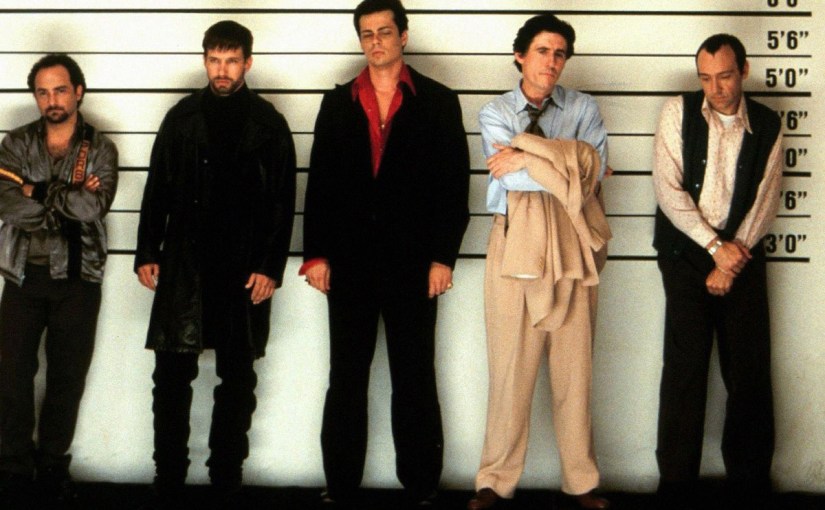
A scenario is set up early on that assembles five different kinds of criminals in a police lineup.  It works as a device to team these guys together to pull off additional heists.  A prologue to the film depicts the aftermath of their last job together.  One holdover, a hobbled cripple named Verbal Kint (Kevin Spacey) is brought into a police precinct to be interviewed by a determined detective named Kujan (Chazz Palminteri).  Verbal might ramble on endlessly in circles about nothing, but Agent Kujan is going to get to the bottom of what happened the night prior on a shipping dock that turned up several corpses.  How did it all go down, and where is the money and cocaine that was expected to be there?

Verbal was one of the five in that lineup, along with McManus (Stephen Baldwin), Hockney (Kevin Pollack), Fenster (Benicio Del Toro) and Keaton (Gabriel Byrne).  Each carries a different specialty or personality, but Keaton is the guy that Kujan is really after.  He’s a master criminal who’s been known to fake his own death, supposedly turn legitimate while dating a high-priced lawyer, and now may be the lead suspect in an armored truck heist.  On the other hand, maybe it was one of these other four guys. 

Amid all of this back and forth and side stepping stories, there is mention of a name – Keyser Soze.  Whenever he comes up in the vernacular of the script, the mood seems to change.  These criminals, usually comfortable in their own cloth of transgressions, get noticeably frightened and concerned if there is even a remote possibility that this Soze character is the engineer behind what follows them. 

It’s fun!  The Usual Suspects is fun.

McQuarrie’s script will toss out names of people we never meet.  It will quickly imply an anecdote from another time.  It’ll share a bunch of short stories with how these five guys work together, like upending a secret criminal sect of the New York City police force while robbing them of their fortunes. Yet, a tall tale of lore will intrude on their typical heists to derail what we may normally be familiar with in other crime dramas or noir films.   

Spacey is the real star of The Usual Suspects.  He earned the Academy Award for Supporting Actor because Verbal Kint is so well drawn out as a weak, unhelpful, and frustrating man.  Often, you ask yourself what the heck is this geeky looking crippled guy even talking about. 

On other occasions, I’ve noted that sometimes with movies I can not determine if I just watched a superior film or dreadful nonsense until I’ve reached the final five minutes.  The final five minutes of a movie can be the verdict.  Sometimes you’ll claim the journey getting there was great, but the conclusion was a big letdown.  If you have never seen The Usual Suspects, then you likely won’t know if the path towards its end is good until you’ve reached the culmination. 

Roger Ebert couldn’t stand this picture, and I’m not going to say he didn’t know what he was talking about or that he was wrong.  Bryan Singer and Christopher McQuarrie’s assembly of scenes don’t make for a well-defined picture, even after the movie is over.  Ebert was less than fond of that technique.  I think that was their intent, though.  Everything you have seen doesn’t have a suitable answer.  Certain parts don’t link well with others.  However, the director and screenwriter were always working towards an ending while piloting the film in swerves and unexpected knee jerk turns.

Unlike Ebert, however, I’m wholly satisfied with the film.  In fact, the first time I saw the movie, I cheered for the conclusion that got more than just one over on me.  On repeat viewings, knowing how the picture wraps up, I treasure the path towards its finale. 

If you study Verbal Kint, you’ll realize that he doesn’t offer easy answers and explanations for what’s occurred, thereby lending to the frustration of Agent Kujan who only demands cookie cutter, fall-into-place arrangements. What can I say Roger Ebert?  How else should I lay it out for you Agent Kujan? Life is messy with no easy answers sometimes.  Especially, in film noir.  

Ironically, one of Ebert’s favorite cinematic characters is Harry Lyme.  So, I guess Keyer Soze couldn’t live up to that threshold or repute.  If that’s the case, then I forgive you Roger.