
By Marc S. Sanders
For a perfect blend of the supernatural, suspense, mystery, drama, romance and comedy, the first film that will always come to mind is the surprise hit film Ghost from 1990. One of the zany Zucker brothers, Jerry to be more precise, who introduced the world to slapstick spoof (Airplane!, The Naked Gun) directed this film turning Demi Moore into a ten-million-dollar actress, placing Patrick Swayze ahead of his Dirty Dancing looks and earning Whoopi Goldberg a very well-deserved Academy Award. Ghost was a film for all kinds of movie goers.
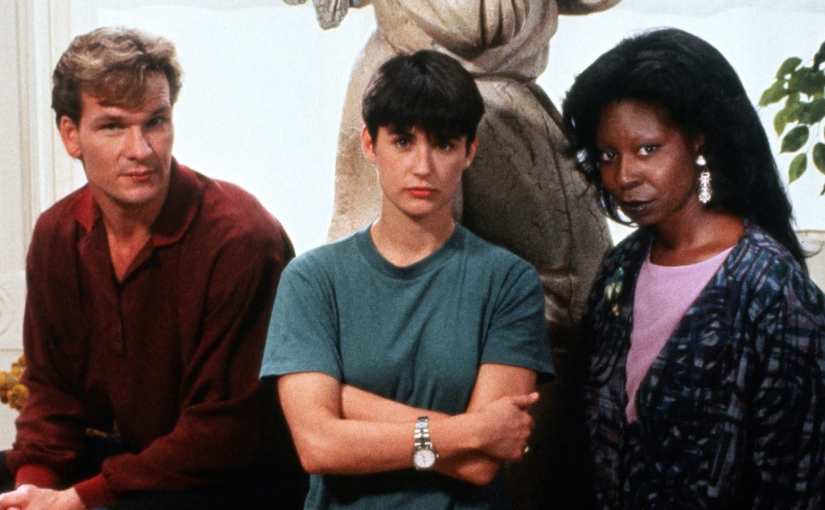
Sam Wheat (Swayze) is an up-and-coming New York City business executive who loves his new live-in girlfriend, Molly (Moore) even if he can only say “Ditto!” when she tells him she loves him. Shortly after the picture begins Sam is gunned down following an evening at the theatre. Unbeknownst to Molly and anyone else living on earth, Sam’s spirit lives on though, and he realizes that he was not the victim of some random mugging/murder. Now, Sam must find out who arranged to have him killed and why, while also protecting Molly from becoming a victim.
Along the way, Sam crosses paths with a phony con artist, working as a medium, named Oda Mae Brown (Goldberg) who turns out to be the real thing when she can actually hear Sam’s voice and communicate with him. Sam must recruit Oda Mae to be a go between for him with Molly and everyone else necessary to follow up on in order to resolve the mystery of his sudden death.
Ghost succeeded in every category of filmmaking. Rewatching the film decades later, I believe Demi Moore should have gotten an Oscar nomination. Her close ups on camera with beautiful, muted colors from Adam Greenberg’s cinematography are masterful. Greenberg should have been nominated too. He’s got perfect tints of pearl whites both on the cobble stone streets of New York with the outer architecture of the apartment buildings, as well as within the studio apartment where the couple lives. He strives for an ethereal look with his lens. Gold often occupies Molly’s close ups with dim lighting. Blues and blacks and steel glinting shines follow Sam’s trajectory.
Look at the lonely scenes that Moore occupies in the couple’s apartment. There’s a haunting image of isolation with no dialogue capturing the young actress at the top of a staircase when she eventually rolls a glass jar off the top and it shatters below. It’s one of the moments that defines a sorrowful character, and not many cry on screen better than Demi Moore. Later, Sam is engaging in a pursuit through the subway system and races down a steep blue escalator in the dead of night. Zucker places Greenberg’s camera at the bottom of the escalator to show the depth of hell that Sam may be risking continuing his chase. The images and transitions of this whole movie from scene to scene are stunning.
I mistakenly recall Whoopi Goldberg as just a comedienne doing her stand up schtick in this film. Not so. Goldberg looks radiant on film and while she starts out comically as the script calls for, she eventually resorts to sensitive fear of what her paranormal partner demonstrates as real within this fantasy. There are so many dimensions to this character. She’s silly. She’s exact in her nature for what’s at stake and the dialogue handed to her from Bruce Joel Rubin’s Oscar winning script compliments the actress so well. Goldberg never looks like she’s working for the awards accolades. Yet, she earned every bit of recognition that followed her.
Patrick Swayze makes more out of the straight man role than what could have been left as simple vanilla. His spirit character uncovers more and more about his afterlife and what happened to him as the film moves along. With each discovery, you’re convinced of Sam’s surprises and what he becomes capable of as a ghost. Long before superhero films became the novelty, Sam Wheat operates like one who has to learn of his origin and then acquire his new talents and powers to fend off the bad guys.
Jerry Zucker, working with Rubin’s script, Greenberg’s photography and Oscar nominated editing from Walter Murch, along with haunting yet sweet scoring from Maurice Jarre, builds a near perfect film. The narrative of Ghost shifts so often from comedy to crime to drama to romance and the various natures of the piece hinge so well off each other. That’s due to storytelling and the editing necessary to smooth out any wrinkles. You become absorbed in Jerry Zucker’s direction, especially with the movie’s most famous scene where Demi Moore and Patrick Swayze are sensually doing pottery together accompanied by Bill Medley’s rendition of “Unchained Melody.” Watch that scene with someone you love or take it in on a late Saturday night by yourself with no one to distract you with cackles and eye rolls. You’ll see how effective Zucker’s work is along with Swayze and Moore upholding the scene in a dark, empty apartment. Take it as seriously as the scene was originally constructed. (Then go watch Zucker’s Naked Gun 2 ½ for a chuckle.)
The mystery of Ghost works well with surprises if you are watching it for the first time. You build trust with a character only to realize it is a ruse for something else. I do not want to give too much away. For viewers who have never seen the film, maybe you’ll see an early twist as soon as the film begins. Maybe not. Either way, Ghost performs very naturally, unlike a forced kind of twist that M Night Shyamalan too often relies upon. I do advise that you not watch the trailer that was used for Ghost as I believe it deals out too many of the film’s secrets.
There are movies that I watch over and over again because I love to relive the special moments they offer. Ghost has those kinds of gifts and yet I have not seen it in ages. I’m glad. To experience the picture again was such a treat. While I recalled all of its secrets, this time I was able to take in the various technical achievements and the assembly of the piece, along with outstanding performances.
I have no problem saying that Ghost possesses the best performances within the vast careers of Demi Moore, Patrick Swayze and Whoopi Goldberg. Ghost still holds up. It deserves a rewatch and an introduction to new generations.
 2 UNPAID MOVIE CRITICS!!!!