
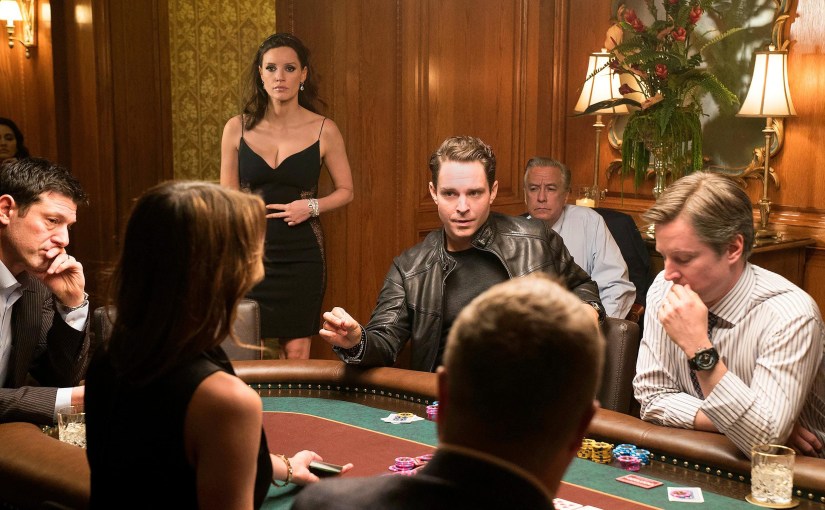
MOLLY’S GAME

By Marc S. Sanders

Despite being a little distracted by a drunk patron sitting next to me, I thought Molly’s Game was very good. It doesn’t measure up to The Social Network, and I feel justified in comparing the two because the sharp, fast dialogue follows what appears to be an intentionally similar narrative from writer, and here director, Aaron Sorkin.

Sorkin in his directorial debut uses great techniques for film editing to match the beats of his dialogue.  His opening voiceover of Jessica Chastain as Molly describing the ultimate worst sports experience will get your heartbeat racing.  It draws you into the film right away.

Chastain is good, but maybe a little over the top.  I needed a little more convincing that she was actually this brilliant, inventive and resourceful woman who was also considered one of the world’s greatest skiers.  Can’t put my finger on it but something was missing with her playing the Molly Bloom role.  Was she really holding her own against these high stakes guys who take big risks in her personally constructed poker ring?  I’m just not sure.

Felt the same about Kevin Costner in the role of her father.  He’s supposed to be an incredibly brilliant psychologist and an intimidating patriarch.  Yet Costner doesn’t fit that mold for me here.  Couldn’t feel the pressure from Dad on his daughter.  Someone else might have been stronger.

Michael Cera too.  I think he is playing a combination variation of Tobey Maguire & Leonardo DiCaprio, two of the most famous celebs that participated in the real Molly Bloom’s underground poker games, but Michael Cera?  Really?  He doesn’t carry the weight or looks of guys like that.  There just was not enough power or presence from him.

None of these actors were the worst options for this cast, I just think the film could have used more appropriate performers. There was more appropriate talent out there, I’m sure.

Idris Elba is great, however.  He’s blessed with an awesome Sorkin monologue in the 3rd act of the film, and he hits every note.

A great script.  A great story worthy of being a big screen film and it’s got me interested to learn more about the real Molly Bloom, including reading her novel.

THE SOCIAL NETWORK

By Marc S. Sanders

Power and knowledge can be a dangerous thing for a kid who is not necessarily as mature as his IQ would suggest. Mark Zuckerberg reinvented the way an entire planet functions from his Harvard dorm room. In the process, he couldn’t have cared less about the antagonism he was generating.

David Fincher’s The Social Network, with a brilliant screenplay by Aaron Sorkin captures kids with too much opportunity to seize, and the hubris they carry when they discover money, jealously, pride, and greed through a winning societal experiment.

The film features one of the best casts ever assembled, at least definitely within the confines of the 21st Century. Andrew Garfield, Justin Timberlake (should’ve been nominated), Armie Hammer (one of the best twin brothers’ portrayals in film), Rooney Mara, Brenda Song, and of course Jesse Eisenberg. Sorkin wrote the dialogue. It’s another thing to deliver it.

These people talk before they think, and it’s likely what caused them the aggravations of their own success and discovery. Watch the first scene between Eisenberg and Mara, as Zuckerberg and his girlfriend, Erica. Zuckerberg is already too smart for his own good. His failure with dating Erica is destined to be his undoing. He’ll never recover from this moment. Never! This is a kid with his hand on the nuclear button and he can’t stop pushing it. The other characters are all the same. Harvard geniuses with so much to gain, but how much will they lose?

Mark Zuckerberg, Cameron & Tyler Winklevoss (the self-absorbed twins of prestige and legacy), and Sean Parker (inventor of Napster) are prophets of a bigger picture. They foresaw the basic human desire for attention. People’s needs to be noticed are the commodities to monetarily profit from. These kids knew that better than anyone else. Ironically, Zuckerberg’s best friend and financial partner, Eduardo Saverin (Andrew Garfield), didn’t know it until he realized he was a large step behind. It cost a lot of money. Ironically, in the process of creating a new means of connecting with friends, it suffered the cost of a friendship, as well.

The Social Network will always be one of my ten favorite films. (Talk about huge Oscar upsets…excuse me The King’s Speech for Best Picture????) I’m always amazed at these kids with power. The knowledge they possess is bigger than anything within the confines of our historical governments, and yet they bicker and steal and betray like toddlers in a sandbox. Switch out “Facebook” for a Nerf football or a Barbie doll, and you can still apply this fast-paced wit of words. Sorkin pounced on that dichotomy. We’ve seen civil lawsuits on film with grand disputes and long speeches in front of arbitrators. We had yet to see college students dominate tables full of lawyers with crackling dialogue exchanged to prove their worth over one another. Amazingly enough, Sorkin used much of the dialogue from recorded transcripts he accessed. These guys actually spoke like this with each other. These technological pioneers gave the planet’s people the attention they wanted. Yet, what ultimately mattered to them was the credit for what they felt entitled to.

I’ll never tire of watching The Social Network, even if listening to Mark Zuckerberg is as exhausting as talking with a stair master.

One of best films ever made.