LAWRENCE OF ARABIA

By Marc S. Sanders

The moment finally arrived where I was able to see David Lean’s epic, also regarded as my colleague Miguel’s favorite film, Lawrence Of Arabia.  It truly is an eye-opening spectacle, and one of the most beautiful pictures I have ever seen, especially enhanced by an up-to-date Blu Ray restoration.  With a near four hour running time there is hardly an element or sliver of film that does not appear out of place.  Far ahead of the conveniences of dazzling special effects and CGI to arrive later in the twentieth century and beyond, Lawrence Of Arabia must be one of the greatest cinematic achievements ever created. 

When you factor in what David Lean made with an earlier picture, The Bridge On The River Kwai, it is fair to say that he was the James Cameron of his time – a bold, daring film director who did not surrender until every shred of a masterpiece was included in a final cut.  What puts a man like Lean ahead of Cameron perhaps, is that he depended on the resources of thousands of human extras and animals, broad desert landscape locations, painstaking architecture to set designs and buildings, along with authentic explosions and battlegrounds while delivering the story of British Lieutenant T.E. Lawrence and his efforts to aid an Arab nation into battle against the Turks during World War I. David Lean was persistent in bringing as much natural quality to his finished product as possible.  In fact, Miguel informed me that Lean was seeking out any possible way to point his cameras at the desert sun to heighten the feeling of the sweltering, unimaginable heat endured by his cast of characters.  It likely pained Mr. Lean that he had to settle for an optical illusion.  Nevertheless, when I was watching the movie, it did not occur to me once.  I was still appreciating his strive for absolute authenticity.

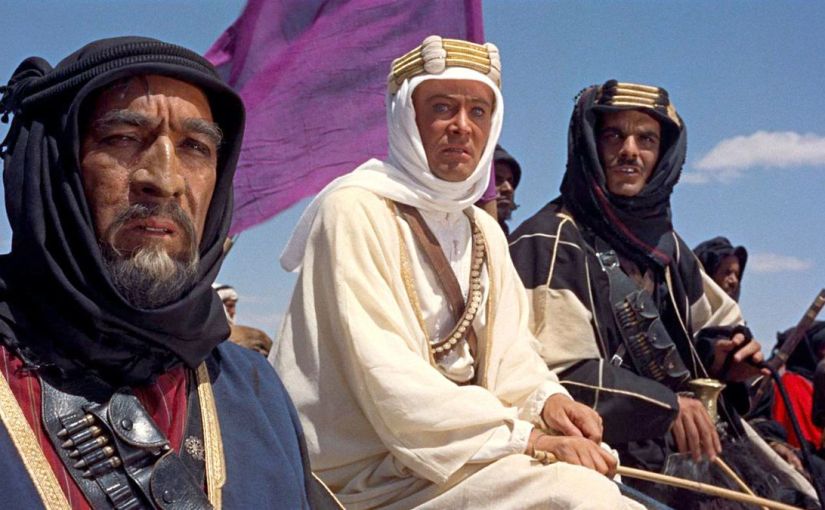
Peter O’Toole is the title character in his unforgettable film debut.  A daring, handsome, charming blond leading actor poised for adventure.  Lawrence is assigned to ally with the Arabs during the war to hold on to the necessary access of the Suez Canal which is a through way for oil, supplies and territory.  His determination for crossing wide, endless desert plains under a sun drenched open blue sky turn him into a leader, and a hero to the Arab soldiers, particularly represented by Sherif Ali (Omar Sharif).  They are a small band of fifty men, but Lawrence proceeds with the intent of gaining fifty more as he begins a long trek from one side of the desert to the other with persistent walking or by riding camel.  Lawrence won’t even leave a single man behind.  His resolve is courageous but could be costly later.

The technical construction of Lawrence of Arabia is likely what many notice and remember first, but the film comes with a well-set character arc for its protagonist.  Peter O’Toole was a perfect casting selection for this role.  Lawrence changes over the course of the film and it’s not a celebratory transformation.  Oft times, it seemed ironic to consider him the villain; perhaps a hero who falls from grace.  His derring-do is impressive, but likely also his undoing.  Lawrence allows strength and confidence to awaken a weak Arab nation who only survived for themselves with what little they held onto before their encounter with him.  Yet, the monster Lawrence creates within his own psyche may have also spawned a challenging threat from the Arabians for many years to come, long after this war is over and further generations come into play.  Bless a people with power but be aware of how that gift is used thereafter.

Lawrence accomplishes what has been regarded as seemingly impossible and now the Arabs adorn him in heroic white cloths (which must be one of the memorable costumes in film history).  He is who they look up to as the giver of their strength and confidence.  However, like most heroes that we find in the best of stories, T.E. Lawrence is weighed by fault, particularly his own hubris.  After his conceit gets him captured and tortured, it is not so easy to return to his home country who insist he continue to carry out his leadership.  Madness is invading his mindset and the hero we have borne witness to for well over two hours of film is now significantly diminished.  Parallel to that is the overconfidence and newfound freedom a political leader like Prince Faisal (Alec Guinness) absorbs for his Arabian people.  The end of David Lean’s film seems to imply what came of T.E. Lawrence’s contributions to the Arabs.  Was the world better or worse for what he achieved with his pioneering, yet dedicated military efforts?  What about Lawrence?  How did he fare, personally?

Forgive my incessant urge to compare David Lean to James Cameron.  I look at a film like Avatar and I see the monies and efforts invested to make that piece.  Yet, I feel like I walk away with little substance.  The films of Cameron not only fall short of story, but often lack texture as well.  I could never reach out and shake the hand of a “Pandoran.”  When I see Lawrence Of Arabia, though, I can feel the sweat and heat that O’Toole and Sharif experience.  Both are big films, not made on the fly. Rather, time and stress and a means to improve and show what’s never been seen or done before are offered.  David Lean might have been given all the monies in the world or the keys to kingdom to make his masterpiece.  However, it’s how he used these resources to painstaking perfection that lend to longevity in reputation for his career and Lawrence Of Arabia.

A train explosion near the start of third act is very impressive.  Lawrence and his men detonate a planted bomb on the tracks, and we see the locomotive derail onto its side, plowing into the hot desert sand.  We feel the immense weight of that steam engine.  We can detect the sand cloud that forms from the crash.  The collision of the cars being ripped apart and burned black thus create a new setting as Lawrence’s Arab followers rush to loot the train.

Grand battle scenes on horse and camel backs are meant to be seen at least ten times over in order to capture every piece of activity from the numerous extras and animals occupying a thousand different corners of the screen.  The bigger the screen, the better enhanced is the viewing experience. 

Long walks and camel rides in the desert may seem tedious for some, but not for me.  I was accompanying T.E. Lawrence and Sherif Ali on this journey.  This is another film where its running time affects what Lean set out to accomplish.  A trek through the desert is impossible to rush and this film is a testament to that notion.  I can’t say I’ve hiked through a desert plain that bears no end in near sight, but now I can lay claim that I’ve watched Lawrence Of Arabia.

Having only seen David Lean’s picture once thus far, I know that on repeat viewings I’d likely see something new each time hereafter.  This film is so alive of its period setting and backdrop and the unforgettable original score from Maurice Jarre give definition to the sweeping adventure that awaits with T.E. Lawrence’s travels.  The cast is marvelous as well.  Peter O’Toole is positively engaging.  Omar Sharif and Anthony Quinn are scene stealing character actors, much like Robert Shaw would become known for a decade later with Jaws.  Alec Guinness may be doing a brown face appearance as an Arab leader, but I’ll just salute the performance.  A charming actor of grand, yet subtle, skill.  I’m glad I’ve discovered him all over again from beyond …River Kwai and Star Wars.

Movies like Lawrence Of Arabia must remain at the top of the broad lexicon of films to watch.  It’s length and scope may be challenging, but its edits, its score, its immense visuals, and the performances therein, are unmatched by most anything else available to watch. 

MIDNIGHT COWBOY

By Marc S. Sanders

There’s an irony to John Schlesinger’s Midnight Cowboy.  At first, the film centers on a Texas bumpkin eager to relocate to New York City and succeed as a hustler.  Upon his arrival though, he could not appear any more virginal.  The cowboy’s name is Joe Buck, portrayed by Jon Voight in his Oscar nominated breakthrough role.

The first act of the film follows Joe on his long cross country bus ride.  He’s dressed in his finest country western shirt, stitched with floral patterns.  He’s got his black leather cowboy boots and of course the cowboy hat.  His origin bred Texas twang completes his image.  He meets a variety of comers and goers on the bus and then finally he reaches his destination. 

Schlesinger’s camera follows Voight as he treks through the city.  A man is passed out (heck, maybe he’s dead) on the street in broad daylight.  My Cinemaniac pals that I watched the film with noted how it’s funny that the streetwalkers don’t take one look at the poor fellow.  Rather they’re looking at Joe’s get up as he clearly stands out among the masses. Joe is the only one looking at the guy on the street.

Interspersed within Joe’s travels and entry into the city are quick flashbacks to where he stemmed from.  It does not look like a favorable upbringing spent with his grandmother.  There are flashes of Joe being victimized by possible sodomy.  There also appears to be a gang rape that he might have participated in.  None of it is made completely clear.  Though, it is evident that Joe has been trying to escape that environment for good. 

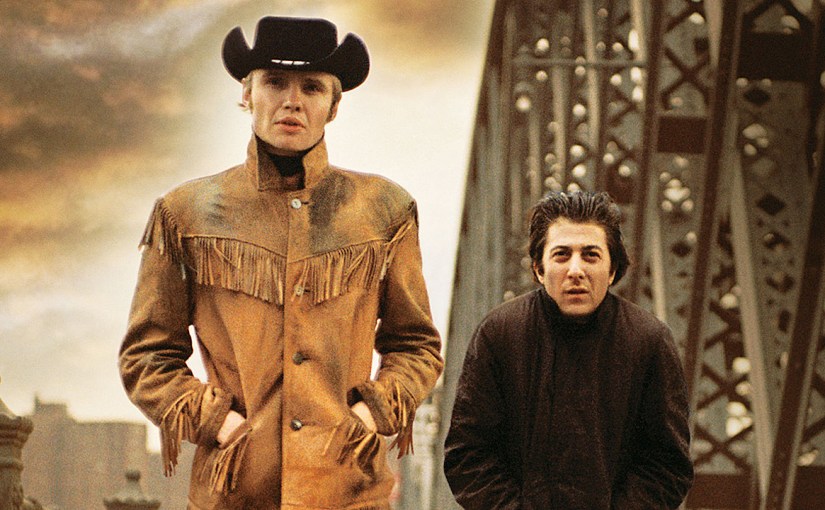
Eventually Joe encounters a sleazy, squat fellow who calls himself Rico Rizzo (Dustin Hoffman), addressed by others as Ratso.  Joe is so naïve that he’ll trust Ratso to get him some action where he can earn some money.  In exchange, Joe is completely willing to surrender the cash in his wallet.  He’ll learn from that mistake once he’s drained of everything but a few coins, locked out of his hotel room he can’t pay for and denied of his cow skinned suitcase that contains his possessions.  Eventually, he has no choice but to live in a condemned tenement building with Ratso. Joe Buck is about to lose a second virginity as he experiences how hard it is to live within the city.  He’ll also realize the value of friendship as he sees no choice but to take care of Ratso who is very sick.  Hoffman’s appearance shockingly changes as Ratso’s health submits to a harsh, unknown illness.  The sweat all over his face is palpable.  The chilling, sickly feeling he exudes is clearly felt.

Waldo Salt’s award-winning script, based upon a novel by James Leo Herlihy, explores the good nature found within two different walks of life despite the dodgy pasts that follow them. Ratso and Joe are one of the oddest couples in cinematic history.  There’s no way these two would want to be together unless one was trying to take advantage of the other or one was left with his guard down, open to being taken for and deceived.   Jon Voight has a tall youthful stature, a handsome man.  Dustin Hoffman is scrawny and significantly shorter with greasy hair, an uneasy limp and a weird squawk to his voice.  The often-times method actor seems to make himself increasingly hideous. 

Perhaps I needed to see Midnight Cowboy at the time of its release.  It surprises me the film merited the prestigious accolades it collected, including Oscars for Best Picture, Director, and Screenplay.  The two actors also received Oscar nominations.  It remains an honest film of its time in the year 1969.  Yet, it is disturbing and ugly too as it captures the seedy side of New York with experimental drug use and Joe’s victimization for sex.  He gets ripped off by who he thought was a kind woman (Sylvia Miles) looking for an intimate evening with his hustler capabilities.  Later, he’ll surrender himself to a man looking for oral pleasure in a movie theatre.  It’s not the typical glamourous epic of a Hollywood yesteryear.  In fact, for a time it was the only film to be recognized for winning Best Picture with an X rating.

The celebration of Midnight Cowboy’s achievements falls upon the relationship between Joe and Ratso.  Had Joe not been so naïve to how lowlifes operate and had Ratso not become so ill, yet welcoming to Joe when he needed a place to stay, then a friendship would not have gradually developed. 

The ending to Schlesinger’s film is touching, though sad.  As the story began, it also ends on a bus heading towards a new destination – another new way of life, different from what Joe experienced in small town Texas or New York City.  The two characters sit together in the back seat and the other passengers eventually observe them like they had on Joe’s first journey.  Either individually or together Ratso and Joe are simply strange to any sort of environment.  Yet, they’ll learn from each other and that’s where Midnight Cowboy triumphs.

MONSTER (2003)

by Miguel E. Rodriguez

DIRECTOR: Patty Jenkins
CAST: Charlize Theron, Christina Ricci, Bruce Dern
MY RATING: 9/10
ROTTEN TOMATOMETER: 81% Certified Fresh Fresh
Everyone’s a Critic Category: “A Movie Based on a True Story”

PLOT: Charlize Theron gives a searing, deglamorized performance as real-life serial killer Aileen Wuornos in Monster, an intense, disquieting portrait of a profoundly damaged soul.


The first time I tried watching Monster, some years ago, I watched it with my girlfriend, but we never finished it.  The scene where Aileen Wuornos (Theron) is attacked and raped, leading to her first murder, was so visceral that my girlfriend had to leave the room before it had finished.  Since that time, she has watched hours and hours of “true crime” documentaries about Wuornos and Bundy and Manson and Speck and so many others.  Go figure.  Having finally finished Monster on my own this morning, I believe she could be ready to give this movie another try, although I’m not sure the version of Aileen Wuornos portrayed in the film will have much resemblance to the one seen in all those documentaries.

In the past, I’ve enjoyed movies like Se7en and Silence of the Lambs and even Zodiac, featuring implacable, inhuman murderers with unfathomable motives and blank faces.  I enjoyed David Fincher’s series Mindhunters far more than I thought I would, despite its disquieting subject matter, partially because the killers portrayed in that series may seem normal at first, but they are eventually revealed to have massive personality disorders, genuine sociopaths with little to no consciences to speak of.  But in Monster, director/screenwriter Patty Jenkins (who wouldn’t direct another film until 2017’s Wonder Woman) denies us the ability to pigeonhole Aileen Wuornos so easily.  She pulls a Hitchcock/Psycho on the audience: getting us to root for the ostensible villain even as she commits one murder after another.

Jenkins accomplishes this by showing how a dysfunctional home life and a sometimes apathetic and cruel society ground down a young girl with the same kinds of hopes and dreams we’ve all had into a damaged woman desperately looking for a connection.  One such apathetic soul in the film says what I’ve thought so many times in my own past about anyone who makes questionable life choices: “Lots of people have bad lives, and they still choose to move towards the light.  Otherwise, we’d all be hookers and druggies.”  Well, sure, that’s easy for me to say, with two loving parents, a private school education, living in a 3-bedroom house and a steady job, etcetera.  But what choices would I have made if my father knew his friend had been molesting me for years and not only did nothing, but beat ME up for it?  What if, in my first job interview, the office manager hadn’t taken a chance on a teenager with no job experience and instead berated me for not having a master’s degree or my own apartment yet?

Monster is not a typical serial killer movie because, while it absolutely does NOT approve of Aileen’s murders, it does not try to pretend she is a mindless, man-hating predator.  She is motivated by hopelessness and, as it happens, love.  Aileen meets and falls desperately in love with a naïve young woman, Selby Wall (Ricci), the first bright spot in her otherwise bleak existence, and will do anything to keep her in her life.  If “anything” happens to encompass hooking and murdering the occasional john, for her it’s a small price to pay for the happiness she has been denied for so long.

Monster has the look of a film shot on a shoestring, much like Henry: Portrait of a Serial Killer, which enhances its authenticity, especially when it’s clear the movie was shot in the real locations visited by Aileen and Selby in real life.  Having lived in Florida for over 35 years, I recognized the feel of the locations, the city streets crowded with convenience stores and car dealerships and seedy motels.  I’m pretty sure I’ve actually been to the “Fun Stop” where Aileen and Selby ride the Ferris wheel.  The usage of these real locations made everything feel legitimate, almost like a documentary.  (Full disclosure: Selby Wall is loosely based on Aileen’s actual girlfriend, Tyria Moore, but Moore refused to allow her name or likeness to be used in the film and divulged little-to-no information about her personal life, so Selby’s character is an estimation at best.)

And then, of course, there’s Charlize Theron’s Oscar-winning performance as Aileen Wuornos.  Anyone familiar with the Wuornos story has seen her most famous photos.  Take it from me: the makeup department used every trick in the book to make Theron look like Wuornos’ double.  It’s uncanny, on par with Rami Malek’s transformation for Bohemian Rhapsody, down to the false teeth that subtly alter her profile.  She even shaved her eyebrows.  But those cosmetic marvels are nothing, nothing compared to Theron’s performance itself.  I recently watched Cate Blanchett in Tár and called that the greatest performance I had ever seen by a woman.  I must now amend that statement.  Theron completely sublimates her famously glamorous persona into a chaotic jumble of nervous speech patterns and a fake swagger and the rambling patter reminiscent of a junkie looking for her next fix.  The only time she ever seems at peace is in the arms of her lover.  This performance is even more remarkable considering how “non-flashy” it is compared to other movie killers like Hannibal Lecter or John Doe.  Sure, she has her outbursts, but rather than feeling like hammy histrionics, they felt raw, like watching hidden camera footage of someone genuinely losing their shit because of some deep personal loss and not because they got the wrong size coffee at Starbucks.  It’s a phenomenal performance.


Attention should also be paid to Christina Ricci’s performance as Selby.  It’s easy to lose sight of Ricci in a film that clearly belongs to Theron, but she pitches her performance just right as another needy soul looking for a connection and all too willing to overlook (initially, at first) the red flags of a girlfriend who comes home in a different car every other night.  Her home life may not have been as scarring as Aileen’s, but she will take any port in a storm offering relief from oppression.

I enjoyed Monster in almost the same way I enjoyed Aronofsky’s Requiem for a Dream.  These people are not the most sympathetic characters ever, or the most relatable, or even the most likable.  But I see how their dysfunctional backgrounds brought them to their desolate situations step by step, and it makes me wonder whether I would have done anything differently in their situation.  I’d like to think I wouldn’t turn to murder and/or drug use in my despair, but Monster made me realize there’s no way to know for sure unless I walk a mile in their shoes.  The last lines spoken in Monster, which I won’t spoil here, lay out the kind of misery Aileen Wuornos seems to have faced at every stage in her life.  Imagine how things might have turned out if she had just been given a chance.


QUESTIONS FROM EVERYONE’S A CRITIC

Best line or memorable quote?
“‘All you need is love and to believe in yourself.’  Nice idea.  It doesn’t exactly work out that way.  But I guess it was better to hear a flat-out lie than to know the truth at 13.”

After watching this film, did you want to learn more about the true story?  Why or why not?
I must be honest and say, no, I did not.  I do not claim that Monster tells the 100% true story from beginning to end.  It’s not a historical document.  It’s a piece of entertainment that strives for truth at the expense of slavish dedication to factual accuracy, and I’m okay with that.  I’m one of those people who believe JFK is a marvelous film, inaccurate though it may be, because it captures the feeling of what it was like during that timeframe.  The same with Monster.  I could watch however many documentaries on the life and death of Aileen Wuornos, and I can’t imagine any other piece of filmmaking approaching truth to any greater degree than this movie did.

CHICAGO

By Marc S. Sanders

When you are a sexy, sultry lady killer, infamy can just about save you from a hanging.  That’s what Rob Marshall’s Oscar winning adaptation of Bob Fosse’s Broadway jazz musical capitalizes on in Chicago. The movie is hot, steamy, dazzling and blazing with magnetic song and dance numbers that are easy to follow while getting your pulse racing.  The design, direction, music, and choreography are magnificent.  The cast is outstanding too.

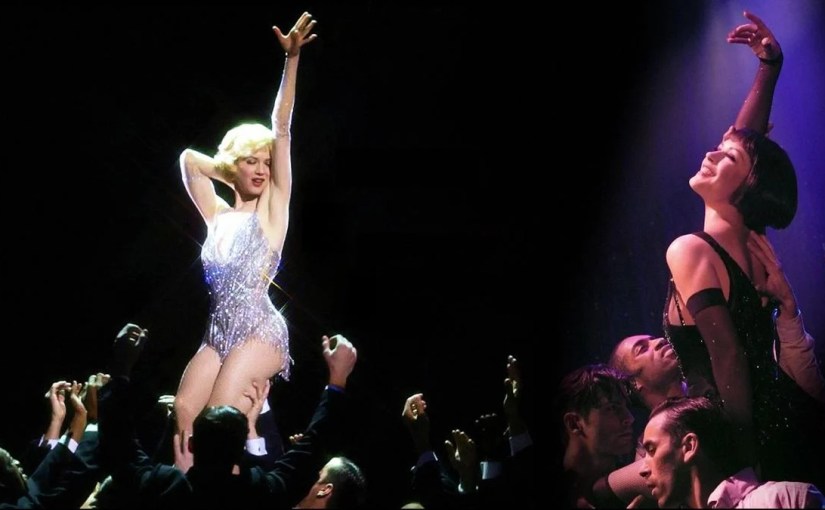
During the glitzy 1920’s in the Windy City, Roxy Hart (Renée Zellweger) is a wanna be night club performer who gets arrested for the murder of her extra marital lover (Dominic West).  She’s thrown in the pokey where the well known warden Matron Mama Morton (Queen Latifah) oversees all of the other murderesses, and often profits off of their sensationalistic crimes.  Roxy’s loser schlub of a husband, Amos (John C Reilly), manages to hire the hottest defense attorney in town, the handsomely slick and underhanded Billy Flynn (Richard Gere), to represent Roxy at trial.  Billy has never lost a case because his specialty is to manufacture drama for his accused clients, generating sympathy in the papers and among the jury.  In the film, there is a scene where Billy is literally pulling the strings on his puppets, particularly a marionette appearance of Roxy on his lap while he does the obvious ventriloquism.  A memorable moment for both Gere and Zellweger.  On the side is Velma Kelly (Catherine Zeta-Jones), a double murderer of her husband and performing partner/sister.  Velma owned the public outcry until Roxy’s name was splashed along the headlines.  Now, the spotlight is quickly moving away from Velma.

Rob Marshall choreographed and directed Chicago.  He demonstrates the fun that can be had with murder.  Call it a new kind of excitement that normally we take jubilant delight with episodes of Murder She Wrote or Agatha Christie tales. 

The theme of this picture is how the story is narrated in a colorful reality.  On a parallel level it is performed on a stage nightclub with a bandleader (Taye Diggs) introducing the players who then breakout into their own testimonial song amid large choruses and dancers to enhance the attraction of headlines and sleazy, operatic narratives.  Christine Baranski is the reporter whose front and center, trying to collect the next big chapter development of whoever leads the hottest storyline at any given moment. 

Marshall will turn a courtroom proceeding led by Billy Flynn into a three-ring circus, while at the same time he’ll cut away to the nightclub.  Billy will be on stage, but he’s now wearing a glittery three-piece suit and doing a ragtime song and dance with a chorus of scantily clad, Burlesque women to apply a little Razzle Dazzle for the judge and jury.  Richard Gere is not who you think of for stage musicals, but he is positively charming.

Queen Latifah has a scene stealing moment to show off her entrance into the picture.  Mama Morton is in a skintight evening dress, complete with a swanky boa while performing When You’re Good To Mama on stage at the nightclub. Frequent cut aways have her dictating her powerhouse tune to the inmates.  John C Reilly performs Mr. Cellophane. He lays out certainty that there’s nothing inauthentic about the pushover loser husband he really is.  Both actors got well deserved Oscar nominations.

Catherine Zeta-Jones and Renée Zellweger are a perfect pair of competitors.  They each have their individual moments and they act with such solid gusto; tough broads not to messed with.  The confidence they exude on screen with character acting, singing, and dancing is second to none.  The script will offer moments when Roxy and Velma think they are high and mighty, and winning the court of public opinion.  Then it will be undone when their hotshot attorney, Billy Flynn, knocks some sarcastic sense into them and a dose of reality sets in.  Roxy isn’t so fond of wearing a conservative black dress with a white collar in court until she sees a fellow cellmate lose her last motion of appeal, and there’s nothing left but to be punished by hanging.  She might be putting on a helluva performance, and signing autographs while souvenir dolls of her likeness are selling on the streets, but none of that ain’t gonna mean a thing if the jury finds her guilty of murder.

Just like I began this article, infamy is the word that kept coming back to me while watching Chicago.  Infamy bears celebrity.  Granted, it’s enhanced for a lively musical motion picture and stage show.  However, there’s a very, sad, and no longer surprising truth to that ideal.  A few years back, I recall news reports about a criminal’s sexy mug shot where he had donned a tattooed tear drop below his eye.  This guy was prime for runway modeling.  However, he was proven to be a violent car thief. He actually got signed by a talent scout following his bail out.  (I think the agent posted the bond.)  Later, he got arrested for some other crime. 

I never saw the reality program Chrisley Knows Best, about a God loving family who proudly live among the finest that money can buy.  Recently, the ultra-vain mother and father were sentenced to over a decade in federal prison for fraud and tax evasion.  Yet, their brand is stronger than ever, as the gossip columns can’t get enough, and their adult daughter’s podcast has millions of listeners.  Word is that a new program is being designed as a follow up to their prison sentences. 

Infamy bears reward.

Chicago pokes fun at the obsessions adhered by the media, the public, the courts and within the penal community.  The well known musical is now decades old, but the topics contained within clearly identify how news is not reported in a simple, objective Walter Cronkite kind of way, anymore.  Everything is heightened.  Everything is dramatized.  It’s not enough that Roxy kills her lover.  That will get her only so much mileage, until the next lady killer comes along (in the form of Lucy Liu, for example).  Roxy must stay relevant.  Announcing she’s pregnant will keep her on the front page (It could help that she faints while doing it). Velma knows all too well that the public favoritism she once had, accompanied with Billy’s sleazy promotion, is even further away. 

Rob Marshall presents a film where any song can be pulled out of context just for its sizzling entertainment.  Try not to forget the Cell Block Tango with solos from Zeta-Jones, as well as her fellow inmate chorus girls, each proudly describing how their guy “Had it coming!!!”.  All That Jazz is arguably one of the best opening numbers to a show, and Catherine Zeta-Jones owns the performance.  Individually, these songs and the performers win my attention in the car or the shower or during a workout.  Assemble them together with the overall storyline, and Chicago becomes a fast paced, kinetic roller coaster that makes you think while you smirk at all the scruples and vices being dismissed. 

The last time I saw Chicago was in theaters in 2002.  I had also seen a stage production of it before then.  I loved it both times.  Rewatching it recently gave me such a jolt of energy.  It is why theatre is a vital source of escapism. Here is an example where you can feel positively entertained while reflecting on a sad truth.  It might be sad, but you’re smiling all the way through while you mouth the brilliant lyrics and tap your feet.

Roxy Hart, Velma Kelly, Billy Flynn and the rest of the cast of characters make Chicago red hot and gleefully sinful.

TITANIC (1997)

By Marc S. Sanders

James Cameron’s Titanic will always remain a timeless piece.  Audiences adore the relationship between the two lovers from different worlds, Jack and Rose, who meet aboard the maiden, and final, voyage of the doomed cruise liner.  Maybe more importantly, the craftsmanship of this film is still beyond compare.  Many know that when this picture was in the making, its budget ran way over and endless rumors of waterlogged technical challenges were rampant through media reports.  Titanic was predicted to sink James Cameron’s career.  Instead, it was the grand Hollywood underdog that no one expected.

I recall seeing the film twice in theaters during the Christmas season of 1997.  I was not so enamored with the script or the fictional love story that Cameron conjured as the central narrative for the real-life tragedy that took approximately fifteen hundred lives on April 15, 1912.  The visual effects were the marvel to watch, and what I patiently waited for, during the second half of the picture.  I had to tread water through the first half though.

A hardly known, but already Oscar nominated (What’s Eating Gilbert Grape?),  Leonardo DiCaprio portrays Jack Dawson, the poor member of the ship’s steerage company who falls in love with an aristocratic young woman named Rose Dewitt Bukater.  Rose is played by Kate Winslet, who’s uncomfortable with the snobbishly wealthy first class section of people she’s forced to associate with by mandate of her possessively cruel, and supercilious fiancée named Cal (Billy Zane) and her mother, Ruth (Frances Fisher).  Call it a Romeo & Juliet love story.  Two lovers are forbidden to be with one another.  Yet, they are going to do it anyway.  It’s simple and nothing dimensional.  It seems to have parallels to Disney’s rated G interpretation of Beauty & The Beast.  Fortunately, what saves the storyline are the performances and chemistry of DiCaprio and Winslet.  These are not even the best roles of either actor’s storied careers.  Yet, they are anything but unlikable. 

The relationship they share aboard Titanic, as it makes its way from Europe to the United States, is told in flashback by a 101 year old woman (Gloria Stuart) to a marine exploration crew who have been meticulously searching through submerged remains of the ship on the ocean floor of the Atlantic.  The most important element to come from this section is a wise choice by Cameron to include an informatively brief analysis of how exactly the ship took on an overabundance of ocean water following a collision with an iceberg, and how it gradually began to sink, weigh down, and split apart before finally concluding with a straight dive down into the murky, cold depths.  I must note that film critic Gene Siskel acknowledged this storytelling device upon the film’s initial release. He hailed this sequence because it offered an early “blueprint” of what audiences could expect to happen and witness during the film’s second half.  We all know the ending to the film, but how exactly did it happen?  The quick breakdown helps.

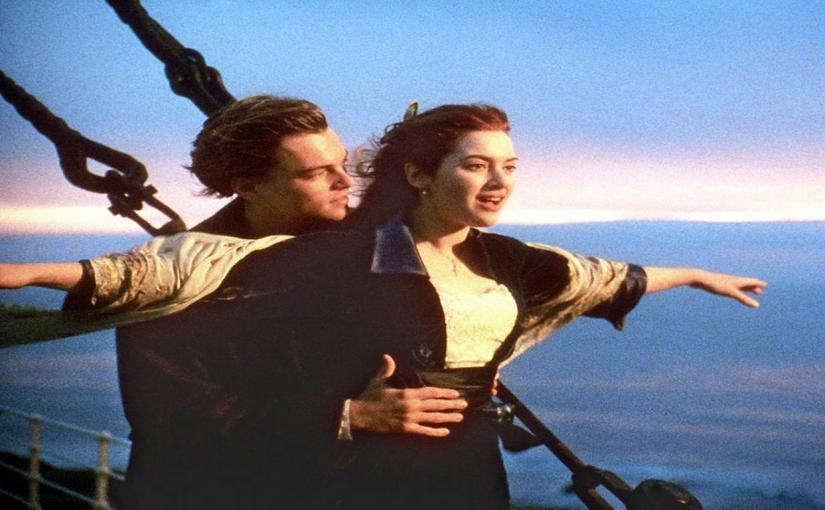
Ahead of the tragedy, Cameron and his set designers offer a grand, functioning piece of machinery that is absolutely impressive to modern audiences, even over a century later.  The decks and hallways are wonderous.  The forward and aft locations seem familiar and solid.  The CGI on this reinterpretation of Titanic is undetectable.  If this film was going to live up to its name, it most certainly has done so.  This ship looks tremendous and strong and indestructible just as the architect and engineer (Victor Garber, Jonathan Hyde) written into the script proudly lay claim to.  The famous moment of the film where Jack supports Rose on the forward bow of the ship with a sunset sky in the background is positively gorgeous.

I do have reservations with the film though.  I think both stories, the forbidden romance and the demise of the ship, in Titanic work.  However, when spliced together, the picture leaves me feeling uneasy.  James Cameron has weaved his fictional romance, appropriate for used, yellow stained paperback books, with a horrifying tragedy.  It’s what you would find in those cheesy Irwin Allen disaster epics from the 1970s.  When Cal’s anger over Jack’s intrusion comes to a boil, he pursues the couple, firing a pistol at them while the ship is continuing to sink.  Jack is apprehended and handcuffed in the lower deck and his doom seems imminent as the water level grows higher.  A priceless blue diamond serves as a MacGuffin that goes back and forth to deliver the operatic divide of these characters.  These are all cinematic inventions painted upon a well-known historical tragedy simply for the sake of adventure and suspense. 

I also found it unconvincing that the only person aboard the ship to question the contingency planning and safety measures ahead of any potential disaster is young Rose, who has no insight into mariner regulation or procedure.  Of all people, it only occurs to Rose that Titanic is not equipped with sufficient lifeboats for all twenty-two hundred people on board.  For storyline options, these avenues written by James Cameron sometimes take me out of the film. 

What I hold fascinating though is where the film depicts the eventual panicked response of the passengers and crew.  We see the captain appear helpless in his defeat against the nature of the ocean running its course over the ship he commands.  A string orchestra chooses to simply perform amid the ongoing disaster, which I have read actually happened.  Most breathtaking is how all the extras in the film react to the growing shift of the ship.  Their slant becomes steeper.  The people do their best to shuffle through the flooding, eventually having to keep their heads above water.  Helpless children are abandoned.  For an emotional punch, the steerage in the below decks is gated off from reaching the top of the ship, and giving themselves a chance at survival on a life boat.  James Cameron accounts for every response and detail that likely occurred during the sinking of the ship.  It’s captivating to witness, despite how tragic the outcome.

Though I do not care for the mix of the love story and the real-life submergence of the ship, Titanic has many strengths beyond what James Cameron achieved with the most up to date technology in visual effects, at the time.  Billy Zane is a villain that you love to hate.  Truly an underrated antagonist in the history of film.  David Warner is an intimidating henchman.  Kathy Bates is a welcome Unsinkable Molly Brown, the crass wealthy woman who sets herself apart from the pretentiousness of her lady peers.   

The exceedingly three-hour running time allows you to become completely familiar with the ship from stem to stern and again the set pieces are magnificent, whether you are hobnobbing with the wealthy up top or the steerage down below.  Every pipe or rope or stairway or hallway or chandelier serves a purpose.  The costumes and makeup designs are appropriate, including the frozen complexions on the bodies that float on the ocean surface following the tragedy.  Cameron’s use of the camera is amazing as he offers wide, expansive shots of nothing but dark ocean with hundreds of people suffering towards their demise. Thus driving home the point that there’s nowhere to find salvation and relief from the bitter cold air and sea water.  These poor people faced unimaginable challenges while competing with panicked crowds, and lack of foresight from those in charge of this newly designed technological wonder.  The movie covers everything that worked against these passengers.

Titanic is an incredible accomplishment. There’s much to see and absorb.  The last time I saw the film was nearly twenty five years ago and much of the footage never escaped my memory.  James Cameron left an indelible impression on moviegoers.  Regardless of the misgivings the film holds, Titanic has held its rightful place as an all-time landmark in cinematic achievement.

NOTE: I took advantage of seeing a newly restored 4K version in 3D at my local movie theater.  I have never been a huge fan of 3D as I often find it murky and distracting from the story.  Had Titanic been offered in standard 2D, that is what I would have gone to see.  Fortunately, this re-release is an exception to my impression with 3D presentations.  The picture is glorious, and I highly recommend the film be seen while it remains in limited release.  Titanic in 3D should not be missed.

TENDER MERCIES (1983)

by Miguel E. Rodriguez

DIRECTOR: Bruce Beresford
CAST: Robert Duvall, Tess Harper, Betty Buckley, Wilford Brimley, Ellen Barkin
MY RATING: 8/10
ROTTEN TOMATOMETER: 84% Fresh
Everyone’s a Critic Category: “A Movie that Won the Oscar for Best Original Screenplay”

PLOT: A broken-down, middle-aged country singer gets a new wife, reaches out to his long-lost daughter, and tries to put his troubled life back together.


Tender Mercies does not feel like a movie that was released the same year as WarGames, Octopussy, and Return of the Jedi.  It has more in common with the spare, character-driven films of the early ‘70s like Five Easy Pieces [1970] and The Last Picture Show [1971].  It’s a movie where not much seems to happen, at least on the surface.  Underneath the barren landscapes and big skies, however, great truths about life and acceptance are on display.

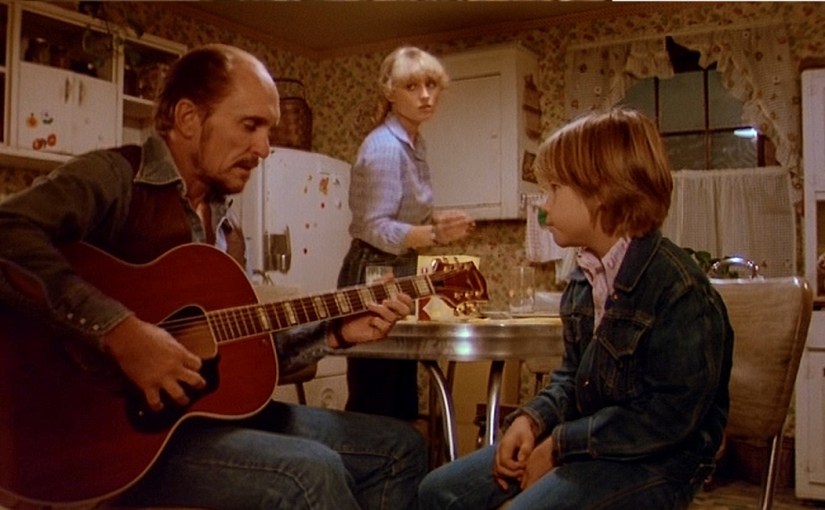
Anchored by an Oscar-winning performance from Robert Duvall, Tender Mercies tells the story of Mac Sledge (Duvall), whom we see at the opening of the film collapsing in a drunken stupor on the losing end of a fight in a rinky-dink roadside motel in rural Texas.  The next morning, broke and abashed, he makes an arrangement with the widowed motel owner, Rosa Lee (Harper): he’ll do odd jobs at the motel for room, board, and $2 an hour.  Rosa Lee’s son 10-year-old son, Sonny, watches this situation unfold impassively and asks Mac some very direct questions: “Did you used to have money?”  “How’d you lose it?”  “You think my dad would’ve liked you?”

The filmmakers (directed by Bruce Beresford, Oscar-winning screenplay by Horton Foote, who also wrote the screenplay for To Kill a Mockingbird [1962]) make some interesting choices for everything that follows.  There is a gentle scene between Mac and Rosa Lee where he shyly asks her, “You ever think about gettin’ married again?”  She says she has.  “Would you ever think about marryin’ me?”  She says she will think about it.  And in the very next scene, it’s made clear that time has passed, they got married, and have been married for several months.  In another film, that kind of “condensed storytelling” would go into the negative column in my book, but not here.  Instead, it feels…right.  We don’t need to show any further details of their courtship, their wedding, Sonny’s feelings about it one way or the other, etcetera.  Those extra scenes would have delayed the narrative structure, showing us things we don’t need to see, but which we can easily deduce.

There’s another scene (I’ll try to tread lightly here) where Mac gives a heartfelt, but still masterfully underplayed, speech to Rosa Lee about how he was in a bad drunk driving wreck years before, and how God saw fit to bring her into his life, but to do so meant her husband had to die, and so on.  “See, I don’t trust happiness.  I never did, I never will.”

When he finished, and Rosa Lee stood there taking it in, in my head, I imagined her replying with something like, “Well, Mac, you don’t have to trust happiness, you just have to trust me”, or “yourself”, or some similarly corny platitude.  Instead, in what must have been superhuman restraint on the part of the screenwriter, Rosa Lee simply stands there, processes what she just heard…and walks offscreen, leaving Mac alone with his thoughts.

That was a big moment for me.  It seemed to me to be a gesture from the filmmakers that this is not a movie about processed dialogue and ancient story arcs and the kind of emotional beats you might expect from a film.  Instead, it felt like I was looking at real people, reacting realistically to real dialogue.  Rosa Lee could have drawn the scene out, but instead she seems to realize there is nothing she can say that will make things better for Mac.  She loves him, but she knows this is something he’ll need to work out for himself, and no amount of sermonizing will help him towards that goal.  It’s a small moment, and it doesn’t occur until late in the film, but it’s this moment that convinced me Tender Mercies had a lot to say in between the pauses and transitional shots of country roads and straight horizons.

There is a lot more to the story, but the film presents very little of it with the kind of forward momentum we’ve come to expect as moviegoers.  Instead, we are treated to new developments almost as if we are intruding on these people and their lives.  Even in a scene at a crowded Opry house where we see Mac’s previous wife, Dixie (Betty Buckley!), belting some good old-fashioned, Parton-esque country tunes, the shot choices and editing still feel almost like we’re voyeurs as we watch Mac listening to one of Dixie’s ballads, then leaving, not quite in disgust, but clearly uncomfortable.  It’s in the aftermath of this concert we get the first solid information on his estranged daughter (Barkin), who would be about 18 years old by now.  Dixie screams at Mac, “She doesn’t remember you!  All she remembers is a mean drunk!”  This scene was so well-realized that I started having flashbacks to some of the fights my own parents got into before their divorce.

I don’t mean to suggest the movie does not have an arc.  It absolutely does.  But Tender Mercies does such a good job of “burying the lead” that I didn’t fully get what the movie wanted to say until the very last scenes featuring two characters tossing a football back and forth.  Mac’s life seems to be back on track.  His music career seems about to be resurrected.  Mac might still have trust issues when it comes to happiness.  Perhaps all we can do is appreciate the small moments of happiness we have while we can.  If sadness or tragedy comes, let it come.  It will hurt for a time, but it will also make those small moments all the more precious.

If that sounds clichéd, well, maybe it is.  Tender Mercies does a much better job of delivering that message than I could ever do, proving once again: a movie is not about what it’s about, it’s HOW it’s about it.


QUESTION FROM EVERYONE’S A CRITIC

Unless you read the script, you can only judge a screenplay by the movie. Based on the movie, do you feel this script deserved the award for Best Screenplay? Explain.
Great question!  For the record, the other nominees that year were the screenplays for The Big Chill, Fanny and Alexander, Silkwood, and WarGames (that last one kinda surprised me).  I am a little surprised Tender Mercies edged out The Big Chill, a movie with far more prominence than this little Texas character study from an Australian director, but I would say Tender Mercies certainly deserved the award based on the movie by itself.  Much like Lost in Translation [2003], the screenplay relies more on silences and context to deliver its message rather than on showy dialogue or melodramatic plot developments (to be fair, there is one sort-of melodramatic plot twist in Tender Mercies, but it’s handled so well it doesn’t play that way).  Sure, Tarantino and Sorkin might deliver high-quality screenplays that are flashier and certainly wordier, but to craft such a high-quality film in such a minimalist style is admirable and deserves recognition.

WOMEN TALKING

By Marc S. Sanders

In the year 2010, a sect of women must hold congress in the upper level of a barn to debate whether to leave their colony or stand and fight against the oppressive men who rape, beat, and brainwash them into believing they will be denied entry into the kingdom of heaven should they never offer forgiveness and tolerance for the abuse they suffer.  That is the story of Women Talking, written and directed by Sarah Polley, from the novel by Miriam Towes.

From IMDB, Towes based her novel on a true story of vicious serial rapes in an insular, ultraconservative Mennonite community in Bolivia. From 2005 to 2009, nine men in the Manitoba Colony, using livestock tranquilizers, drugged female victims ranging in age from three to sixty and violently raped them at night. When the girls and women awoke bruised and covered in blood, the men of the colony dismissed their reports as “wild female imagination”–even when they became pregnant from the assaults–or punishments from God or by demons for their supposed sins.

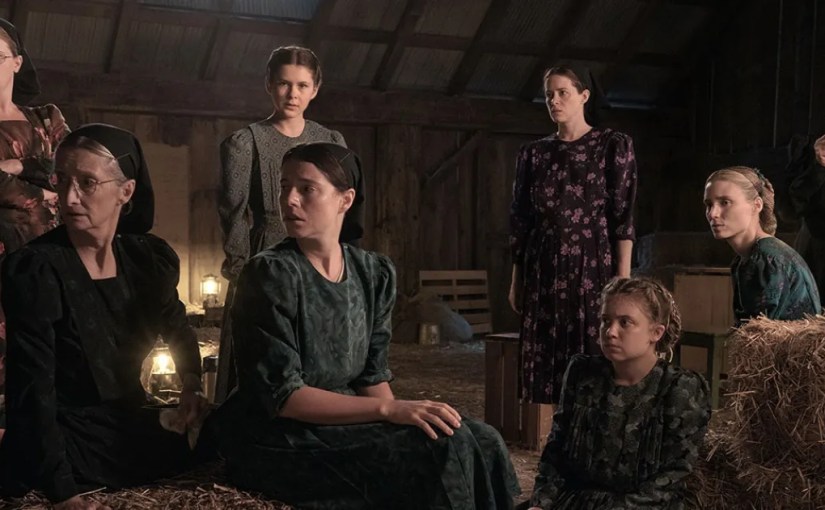
Sarah Polley’s film works like a stage play.  She shoots with deliberately dim cinematography as if to have you feel the cold, helpless isolation the women of this fictional community endure.  These women are smart but uneducated in reading or writing.  When they vote for what do, pictures are drawn to display their options.  Two figures with dueling swords are drawn for stay and fight.  A horse is sketched for the choice to leave.  The women cast their ballots by drawing an X under the picture they opt to follow. 

To know that this piece of fiction is inspired by true events is very chilling, and when the film finishes there’s much to ponder and talk about.  It stays with you.  A young educated man named August (Ben Whishaw, in a beautifully reserved performance) from a university is recruited to keep the minutes of the meetings.  Topics of debate include if they should leave with a mass exodus of all the women, do they also take the young boys; most of them products of the numerous rapes they suffered through.  At what age are these boys incapable of trusting they will not be as monstrous as their bastard and abusive fathers?  What about August?  He is harmless and sympathetic to the ladies’ victimizations.  Shouldn’t he be allowed to go too, or because he is a man, is he excluded?  Frances McDormand’s character, whose appearance lives up to the name Scarface Janz, insists upon doing nothing.  She’s convinced they will be denied entrance into heaven by their almighty God.  To not forgive their attackers is a sin.  Is doing nothing an option?    If they stay and fight, how exactly will that be done?  Violence is an unforgivable sin, as described in doctrine.  How else do you fight against the constant attacks of violence, though?

Women Talking deserves an audience.  It’s a very good film because it draws attention to a modern day hardship.  When there are communities like this in the world that most of us are unaware of, how are the members accounted for?  Are they being nourished and educated and living comfortably?  Is everyone safe and protected?  If they are not, then how are they getting the justice they are entitled to, and do they have a chance of survival?  I appreciate when movies can open my eyes to a reality for which I have yet to carry any regard or awareness.  I feel taught having watched a movie like Women Talking

When the movie began, before knowing anything of what the story was about, my first presumption was that maybe this is an Amish or Quaker community based on the farm country setting and the simple wardrobes of the characters.  The time frame was uncertain to me as well.  Horse and buggies are shown, but no automobiles.  So, is this the early twentieth century, perhaps?  Only after the first ten minutes of exposition, did I realize this was something else taking place within a more recent time period.  It is astounding how far we’ve come globally with the rights of women, minorities and the overall oppressed.  Yet, there are those who regrettably remain overlooked.

Polley’s script is rhythmic with strong dialogue, and the cast of actresses (Rooney Mara, Claire Foy, Judith Ivey, Frances McDormand, Jessie Buckley) are quick with their retorts when one makes one statement after the other.  There are lots of fascinating arguments at play here, reminiscent of Sidney Lumet’s 12 Angry Men.  Again, this is gripping material ready for live stage work. 

I did have a problem with the picture, however. The trajectory of the film works on its dialogue of debates.  The actors deliver lines from Polley’s script perfectly.  This is a smart collection of actors.  Still, it is challenging to keep track of what platform each woman stands upon.  When one gets swayed from one argument over to other side, it is also a little tricky to realize when that has occurred.  Who is staunch in their beliefs is also difficult to keep track of.  The dark photography that Polley layers the film with is meant to be morose.  It works.  It places you in the helpless mood of these afflicted women.  When you consider the practicality of the piece though, it makes it hard to identify who is who and what perspective they have.  Often, the characters don’t stand apart from one another.  It might sound trivial.  I may risk putting a stain on the filmmaker’s art.  Nonetheless, but it got in the way of the movie I was watching.

It is a blessing that Women Talking has received Oscar nominations for Best Picture and for Sarah Polley’s screenplay.  Had it not, the film would likely go unnoticed, and it cannot afford to be.  Sarah Polley’s film deserves attention.  Any one of us may never come upon these very private, hidden, and isolated communities that function under an unfair governance.  However, the film demonstrates the vicious dominance that one sex can have over another which still remains all to common.  No matter how much wiser we have become as a people, there are some who still have never gotten the message.

GUESS WHO’S COMING TO DINNER

By Marc S. Sanders

Watching Stanley Kramer’s Guess Who’s Coming To Dinner had me reflect on a brief encounter I had many years ago.  I was a head teller in a bank and approached the drive thru window to collect a customer’s transaction.  The junior teller who was part of my team got there before me and as she reached for the checks and deposit slip she commented “That’s disgusting!”  I was so engrossed in a busy day that it didn’t register until later what she was referring to.  In fact, I’m proud it did not register.  The customers in the car were a mixed couple with two children in the back.  I guess I’m happy to be naturally color blind.  Sadly some others still live with such an ailment.  We’ve come a long way, but I think we have a lot further to go.

Guess Who’s Coming To Dinner is a classic American film that should be watched by anyone with a pulse.  If not for anything else, then to realize that somehow our human nature is held back by prejudices that we can not keep from considering.  So, let’s learn to overcome whatever foolhardy thinking stands in the way of happiness for ourselves and our loved ones.

Sidney Poitier portrays Dr. John Prentice, a gentlemanly successful, polite, and brilliant physician with an educational background from Johns Hopkins, a professorship at Yale and internships with the World Health Organization in Africa and Asia.  He has just flown into San Francisco from a Hawaiian vacation with the young girl he has fallen madly in love with, Joanna Drayton (Katharine Houghton).  Joanna is the daughter of Matt and Christina Drayton (Spencer Tracy, Katharine Hepburn).  She is a highly energetic twentysomething with an optimistic view on life.  Everyone else has to take a second look at the fact that Joanna is paired up with a Negro or a colored man (as the movie indicates).  Even their cab driver has to offer an odd glance while the happy couple kiss in the back seat.  John is even aware that it can be a little startling at first.  Joanna doesn’t give it a second thought as she was raised by liberal parents who taught her that no race or creed is better than any other.  Everyone is equal.

The test for Matt and Christina however is whether a black man can be a husband to their white daughter?  It’s much different when you are on the outside looking in.  How do you respond when such a scenario occurs within your own household.  Even the black loyal housekeeper to the Draytons, Tillie (Isabel Sanford), takes a serious contempt towards the situation, more vocally than Joanna’s parents.  For Tillie, this is a hairbrained stunt by a wild-eyed young girl.  John’s parents fly up to meet Joanna and they have reservations as well.  It does not help that John doesn’t share with his mom and dad that Joanna is white ahead of meeting her in person.  Joanna also did not offer the same courtesy to Matt and Christina about John.  Curiously, for Joanna it should not even make a difference.  For John, he’s hesitant because he knows this will not play out well, initially. John is okay with his new, loving relationship.  He’s wise enough to know that his parents, particularly his father, will not be, however.

What caught my attention more than anything was the difference in age between John and Joanna.  He’s 37.  She’s 23. 

In Stanley Kramer’s film, there isn’t so much a prejudice towards whites or blacks.  It’s more so that there is a reservation toward a mixed race couple.  Should blacks only belong with blacks, and whites only belong with whites?  Of course not.  However, biting sarcasm is tossed into the script suggesting that what Joanna and John are doing would be considered illegal in 14 states.  It wasn’t at the time of the release of this film in 1967, but this was just ahead of when Dr. Martin Luther King Jr was assassinated amidst the civil rights movement spreading throughout the country.  Joanna even makes reference to the fact that she would not let go of John even if her mother was Governor of Alabama, who at the time was Governor Lurleen Burns Wallace, wife of notorious segregationist and former Governor George Wallace.  As well, let’s face it.  While it might be legal on the books, many in the United States were still intolerable of a living situation like this. Legally, a mixed marriage can happen.  Yet not everyone settles for just accepting what is law. 

Spencer Tracy as Joanna’s father Matt is the one who most prominently struggles with this situation.  He’s insisted upon to offer his blessing on John and Joanna’s upcoming nuptials.  However, he’s on a deadline to approve as they are flying out of town later that night and will get married in ten days while John is working in Geneva.  This is all contrived to contain the story within one day where a beginning is offered that must arrive at an end that provides closure.  It’s kind of sitcomy.  Christina warms up to the idea.  She likes John very much.  It’s Matt who has the problem.  It’s also John’s father (Roy Glenn) who takes issue as well.  His mother (Beah Richards) approves if the children are happy simply because she loves her son.

Spencer Tracy closes the film with his reasoning on the subject.  Arguably it is one of the most well thought out soliloquies in film history.  What I took away from it the most is that he stressed his concern for how hundreds of people across this country will look upon John and Joanna with unjustified derision.  Yet, the young couple will have to plow on and survive through those challenges. 

As a film, I could not help but account for a common theme in the picture which did not have so much to do with race as it did with a change in generations.  First, Kramer offers a quick escapist scene where a white delivery truck driver is bopping along to the latest rock music.  Tillie’s daughter joins in and hops in the truck for a ride with the fella.

Matt drives to a diner with Christina and orders an ice cream float.  Upon leaving, he accidentally backs his car into a young black man’s hot rod.  The older white man has to negotiate and accept fault with the younger, frustrated black man.  Once it is settled, Matt vents to his wife that he runs into one of them everywhere he looks.  Times have changed.  Matt has taught his daughter that no race is better than any other.  Does he realize that as well, though? 

Later in the film, Sidney Poitier as John has a stern conversation with his father.  John says in no uncertain terms that he owes nothing to his father.  He does not owe it to his father to not fall in love with a white woman.  His father owes everything to him for having him as a son, and he will commit that same mindset to his own children, if he should ever have any, regardless of the changes that come of that future generation.

There’s a reason Sidney Poitier is noted as a pioneer for black actors in cinema.  He was the first African American man to win an Academy Award for Lillies In The Field.  He also performed in Guess Who’s Coming To Dinner in the same year he made In The Heat Of The Night, which focused on a black Philadelphia cop headlining a murder investigation in the racist state of Mississippi at the time.  Both films were nominated for Best Picture. Heat won.  Poitier was well aware of the racist strife permeating throughout the country.  Per his insistence for his own safety, In The Heat Of The Night had to be shot primarily in the state of Illinois, away from the southern states that were not ready to accept a black man in an authoritative role.  I recall reading that Poitier refused to be cast in roles as the clown where the black man was treated as the punchline for white people’s entertainment.  He kept to a policy of adhering to roles demonstrating the intelligence of black men the same as other colleagues in his profession who were of the Caucasian race.  What an influence he was because of his doctrine.

Guess Who’s Coming To Dinner does not take daring risks with its story.  Every single character is likable, other than the racist colleague memorably dismissed early in the picture by Hepburn.  At times, the story does play like a sitcom ready to welcome a laugh track.  Nevertheless, it is an important film to see nearly sixty years later when racism and prejudice remain uninvitingly prominent.  The script, written by William Rose, is so sensible.  What is so wrong with a man, any man, in love with a woman, any woman?  Yes.  It feels unconventional when your household has consisted of one race for so many years or decades.  However, despite the difference in the pigments of two people’s skin, happiness is what is most important.  Matt testifies towards his unconditional love for Christina in his closing remarks and determines that is the one true factor in a relationship that must always be questioned whether it is the start of something new or something that has reached its twilight years.

As I come to my conclusion, again I reflect to that incident I had working in the bank with that teller.  What exactly was so “disgusting?”

NOTE: On this second viewing of the film, I specifically paid attention to Spencer Tracy’s closing monologue.  George Clooney recalled on Inside The Actor’s Studio with James Lipton, a story he heard.  Tracy was very ill during the making of this picture.  So ill, that Katharine Hepburn contributed financing to making this film to appease the insurance company that was concerned about the actor being unable to finish the project.  She drove him to and from the studio and often left early with him when she could see he could not go on much longer in the shooting days. During Spencer Tracy’s monologue, you can see him looking down frequently as he delivered his dialogue.  He was reading lines and blocking cues on the floor.  Clooney was just so impressed.  Typically, an actor would be directed to avoid looking down so much and focus on the camera in front of him or the other performers in the scene.  Spencer Tracy was just so impressive with his timing in this moment.  His glances down at the floor were embedded into the behavior of the character.  Sadly, Spencer Tracy passed away 17 days after filming was completed on Guess Who’s Coming To Dinner.  He received a posthumous Oscar nomination for Best Actor.  I like to think the challenge he endured lent itself to an adoring, beautiful and unforgettable performance. 

THE WHALE

By Marc S. Sanders

I still have a lot of catching up to do, but arguably the best performance by any actor in 2022 comes from Brendan Fraser in Darren Aronofsky’s The Whale, an adaptation of the stage play written by Samuel D. Hunter.

Fraser plays Charlie, an intelligent online writing professor.  His course is done online as he has become an enormously overweight recluse, following the loss of his boyfriend, circumstances to be revealed over the course of the film.  Charlie is so obese that he can barely walk, and he confines himself to the left side of his sofa with the television in front of him and his laptop nearby to conduct his courses or to pleasure himself with gay pornography.  He has a walker to get himself on to his feet and carry his bulk, but showering is not easy.  Even picking a key up off the floor is an impossibility.

He receives visits from his only friend, a nurse named Liz (Hong Chau).  When she arrives on Monday, she discovers that his blood pressure is indicative of congestive heart failure and urges him to go to the hospital.  He insists he can not afford the bills and has no insurance.  He also receives unwelcome visits from a young man named Thomas (Ty Simpkins) spreading the word of God with brochures from the local church.  Lastly, the visits Charlie treasures the most are from his cruel and mean-spirited daughter Ellie (Sadie Sink) who takes no reservations with berating Charlie as a deadbeat dad and only comes to him because she practically demands he write her essays to avoid dropping out of school.  She also rudely takes pictures of Charlie at any given moment.  Each time she raises her cell phone for a click, it feels like she is giving her father the harshest middle finger imaginable.

Much like an earlier film, known as The Wrestler, Darren Aronofsky explores what comes after the main character has tormented himself into a destiny difficult to escape or be rescued from.  Aronofsky is frank about offering up helpless souls only now living with everyday ongoing pain both physically and, as we discover, more importantly, mentally.  Highlights of Charlie’s day are when the pizza is delivered and he shouts through the door that the money is in mailbox.  The delivery guy knows the routine all too well by now and the best he can offer is to ask if Charlie is okay while never seeing his grotesque appearance.

Aronofsky doesn’t offer much variety on the surface.  The film takes place entirely in Charlie’s apartment.  Sometimes we go down the hallway and see another room or we get a conversation between Liz and Thomas on the front porch.  The cast only boasts seven actors.  Yet, Hunter’s screenplay is not limited to what Charlie is having to endure.  There is also an unexpected backstory to Thomas and there’s more to uncover with Liz and Ellie. The pizza delivery guy, who we never see, even discovers something.  One particular essay about Moby Dick that Charlie desperately urges Thomas to read out loud early on has a surprising significance that I didn’t see coming. 

Still, the film belongs almost entirely to Brendan Fraser and how he enhances the performances of his cast mates, particularly Sadie Sink.  Their scenes are so well performed.  She is an outstanding young actor working on a manic level.  I imagine Sadie Sink had to come down from the hyper activeness of her scenes.  She is uncompromisingly mean. When the director yells, there is no way she could just turn that characterization off.  I bet she walked away from the set to catch her breath.  Opposite her, Fraser’s character has no choice but to be more restrained.  Physically, it is hard for him to breathe and therefore speak at times at a high octave.  He cannot stand up very well and rush to embrace his daughter even if he wanted to try.  She is mean enough to challenge him though.  The outcome of that moment will have you hate her character for sure.  Yet, you don’t forget she’s a kid and her current state is a product of something else, perhaps from Charlie’s past misgivings.

Timewise, they are also on uneven playing fields.  Hunter’s script counts down the days as the top of some scenes depict it as Monday and then Tuesday and so on.  Charlie is running out of time and has a lot of hanging threads to tie off.  Ellie has an entire life ahead of her to name call and scream at him and hurt him, but Charlie cannot afford to upset someone and work on apologies later.  The best he can take advantage of right now is to appeal for all the wrongs he’s committed or been accused of.  Most importantly, can he fix his relationship with his daughter?

Liz is a health care professional by trade and knows what is best for Charlie, but likely also knows it’s too late and rather hopeless, considering his current condition.  So, it only makes sense to surrender to his needs by bringing him meatball subs and barbecue ribs.  What she is determined to do is to keep his daughter and ex-wife away from him.  It’s a conflict that Charlie has no choice but to allow.

Thomas is that last new person to ever enter Charlie’s life.  Yet, what is his gospel of God and salvation going to do for Charlie now?  Charlie can’t keep this kid from coming over, but is he really going to listen and take any of it seriously? 

Brendan Fraser’s performance is so limited to the setting of the film and the physical restraint of being a large man with no flexibility.  However, he provides so much in the pain his character has suffered long before the current week captured on screen.  It’s an astonishing achievement in acting.  Within the bulbous head depicted in so many closeups are tired eyes that have gone through so much like toiling with leaving a marriage in exchange for a homosexual relationship, and weakening a connection with his child.

Beyond the enormous weight he lives with, Charlie also lives with an unhealthy food addiction.  Just ahead of the last act of the film, Aronofsky is relentless in showing how Charlie responds to personal suffering, not physical, by drowning himself in enormous amounts of sloppy and messy food as Fraser guzzles everything into his mouth.  Charlie suffers from so much more than just being morbidly obese.  He could live with that.  It’s other moments and people and losses in his life that are hard to continue to live with.  The difficulty of those things is cursed upon by Charlie with uncontrollable amounts of food.  Some people who suffer with difficult matters might hide in bed all day or binge watch television for an entire week.  Some turn to drugs and alcohol.  Charlie binges on food.  He doesn’t love his food.  He only uses it to drown out his pains.

I imagine it’s hard to learn about people like Charlie who are held down by the challenge of extreme obesity.  They have become so physically large that they literally can not get up from their sofa without help and therefore never leave their homes.  Because they never go outside, we are unaware of people like this.  I once had a neighbor that I never, ever saw.  I could hear their TV in the apartment next door but I never saw them.  How is that possible?  Why is it that they never revealed themselves?  There’s a story there.  Maybe a terrible or uncontrollable dilemma.  Darren Aronofsky, Samuel D. Hunter and Brendan Fraser offer a glimpse into what goes on behind this closed door.  It’s heartbreaking. 

Maybe it is so tragic because of why Charlie is shown within his confines by Aronofsky, written within the circumstances that Hunter offers and most importantly demonstrated by Fraser as a man ready for his life to end.  If only he can resolve a final digression with his teenage daughter suffering from a pain of anger likely instigated by him. 

Again, Brendan Fraser’s performance is the best one I have seen this year, and with no doubt in my mind, he should absolutely win the Oscar.  This could go down as the best accomplishment is his colorful career. 

THE USUAL SUSPECTS

By Marc S. Sanders

There’s something inviting – or maybe intriguing – about seeing a person in a hat with a dark trench coat on.  Just the person’s silhouette will leave you asking for more.  What is it to this guy?  Steven Spielberg does that in the first few minutes with Indiana Jones in Raiders Of The Lost Ark.  Before Indy, there was Orson Welles as Harry Lyme in The Third Man.  Guys like these have a danger to them, and we can’t look away.  In The Usual Suspects, one of many variations of a legend called Keyser Soze has a dangerous reputation that carries him, and we want to know more about the figure in the hat and coat.  In the first few minutes of the film, we see this mysterioso extinguish a kerosene flame by urinating on it.  Who is this guy?  Maybe we, as the viewers, are Icabod Crane looking at an updated inspired spawn of The Headless Horseman.  Perhaps, we are actually catching a glimpse of that boogeyman who hid in our closets or under the beds.

Bryan Singer’s modern day film noir, masterfully written with inventive riddles by Christopher McQuarrie, works towards its ending as soon as the opening credits wrap up.  Each scene hops from a different setting or time period and as a viewer you feel like you are sitting at a kitchen table turning puzzle pieces around trying to snap them together.  Not all of it makes sense by the time the picture has wrapped up.  That’s okay though, because one of the players in the story perhaps played a sleight of hand and we can do nothing but applaud when we realize we’ve been had.  Magic is fun when you never quite realize where or when the deceit began.

A scenario is set up early on that assembles five different kinds of criminals in a police lineup.  It works as a device to team these guys together to pull off additional heists.  A prologue to the film depicts the aftermath of their last job together.  One holdover, a hobbled cripple named Verbal Kint (Kevin Spacey) is brought into a police precinct to be interviewed by a determined detective named Kujan (Chazz Palminteri).  Verbal might ramble on endlessly in circles about nothing, but Agent Kujan is going to get to the bottom of what happened the night prior on a shipping dock that turned up several corpses.  How did it all go down, and where is the money and cocaine that was expected to be there?

Verbal was one of the five in that lineup, along with McManus (Stephen Baldwin), Hockney (Kevin Pollack), Fenster (Benicio Del Toro) and Keaton (Gabriel Byrne).  Each carries a different specialty or personality, but Keaton is the guy that Kujan is really after.  He’s a master criminal who’s been known to fake his own death, supposedly turn legitimate while dating a high-priced lawyer, and now may be the lead suspect in an armored truck heist.  On the other hand, maybe it was one of these other four guys. 

Amid all of this back and forth and side stepping stories, there is mention of a name – Keyser Soze.  Whenever he comes up in the vernacular of the script, the mood seems to change.  These criminals, usually comfortable in their own cloth of transgressions, get noticeably frightened and concerned if there is even a remote possibility that this Soze character is the engineer behind what follows them. 

It’s fun!  The Usual Suspects is fun.

McQuarrie’s script will toss out names of people we never meet.  It will quickly imply an anecdote from another time.  It’ll share a bunch of short stories with how these five guys work together, like upending a secret criminal sect of the New York City police force while robbing them of their fortunes. Yet, a tall tale of lore will intrude on their typical heists to derail what we may normally be familiar with in other crime dramas or noir films.   

Spacey is the real star of The Usual Suspects.  He earned the Academy Award for Supporting Actor because Verbal Kint is so well drawn out as a weak, unhelpful, and frustrating man.  Often, you ask yourself what the heck is this geeky looking crippled guy even talking about. 

On other occasions, I’ve noted that sometimes with movies I can not determine if I just watched a superior film or dreadful nonsense until I’ve reached the final five minutes.  The final five minutes of a movie can be the verdict.  Sometimes you’ll claim the journey getting there was great, but the conclusion was a big letdown.  If you have never seen The Usual Suspects, then you likely won’t know if the path towards its end is good until you’ve reached the culmination. 

Roger Ebert couldn’t stand this picture, and I’m not going to say he didn’t know what he was talking about or that he was wrong.  Bryan Singer and Christopher McQuarrie’s assembly of scenes don’t make for a well-defined picture, even after the movie is over.  Ebert was less than fond of that technique.  I think that was their intent, though.  Everything you have seen doesn’t have a suitable answer.  Certain parts don’t link well with others.  However, the director and screenwriter were always working towards an ending while piloting the film in swerves and unexpected knee jerk turns.

Unlike Ebert, however, I’m wholly satisfied with the film.  In fact, the first time I saw the movie, I cheered for the conclusion that got more than just one over on me.  On repeat viewings, knowing how the picture wraps up, I treasure the path towards its finale. 

If you study Verbal Kint, you’ll realize that he doesn’t offer easy answers and explanations for what’s occurred, thereby lending to the frustration of Agent Kujan who only demands cookie cutter, fall-into-place arrangements. What can I say Roger Ebert?  How else should I lay it out for you Agent Kujan? Life is messy with no easy answers sometimes.  Especially, in film noir.  

Ironically, one of Ebert’s favorite cinematic characters is Harry Lyme.  So, I guess Keyer Soze couldn’t live up to that threshold or repute.  If that’s the case, then I forgive you Roger.