ORDINARY PEOPLE

By Marc S. Sanders

Psychiatry is regarded as a stigma within the world of Ordinary People.

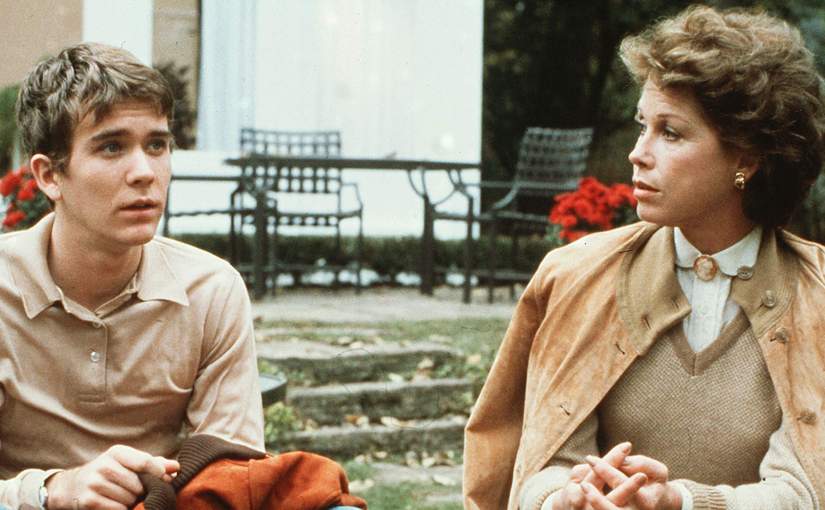
Robert Redford’s Oscar winning directorial debut centers on a troubled high school student named Conrad (Timothy Hutton in an Oscar winning role) who finally gets the gumption to see Dr. Berger (Judd Hirsch) following a suicide attempt brought on by the guilt he carries when he could not rescue his older brother, Buck, in a stormy boating accident. His parents, Beth and Calvin (Mary Tyler Moore and Donald Sutherland), accept this action with differing viewpoints.

For Beth it’s shameful and unnecessary to see a doctor. Her stance is made all the more clear when her own mother frowns upon this, especially with this doctor being a Jew. On the other hand, Calvin looks at it as an opportunity for a breakthrough. This doctor could really be good for Conrad. Beth is embarrassed when Calvin has a few drinks at a neighborhood dinner party and shares these developments with some friends.

For a WASP community, seeing a psychiatrist is not regarded well. It shows that Beth’s image of a perfect lifestyle is tainted. Any problems they have should be resolved in the home. What never occurs to Beth, however, is the resentment she fails to hide for her second son. There’s nothing breaking through Beth’s exterior to allow her true feelings to come out. By contrast, Conrad gradually lets his inner struggle loose and the film shows that it helps, as challenging as it could be.

In 1980, the prior year’s Best Picture winner was Kramer vs Kramer. Three years later it would be Terms Of Endearment. Hollywood was recognizing an audience’s interest in the domestic life. The Vietnam War was now in the past. Reagan economics were taking over and middle-class America seemed to be doing well. Redford’s adaptation of Judith Guest’s novel with a screenplay by Alvin Sargeant showed what was happening behind closed doors. Dramatic moments occur and they can offer a terrible shock in the moment but as days move on, so does everyone around you. You make efforts to do so as well, but you’re still weighed down by that one moment of loss.

Redford directs Hutton with quiet moments of anguish. Quick cut flashbacks offer a glimpse of what’s running through Conrad’s mind. Fortunately, it doesn’t run too long and upstage Hutton’s performance. Timothy Hutton is astonishing with his twitches and stutters and struggle to simply sit still. His blank stare of his blue eyes covey his deep depression. When a girl classmate takes notice of him, you feel the remedy of his sessions starting to make a difference. Where his mother refuses to recognize his need for love, someone else does and you feel better about yourself as well.

There’s always a reason to live. Dr. Berger reminds Conrad of that. Judd Hirsch is right for his role against the waspy wealth of Conrad’s upbringing. He encourages a “not giving a shit” attitude to how people perceive Conrad. We all want a mother’s love, but it doesn’t always work out that way. We want to be accepted at school. That might not work out either. With his sloven stature and chain-smoking manner, Hirsch is very convincing in reminding Conrad to say it’s okay to tell someone to fuck off, and most importantly to stop punishing himself for saying it.

Mary Tyler Moore and Donald Sutherland work incredibly well at conflicting with each other while also convincing us that before this terrible accident they likely complimented one another perfectly. Yet, as the film explains, life gets messy. The question is how best to respond when the mess appears and stays with you. Conrad finds the benefits in seeing a therapist like Dr. Berger. Beth will hear nothing of the idea. A magnificent scene done with one tracking camera comes out of nowhere while Beth and Calvin are playing golf with relatives. A slight mention of their son by Calvin gradually explodes into what really sets Calvin and Beth apart from one another. All of their sub conscious thoughts explode on a crowded golf course in front of the community they’ve absorbed their history and marriage within. Redford gets the best beats out of his actors because the shields that maintain their personas will only hold for so long. It’ll break down at a time when it’s never opportune or convenient. This scene occurs near the end of the film as we see Conrad’s recovery, while Beth and Calvin are still mired in both individual and shared heartache and resentment. It’s a crescendo moment that the film builds to for these characters.

Within film discussions, Ordinary People is often sadly regarded as the film that once again denied Martin Scorsese of a well-deserved Oscar (for arguably his greatest work Raging Bull). I don’t think that’s fair, however. Some might say Ordinary People may be dated. However, now that I’ve finally seen the film, I can’t deny it’s importance. Mental health has become more apparent through all kinds of different social classes. Yet we still hide ourselves, and are encouraged to shelter ourselves under a facade of happiness. That can’t always be true for any of us. We, as humans, all suffer. We all feel pain or embarrassment or sadness. If anything, a piece like Ordinary People reminds us that we are all typical, and must succumb to dealing with issues far beyond our mental capacity at one time or another.

OUT OF AFRICA

By Marc S. Sanders

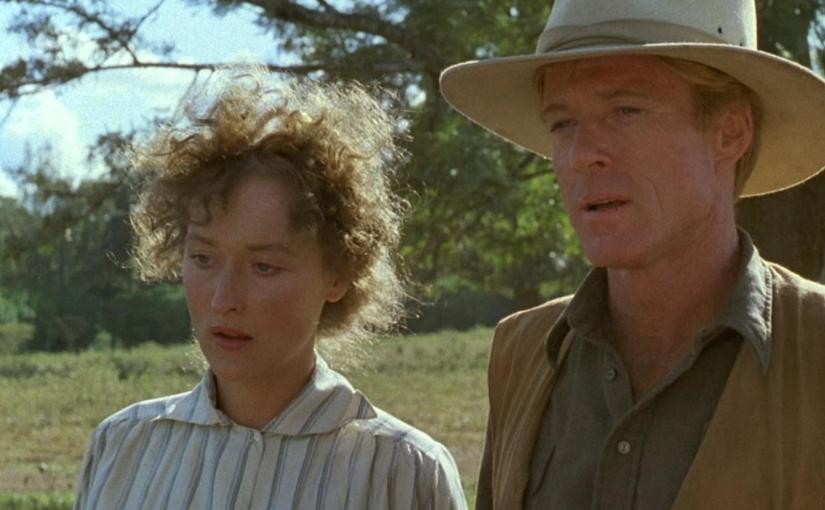
Sydney Pollack’s Out Of Africa might seem like a whirlwind romance if you’re only looking at the top billed names of the cast, Robert Redford and Meryl Streep, but it’s much more than that. It’s an education of the African continent beginning in 1913 when World War I was on the brink, and the British monarchy appeared to become territorial of its lands.

Karen Blixen (Streep) is a Danish Baroness who marries a Swedish nobleman, Baron Bror Blixen (Klaus Maria Brandauer) out of simple convenience. She plans to begin a cattle farm outside of Kenya to manage with Bror. To her unfortunate surprise, Bror has invested her monies in harvesting coffee on the land, which is much more difficult to produce at the altitude where they settle. Bror is also not so concerned with growing to love Karen and would much rather hunt on safari and be a womanizer, while welching off of Karen’s enterprise.

Karen grows to love Africa with its wildlife, as well as the local people whom she does not object to them squatting on her property. She provides medical aid and schooling for the children, too.

Karen also encounters the dashing adventurer, Denys Finch Hatton (Redford). Denys comes in and out of her life where he welcomes her on expeditions that are up close with lions and rhinos. He also takes her in his biplane to get God’s perspective of the lush scenery, a major centerpiece of the film. Denys, however, is not concerned with offering the full commitment Karen seeks. He’s happy to carry on with his safari treks only to return on occasion.

Clocking in at nearly three hours, Pollack’s film gives plenty of time and footage to absorb gorgeous landscape views of Africa from above and across the plains. The cinematography is on par with some of the best I’ve ever seen in a motion picture, compliments of David Watkin. The colors of sky with green, brown and yellow landscapes are breathtaking. Sunsets are spectacular with Redford’s silhouette in the foreground. Herds of cattle consisting of oxen, gazelles and lion feel so up close and personal. The production design of Karen’s home and coffee farm are also noticeably authentic. The home feels comfortable.

Out Of Africa is based on the stories told from Isek Denisen, Karen’s pseudonym. Like many of these sweeping epics, I find that I need to get accustomed to the nature of the film first. Dialects, when done authentically like Streep always strives for, are challenging for me to understand initially. The African people are hard to understand at times. As well, this is a period picture in a territory that I’m mostly unfamiliar with. So, I find that I have to adjust to the habitat and culture of the characters. Frankly, the first half hour or so was a little tough for me to stay with the picture. Once I got my footing with the film, though, I could not get enough. I felt terrible for Karen when she contracts syphilis. I was truly annoyed with how the Baron treats Karen with such disdain. It’s also heartbreaking when Karen and Denys are in disagreement with one another, simply because I loved the chemistry between Redford and Streep. Later setbacks feel tragic, especially as you feel like you’ve traveled through the progress and impactful differences that Karen affectionately made for Africa and its people.

Out Of Africa is an outstanding piece of filmmaking. It’s another example of a film where the setting is as much a character as the leads who carry the story. Sydney Pollack and his crew, which includes grand horn and string chords from Oscar winning composer John Barry present a captivating story that also feels rich in a documentarian point of view. A restored copy of the film on a large flat screen TV is a must see.

ALL THE PRESIDENT’S MEN

By Marc S. Sanders

People talk too much.

Ten minutes into Alan J Pakula’s film, that’s all I can think about. William Goldman’s dialogue heavy script pounds away at depicting Washington Post reporters Carl Bernstein and Bob Woodward’s uncovering of the Watergate break in, and it shows that simply, people talk too much. So much so that just a stutter or a name in passing conversation will dig the hole deeper and deeper towards self-incrimination, and that of other accomplices. Once a source trips up, then a good reporter can pounce.

Names, dates, slamming doors, rotary phones, typewriters and papers fly fast and furiously during Pakula’s film and that’s what upholds the breakneck pace of the investigative journalism. In a film like this, a crime is depicted and investigated, only the words are the real weapons.

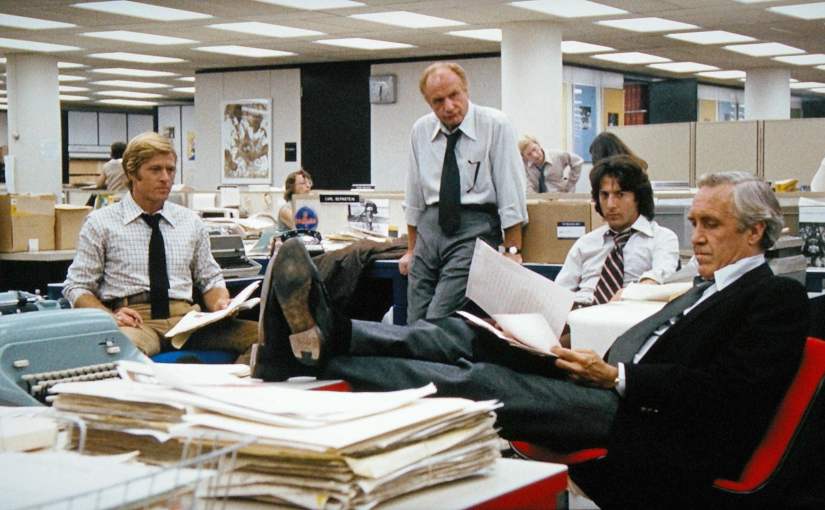
I don’t find All The President’s Men to be a history lesson in the corruption of Nixon’s administration. Rather, I only see what was necessary for Woodward & Bernstein to truthfully prove the corruption took place. The reporters, played by Robert Redford and Dustin Hoffman, seem to run on endless adrenaline of coffee, cigarettes and fast food effectively showing their drive while donning loose ties, wrinkled shirts, and crumpled notepads amid unkept desks and apartments. It’s visually convincing. A story like this doesn’t sleep, nor does it take a vacation. A story like this makes a viewer feel like he/she is still up at 2am, catching a cab to meet a shadowy source in a haunting parking garage; thanks Hal Holbrook for Deep Throat (“Follow the money.”).

Redford has a great scene where Pakula never stops running the camera on close up for over six minutes. All that Redford is doing is dialing, and talking on the phone while maintaining two different conversations. I don’t know if this moment happened in real life but I imagine the best reporters in a pre internet phase had to hold out for opportune times like this to fall into their laps. The cut does not end and Pakula was instinctively wise to do that. The scene itself serves that harrowing pace. Less is more in a moment like this. Props to Redford for maintaining the statuesque momentum.

Equally so, Hoffman has a couple of good moments with Jane Alexander (his eventual costar in Kramer vs Kramer.). She beautifully depicts a victim of intimidating threat, and Hoffman must tread carefully with his questions by strategically letting himself into her home, puffing on a cigarette, sipping cold coffee, speaking softly and eventually getting out his notepad as she gradually breaks down her shell. Alexander doesn’t make it easy and so their scenes work so well in taut suspense of low whispers.

Nixon’s cohorts really are not the antagonists here. In essence, Goldman’s script (based on the reporters’ published book) welcomes the challenge of acquiring factual reporting as the overall conflict. This is best represented by Jason Robards’ portrayal of Post Editor Ben Bradlee. Robards won an Oscar, and he so deserved it. He wouldn’t give “Woodstein” a break until the truth willed itself out by the proper means that are necessary. He’s intimidating in the role but he’s open minded enough to not ignore the young reporters’ instincts. I love watching his scenes; the way he commands an office from a chair with his feet up or fidgets and writes with his red pen. When his boys finally get a solid piece, Bradlee’s character breaks for one moment to knock on a desk and clap his hands as he walks away from his men. They got it. He didn’t relent, and they finally got it. I love that moment. Simply marvelous.

All The President’s Men remains a favorite film of mine. The dialogue moves so fast that after seeing it a number of times I still haven’t connected all the dots, and yet that’s what I appreciate about it. I see something new every time.

NETWORK

By Marc S. Sanders

Without question, what would become the absolute most prophetic film ever made is Sidney Lumet’s biting, satirical masterpiece called Network with its script from Paddy Chayefsky. 

Network works on all cylinders because it was released following a shedding of maybe the last of pure American innocence.  The country had finally pulled out of a losing war in Vietnam.  Our President Nixon was shamed out of office.  Happy housewife programs like The Donna Reed Show and Leave It To Beaver were behind us.  The outright, prejudiced Archie Bunker was who Americans were tuning in to each week.  There was even an incident of a newscaster, named Christine Chubbuck, who shot herself dead on live television.  Looking back, today in 2022, it all seems inevitable that we would arrive at where we are now; where we are always seeking some semblance of showmanship and we’ll get our own brand of infamy no matter how desperate we become.

Chayefsky’s script focuses on the fictional network of UBS in present day, 1976.  Well known newscaster Howard Beale (Peter Finch) announces on air that the following week will be his last broadcast as the network has opted to let him go due to poor ratings.  So, he entices his viewers to tune in when he will kill himself live on the air.  It’s a hilarious scene actually due to the ignorance of everyone else in the studio.  The director is flirting with his assistant. Another crew member is eating a sandwich.  No one is even paying attention to the centerpiece they have on the air.  Howard Beale has been taken for a granted as a has been for so long, it really doesn’t matter what he has to say as long as he’s reading the cue cards.  Who’d ever announce on live television in front of millions of viewers that he was intending to kill himself?

Max Schumacher (William Holden), the head of the news division, takes his friend into hiding from the media frenzy suddenly created.  Yet, the next night and after much convincing, Beale is permitted to go on the air again, and make a statement to undo whatever outlandish damage this has all become.  Instead, he decries that life is bull shit.  Max, fed up with the corporate tugs of war already, opts to leave him on and ironically a new opportunity presents itself.  Beale’s moment of insanity and his gradual mental breakdown might be real, but man, this could also pull the UBS news division out its ratings slump and bring it ahead of CBS, NBC and ABC. 

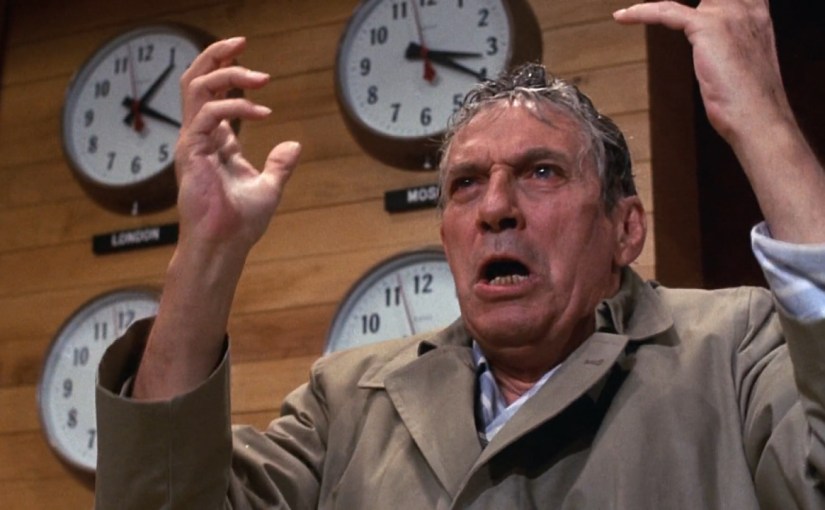
The young and energetic Diana Christensen (Faye Dunaway) in the entertainment division, works her way into the news division and takes over its programming from Max.  She convinces the corporate honchos like Frank Hackett (Robert Duvall) to use Beale as a ratings appeal.  The entire company eventually understands what Diana foresees could actually work when a rain-soaked Beale storms on to the studio set urging his viewers to shout out their windows that they are “mad as hell, and I’m not going to take this anymore.”  Now, the evening news consists of sections featuring Howard’s ranting and ramblings, as well as Sybil The Soothsayer and other such nonsense, most notably a new program from an actual terrorist group known as The Ecumenical Liberation Army. 

From there, the detritus of what UBS commits to for lead ratings night after night only validates that television is not about morals and objectivity in the industry of news reporting.  A slight telling moment has Beale come to Max with an old black and white photograph of them posing with the likes of Edward R Murrow and Walter Cronkite.  They reflect joyfully on the memories, but now they are just memories. These kinds of men of the airwaves no longer exist. Beale is now a jester to the masses who tune in for his mad man speeches labeled as “news.” 

Long before the buffoonery of out of touch Presidential Candidates and over opinionated newscasters who lacked any merit or research to uphold their viewpoints, Chayefsky and Lumet were nervy enough to actually believe moviegoers would buy this satire. 

No matter the medium, satire is maybe the riskiest category of entertainment.  Someone is going to be pissed off and offended.  Others won’t believe this could ever be possible.  In elementary school, I remember reading a short story that proposed cutting down on overpopulation by having people eat their young.  You know what?  After much discussion with fellow classmates at the time, the idea had some logic to it.  Recently, Adam McKay wrote and directed a film called Don’t Look Up that presented a what if scenario to the inevitable end of the world by means of an incoming comet crashing down into Earth.  Unlike Network, some of the elements in that film didn’t work for me.  So, satire is a crap shoot.

Had I seen Network when it was first released, I wonder what I would have thought.  Would I have bought all of its absurdity?  I believe I saw it before reality television became such a novelty and ever since that first time watching, I truly accepted the logic that comes across the decision makers at the UBS network.  Corporate functionality, no matter the industry, relies on monies.  Nothing else matters.  UBS quickly learns that image can be spared.  Money is what keeps everyone happy and afloat.  If the performance of the company falters, changes need to be made; no matter how desperate those actions may appear to be. 

So, Howard Beale becomes a sensation for the UBS network and he is at least besting or tying with top rated shows like All In The Family and Little House On The Prairie.  Yet, Howard is also a mentally ill raving lunatic who needs treatment.  What happens when he declares something to the public that is detrimental to the corporate future of UBS, its top one percent, and its shareholders.  You can’t censor a lunatic with reason.  Ned Beatty as Arthur Jensen, the all-powerful, emperor like CEO, delivers a commanding scene that is one for the ages in response.  He truly deserved his sole career Oscar nomination here…all for one scene perfectly staged in a dimly lit board room with his giant stature poised behind rows of green banker lamps.  He turns Beale into his own prophesized pawn.  Now, that may satisfy the man at the top of the pyramid, but at the end of the day, what about the ratings?????

Chayefsky’s script is one of the greatest ever written.  Not only are the satirical ideas so clearly drawn, but the dialogue is biting with truth in its sarcasm and wit.  When Diana suggests giving The Ecumenical Liberation Army its own weekly program depicting real life footage of their massacres and kidnappings across the country, a staffer retorts “What do you wanna call it?  The Mao Tse Tung Hour?”  When Beale asks the god like image of Arthur Jensen “Why me?”, the response is simply “Because you’re on television, Dummy!”

Maybe we thought the limit of influence stopped with television.  The script for Network felt sure of that.  Yet, we’ve graduated from the simplicity of television and we’ve entered the age of the internet.  Suicides and violence, pornography, slander, opinions and viewpoints can all easily be conjured up by the devices we use to access the internet and we can slant our own news stories in our own way.  News is no longer reported with an objective, omnipotent narration.  It’s dramatized.  I may be a resident in Florida but if someone captures a live on-going police car chase happening on the freeways of Los Angeles, it’s brought to my attention for the thrill of the story.  From a news perspective how is a car chase on the other side of the country relevant to me?  I don’t know the drivers or what motivated them.  I don’t live there.  So, it’s not going to affect my commute home.  Yet, my local news station finds it imperative to show it to me.  No matter the heights of insanity a subject may be, if it’s watchable with a ratings potential, I can rely on my local journalists to bring it to me fast and immediate with zoom in close ups and hi definition.  They’ll even replay it for me in slow motion a hundred times, just to stretch the story until the commercial break.

Network also explores the corporate obsession America entered into by the mid-70s.  Chayefsky uses the Diana Christensen character as a departure from the wholesome Donna Reed image.  Women are working in the offices now.  They are beautiful, smart, strong and assured.  Yet, have they also lost their humanity?  Has this happened to only women?  Diana uses her edge to sleep with her mentor, Max, a much older married man of 26 years.  The aging Max surrenders to his libido but is it worth it?  Diana is too quick in bed and while she’s love making, she’s orgasming to the latest ratings poll from her wunderkind, Howard Beale.  Chayefsky demonstrates how maddening corporate America has become by sucking any emotion of love, loss, happiness and sadness that people are heretically born with.  It’s as if a cancer has killed whatever natural stimuli people were gifted with, and he’s not wrong.  People don’t work 9 to 5 jobs any more.  They work 12 to 12.  When they are not working, they are enhancing their “social status” by means of social media. 

Network is one of the greatest films ever made.  Lumet and Chayefsky put everything on display in its no holds barred honesty.  Still, the performances must be recognized.  This film has one of the greatest casts ever assembled.  Dunaway is magnificent as the young woman with the drive to turn the television industry on its ear.  She deserved her Oscar.  Robert Duvall never received enough credit as the unforgiving corporate lackey resting just under the top while making sure profit is provided before anything else.  William Holden was already in his golden years of film acting by this time.  With Beatrice Straight, playing his wife (in her brief but Oscar winning role), they represent an honorable profession and household that is now long gone.  His character is fired twice within the first hour of the film by the modern corporate mentality, and then he’s resigned to write a tired book about his journalistic accomplishments because there is simply nothing left to do.  He’s a dinosaur in the modern age of television and business.  Peter Finch was the first to win a posthumous Oscar for his turn as Howard Beale.  If this character were real and was televised as the film demonstrates, I can’t deny that I would buy into his raving rhetoric.  I’d have no idea what he’s talking about.  I wouldn’t care, but I would tune in later in the week when John Belushi would mimic him on Saturday Night Live.

With each viewing of Network, you find something new to relate with every time.  The reason is that it stays consistent with the evolution of our planetary function.  Even in this age of Covid where stories are never consistent yet always hyped for dramatic impact, there is something to nod at and understand from the messages of Network.  It could be a world war, a new president, an assassination, a school shooting, a police chase, a riot or a pandemic.  Network had already considered the response to any topic that’s ever been the top story. 

Network is one of the most important films ever made.

THE GODFATHER PART II

By Marc S. Sanders

The first film to use the number 2 (or Roman numeral II, in this case), in its title and the first sequel to win Best Picture is Francis Ford Coppola’s continuous adaptation of Mario Puzo’s Corleone family legacy in The Godfather Part II. It is worthy of all of the accolades it collected as an individual film. Yet, it does not best the first film.

Unlike the 1972 classic, Part II does not provide much character arc for anyone. We’ve already seen Michael (Al Pacino, silently ferocious here) change from good college boy and war hero to the evil puppet master Mafioso he eventually became. This film shows him exercising his threateningly murderous deeds as he works in conjunction with a sly Nevada Senator, a Jewish Miami mob boss (an excellent performance from Lee Strasberg) from the time of his father’s reign, and another mob guy from New York (Michael V Gazzo). We get a whiff of all these guys early on during a commencement celebration for Michael’s son. Coppola keeps this a running theme of grand openings in all three films. It’s a great method of introductions each time.

Following the party, an assassination attempt is brought against Michael. But who did it? Problem is this is where the foundation of the film is not so strong. It’s never really made clear who betrayed Michael. That’s a little bothersome.

Coppola depicts another storyline altogether with the early 20th century origin of Vito Corleone flawlessly played by Robert DeNiro who hardly speaks any English while communicating in a Sicilian variant of Italian. Young Vito immigrates to America following an escape from the Sicilian Don that murdered his family. In New York we witness his rise to power. Famed Cinematographer Gordon Willis washes out these flashback images to enhance a pictorial history accompanied by Angelo P. Graham’s art direction of early brick and mortar architecture and the muddy streets of early Little Italy, New York. It’s a time travel back to a historical age. It’s magnificent.

Back in the 1950s, Puzo and Coppola bring authentic fiction to real life history as Michael considers a go at a business enterprise in Cuba. However, will the rebellion uprising interfere with his plans, and what will it cost him? As well, there’s a great sequence where he has to testify before a congressional hearing in response to suspicion of criminal activities. Coppola used the infamous McCarthy hearing footage as inspiration for this predecessor to what C-Span would eventually look like.

Yet, there’s another story to become involved with as Michael must contend with his dim witted older brother Fredo. John Cazale is superb as the guy who wanted more but was limited by the influence of competing factions and his loyalty to his brother. Pacino and Cazale always had great chemistry together. A great conversation moment occurs in the third act following a terribly surprising twist. One of the best scenes in the film occurs on the porch of the Corleone compound.

More story elements come into play as Michael attempts to balance his married life with Kay (Diane Keaton). She’s pregnant again. Yet, what will that mean for the future of the family?

The sequel to The Godfather assembles another stellar cast. So good, that the film garnered three Oscar nominations in the Supporting Actor category alone (DeNiro, Gazzo, Strasberg) as well as a nomination for Pacino as Best Actor and Talia Shire (Supporting Actress) as Connie, Michael’s sister. That nom left me a little dubious only because there’s not much material for Shire to play with here.

Coppola’s detail is at the top of his game again. The film, like the first, feels like a true life biography.

Puzo offers heartbreaking moments, most especially in the film’s shocking end which leads to a flashback assembly of characters from the first film. That scene alone plays as a great reminder of what Michael once was before becoming the hideous monster that closes the story. Puzo’s whole Godfather franchise hinges on well defined, crushing tragedy.

The Godfather Part II is nothing short of mesmerizing and wholly engaging. You can watch it over and over again. It’s layered in rich storytelling and narratives that provide endless amounts of material for a family meant to be mired in secrets, deliberately hidden in the dimly lit rooms that Willis photographed.

It’s a treat to be the fly on the wall wherever Michael and his family move to next.

THE GODFATHER

By Marc S. Sanders

Probably the greatest character story arc in all of film is of Al Pacino’s portrayal of Michael Corleone in Francis Ford Coppola’s The Godfather based upon Mario Puzo’s best-selling novel. (The film is a thousand times better than the book.)

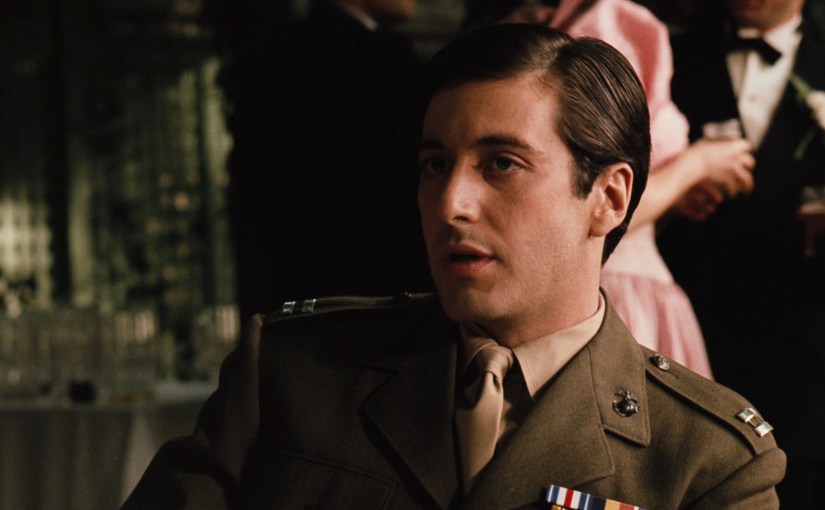
Michael is the youngest of three sons intended for a legitimate life separate from his Mafia family. The masterful opening sequence of his sister’s lavish wedding show him courting his eventual wife, Kay (Diane Keaton), and never feeling proud of the actions of his notorious father, Vito (Marlon Brando), nor his brother Sonny (James Caan) or their consigliere, Tom (Robert Duvall). He’s an innocent war hero in uniform with an open mind of an untarnished future. It is only when bad blood circumstances are tested that he feels forced to strike with the same intent that the Corleone family is infamous for.

Coppola presents quiet, subtle moments of expression in Pacino on camera. You see the change in Michael sneak up on you and you see a character develop into something else entirely. What starts as a false impression to appear as if he’s carrying a gun in his pocket, soon after leads to murder, by means of nothing personal but “strictly business.” From there, he retreats and hides until he is blessed with carrying on an evil legacy.

Yes, the first chapter in the operatic trilogy of crime, is mostly known for a grandstanding performance by Marlon Brando but the story relies on Pacino as Michael. Michael Corleone at least must be one of Al Pacino’s greatest roles. He arguably has one of the most impressive resumes in all of film. Here is where it jump started.

The direction by Coppola is a film student’s required studying. With Puzo’s script, the best idea was to open the film with a wedding. As the film offers so many characters and much back story among all of the guests, the interaction and workings of the family are efficiently condensed into this 25 minute opening sequence. Don Vito meets with people needing favors while outside the home, the crew is dancing, doing their jobs and minding who is watching. By the end of this opening you have a full grasp of the family tree and who works for who and what their characters are like. Sonny is the hot head. Michael is the innocent. Fredo (the middle son played by John Cazale) is not doing much but being a cut up, Momma Corleone is the valued matriarch and Tom is the well managed advisor. You even get a glimpse of some “very scary guys,” some competing hoods, who’s cheating on who, and some people who need help with citizenship and film casting.

Art direction from Alex & Dean Tavoularis is magnificent, depicting a post WWII New York, and a historical Sicily stagnant in open plains, romance and murderous pasts.

The cinematography is better today than it was originally. Gordon Willis returned decades later to (for lack of better word) lighten up the picture. The interiors remain dark in secret and comfort, but the characters are more illuminated. The Blu Ray restoration is a fantastic return to the classic film and its two sequels.

The Godfather is endlessly quotable and never dull no matter how many times you watch it. Puzo’s screenplay plays like the biography of a real person and family, much like his adaptation for the screen of 1978’s Superman: The Movie. It is an American classic rich in a history we believe has been told and carrying on the tradition over the course of a 10-12 year period.

I return to praise Pacino to remind you how his appearance even changes as he gradually builds his strength and accepts his title of Don. I feel like I’m looking at two physically different people from the beginning in his Marine uniform with boyish looks, to his independent walkabout way during his Sicily retreat, to a more broad shouldered, slicked back hair, dark suit tailored appearance during the film’s third act. It’s an uncanny transformation that is built on performance and expert direction and writing from Coppola and Puzo. I still get chills as Michael in his college boy sports jacket volunteers himself to satisfy a family vengeance. Coppola zooms in on him slowly as he sits in a leather arm chair, arms at his side, legs folded. We are seeing a new man in charge for the first time. It’s chilling.

The Godfather is one of the greatest pictures that will ever be made. It’s a perfect chemistry of technical achievement, attentive storytelling and sensitive, yet powerful performances from probably the best cast ever assembled.

I’m amazed that I know of some friends who still have yet to see it.

The Godfather is the film that everyone should see before they die.

FORREST GUMP

By Marc S. Sanders

There’s not much that I can say to further praise the merits of Robert Zemekis’ Forrest Gump. It’s a film of legend though it’s a sore spot for die-hard fans of Pulp Fiction, which competed for Best Picture in 1994. Guess which film won. Tom Hanks won the Oscar for the second year in a row, following his outstanding turn in Jonathan Demme’s Philadelphia. Zemekis won Best Director. Eric Roth’s screenplay won as well.

What holds a lasting impression for me about Forrest Gump is the sweeping travel through time of a man with limited intelligence but unlimited willingness to explore and participate, whether it be as a Ping Pong Champion, a Medal of Honor recipient for heroism during the Vietnam War, a millionaire entrepreneur of a shrimping boat business, or a man who just felt like running from one corner to the next of the North American continent. Forrest Gump never knew to compromise a belief he had, probably because he was never aware of the capability to compromise in the first place.

An interesting theme occurs throughout Roth’s screenplay (adapted from the novel by Winston Groom). The people that Forrest encounters are always shouting their ideals and agendas. Yet no one seems to listen. Not just Forrest though. No one at all listens to each other. Lieutenant Dan (Oscar nominee, Gary Sinese) shouts for an immediate evacuation of a hostile territory under attack and no one on the other end of the line, appears to be listening to him. He orders Gump to leave him there, but Forrest does not listen. Forrest only focuses on rescuing his friends, Lt. Dan and Bubba (Mykelti Williamson). What exactly were Americans like the Hippie movements, the War Veterans, the Black Panther party, even the men in the burlesque nightclubs, as well as the various assassinations attempting to accomplish really? Did they accomplish anything? Did any of these parties make an impactful change, or did they just like to hear themselves talk? Did they just want the recognition for only themselves and no one else? When Forrest meets up with his love Jenny (Robin Wright), in a gorgeous caption in front of the Washington Monument (often shown during Oscar film compilations), he has just shared his thoughts over a loudspeaker, unaware that not one of the thousands of war protestors could hear him because the microphone had been unplugged. Later that day, a Black Panther participant only cares to wave his finger and shout his agenda in Forrest’s face. Is Forrest interested? Is he even listening? Is the Jenny, the hippie and her protestor boyfriend listening? Like many Americans, Forrest was only concerned with what was most important to him; Jenny. When Forrest develops a following during his cross country run, everyone is looking for his purpose and his message, and Forrest is unaware that he needed to offer one. Americans are always looking for the next best following. When Forrest passes the Grand Canyon and stops running, the parade of lost souls behind him shouts, “Now what are we supposed to do?” Forrest doesn’t listen. He just walks away and declares he’s tired. America during the mid twentieth century was lost. Forrest was not. Forrest just went in the direction in front of him.

Zemekis pulls an interesting trick of contrasting Forrest against other regulars. The nurse who sits on the bench next to Forrest is more interested in reading a mundane two dimensional issue of “People Magazine.” A man listening to Forrest’s tale of rescue in Vietnam was only concerned with the bullet that struck Forrest in the butt, not the men he saved or the loss of his dear friend Bubba. The old codgers who hang around the local barber shop in Greenbough, Alabama just watch the exploits of Forrest as the years go by. Their hair gets grayer and their skin gets more wrinkled, and life just passes them by while Forrest passes life by. It’s a subtle, yet effective, device that I appreciate on repeat viewings.

Sally Field contributes to the disregard Forrest has for menial issues. If Forrest is going to be denied going to a regular school because his intelligence level falls a few points below average, she will make certain that does not interfere even if it means pleasuring the principal. Mama Gump has the wit and intelligence. Forrest does not. However, their commonality shows in their disregard for what keeps us from living life to the fullest. Without Mama as his influence, Forrest would never have met the President again, and again, and again.

Mama reminds Forrest that “Life is like a box of chocolates…” You know the rest! It doesn’t matter what we get, as long as we get what we pursue.

her

By Marc S. Sanders

Director/Screenwriter Spike Jones is a master at adding multiple dimensions to what we always know exists. It’s been evident in his prior films, Adaptation, Where The Wild Things Are, (which I did not care for personally), and most especially in Being John Malkovich. He plants the seeds of fantasy in what we can normally touch, hear and see. Then his elements of fantasy receive a supportive crutch from what his viewers have always been familiar with.

her is another masterwork; a film that takes place in the not too distant future that expounds on our current digital age. If we can already talk to “Siri” or “Alexa” and trick–umm, excuse me, “her” (I mean “Siri”) into making sophomoric dirty jokes, then of course we are bound to approach the stage where we can literally, truly fall in love with her and then she can reciprocate.

With her raspy yet silky vocals, Scarlett Johansson is inspired casting as the voice of “Samantha.” Had she actually had a physical presence in the film I would have totally fallen for her affections. The film hinges on the performance of Joaquin Phoenix as Theodore. If we can’t believe that he loves “Samantha” more than he loves himself (a surefire test of true love as far I’m concerned) then “her” falls apart. Phoenix passes abundantly. He deserved his Oscar nomination.

From the start, you become very accustomed to the banter between Theodore and his electronic device voiced by “Samantha.” Both have personal feelings. Both have personal longings (more especially “Samantha” the computer, of all things!!!).

Spike Jonze explores all the diameters and dimensions of a loving relationship. The ups, downs, and in betweens. What’s different is how all of these layers of a relationship are received in this currently fictional (bound to come true, one day) dynamic of a relationship. Theodore and “Samantha” are affectionate. They argue, they laugh, they even make love. Watch the movie to understand that last point. It happens, and it is perfectly executed with the residual effects of their lovemaking bringing the film into its next act brilliantly.

Jones won the Oscar for original screenplay simply for how innovative this picture is. I’m not sure it’s the most exciting two hours of film, however. Personally, I think other films in this category back in 2013 had sharper and more interesting scripts. her is practically all talk and when it ended, I was ready for it to be over, and it concluded as I expected.

Still, Jones is fortunate that his cast (Johannsson, Phoenix, Amy Adams and Rooney Mara and Chris Pratt) trusts him. If they hadn’t, this movie would have lost its magic by probably how absurd this script must have originally been perceived on paper. Well done work by all involved but credit has to begin with Jones, the screenwriter.

THE BIG SHORT

By Marc S. Sanders

Ever since Adam McKay’s The Big Short was released in 2015, it has remained a favorite film of mine. I watch it at least once every year. McKay’s script with Charles Randolph, adapted from the book by Michael Lewis, is enormously funny but also realistically frightening.

The film shows how America’s housing market crashed in the first decade of the 21st Century. Mortgage backed securities never failed in history until now, and no one anywhere, especially the banks, ever believed a crash would occur, but it did. Only a select few people like Dr. Michael Burry (Christian Bale) and Jared Vennet (Ryan Gosling) foresaw what no one else could imagine, and thus they took advantage of it by making enormous betting transactions against the housing market. To say you need a strong stomach for this kind of investment is a serious understatement.

Burry is the first one to realize that the country as a whole will default on their mortgages once their interest rates go up in 2007. He represents Scion Capital and invests billions of dollars against the mortgage backed investments. Now he watches for the next two years while the capital at Scion declines into negative digits and drowns out the frustration with death metal music. Bale is fascinating as Burry who has a brilliant mind, but he lacks social skills.

Vennet gets wind of Burry’s discovery and sells the idea to Mark Baum (Steve Carell) and his team of representatives. Vennett narrates how it all played out in the market; how ratings agencies gave triple A rankings to bonds made up of worthless backed securities. McKay wisely has Vennett introduce celebrities like Margot Robbie, Anthony Bourdain and Selena Gomez to break down the vast complexities of everything. Robbie in a bathtub. Gomez playing black jack. It’s hilarious and relatable. Gosling is great. A great scene is his selling presentation which includes a metaphoric prop of a Jenga tower. Vennet has no qualms about collecting premiums as the rest of the country is going down. He’s profiting, and why not? Big banks have been doing it for years.

Carell is spectacular as well as Mark Baum. He has a heart, but he’s an angry individual. It sickens him to make money off this short buy, but it’s the responsible action to take for the benefit of his own clients. Mark also suffers from his brother’s suicide. McKay allows just enough time for this to draw out the misery of this character. Carell should have gotten an Oscar nomination at least. Baum is a guy with no filter as he confronts authoritarian parties throughout the film. He’s a hero really, but he’s not a guy I’d ever want to be left in a room with either.

An additional story arc comes from two young guys (Finn Wittrock & John Magaro) who also uncover this opportunity. They enlist Brad Pitt as a recluse who get them into the arena of big traders. These kids who started their investment company in a garage are great as well. Another party who came out of nowhere to uncover what no one else saw.

McKay assembled a magnificent blend of actors for these unusual characters who always hid behind their computer monitors. He directs with a lighthearted approach having his characters breaking the 4th wall at times to explain what all of this means in the simplest terms.

As simple as McKay makes it with his humor, this was a terrible, terrible tragedy putting millions of people out of work and owners losing their homes. Even renters lost their homes. Pay your rent but it means nothing if your landlord isn’t paying his mortgage. McKay tragically shows this outcome.

It’s terrible to imagine, but it’s a major downfall of the American economy. When the country, is doing well, while paying short term low interest rates, no one concerns themselves with what could all go away in an instant. It’s a vicious cycle, and the only funny thing about it all is that the supposedly most brilliant investors will naively allow this to happen over and over again.

The Big Short is one of the best films made in the last 20 years.

BLACKKKLANSMAN

By Marc S. Sanders

Spike Lee has finally received a Best Director Oscar nomination for his film BlacKkKlansman. It is based on the book by Ron Stallworth. In the 1970s, Stallworth was the only black police officer in the Colorado Springs police department. He was always ready to face the backlash and criticism for his afro and skin color. He also orchestrated an infiltration of the Ku Klux Klan while developing a trust with their Grand Wizard and eventual Presidential candidate David Duke.

John David Washington (son of Denzel) portrays Stallworth with high intelligence, instinct and even tolerance to stay focused on the end goal of incriminating Klan members out to do more than just march. Stallworth partners up with Flipp Zimmerman, a Jewish cop who will make his presence as Stallworth among the ranks of the Klan. Call it a Cyrano set up. Stallworth does the talking over the phone. Flipp stands in their presence.

I’ve usually been hot and cold on Spike Lee. Forgive me but when a “Spike Lee Joint” debuts in theatres, my subconscious immediately expects a very biased and unfair viewpoint of racial tensions in America. I don’t care for Lee’s outspoken statements in the media at times and I shake my head at some of his misguided actions. That’s another conversation that I welcome to have with anyone at another time. However, Lee takes a very aware and balanced approach here. The film opens with Alec Baldwin as an evil messenger of hate attempting to record a sermon for his disciples. Lee films Baldwin very disturbingly among different color hues and jittery close ups and wide angles. It’s nauseating and it should be.

Then Stallworth’s story begins and he is assigned to go undercover at a former Black Panther member’s (played by Corey Hawkins, who I loved in the revival of 24) speaking event on a college campus. The police expect this will be an orchestration of violence among the black community but Stallworth sees it is anything but that. Lee commits a beautiful filmmaking effort as he shows the faces of black people listening to the speech in spotlights as Hawkins continues on. These are college students simply looking for a way to never succumb to anyone who considers them inferior. The speaker does hold the white man accountable, yes, and I don’t care for that as I’m a white man with no instinct of superiority. Therefore, don’t lump me in with a small sect of misguided people, please. Still, the scene is effective and relatable. America has its ugly histories and America is not settling for insensible and uncaring treatment of its people either.

From here, the film takes on a more linear story as Stallworth and Zimmerman build their case.

Lee offers good debates among his cast of characters. Stallworth becomes attracted to an activist named Patrice, played very well by Laura Harrier. Here’s hoping to a long, successful career for her. Patrice believes the police are the enemy and even questions if Stallworth will remain a police officer following this case. Stallworth takes pride in being a cop. Black Life vs Law Enforcement.

Stallworth and Zimmerman bear witness to the mentality of the Klan. Over and over the Klan members suspect Zimmerman of his Judaism. He denies it and goes to great lengths to disprove his heritage and yet the Klan continues to question him, despite some high level members truly believing his guise of white supreme devotion. White Supremicists vs. Judaica & Black Life.

Lee has offered a powerful film that left my wife and I up until two in the morning discussing its dynamics; discussing how many things have changed for the good since the 50s; discussing how many have gotten better, have gotten worse and how some things have sadly resurfaced in recent years.

BlacKkKlansman reminds me that Lee is truly an accomplished filmmaker. Beyond his messages and viewpoints, Lee knows how to edit a scene and offer inventive camera angles and direction. He’s a prize student of film, now a teacher. This latest effort is a reminder of how Lee’s production of Malcolm X in 1991 was robbed of recognition at the Academy Awards, a true injustice.

BlacKkKlansman is Spike Lee’s best film since Malcolm X and one of the best films of 2018.