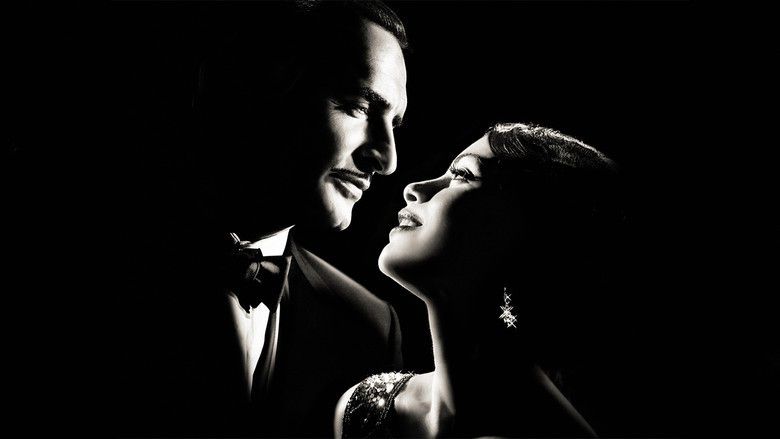
THE ARTIST (2011, France)

by Miguel E. Rodriguez

Director: Michel Hazanavicius
Cast: Jean Dujardin, Bérénice Bejo, John Goodman, James Cromwell, Penelope Ann Miller, Missi Pyle, Malcolm McDowell
My Rating: 10/10
Rotten Tomatometer: 95% Certified Fresh

PLOT: A hugely popular silent film idol must adjust to culture shock when “talkies” suddenly invade the movie business.


Is there a movie more in love with the First Golden Age of Hollywood than The Artist?  I can’t think of one.  Sunset Blvd. comes close, but that was a caustic commentary on the heartless tendencies of studio executives to reject the Old and embrace the New.  The Artist covers the same ground, but in a much more comic fashion.

Not to say The Artist pulls its punches.  Not at all.  It tells the story of a silent film idol, George Valentin (Jean Dujardin), who has a meet-cute with a fan, Peppy (the stunning Bérénice Bejo), outside of a movie theatre.  Long story short, she becomes a bit player in numerous silent films and eventually becomes a superstar when the talkies take over Hollywood.  And George?  He struggles, as so many other silent actors did, to acclimate himself to a brave new world where faces and title cards aren’t enough anymore for an audience who is always looking for something new.

And, oh, yeah, did I mention The Artist is itself a silent film?  Shot in black and white?  Filmed in the old 1:33 aspect ratio?  Yeah.  It’s actually pretty cool.  It takes a little while to get used to seeing modern actors moving their mouths and not hearing their voices, but after a while, my brain acclimated itself to this “new” way of watching a movie.

As I was saying, The Artist doesn’t pull its punches in exposing Hollywood’s appetite for the New (in ways I don’t want to give away here), but it is still far more whimsical and audience-friendly than Sunset Blvd.  I’d compare it more to Singin’ in the Rain, if I had to compare it to anything at all.  But The Artist is a singular achievement, and well worth the Best Picture Academy Award for 2011.

There are two scenes in particular that elevate The Artist. In one, Peppy, who has always adored George from afar, finds herself alone in his dressing room.  She spots one of his jackets hanging on a coat rack and embraces it, imagining his arms inside it.  She then slips one of her own arms into the jacket, and voila!  She has a brief love scene where it really feels like she’s interacting with another person’s arm.  It’s a little hard to describe, but the effect is magical.

The second scene is one of my favorite scenes of all time.  George has just gone to see one of Peppy’s new films, a talkie.  The audience loves it, but he is still resistant to the idea.  He retreats to his dressing room, but something bizarre happens.  Remember, up until now, the movie has been completely silent (except for a musical score).  But this time, when he puts a glass down on a table…it clinks.  He stares.  What the heck was that???  He does it again.  Clink!  What’s going on???  He picks up a comb and drops it.  Thunk!  What the hey?!!  He opens his mouth to yell…but nothing comes out!

It’s a wonderfully comic moment, and a perfect way to demonstrate George’s anxiety at what this new technology will mean for him.

The more I think about The Artist, the more I’m realizing that the only way to properly discuss it is to go almost scene by scene, and I certainly don’t want to go down that road, especially for anyone who may not have seen it.  I mean, there’s the dog, George’s butler, the release date for one of his movies (October 24th, 1929, oh dear), the auction, the fire, and the deliriously happy ending, the kind of ending that tends to only exist in movies.

That’s really all The Artist is.  It’s an efficient engine designed to pull at our heartstrings and deliver a feel-good ending after teasing us with darker possibilities here and there.  The fact that it’s black-and-white and silent is a bonus, especially for film buffs.  It may not be realistic, but when it comes to Hollywood’s Golden Age…I mean, who really cared about realism back then?  (Back then, they didn’t need words, they had faces.)
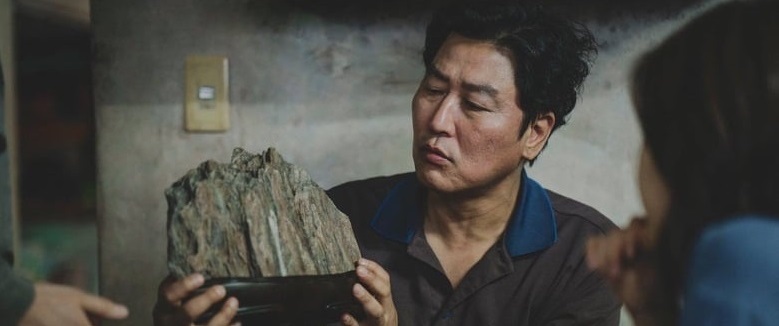
PARASITE (2019)

by Miguel E. Rodriguez

Director: Bong Joon Ho
Cast: Kang-ho Song, Sun-kyun Lee, Yeo-jeong Jo
My Rating: 10/10
Rotten Tomatometer: 99% Certified Fresh

PLOT: Ki-taek and his family, all unemployed, take peculiar interest in the wealthy and glamorous Parks, as they ingratiate themselves into their lives one by one.


Watching Parasite reminded me of the first time I saw Pulp Fiction.  I told my friends that it was like being on a roller-coaster at night wearing a blindfold: you have no idea where you’re going or what’s coming, but the ride is exhilarating.

That’s Parasite.  The hype is real.  This is one of the best movies I’ve ever seen, and if you plan on seeing it, I would highly recommend you do so BEFORE reading further.  I have no plans to spoil ANYTHING, but the less you know about the movie before going in, the better.

(You’ll have to bear with me, I’m writing this shortly after seeing the movie myself, it’s currently 11:14 PM, and I’m starting to get a little tired, but I want to get this all down before I pass out, so it may get a little “rambly” for a while.  You’ve been warned.)

Parasite is many things.  It’s a social commentary, a black comedy, a family drama, and a Hitchcockian thriller all rolled into one delicious Korean dish.  (The film and filmmakers are Korean.)  The beauty of the movie is that it manages to be all those things without losing track of itself.  I can’t count how many movies I’ve seen that attempted a tonal shift in the middle or at the end, and it just falls flat.  Where lesser movies failed, Parasite succeeds.

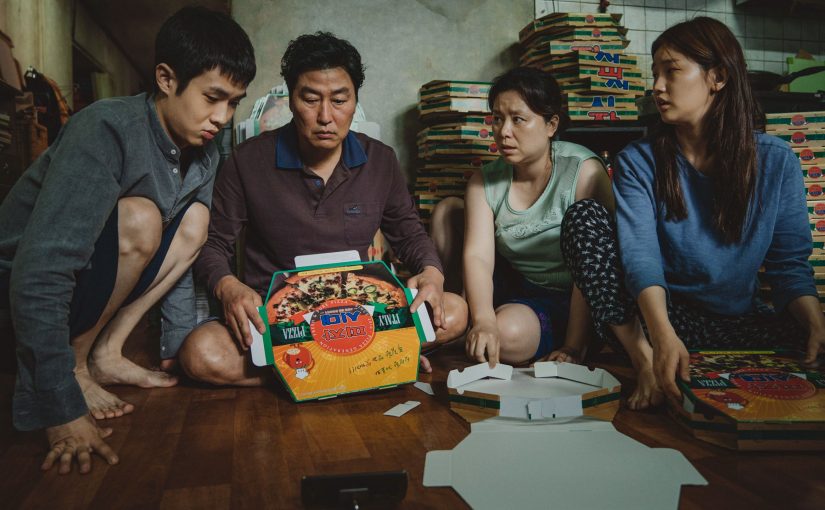
The plot involves a nuclear family, the Kims (father, mother, college-aged son and daughter), living in near-poverty in a sub-basement.  They fold pizza boxes to make a little cash.  They steal wi-fi from a shop next door.  When fumigators spray outside their street-level window, they open it wide to take advantage of the free pest control.  They aren’t starving, but they are desperate.  Yet they don’t appear to be beaten down by their condition.  They’ve become a family of hustlers, not in any criminal manner, but in ways that enable them to get by on the bare minimum until one of them can get a leg up.

Opportunity knocks one day when a friend of the son, Ki-woo, gets him a job as an in-home tutor for the high-school daughter of a wealthy family, the Parks.  Ki-woo changes his name to Kevin, then suggests to Madame Park that her 7-year-old son could use an art tutor.  This gets his sister, Ki-jung hired.  She changes her name to Jessica and finds a creative way to get her father hired as Mr. Park’s personal driver.  Then the Parks’ long-time housekeeper somehow has to be eliminated so the MOTHER can get hired.

Before long the entire family is working for the Parks, though it’s important to note the Park family has no idea their new employees are all related.  This is all done with great humor, not in a farcical way (that will come later), but in such a way that you find yourself rooting for this down-on-its-luck family of con artists to finally get a taste of the good life.

There’s a long scene where the Parks have gone camping, and the Kims gather in the enormous living room of the Parks’ lavish home and just sit and eat and drink and talk and get drunk.  This is the family drama/social commentary part of the movie.  There’s something a little sad about seeing these people who are like any other people, who seem no less deserving than the Parks, but their best-laid plans have come to nothing, and the highlight of their lives is to get hammered in somebody else’s house.  Suppose Kevin falls in love and decides to marry the girl he’s tutoring, when she’s a little older.  Who will they get to be his parents?  Will they need to hire actors?

Trust me, I haven’t spoiled ANYTHING.  Swearsies.  This movie is brilliantly, ingeniously split into two parts.  The first half is prologue.  The second half is genuinely, literally breathtaking.

Something happens that forces the Kim family to examine and re-evaluate their life choices up to the present.  It also forces them to do some very fast thinking indeed, which is where some of the funniest and darkest comedy takes place.  This is where the movie really takes off, where it had me reminiscing about the twists and turns in Pulp Fiction.

And nothing…nothing can prepare you for the finale.  About which I’m saying nothing.  Again.

From a cinephile’s perspective, Parasite is miraculous.  It manages to be several different things all at once, allowing you to savor every individual aspect of it without any one part of it overpowering the other parts.  The screenplay is unbelievably inventive.  The direction is sure-footed and masterful.  The acting is pitch perfect throughout.  It made me think, it made me laugh, it made me cringe, it made me say, “Oh S#i+!” MANY times, and it made me bring my hand to my mouth like a shocked Victorian-era woman many, MANY times.

I say again.  The hype is real.  You owe it to yourself to see this movie whenever you can.

[Ed. note: the Criterion blu-ray of Parasite contains an interesting experiment: a black-and-white version of the film, which is apparently how the director originally envisioned the film, and which might account for its stark imagery in places.]

THE FRENCH CONNECTION

By Marc S. Sanders

Popeye’s in town.

“You been picking yer feet in Poughkeepsie?”

One of the first gritty crime dramas.

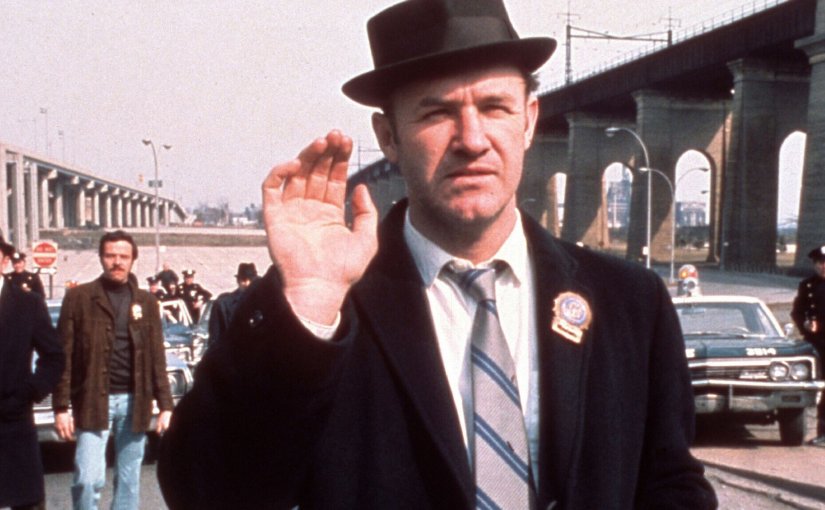
With modern cinema offering huge bravura performances a la Daniel Day Lewis or Christoph Waltz these days, it’s any wonder that today’s generation of movie goers would be puzzled that Gene Hackman won the Best Actor Oscar for this film, The French Connection, which also happened to win Best Picture. His character has no big monologues, no huge crying scenes. In fact for most of the film, he’s slamming guys up against a wall or following them up and down the dirty Brooklyn streets. Yet, his accolades were nothing short of deserved.

Watch as Hackman’s Popeye Doyle gradually exhausts himself in pursuit of “Frog 1.” His character starts out as a thrill seeking detective only to find his limits pushed against a better cat and mouse player. Dialogue isn’t sophisticated here to show his state of mind, but rather his expressions offer everything. Simply look at his close up following the extensive car search (an incredibly satisfying scene for me as a viewer).

If that’s not enough, the car/foot chase through Brooklyn is one that still has not been matched. See how it was done before CGI.

A simple drug deal is plotted perfectly from Marseille to New York, and best of all, it is all true (well mostly).

What’s most curious is the film provides one of the oddest and most unforgiving endings in a film ever. Perhaps you’ll agree (????). But, remember…THAT IS HOW IT HAPPENED!!!!

This was a film from 1971 that was raw in its language, gritty in its setting, spiteful and unafraid of the image it would leave, and that is why it won Best Picture, Best Director and Best Actor.

Bottom line, it would never have been made today. Never!

(Word of advice, ignore the sequel. A prime example of Hollywood shamelessly cashing in.)

WEST SIDE STORY (1961)

By Marc S. Sanders

The musical answer to Romeo & Juliet will always remain as one of my favorites.

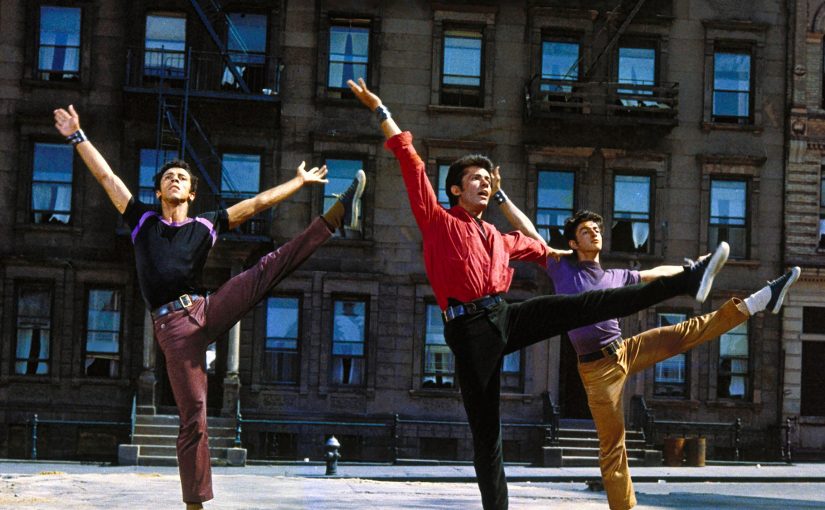
West Side Story crackles with energy as soon as the 6 minute overture begins and segues into overhead shots of New York City accompanied by its frequent whistle calls. Then it zooms in for something new, fresh, and eye popping; precise choreography from Jerome Robbins to represent street fighting by means of heart racing ballet. You simply can’t take your eyes off the screen.

Young love and pride carry Robbins’ film with partnered direction from Robert Wise. It’s sadly amazing that the prejudices that shape the story are arguably more evident and profound nearly 60 years later. Tony & Maria must never be together. Change the names today, and the logic behind the societal law will often mirror the reasoning found in the film.

Am I focusing too much on that message though? There’s so much to cherish in West Side Story. A film that boasts numbers like “America,” “I Feel Pretty,” “Tonight,” “Stay Cool Boy,” “When You’re A Jet,” “Maria,” and my favorite “Officer Krupke.” It does not get much better than this.

The dancing lunges at the camera. The dialogue may be dated, yeah, but the cast is so genuine to the setting (even if Natalie Wood is lip syncing her songs).

Steven Spielberg has remade the film, to be released in December, 2021. I’ll go see it, sure. Yet I don’t believe it’ll compare to the original 1961 winner for Best Picture as well as the other 9 Oscars it was recognized for.

Go back and catch up with West Side Story. It should be seen by anyone who ever wanted to watch a great film.

NOMADLAND

By Marc S. Sanders

amazon ( n.) a large strong and aggressive woman; Synonyms: virago. amazon ( n.) mainly green tropical American parrots; 2. Amazon ( n.) (Greek mythology) one of a nation of women warriors of Scythia (who burned off the right breast in order to use a bow and arrow more effectively);

As I reflect on watching the 2020 Best Picture Oscar winning film, Nomadland, I considered the literal translation of the word “amazon.”  To many of us, I would think the word has an entirely different meaning.  Director, writer and editor Chloe Zhao probably considers both the literal definition of the first noun (noted above), as well as the brand name that seemingly runs the world these days.

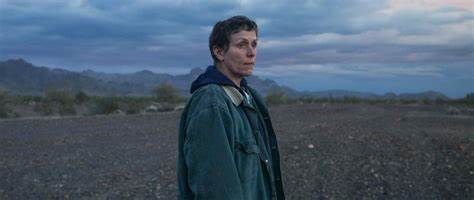
Fern, played without compromise by Frances McDormand, is likely a strong and aggressive woman, though only subconsciously large.  I’d argue you would have to be in order to survive as a nomad within a pre-Trump era mid-western America with a beat up van as your mobile residence and a deep plastic bucket for a toilet that isn’t hard on your knees when used.  Fern is a former resident of Empire, Nevada.  Empire and its postal zip code no longer exist as of 2011 when the sheetrock factory that sustained the town closed up after 88 years, thus forcing all its residents to give up their homes and relocate elsewhere.  Now that Fern is widowed, she does not see any other way to live other than in the van she calls “Vanguard.”  She lives paycheck to paycheck with seasonal jobs that are hopefully available.  The first of these jobs includes a packing facility for Amazon.  Once the holidays are over, it’s up in the air as to what she’ll come across next.

Zhao is an observational director.  To depict a film about a lonely, uncertain post middle age nomadic widow will require shots of the country like frost on the ground, deep snow, endless roads, hot deserts and moonlit campfires with other nomads who come by Fern’s way.  These people (many of which are real life nomads in the film) might travel individually but they are a community as well.  They teach one another in ways of being resourceful with auto repair or what’s the best bucket for a toilet.  They provide people like Fern with temporary job opportunities.  They also counsel one another with how to deal with grief and share their own health challenges like the various forms of cancer and illnesses they endure and how they plan to live out the remainder of their limited time on earth.  One woman with an inoperable brain tumor is determined to make it back to Alaska.  What drives these people is not necessarily a will to survive.  More importantly, it’s the knowledge that they will cross paths with one another again.  An experienced nomad who lost a son to suicide never considers saying goodbye to anyone he encounters.  Rather, he is staunch in telling others that he’ll “see them down the road,” at another time and place.  He reminds Fern that to live this life is to never close the book or end a chapter, and memories of those we have lost can only stay alive if Fern and others stay alive.

I appreciate a film like Nomadland simply because I’ve never been the brave traveler.  One of my greatest fears is being lost and alone.  It has always terrified me.  I still don’t trust the navigation apps on my cell phone.  I have to see the destination in front of me.  Luckily, my wife keeps me in check.  Yet, Nomadland is a film that gives me an opportunity to explore places I might never arrive at, while I sit safely in front of my flat screen.  Chloe Zhao shoots with wide lenses to take in gorgeous landscapes.  How fortunate for Fern that she can encounter all of this beauty in person.  How fortunate, as a viewer, a film like this allows me to witness what’s out there.  How sad though as well that sometimes this way of life seems treacherous and nonsensical.  Whatever entity created the earth allowed no sympathy for a flat tire or a broken-down engine, when you have no means of paying for replacement parts.  As well, mother nature is not always going to be that companion that holds your hand during lonely times.  Corporate America certainly won’t do that either, but it is a necessary evil.  Thank you, Amazon!

Frances McDormand is perfect for this role as she carries no inhibitions about herself.  She will truly show herself sans makeup or coiffed hairstyles, floating nude in a stream, or go so far as to literally defecate on screen in that practical bucket to demonstrate how truly unglamourous and unforgiving the life of a nomad is. 

Nomadland is not a favorite film of mine, but I can’t help but appreciate its honesty thanks to Zhao, McDormand and the numerous real-life nomads that inhabit the picture.  It’s a sad story; not a triumphant one, but it is also a film that tries to emulate the comfort of being “houseless…not homeless” as Fern describes with absolute certainty.  It might not be the life for many of us, but it is definitely a life meant for Fern.

GREEN BOOK

By Marc S. Sanders

The biggest surprise of Green Book is who its director is, the unlikely Peter Farrelly of The Farrelly Brothers, directors of Dumb & Dumber and There’s Something About Mary. Yet, when I reflect on the film it should not be a surprise. The Farrellys are known for raunchy humor, but often it stems from an honest source. When Viggo Mortensen’s character Tony folds an entire pizza pie in half and then scarfs it down whole, that’s a Farrelly touch but likely also what an Italian club bouncer raised in the Bronx would do without any consideration. He’d also win out in hot dog eating contest. Mortensen’s character is a far cry from his Russian Heyman in Eastern Promises or Stryder in The Lord Of the Rings. The pizza and hot dog scenes are great moments in a film weighted down by the Uncle Tom mentality of Deep South USA in 1962. Peter Farrelly needed to direct this film, and it just might be the best picture of the year.

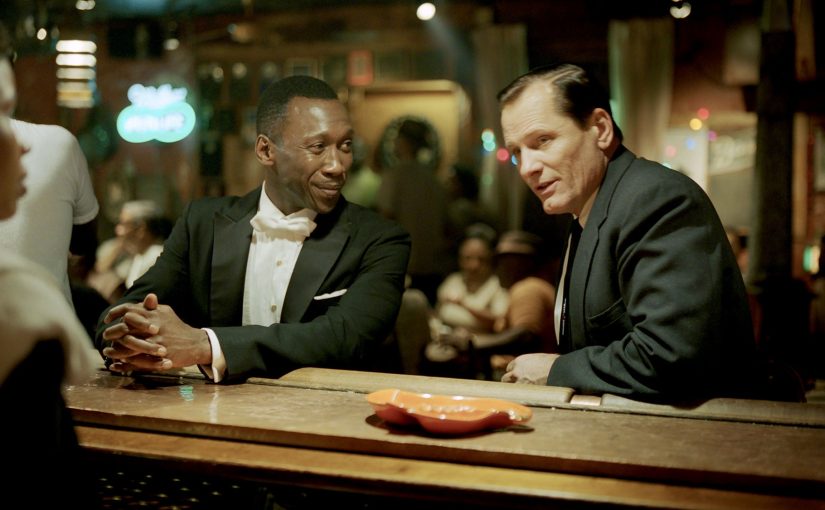
Tony (or “Tony Lip” as he’s known among his peers) is hired by Dr. Don Shirley played with such eloquence by Mahershala Ali. Dr. Shirley is an African American pianist, arguably the best in the world and ready to embark on a tour of the Midwest to Southeast of the country. It’s not that simple however as Dr. Shirley is all too aware of the racial prejudice that will befall him. Tony is hired to be Dr. Shirley’s driver as he has the toughness to look out for Shirley in the event that it is necessary. Sadly, the film shows that Tony is more than necessary.

There’s much comedy here between Ali, playing the well spoken “Felix” role, against Mortensen in the “Oscar” part. Tony and Don are worlds apart having virtually no understanding how the other half lives or what they are forced to compromise with on a daily basis. The hardships that Green Book offers focus more on Dr. Shirley as he is forced into humiliating circumstances where he is offered only an outhouse to use or denial of entry into a dining room. He could be wearing the sharpest of tuxedos, while Tony is a self aware “goombah” slob with no civility and Dr. Shirley remains the one to be overlooked. His value to Deep South America is to play his Steinway piano like meager jester.

There’s much to learn about our country’s mid 20th century history in Green Book. It’s a film I encourage families with pre-teen children to see. Not only will they learn of disillusioned hatred and treatment of black minority, but they will be entertained as well. References to Robert and John Kennedy are presented as well Aretha Franklin, and a Boston Celtics player (Name I cant recall).

The comedy that Farrelly brings keeps the audience engaged. The best dramas possess great comedy like Steel Magnolias, Terms Of Endearment, The Help, and even Kramer vs Kramer. If we can laugh along with our characters, then we will appreciate them that much more when harm and pain strikes. We want to ease their pain and be angry for them when those moments arrive. Their comedy of natural behaviors breeds affection for them. When they are compromised, we cry for them. Farrelly executes this format perfectly.

Mahershala Ali is a stand out here. He is snobbish at times towards the unmannered Tony but he is never deserving of his dismissiveness. He is a victim of the “colored mentality.” If not for the color of his skin, Dr. Shirley would have been regarded by all as a man of integrity; a hero to the American people. Sadly in 1962, many could not see past skin color. Thankfully, a great moment towards the end reminded me that it was in fact many…but not all. Watch the movie, and then tell me if you know what I’m referring to.

Remember, this is probably the best picture of 2018. Bring your children to see Green Book. Keep your children aware.

PARASITE

By Marc S. Sanders

I first discovered director Bong Joon-Ho when I watched his futuristic sci fi adventure Snowpiercer. I loved that film despite how absurd the set up was. Absurdity, though, is a credit to his craft. That’s why his latest film Parasite is a hugely successful interpretation of class warfare within South Korea. It might all appear drastically unlikely. Yet, it’s all absolutely possible when you reflect on the film after you’ve seen it.

Parasite begins almost like a farce and ends in deep, realistic horror that you’d never expect, even after you surpass the films midway surprise.

It’s best I leave much of the film’s details out. The less you know the better. I knew nothing at all about the film beyond the numerous accolades it has received. I was better off for it.

Joon-Ho’s film makes its point quickly that there is always someone better off than us and always someone worse off. (This was a theme carried over from Snowpiercer.). A poor family living off scrap money for folding pizza boxes while living in a cramped, bug ridden basement is still better off than the drunk who pisses on the street, outside their window. Just as an upper class family with all the best things in life are better off than them.

It’s only when this poor family find opportunity to dupe their way into this wealthy home through jobs they are hired for that we eventually see how lighthearted material, compliments of Joon-Ho and his writing collaborator, Jin Wan Han, can convincingly escalate into class warfare politics that even their characters ever hardly acknowledge, or are aware of. Is the wealthy matriarch really aware where her family chauffeur stems from or where he lives? The off putting scent of someone’s presence can quickly turn a tide or an impression.

I might sound vague, but I have no choice. It would be a betrayal to the imagination of the best film of 2019 if I spelled the film out for you.

Simply know that I truly appreciate the symbolic research Parasite presents as it makes note of a Korean child’s fascination with Native Americans, and how their plight parallels the story. Even that drunk taking a piss on someone else’s territory. Even the gift of a stone sculpture told me how one can be crushed or weighted down by his own country.

Parasite begins as one movie and ends as maybe five other different movies. It’s a farce. It’s wry and conveniently ironic; maybe silly at one point. It’s suspenseful and surprising. It’s also shockingly horrific.

I recently declared Clint Eastwood’s film Richard Jewell the best film of year. I stand corrected.

Parasite is the best film of the year.

DRIVING MISS DAISY

By Marc S. Sanders

Mainstream films released by big studios suffer from a major problem these days.  Too often, they don’t allow their characters to breathe.  Films today rush to the climax or the action or the cliffhanger that’ll whet our appetites for a sequel or a crossover or a toy product.  Bruce Beresford’s Driving Miss Daisy escaped all of those conventions.  In fact, I’d argue that Beresford made a buddy picture with his Best Picture Winner based upon Alfred Uhry’s well received play.

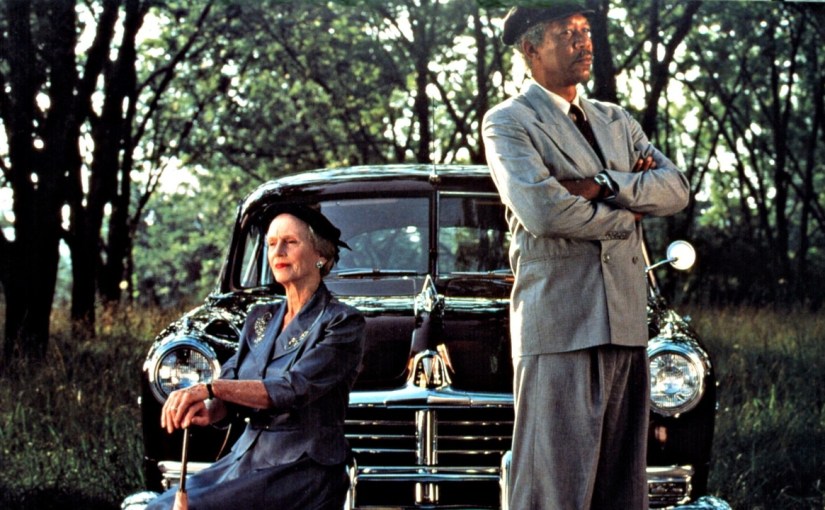
Daisy Werthan (Jessica Tandy, who won the Oscar, and held the record for oldest recipient) is an insistently independent old southern Jewish woman living in Georgia.  She drives her car where she wants to and whenever she wants to go somewhere.  However, following an accident in her driveway, her son Boolie (Dan Aykroyd in a very surprisingly good performance) breaks the hard truth to Daisy that her driving days are over since it’s likely no insurance company will ever affordably cover her.  Boolie recruits Hoke Colburn (Morgan Freeman in one of the most gentle and delicate performances of his amazing career) to chauffer the proud woman around her Georgia neighborhood.  Naturally, Daisy does not take well to Hoke at first.

The film begins in the 1950’s and then spans roughly 20 years from that point.  I love how Beresford presents the passage of time.  The cars that Hoke carries Daisy in change as the years go by.  As a new car is shown parked in Daisy’s garage, the relationship and eventual friendship of Hoke and Daisy become stronger and, on some occasions, franker and more honest.  With Hans Zimmer’s energetic score that seems to accelerate the speed of the automobiles Hoke drives, Driving Miss Daisy feels like a very sweet and tender film.  It is.  Moreover, it’s an alive picture.  However, the film does not ignore the prejudiced mentality that’s embedded within the south.  A telling moment occurs when Hoke is driving Daisy to a family gathering in Alabama.  Why would an elderly black man with an elderly Jewish woman sitting in the back seat be met with such disdain by policemen who question their presence while eating lunch on the side of the rode?  I won’t repeat the officer’s comment here, but it is ugly and a sad reflection of how things were.  Are things still that way?

Uhry’s script adaptation from his play does not stop there though.  He questions Daisy’s own stance.  She takes no issue with black people catering to her and her home on regular basis, and she becomes enamored with Martin Luther King’s inspiring wisdom.  So, when she is given the opportunity to see Dr. King speak in person, it only makes sense that Hoke will question why he was invited last minute to join her.  After so many years of servitude, why did Daisy wait until Hoke literally drove up to the location of the speech to invite him in?  I’d argue that it never occurred to Daisy, and I think Alfred Uhry believed that is part of the problem.

Both Daisy and Hoke experience anti-Semitism and racism in the mid twentieth century south.  Ironically, the film demonstrates that common victimization is one reason why they need one another.  I’m thankful that Beresford does not show a burning synagogue for dramatic effect.  Instead, he relies on Uhry’s dialogue as Hoke breaks the news to Daisy when they are on their way for morning Shabbat services.  How does Daisy feel in this circumstance?  The synagogue can be rebuilt.  The horror of knowing this kind of hate exists will never be erased.  That’s the terrible shock.  As well to empathize, Hoke describes how as a child he saw his uncle get lynched and hung from a tree.  Daisy and Hoke unite in the hate that surrounds them.

The performances of Freeman, Tandy and Aykroyd are exquisite.  Their dialect for each of their respective characters rings so true of the Georgian southern regions they stem from.  Freeman has an enunciation that rings of a black man who never learned to read.  He even develops a laugh that seamlessly works into his dialogue and reaction to Daisy’s stubbornness.  His posture is marvelous as an elderly gentleman who will walk slowly while hunched over.  It just looks so natural. Aykroyd is in no way doing one of his comedy characters.  He carries the gut of a well-fed southern man who’s become successful with his family business while not taking every fit that his mother has so seriously.  If any of us have had to tend to an elderly relative, then we can certainly relate to Boolie’s position.  Tandy is wonderful at method acting; it should be studied in performance art classes.  She was an elderly woman already when cast in the role.  Yet, as the years carry on through the story, she changes her gait to how this woman’s bones might become more brittle, or how she might speak slower or smile or frown or chew her food.  She has such a fire in every one of her scenes.  A heartbreaking scene where she appears to be having a frantic form of dementia is very eye opening as she paces her historic two-story home looking for papers she graded years earlier as a teacher.  The younger Freeman (playing a far older man) has to keep up with Tandy in this moment; even Beresford’s steady cam has to move quickly to keep focus.

Recently, I had reviewed Terms Of Endearment, and I alluded to the fact that not enough films about middle age people are focused upon, or at least given the commercial attention that they should be given.  Why is that?  So many middle age and elderly characters are so interesting.  I said it before.  Look at The Golden Girls sitcom.  After all, characters with more years behind them have had more moments to live and breathe. Actually, they have a longer history with more nuances and meaningful events they have already encountered, as opposed to twenty somethings with hot cars, pecs and guns.  Film studios are missing out on a wealth of great storytelling. 

Driving Miss Daisy is well paced story of friendship and fear, and often natural comedic material within its three lead roles.  It’s never boring.  It’s only more and more interesting as the years of the story pass by.  It’s simply an endearing buddy picture of the finest quality. 

CRASH (2005)

By Marc S. Sanders

Paul Haggis’ vignette themed script for Crash should not have won Best Screenplay. The film he directed should not have won Best Picture. Could it be that because this picture is masked as that special movie with that especially poignant message that it got the recognition I don’t think it ever deserved? I can appreciate the attempt at bringing hot button social issues like racism and injustice to light, but it does not need to be as immaturely contrived as this picture.

Crash occurs over two days within the city of modern day Los Angeles. A select group of characters of different social classes and ethnicities are covered, and the film circumvents back and forth among their perspectives. For the most part, all of these people have major social hang-ups with people outside their race. The first example shows us that if a white woman who is simply cold on a winter night hugs her husband tightly for some warmth, apparently a couple of black men will automatically believe this woman is fearful of their approach.

Especially today, I know that prejudice exists, but to this extreme and this contrived…I’m not sure. I guess I’m not sure because I have not experienced it enough to be convinced yet. When I read a friend’s testimony of falling victim to racial prejudice I lean towards believing everything they tell me. I guess it’s this movie, Crash, that left me feeling dubious and maybe that’s because the circumstances seem way too forced.

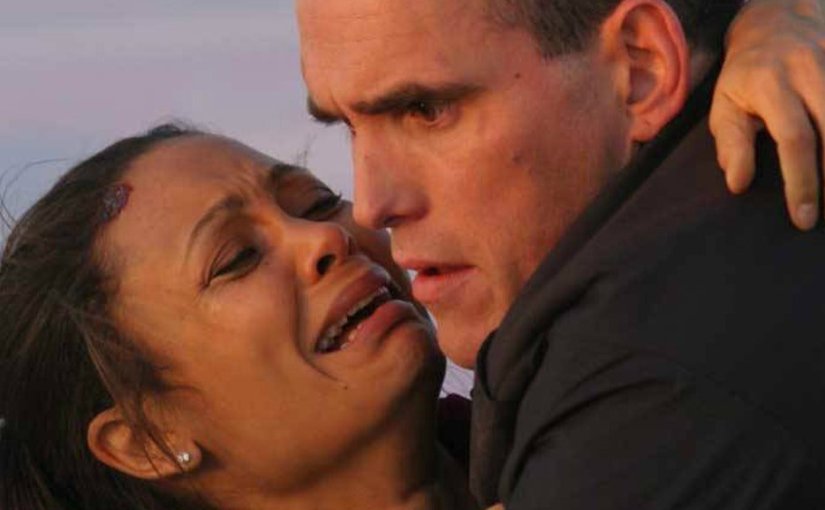
A racist cop (Matt Dillon) will pull over a well to do Muslim man (Terrence Howard) driving a high priced SUV and perform a sobriety test for no reason. Then the cop will deliberately frisk the man’s wife (Thandie Newton) with digital penetration. The next day, it’ll just happen to be that this woman will have no choice but to be rescued from a burning car by this same racist cop. Now I’m supposed to believe that the racist cop is not so bad, and the woman learns to become more tolerant. Well gee, thank heavens for coincidences!

The Muslim man (a television show director) gets car jacked the following day, and in a tense pull over moment he’s mistaken as the criminal. Fortunately, the partner of the racist cop (Ryan Phillipe) is there to subdue the situation. I’m sorry, but life doesn’t work out to be this tidy. Call me cynical, but more often than not we are not given a second chance at first impressions.

One of the real car jackers (Chris “Ludacris” Bridges) gets a moment of clarity and suddenly he’s generously giving out his last forty dollars to a group of Asian people being held in a van for human trafficking. Forgive me. If I want to begin respecting this car jacker who has held multiple people at gun point and even runs over a man, only to toss him out on the drive up to the Emergency Room, I’ll be more apt to do so if the criminal turns himself in.

I dunno. Maybe I’ve got a personal issue with Crash. It could not be more apparently preachy in how it patronizes me to simply understand the seething hate and criminal violations of its characters. I’m supposed to empathize with the racist cop because his ill father can’t get the health care he’s entitled to? I’m supposed to understand the prejudicial anger that the WASP wife (Sandra Bullock) of a District Attorney (Brendan Frasier) expresses because she no longer trusts her dedicated Hispanic housekeeper or the locksmith (Michael Pena) changing the locks on their house following a car jacking?

No. Paul Haggis didn’t earn that response from me in almost all of the short story scenarios his film offers. Maybe it’s because I tend to compartmentalize my episodes. I like to think that I don’t allow one experience with one kind of person cloud my judgement on the next person I encounter. A waiter can totally screw up my order and can even mouth off to me in a heated moment. Yet, I’ll return to the restaurant on another occasion because it’s likely I’ll run into a different waiter.

Haggis depicts people who appear to have a blanket opinion of other people with different backgrounds. These are all extremely prejudiced people with next to no understanding of where each of them stem from. An angry Persian man (Shaun Toub) puts blame on the locksmith after his convenience store is ransacked. The locksmith was only trying to explain that the back door needed to be replaced. The Persian refused to listen because his English is limited. So he just gets angry and curses the locksmith out. Haggis opts to insert a language barrier between the two men to serve up an eventual tense and dramatic moment in a neighborhood driveway with a loaded gun and a little girl. A loaded gun and a little girl! Yup, I think they teach these are the true ingredients for effective drama on the first day of screenwriting class. Again, it all comes about a little too forced.

The conveniences and ironies that bubble up at times are surprising. “Oh that guy is that guy’s brother! I see.” Things like that. However, I don’t think that is necessarily the strength of the picture.

In a film like Magnolia, we are treated to the vignettes of a handful of people too. However, not every single one of those people are sketched by means of their prejudiced natures. They are drawn by a variety of different elements whether it be a traumatic past or an inclination to do good. Then it’s kind of fun to uncover how each player is connected to one another.

In Crash, the players are only connected by the hate they carry within themselves, and Paul Haggis forces a redemption upon most of them with small gestures or a line of dialogue or the purity of a welcome snowfall to close out the film. Sorry, life is lot more messy and complicated than that. I guess I’m saying I may have learned a lot more about human nature from a downpour of frogs than a downpour of snow.

BRAVEHEART

By Marc S. Sanders

Mel Gibson’s Braveheart is a barbaric film. It’s barbaric in its nature, its violence and its characters. It’s also a magnificent piece of moviemaking.

It’s incredible how Gibson can depict himself in violent battle sequences swinging his sword and tumbling over enemy extras while directing the film. Braveheart is truly one of the best films to be directed and produced by its lead actor.

In the 13th century, King Edward Longshanks keeps a firm rule of British monarchy over Scotland. He finds the Scottish to be unruly and out of order. Taxes alone will not keep them at bay. So he declares it noble to have any Englishman bed a newly Scottish bride before her husband has the opportunity. Therefore, to avoid this experience, William Wallace (Gibson) marries his true love Murron (Catherine McCormick) in secret from the British Empire.

Following the escape from rape by an English captain, Murron is taken, with her throat slit to draw out Wallace. From that point on, Wallace never puts down his sword as he begins the Scottish uprising for freedom from British rule.

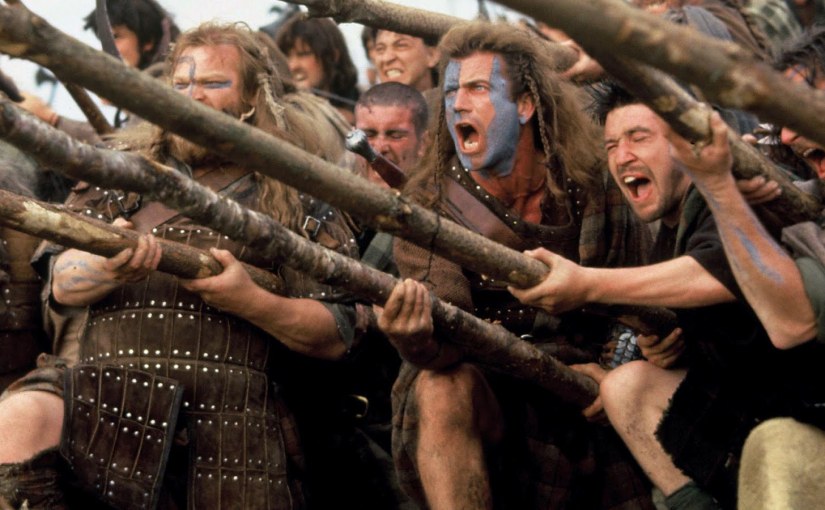
Braveheart is not a complex film and we’ve seen films like this before with swords and shields over wide open battlegrounds. However, the construction of Gibson’s film is outstanding. The extras that make up the British and Scottish armies are dense with breadth. The battle scenes are bloody and fierce with axes, swords, bows & arrows and burning tar.

It’s also a moving piece as Wallace remains steadfast with drive to deliver freedom for his people. It’s not so much a character arc for Wallace. He only changes once Murron is killed from wanting to remain peaceful to war torn and strategic in his attacks.

Instead, a good arc comes from Angus McFayden as Robert The Bruce, a confused Scottish nobleman who allies with William but whose judgement is clouded by his aging father. McFayden gives some brief voiceover narration. His character delivers a few surprises as Wallace continues to do damage to Longshanks’ territorial control.

Patrick McGoohan plays Longshanks and he’s another good villain in a long line of English antagonists. He’s determined to keep his rule and bloodline intact despite his gay, weakling for a son whom he forces into wedlock with the princess of France, Isabella (Sophie Marceau).

There’s a lot of dynamics to Braveheart. Battle scenes of blood and gore with burning flames and garish makeup are the main attraction. However, Gibson’s film offers up conflicts of interest found in Randall Wallace’s script. Romance between William and Marron as well as the rich history that led to Scotland’s independence and the almighty power of England and its conceit that would lead to the country’s defeat against a man’s will to lead his brute army to something greater which they never envisioned.

Braveheart is good entertainment.