THE LOST WEEKEND (1945)

by Miguel E. Rodriguez

DIRECTOR: Billy Wilder
CAST: Ray Milland, Jane Wyman, Phillip Terry, Howard Da Silva
MY RATING: 8/10
ROTTEN TOMATOMETER: 97% Certified Fresh

PLOT: The desperate life of a chronic alcoholic is followed through a four-day drinking bout.


I don’t drink.  Like, at all.  I’ve never taken drugs, and I’ve never smoked a cigarette.  Luckily, I have never been gripped in the throes of a crippling addiction, unless collecting movies counts as an addiction, in which case I plead the fifth.  I say this, not to brag, but because a lot of my first impressions of Billy Wilder’s The Lost Weekend are tinted by the fact that I don’t know the first thing about being drunk or what it means to suffer from an addiction so crippling that it would force me to hang a liquor bottle outside my window to hide it from my brother.

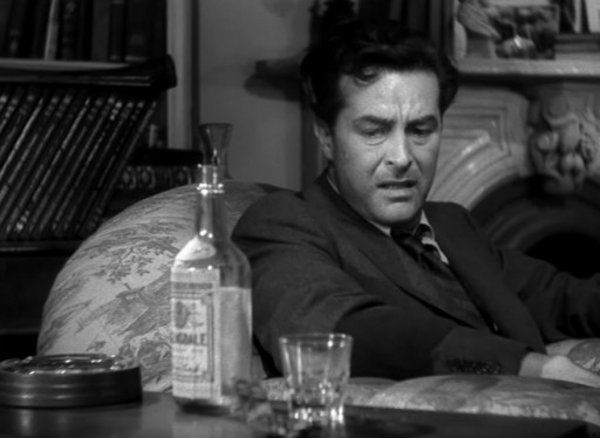
As it happens, Don Birnam (Ray Milland) DOES suffer from this kind of mid-to-late-stage alcoholism.  We first meet Don as he and his brother, Wick (Phillip Terry), are packing for a long weekend to get away from everything and everyone, including alcohol.  Don is a would-be author who needs a break from…something.  (Whatever he went through is never specified, only hinted at: “It’ll be good for you, Don, after what you’ve been through.”)  Don’s plan to surreptitiously pack the hidden bottle of liquor falls through after the arrival of his almost unbelievably good-hearted girlfriend, Helen (Jane Wyman).  No matter.  He still has a plan, which he confides to the long-suffering but increasingly annoyed bartender, Nat (Howard Da Silva).  He’s bought two bottles of rye.  He’ll hide one badly in his own suitcase and another in his brother’s suitcase.  When Wick discovers the badly hidden bottle in Don’s suitcase, he’ll chew Don out, Don will act suitably contrite, and Wick won’t think about searching his OWN suitcase for a second bottle.  What could go wrong?

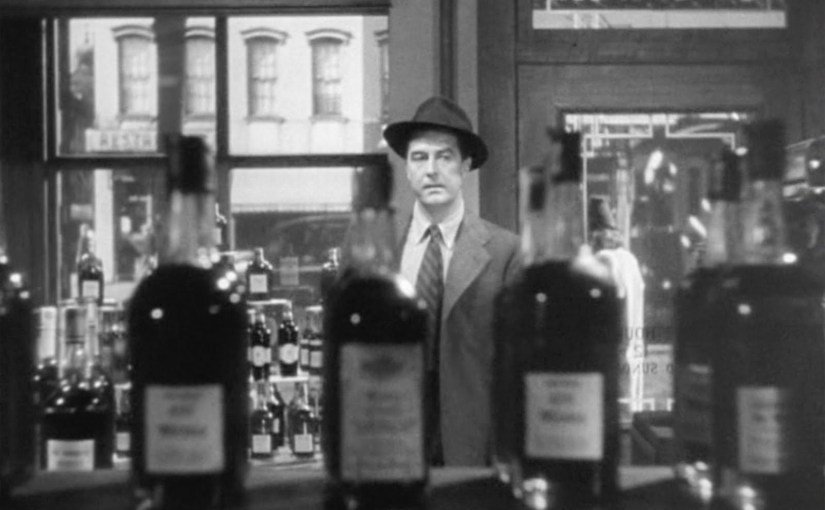
During these first few scenes, when Don lies and lies and drinks shot after shot in a bar and winds up missing the train for his getaway weekend, I found it difficult to sympathize with him.  Oh, he’s clever and loquacious when he’s either about to drink or while he’s drinking.  He has enough knowledge to quote Shakespeare at the right times and wittily proposes to Nat the bartender: “I wish I could take you along, Nat.  You and all that goes with you.”  Under the right circumstances, Don is a fun guy, always good for a laugh…until his seventh or eight or ninth shot of bourbon.  Then the other Don shows up, Don the drunk, Don the liar, the Don who gets so desperate for cash that he’ll walk 70 or 80 New York City blocks trying to find an open pawn shop so he can hock his typewriter for drinking money.

For some reason, it was harder for me to empathize with Don Birnam than it was to empathize with any of the main characters in Darren Aronofsky’s Requiem for a Dream (2000).  In that film, not a single leading character escapes the ravages of addiction, and yet even as they made their mistakes, I empathized with them and grieved when their bad decisions made things worse and worse.  With Don Birnam, however, every bad decision he made just made me like him less and less.  I remember thinking at one point, “He’s brought this all on himself, he deserves what he gets.”  Not a very Christian attitude, but I’m not gonna lie about it: that’s what I felt.

And his girlfriend, Helen…wow.  It’s almost like she needs as much of an intervention as he does.  She loves Don so unconditionally it’s almost unbelievable.  What’s the attraction?  Perhaps it’s symptomatic of the era in which The Lost Weekend was made.  She discovers Don’s alcoholism late in their 3-year dating relationship.  (What did people think in 1945 of someone who dates a man for 3 years?)  Instead of breaking up with him or giving him ultimatums, she devotes herself to “fixing” Don.  Not precisely the course of action I would recommend myself in today’s world, but there you have it.

Director Billy Wilder presents this first half of the movie in a very uninflected tone with little-to-no comic relief.  This flat tone becomes very effective at simply presenting the information without directly commenting on it one way or the other.  There are moments up to this point where the movie seems to side with Don (his struggle to find a bottle whose hiding place he’s forgotten is particularly pathetic), but it’s still not really passing judgment or giving him a pass.

And then…the turning point.  Don accidentally falls down a flight of stairs and knocks himself out after finagling some drinking money out of a young lady he flirts with at his favorite dive.  When he wakes up, he’s lying in a bed in the Alcoholic Ward of the local hospital, face to face with one of the strangest characters I’ve ever met in a Billy Wilder movie, and that’s saying something.  He’s a nurse.  “Name of Nolan.  They call me Bim.  You…can call me Bim.”  The closest I can get to describing Bim’s weirdness is to imagine an evil Waylon Smithers from The Simpsons as a male nurse.  On quaaludes.  To Don’s slowly increasing discomfort, Bim lovingly describes what Don is in for during his stay on the Alcoholic Ward, giving the inside scoop on the various repeat offenders and what to expect during his D.T.’s: “You know that stuff about pink elephants?  That’s the bunk.  It’s little animals.  Little tiny turkeys in straw hats.  Midget monkeys coming through the keyholes.”  This Bim…he has NO bedside manner, man.  “Prohibition…that’s what started most of these guys off.  Whoopee!”  (Nice little social commentary there…classic Wilder.)

Don manages to find his way home once again, having not had a drink for almost a day-and-a-half, if my memory is correct.  And it’s at this point that the movie, Billy Wilder, and Ray Milland finally got me in Don Birnam’s corner.

SPOILER ALERT, SPOILERS COMING.

Don finally has a bout of the D.T.’s.  It’s not turkeys or monkeys or elephants, though…it’s a rat.  A single rat chewing its way out of the wall in front of him.  Then, out of nowhere…a bat finds its way into the apartment and flutters around the room.  Don is understandably distressed.  But then the capper: the bat swoops down to where the mouse’s head is poking through the hole, there is a terrible squealing sound, the bat sort of trembles and scuffles…and a stream of thick blood starts to dribble out of the hole where the bat is presumably chewing the rat’s head off or something.

To say I was surprised is an understatement.  Don starts screaming his head off…and at long last I finally empathized with Don’s situation, and I no longer wanted him to wind up penniless and/or alone and/or dead.  I wanted the movie to find a way to fix him, like Helen tries desperately to do through the entire picture.  From then on, I was on his side, or Helen’s side, or whoever’s side, it didn’t matter, as long as he figured out a way to get out from under the disease that was slowly killing him.

I would not dream of revealing exactly how the movie ends.  It might go the way of Leaving Las Vegas (1996).  Or it might go the way of the vastly underseen Duane Hopwood (2005), featuring David Schwimmer as an alcoholic father on a path of self-destruction, but who manages to turn things around.  (Sorry if I spoiled that for you, but I’m betting it’s not a movie most people will want to seek out.)  I will say that it’s the ending of The Lost Weekend that really showcases the era in which it was made more than anything else.  But it could just as easily have gone the other way and still been just as successful.

The Lost Weekend cleaned up at the 1945 Oscars, winning awards for Best Picture, Best Director, Best Actor, and Best Adapted Screenplay (it was based on a novel).  At the time, it was the most unglamorous movie ever made about alcoholism.  Up to that point, drinking in movies rarely if ever led to hangovers and the D.T.’s and spending the night in the Alcoholic Ward.  It certainly belongs to be mentioned with Wilder’s greatest films.  But you’re gonna wanna watch something a little lighter afterwards.  Stalag 17, maybe.  Or Some Like It Hot.  A laughter chaser.

THE LOST WEEKEND

By Marc S. Sanders

Ever wonder why I write so many reviews?  It’s because I yearn to be a successful playwright/screenwriter.  I’ve directed three original plays that I’ve written over the years.  I will be directing a fourth for the holiday season later this year.  Had a few short plays I wrote performed locally as well.  Still, I suffer from a terrible ordeal that often grinds me into bouts of depression and internal rage.  Writer’s block! 

My father always told me that he stayed away from gambling and casinos. He said it was because he could have an addictive personality and he was not confident he could stop if he started.  I know what he means.  I have an addiction.  One that’s not commonly recognized, but I obsess over something every single day. Without fail, every damn day.  It’s my weakness.  Sorry.  I must keep that to myself, though.  Yet my pursuit of what preoccupies my mind taxes on my motivations to write and stretch the imagination needed for churning out one script after another.  So, a remedy is to write about movies that speak to me in lieu of my next great play. 

Billy Wilder’s Oscar winning drama The Lost Weekend demonstrates a writer’s inability to exercise his talent when an endless need for alcohol consumes his every waking moment.  Ray Milland delivers an Oscar winning performance as Don Birnam, an alcoholic wannabe writer of the worst kind.  When Wilder’s film opens, Don seems healthy and spry.  He’s clean shaven, well dressed, and ready to pack a bag for a weekend getaway that his brother Wick (Phillip Terry) has arranged for him along with Don’s girlfriend Helen St. James (Jane Wyman).  Wick implies to Don that this trip is just what his brother needs after what he’s recently been through, and he’ll have his typewriter with him to write in calming solitude.  Eventually we get an idea of what Wick has been referring to as Don attempts to sneak a bottle of rye that is strung outside the window of his New York apartment.  Wick catches Don in the act, pours the bottle down the drain and assures him that he won’t find another drop of liquor anywhere.  He doesn’t even have money to go to the corner bar.  So, Wick and Helen leave Don alone for a few hours before it’s time to depart. Don gets ahold of some cash though, and thus begins a spiral into a drunken binge over a four-day weekend.

I read that when this film was released, test audiences laughed at it.  I guess in 1945 people were not attuned or prepared to witness an account of a very real disease like alcoholism.  I’m not certain it was even diagnosed as a disease at that time.  Surely, the addiction was an ailment though, and Billy Wilder uses some effective cinematic devices to demonstrate the journey into madness and desperation for even just a tiny shot glass of gin or rye. 

A repetitive device is to show a tormented performance from Milland within the shadow of bars or fences.  He’s trapped in his own need for swill.  A telling moment occurs when Don is desperately trying to pawn off his typewriter just for some money to buy more alcohol.  Every store in the city is gated and closed on this particular Saturday though.  It’s the Jewish holiday of atonement for past sins, Yom Kippur.  I found that little detail to be interesting.  Surely, it’s a sin to harm yourself whether by alcohol or suicide, for example, and the holiday is a time for speaking to your inner self and Hashem (G-d) for your past transgressions.  Yet, that is no matter to Don.  He’s not ready or wanting to climb out of his dark hole.

Inanimate objects or props are also given much focus.  Early on, Don is seen at the local bar and Billy Wilder brings an inventive visual to explain just how much this character has consumed in under two hours.  The camera focuses on the wet rings on the bar top left by Don’s shot glass.  First there are two rings, then four and soon, fifteen.  Wilder also zooms his lens into the very bottom of the small glass filled with liquor to show how much the audience will drown in Don’s despair over the course of the film.

Other props also work towards Don’s paranoia such as a ceiling lamp bearing the shadow of a hidden bottle.  Milk bottles left in front of his apartment are not collected from one day to the next showing the passage of time for this weekend, and how even the most basic chore is dismissed so Don can extend his stupor.  A lady’s unguarded purse offers temptation.  A tossed lamp shade seems to glare at Don like a hole that he’s in, as he gets weaker and weaker. 

A magnificent scene, one that I can envision a skilled director doing today with quick cuts on digital film, occurs as Don recalls sitting in a crowded opera house watching the toasting scene of La Triviata; one of the most recognizable operas of all time.  Don is one of many in the audience, and yet he’s the only one alone with the production’s props of various drinking glasses and champagne bottles being used on stage that are mere inches away.  Very quickly into the scene, Billy Wilder skillfully draws focus from the opera singers and diverts towards the immense amount of liquor adorning the stage and the cast with quick cuts of Don salivating and perspiring alone in a chair of a crowded theater.  Everyone else is watching the performance.  Don is gazing at the alcohol.  I wouldn’t be surprised if Martin Scorsese had much admiration for such a sequence.

Phillip Terry is very good in his performance.  I’m surprised he’s not promoted as much as the other two stars of the picture.  Wick cares for his brother, but he’s ready to give up on him after six years of this ordeal, with one more transgression played out. He’s exhausted from lying to cover for Don’s weakness.  He represents the outsider of the dilemma who’s been affected by someone else’s ailment. Jane Wyman as Helen serves a nice purpose as well.  The one last hope for Don.  She’s the only one left who holds on to the faith that she can pull Don out of this nightmare.  Wilder presents these characters as side effects in the Oscar winning script written by him and Charles Brackett. 

Another haunting, but effective dimension comes when Don finds himself in the alcoholics’ ward at Bellevue Hospital, shot on location, and the first film to ever do so.  With an eerie use of a theremin in the soundtrack from Miklós Rózsa, Don is surrounded by dark shadows and tormented victims suffering from drying out just like him.  A nurse explains that he still has the DTs to experience like envisioning being surrounded by horrifying images like bugs crawling on him or something comparatively worse.  I recall from childhood seeing this symptom used on an episode of M*A*S*H.  Wilder invents his own kind of imagery and it’s pretty shocking in its grotesqueness.

I ask for forgiveness when I say that The Lost Weekend seems a little melodramatic. Maybe that’s because movies have built themselves into much more graphic and honest depictions of alcoholism since 1945.  The ending seems to welcome a stringy violin to accompany Ray Milland’s final scene with Jane Wyman.  However, I’m completely impressed with how pioneering this movie must have been for its time.  Billy Wilder didn’t shy away from the dramatic side of drinking. 

The Lost Weekend is certainly an effective and important piece on the study of alcoholism.  I’d recommend it as a visual reference to what can happen to the one who suffers, as well as those around him, including the bartender who deals with the regulars he easily knows by name.  While it’s certainly a movie of its time, the message remains the same.  Though I’m no expert on the effects of alcohol, I’ve seen enough friends who deal with the problem to know that the message in Wilder’s film still rings true.  An addiction to drink will dominate a life.

I always say that movies offer another valuable avenue to learn from.  There’s much to learn from The Lost Weekend.

LAWRENCE OF ARABIA

By Marc S. Sanders

The moment finally arrived where I was able to see David Lean’s epic, also regarded as my colleague Miguel’s favorite film, Lawrence Of Arabia.  It truly is an eye-opening spectacle, and one of the most beautiful pictures I have ever seen, especially enhanced by an up-to-date Blu Ray restoration.  With a near four hour running time there is hardly an element or sliver of film that does not appear out of place.  Far ahead of the conveniences of dazzling special effects and CGI to arrive later in the twentieth century and beyond, Lawrence Of Arabia must be one of the greatest cinematic achievements ever created. 

When you factor in what David Lean made with an earlier picture, The Bridge On The River Kwai, it is fair to say that he was the James Cameron of his time – a bold, daring film director who did not surrender until every shred of a masterpiece was included in a final cut.  What puts a man like Lean ahead of Cameron perhaps, is that he depended on the resources of thousands of human extras and animals, broad desert landscape locations, painstaking architecture to set designs and buildings, along with authentic explosions and battlegrounds while delivering the story of British Lieutenant T.E. Lawrence and his efforts to aid an Arab nation into battle against the Turks during World War I. David Lean was persistent in bringing as much natural quality to his finished product as possible.  In fact, Miguel informed me that Lean was seeking out any possible way to point his cameras at the desert sun to heighten the feeling of the sweltering, unimaginable heat endured by his cast of characters.  It likely pained Mr. Lean that he had to settle for an optical illusion.  Nevertheless, when I was watching the movie, it did not occur to me once.  I was still appreciating his strive for absolute authenticity.

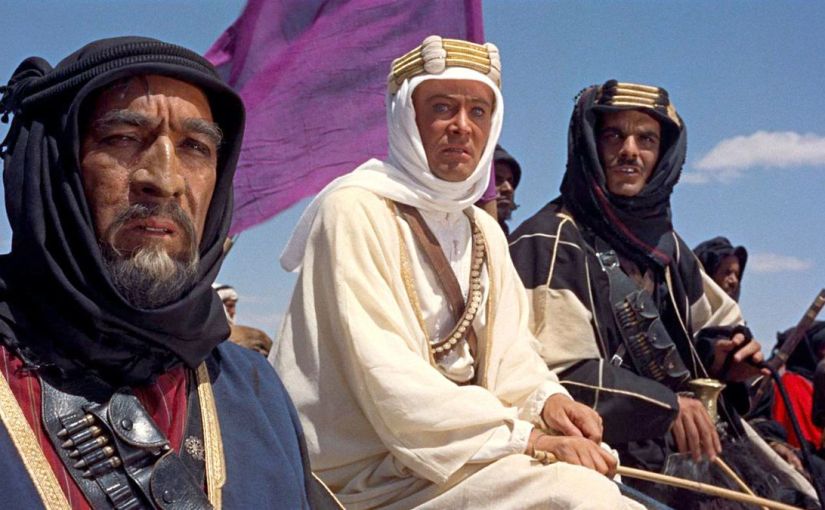
Peter O’Toole is the title character in his unforgettable film debut.  A daring, handsome, charming blond leading actor poised for adventure.  Lawrence is assigned to ally with the Arabs during the war to hold on to the necessary access of the Suez Canal which is a through way for oil, supplies and territory.  His determination for crossing wide, endless desert plains under a sun drenched open blue sky turn him into a leader, and a hero to the Arab soldiers, particularly represented by Sherif Ali (Omar Sharif).  They are a small band of fifty men, but Lawrence proceeds with the intent of gaining fifty more as he begins a long trek from one side of the desert to the other with persistent walking or by riding camel.  Lawrence won’t even leave a single man behind.  His resolve is courageous but could be costly later.

The technical construction of Lawrence of Arabia is likely what many notice and remember first, but the film comes with a well-set character arc for its protagonist.  Peter O’Toole was a perfect casting selection for this role.  Lawrence changes over the course of the film and it’s not a celebratory transformation.  Oft times, it seemed ironic to consider him the villain; perhaps a hero who falls from grace.  His derring-do is impressive, but likely also his undoing.  Lawrence allows strength and confidence to awaken a weak Arab nation who only survived for themselves with what little they held onto before their encounter with him.  Yet, the monster Lawrence creates within his own psyche may have also spawned a challenging threat from the Arabians for many years to come, long after this war is over and further generations come into play.  Bless a people with power but be aware of how that gift is used thereafter.

Lawrence accomplishes what has been regarded as seemingly impossible and now the Arabs adorn him in heroic white cloths (which must be one of the memorable costumes in film history).  He is who they look up to as the giver of their strength and confidence.  However, like most heroes that we find in the best of stories, T.E. Lawrence is weighed by fault, particularly his own hubris.  After his conceit gets him captured and tortured, it is not so easy to return to his home country who insist he continue to carry out his leadership.  Madness is invading his mindset and the hero we have borne witness to for well over two hours of film is now significantly diminished.  Parallel to that is the overconfidence and newfound freedom a political leader like Prince Faisal (Alec Guinness) absorbs for his Arabian people.  The end of David Lean’s film seems to imply what came of T.E. Lawrence’s contributions to the Arabs.  Was the world better or worse for what he achieved with his pioneering, yet dedicated military efforts?  What about Lawrence?  How did he fare, personally?

Forgive my incessant urge to compare David Lean to James Cameron.  I look at a film like Avatar and I see the monies and efforts invested to make that piece.  Yet, I feel like I walk away with little substance.  The films of Cameron not only fall short of story, but often lack texture as well.  I could never reach out and shake the hand of a “Pandoran.”  When I see Lawrence Of Arabia, though, I can feel the sweat and heat that O’Toole and Sharif experience.  Both are big films, not made on the fly. Rather, time and stress and a means to improve and show what’s never been seen or done before are offered.  David Lean might have been given all the monies in the world or the keys to kingdom to make his masterpiece.  However, it’s how he used these resources to painstaking perfection that lend to longevity in reputation for his career and Lawrence Of Arabia.

A train explosion near the start of third act is very impressive.  Lawrence and his men detonate a planted bomb on the tracks, and we see the locomotive derail onto its side, plowing into the hot desert sand.  We feel the immense weight of that steam engine.  We can detect the sand cloud that forms from the crash.  The collision of the cars being ripped apart and burned black thus create a new setting as Lawrence’s Arab followers rush to loot the train.

Grand battle scenes on horse and camel backs are meant to be seen at least ten times over in order to capture every piece of activity from the numerous extras and animals occupying a thousand different corners of the screen.  The bigger the screen, the better enhanced is the viewing experience. 

Long walks and camel rides in the desert may seem tedious for some, but not for me.  I was accompanying T.E. Lawrence and Sherif Ali on this journey.  This is another film where its running time affects what Lean set out to accomplish.  A trek through the desert is impossible to rush and this film is a testament to that notion.  I can’t say I’ve hiked through a desert plain that bears no end in near sight, but now I can lay claim that I’ve watched Lawrence Of Arabia.

Having only seen David Lean’s picture once thus far, I know that on repeat viewings I’d likely see something new each time hereafter.  This film is so alive of its period setting and backdrop and the unforgettable original score from Maurice Jarre give definition to the sweeping adventure that awaits with T.E. Lawrence’s travels.  The cast is marvelous as well.  Peter O’Toole is positively engaging.  Omar Sharif and Anthony Quinn are scene stealing character actors, much like Robert Shaw would become known for a decade later with Jaws.  Alec Guinness may be doing a brown face appearance as an Arab leader, but I’ll just salute the performance.  A charming actor of grand, yet subtle, skill.  I’m glad I’ve discovered him all over again from beyond …River Kwai and Star Wars.

Movies like Lawrence Of Arabia must remain at the top of the broad lexicon of films to watch.  It’s length and scope may be challenging, but its edits, its score, its immense visuals, and the performances therein, are unmatched by most anything else available to watch. 

MIDNIGHT COWBOY

By Marc S. Sanders

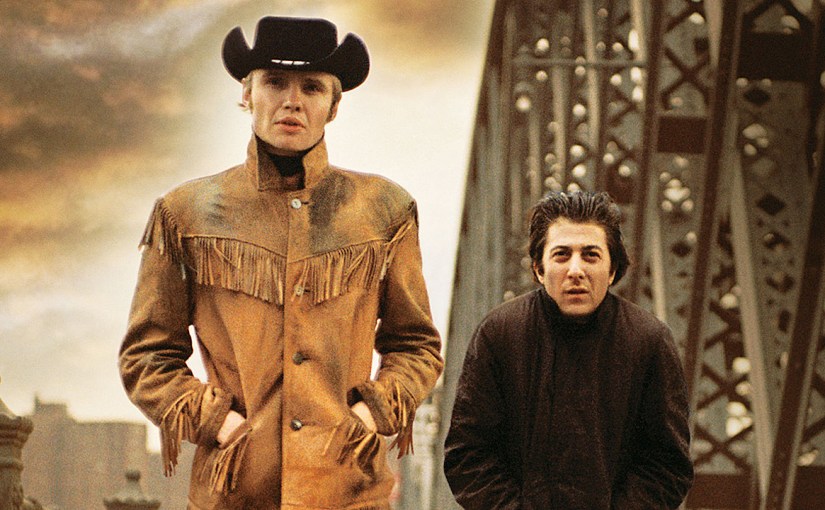
There’s an irony to John Schlesinger’s Midnight Cowboy.  At first, the film centers on a Texas bumpkin eager to relocate to New York City and succeed as a hustler.  Upon his arrival though, he could not appear any more virginal.  The cowboy’s name is Joe Buck, portrayed by Jon Voight in his Oscar nominated breakthrough role.

The first act of the film follows Joe on his long cross country bus ride.  He’s dressed in his finest country western shirt, stitched with floral patterns.  He’s got his black leather cowboy boots and of course the cowboy hat.  His origin bred Texas twang completes his image.  He meets a variety of comers and goers on the bus and then finally he reaches his destination. 

Schlesinger’s camera follows Voight as he treks through the city.  A man is passed out (heck, maybe he’s dead) on the street in broad daylight.  My Cinemaniac pals that I watched the film with noted how it’s funny that the streetwalkers don’t take one look at the poor fellow.  Rather they’re looking at Joe’s get up as he clearly stands out among the masses. Joe is the only one looking at the guy on the street.

Interspersed within Joe’s travels and entry into the city are quick flashbacks to where he stemmed from.  It does not look like a favorable upbringing spent with his grandmother.  There are flashes of Joe being victimized by possible sodomy.  There also appears to be a gang rape that he might have participated in.  None of it is made completely clear.  Though, it is evident that Joe has been trying to escape that environment for good. 

Eventually Joe encounters a sleazy, squat fellow who calls himself Rico Rizzo (Dustin Hoffman), addressed by others as Ratso.  Joe is so naïve that he’ll trust Ratso to get him some action where he can earn some money.  In exchange, Joe is completely willing to surrender the cash in his wallet.  He’ll learn from that mistake once he’s drained of everything but a few coins, locked out of his hotel room he can’t pay for and denied of his cow skinned suitcase that contains his possessions.  Eventually, he has no choice but to live in a condemned tenement building with Ratso. Joe Buck is about to lose a second virginity as he experiences how hard it is to live within the city.  He’ll also realize the value of friendship as he sees no choice but to take care of Ratso who is very sick.  Hoffman’s appearance shockingly changes as Ratso’s health submits to a harsh, unknown illness.  The sweat all over his face is palpable.  The chilling, sickly feeling he exudes is clearly felt.

Waldo Salt’s award-winning script, based upon a novel by James Leo Herlihy, explores the good nature found within two different walks of life despite the dodgy pasts that follow them. Ratso and Joe are one of the oddest couples in cinematic history.  There’s no way these two would want to be together unless one was trying to take advantage of the other or one was left with his guard down, open to being taken for and deceived.   Jon Voight has a tall youthful stature, a handsome man.  Dustin Hoffman is scrawny and significantly shorter with greasy hair, an uneasy limp and a weird squawk to his voice.  The often-times method actor seems to make himself increasingly hideous. 

Perhaps I needed to see Midnight Cowboy at the time of its release.  It surprises me the film merited the prestigious accolades it collected, including Oscars for Best Picture, Director, and Screenplay.  The two actors also received Oscar nominations.  It remains an honest film of its time in the year 1969.  Yet, it is disturbing and ugly too as it captures the seedy side of New York with experimental drug use and Joe’s victimization for sex.  He gets ripped off by who he thought was a kind woman (Sylvia Miles) looking for an intimate evening with his hustler capabilities.  Later, he’ll surrender himself to a man looking for oral pleasure in a movie theatre.  It’s not the typical glamourous epic of a Hollywood yesteryear.  In fact, for a time it was the only film to be recognized for winning Best Picture with an X rating.

The celebration of Midnight Cowboy’s achievements falls upon the relationship between Joe and Ratso.  Had Joe not been so naïve to how lowlifes operate and had Ratso not become so ill, yet welcoming to Joe when he needed a place to stay, then a friendship would not have gradually developed. 

The ending to Schlesinger’s film is touching, though sad.  As the story began, it also ends on a bus heading towards a new destination – another new way of life, different from what Joe experienced in small town Texas or New York City.  The two characters sit together in the back seat and the other passengers eventually observe them like they had on Joe’s first journey.  Either individually or together Ratso and Joe are simply strange to any sort of environment.  Yet, they’ll learn from each other and that’s where Midnight Cowboy triumphs.

CHICAGO

By Marc S. Sanders

When you are a sexy, sultry lady killer, infamy can just about save you from a hanging.  That’s what Rob Marshall’s Oscar winning adaptation of Bob Fosse’s Broadway jazz musical capitalizes on in Chicago. The movie is hot, steamy, dazzling and blazing with magnetic song and dance numbers that are easy to follow while getting your pulse racing.  The design, direction, music, and choreography are magnificent.  The cast is outstanding too.

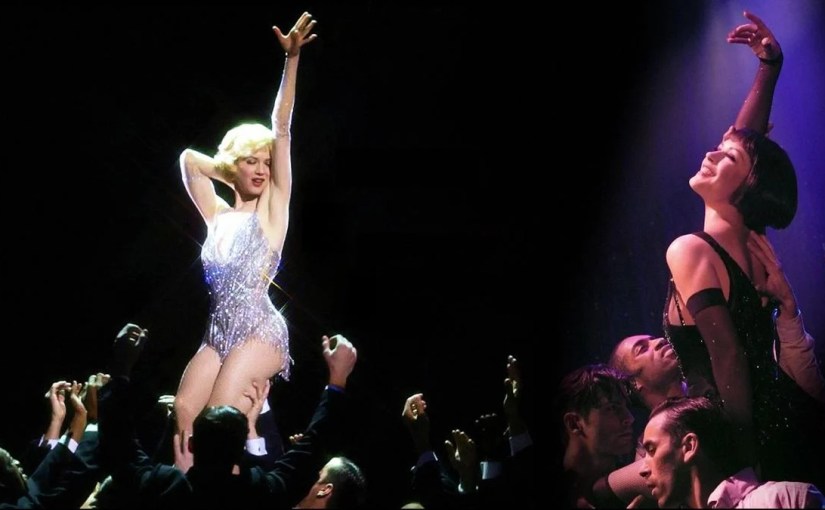
During the glitzy 1920’s in the Windy City, Roxy Hart (Renée Zellweger) is a wanna be night club performer who gets arrested for the murder of her extra marital lover (Dominic West).  She’s thrown in the pokey where the well known warden Matron Mama Morton (Queen Latifah) oversees all of the other murderesses, and often profits off of their sensationalistic crimes.  Roxy’s loser schlub of a husband, Amos (John C Reilly), manages to hire the hottest defense attorney in town, the handsomely slick and underhanded Billy Flynn (Richard Gere), to represent Roxy at trial.  Billy has never lost a case because his specialty is to manufacture drama for his accused clients, generating sympathy in the papers and among the jury.  In the film, there is a scene where Billy is literally pulling the strings on his puppets, particularly a marionette appearance of Roxy on his lap while he does the obvious ventriloquism.  A memorable moment for both Gere and Zellweger.  On the side is Velma Kelly (Catherine Zeta-Jones), a double murderer of her husband and performing partner/sister.  Velma owned the public outcry until Roxy’s name was splashed along the headlines.  Now, the spotlight is quickly moving away from Velma.

Rob Marshall choreographed and directed Chicago.  He demonstrates the fun that can be had with murder.  Call it a new kind of excitement that normally we take jubilant delight with episodes of Murder She Wrote or Agatha Christie tales. 

The theme of this picture is how the story is narrated in a colorful reality.  On a parallel level it is performed on a stage nightclub with a bandleader (Taye Diggs) introducing the players who then breakout into their own testimonial song amid large choruses and dancers to enhance the attraction of headlines and sleazy, operatic narratives.  Christine Baranski is the reporter whose front and center, trying to collect the next big chapter development of whoever leads the hottest storyline at any given moment. 

Marshall will turn a courtroom proceeding led by Billy Flynn into a three-ring circus, while at the same time he’ll cut away to the nightclub.  Billy will be on stage, but he’s now wearing a glittery three-piece suit and doing a ragtime song and dance with a chorus of scantily clad, Burlesque women to apply a little Razzle Dazzle for the judge and jury.  Richard Gere is not who you think of for stage musicals, but he is positively charming.

Queen Latifah has a scene stealing moment to show off her entrance into the picture.  Mama Morton is in a skintight evening dress, complete with a swanky boa while performing When You’re Good To Mama on stage at the nightclub. Frequent cut aways have her dictating her powerhouse tune to the inmates.  John C Reilly performs Mr. Cellophane. He lays out certainty that there’s nothing inauthentic about the pushover loser husband he really is.  Both actors got well deserved Oscar nominations.

Catherine Zeta-Jones and Renée Zellweger are a perfect pair of competitors.  They each have their individual moments and they act with such solid gusto; tough broads not to messed with.  The confidence they exude on screen with character acting, singing, and dancing is second to none.  The script will offer moments when Roxy and Velma think they are high and mighty, and winning the court of public opinion.  Then it will be undone when their hotshot attorney, Billy Flynn, knocks some sarcastic sense into them and a dose of reality sets in.  Roxy isn’t so fond of wearing a conservative black dress with a white collar in court until she sees a fellow cellmate lose her last motion of appeal, and there’s nothing left but to be punished by hanging.  She might be putting on a helluva performance, and signing autographs while souvenir dolls of her likeness are selling on the streets, but none of that ain’t gonna mean a thing if the jury finds her guilty of murder.

Just like I began this article, infamy is the word that kept coming back to me while watching Chicago.  Infamy bears celebrity.  Granted, it’s enhanced for a lively musical motion picture and stage show.  However, there’s a very, sad, and no longer surprising truth to that ideal.  A few years back, I recall news reports about a criminal’s sexy mug shot where he had donned a tattooed tear drop below his eye.  This guy was prime for runway modeling.  However, he was proven to be a violent car thief. He actually got signed by a talent scout following his bail out.  (I think the agent posted the bond.)  Later, he got arrested for some other crime. 

I never saw the reality program Chrisley Knows Best, about a God loving family who proudly live among the finest that money can buy.  Recently, the ultra-vain mother and father were sentenced to over a decade in federal prison for fraud and tax evasion.  Yet, their brand is stronger than ever, as the gossip columns can’t get enough, and their adult daughter’s podcast has millions of listeners.  Word is that a new program is being designed as a follow up to their prison sentences. 

Infamy bears reward.

Chicago pokes fun at the obsessions adhered by the media, the public, the courts and within the penal community.  The well known musical is now decades old, but the topics contained within clearly identify how news is not reported in a simple, objective Walter Cronkite kind of way, anymore.  Everything is heightened.  Everything is dramatized.  It’s not enough that Roxy kills her lover.  That will get her only so much mileage, until the next lady killer comes along (in the form of Lucy Liu, for example).  Roxy must stay relevant.  Announcing she’s pregnant will keep her on the front page (It could help that she faints while doing it). Velma knows all too well that the public favoritism she once had, accompanied with Billy’s sleazy promotion, is even further away. 

Rob Marshall presents a film where any song can be pulled out of context just for its sizzling entertainment.  Try not to forget the Cell Block Tango with solos from Zeta-Jones, as well as her fellow inmate chorus girls, each proudly describing how their guy “Had it coming!!!”.  All That Jazz is arguably one of the best opening numbers to a show, and Catherine Zeta-Jones owns the performance.  Individually, these songs and the performers win my attention in the car or the shower or during a workout.  Assemble them together with the overall storyline, and Chicago becomes a fast paced, kinetic roller coaster that makes you think while you smirk at all the scruples and vices being dismissed. 

The last time I saw Chicago was in theaters in 2002.  I had also seen a stage production of it before then.  I loved it both times.  Rewatching it recently gave me such a jolt of energy.  It is why theatre is a vital source of escapism. Here is an example where you can feel positively entertained while reflecting on a sad truth.  It might be sad, but you’re smiling all the way through while you mouth the brilliant lyrics and tap your feet.

Roxy Hart, Velma Kelly, Billy Flynn and the rest of the cast of characters make Chicago red hot and gleefully sinful.

TITANIC (1997)

By Marc S. Sanders

James Cameron’s Titanic will always remain a timeless piece.  Audiences adore the relationship between the two lovers from different worlds, Jack and Rose, who meet aboard the maiden, and final, voyage of the doomed cruise liner.  Maybe more importantly, the craftsmanship of this film is still beyond compare.  Many know that when this picture was in the making, its budget ran way over and endless rumors of waterlogged technical challenges were rampant through media reports.  Titanic was predicted to sink James Cameron’s career.  Instead, it was the grand Hollywood underdog that no one expected.

I recall seeing the film twice in theaters during the Christmas season of 1997.  I was not so enamored with the script or the fictional love story that Cameron conjured as the central narrative for the real-life tragedy that took approximately fifteen hundred lives on April 15, 1912.  The visual effects were the marvel to watch, and what I patiently waited for, during the second half of the picture.  I had to tread water through the first half though.

A hardly known, but already Oscar nominated (What’s Eating Gilbert Grape?),  Leonardo DiCaprio portrays Jack Dawson, the poor member of the ship’s steerage company who falls in love with an aristocratic young woman named Rose Dewitt Bukater.  Rose is played by Kate Winslet, who’s uncomfortable with the snobbishly wealthy first class section of people she’s forced to associate with by mandate of her possessively cruel, and supercilious fiancée named Cal (Billy Zane) and her mother, Ruth (Frances Fisher).  Call it a Romeo & Juliet love story.  Two lovers are forbidden to be with one another.  Yet, they are going to do it anyway.  It’s simple and nothing dimensional.  It seems to have parallels to Disney’s rated G interpretation of Beauty & The Beast.  Fortunately, what saves the storyline are the performances and chemistry of DiCaprio and Winslet.  These are not even the best roles of either actor’s storied careers.  Yet, they are anything but unlikable. 

The relationship they share aboard Titanic, as it makes its way from Europe to the United States, is told in flashback by a 101 year old woman (Gloria Stuart) to a marine exploration crew who have been meticulously searching through submerged remains of the ship on the ocean floor of the Atlantic.  The most important element to come from this section is a wise choice by Cameron to include an informatively brief analysis of how exactly the ship took on an overabundance of ocean water following a collision with an iceberg, and how it gradually began to sink, weigh down, and split apart before finally concluding with a straight dive down into the murky, cold depths.  I must note that film critic Gene Siskel acknowledged this storytelling device upon the film’s initial release. He hailed this sequence because it offered an early “blueprint” of what audiences could expect to happen and witness during the film’s second half.  We all know the ending to the film, but how exactly did it happen?  The quick breakdown helps.

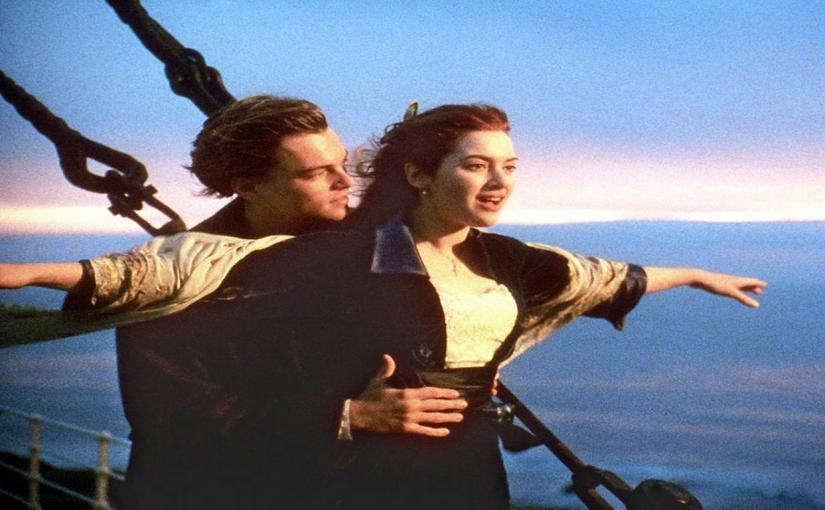
Ahead of the tragedy, Cameron and his set designers offer a grand, functioning piece of machinery that is absolutely impressive to modern audiences, even over a century later.  The decks and hallways are wonderous.  The forward and aft locations seem familiar and solid.  The CGI on this reinterpretation of Titanic is undetectable.  If this film was going to live up to its name, it most certainly has done so.  This ship looks tremendous and strong and indestructible just as the architect and engineer (Victor Garber, Jonathan Hyde) written into the script proudly lay claim to.  The famous moment of the film where Jack supports Rose on the forward bow of the ship with a sunset sky in the background is positively gorgeous.

I do have reservations with the film though.  I think both stories, the forbidden romance and the demise of the ship, in Titanic work.  However, when spliced together, the picture leaves me feeling uneasy.  James Cameron has weaved his fictional romance, appropriate for used, yellow stained paperback books, with a horrifying tragedy.  It’s what you would find in those cheesy Irwin Allen disaster epics from the 1970s.  When Cal’s anger over Jack’s intrusion comes to a boil, he pursues the couple, firing a pistol at them while the ship is continuing to sink.  Jack is apprehended and handcuffed in the lower deck and his doom seems imminent as the water level grows higher.  A priceless blue diamond serves as a MacGuffin that goes back and forth to deliver the operatic divide of these characters.  These are all cinematic inventions painted upon a well-known historical tragedy simply for the sake of adventure and suspense. 

I also found it unconvincing that the only person aboard the ship to question the contingency planning and safety measures ahead of any potential disaster is young Rose, who has no insight into mariner regulation or procedure.  Of all people, it only occurs to Rose that Titanic is not equipped with sufficient lifeboats for all twenty-two hundred people on board.  For storyline options, these avenues written by James Cameron sometimes take me out of the film. 

What I hold fascinating though is where the film depicts the eventual panicked response of the passengers and crew.  We see the captain appear helpless in his defeat against the nature of the ocean running its course over the ship he commands.  A string orchestra chooses to simply perform amid the ongoing disaster, which I have read actually happened.  Most breathtaking is how all the extras in the film react to the growing shift of the ship.  Their slant becomes steeper.  The people do their best to shuffle through the flooding, eventually having to keep their heads above water.  Helpless children are abandoned.  For an emotional punch, the steerage in the below decks is gated off from reaching the top of the ship, and giving themselves a chance at survival on a life boat.  James Cameron accounts for every response and detail that likely occurred during the sinking of the ship.  It’s captivating to witness, despite how tragic the outcome.

Though I do not care for the mix of the love story and the real-life submergence of the ship, Titanic has many strengths beyond what James Cameron achieved with the most up to date technology in visual effects, at the time.  Billy Zane is a villain that you love to hate.  Truly an underrated antagonist in the history of film.  David Warner is an intimidating henchman.  Kathy Bates is a welcome Unsinkable Molly Brown, the crass wealthy woman who sets herself apart from the pretentiousness of her lady peers.   

The exceedingly three-hour running time allows you to become completely familiar with the ship from stem to stern and again the set pieces are magnificent, whether you are hobnobbing with the wealthy up top or the steerage down below.  Every pipe or rope or stairway or hallway or chandelier serves a purpose.  The costumes and makeup designs are appropriate, including the frozen complexions on the bodies that float on the ocean surface following the tragedy.  Cameron’s use of the camera is amazing as he offers wide, expansive shots of nothing but dark ocean with hundreds of people suffering towards their demise. Thus driving home the point that there’s nowhere to find salvation and relief from the bitter cold air and sea water.  These poor people faced unimaginable challenges while competing with panicked crowds, and lack of foresight from those in charge of this newly designed technological wonder.  The movie covers everything that worked against these passengers.

Titanic is an incredible accomplishment. There’s much to see and absorb.  The last time I saw the film was nearly twenty five years ago and much of the footage never escaped my memory.  James Cameron left an indelible impression on moviegoers.  Regardless of the misgivings the film holds, Titanic has held its rightful place as an all-time landmark in cinematic achievement.

NOTE: I took advantage of seeing a newly restored 4K version in 3D at my local movie theater.  I have never been a huge fan of 3D as I often find it murky and distracting from the story.  Had Titanic been offered in standard 2D, that is what I would have gone to see.  Fortunately, this re-release is an exception to my impression with 3D presentations.  The picture is glorious, and I highly recommend the film be seen while it remains in limited release.  Titanic in 3D should not be missed.

SHAKESPEARE IN LOVE

By Marc S. Sanders

William Shakespeare’s works will always remain timeless.  His accomplishments are simply magnetic.

If you have any love for live theater, you’ll likely have at least a fondness for John Madden’s Oscar winning film Shakespeare In Love.  I loved the movie.  Perhaps that is because as a moonlighting playwright, myself, I could relate to The Bard’s early dilemma in the film – writer’s block.  It’s a gnawing, aggravating experience to go through.  You have an urge to create.  You just don’t know where to begin.  Believe me Bill, I know what you’re going through.

This likely fictional telling of William Shakespeare’s process of conceiving Romeo & Juliet begins with two competing theaters who have purchased the rights to Shakespeare’s (Joseph Fiennes) newest play that he has titled Romeo & Ethel, The Pirate’s Daughter, a comedy of course.  However, he has not yet written one page.  Not only does he suffer through his writer’s block, but William also has to endure the pressure of the theatre companies to stage and cast the play.  Geoffrey Rush and Martin Clunes are the scene stealing theatre owners who pester poor Bill for his script. 

My experiences in theatre allow me to also relate to the frustrations of staging a play.  Casting can be troubling if you don’t have the right selection of actors for the roles to be filled.  Huge egos can also be an annoyance.  Ben Affleck seems perfectly cast for that. (“What is the play, and what is my part?”)  In Shakespeare’s time, women are absolutely forbidden on the stage. As most theater presentations are intended to be comedic, men occupying the female roles only heightens the humor.  Still, as troubling as it is to cast the supporting roles with the available men of the company, including Ethel and her nurse, no one seems right for the role of Romeo. 

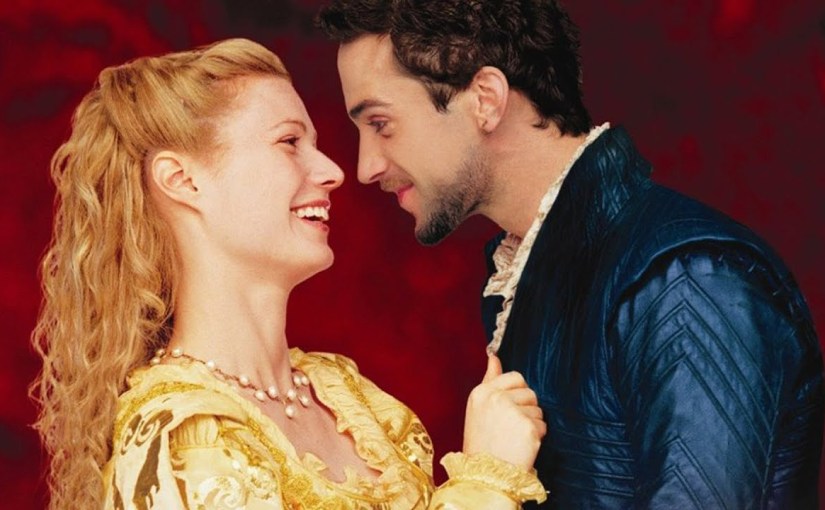
A fan of his, and a lover of theater, is Viola De Lesseps (Gwyneth Paltrow), the daughter of a wealthy merchant.  She musters the courage to disguise herself as a man and attend an audition under the name of “Thomas Kent.”  William is immediately taken with Thomas’ stage presence and upon his pursuit of him, encounters Viola.  They are both immediately stricken with love for one another and soon the writer learns of Viola’s deceit and revels in trysts with her while they maintain the secret for the integrity of the play that he now has inspiration to continue writing to its grand conclusion.  Viola is the muse that William has been seeking.

One problem beyond the usual obstacles in producing a play for performance time comes in the form of Lord Wessex (Colin Firth), a snobby cash poor aristocrat, who claims Viola as his soon to be bride as a means of earning a stature of wealth through her family.  Wessex is a demanding and unreasonable fiend of course, and Firth delivers an effectively cruel villain against the heroism found in Fiennes’ Shakespeare.

As the play is rehearsed and the romance between Viola and William continues to blossom, the drama is not left only on the stage.  A grand scene bordering on slapstick occurs when the competing theaters engage in a swashbuckling dual.  Props are tossed, swords are swung and feathered pillows explode.  Later, adventure on the level of Errol Flynn occurs with swordplay between William and Wessex within the theater and its trappings.  Screenwriters Marc Norman and Tom Stoppard inventively imply that theater, as we know it today, was simply inspired by what Shakespeare encounters in his own life.  When I conduct playwrighting workshops at my local community theater, I always tell the class that you have to “write what you know.”  Shakespeare In Love precisely demonstrates that mantra, even if it is elevated for the theatrics of cinema.  After all, this movie proudly boasts its silly comedy as much as it embraces its romance which thankfully never drowns in sap.

A wonderfully well edited centerpiece cuts between Viola and William’s passion for one another against their stage rehearsals with Viola in her guise as “Thomas Madden.”  In bed, they romance each other with recognizable dialogue, originally written by the real Shakespeare, that then makes its way into William’s pages for his script in progress.  This is where Gwyneth Paltrow really shines as she is momentarily depicted as the lovely Viola and then we see her in the guise of “Thomas,” the naturally gifted actor perfect for William’s Romeo character.  Paltrow’s range with the Oscar winning performance is done so well in this sequence alone.

The final act of the film is joyously assembled.  Behind the scenes, actor and writer William Shakespeare stresses over a stuttering actor who has entered the stage to begin the play.  Can he get through the scene?  What about the poor actor who is stricken with stage fright, and suddenly can’t go on as Juliet?  The audience is left in a rapturous trance with open mouths of silence and tears, following the suicides of the lovers on stage.  Yet, they don’t know if they should applaud at the end of the play.  The actors don’t know how to respond to the applause.  As well, are we given an opportunity to bear witness where the well-known phrase “The show must go on!” originated from?

It’s also necessary to point out one of the most favorite side characters to ever grace a film.  Judi Dench is the staunch and intimidating Queen Elizabeth I.  Arguably, this brief role, that I believe amounts to no more than five and half minutes on screen, carried Dench to not only Oscar glory but a celebrated favorite character actress for years to come.  Dench demonstrates how fun acting can be even if she is wrapped up in layers of 16th century wardrobe and caked on makeup.  Her first scene has her laughing at a poor actor performing with an uncooperative poodle.  Her last scene has her tearing down the romantic gesture of men laying down their coats for her to cross over a mud puddle.  It’s an unforgettable appearance in the film.

I take issue with one element of the picture, however.  Forgive me for going against the opinion of the Academy Awards, but Shakespeare In Love would have been an even grander experience for me had it not been for an overproduced and intrusive original score from Oscar winner Stephen Warbeck.  The music cuts into the film too much.  It borders on obnoxious.  Over and over, I was telling myself, these scenes hold together beautifully without any of the blaring horns and trumpets from Warbeck’s orchestra.  This film has an outstanding cast of actors and often I felt like they were being upstaged by the soundtrack of the film.  There are magnificent scenes with witty dialogue delivered by the likes of Imelda Staunton, Tom Wilkinson, Ben Affleck, along with Dench, Firth, Paltrow, Fiennes and Rush.  I could literally envision these moments working based simply on their performances alone.  Imagine watching a live stage performance, only elevator music cuts in at the most inopportune times. 

Still, I refuse to end on a sour note for Shakespeare In Love.  It is worthy of a standing ovation.  John Madden’s film is a grand production in cast performance, art direction, costume and makeup.  The script by Marc Norman and Tom Stoppard is brilliantly clever and witty as they weave inspired references from Shakespeare’s various sonnets, poems and plays into rich, everyday dialogue. 

Sustaining the value of performing arts can easily begin with a viewing of Shakespeare In Love in a school curriculum.  Even better would be to adapt this film into a stage play.  I think to watch Shakespeare In Love, live on stage, would be a wonderous experience.

THE DEER HUNTER (1978)

by Miguel E. Rodriguez

THE DEER HUNTER (1978)
Director: Michael Cimino
Cast: Robert De Niro, John Cazale, John Savage, Christopher Walken, Meryl Streep
My Rating: 10/10
Rotten Tomatometer: 86% Certified Fresh

PLOT: An in-depth examination of the ways in which the Vietnam War impacts and disrupts the lives of several friends in a small steel mill town in Pennsylvania

[Author’s note: This will be the first in an ongoing series of reviews inspired by a book given to me as a birthday present by my long-suffering girlfriend.  Entitled Everyone’s a Critic, it challenges readers to watch a movie a week within a given category, then answer questions like, “Why did you choose this particular film” or “Do you feel this film deserved the award? Why or why not?”  Clearly designed to inspire discussion.  This category was “A Film That Has Won Best Picture.” This format is a work in progress, so I hope you’ll bear with me on future installments.

I am going to assume, for the most part, that most readers will have seen the movies being reviewed in this series.  Therefore, some spoilers may or will follow.  You have been warned.]


Once about every couple of years, I like to pick up and read Stephen King’s The Stand in its original uncut version.  My paperback copy runs to 1,141 pages, not including King’s foreword and a brief prologue.  Even Tolstoy would look at that thing and go, “Dude…edit yourself.”  But having read it numerous times now, I cannot imagine what could possibly have been excised from the edited version of King’s novel.  Every detail of that apocalyptic saga feels necessary.  Reading it is like falling into a fully realized alternate universe.

That’s what watching The Deer Hunter is like.  I can still remember the first time I watched it.  I knew its reputation as one of the greatest Vietnam War movies ever made, had heard of its harrowing Russian Roulette scene, and was intensely curious.  I popped it into the VCR, hit play…and for the first 70 minutes I got a slice-of-life drama about steel workers in a tiny Pittsburgh town (Clairton, for the detail-oriented) where, mere days before three friends ship off to Vietnam, one of them is getting married.  And the centerpiece is the wedding reception.  Ever watch a video of a wedding reception?  How high do you think a young teenager would rate its entertainment value on a scale of 1 to 10? 

I could not appreciate, as I do now, how vital this scene is.  Relationships are stated, expanded upon, and brought to a kind of cliffhanger.  Take the mostly non-verbal interplay between Linda (a luminous young Meryl Streep) and Michael (Robert De Niro).  Linda is clearly in a relationship with Nick (Christopher Walken), but it is painfully obvious that Michael and Linda have eyes for each other.  Mike watches intently from the bar as Linda dances at the reception, and whenever their eyes meet you can almost hear their hearts stop beating.  The oblivious Nick even pairs them on the dance floor while he visits the bar himself.  The awkwardness as Michael forces small talk and Linda shyly reciprocates is palpable.  And…is that Nick giving the two of them the eye at one point…?

As a kid, I wondered why this soap opera nonsense was necessary in a Vietnam film.  Of course, I didn’t know what was coming.  That’s the beauty and wonder of The Deer Hunter.  It challenges you to follow along with this miniature melodrama to give meaning to what comes next.

There is a key moment during the reception when an Army soldier wearing a green beret stops by the reception.  Mike, Nick, and Steven (John Savage), who are gung-ho about serving their country, yell their support and let him know how much they’re looking forward to killing the enemy.  The steely-eyed soldier raises his glass, looks away, and says, “Fuck it.”  It’s not terribly subtle, but the ominous nature of this moment always fills me with a sense of foreboding, even having seen the film many times by now.

But even after the reception is over, there is one more small-town pit stop to make before the movie gets to Vietnam.  (In fact, The Deer Hunter spends surprisingly little time in Vietnam.)  Michael and a group of friends including Nicky and Stan (John Cazale) go hunting for deer in the mountains as a kind of ritual before Nick, Mike, and Steven are deployed.  It is in this sequence that Oscar-winning cinematographer Vilmos Zsigmond’s talents are put to stunning use.  We are shown vistas of the Allegheny Mountains that are simply breathtaking, with Mike and his friends seen as mere dots in the mountainsides.  Choral music with a men’s choir singing in Russian is heard on the soundtrack, giving the sequence a majestic aura that must be seen and heard to be believed.

Then the hunt is over, and the boys all have one last drunken night at the bar owned by another friend, John (George Dzundza in an under-appreciated, realistic performance).  Here they all sing along to Frankie Valli and listen somberly as John plays a sad classical tune on his piano.  And then, in one of the film’s masterstrokes of editing, we slam-cut immediately to the jungles of Vietnam – no boot camp, no footage of them being trained or flown over there, just suddenly they’re there and the contrast between the carnage we experience in the first few minutes of Vietnam versus the rhythms of their lives in Clairton could not be more extreme.

In a horrific but mercifully brief sequence, we watch as a Viet Cong soldier calmly walks into a burned-out village, discovers a hidden pit holding terrified villagers, and remorselessly tosses a grenade inside.  We then watch as Mike, now a battle-hardened soldier, emerges from a hiding place with a flamethrower and burns the VC soldier alive.

The effect of this scene cannot be understated.  To witness Michael torching a soldier, even after that soldier committed a brutal act himself, is jarring.  And why is it so jarring?  Because we have seen Mike as a civilian, as a friend, as a would-be lover, during that lengthy sequence at the wedding reception and while hunting with his friends.  Admittedly, you got the sense that he could or would get violent if necessary.  (He’s clearly the alpha male of his “clique.”)  But this…I mean, damn.

Then, in one of those Hollywood conveniences that never get old, Mike is unexpectedly reunited with Nick and Steve who just happened to arrive at that very same village with another platoon of US soldiers.  And then, immediately after being reunited, they are captured by enemy forces, imprisoned with several enemy combatants in a riverside compound, and forced by their sadistic keepers to play Russian roulette with each other as the guards bet on the outcome.  Michael comes up with a horrifyingly logical escape plan: convince the guards to put THREE bullets in the chamber instead of one.

Much has been made regarding the historical inaccuracy of this scene.  To those arguments, I say: who cares?  As someone once said, riffing from Mark Twain, “Never let facts get in the way of truth.”  The truth of the matter is, the Vietnam experience was a modern-day horror show, leaving physical and psychic scars on its participants and on our country.  In my opinion, the Russian roulette scene can be interpreted as a symbol of how those soldiers, or ANY soldiers, must have felt every single day.  Going on a routine patrol in the jungle could have potentially lethal circumstances.  They rolled the dice every time they called in an airstrike, betting they didn’t get firebombed themselves.  Booby traps were everywhere.  How is life in a war zone that much different from being given a one-in-six chance at living or dying?

I’ve already gone into far more spoilers than I am accustomed to, so let’s just say this happens and that happens, Michael winds up making it back home, Steven is grievously wounded in the escape attempt, and Nick goes AWOL when, after making it back to a military hospital in Saigon, he wanders the streets at night and discovers an underground ring of lunatics who run a high-stakes game of Russian roulette.  And we’re still just at the mid-point of the film.

When we see Michael back home, the earlier sequences establishing the rhythms of small-town life and his feelings towards Linda, for example, all come into focus.  We need that reception and the hunting scenes so we can see how much Michael has changed.  For example, when Michael is arriving back home by taxi, still in full military dress, he spots a huge banner: “WELCOME HOME MICHAEL”.  He tells the driver to keep going.  In a hotel room later that night, he sits on the edge of his bed and rocks back and forth, winding up crouching against the wall.  He is completely unable to process how to deal with people anymore.  Or, at least, he doesn’t trust what he will or won’t say.  I watch that scene, and I feel such intense sympathy and empathy.  What he’s feeling, what he’s been through, what he’s seen, is so huge that he knows he’ll never be able to explain it to anyone who hasn’t been there.  He knows he’ll get questions like, “What was it like?  Did you kill anyone?  How are you feeling?  Where’s Nicky?”  I’ll never know what it’s like to fight in a war, but if I had gone through what he’d gone through, I wouldn’t have stopped either.

There is a heartbreaking scene where Linda, who is more than a little distraught that Nicky is AWOL, hesitantly suggests to Michael that they go to bed.  “Can’t we just comfort each other?”  Mike rebuffs her, but in a way that makes it clear he’d like to, regardless.  De Niro’s performance here is staggering.  As he walks out, he makes a statement, showcasing how much he is feeling but also how unable he is to articulate it: “I feel a lot of distance, and I feel far away.”  I knew exactly what he was talking about.

The very end of The Deer Hunter is one of the most emotionally shattering finales of any movie I’ve ever seen.  It ends with a simple song, first sung as a solo, then joined by everyone else at the table.  I will not reveal what happens to get us there.  Is it shameless manipulation?  Yes.  Does it work?  Yes, so I can forgive the “shameless” part.

One of the criticisms I’ve read more than once about The Deer Hunter is how “one-sided” it is.  To which I say, “Well, duh.”  The Deer Hunter is not presented as a history lesson or a lecture on the internal politics in the country of Vietnam during the war.  The Deer Hunter is intended to make us feel something.  It wants to show us what happens to a person who is exposed to the very worst side of human behavior and lives to talk about it.  It wants to remind us that a country can wave a flag and stand for what’s right and be willing to sacrifice its best and brightest souls for a righteous cause…but it must also be prepared for the aftermath.  The Deer Hunter is a somber prayer that our country remembers the cost it demands, and that it will take care of its own when the dust settles.

NOMADLAND (2020)

by Miguel E. Rodriguez

Director: Chloé Zhao
Cast: Frances McDormand, David Strathairn, and a cast of non-professionals/actual “nomads”
My Rating: 8/10
Rotten Tomatometer: 93% Certified Fresh

PLOT: A woman in her sixties, after losing everything in the Great Recession, embarks on a journey through the American West, living as a van-dwelling modern-day nomad.


Nomadland is one of the most visually beautiful films I’ve seen recently.  It mostly reminded me of Brokeback Mountain (2005) with its sprawling vistas of distant mountains, lonely country roads against a looming sky, and desert badlands illuminated by that elusive light that appears only during the “magic hour” so coveted by cinematographers and photographers alike.  It’s beautiful and well-made.  As a message film that won the Academy Award for Best Picture of 2020…I mean…it’s good and admirable, but it didn’t quite get to me like it was clearly trying to.

As a piece of propaganda (intentional or not), I can see Nomadland being effective for anyone who has been disillusioned of the American Dream by financial troubles.  Set in 2011, the film follows Fern (McDormand) as she hits the road in a van after the gypsum mining company her deceased husband worked for folded, displacing an entire town, Empire.  Even the town’s zip code was discontinued.  Fern literally lives out of her van, which doubles as living quarters, bedroom, dining room, and (revealed in a shot that I was stunned to learn was real) bathroom.  She works seasonal jobs throughout the American West at various parks, restaurants, and even an Amazon warehouse during the holidays.

On her travels, she encounters a large community of fellow nomads.  Periodically (I think annually), they gather at a location in the middle of the desert to trade goods, share stories and nomadic tips, and basically support each other for a week or a month or whatever…it’s not made clear exactly how long everyone stays before they go their separate ways once more.  On this occasion, she meets a fellow traveler named Dave (Strathairn) who trades her for a can opener.  Over the course of the film, Fern’s and Dave’s paths will intersect again and again.  I thought we were getting the kernel of a corny love story, but not quite.  The purpose of their relationship is pragmatic, not romantic.

Another traveler Fern meets is Swankie, a lively woman in her seventies who hangs a skull-and-crossbones flag from her van when she wants no visitors.  Honestly, it made me wish I had a similar flag to hang from my neck to communicate the same thing in public.  Anyway, Swankie reinforces Fern’s commitment to this way of living by describing trips to Alaska, a visit to a large community of swallows nesting on a cliff while on a canoe trip, and by revealing one of the real reasons Swankie has adopted this lifestyle in the first place.  All with no bills to pay, other than gas, food, and vehicular upkeep.

The movie follows Fern from one place to another over the course of a little over a year.  We see her working, driving, talking with people she meets, cooking on her tiny gas stove inside her van, dealing with the cold in the winter, reminiscing over old photos and slides.  There are two interesting side trips when she can’t avoid reaching out to…well, I guess “civilization” is the right word.  One occurs because her beloved van breaks down and she has to get to her sister’s to ask her for repair money.  Another occurs when she takes Dave up on an offer to…no, won’t spoil it.

At times, I found myself comparing Nomadland to Cast Away, Robert Zemeckis’ 2000 film where Chuck Noland (Tom Hanks) finds himself stranded on a desert island after a plane crash.  In both situations, the heroes find themselves isolated from civilization.  They must both learn to deal with an alternate way of life, and there is no alternative.  Adapt or die.  (When Swankie learns Fern doesn’t even know how to change a tire, she reprimands her.  “You can die out here.  You’re out in the wilderness, far away from anybody.  You can die out here.  Don’t you understand that?  You have to take it seriously.  You have to have a way to get help.  You have to be able to change your own tire!”  It’s a sobering reminder that, even though she has a cell phone (how she pays the bill is a mystery to me), Fern must be self-sufficient in order to survive.)

Furthering the similarities to Cast Away, there’s even a moment where Fern has an opportunity to sleep in a real bed.  We see her crawl underneath the covers…but in the middle of the night, she creeps back out to her faithful van to get a real night’s sleep, just like Chuck Noland sleeping on the floor of his hotel room.

But what does it all mean?  What is Nomadland trying to say?  I couldn’t shake the idea that Zhao’s film, based on a book of the same name, was an attempt, like Into the Wild (2007), to romanticize the concept of shedding our material needs, stripping ourselves down to the necessities, and getting back in touch with nature.  I have no doubt this notion appeals to many people.  Well, that much is clear because nearly everyone in the film besides McDormand and Strathairn are non-actors who are playing themselves, and they’re all nomads, too.  But is the movie simply showing me how and why a person makes this decision?  Or is it trying to convince me that I should do the same thing?  Is this one of Ebert’s “empathy machines” that allows me to live in someone else’s shoes for 107 minutes and experience life through their eyes, or, like Into the Wild, is it making the case that folks who haven’t made this decision themselves are slaves to a corporate system?

At one point, a gentleman named Bob, who is a real person and is one of the main coordinators of the community that meets once a year in the desert, makes a speech to the nomads who have gathered:

I think of an analogy as a work horse. The work horse that is willing to work itself to death, and then be put out to pasture. And that’s what happens to so many of us. If society was throwing us away and sending us as the work horse out to the pasture, we work horses have to gather together and take care of each other. And that’s what this is all about. The way I see it is that the Titanic is sinking, and economic times are changing. And so my goal is to get the lifeboats out and get as many people into the lifeboats as I can.

I’d be lying if I said his notion wasn’t appealing.  Who wouldn’t want to live a life of seeing the country, parts of which many of us may never see in our lifetimes?  Never being tied down to a job, to familial obligations, bills, taxes, the eternal quest for the almighty Dollar?  I get it.  But…if I didn’t have a job, didn’t earn a living, didn’t pay my bills, and have enough left over to buy a home entertainment system including the Blu-ray of Nomadland…I would never have seen this lovely film in the first place.

So, no, the concept of living as a nomad is not something I would seriously embrace…yet.  Life is good.  I have a job.  I have family.  I have friends who are as good as family.  I have the woman I love beside me.  I’ve seen Alaska, England, Greece, New York, Miami, and Key West.  Nomadland argues that, if any of that would ever change, there is an alternative to depression and slaving away and eking out a living in my retirement years in a 1-bedroom apartment.  Perhaps, on that day, I might re-evaluate my opinion of nomadic living.

But that day is not today.

Tomorrow is not looking good, either.

SCHINDLER’S LIST

By Marc S. Sanders

Oskar Schindler was a handsome, well dressed man. A man of wealth, power, and influence. A successful businessman. He was a womanizer. And Oskar Schindler was a Nazi who saved 1100 Jews from the atrocities of the Holocaust.

On a filmmaking measure alone, Schindler’s List is one of the best pictures to ever be made. Steven Spielberg’s production value is incomparable. Nothing I can recall appears as grand (not sure that’s the appropriate word here???) and authentic as Schindler’s List. How did Spielberg pull off this feat? How did he direct hundreds, thousands maybe, of extras to reenact the vilest human suffering that a generation of people could ever encounter? I’m astounded. Positively astounded.

This evening was only my second time seeing the film. I always put off watching it over the last 30 years; reluctant maybe to see a horrifying truth. The first time I saw the film was on Christmas Day, 1993 at the Hyde Park cinemas in Tampa, Florida with my father. I didn’t realize it at the time, but I was in the beginning stages of the flu with a high fever. Midway through the film, I had to leave the theatre as my illness caught up with me. I mustered the strength to return to watching the remainder of the movie, as I recall I could not go without finishing this masterpiece. I was horrified and yet amazed; amazed that this moment in world history could have ever occurred.

To see a man like Amon Goth (brutally and uncompromisingly played by Ralph Fiennes), a high ranking Nazi, excuse himself from his nude mistress’ bed and perch himself on his balcony to sniper random Jewish prisoners as a means of sport was sickening and twisted to me. Twenty five years later, it is this moment that has always stayed with me, as much of the story and scenes left my memory from so long ago. This moment as well as Spielberg’s choice to highlight a young girl in a red coat amidst a most somber black and white picture have stayed with me all these years. The glimpse of red serves as a truth to Schindler’s naivety. Spielberg is a thinking director. He never follows the manual. He chooses to think outside the box. A glimpse of a child dressed in red in a sea of black and white where mutilated corpses and possessions are aimlessly strewn about. It’s a marvelously telling moment.

Liam Neeson plays Schindler. It will likely be the greatest role of his career. Schindler is a man who even fools the audience until the very end when he reveals that the war has ended and his salvation has rescued these 1100 souls. Finally, his humanity no longer hides and he weeps to his accountant and accomplice, Itzhak Stern (played subtly and beautifully by Ben Kingsley). Schindler weeps for he could have saved more. Neeson is superb in this moment. His commanding stature crumbles, his materialism and wealth have disappeared. Neeson translates all of that clearly, and finally my tears arrive. Prior to this moment, I was numb to the Nazi tactics of gas chambers, careless bloodshed and apathetic separation of families and friends; perhaps because I’ve extensively studied it during my years in Yeshiva. Before Schindler’s List, much of the history on the Holocaust seemed like textbook fare to me. Spielberg made its terrifying and tragic reality real.

Ben Kingsley’s performance is so important as well. The architect behind the list, his portrayal of Stern is countered with contained fear and leveled sensibilities amid the senseless intentions of a dominant force of evil. His instincts kept him alive so that only he could help keep his comrades alive.

Schindler’s List won the Best Picture Oscar for 1993, only 50-52 years following the events of the Holocaust. Many survivors thankfully remained to see Spielberg’s epic premiere. People who I share this planet with experienced the most insane and heinous evil ever encountered. They were well to do people living normally until they were violently pulled from their homes, stripped of their possessions, separated from their families, suffered at the threat of murder, witnesses to other murders and hate crimes, humiliated, beaten, forced into slave labor in tightly contained ghettos and eventually thrust into concentration camps. Yet, these few survivors lived to carry on with their lives and deliver new generations, beyond this morally ugly and evil historic episode.

I’m being redundant as I’ve said it many times before, but isn’t that the point? The Holocaust and the Nazi regime only occurred around 85 years ago. This happened before. This can happen again.

Thank you, Steven Spielberg for Schindler’s List.

I don’t consider myself to be very religious anymore. Because of moments like the Holocaust, I question how a God could ever be possible. Still, for the survivors and those that perished, I can only say Baruch Hashem, and L’Chaim. 

Peace.  Progress.  Love.