ALICE DOESN’T LIVE HERE ANYMORE

By Marc S. Sanders

Martin Scorsese was destined to be a great director. No doubt about it. Look at 1974’s Alice Doesn’t Live Here Anymore. Not only does it offer an Oscar winning performance from Ellen Burstyn as Alice, but this early career film contains skilled tracking shots.

Scorsese uses his camera like a musical instrument. He times it to move on a certain cue. Near the end when Alice needs to pick up her 12 year old son Tommy (Alfred Lutter, well played here) from a police station, Scorsese is clearly on foot positioned behind the police counter. When the time is right, he walks it behind the cop and extras in a crescent step by step over to behind Alice. We are in the scene. It didn’t take much imagination, but Scorsese is economical for an engaging payoff. The camera continues to follow a young Jodie Foster as Tommy’s rebellious pal, Audrey and then after she’s quickly escorted out by her mother, it peers into the room where Tommy is waiting. It’s an unbroken steady cam moment that predates his classic tracking shot of the Copacabana in Goodfellas, or the bloody overhead outcome from Taxi Driver.

The story is decent, though nothing big. Alice is forced to flee following one set back after another with the men she encounters in her life. First she’s unexpectedly widowed from her unappreciative and cruel husband, next she encounters a charmingly young Harvey Keitel who sheds his first impression quickly. Then she comes across Kris Kristofferson but is he right for her?

The second half of the film inspired the basis for the classic TV show Alice, featuring Linda Lavin and Vic Tayback who plays Mel the cook in the film as well. Scorsese uses the diner sequences for some good laughs of confusion and slapstick with side characters Flo (scene stealer Diane Ladd) and Vera (Valerie Curtain, another scene stealer).

These are good characters here. You want Burstyn’s Alice to be happy and succeed as a mother to Tommy and become the singer she dreams about. She’s adoring. She tries, and she always works hard. Burstyn has some great moments of various range whether she’s feeling like a pestered mom driving the long highways, having anguish and fear with the men who cross her path, or when she’s singing Gershwin’s “I’ve Got A Crush On You” at the piano of a seedy bar. I loved her in the role.

This is not really a special movie. Yet, it’s an important one in cinematic history. See this film to see the master director when he was merely a pupil, exceeding what was likely minimally ever expected of him to accomplish.

Martin Scorsese is just a great director.

NETWORK

By Marc S. Sanders

Without question, what would become the absolute most prophetic film ever made is Sidney Lumet’s biting, satirical masterpiece called Network with its script from Paddy Chayefsky. 

Network works on all cylinders because it was released following a shedding of maybe the last of pure American innocence.  The country had finally pulled out of a losing war in Vietnam.  Our President Nixon was shamed out of office.  Happy housewife programs like The Donna Reed Show and Leave It To Beaver were behind us.  The outright, prejudiced Archie Bunker was who Americans were tuning in to each week.  There was even an incident of a newscaster, named Christine Chubbuck, who shot herself dead on live television.  Looking back, today in 2022, it all seems inevitable that we would arrive at where we are now; where we are always seeking some semblance of showmanship and we’ll get our own brand of infamy no matter how desperate we become.

Chayefsky’s script focuses on the fictional network of UBS in present day, 1976.  Well known newscaster Howard Beale (Peter Finch) announces on air that the following week will be his last broadcast as the network has opted to let him go due to poor ratings.  So, he entices his viewers to tune in when he will kill himself live on the air.  It’s a hilarious scene actually due to the ignorance of everyone else in the studio.  The director is flirting with his assistant. Another crew member is eating a sandwich.  No one is even paying attention to the centerpiece they have on the air.  Howard Beale has been taken for a granted as a has been for so long, it really doesn’t matter what he has to say as long as he’s reading the cue cards.  Who’d ever announce on live television in front of millions of viewers that he was intending to kill himself?

Max Schumacher (William Holden), the head of the news division, takes his friend into hiding from the media frenzy suddenly created.  Yet, the next night and after much convincing, Beale is permitted to go on the air again, and make a statement to undo whatever outlandish damage this has all become.  Instead, he decries that life is bull shit.  Max, fed up with the corporate tugs of war already, opts to leave him on and ironically a new opportunity presents itself.  Beale’s moment of insanity and his gradual mental breakdown might be real, but man, this could also pull the UBS news division out its ratings slump and bring it ahead of CBS, NBC and ABC. 

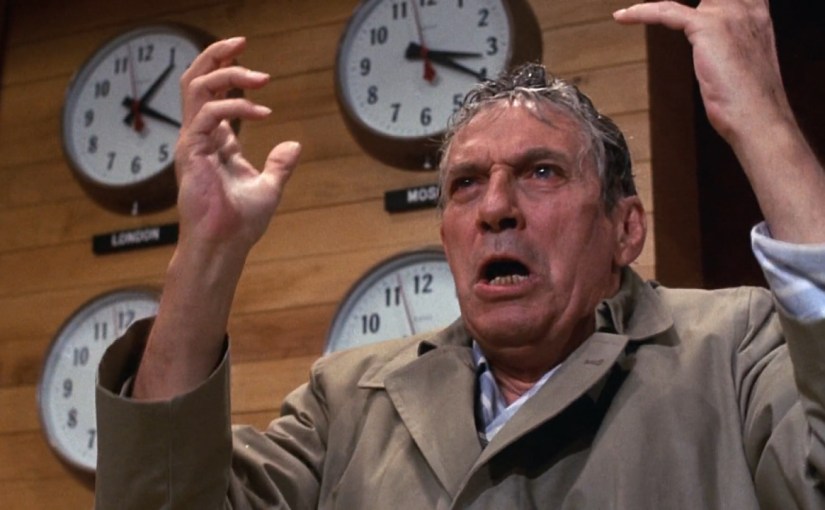
The young and energetic Diana Christensen (Faye Dunaway) in the entertainment division, works her way into the news division and takes over its programming from Max.  She convinces the corporate honchos like Frank Hackett (Robert Duvall) to use Beale as a ratings appeal.  The entire company eventually understands what Diana foresees could actually work when a rain-soaked Beale storms on to the studio set urging his viewers to shout out their windows that they are “mad as hell, and I’m not going to take this anymore.”  Now, the evening news consists of sections featuring Howard’s ranting and ramblings, as well as Sybil The Soothsayer and other such nonsense, most notably a new program from an actual terrorist group known as The Ecumenical Liberation Army. 

From there, the detritus of what UBS commits to for lead ratings night after night only validates that television is not about morals and objectivity in the industry of news reporting.  A slight telling moment has Beale come to Max with an old black and white photograph of them posing with the likes of Edward R Murrow and Walter Cronkite.  They reflect joyfully on the memories, but now they are just memories. These kinds of men of the airwaves no longer exist. Beale is now a jester to the masses who tune in for his mad man speeches labeled as “news.” 

Long before the buffoonery of out of touch Presidential Candidates and over opinionated newscasters who lacked any merit or research to uphold their viewpoints, Chayefsky and Lumet were nervy enough to actually believe moviegoers would buy this satire. 

No matter the medium, satire is maybe the riskiest category of entertainment.  Someone is going to be pissed off and offended.  Others won’t believe this could ever be possible.  In elementary school, I remember reading a short story that proposed cutting down on overpopulation by having people eat their young.  You know what?  After much discussion with fellow classmates at the time, the idea had some logic to it.  Recently, Adam McKay wrote and directed a film called Don’t Look Up that presented a what if scenario to the inevitable end of the world by means of an incoming comet crashing down into Earth.  Unlike Network, some of the elements in that film didn’t work for me.  So, satire is a crap shoot.

Had I seen Network when it was first released, I wonder what I would have thought.  Would I have bought all of its absurdity?  I believe I saw it before reality television became such a novelty and ever since that first time watching, I truly accepted the logic that comes across the decision makers at the UBS network.  Corporate functionality, no matter the industry, relies on monies.  Nothing else matters.  UBS quickly learns that image can be spared.  Money is what keeps everyone happy and afloat.  If the performance of the company falters, changes need to be made; no matter how desperate those actions may appear to be. 

So, Howard Beale becomes a sensation for the UBS network and he is at least besting or tying with top rated shows like All In The Family and Little House On The Prairie.  Yet, Howard is also a mentally ill raving lunatic who needs treatment.  What happens when he declares something to the public that is detrimental to the corporate future of UBS, its top one percent, and its shareholders.  You can’t censor a lunatic with reason.  Ned Beatty as Arthur Jensen, the all-powerful, emperor like CEO, delivers a commanding scene that is one for the ages in response.  He truly deserved his sole career Oscar nomination here…all for one scene perfectly staged in a dimly lit board room with his giant stature poised behind rows of green banker lamps.  He turns Beale into his own prophesized pawn.  Now, that may satisfy the man at the top of the pyramid, but at the end of the day, what about the ratings?????

Chayefsky’s script is one of the greatest ever written.  Not only are the satirical ideas so clearly drawn, but the dialogue is biting with truth in its sarcasm and wit.  When Diana suggests giving The Ecumenical Liberation Army its own weekly program depicting real life footage of their massacres and kidnappings across the country, a staffer retorts “What do you wanna call it?  The Mao Tse Tung Hour?”  When Beale asks the god like image of Arthur Jensen “Why me?”, the response is simply “Because you’re on television, Dummy!”

Maybe we thought the limit of influence stopped with television.  The script for Network felt sure of that.  Yet, we’ve graduated from the simplicity of television and we’ve entered the age of the internet.  Suicides and violence, pornography, slander, opinions and viewpoints can all easily be conjured up by the devices we use to access the internet and we can slant our own news stories in our own way.  News is no longer reported with an objective, omnipotent narration.  It’s dramatized.  I may be a resident in Florida but if someone captures a live on-going police car chase happening on the freeways of Los Angeles, it’s brought to my attention for the thrill of the story.  From a news perspective how is a car chase on the other side of the country relevant to me?  I don’t know the drivers or what motivated them.  I don’t live there.  So, it’s not going to affect my commute home.  Yet, my local news station finds it imperative to show it to me.  No matter the heights of insanity a subject may be, if it’s watchable with a ratings potential, I can rely on my local journalists to bring it to me fast and immediate with zoom in close ups and hi definition.  They’ll even replay it for me in slow motion a hundred times, just to stretch the story until the commercial break.

Network also explores the corporate obsession America entered into by the mid-70s.  Chayefsky uses the Diana Christensen character as a departure from the wholesome Donna Reed image.  Women are working in the offices now.  They are beautiful, smart, strong and assured.  Yet, have they also lost their humanity?  Has this happened to only women?  Diana uses her edge to sleep with her mentor, Max, a much older married man of 26 years.  The aging Max surrenders to his libido but is it worth it?  Diana is too quick in bed and while she’s love making, she’s orgasming to the latest ratings poll from her wunderkind, Howard Beale.  Chayefsky demonstrates how maddening corporate America has become by sucking any emotion of love, loss, happiness and sadness that people are heretically born with.  It’s as if a cancer has killed whatever natural stimuli people were gifted with, and he’s not wrong.  People don’t work 9 to 5 jobs any more.  They work 12 to 12.  When they are not working, they are enhancing their “social status” by means of social media. 

Network is one of the greatest films ever made.  Lumet and Chayefsky put everything on display in its no holds barred honesty.  Still, the performances must be recognized.  This film has one of the greatest casts ever assembled.  Dunaway is magnificent as the young woman with the drive to turn the television industry on its ear.  She deserved her Oscar.  Robert Duvall never received enough credit as the unforgiving corporate lackey resting just under the top while making sure profit is provided before anything else.  William Holden was already in his golden years of film acting by this time.  With Beatrice Straight, playing his wife (in her brief but Oscar winning role), they represent an honorable profession and household that is now long gone.  His character is fired twice within the first hour of the film by the modern corporate mentality, and then he’s resigned to write a tired book about his journalistic accomplishments because there is simply nothing left to do.  He’s a dinosaur in the modern age of television and business.  Peter Finch was the first to win a posthumous Oscar for his turn as Howard Beale.  If this character were real and was televised as the film demonstrates, I can’t deny that I would buy into his raving rhetoric.  I’d have no idea what he’s talking about.  I wouldn’t care, but I would tune in later in the week when John Belushi would mimic him on Saturday Night Live.

With each viewing of Network, you find something new to relate with every time.  The reason is that it stays consistent with the evolution of our planetary function.  Even in this age of Covid where stories are never consistent yet always hyped for dramatic impact, there is something to nod at and understand from the messages of Network.  It could be a world war, a new president, an assassination, a school shooting, a police chase, a riot or a pandemic.  Network had already considered the response to any topic that’s ever been the top story. 

Network is one of the most important films ever made.

THREE BILLBOARDS OUTSIDE EBBING, MISSOURI

By Marc S. Sanders

From February 2017:

A number of years ago I read Roger Ebert’s review of a Kevin Spacey film called The Life Of David Gale, only after seeing the film myself. Reading his viewpoint assured me that perhaps I do recognize good and bad filmmaking with the absence of influence. Like me, he hated the film because of its contrivances and the complete 180 on Spacey’s character. He said it angered him so much that he wanted to throw his popcorn at the screen. Years later, I feel the same way, for nearly identical reasons after seeing this 2017 Best Picture nominee. I hate Three Billboards Outside Ebbing, Missouri.

I HATED THIS MOVIE. Hated it so much that I’m pissed over how much I hated it. This film is worthy of Best Picture, Actors and Screenplay nominations???? There was nothing better than this dreck???? Not Baby Driver, or Wonder Woman? Not All The Money In The World? Blade Runner 2049?

This film contains great talent trying way too hard to elevate the stupidity of the unjustified actions of their characters so much that suspension of disbelief isn’t just thrown out the window (like one hapless character who earns no justice), it’s burned, beaten, raped, shot, burned again, thrown off a building and drowned.

Consider midway thru the film, Sam Rockwell’s nominated performance as a vile, heinously racist backwoods lawman. He reads a letter and is magically transformed into a do gooder Boy Scout. There’s no way in hell I’d ever believe this. No one should. This guy is the entire KKK in one embodiment. By the time this bastard gets to this “epiphany” he had already committed the most sickening and atrociously violent actions fathomed, and in great detail. Yet magically a letter from a friend and an arson scene that burns him suddenly transform him. Just like that. Uh uh. Too convenient. Too manufactured. Too insulting to a movie going audience.

This film is full of other ridiculous contrivances that are simply too long and spoilery to describe here. (I’d love to spoil the film to salvage anyone from seeing this crap.)

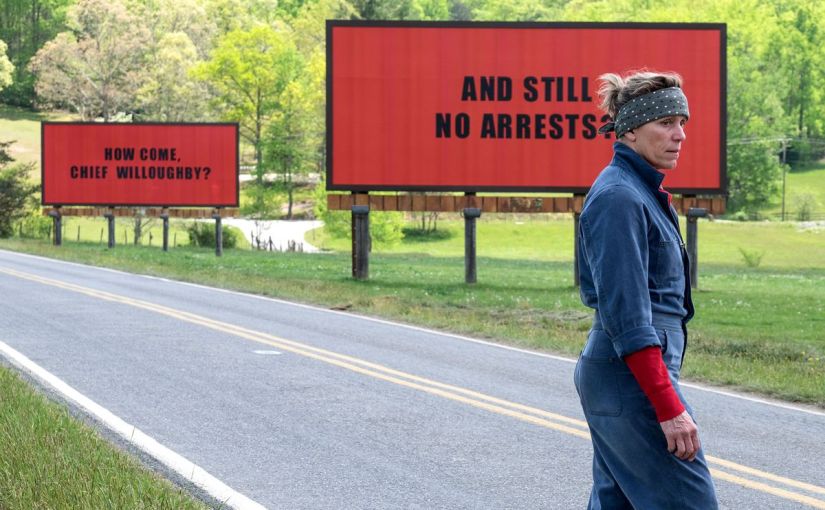
Frances McDormand’s character is also despicably written. Here’s a character entitled to the anger she has after losing a daughter to rape and murder, worthy of attention due to the stubborn intellect she conveys during the act one exposition, yet as the film progresses, she becomes incredibly stupid and downright unlikable. What a thoughtless jerk she is. Nothing to cheer for. Nothing to love to hate. Nothing to laugh at. Nothing to cry over. Nothing. She’s just an asshole who conveniently gets away with her actions, yet everyone knows she’s the culprit.

In a film like this the bad cops are uncaring racists. The good ones are the clueless keystone cops who conveniently can’t see the forest through the trees. I don’t like it, and more importantly I don’t believe it. Unacceptable!!!

What a stupidly shitty movie that has been executed here in exchange for arguably the most interesting idea of all the 9 Best Picture nominees. I salute the idea of the film. It’s the execution that’s deplorable.

The only redemption that can come from this garbage now is if this film does not win one single Oscar. Sadly, I think I’ll be wrong. Congratulations Sam Rockwell, you stole a trophy from three much more entitled actors (Christopher Plummer, Richard Jenkins and I hear Willem Defoe.) Woody Harrelson’s performance in this pic is also up for grabs….for what? He coughs up blood quite well. I have no clue, otherwise.

Don’t believe the hype. Three Billboards… only has a great title, a great concept on paper and a great cast list. Beneath all that is carbon monoxide. Don’t breathe it in. You’ll only feel sick after watching it.

This will likely remain as one of the ten most despised movies I’ve ever seen.

THE SILENCE OF THE LAMBS

By Marc S. Sanders

Everyone remembers Anthony Hopkins’ memorable turn as the infamous Dr. Hannibal Lecter in The Silence Of Lambs.  He was “Hannibal The Cannibal;” a renowned and brilliant psychiatrist who was eventually captured for being the one who ate his victims with sophisticated glee.  The real attraction, though, is how director Jonathan Demme delivers the film adaptation of Thomas Harris’ best selling novel through a lens that only finds one strong heroine amid a sea of intimidating men.  The heroine is the intuitive, but petite Clarice Starling.  The men are nearly everyone else cast in the film, and I mean everyone all the way down to the extras; the extras, here, are a perfect example how necessary they are towards any film’s palette.

Ever since the film was released in 1991, the dialogue of Ted Tally’s script is worthy of repeating and mimicking in social circles.  Lecter remains spoofed in nearly every pop culture medium.  Hopkins’ character is unforgettable and he’s been ranked among the greatest film villains of all time with the likes of Darth Vader and Harry Lyme.  It’s a worthy honor.  His timing is subtle and mischievous while he remains silently dangerous.  You can’t take your eyes off the actor and you can’t erase the devilishly fun and evil character from your sub conscious.  Opposite this performance though is Jodie Foster in a top billing role as an FBI trainee named Clarice Starling, assigned to interview and maybe study Lecter as a means to a solid lead in finding a serial killer that has been identified in the media as “Buffalo Bill.”  Bill has been skinning and killing girls with large physicalities, around the east to mid-west portion of the United States.

So, there is a detective story at play here as Hannibal aids Clarice in her search for the killer, but only under his rules.  Demme paints the film with Clarice ably performing her job no matter the towering strength or perverted fantasies found in nearly any man.  An outstanding image early on shows her small frame entering an elevator.  She has been summoned to her supervisor’s office from the outdoor obstacle course.  She is sweaty, and looking tired.  The elevator is full of a dozen men in red uniform polo shirts that hug every muscle; they are strong, fit and healthy.  Clarice stands front and center and she has no reluctance to stand among this exclusive group.  Later in the film, Clarice is invited by her supervisor, Jack Crawford (Scott Glenn in a deservedly dark and quiet performance), to investigate one of Bill’s victims that turned up in the swampy waters of West Virginia.  The coroner’s examination room is filled to the max with sheriffs who believe they serve a purpose to stay there to witness what’s uncovered.  The strength of Clarice is really shown here as she shoos them away.  The men’s facial expressions tell us they don’t care for this request, but Clarice isn’t going to allow them to remain.  Most importantly are her encounters with the head of the Baltimore psychiatric ward that houses Lecter.  He is known as Dr. Chilton played by Anthony Heald.  Chilton – a great character name that clearly colors in the twisted perversion of this guy.  Chilton is happy to boast of his prized attraction, Lecter, as if he’s a rare tiger and he has no reluctance to hit on Clarice when she comes to visit with Lecter.  Always, Clarice will not allow herself to be succumbed, patronized or victimized by any of these towering figures of masculinity in what is unfairly regarded as a man’s world in law enforcement, crime or psychiatry.  Starling easily reminds Chilton that she was a student at the University of West Virginia, not a charm school.  With Tally’s script, Jodie Foster uses these deflective techniques of her character without effort.  Her methods of fencing with these men are a natural ability.  Even when she’s in film transition periods of training at the Academy, Clarice can maintain her stance against a hard-hitting male boxer pounding away at her boxing shield.  She just won’t fall over. As well, she doesn’t wince as the male students give her a glance from behind when she’s jogging on the grounds. 

Demme is an outstanding director who uses these interpretations of this woman to drive his film.  This very same year, 1991, Ridley Scott directed Thelma & Louise.  In that film, the title characters had to realize that they didn’t have to take any shit from a man.  They started out weak, though, and had no choice but to eventually get stronger.  Here, it’s already part of the woman’s instinctive nature. 

Hannibal Lecter is shown to be well versed in the finer things of art, literature, music and, forgive me, cuisine.  At one point, Demme focuses on a picture Lecter has sketched depicting Clarice in an almost angelic nature.  I’ve never forgotten that image.  Nearly all of the settings in The Silence Of The Lambs include stairways that always lead us in the down direction, to an assortment of various hells.  Clarice, the pure angel with nary a fault beyond limited experience as an FBI agent peels the onion away on her quest for a killer by entering into the treacherous depths beneath her; pits of hells.  The opening shot of the film has Clarice pulling herself up with a rope on an obstacle course as if she is ready to enter the heavens, ready to stand above everything, but then she is summoned to Crawford’s office located at the Department of Behavioral Sciences at the FBI.  She has to take an elevator down and then various stairways further down into a labyrinth of claustrophobic offices with no windows, surrounded by cinderblock and populated with men in uncharacteristic suits that don’t appear warm or cuddly.  Crawford may seem like her ally, but really, he’s using her as a sacrificial pawn on a chess board putting her in an arena with psychotically dangerous prisoners, in particular, the worst of them all, Hannibal The Cannibal. 

When Clarice goes to visit Hannibal, she is escorted by Dr. Chilton, who relishes in describing how careful he handles his prized thing, and willingly shows what this monster is truly capable of by providing an unwelcome photograph of how Lecter brutalized a female nurse.  This conversation is played upon a much more frightening descent of unlimited stairways and bars that clang loudly and are painted red and rusted, eventually leading to a stone walled dungeon for these unimaginable beings of death and perversion.  Clarice is left all alone to navigate her way down a long corridor until she reaches Lecter’s cell.

Yet, an even more frightening third descent into hell occurs in the final act as Clarice’s pursuit leads to Buffalo Bill.  Bill’s home is dark, lurid, filthy and maze like; but always seeming to go down further and further into one doorway after another and down one staircase after another, including a deep well where his latest victim is kept.  Like the other descents, Clarice uses her femineity as a tool of strength to survive.  I can claim without any hesitation that Clarice Starling is one of the greatest heroines in the history of film. 

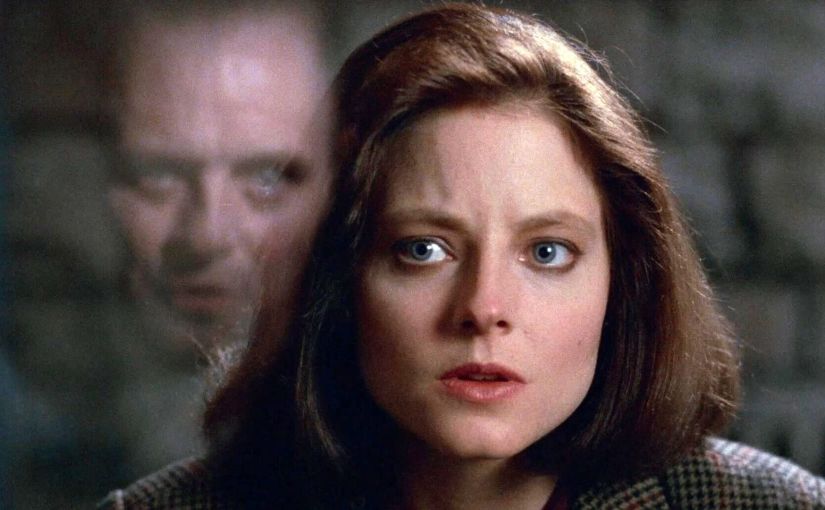
The one man who rattles her, and weakens her, though is Hannibal Lecter.  Watch their tete a tete when they meet for the first time.  Starling demonstrates some overconfidence against Lecter’s seemingly polite demeanor.  With her white trash Virginia dialect, she even gets a little smarmy with the Doctor, but then he disarms her immediately with a comeback that shakes her very core.  Demme’s reliance on close ups for both characters serve this scene and others so well.  Clarice’s encounters with Hannibal are the most important and vital moments in the film because they are the only opportunities for Jonathan Demme and Ted Tally to show the main character’s weakness.  Every hero has to have a weakness if they are to remain compelling.  Clarice is not, in fact, undefeatable. 

The film could have simply worked as a basic detective story.  Put up the clues and the narration of the picture will eventually assemble all together for a resolution where the bad guy is captured.  Yet, Thomas Harris’ character creation uses Hannibal as a defiant obstacle blocking the path for Clarice.  Hannibal lacks much stimulation in a cold, specially designed prison cell.  He’s maybe only honored with impenetrable plexiglass to contain him as opposed to traditional bars.  He needs to be enthralled.  On the surface, Clarice appears as a frail prey that he can take his time munching on.  He’s happy to help Clarice catch Buffalo Bill with the case files she provides, but in exchange he wants to uncover what haunts her psyche.  Such a strong character Clarice is, but she has to be willing to weaken and expose herself to desperately find a dangerous killer.  Can she do it?  She’s never allowed herself to do that before.  And thus, we come to comprehend the obscure title of this film and the book it stems from.  (Anthony Hopkins actually thought it was a children’s fantasy when he was sent the script to read over.)

This write up is not necessarily a review, but a means to honor the careful film and storytelling technique that Jonathan Demme strives for with The Silence Of The Lambs.  You might say, yeah, there’s a lot of walking in this picture, but pay attention to the direction of the walking.  Always going down, somewhat reminiscent as Little Red Riding Hood entering a dark and spooky forest and encountering the biggest and baddest wolf.  Jodie Foster might be in a company of men here, but the film works as a dual of femineity vs masculinity.  It’s strange to believe that Demme actually had Michelle Pfeiffer in mind for the Starling role initially, a more than capable actress, but one who at the time was more glamourous (The Fabulous Baker Boys and The Witches Of Eastwick).  Beyond the silly Disney films, Foster was known for lurid pieces like Taxi Driver and her first Oscar winning role as a rape victim in The Accused.  Clarice Starling is a character beyond a pop culture appearance of the time, and Jodie Foster emanates that portrayal.

The writing of The Silence Of The Lambs is so intelligent.  There’s a witty, yet deliberately poor taste, of sarcasm to Hannibal Lecter as he thrives off his superior intellect over Jack Crawford and the FBI.  It’s only enhanced when he’s dealt a lowly, formally white trash female student to play with.  Ted Tally offers precise timing in the dialogue with Clarice and Hannibal.  Thomas Harris’ drive to further a cameo appearance of Lecter in a prior novel (Red Dragon) with this book is a gift to readers and eventually movie watchers.  The Silence Of The Lambs doesn’t follow formula with a Law & Order technique of ballistics and witness interviews.  It drives into other directions to feed its development. 

Jonathan Demme’s film is pioneering.  I recall seeing it in theatres with other high school friends.  I was not enthused to see it.  The title was too odd.  The picture was primarily a talking piece.  There were gross and unwelcome images within the film.  It’s very ugly at times.  I was frankly accustomed to the likes of Dirty Harry and Lethal Weapon films for my cops pursuing the robbers ideals.  I recall not even liking the film when we left, and I couldn’t comprehend its appeal that followed for the remainder of nearly an entire year, all the way up to when it was awarded the five main categories of Oscar wins (Actress, Actor, Screenplay, Director and Picture).  I definitely wasn’t accustomed to a strong character like Clarice.  Later that year, I saw Thelma & Louise and fell in love with their eventual triumph.  I needed to be spoon-fed their initial weaknesses at first.  Who was this Clarice in this picture, though?  I could not identify her strength that displayed right from the get go.  I wasn’t even 18 years old at the time and now I can say I just wasn’t mature enough for this film back in 1991.  Now, it’s thankfully clearer, though I still appreciate its subtlety so much. Jonathan Demme had such a clear vision of where he was taking this film and because it’s not dated, The Silence Of The Lambs stands as thriller, and an intelligent thought provoking piece that stays with you for a long time after each viewing.

CABARET

By Marc S. Sanders

Is it possible for a musical to be disturbing? Maybe Bob Fosse’s Cabaret favors that argument.

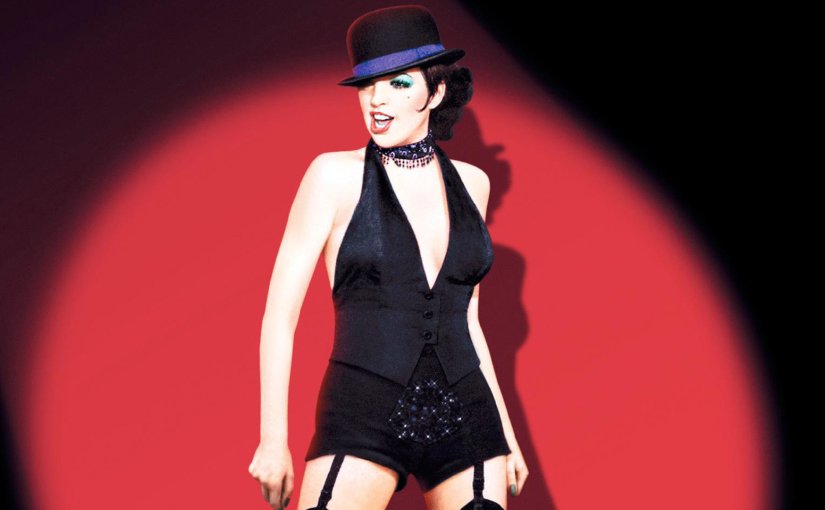
Liza Minnelli won the Academy Award for Best Actress in 1972 for her portrayal of Sally Bowles, a carefree, happy go lucky performer at the underground Kit Kat Club located in Berlin, 1931. She is the lead attraction among a company of dancers doing a different kind of stage vaudeville with its colorful emcee played amazingly by Joel Grey, also an Oscar winner.

The musical numbers are outlandish with caked on makeup and outfits that could make Victoria’s Secret seem like a children’s shop. I gathered from the film that Fosse, who choreographed the numbers as well, offered up the escape of life first, before showing the harsh reality of Berlin in its historical context.

Sally and the Emcee’s performances are first on hand, depicted as silly and showstopping. Thereafter, Sally encounters an English gentleman named Brian Roberts (Michael York) who is a professor of English study attempting to complete his doctorate. As Sally and Brian become closer as friends first, he must reluctantly admit to Sally that he’s a better bed companion with a man than with a woman. Sally doesn’t understand why he didn’t say that in the first place as she attempts to come on to him.

Herein lies the dilemma many faced as the Nazi party was gaining traction in Germany. How necessary is it to hide your true natures to preserve your life? Sally’s underground lifestyle at the club clouds her vision of what’s gradually happening in the world. Nevertheless, they eventually develop a relationship as Brian appears to be bisexual, more specifically.

A side story concerns Brian & Sally’s relationship with a baron named Maximillan (Helmut Griem), who will wine and dine them at his estate only to later abandon the respective relationships he sets up with them to more or less make them feel as cheap as prostitutes. I wasn’t sure what to gather from this extension, however. The irony is that unbeknownst to Sally and Brian they have both been sleeping with Max. Eventually, Sally reveals she’s pregnant but does not know who the father may be, Brian or Max, and an abortion is considered.

An additional side story concerns a wealthy Jewish German heiress named Natalia who falls in love with a German Jew named Fritz living under the guise of a Protestant.

Cabaret is a loose adaptation of The Berlin Stories by Christopher Isherwood (the Brian character) and his experience with stage performer Jean Ross (the Sally character). Isherwood’s stories gradually formed into different iterations of stage plays and short stories before making it to Broadway and Fosse’s celebrated film.

Though Fosse apparently took some questionable liberties and departures from Isherwood’s writings, I think it depicts the personal struggles of love and self identity while the world around them is quickly changing into a scary reality where your own self identity could get you killed.

Fosse gives terrifying glimpses of how the Nazi party seeps it’s way into a decadent Berlin of underground showmanship. Though apparently Berlin really wasn’t so decadent as the film has you believe. Ross and Isherwood have gone on record describing Berlin was a more destitute and poor environment, actually.

In Fosse’s film, a Nazi youth is seen early on being kicked out of the Kit Kat Club. A few minutes later, the night club manager is being beaten in an alley. Fosse juxtaposes scary moments like this against the silly debauchery depicted on stage. It’s as if the Gypsies, homosexuals and Jews in the area are unaware of the evil practice that is gradually taking over outside.

Soon, Fosse makes the swastika more apparent in the streets with propaganda handouts. Most telling is when a young boy is seen at an outdoor beer garden gathering singing a number selfishly entitled “Tomorrow Belongs to Me.” Fosse is frighteningly effective at showing this boy from the neck up. Eventually, he moves the camera down to reveal the boy’s swastika wrapped around his sleeve. The song which seemed to champion beauty and nature now evolves into a march of grandstanding fascism. It completely shocked me. Just as people like Brian and Fritz are reluctant to reveal their backgrounds, both sexually and religiously, the Nazi party is proud to announce their mindset in a converse manner. By the end of the film, the audience at the Kit Kat Club more predominantly shows Nazis in the audience as opposed to just the one shown in the beginning of the film. Hatred has spread its disease.

While Minnelli shines in her role, her showstopping moment really comes at the end when she dangles her carefree attitude while belting out the title song with “Life Is A Cabaret.” Along with Joel Grey’s Emcee closing out the film with the “Finale,” this musical goes against the grain of most musicals’ cheerful close outs or romantic theatrics. Fosse’s mirror image of the Nazi party taking in Sally and Emcee’s performances are chilling. We sense the characters’ time is at an end and wisely the film runs its closing credits among frightening silence with the cold, blurred images of Nazi soldiers staring right at us.

I had never seen the film of Cabaret until now, but I had attended two different stage productions; neither of which I liked. Bob Fosse’s film seems more clear with its content than I ever got from a stage performance. Perhaps it is because the Oscar winning art direction is more apparent than a stage set. We can see the bustling of Berlin change amid a political climate that at first is not taken so seriously. As hurtful and harrowing the relationships of love between Brian with Sally and then with Max, as well as Fritz and Natasha are, none of this will eventually compare to the upcoming demise for Berlin.

As Miguel noted in our recent podcast that focused on musicals, Cabaret won the most Oscars without winning Best Picture (losing to The Godfather). It’s clear how deserving it was of its accolades. The musical numbers are very engaging but the fear of fascism is well developed too. So there is a roller coaster of emotions to absorb from Fosse’s film. I believe in that podcast I noted that Francis Ford Coppola won Best Director. I now realize I was wrong. It was in fact Bob Fosse who took home that prize, and it’s truly evident how deserving that honor was for him.

Again, while I’ve yet to find a stage production I’ve liked, I was terribly moved by the film. Cabaret, the film from 1972, is a sensational and frightening production.

LA LA LAND (2016)

by Miguel E. Rodriguez

Director: Damien Chazelle
Cast: Ryan Gosling, Emma Stone, John Legend
My Rating: 9/10
Rotten Tomatometer: 91% Certified Fresh

PLOT: While navigating their careers in Los Angeles, a jazz pianist (Gosling) and an actress (Stone) fall in love while attempting to reconcile their aspirations for the future.


SPOILER ALERTS! MULTIPLE SPOILER ALERTS!


La La Land was greeted by the American public in one of two ways.  There was no middle of the road.  You either loved it or hated it.

Critics loved it.  It broke records at the Golden Globes that year and was the odds-on favorite to win Best Picture at the Oscars (Moonlight took the prize instead, and deservedly so).

When it came to the viewing public, people were immediately divided into opposing camps, with each trying to convince the other they were wrong.  “It’s homage!” cried one camp.  “It’s derivative and sad!” cried the other.

Me?  I’m part of the “loved-it” camp.  And after re-watching it tonight, for the first time since seeing it in theatres, I have no plans to change my mind.

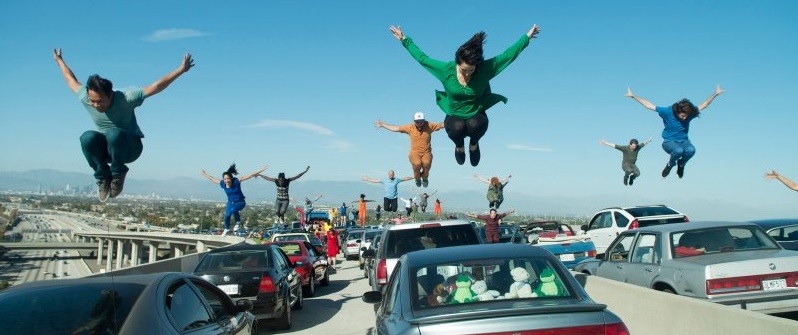
I once wrote that there is no movie more in love with “old Hollywood” than The Artist.  Well, La La Land is more in love with classic movie musicals, specifically, than any other modern movie in recent memory.  It opens with an astonishing musical number, “Another Day of Sun”, set on a Los Angeles overpass.  In a breathtaking feat of choreography and cinematography, scores of dancers perform nifty moves in and around a traffic jam, incorporating a live band inside what looks like a UPS truck, in one single take…or at least what LOOKS like one single take.  Could be some CG in there.  Who cares?  It’s awesome, and it sets the tone right away: this will be like one of those old musicals where people break into song and dance without warning.  You can stay where you are or you can leave now, but this is what’s happening.

After that, we settle in to a tried and true story of boy (Sebastian [Ryan Gosling], a jazz pianist who wants to start his own jazz club) meets girl (Mia [Emma Stone], an aspiring actress looking for a break).  This part of the story was old when Mickey Rooney and Judy Garland did it in countless other films, so yeah, I get it.  I can see why some folks called it derivative.

But that criticism neatly dismisses the underlying subplot about the Old vs. the New.  Sebastian desperately wants to start a jazz club that plays the greats – Monk, Coltrane, Davis – because, as he says in a passionate speech to Mia, jazz is dying.  Nobody wants to hear it anymore.  It’s old.  (He decries a nearby club that combines jazz, samba, and tapas, or some such nonsense.)  “They worship everything and value nothing,” he laments.

But Keith, a fellow musician (played by John Legend) tries to get him to see sense.  (“How are you gonna be a revolutionary if you’re such a traditionalist?”)  History is written by the people who strike out in a new direction.  Sebastian himself uses this philosophy with Mia, who has gotten tired of auditioning for the same teachers and doctors and coroners over and over again.  He tells her to do something different if you’re tired of the same old/same old.  She takes his advice and starts writing a one-woman play about her life.

And here’s where it gets cool.  While the characters in the movie are urging each other to embrace new concepts, La La Land still has one foot firmly in the past, i.e., the grand musical traditions of Gene Kelly and Fred Astaire and Cyd Charisse, etcetera.  Two later numbers stick out in my mind.  One is a twilight duet between Sebastian and Mia, shot on location in the Hollywood Hills when the sky is that perfect shade of somewhere-between-pink-and-purple.  They sing a little and then they do a beautiful dance together, but they’ve just met, so they’re careful to dance ALONE together…watch it and you’ll see what I mean.  Right out of Vincente Minnelli.  (Let’s be clear…Gosling and Stone are not exactly Fred and Ginger, but they do a damn sight better than I could do myself, so I give them props.)

Another number with classic-musical overtones is set during the first giddy months of their relationship.  With little or no singing (can’t remember which), we follow Sebastian and Mia as they tick off Los Angeles landmarks, finishing at the famous Griffith Observatory.  They enter the planetarium, and in a gloriously giddy moment of cinematic fantasy, they rise into the air and dance among the stars and galaxies before falling perfectly into their seats and sharing a kiss.  I no longer remember what I did the first time watching this movie, but this time around, I watched that whole sequence with a goofy grin on my face.  If you can’t enjoy watching people dancing in the stars, well…

At one point, Sebastian tells someone, “You say ‘romantic’ like it’s a dirty word.”  I like that.  This movie is, above all, romantic, in spite of how it ends.  It’s romantic in the sense that it revels in the unreasonable, illogical hope that everything will work out okay in the end.  Sometimes it does, sometimes it doesn’t, but that doesn’t mean you can’t still dream.  (There’s even a song about this exact thing, sung by Emma Stone in a sequence near the end that oozes romance and heartbreak.)

But all of this is nothing…nothing…compared to the emotional roller-coaster of the last thirty minutes of the movie.  It’s here that La La Land gets all serious in the middle of the fluff, because it explores the nature of success and what is necessary to achieve it.  Sebastian is touring with a band that pays well…but it’s not exactly a jazz ensemble.  Mia is just about ready to give up acting…until a casting agent gives her an opportunity to star in a movie shooting in Paris for four months.  These two characters, for whom the audience has been rooting for the previous 90 minutes, are on a downward spiral, and the only way to save their relationship would be for one or the other to completely give up on their dreams.  But neither of them would ask that of the other.  So they go their separate ways.

WHAT?  After all this they don’t wind up together?  Well…what would you have preferred?  An ending that awkwardly keeps them together, with him, say, playing jazz in a French club while she shoots a movie in Paris during the day?  Enjoying success together?  Having kids?  Sure, that kind of ending is POSSIBLE.  (In fact, in one of the many highlights of the movie, you even get a tease of what that might have been like.)  But, hey.  Isn’t that just the traditionalist way of looking at things?  Why not strike out in a different direction?  Do something no one’s doing.  End your movie where each character gets what they’ve always wanted their entire lives…even if that means they don’t get each other.

Boy, that last sentence sounds harsh.  But that’s what this movie’s about, and I think the film’s detractors simply couldn’t get past the grand tradition that demands the two leads wind up together.  They wanted Singin’ in the Rain, and instead they got the musical equivalent of The Remains of the Day.  (Maybe not quite that extreme, but I trust the point is made.)

ANYWAY.  Like I said, I just finished watching this a couple of hours ago, and I am no less convinced of its greatness.  Even though it’s a wrench watching their relationship head towards the rocks, the movie makes up for it at the end with half an hour of glorious, emotional catharsis that left me feeling wrung out, but in a good way.  It’s not quite a tragedy, but not quite a comedy.  Like life itself, it falls somewhere in between.

THE FAVOURITE (2018)

By Miguel E. Rodriguez

Director: Yorgos Lanthimos
Cast: Olivia Colman, Rachel Weisz, Emma Stone, Nicholas Hoult
My Rating: 10/10
Rotten Tomatometer: 94% Certified Fresh

PLOT: In early 18th century England, a frail Queen Anne (Colman) enjoys the attentions of her close friend, Lady Sarah (Weisz), but when Sarah’s cousin (Stone) arrives at court, a subtle power struggle ensues.


This movie is a TRIP.  Imagine that someone crossed the sex-driven antics in Dangerous Liaisons with the cat-fighting in All About Eve, directed by someone who idolizes Stanley Kubrick and David Fincher.  It’s that good.

Where to begin?

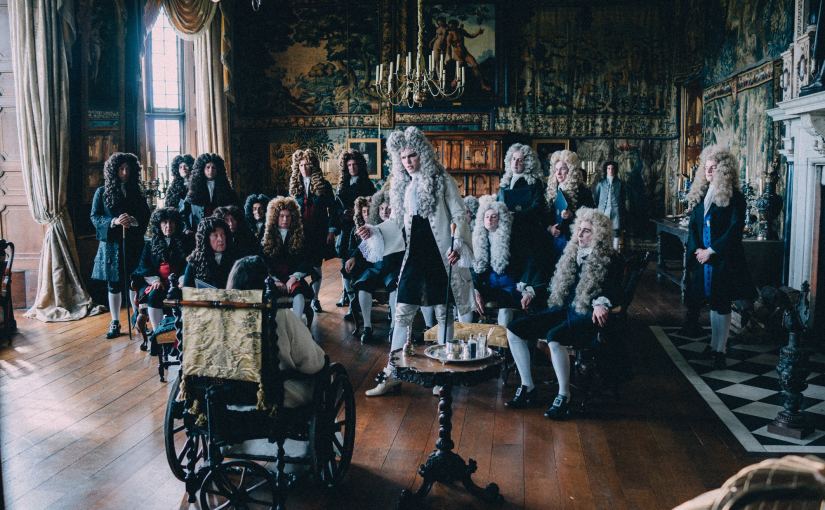
I loved the story.  It’s a basic power struggle/love triangle, but told with immense wit and originality.  Queen Anne indulges in sexual dalliances with her closest confidante, Lady Sarah.  Then Abigail appears, a distant cousin to Lady Sarah; she’s hired as a scullery maid and slowly works her way into Lady Sarah’s confidence as her handmaiden.  When the Queen starts to show a preference for Abigail over Lady Sarah, oh, the fur doth fly.

Rarely has it been so much fun to see such bad people behaving so badly.  At first, I was rooting for Abigail, who is only doing what seems necessary to survive, but then it becomes obvious that there ARE no good guys in this movie.  Abigail proves herself just as capable of social atrocities as Lady Sarah or Queen Anne herself.  Normally, I HATE movies with no clear heroes, but the screenplay and camerawork kept me constantly engaged and entertained.  I think I had a smile on my face continuously after the 30-minute mark.

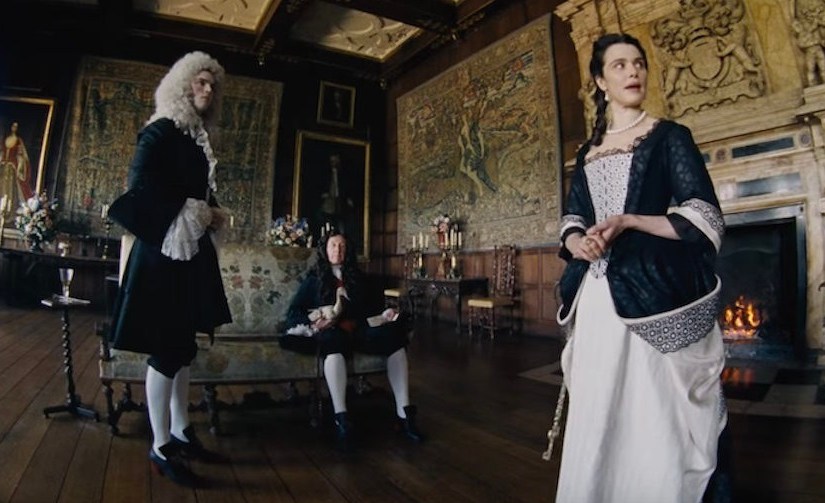
And let’s talk about that camerawork.  I’ve never seen one of this director Yorgos Lanthimos’s films before, but if they share the same visual inventiveness as THIS movie, I am going to seek them out.  The list of directors working today with visual styles unique to them is relatively short, so to find this fresh take on moving pictures was a delightful surprise.  There are a couple of places where extremely-wide-angle “fish-eye” lenses are used, distorting the picture on the edges so it looks like you’re looking at the scene through the bottom of a Coke bottle.  I found that particular device odd, calling attention to itself, but it worked.  It sort of created this idea that we’re looking at a staged performance rather than attempting to mimic or capture strict reality, which makes some of the behavior of the main characters more palatable than they might be in another film.

There are one or two moments that are so over the top, they might have derailed another film.  At one point, two characters dance during a formal party, as the Queen looks on.  It starts out daintily enough, like you’ve seen in countless other 18th-century films, the mincing steps back and forth, a little bow here, a curtsy there.  Then, as the music continues…something happens.  The man lifts the woman and swings her around on his hips like a swing dance.  They start to move their hands like in the “Vogue” video.  At one point, I’d swear the man started a rudimentary breakdancing move.  What’s going on here?  Why is this jarringly anachronistic dance intruding on the proceedings?

My first reaction while watching the movie was to just laugh in disbelief, while asking, “What IS this?”  Looking back on it now, I’d guess the purpose was to put ourselves into the mind of the Queen, whose perception of the dance starts to degrade the angrier she gets.  Regardless of its true purpose, it’s thoroughly weird but hilarious.

(Also, the screenplay contains some of the greatest zingers I’ve heard in a very long time, although I doubt some of them are historically accurate.  Not that I’m a historian, of course, but I remain unconvinced that British royals in the 1700s ever used the term “vajoojoo.”)

I’ll be honest, I was not previously aware of the actress Olivia Colman, who portrays the fragile, temperamental Queen Anne, before this movie, but I’ll be looking out for her from now on.  She more than holds her own with two Oscar winners (Emma Stone and Rachel Weisz).  Colman’s Queen Anne is a spoiled brat whose petulance is tolerated because, you know, she’s the Queen.  I loved a moment when she walks past an unsuspecting footman and yells at him, “Look at me!  Look at me!!!”  He turns and looks, and she immediately yells: “HOW DARE YOU LOOK AT ME!!!”  Right there, early on, her character is indelibly defined.

The depths to which all three women sink to exact their own particular brands of revenge upon each other will astonish you.  While the ending is not the one I quite hoped for, it’s extremely satisfying in a “be careful what you wish for” kind of way.  This movie was a delicious romp, and is definitely worth your time.

THE FAVORITE

By Marc S. Sanders

Director Yorgos Lanthimos’ The Favorite. Wow! This is a weird one.

This film focuses on a competition of one-upmanship between two ladies, one a servant named Abigail (Emma Stone); the other a close friend, Lady Sarah (Rachel Weisz) of Queen Anne during 18th Century England. As Queen Anne is frail physically, and often mentally (she insists on keeping 30 rabbits running loose in her bed chamber), Abigail capitalizes on opportunity to win the admiration of the Queen over Lady Sarah, a cruel woman in her own right. The humor is more shocking than overt or witty.

It becomes laughable to witness the shenanigans of the highest of aristocrats from mud baths to duck shooting to naked fruit tossing at one another. Sometimes, you ask why? Then again, it is probably because a lower class, say the majority of the free world, would like to stick it to the upper class and show them as the fools that they are or that we wish them to be. A royal vase is always nearby if a lady feels the need to vomit; not a bucket, a vase.

Olivia Colman is very good as the Queen, seemingly incapable of making decisions and being subtly overruled by the influence that her friend Lady Sarah carries. If the Queen really wants to reduce the taxes imposed to prolong a war with France, Lady Sarah will make certain that just the opposite is done. The Queen will unsurely oblige and back up the message that Sarah makes to the Cabinet. Sarah has no reluctance in abusing and humiliating the servants, the men in the Cabinet or anyone else, including the Queen. She will happily admonish the Queen by criticizing her makeup just as she is to meet with a Russian diplomat, thereby allowing herself to run the meeting while the Queen retreats to her chambers.

Abigail has come from wealth but due to hard times, has become recruited to be a servant destined to take care of menial tasks or be humiliated by being forced to watch an English officer pleasure himself, falling into “mud that stinks,” or taking cruel showers with a rough sponge. An opportunity arises however, when she discovers a natural way to bring relief to the Queen’s frail legs. Soon, Abigail is becoming intimate with the Queen much to the dismay of Sarah and now the cruel games of back and forth begin.

No one is really likable here. It’s a competition in royal politics, and politicians of any nature in any setting are never entirely liked. To hold stature, requires ego. Ego, however, is not a strong enough word for how these three ladies treat each other. The frail Queen is just as guilty. If she feels slighted, she will disregard those that have won her over in prior moments, particularly to her first friend Sarah and later to Abigail. When Sarah goes missing, the Queen declares she better be dead when she eventually begins to worry. If she’s not dead, the Queen will surely slit her throat. Abigail wins the Queen’s affections but will ultimately be used cruelly as well.

Eventually, all of this back and forth has to end of course, and Lanthimos along with screenwriters Deborah Davis and Tony McNamara bring in a sneaky last “stick it to ya” moment.

I’d never seen a film by Yorgos Lanthimos before. I’d heard good things about his other film The Lobster, though. Here, he’s got a camera angle I rarely see in films. There are times when a wide shot of a room, like the Queen’s chambers or outskirts of the palace are shot through the bottom of a glass, where the edges of the caption are curved outward, almost like looking at the film through a view finder or a telescope. Not sure why he opted for this technique. Perhaps it was to up the ante on the strange environment of it all; to offer a discomforting feeling towards watching this community of Establishment behave behind closed doors.

Rachel Weisz and Emma Stone are also very good. A film like this could have played like a bad day time soap opera cat fight. Yet, when you have Academy Award winning actresses like Weisz (The Constant Gardner) and Stone (La La Land), you are watching a period piece that will stand out albeit very strangely.

Yes. Once again, The Favorite is a very strange film. A good film and a weird film that takes some patience and getting used to. Four people walked out of the theatre I was in, but there was still plenty of laughter from the crowd. The best of the year, like most critics claim? Maybe not. Then again, most of the critics’ common choices for best of the year is indicative that 2018 really was not a great year as a whole for movies. I’d argue prior years have offered a better collection of films to treasure, admire, award and salute. In another year, The Favorite would be trumped by many other candidates.

NOMADLAND

By Marc S. Sanders

amazon ( n.) a large strong and aggressive woman; Synonyms: virago. amazon ( n.) mainly green tropical American parrots; 2. Amazon ( n.) (Greek mythology) one of a nation of women warriors of Scythia (who burned off the right breast in order to use a bow and arrow more effectively);

As I reflect on watching the 2020 Best Picture Oscar winning film, Nomadland, I considered the literal translation of the word “amazon.”  To many of us, I would think the word has an entirely different meaning.  Director, writer and editor Chloe Zhao probably considers both the literal definition of the first noun (noted above), as well as the brand name that seemingly runs the world these days.

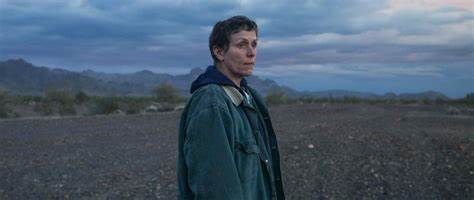
Fern, played without compromise by Frances McDormand, is likely a strong and aggressive woman, though only subconsciously large.  I’d argue you would have to be in order to survive as a nomad within a pre-Trump era mid-western America with a beat up van as your mobile residence and a deep plastic bucket for a toilet that isn’t hard on your knees when used.  Fern is a former resident of Empire, Nevada.  Empire and its postal zip code no longer exist as of 2011 when the sheetrock factory that sustained the town closed up after 88 years, thus forcing all its residents to give up their homes and relocate elsewhere.  Now that Fern is widowed, she does not see any other way to live other than in the van she calls “Vanguard.”  She lives paycheck to paycheck with seasonal jobs that are hopefully available.  The first of these jobs includes a packing facility for Amazon.  Once the holidays are over, it’s up in the air as to what she’ll come across next.

Zhao is an observational director.  To depict a film about a lonely, uncertain post middle age nomadic widow will require shots of the country like frost on the ground, deep snow, endless roads, hot deserts and moonlit campfires with other nomads who come by Fern’s way.  These people (many of which are real life nomads in the film) might travel individually but they are a community as well.  They teach one another in ways of being resourceful with auto repair or what’s the best bucket for a toilet.  They provide people like Fern with temporary job opportunities.  They also counsel one another with how to deal with grief and share their own health challenges like the various forms of cancer and illnesses they endure and how they plan to live out the remainder of their limited time on earth.  One woman with an inoperable brain tumor is determined to make it back to Alaska.  What drives these people is not necessarily a will to survive.  More importantly, it’s the knowledge that they will cross paths with one another again.  An experienced nomad who lost a son to suicide never considers saying goodbye to anyone he encounters.  Rather, he is staunch in telling others that he’ll “see them down the road,” at another time and place.  He reminds Fern that to live this life is to never close the book or end a chapter, and memories of those we have lost can only stay alive if Fern and others stay alive.

I appreciate a film like Nomadland simply because I’ve never been the brave traveler.  One of my greatest fears is being lost and alone.  It has always terrified me.  I still don’t trust the navigation apps on my cell phone.  I have to see the destination in front of me.  Luckily, my wife keeps me in check.  Yet, Nomadland is a film that gives me an opportunity to explore places I might never arrive at, while I sit safely in front of my flat screen.  Chloe Zhao shoots with wide lenses to take in gorgeous landscapes.  How fortunate for Fern that she can encounter all of this beauty in person.  How fortunate, as a viewer, a film like this allows me to witness what’s out there.  How sad though as well that sometimes this way of life seems treacherous and nonsensical.  Whatever entity created the earth allowed no sympathy for a flat tire or a broken-down engine, when you have no means of paying for replacement parts.  As well, mother nature is not always going to be that companion that holds your hand during lonely times.  Corporate America certainly won’t do that either, but it is a necessary evil.  Thank you, Amazon!

Frances McDormand is perfect for this role as she carries no inhibitions about herself.  She will truly show herself sans makeup or coiffed hairstyles, floating nude in a stream, or go so far as to literally defecate on screen in that practical bucket to demonstrate how truly unglamourous and unforgiving the life of a nomad is. 

Nomadland is not a favorite film of mine, but I can’t help but appreciate its honesty thanks to Zhao, McDormand and the numerous real-life nomads that inhabit the picture.  It’s a sad story; not a triumphant one, but it is also a film that tries to emulate the comfort of being “houseless…not homeless” as Fern describes with absolute certainty.  It might not be the life for many of us, but it is definitely a life meant for Fern.

DRIVING MISS DAISY

By Marc S. Sanders

Mainstream films released by big studios suffer from a major problem these days.  Too often, they don’t allow their characters to breathe.  Films today rush to the climax or the action or the cliffhanger that’ll whet our appetites for a sequel or a crossover or a toy product.  Bruce Beresford’s Driving Miss Daisy escaped all of those conventions.  In fact, I’d argue that Beresford made a buddy picture with his Best Picture Winner based upon Alfred Uhry’s well received play.

Daisy Werthan (Jessica Tandy, who won the Oscar, and held the record for oldest recipient) is an insistently independent old southern Jewish woman living in Georgia.  She drives her car where she wants to and whenever she wants to go somewhere.  However, following an accident in her driveway, her son Boolie (Dan Aykroyd in a very surprisingly good performance) breaks the hard truth to Daisy that her driving days are over since it’s likely no insurance company will ever affordably cover her.  Boolie recruits Hoke Colburn (Morgan Freeman in one of the most gentle and delicate performances of his amazing career) to chauffer the proud woman around her Georgia neighborhood.  Naturally, Daisy does not take well to Hoke at first.

The film begins in the 1950’s and then spans roughly 20 years from that point.  I love how Beresford presents the passage of time.  The cars that Hoke carries Daisy in change as the years go by.  As a new car is shown parked in Daisy’s garage, the relationship and eventual friendship of Hoke and Daisy become stronger and, on some occasions, franker and more honest.  With Hans Zimmer’s energetic score that seems to accelerate the speed of the automobiles Hoke drives, Driving Miss Daisy feels like a very sweet and tender film.  It is.  Moreover, it’s an alive picture.  However, the film does not ignore the prejudiced mentality that’s embedded within the south.  A telling moment occurs when Hoke is driving Daisy to a family gathering in Alabama.  Why would an elderly black man with an elderly Jewish woman sitting in the back seat be met with such disdain by policemen who question their presence while eating lunch on the side of the rode?  I won’t repeat the officer’s comment here, but it is ugly and a sad reflection of how things were.  Are things still that way?

Uhry’s script adaptation from his play does not stop there though.  He questions Daisy’s own stance.  She takes no issue with black people catering to her and her home on regular basis, and she becomes enamored with Martin Luther King’s inspiring wisdom.  So, when she is given the opportunity to see Dr. King speak in person, it only makes sense that Hoke will question why he was invited last minute to join her.  After so many years of servitude, why did Daisy wait until Hoke literally drove up to the location of the speech to invite him in?  I’d argue that it never occurred to Daisy, and I think Alfred Uhry believed that is part of the problem.

Both Daisy and Hoke experience anti-Semitism and racism in the mid twentieth century south.  Ironically, the film demonstrates that common victimization is one reason why they need one another.  I’m thankful that Beresford does not show a burning synagogue for dramatic effect.  Instead, he relies on Uhry’s dialogue as Hoke breaks the news to Daisy when they are on their way for morning Shabbat services.  How does Daisy feel in this circumstance?  The synagogue can be rebuilt.  The horror of knowing this kind of hate exists will never be erased.  That’s the terrible shock.  As well to empathize, Hoke describes how as a child he saw his uncle get lynched and hung from a tree.  Daisy and Hoke unite in the hate that surrounds them.

The performances of Freeman, Tandy and Aykroyd are exquisite.  Their dialect for each of their respective characters rings so true of the Georgian southern regions they stem from.  Freeman has an enunciation that rings of a black man who never learned to read.  He even develops a laugh that seamlessly works into his dialogue and reaction to Daisy’s stubbornness.  His posture is marvelous as an elderly gentleman who will walk slowly while hunched over.  It just looks so natural. Aykroyd is in no way doing one of his comedy characters.  He carries the gut of a well-fed southern man who’s become successful with his family business while not taking every fit that his mother has so seriously.  If any of us have had to tend to an elderly relative, then we can certainly relate to Boolie’s position.  Tandy is wonderful at method acting; it should be studied in performance art classes.  She was an elderly woman already when cast in the role.  Yet, as the years carry on through the story, she changes her gait to how this woman’s bones might become more brittle, or how she might speak slower or smile or frown or chew her food.  She has such a fire in every one of her scenes.  A heartbreaking scene where she appears to be having a frantic form of dementia is very eye opening as she paces her historic two-story home looking for papers she graded years earlier as a teacher.  The younger Freeman (playing a far older man) has to keep up with Tandy in this moment; even Beresford’s steady cam has to move quickly to keep focus.

Recently, I had reviewed Terms Of Endearment, and I alluded to the fact that not enough films about middle age people are focused upon, or at least given the commercial attention that they should be given.  Why is that?  So many middle age and elderly characters are so interesting.  I said it before.  Look at The Golden Girls sitcom.  After all, characters with more years behind them have had more moments to live and breathe. Actually, they have a longer history with more nuances and meaningful events they have already encountered, as opposed to twenty somethings with hot cars, pecs and guns.  Film studios are missing out on a wealth of great storytelling. 

Driving Miss Daisy is well paced story of friendship and fear, and often natural comedic material within its three lead roles.  It’s never boring.  It’s only more and more interesting as the years of the story pass by.  It’s simply an endearing buddy picture of the finest quality.