HOTEL TERMINUS: THE LIFE AND TIMES OF KLAUS BARBIE (1988)

by Miguel E. Rodriguez

DIRECTOR: Marcel Ophüls
MY RATING: 9/10
ROTTEN TOMATOMETER: 100% Fresh

PLOT: A documentary about Klaus Barbie, the Gestapo chief in Lyon, France, and his life after the war.


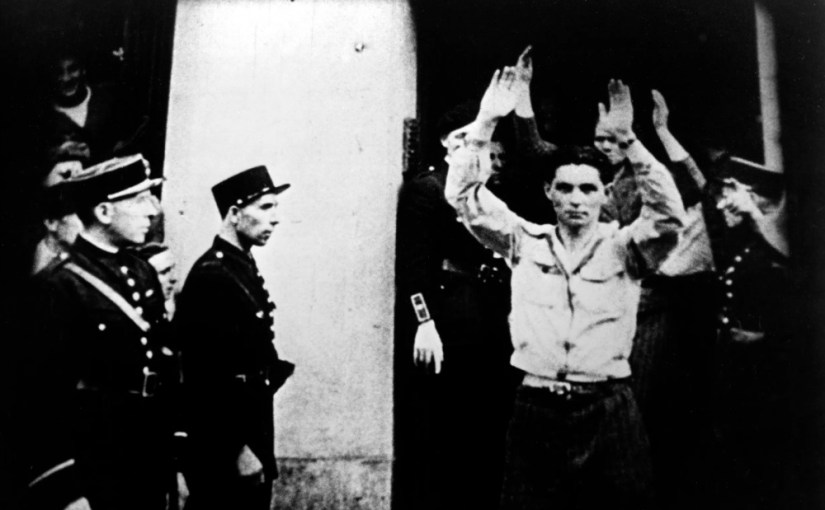
There is so much to unpack in Hotel Terminus, Marcel Ophüls’ epic documentary, that I am hesitant to even try to write about it.  In terms of the craft of filmmaking, there is nothing to critique aside from the skillful editing, which surprisingly makes its 4.5-hour running time fly by.  In terms of content…I mean, where could I even begin?  Here’s a summary I found online: “Marcel Ophüls’ riveting film details the heinous legacy of the Gestapo head dubbed ‘The Butcher of Lyon.’ Responsible for over 4,000 deaths in occupied France during World War II, Barbie would escape – with U.S. help – to South America in 1951, where he lived until a global manhunt led to his 1983 arrest and subsequent trial.”

Wait, what?  The United States intelligence apparatus smuggled a brutal Nazi officer out of Europe?  Six years after the Nuremberg trials?  Yes.  Ophüls interviews various players from US Army Counterintelligence – known as the “CIC” in the 1940s – who state flatly on camera that Barbie had connections and information regarding Russian communists, so it was in America’s best interests to keep Barbie alive and out of prison and get him to South America.

So, at the very least, today I learned something.

This sprawling documentary also features eyewitnesses to Barbie’s atrocities in Lyon, France, where he was stationed.  I don’t want to recite a laundry list of these terrible acts, but the film does key on two specific events during his tenure: the arrest and execution of Jean Moulin, a French Resistance leader, and the deportation to Auschwitz of 44 Jewish children from an orphanage in a town called Izieu.  Ophüls interviews scores of people who were in the room when Barbie arrested Moulin.  Many of them disagree who was to blame – a rat or someone with loose lips – but they all remember who made the arrest.  The stories from witnesses to the deportation of the children are beyond belief.

What is the point of a documentary like this?  Why should it be important for a filmgoer, or just an average Joe, to block out nearly five hours to watch a series of talking heads tell story after shocking story about the inhuman tactics of a monster?  Well, for one thing, that’s not the whole story.  Hotel Terminus actually has an arc, because Barbie was discovered living in Bolivia in 1972.  In 1983, he was extradited to France where he was convicted on numerous crimes against humanity and sentenced to life in prison, where he died in 1991.  The filmmakers didn’t know that in 1988, of course, but it felt good to throw that factoid in there.  Another interesting factoid: America apologized to France in 1983 for helping him escape to Bolivia in the first place.  Better late than never, I guess?

So, it’s good to know while watching that the man in question will eventually get his just desserts.  But there are times when it almost feels like the “A-story” of Barbie’s eventual arrest gets overwhelmed by the “B-story,” which is the paradoxical attitudes of many of the people interviewed.  One man wonders, what’s the point of it all?  Barbie committed his crimes forty years earlier, and France has a statute of limitations of twenty years, so just let the man grow old and die in obscurity.  Another theorizes that stirring up old memories of the war when many would rather move on actually created more civil unrest in France and Germany.  Barbie’s defense attorney at his war crimes trial (a Eurasian Frenchman) wonders why Barbie is being tried for crimes against humanity while France’s own acts of torture and horrific imprisonment during the Battle of Algiers are discreetly ignored.

And always Ophüls has rejoinders for each of these statements with stories of families separated, men and women tortured, family members whisked away and never seen again.  One woman recalls being tortured as a girl by Barbie, while her mother was told, “This is YOUR fault; if you would just talk, we would stop.”  And so on, ad infinitum.  But I am compelled to point out again how compelling this was.  These and so many other stories like them did not depress me or lower my spirits.  Instead, I was riveted.  I can’t explain why.  For myself, I felt like this was something I needed to hear, and other people needed to hear.  Here was a record of something that really happened, to real people in a real place in a time that was not so long ago, in the grand scheme of things.

There was also a section that really made me take notice.  Many, MANY people said on camera that, in his old age, Barbie was “a good man.”  He was friendly to his neighbors – even some Jews! – and a loving father.  His daughter-in-law is interviewed, and she states that he always had a kind word for her and always tried to include her in his family circle, even after her husband (Barbie’s son) died.  It made me think about the driving force behind last year’s brilliant Zone of Interest: the banality of evil.  Perhaps among many others, Barbie was living proof that evil will not always wear a black hat and have glowing red eyes.  Evil is just as capable of engaging you in friendly conversation as the next man.  (I was also reminded of a line from David Fincher’s Se7en: “If we catch John Doe and he turns out to be the devil, I mean if he’s Satan himself, that MIGHT live up to our expectations.  But he’s not the devil.  He’s just a man.”)  Is that one of the lessons of this film?  That evil is not supernatural or some kind of horrific aberration, but just a small person with delusions of grandeur?  Discuss.

There are echoes of Schindler’s List in the details of these stories, but Ophüls notably never uses any archival footage of concentration camps or of the Holocaust itself.  He apparently felt that audiences had, regrettably, become accustomed to the gruesome imagery of those events.  Instead, he relies on the viewer’s imagination to provide all the necessary details.

He also, tellingly, never provides answers to the stickiest questions that surrounded Barbie’s trial, especially the one about France being willing to charge him with crimes against humanity while ignoring their own history in Algeria.  I thought about that one a lot in relation to America.  Our country is great for a whole host of reasons, but it’s not perfect.  We rise up in vocal disapproval when a foreign country commits genocide, or when a country’s citizenry is threatened by totalitarianism…while ignoring (for the most part) the fact that our country exists because of genocidal practices against indigenous Americans.  Am I suggesting that perhaps Ophüls is wrong to focus on Barbie and not France’s history?  Absolutely not.  Barbie was a monster and got what he deserved, belatedly or not.  But I am suggesting that the film raises questions that deserve further discussion.

Ultimately, I’m glad I saw Hotel Terminus, and I would unhesitatingly recommend it to anyone who asks.  The visceral nature of the stories told by some of the subjects is enough to make it compelling, even without the overarching structure of following Barbie to his downfall.  It’s a challenging watch, to be sure, but I promise you’ll never be bored.  Trust me.

HOMICIDE (1991)

by Miguel E. Rodriguez

DIRECTOR: David Mamet
CAST: Joe Mantegna, William H. Macy, Ving Rhames, Rebecca Pidgeon
MY RATING: 8/10
ROTTEN TOMATOMETER: 88% Fresh

PLOT: A Jewish homicide detective investigates a seemingly minor murder and falls in with a Zionist group as a result.


Homicide is one of those movies where the lead character experiences just one damn thing after another until he winds up in a situation that is not even barely hinted at in the film’s first half hour.  If I didn’t think it was being a little pretentious – and maybe if I understood the term just a little more – I’d call it Kafkaesque.  It reminds me a bit of Martin Scorsese’s After Hours, where that lead character is drawn unwittingly into the unexplored jungles of New York City at night.  Likewise, Detective Bobby Gold (Joe Mantegna) starts the film on a manhunt, searching for a wanted killer, and thirty-six hours later winds up begging Zionist activists to let him be involved in blowing up a storefront suspected of printing Nazi pamphlets.

In other hands, the events of the film leading up to Gold’s digression into racial/social activism could come off as comic.  First, he’s put on the manhunt case, searching for a man named Randolph.  Then a weirdo booked for killing his family wigs out at the station and attacks Gold, ripping the strap off his holster, and giving him a bump on the head that’s visible for the rest of the movie.  (I was unavoidably reminded of Jake Gittes’s nose in Chinatown.  Both wounds serve as constant reminders of either the odds the characters face or of the unpredictability of the world they inhabit.)  On their way to interrogate Randolph’s mother for his whereabouts, Gold and his partner, Sullivan (William H. Macy), randomly run into what looks like a hostage situation which turns out to be a cop cornered by a vicious dog in a candy store.  In the store is a dead woman.  The commanding sergeant arrives at the scene and gives Gold the dead woman case.  Turns out the dead woman is Jewish.  Her family shows up at the scene, learns Gold is Jewish, and insist he be their personal liaison for the case.  Meanwhile, Sullivan has to carry on with the Randolph case on his own.  A recurring theme will be how Gold keeps missing out on important events with the Randolph case while babysitting the family of the dead woman, a case he considers unimportant.

What happens next unfolds so naturally and surprisingly that I will not spoil it for you.  What I will say is that Mamet turns a standard police procedural into a searing character study of a man who has never really considered who he is in terms of his heritage.  At one point, he speaks with a Jewish scholar who shows him a page of Hebrew text.  Gold says, “I can’t read it.”  The scholar tells him, “You say you’re a Jew and you can’t read Hebrew.  What are you then?”  This is a question that Gold will try to answer for the rest of the film.

On a personal note, that bit of dialogue resonated quite a bit with me.  I’m full-blooded Puerto Rican on both sides of my family.  Yet my knowledge of Spanish is barely passable.  When faced with reading Spanish text, I can sound out the words, but my comprehension level is probably only 60 to 70%.  My conversation with fluent Spanish speakers is halting, at best.  I just never took the time to learn it as thoroughly as my parents or my sister did.  Does that make me any less Puerto Rican?  I don’t think so, and I might feel resentment towards a stranger telling me that I’m not Puerto Rican just because I don’t speak Spanish.  I know who and what I am, and my identity is not tied to what language I speak.

But things are different for Detective Gold.  Earlier in the film, he talks to his partner, Sullivan, on the phone and talks about how the Jewish family he’s now working for, or with, are high-strung, crying wolf (they claim someone is shooting at them from the building next door, but there are no bullet holes to prove it), how they saved ten bucks a week by letting the old lady work at the store herself, how they’re “not MY people, baby.”  Only after he realizes he’s been overheard does he feel immense guilt and obligation to help the family.  Not to just solve the case, but to “find the killer.”  So, he’s experiencing all sorts of new emotions that may or may not be interfering with his ability to do his job impassively.

The people in Homicide sound as if they are speaking in subtext only, using Mamet’s unique writing style to bypass what we think of as “normal” speech and deliver lines that are almost poetic, even when laced with racial epithets and curse words.  This makes the overall tone of any Mamet-scripted film seem hyper-stylized, as if the characters are one level removed from reality, but not in a bad way.  It elevates the film somehow.  I’m at a loss to describe it more accurately.

One bit of dialogue exemplifies what I’m talking about.  Gold is being thrown out of a building.  The gentleman at the door tells him, “Don’t bother to return.  The next time you come, there’ll be nobody here.”  Don’t bother to return?  That’s unnecessarily decorous.  “Normal” conversation would be something like, “Don’t bother coming back.  If you do, we won’t be here.”  However, Mamet’s signature word choices here suggest an almost Shakesperean construction, as if the words are being shoehorned into a buried structure or pattern that operates subconsciously.  Based on what happens with Gold throughout the film, I could theorize that Mamet is trying to create a mood reminiscent of Greek tragedy, and the actors are reciting dialogue that has been translated from Greek or some other language.

But that’s just me.

The experience of watching Homicide will never be quite as exciting or kinetic as other superlative crime dramas like, say, Heat or The Departed, movies that also examine their characters in detail, sending them on similar journeys of self-discovery.  Those other movies are defined as much by their action as by their intelligence.  In Homicide, any “standard” action scenes are purely incidental, or sometimes accidental, intended not to thrill but to move the plot forward with a minimum of fuss.

In any event, the action is not the linchpin of this film.  We watch Homicide, not to see who Gold kills or who tries to kill Gold, but to see if he is capable of resurrecting the person within himself that he thought he had killed long ago, a sacrifice he made on the altar of being a good cop.  He has a painful conversation where he realizes that everything he’s done to suppress his own self has been, “Not for me.  All for someone else.”  He must decide whether to act in service of his conscience or his sworn duty as a cop.  The choices he makes have consequences he never anticipated, as with all good tragedies.  Homicide reminds us of that inescapable fact, not with a bang or a whimper, but with the calm, flat gaze of an impassive Greek god who lets us draw our own conclusions.

THE MAN IN THE MOON (1991)

by Miguel E. Rodriguez

DIRECTOR: Robert Mulligan
CAST: Sam Waterston, Tess Harper, Reese Witherspoon, Jason London, Emily Warfield
MY RATING: 10/10
ROTTEN TOMATOMETER: 91% Fresh

PLOT: A 14-year-old girl in 1957 comes of age when she develops a crush on a handsome neighbor…who only has eyes for her older sister.


The Man in the Moon has a plot that sounds like a high-concept pitch somewhere between an ABC After-School Special and a third-tier soap opera.  But somehow, magically, it transcends the trappings of soap opera and veers towards the truly operatic, touching on grand emotions while keeping itself grounded in reality.  I watched the movie in awe, wondering how something so sappy was holding my interest the whole way through.  Afterwards, I came up with two overarching reasons: the spectacular debut performance of a 14-year-old Reese Witherspoon, and the sure-footed direction from one of Hollywood’s old masters, Robert Mulligan, who cut his teeth on stage plays for television in the 1950s before directing his masterpiece in 1962, To Kill a Mockingbird.

Like Mockingbird, The Man in the Moon takes place in the deep South.  The time is 1957, when Elvis was king and children were still encouraged to say “Yes, ma’am” and “No, sir” to their parents.  Dani Trant (Witherspoon) is still young and tomboyish enough to escape her Sunday chores by dashing off to the local swimming hole after church.  Her older sister, Maureen (Emily Warfield), is set to start college at Duke in a few months.  Their close relationship is established in a sweet opening scene where they sit in their outdoor, screened-in bedroom, doing each other’s hair and talking about life and Maureen’s doubts and how Dani envies Maureen, and so on.  Like in real life, the conversation touches on deep topics, but never really resolves anything.  It just feels good to talk, to know the other person is really listening.  This scene is mirrored in the movie’s final scene in a fantastic bit of screenwriting where the conversation is very different, but the emotions being discussed are more or less the same.

One day, Dani goes skinny dipping in the watering hole and finds an unexpected visitor: Cort Foster (Jason London), 17, whose mother and younger brothers have just moved back to their old farm next door.  Turns out Cort’s mother, Marie, is an old friend of Dani’s mom, Abigail.  This is the kind of stuff soap operas thrive on, but even at that point, even though I was aware of the contrivances of the story, I never felt overly manipulated.  It all just felt very…real.  Once again, it’s a testament to the director’s skill in making sure nothing gets punched up unless there’s a reason for it.  It’s never bland, don’t get me wrong.  But it never feels fake.  I don’t like the word “organic” in connection with acting or directing, but that feels like the right word to use here.

Things move swiftly.  Dani and Cort become quick friends, but when things get a little too flirtatious at the swimming hole, Cort backs away and admonishes Dani.  “You almost got more than kissed, little girl.”  Dani asks Maureen for tips on kissing boys.  It looks as if Cort is always on the verge of making a bad decision, but he has the good sense to put on the brakes.  The film is making you think the movie is going to be about one thing, but then there’s a family crisis, and in the hubbub, Cort meets Maureen, there’s an instant attraction, Dani feels left out…

But that’s enough summarizing.  Based on what I’ve written, you may already think you know the arc of the film, but I can assure you, you’re wrong.

Let’s talk instead about Reese Witherspoon’s performance.  It must be seen to be believed.  It belongs in the pantheon of the greatest debut performances of all time.  She is as self-assured and confident and natural as she was in her Oscar-winning performance in Walk the Line.  It’s almost like watching some of the early films of Marilyn Monroe; the screen just seems a little brighter when she’s present.  Watch her facial expressions when Cort realizes who she is after their first encounter at the swimming hole.  Watch her smile after her first kiss.  Look at her self-control when she tells her father she understands why he had to take the strap to her (that’s a long story that I won’t spoil).  For the most part, I just watched her performance in awe, but once or twice I turned on my analytical mode and tried to see if I could “catch” her acting.  Couldn’t do it.  The fact she wasn’t at least nominated for an Oscar for this movie is a complete freaking mystery to me.

For that matter, the whole movie is a mystery to me.  Before watching it, I had only heard about it from a rave review by Roger Ebert.  I couldn’t find it streaming anywhere so I had to pay a relatively pretty penny to get it on Blu ray, sight unseen.  (Spoiler alert: it was worth it.)  Yet here is a brilliant gem of a film that tells a simple story of love and sadness and doubt and everything in between.  There are some plot surprises – I won’t say twists, exactly, it’s not a Shyamalan movie – that I absolutely did not see coming.  In retrospect, maybe I should have, but the storytelling kept me engrossed in the moment.  It kept me focused on the here and now, so I never felt the need to try and guess what was around the corner.  I hesitate to use this word, too, but it was mesmerizing.  To tell a story this cornball (on the surface!) and keep it fresh and alive is some kind of miracle.

It’s been said that no good movie is too long.  The Man in the Moon clocks in at just under 100 minutes with credits, but I was prepared to stick with it for at least another half hour, just to see what these characters would do and say, and how they would deal with the next challenges life throws at them.  When the movie ends, it doesn’t feel like an ending.  It has the good sense not to make things too final, as if the solutions to all the issues in the film could be wrapped up in a bow.  All that remains is the bond between two sisters, and if they have that, that’s all that matters.

THE GRIFTERS (1990)

by Miguel E. Rodriguez

DIRECTOR: Stephen Frears
CAST: Anjelica Huston, John Cusack, Annette Bening, Pat Hingle, Charles Napier, J.T. Walsh
MY RATING: 9/10
ROTTEN TOMATOMETER: 91% Certified Fresh

PLOT: A small-time con man has torn loyalties between his new girlfriend and his estranged mother, a high stakes grifter working for the mob.


Imagine your favorite film noir from the 1940s and ‘50s.  The Big Heat, say, or Double Indemnity.  Now imagine someone remade it, set it in the modern world, retained most, if not all, of the hard-boiled dialogue and characters, threw in some gratuitous nudity, and added some Freudian subtext that would have made Oedipus blush.  Oh, and imagine David Mamet directed it.  Voila…you’ve got 1990’s The Grifters, directed by Stephen Frears and co-produced by none other than Martin Scorsese.  It tends to move just a tad slow at times, but all that simmering pays off in the movie’s phenomenal final reel.  I am going to have to tread carefully indeed to avoid spoiling some of the movie’s best surprises.  Here goes:

As the movie opens, we are introduced to three very different characters, at least on the surface.  Lilly (Anjelica Huston) works for the mob by visiting horse racing tracks across the country and laying pricey bets on long shots to bring the odds down just in case they pay off.  She also skims just enough off the top to stay under the radar.  Roy (John Cusack) is a young man pulling small-time cons of his own, like the one where he flashes a $20 bill at a bartender, then pays with a $10 bill instead, getting $20 worth of change at half the price.  And Myra Langtry (Annette Bening in her breakout role) is first glimpsed attempting a lame con at a jewelry shop that ends with her offering her body to the jeweler instead.  (I like the fact that nearly everyone calls her “Mrs. Langtry” even though no one seems to have laid eyes on her husband.)

Myra is Roy’s vivacious new girlfriend.  Lilly is Roy’s estranged mother; she had him when she was fourteen years old (yikes) and he left home at 17, as he puts it, “with nothing but stuff I bought and paid for myself.”  Roy values his independence above all else, maybe even more than the money he’s “earned” and stashed away behind the ugly clown paintings in his living room.  So, when Lilly unexpectedly drops by his apartment in Los Angeles (which she always pronounces “Los Ann-guh-leez”) on her way to the track at La Jolla, he lies about his livelihood.  The last thing he wants is a concerned grifter mother trying to partner up with him.  He learned that from a mentor years ago, seen in a flashback: “You take a partner, you put an apple on your head and hand the other guy a shotgun.”

Due to an injury sustained from a bartender who caught him in a grift, Roy winds up in the hospital, where Lilly meets Myra for the first time.  They are not impressed with each other; their introductory conversation is brief, but it plays like Bette Davis clashing with Joan Crawford.  We get a little more information about Myra’s situation when we see her go home to her apartment where she is met by her landlord, Joe, who demands payment on her outstanding bill.  Her response is to bat her eyes and launch into a patter of what sounds like a radio or TV commercial.  “You, too, could learn to dance!  All you need is a magic step!”  After some more back and forth, she lies down naked on her bed and offers Joe a choice: “Only one choice to a customer, the lady or the loot.  What’s it gonna be?”

What makes a scene like that sparkle, along with virtually every scene in the film, is the fierce individuality displayed by the characters.  They are each wholly original, not simply placeholders for foregone dialogue or plot developments.  In classic film noir, the lead character is usually a smart guy (or gal) who thinks he’s smarter than everyone else but gets caught off guard by his own desires.  In The Grifters, all the main characters are smart…and they stay that way the whole movie.  There is not one single plot development that evolves because anyone makes a dumb decision.  You can see that they all have a clear view of all the angles, and no one is going to make a stupid choice for the sake of the script.  I can’t tell you how rare that is.  The plot and the story unwind and are wound up like a precision watch.  By the time the credits roll, you can see exactly why each character made the decisions they did, leading them to the shocking finale in the last reel.

I really can’t say more about the plot without simply retelling scenes or giving away spoilers.  Throughout the film, Huston, Cusack, and Bening deliver performances that would be right at home in a Mamet film.  They’re allowed to show more emotion than can usually be found in Mamet (I’m thinking particularly of House of Games), but their pared-down, hard-boiled dialogue cuts to the heart of the matter without being flowery.  There’s a scene involving Lilly’s boss, Bobo, played by Pat Hingle with a flat-eyed menace that would make Sonny Corleone run for cover.  His deadpan dialogue with Lilly about oranges is one of the tensest gangland conversations I’ve ever seen, and he does it without ever raising his voice.  Brilliantly written.

If this review has been vague, it’s because I am trying to preserve the unexpected twists and turns about who’s who, and who’s hiding what, and why.  If you find yourself wondering why things are moving kind of slow in the first 30-45 minutes, just be patient and let your ears bask in the hum of the crisp dialogue; observe how each character behaves according to their character, not according to a script; and marvel how a movie set in modern day can still have dizzy dames and classy broads and world-weary heroes and not feel like a relic from the 1940s, but instead feels as fresh as a movie that was released yesterday.  The Grifters is nearly-buried treasure that deserves to be rediscovered.

BORN ON THE FOURTH OF JULY (1989)

by Miguel E. Rodriguez

DIRECTOR: Oliver Stone
CAST: Tom Cruise, Kyra Sedgwick, Raymond J. Barry, Jerry Levine, Frank Whaley, Caroline Kava, Willem Dafoe
MY RATING: 7/10
ROTTEN TOMATOMETER: 84% Certified Fresh

PLOT: A biography of Ron Kovic, a fiercely patriotic Marine who fights in Vietnam, is paralyzed in battle, and experiences a dramatic turnaround upon his return home.


I can already tell this is going to be a difficult review to write.

There is nothing overtly wrong with Oliver Stone’s Born on the Fourth of July.  It is expertly directed, and the pacing never flags.  Tom Cruise’s Oscar-nominated performance is deservedly legendary; he leaves nothing in the tank, a fierce rebuttal to critics who thought he was nothing but a pretty face.  But even though there is much to admire, when the closing credits rolled, I felt oddly detached.  The movie kept me at arm’s length from really engaging with the lead character.  Or maybe I kept the movie at arm’s length.

Could it be that I simply don’t care for Vietnam films anymore?  Not likely.  One of my absolute favorite films is Michael Cimino’s masterpiece The Deer Hunter.  In fact, the opening scenes of Born on the Fourth of July are reminiscent of that earlier film in that it takes its time establishing the main character, Ron Kovic, as a young man in the early-to-mid 1960s at the dawn of the Vietnam War.  Born and raised in Massapequa, New York, his strict Catholic upbringing and his devotion to high-school wrestling instill a strong sense of right and wrong in the world.  A point is made about how America had never lost a war up to that time.  Kovic’s wrestling coach exhorts him and his teammates as if he were a Marine drill instructor.  “I want you to kill!  You hear me?! …You got to pay the price for victory, and the price is sacrifice!!”  It’s not very subtle, but Stone is making it clear that, in those days leading up to the Vietnam quagmire, the American credo was, “Winning isn’t everything, it’s the ONLY thing.”

Kovic enlists, sees combat, and during two horrific sequences, he experiences: an unintended massacre of Vietnamese civilians, the accidental shooting of a fellow soldier (with Kovic himself behind the trigger), and a fateful gun battle during which a bullet went through his right shoulder, collapsing a lung and severing his spinal cord, paralyzing him from the waist down.  These scenes are appropriately skittish and terrifying, putting us in Kovic’s boots and making us feel the unimaginable stress of fighting a war where half the time you weren’t sure who or what you were shooting at.  Kovic is shipped stateside…and here, as they say, is where his troubles REALLY began.

If the scenes set at the VA Hospital during Ron Kovic’s convalescence weren’t based on his actual experiences, I would denounce them as sensationalistic and manipulative.  Rats roam free among the beds.  (A nurse provides spectacularly unhelpful advice: “You don’t bother them, they ain’t gonna bother you.”)  Orderlies spend their down time getting high on marijuana or worse.  Unchecked catheters get backed up.  When a vital blood pump malfunctions, a doctor has to go to the basement to “rig up a substitute.”  And through it all, Ron Kovic does everything in his power to prove to the (correctly) pessimistic doctors that he will walk again, even re-injuring himself in the process.

(It’s futile, I know, to critique a film for what it’s not instead of what it is, but I can’t help wondering if I might have developed a more emotional reaction or attachment to the film if the entire film had focused on Kovic’s tenure at the VA hospital…although I will admit that would be a thoroughly depressing film.  Also, it might have developed some unintentional similarities to One Flew Over the Cuckoo’s Nest.  Who knows.)

The rest of the film details Kovic’s return home to his family, his emotional swings between the lowest kind of depression (“Who’s going to love me, Dad?  Who’s ever going to love me?”) and angry shouting matches with his parents and occasional bar fights.  Eventually, Kovic has a revelation: he still loves his country, but he can’t stand the government that sent him and his friends halfway around the world for a cause he no longer understands.  After a short hiatus in Mexico (I won’t get into too many details about that plot point because it’s the one section of the film that borders on boring), he returns home and dedicates his life to speaking up for the men and women who returned from Vietnam to a country that, at worst, hated them, and at best, simply didn’t care about them.

Again, the film is a stirring portrait of a man and a life.  However, as much as I want to, I can’t pin down what it is about the movie that failed to reach me at the kind of emotional level that other biographies have done before.  I just recently watched My Left Foot, with Daniel Day-Lewis’s towering performance at its center.  Another film biography, another main character confined to a wheelchair, a character who comes to terms with himself and how the world responds to him and comes up with a way to respond to the world.  But My Left Foot made my heart soar in a way that Born on the Fourth of July never achieved.  I watched the movie intently, focusing on every plot development and every nuance.  But it just didn’t grab me.  I am at a loss to explain why.

Could it be because of the presence of Tom Cruise in the lead role?  He showed these kinds of acting chops again ten years later in Magnolia, giving another Oscar-nominated performance.  In that movie, he completely disappeared into the role, despite having one of the most recognizable faces on the planet.  Perhaps the younger Tom Cruise (only 27 at the time) emits the kind of wattage that overshadows those around him?  So that you’re aware of the face first and the character second?  Maybe.  So why doesn’t the same thing happen in Magnolia or even The Last Samurai?  Perhaps it took him ten years to find a way to modulate or customize his performance so that, when it counts, the character comes first and the Cruise persona second.

I’m speculating.  The bottom line is, Born on the Fourth of July is a worthy addition to the resumes of both Oliver Stone and Tom Cruise.  It knows the story it wants to tell and resolutely sticks with it the whole way.  There are no sidetracks at any time, not even when he becomes an activist.  The focus is always on Ron Kovic, not the cause.  Stone and his screenwriters trusted that the story of Ron Kovic would draw enough attention to the cause on its own.  That approach would work with just about any other film.  This time, it had the effect of diluting the emotional experience while still holding my attention all the way through.  I would still recommend it to anyone who hasn’t seen it, if for nothing else to see Cruise play a role where he gets to sound notes he rarely got to play in his early career.  Would I watch it again?  Maybe.  I think the story is important enough for me to try to see what I might have missed this time around.

DEKALOG (Poland, 1989-1990)

by Miguel E. Rodriguez

DIRECTOR: Krzysztof Kieslowski
CAST: A host of Polish actors unknown to me
MY RATING: 8/10
ROTTEN TOMATOMETER: Not Rated

PLOT: Director Krzysztof Kieslowski presents ten short films, each related in one way or another with one or more of the biblical Ten Commandments.


Nearly every review or description I’ve ever read of Kieslowski’s Dekalog states that the ten 1-hour films in this ambitious cycle are each based on one of the biblical Ten Commandments.  Not so.  I also assumed that each film would somehow be a moral tale ending with an unequivocal statement about right and wrong.  Also not true.  These films are the most mature and literate explorations, not of morals, but of ethics, that I’ve ever seen.  We believe we know what’s right and what’s wrong, and that we would have the ethical fortitude to do what’s right, given the option.  Dekalog argues that, in today’s world, whether it’s late-1980s Poland or present-day America, the moral absolutes dictated by the Ten Commandments are unachievable.  All we can do is choose what we believe is the right thing and hope for the best.

Kieslowski, much better known perhaps for his Three Colors trilogy, seems to have written these films, along with Krzysztof Piesiewicz, as case studies or thought experiments for ethical quandaries.  In Dekalog Two, a woman has a semi-comatose husband.  She approaches the doctor with a dilemma: she is pregnant with another man’s child, so she must know whether her husband will recover or if he is beyond hope.  If the doctor says he will recover, she will get an abortion.  If the doctor says he will die, she’ll keep the baby.  Now the doctor has two lives in his hands.

In Dekalog Four, a young woman’s father is away on business.  She discovers a letter, hidden by her father, from her dead mother, that says, “Open after my death.”  She opens it (dishonoring her father’s obvious wish that it not be found), and what she finds could radically redefine her relationship with her father, along with resolving some sexually ambiguous feelings she’s been having lately.

I could go on and on.  For the curious, a full synopsis of each film in the cycle can be found online.  But you get the idea.  Each self-contained story is a “what would you do” scenario where your answer may tell you more about yourself than you anticipated.  They seem more inspired by the format of Jesus’ parables instead of Moses’ tablets, just without the neat and tidy ending.  (Well, Dekalog Ten’s ending is cut-and-dried, but that’s all you’ll get out of me in terms of endings.)

For me, the weakest of the ten films was Dekalog Two, despite its sensational premise.  It gets a little too mystical for its own good at one point.  But setting that one aside, I was amazed at how enthralled I was while watching each chapter.  Kieslowski begins each film almost as if you were walking into the middle of the story instead of starting cleanly at the beginning.  Characters are introduced who appear to have no connection whatsoever, and you must be a little patient as the story develops.  At first, I found this approach a little discombobulating, but as I got more accustomed to it, I thought I could see its purpose.  This is real life, not the kind of storytelling we are accustomed to from Hollywood and (let it be said) elsewhere.  The stories we remember and retell from our lives don’t begin with a lovely credit sequence and stirring music.  It’s usually something like, “So there I was, at the doctor’s office, and he told me I was impotent…”

This method also had the effect of sharpening my attention as each film began.  Since I wasn’t being spoon-fed the story, I paid close attention to each shot, trying to memorize a face or recall a name.  And each story had this remarkable ability to lure me into complacency or banality, and suddenly BANG, a monkey gets thrown into the wrench, reshaping everything you just saw, or what you thought you were going to see.  I’m thinking especially of Dekalog Four, with the dead mother’s letter; Dekalog Seven with the ostensible kidnapping with hidden motives; and Dekalog Ten where a father’s death brings two estranged brothers together for one last surprise in his heavily secured apartment.

Because I was watching so carefully, there were several things I noticed that carried over from one seemingly unrelated tale to the next:

  • REFLECTIONS: Every film makes liberal use of reflections for some compositions, whether it’s a scene shot in a mirror or a pane of glass or a puddle or even just reflections on the lens of the camera.  I am not enough of a film scholar to elaborate what that could mean, aside from the obvious: these films are intended to elicit self-reflection from the viewer.  Passive viewing of these films simply will not do.
  • CAMEOS: All ten films take place mostly in or around the same imposing apartment complex in Warsaw.  (Look closely at the structures and the beams for the outside porches resemble church crosses.)  As such, characters from one chapter will “bleed” into at least one of the others.  The father in Dekalog One appears near the beginning of Dekalog Three.  The pregnant wife in Dekalog Two is trying to catch a cab in Dekalog Five.  The impotent husband in Dekalog Nine shows up in reverse order as a bike rider in Dekalog Six.
  • EXTERIORS: I cannot recall more than two or three shots in all ten films that showed an unambiguously sunny day.  Daytimes in Dekalog are invariably overcast and gloomy.  If we are meant to interpret that as a symbol, and the apartment complex is the world we all inhabit, then Kieslowski seems to be saying that the world is a dark and dreary place, indeed.  Is there any hope at all in this gray cycle of films?  I think so.  Many of the films end on, if not exactly a happy note, then at least a hopeful note.  For myself, I watch the credits roll on each one and I imagine the characters making peace with their choices, because…well, that’s what I have to do daily.  If I can do it, they can do it.  Or vice versa.
  • THE WATCHER: There is one actor who appears in nine of the ten films in Dekalog.  He never speaks, is never named (on IMDb, he is credited simply as “Young Man”), and never directly interacts with any other character.  I took to calling him The Watcher, after the Marvel Comics character who is doomed to spend eternity witnessing human history without the ability to help in any way.  What does he represent?  Is he an angel, in keeping with the cycle’s biblical name?  He seems to appear whenever a main character is about to make a choice of some kind; in one instance, he gives an almost imperceptible shake of the head as if to say, “Don’t do this.”  If you ask me, I would say the Young Man is the embodiment of guilt, a warning stare from some cosmic force that is saying, “Can you live with what you’re about to do?”  The main characters make their own choices, deciding what they can or can’t live with.  Discuss.

I hope all this mumbo jumbo hasn’t deterred you from seeking out this series and giving it a go.  All the same, as much as I do recommend Dekalog, I’m a little stuck on who exactly I would recommend it to.  All told, it’s a 9-hour-34-minute excursion into the kind of ethical dilemmas that could occupy an entire semester at a film school…and probably has.  On the other hand, with streaming popularity at an all-time high (depending on who you ask), one can think of it as a 10-part HBO miniseries…in Polish.  After all, that’s how it was originally envisioned anyway, as a limited series for Polish television. Take a chance.  Find a copy to buy online.  Or stream it if anyone is offering it.  I promise, you will be mulling over these films long after the latest Venom movie has faded from memory.  (Sorry, cheap shot, couldn’t resist, but you know I’m right.)

MY LEFT FOOT (Ireland, 1989)

by Miguel E. Rodriguez

DIRECTOR: Jim Sheridan
CAST: Daniel Day-Lewis, Brenda Fricker, Fiona Shaw
MY RATING: 10/10
ROTTEN TOMATOMETER: 98% Certified Fresh

PLOT: Christy Brown, born in 1932 with cerebral palsy, learns to paint and write with the only limb under his full control – his left foot.


For so many years, I have admired Daniel Day-Lewis as an actor, especially his performance in There Will Be Blood, which is the only performance I’ve seen on screen that has ever really motivated me to be a better actor myself.  However, I never got around to seeing his breakout movie, My Left Foot, until just recently.  All I can say is: WOW.  I had always assumed (big mistake) that this film would be a long, dark journey of the soul leading finally to an uplifting climax, but not after a lot of scenes of heartbreak and pathos and general gloom.  I could not have been more wrong.  There is as much heartwarming joy in My Left Foot as it’s possible to contain in any film, and it’s balanced by acknowledgement of Christy Brown’s condition and his down days and his struggles.  It’s a brilliant high-wire act, flawlessly performed both in front of and behind the camera.

Christy Brown is born with cerebral palsy in Ireland in 1932 to a Catholic family that grows in number almost through the entire film.  In a day and age that was simply not equipped to handle disabled children, Christy’s father is blunt: “He’ll go in a coffin before any son of mine will go in a home.”  While his motives were probably more about saving face in his community than anything altruistic, it’s this attitude that most likely saved Christy’s life.  Christy is brought home where his parents and his many sisters and brothers acknowledge and learn to work around his condition, but they refuse to treat him as anything other than a “normal” playmate and sibling.  Some of the happiest scenes in the film are when the children push Christy around in a wheelbarrow, racing up and down their street, as much for his enjoyment as for theirs.

Christy’s mother (Oscar-winner Brenda Fricker) patiently learns how to interpret young Christy’s unintelligible grunts and constantly shifting facial expressions, so it seems as if they’re communicating with each other in a secret language.  When young Christy shocks the family by picking up a piece of chalk with his left foot and writing “MOTHER” on the floor, the father’s response made me smile and smile: he carries Christy to the local pub and announces, “This is Christy Brown!  My son!  Genius!”  If this didn’t happen in real life, it bloody well should have.

(I also loved the bit where the older Christy plays soccer with his friends.  As a very capable goalie, no less.  When the time comes to take a penalty kick, his brothers line him up carefully on the ground so he can use his deadly left foot to rip the back of the net.  Or storage shed, whatever.)

I mention all these moments and interactions between Christy and his family because they are at the core of what makes this movie special.  Yes, Day-Lewis’s performance is the stuff of legend, there’s no denying that.  But the screenwriters are very careful to let us see that, despite his literally crippling affliction, Christy never lacked an unshakeable support structure.  I found myself wondering if I had the kind of fortitude, not to persevere like Christy, but to go all in on supporting a sibling or any loved one, loving them, and always being there for them.  It’s easy enough to say I am willing to do things like that.  I only hope, if I were ever faced with that kind of challenge, that I would meet it with the same kind of unconditional grace and love exhibited by the family of Christy Brown.  Here endeth the introspective portion of this review.

I can’t tell you enough how enthralling and well-balanced this film is.  In my experience, most movies about characters with terminal illnesses tend to wallow too deeply in the grief and sorrow associated with that illness.  My Left Foot makes a conscious decision to establish the illness, lay down the boundaries, and then move forward as if the main character weren’t ill at all.  In a sense, that is the case with Christy Brown in the first place.  As brilliantly portrayed by Day-Lewis, you can always see the mind at work behind the uncontrollable gestures.  There is nothing at all wrong with his mind, only his body, which betrays him and frustrates him.

There is one specific scene that seems to stick in the mind of everyone who sees the film.  Christy has been taken under the wing of a doctor, Eileen Cole (Fiona Shaw) who specializes in treating his condition.  His speech improves, his painting improves.  He falls in love with her.  In an agonizing scene, he confesses his love to her in a restaurant while several other associates look on.  She mistakes his declaration of affection and informs him of her engagement to another man at the table.  After a stunned silence, Christy uses his loudest speaking voice and carefully and very slowly says, “Congratulations.”  Director Jim Sheridan points the camera, not at Christy, but at the horrified and embarrassed dinner guests at the table, and at the other restaurant patrons who stop and stare in disbelief at the noises Christy is forcing into the air.  He has some other choice words regarding platonic love, and the scene ends with him pulling the tablecloth off the table with his teeth.

The emotions on display in this scene were so raw and honest and painful that I found myself covering my eyes a bit.  I felt every bit as embarrassed as those dinner guests.  But I also felt enormous empathy for Christy.  He is raging, not only at Dr. Cole and her rejection of his affection, but at the fates that locked his soul away in a body that was a constant reminder of his “differentness.”  Later scenes show us that he was able to make peace to a much greater degree in later life, but these scenes and others reveal the unimaginable conflict in his sharp mind.

I’m rambling, I think.  I don’t feel I have successfully conveyed how joyous My Left Foot truly is.  I had a goofy smile on my face for the first half hour of the movie.  I laughed out loud many times, especially at Christy’s father’s wake, a scene I vividly remember seeing at the Oscars that year.  Christy Brown was not a perfect man, and the movie does not pretend that he is.  But the movie does end on a wonderful high note that would be crushingly melodramatic in almost any other film.  My Left Foot earns it by showing us his journey, completely, concisely, and with enormous understanding.

SANTA SANGRE (Mexico, 1989)

by Miguel E. Rodriguez

DIRECTOR: Alejandro Jodorowsky
CAST: Axel Jodorowsky, Blanca Guerra, Thelma Tixou, Sabrina Dennison, Adan Jodorowsky
MY RATING: 9/10
ROTTEN TOMATOMETER: 86% Certified Fresh

PLOT: In Mexico, the traumatized son of a carnival knife-thrower and trapeze artist bonds grotesquely with his now-armless mother.


In years past, whenever I read articles or reviews that evoked the name of Alejandro Jodorowsky, it always seemed to be with the reverence and awe befitting a living saint, or at least a holy fool.  He was mentioned alongside words like “fever dream” and “visionary” and “madman.”  His name pops up a little more frequently these days due to the huge popularity of the new Dune films; he was slated to direct his own version of Frank Herbert’s sci-fi masterpiece, but it stalled in the planning stages around 1976, after $2 million had already been spent in pre-production.  (Storyboards of his intended visions for Dune boggle the mind…Google them some time if you’re unfamiliar.  One of the sticking points was that he wanted the movie to be between 10 to 14 hours long.)

I mention all this because it has taken me this long to finally get around to seeing one of Jodorowsky’s films, Santa Sangre, and I can honestly say that all the hyperbole surrounding his name is justified.  It’s not a perfect film, because how could it be?  It’s a film that tells a straightforward story, but the emotions driving the storyteller are on full display, not necessarily his technique.  Or maybe his technique is flawless because the film conveys such raw emotional power.  I don’t know.  I may be unqualified to break this movie down into its component parts to critique it effectively.  All I can say is, if you ever find yourself starved for new images in cinema, Santa Sangre will satisfy you for months, if not years.

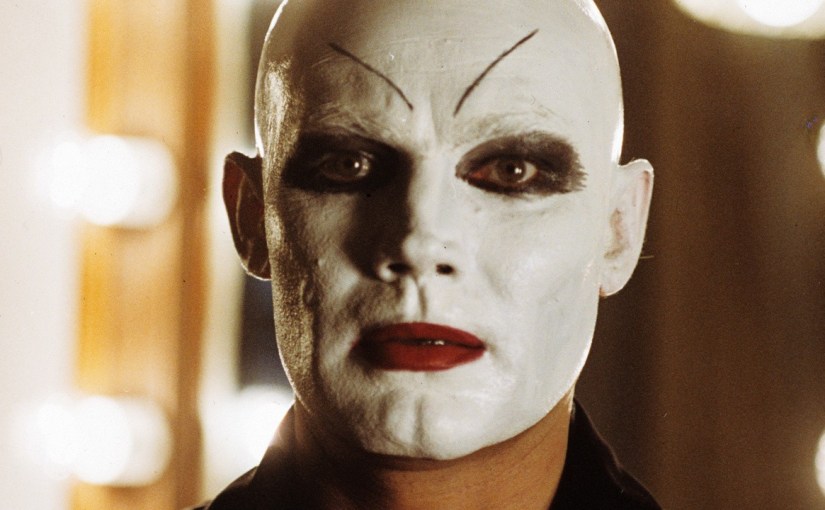
A prologue shows us a naked man in a Mexico asylum who apparently believes he is an eagle.  As orderlies dress him, we flash back to the man as a young boy, Fenix, who performs as a magician in a third-rate travelling circus.  His fat father, Orgo, is the ringmaster and a knife-thrower.  His mother, Concha, is a trapeze artist, but she is also the leader of a bizarre sect of Catholicism that worships the figure of a girl who lost both her arms to vicious rapists.  We also meet a young deaf-mute girl, Alma, and her ostensible mother, The Tattooed Woman (she is never called anything else), who seduces Orgo by letting him throw knives at her.  From the documentary on the very loaded Blu-Ray, I learn that the actress playing The Tattooed Woman volunteered to be the “target” while a professional knife-thrower threw real knives at her…including one that lands in an outrageously small space between her thighs.  Crazy.

Later, when Concha discovers them in bed together, she throws acid on Orgo’s genitals.  Enraged, Orgo takes two of his throwing knives and literally disarms Concha.  He later staggers out of his tent and meets an ignominious end by his own hand.  Concha’s son, Fenix, has witnessed most of this while locked inside one of the circus trailers, which PROBABLY influenced his current state of insanity.

In between these two events, we have seen Fenix despair over one of the circus elephants that is clearly dying, blood trickling out of its trunk as his caretaker looks on sorrowfully.  What follows is a scene depicting a funeral procession for the elephant, but the procession is nothing compared to how the elephant and its massive coffin are disposed of.  This and many other circus scenes feel like Fellini by way of David Lynch.

Back in the present…after an outing with other patients at the asylum (played by real Down syndrome patients) goes bad (they are hijacked by a pimp who offers them cocaine), Fenix escapes and reunites with his now-armless mother.  She co-opts him to be her arms in a vaudeville act and at home, where he sits or stands behind her everywhere and manipulates his arms so effectively the illusion of his arms being her arms is complete.

…but I’m just giving you lists.  There is much more to discover in Santa Sangre that I do not want to spoil.  It is a singular experience, lending itself to many and varied interpretations and certainly not appealing to everyone.  Jodorowsky is okay with that.  He says in an interview that he does not make films to make a living.  He only makes a movie when he has something to say.

So…what is he saying in Santa Sangre?  There are elements of domineering motherhood with Concha virtually subsuming the grown Fenix and his arms.  Later developments show us that she has become the most fearsome mother figure since Mrs. Bates.  Is Jodorowsky exorcising some psychic demons from his childhood?  You tell me.

The strange cult led by Concha features in its temple a large pool of blood, supposedly the blood of the disfigured saint that never evaporated.  There is a lot of blood in Santa Sangre…naturally.  There’s the dying elephant, the death of Orgo, a splatter house murder that looks inspired by Sam Raimi’s The Evil Dead, a hallucination where Fenix imagines he is bleeding out like the circus elephant, and more.  Blood is a central element in the Catholic and Christian faiths.  Is Jodorowsky making a grand statement about the inherently gruesome nature of organized religion, where something that is worshipped on one hand is off-putting and hideous on the other?  You tell me.

Jodorowsky cast three of his own sons in the film (one of them, in a small role as the aforementioned pimp, died shortly after the film was completed).  There are no honorable father figures in the film.  Was the movie intended as some kind of cinematic apologia for his failures as a father?

One scene features a man who spies the older version of Alma, the deaf-mute girl from the circus, on a street at night, and holds her with his gaze.  Then he reaches up to his right ear and slowly performs an act that was only hinted at in Reservoir Dogs.  What is Jodorowsky trying to say with this scene?  Jodorowsky helpfully answers this question in an interview: he doesn’t know.  He just heard about this guy who literally pulled a “Van Gogh” and was able to do this weird little trick, so he drafted him into the movie on the spot.  The scene is only there because Jodorowsky thought it looked cool.  Chew on that.

Based on that “explanation”, how much of the rest of the movie may we infer is there just for the sake of being there?  If everything is a symbol for something else, couldn’t we also argue that nothing is a symbol?  For the sake of argument, let’s say that the whole movie doesn’t really symbolize anything aside from Jodorowsky’s overpowering need to put these visions on the screen.  Why can’t it just be, as I mentioned before, a fever dream, a movie composed entirely of images that are not concerned with placating any Hollywood demographic or studio focus groups?  I am reminded of a line from The Adventures of Huckleberry Finn: “Persons attempting to find a motive in this narrative will be prosecuted; persons attempting to find a moral in it will be banished; persons attempting to find a plot in it will be shot.”

That’s not to say Santa Sangre is plotless, not by a long shot.  There is a definite story arc with clearly established characters, surrounded by phantasmagorical imagery.  If Jodorowsky’s motives or morals are not clearly defined, I’m okay with that.  I just know that I’ll be mentally chewing over some of that imagery for a very long time.

[Note: I must point out that the making-of documentary on the Blu-Ray is one of the most informative and entertaining behind-the-scenes docs I’ve ever seen.  From it, I learn that the film was inspired by, among other things, a rehabilitated real-life serial killer that struck up a conversation with Jodorowsky at a bar one day.  That The Tattooed Lady was unable to shower properly for seven weeks due to the fragile nature of her fake tattoos.  That the deaf-mute Alma was played by a real deaf-mute girl.  That for the older Fenix to walk perfectly in step with Concha to be her arms as she walked around, the actress playing Concha would reach behind her and grab him by his testicles.  It’s one of the few making-of docs that I would consider required viewing after watching the movie itself.]

DISTANT VOICES, STILL LIVES (United Kingdom, 1988)

by Miguel E. Rodriguez

DIRECTOR: Terence Davies
CAST: Freda Dowie, Pete Postlethwaite, Angela Walsh, Dean Williams, Lorraine Ashbourne
MY RATING: 10/10
ROTTEN TOMATOMETER: 80% Certified Fresh

PLOT: A brief family history told in two parts. Distant Voices focuses on the father’s role, while Still Lives follows the children into adulthood and marriages of their own.


About a year-and-a-half ago, I was challenged by a friend to compile a list of my 100 favorite films.  If I were asked to do it again today, Terence Davies’ masterpiece Distant Voices, Still Lives would be on that list.  Here is a movie that is not even ninety minutes long, but it encompasses as much emotion and history as any epic by Bertolucci or Bergman.

The film’s strategy of dividing itself into two distinct sections is crucial.  The first half, Distant Voices, gives us the fragmented, free-associative memories of three children remembering their abusive father and long-suffering mother.  The second half, Still Lives, follows the children as they mature, marry, and cope with their buried emotional issues.

I’m going to attempt to describe how the film works, but it’s a miracle and a mystery to me why it works.  It does not lend itself well to a verbal description.  It’s something you have to see for yourself.

First, music and song play a huge role in both sections.  The movie is by no means a musical, but I’ll bet there aren’t five minutes strung together in the movie where someone isn’t singing or listening to a song on the radio.  Music is either a trigger for distant memories or a catalyst for creating new ones.  I could say the same thing about myself and movies.  Ask me when or where I met some of my oldest friends and I may not remember accurately, but I can tell you exactly when and where I saw Star Wars for the first time, or what my first R-rated movie was (Fort Apache: The Bronx) and who I saw it with.  Distant Voices, Still Lives taps into the mystery of memory and employs an editing strategy that brings it beautifully to life.

In the first section, Distant Voices, time shifts freely back and forth between the ‘40s and ‘50s, between when the three siblings – Eileen, Tony, and Maisie – are young children and adults.  A shot will show the three of them and their mother dressed as if for a wedding.  One of the daughters wishes her dad was here.  The next shot shows a hearse pulling up outside.  It’s the father’s coffin.  The family solemnly piles in.  The next shot we’re back to the wedding preparations as one daughter thinks to herself, “I don’t.  He was a bastard and I bleedin’ hated him.”  Then we flash back again to the past as the father (Pete Postlethwaite) viciously torments her and beats her with a broom.  Then forward again, and back and forward, and so on.

By that description, I worry that some readers will think the movie is chaotic and impossible to follow.  Not so.  It follows the same kind of free-associating logic as our own memories.  I was blessed to have a mother and father who never abused me in any way, but they weren’t perfect.  As I sit here, I am remembering all the good things and bad things that happened years ago, and if you think those memories are streaming through my consciousness in any linear way, you’re fooling yourself.  Memory only takes a linear form after careful editing.  When you’re in the actual process of remembering, everything is jumbled, out of order, but you always come back to yourself in the present.

That’s what this movie evokes, better than any other movie I can remember: the simultaneous juxtaposition of good memories on top of bad ones.  One brilliant sequence shows the three kids sleeping in bed on Christmas Eve as their father tenderly places their meager presents in a stocking at the foot of the bed.  The very next shot appears to be the following morning, the three children sitting nervously at the breakfast table, a meal spread out, and the father sitting at the head of the table, his hands trembling with rage before he pulls the tablecloth to the floor, plates, food and all, and yells off camera, “CLEAN IT UP!”  What a loathsome man.

Another brilliant scene: the father sings softly to himself while grooming a horse.  The three young children quietly climb to the hayloft and watch him silently from above.  What’s going through their heads?  I can remember doing something similar when watching my father work under the hood of his beloved Coronet 500, or when he was stretching before his daily runs.  It was a glimpse of a man at peace with himself when he thinks no one else is watching.  The attention to detail in each little scene is meticulous and absolutely accurate.

All these scenes and more build up a precise image of the man who will loom large in the memories of all three children and their mother during the second half of the movie.  A daughter marries and has a child.  The other daughter marries and is happy at the ceremony, but her husband reveals himself to be a selfish man.  The son fends off marriage as long as he can.  A baby’s baptism and the ensuing celebration at the local pub becomes the focal point of the story as memories and flashbacks branch off to flesh out their personal lives.  A moment occurs that is worthy of comparison to Scorsese or Coppola, but I don’t even want to hint what it is because of its immense visual power.

And always, in at least every other scene, are people singing: gospel tunes, hymns, drinking songs, Broadway tunes (“Buttons and Bows”), Bobby Darin, children’s songs, until it gets to the point where a scene feels almost incomplete when someone isn’t singing.  I may be exaggerating a tiny bit, but not much.  It’s almost like the songs release any tension that existed in the scene before it.  It’s one of the best uses of music in a non-musical that I’ve ever seen.

And what of the mother in all this, whom I just realize I’ve barely mentioned?  Despite all the abuses heaped upon the children by the father, she is clearly the one who suffers most of all, both physically and emotionally, but you’d never know it.  When the angry adult son demands to have a drink with his father, and his father refuses, the mother’s voice tenderly urges him to do so.  When her adult children ask her why she married such a man in the first place, she says, “He was nice.  He was a good dancer.”  She suffers in silence, never saying a bad word about her monster of a husband, not even to her children, and when she sings, any happy words are tinged with regret.

When this film was over, I felt like I had watched an epic miniseries.  I don’t mean that in a negative sense.  I mean that, through the economic storytelling and direction, I felt like I knew every sibling, the mother, and most of their friends inside and out.  I may not remember all their names, but I remember their faces, their personalities, their hopes and dreams, their regrets, and how their father’s memory affects them even now.  For eighty-four minutes, they were people as real as you or me.

One of the last shots of the movie shows the son, on the brink of marriage, standing in the pub’s doorway, weeping.  We do not get a contrived scene where a sister or the mother comforts him and asks him what’s wrong and he tells us.  The static camera shot just shows him as he weeps while behind him, in the pub, people sing and sing.  There is more emotional depth in his silent weeping than in fifty monologues.  Distant Voices, Still Lives is one of the best family dramas I’ve ever seen.

DOWN BY LAW (1986)

by Miguel E. Rodriguez

DIRECTOR: Jim Jarmusch
CAST: Tom Waits, John Lurie, Roberto Benigni, Nicoletta Braschi, Ellen Barkin
MY RATING: 8/10
ROTTEN TOMATOMETER: 88% Fresh

PLOT: A disc jockey, a pimp, and an Italian tourist escape from jail in New Orleans.


The bare-bones plot description above sounds to me like a challenge from some bizarre reality show for screenwriters.  “Here’s your plot, aaaaand GO!”  The opening sequences of Jim Jarmusch’s Down by Law look and feel like an ambitious student film, down to its use of music and the black-and-white cinematography and the artsy montage of Bourbon Street and Orleans Parish, where the film takes place.  Having never seen a Jarmusch film before, as I watched these scenes, I was prepared to sit through a dense character study in which nothing much happens but a lot of talking is involved.  In a weird way, I found myself thinking of Clerks, but I despaired that Down by Law would come anywhere near Smith’s film in terms of getting me engaged in the story.

And then…a funny thing happened…

The film introduces us to two characters.  The first one we meet in great detail is Zack (Tom Waits), a gravelly-voiced former deejay living in near squalor with his girlfriend, Laurette, played by Ellen Barkin on the cusp of major stardom.  Their one scene together reveals the strategy for the rest of the film.  As I suspected, not much happens aside from a lot of talking or, in the case of this first scene, a lot of yelling, but there is a vibe or a sensation or something to the dialogue and the crisp black-and-white images that made their scene more immediate.  I am at a loss to explain exactly what it was.  I got the sense that I wasn’t watching two actors playing a scene.  I felt as if I was looking through a crack in the back wall at two real people having a real conversation.

The next character we meet, Jack (John Lurie), is not as savory as Zack.  Jack is a pimp whom we get to know during a conversation with one of his girls, Bobbie (Billie Neal).  Jack is a small-timer who dreams of hitting it big, but we know, as Bobbie does, that Jack’s big talk will never amount to much.  Jack walks and talks like he’s the man, addressing other hookers and pimps by name, and maybe he even sounds a little dangerous.  But his eagerness to expand his operation leads to some questionable decision-making that lands him in jail, to the great surprise of no one.

I just have to mention again the peculiar power of the direction and the dialogue.  The characters sometimes tend to ramble, but there’s never a second that feels superfluous.  There’s a scene where Zack, the deejay, is approached by an old acquaintance who offers him $1,000 just to drive a car from point A to point B.  The little verbal ballet between the two men, performed in mostly one shot as I recall, could have gone wrong any number of ways, as Zack demurs and his friend persists and round and round they go.  Perhaps because the dialogue is a little circular, it feels more natural than the kind of “punchy” dialogue you might get in a film noir.  The style, the camera placement, the acting, everything just sort of comes together and turns potentially boring dialogue into small windows into Zack’s psyche, and everyone else’s, for that matter.  (I think my online colleague, Marc, would enjoy this film very much, because it uses everyday language to illuminate precisely observed and defined characters.)

Zack winds up sharing Jack’s cell in jail for reasons I won’t get into.  It’s here that the story takes a unique turn.  I’ve read Down by Law described elsewhere as dreamlike or even like a fairy tale.  If so, Roberto Benigni is a benign Rumpelstiltskin.  Benigni plays Roberto (of course), an Italian tourist who has landed in jail for…well, let’s just say his offense is a little more severe than what Zack and Jack are in for, which is funny because Roberto speaks mostly broken English and walks and talks like an Italian Charlie Chaplin.  He doesn’t look like he would hurt a fly, much less commit the crime he supposedly committed.

Benigni’s presence in the film brings a lightness to the movie’s center section as the three men stew in their jail cell for weeks and months.  Zack and Jack are world-weary, anxious to tough out their time with minimal connection to each other, much less to Roberto, who is about as different from Zack and Jack as it’s possible to be without being an actual Muppet.  Is there some kind of deeper commentary being made here about how important it is to just connect with each other to make our lives easier to cope with?  How we would all be better off if we were more like Roberto, who delights in the phrase, “I scream, you scream, we all scream for ICE cream” so much that he almost starts a prison riot with it?  I don’t know.  Maybe.  I just know I felt a warm little glow watching Benigni’s performance, and how well he contrasted with Zack and Jack.

Eventually, the three men escape from prison; Jarmusch makes a bold move by never revealing exactly how they escape, because the how isn’t as important as the fact that they escape, period.  Here is where the movie really evokes fairy tales as the three men trudge through the Louisiana swamps, slowly starving, wary of alligators, working together but getting on each other’s nerves.  Even Roberto’s bubbly personality takes a brief hiatus when his comrades appear to desert him…twice.

I would rather not synopsize the plot any further.  The movie isn’t concerned with a Hollywood-style plot as it is with showing the interplay of these three very specific characters under extraordinary circumstances.  When it’s done as well as this, it’s a pleasure to experience a film that seems completely free from cliches and predictability.  As I said, I’ve never seen a Jarmusch film, but even without knowing much about his filmography, I’m glad I started with this one.  When the closing credits rolled, it strangely didn’t feel like the movie was over.  Instead, it felt as if everything I just saw was the prologue for the rest of their lives.  I envisioned a future where each character is sitting in a bar or on a park bench and spinning a yarn to whomever will listen.  “Hey, I ever tell you about the time I escaped from a New Orleans prison with two other guys?”  Maybe that’s not quite realistic, but when you’re dealing with a seriocomic neo-noir fairy tale, anything’s possible.

[Note: there is a late sequence featuring an Italian actress named Nicoletta Braschi.  Roberto falls in love with her, and she with him, and says they will spend the rest of their lives together.  In real life, Braschi and Benigni were married five years after the film was released, and they are still married today.  Fairy tale, indeed…]