AN EDUCATION (2009, Great Britain)

by Miguel E. Rodriguez

Director: Lone Scherfig
Cast: Peter Sarsgaard, Alfred Molina, Rosamund Pike, Dominic Cooper, Olivia Williams, Emma Thompson, Carey Mulligan
My Rating: 9/10
Rotten Tomatometer: 93% Certified Fresh

PLOT: A coming-of-age story about a teenage girl in 1960s suburban London, and how her life changes with the arrival of a playboy nearly twice her age.


Lone Scherfig’s An Education, written by famed British author/screenwriter Nick Hornby, is yet another example of how my preconceived notions of a film are often very wrong.  Based on the plot description above, I assumed I was in for what I call a “spinach movie”: something that’s good for you, but not a lot of fun to eat.  I thought the film would be dark and deep, delving into unsavory territory involving a predatory older man putting the make on an underage girl.  Lessons would be learned, but it would be an uncomfortable watch.

For about the first half of the film, I felt I was mostly right.  It’s 1962 in England, and Jenny (Carey Mulligan in her first major role) is a sixteen-year-old student who is studying hard to pass her A-levels – I think I got that right – with flying colors, which she hopes will give a favorable impression to the admissions board at Oxford.  Her father (Alfred Molina) supports her plans…or rather, he supports HIS plans for her.  He gives several impassioned speeches about the importance of getting a higher education, making sacrifices, dropping her cello hobby, etcetera, all in the service of getting those Oxford-level grades.

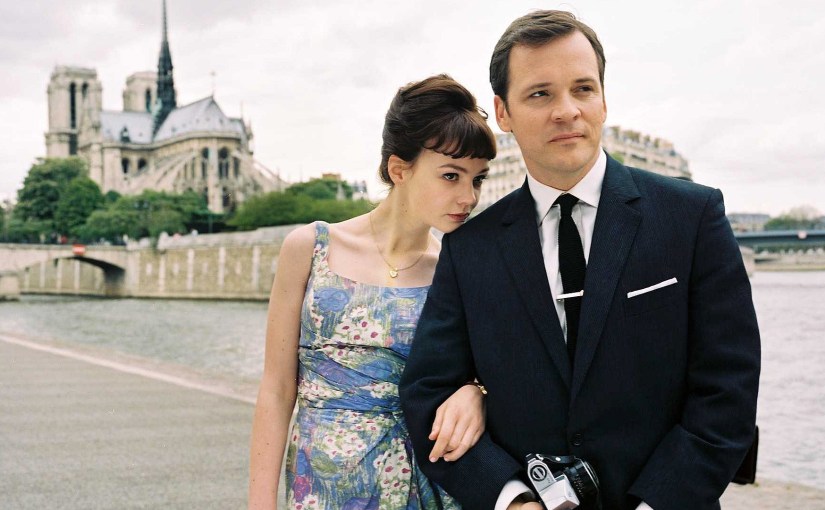
One day, Jenny gets caught in the rain and is rescued by David (Peter Sarsgaard), a charming older man driving an irresistible maroon sportscar.  He isn’t just charming, he’s effortlessly charming, turning the exact right phrases to put Jenny at ease.  The morning after he drives her home, he leaves a bouquet of flowers at her doorstep.  He bumps into her again quite by accident, or “accident”, and asks her on a date for dinner and a concert.  For this, he must convince Jenny’s very suspicious father…which he does with silver-tongued ease.

Jenny is caught up in this whirlwind of attention from a much older man who is clearly well off with sophisticated friends, Danny and Helen (Dominic Cooper and Rosamund Pike).  Jenny’s father, Jack (Alfred Molina), is torn between his protective instincts and the idea that Jenny might have met a man who could make her dreams of Oxford…moot.  Why worry about the expense of university when a rich husband can keep his daughter well cared for?

Despite the father’s (and my own) forebodings, Jenny is genuinely enjoying herself.  She loves music, so David takes her to a concert.  She loves art, so David takes her to an art auction.  She loves learning and speaking French, so David takes her to Paris.  His method of getting Jenny’s father to agree to this overnight trip is simultaneously simple and diabolical.  Jenny is having fun for what seems to be the first time in her life.

She’s having so much fun that, for a while, I wasn’t quite sure what the movie was advocating.  Is it supporting this relationship?  She has a very frank conversation with David regarding her wish to remain a virgin until her seventeenth birthday.  David agrees…then, in one of the ballsiest (and creepiest) moves I’ve ever seen from a guy in a movie, he asks her to give him a “peek.”  What is going on?!?  This guy is clearly a cad.  But he’s so nice to her…and she’s having fun…!

Put it this way: I was prepared to throw something at the television by this point.

Around the midway point, though, the movie finally makes its true purpose known.  It’s not about judging Jenny, which is too easy to do, or even judging David, which is ridiculously easy to do.  The film is based on a memoir by a British journalist named Lynn Barber, which made some of the revelations about David’s past and how he makes a living easier to swallow, knowing that it’s based at least partially on fact.  It also made all the “icky” parts in the first half of the film a little more palatable.  When you realize that someone really went through this, it puts everything in a different light.  I had the same epiphany during Schindler’s List; the concept that this all actually happened brought a deeper level to the viewing experience that I hadn’t expected.  (It’s also what made Fargo so much more entertaining than your average crime film, but that’s another story…)

Anyway, this happens and that happens, and before you know it, Jenny has made the kinds of decisions that would make grown men and women tremble with anxiety. The movie’s title takes on a whole new meaning.  It’s not just about Oxford anymore.  It’s about studying at the University of Life, where the only way to know if you passed your test is if you’re still willing to take the next one, and the next, and the next.  Even David learns a thing or two.  Maybe.  It’s a little inconclusive when it comes to that guy.  What a jackass.

So…is it any good?  Yes, it is.  It’s got brilliant performances working from a Nick Hornby script that switches easily among pathos and embarrassment humor (witness the predicament of Jenny’s other suitor at her 17th birthday party) and even a little suspense.  I tend to think of Hornby as Britain’s answer to Cameron Crowe.  Hornby’s books and screenplays walk that same tightrope time after time (About a Boy, High Fidelity, the original Fever Pitch – soccer, not baseball), just like Crowe’s best work (Jerry Maguire, Say Anything, Almost Famous, which I don’t particularly love, but I do acknowledge its craftsmanship).  By the time I got to the end of An Education, the double- or triple-meaning of the title is fully realized.  Everyone has learned something.  Not all of it has been good.  It doesn’t all tickle.  But, except possibly for David, everyone has taken what they’ve learned, good or bad, and put it to good use.  That’s a satisfying ending.

[Side note: after this movie was over, I found myself thinking of Licorice Pizza and its plot regarding an underage boy and an adult woman. I can imagine my friend and partner-in-crime reading my favorable review above and asking me, “If you like this movie, how can you not like Licorice Pizza?” (He really loved Licorice Pizza.) The difference is that, by the time An Education is over, the characters have EVOLVED. Discuss.]

BEN-HUR (1959)

by Miguel E. Rodriguez

Director: William Wyler
Cast: Charlton Heston, Jack Hawkins, Haya Harareet, Stephen Boyd, Hugh Griffith
My Rating: 9/10
Rotten Tomatometer: 86% Certified Fresh

PLOT: After a Jewish prince is betrayed and sent into slavery by a Roman friend in 1st-century Jerusalem, he regains his freedom and returns for revenge.


For my money, 1959’s record-setting production of Ben-Hur would be a better pick for an annual Easter flick over C.B. de Mille’s overblown The Ten Commandments.  Certainly, Commandments shows the actual story of Passover and might lay claim to more special effects sequences, but Ben-Hur feels grander AND more intimate at the same time.  Plus it actually shows Christ and the crucifixion at the end, and what better symbols could you ask for in an Easter film?

Then, of course, there’s that chariot race.  Game, set, and match.

Ben-Hur was created in an era when Hollywood was watching its profits dwindle because of the advent of television, which was keeping more and more people glued to their sets at home instead of paying for a ticket at the box office.  One way to get people back into theaters was to take the “bigger-is-better” approach: do things that were impossible on a TV budget.

Consider these statistics: Three hundred separate sets were built for Ben-Hur.  The chariot race alone required 15,000 extras on 18 acres of backlot at Cinecitta Studios in Rome and took 10 weeks to shoot.  Over a million props were needed, and it took two years to amass them all before shooting.  Approximately 1.25 million feet of expensive 65mm film was exposed and developed at a cost of roughly a dollar per foot.  The budget for the film ballooned to nearly $15 million, equivalent to over $146 million in today’s dollars, an unthinkable amount in the late 1950s.

But when it was released, Ben-Hur made history by being the first film to win eleven Academy Awards, including Best Picture, Best Director, Best Actor, and Best Supporting Actor.  It remains the only film to date to win Best Picture and Best Visual Effects.  At the box office, it raked in $75 million ($731 million when adjusted for inflation), making it one of the most profitable films in Hollywood history at the time.  It remains popular today, ranked in the IMDb’s top 250 most popular movies and listed as the #2 epic film of all time by the American Film Institute.  (#1 is Lawrence of Arabia, naturally.)

How does a 63-year-old film, with a running time of 3 hours and 42 minutes, with a blatantly religious plotline culminating in the crucifixion of Christ and a shamelessly manipulative miracle, and featuring some of the hammiest acting this side of Bollywood, remain as popular as it is?  Because despite its shortcomings, it does what every film should do, long or short, sacred or secular: it tells a rollicking good story, and it does it extremely well.

After a solemn prologue depicting the first Nativity, we jump forward 26 years and meet Judah Ben-Hur (Charlton Heston), a wealthy Judean prince who enjoys a reunion with his old friend, Messala (Stephen Boyd).  They grew up together but went their separate ways, and now Messala is a Roman tribune assigned to keep the peace in Judea.  Poor Judah realizes just how far they’ve grown apart when an accident leads Messala to arrest Judah and his mother and sister, to demonstrate his power and loyalty to Rome.  Judah vows vengeance and is sentenced to die as a galley slave.  But fate intervenes in the form of Quintus Arrius (Jack Hawkins), a Roman general whose life Judah saves in battle.  Arrius befriends Judah and officially adopts him as his own son, giving Judah the means to return to his homeland, wreak his vengeance upon Messala, and rescue his mother and sister from prison.

…and that’s just Act One.  Act Two focuses heavily on Judah’s revenge in the form of one of the greatest set pieces in Hollywood history: the chariot race.  Or, more properly, The Chariot Race.  If you’ve never seen it, Google/YouTube it.  Even viewed as a stand-alone scene, it is as breathtaking and thrilling as any car chase ever filmed.  It’s so good that George Lucas cribbed many of its beats for the pod-race sequence in Star Wars: Episode I – The Phantom Menace.  The crashes you see during the race were planned, but they were performed with real stuntmen in real danger.  Note especially one sensational stunt where a 2-wheeled chariot drawn by four horses, at full gallop, approach a crashed chariot in their path.  The horses leap the chariot, then the chariot dangerously rolls over the crash itself, hurling the stuntman so high into the air he nearly topples head over heels over the front of his own chariot.  I am at a loss to imagine how they could possibly accomplish this same scene today without the use of visual effects.

Peppered throughout the story are brief scenes featuring Jesus of Nazareth, although we never hear Him speak, and we never see His face.  In Act One, He offers water to Judah as he is being marched to the galleys, a compassionate act that will resonate through the years.  Later He is glimpsed from a distance delivering the Sermon on the Mount.  And later still, we see His trial, His journey to Golgotha, and His crucifixion.  Everyone involved in those scenes show the appropriate and expected levels of awe and sadness, while the score plays a mournful dirge.  It’s a little ham-handed by today’s standards, especially when compared to modern films like The Passion of the Christ, but it is still effective.

The movie’s highest level of filmmaking, apart from The Chariot Race, is on its best display in the first half of the movie.  Nearly two-and-a-half hours fly by, thanks to superb editing.  It’s never boring or soapy.  (Well…ALMOST never soapy.  The requisite love scenes between Judah and the slave girl Esther, played by the lovely Haya Harareet, are not as easy to watch as the rest of the film, but thankfully there aren’t that many of them.)  Every event and every scene feels crucial to the story.  There’s never a moment that drags.  Like the best epic films, watching Ben-Hur makes me feel like I’m reading a richly detailed novel.

If the film has a major downfall, it’s the story that follows The Chariot Race.  The movie doesn’t exactly grind to a halt, but it doesn’t offer the viewer any kind of climactic punches that can match the visceral effect of Judah’s capture, escape, and victory in the race.  (Sorry if I spoiled that for you, but if you seriously thought he lost that race, seek help.)  Sure, there’s the capture and crucifixion of Jesus and the miraculous aftermath, but while that satisfies the true arc of the story, I still, to this day, feel like the film deflates a little at the end.  There’s simply nothing it can offer that could possibly follow up that damn Chariot Race.  The race is the payoff.  Everything that follows feels anti-climactic.

That quibble aside, Ben-Hur is still as captivating as it ever was, with “old” Hollywood’s full power brought to bear to bring audiences a cinematic experience unlike any other at that time.  No matter where you might stand when it comes to its religious overtones, you can’t deny that the movie is exactly as respectful as it needs to be for this story.  And ultimately, the message of the film isn’t “An eye for an eye.”  It’s “Love thy enemy as thyself.”  It takes Judah Ben-Hur a little while to get there.  But he gets there.

THE DARJEELING LIMITED (2007)

by Miguel E. Rodriguez

Director: Wes Anderson
Cast: Owen Wilson, Adrien Brody, Jason Schwartzman, Amara Karan
My Rating: 8/10
Rotten Tomatometer: 69%

PLOT: A year after their father’s funeral, three brothers travel across India by train in an attempt to bond with each other.


In one of the bonus features on the Criterion Blu-ray for Wes Anderson’s charming The Darjeeling Limited, film critic Matt Zoller Seitz compares it to Stanley Kubrick’s 2001: A Space Odyssey because (I’m paraphrasing here) it is the perfect distillation of the director’s method, mood, and style.  I would reserve that distinction for either The Royal Tenenbaums or The Grand Budapest Hotel, myself, but The Darjeeling Limited certainly does capture everything that is typical of a Wes Anderson film: charm, whimsy, troubled souls, a quest of some kind, attention-grabbing camera moves, frequent slo-mo (but not too much), cameos, light and dark material jockeying for position, and a denouement that may signal the end of the film but certainly not the final arc of the main characters.

Meet the Whitman brothers: Francis (Owen Wilson), Peter (Adrien Brody), and Jack (Jason Schwartzman).  A year ago, their father died, and for the first time since that day, they’re about to meet each other and speak to other on board The Darjeeling Limited, a train that will take them across India on a spiritual journey.  Francis, the eldest, is the eager organizer of this little pilgrimage, providing everyone with laminated daily itineraries that are produced by Brendan, his personal assistant who is also travelling in a separate train car.  Francis will spend much of the film wearing bandages on his head and face that make him look as if he lost a fight with a honey badger.  What caused these injuries is not for me to say.

The ostensible reason for this journey is spiritual awakening and reconnecting with each other.  “I want us to become brothers again like we used to be and for us to find ourselves and bond with each other,” says Francis.  Peter and Jack are skeptical and not exactly psyched for this little trip, each for their own reasons.  Peter has a wife back home, 7-and-a-half months pregnant, who has no idea he’s in India.  Jack, a writer, has broken up with his girlfriend, but he obsessively checks her voicemails remotely because he still has the code to her answering machine.  (Hey, this was made in 2007 when you could still do that.)  He has his own return ticket in case he wants to leave the trip early.  Of course, he’ll find that difficult without his passport, which Francis has confiscated.  “For safety,” he argues.  Yeah, right.

There is an ulterior motive for the trip, having to do with who did and didn’t attend their father’s funeral, but ultimately the ins and outs of the characters, while engaging, kind of take a back seat to the trademark Wes Anderson visual style.  This is not a bad thing.  I am not a fan of Anderson’s first film, Bottle Rocket, because I felt it was all posturing with no meat to the story.  However, with each successive film of his, I become more and more endeared and captivated with his trademarks, especially when he uses it to tell stories that I would never have thought would “mesh” with his style.

For example, near the halfway point of the film, an extremely unexpected crisis occurs.  Because the movie has been happy and bouncy and witty up to now, it comes completely out of left field.  But remarkably, in the middle of this action, Anderson’s camera remains as “Anderson-esque” as ever, still performing quick pans and push-ins and keeping me involved in the story.  This crisis might have felt contrived in another film, a plot device to inject some needed drama into the story.  Not here.  Anderson’s storytelling methods made the event feel as random as anything life might throw at us on any given day: the death of a parent, the birth of a child, a snake getting loose in your train compartment, etcetera.

With one or two obvious exceptions (I think), the entire film was shot in India.  The trusty IMDb trivia page informs me the train scenes themselves were filmed inside a moving train travelling from Jodhpur to Jaisalmer.  The beautiful Indian locations are a major feature of the film.  They visit temples, marketplaces, a monastery, and hilltops overlooking vast Indian vistas.

And all the while, Francis, Jack, and Peter struggle to come to grips with their differences and their brotherhood.  “I wonder if the three of us would’ve been friends in real life,” Jack asks at one point.  Great question.  Given what we see in the film, it’s sometimes hard to believe they ever loved each other.  At one point, Francis and Peter get into a wrestling match and Jack has to step in: “I love you, but I’m gonna mace you in the face!”  That’s real love right there.  Right?  I guess…

I’ve heard that if you’re ever not sure what a book or a movie is about, just look at how a character has changed at the end of the story as opposed to what they were like at the beginning.  In The Darjeeling Limited, that’s not so easy to pin down.  I can see that Francis has grown a bit (he eventually relinquishes his brothers’ passports).  But when it comes to Jack and Peter…I’m not sure much has changed with them at all.  Does that make this Francis’s movie through and through?

I’m not sure it matters.  I mean, yes, the story is fun to watch, and I wanted to see where this journey would lead each one of the three brothers.  But for me, the element, or factor, or whatever, that makes The Darjeeling Limited so fun to watch is the directorial style of Wes Anderson.  In this film, as in so many of his films, it’s not about the destination.  It’s about the journey.

[Trivia note: the Criterion Blu-ray also contains a short film called Hotel Chevalier which is intended as a kind of prologue to The Darjeeling Limited.  Don’t make the mistake I did…if you get the Blu-ray, be sure to watch the movie with the prologue.  Don’t wait until after watching the main feature.]

[Super-nerdy trivia note: every musical cue in the film was cribbed from the early films of James Ivory and Satyajit Ray; Wes Anderson wanted to pay tribute to the filmmakers who influenced so much of his style.]

ELEVATOR TO THE GALLOWS (1958, France)

by Miguel E. Rodriguez

Director: Louis Malle
Cast: Jeanne Moreau, Maurice Ronet, Georges Poujouly
My Rating: 10/10
Rotten Tomatometer: 93% Certified Fresh

PLOT: A married woman and her lover hatch an apparently foolproof plan to kill her husband (his boss), but a split-second decision at a crucial moment sends everything into a tailspin.


We plan, God laughs. – old Yiddish proverb

Let me get this out of the way right at the top: Elevator to the Gallows is one of the best crime drama/thrillers I’ve ever seen.  It holds its own against anything by Hitchcock or Clouzot.  With admirable focus and restraint, first-time director Louis Malle (My Dinner with Andre, Vanya on 42nd Street) crafts a gripping illustration of how the best laid plans can fall apart because of one minor miscue.

The film cuts right to the chase at the opening scene, showing a phone conversation between Florence Carala (Jeanne Moreau) and her lover, Julien Tavernier.  They discuss their plans for Julien to kill her husband in his office on a Saturday evening, after which he’ll pick her up at a café where she’ll be waiting, and that will be that.  Everyone will assume her husband is in Geneva on business, and no one will discover the murder, which Julien will arrange to look like a suicide, until Monday morning, giving Florence and Julien plenty of time to make their escape.

(I liked how we never got any flashbacks of the relationship between Florence and Julien.  All we need to know is, they’re lovers, they’re desperate enough to commit murder, and that’s it.  Very concise.  I love it.)

Julien’s plan involves using a grappling hook to avoid using the office elevator to get to his boss’s office one floor above his.  He proceeds with the plan, nearly getting caught in the process, but he’s able to commit the crime and leave the building with several witnesses as an alibi, witnesses who will say they never saw him enter his boss’s office before he left.  So far so good.

Julien gets to the street, takes the top down from his convertible, takes one last look back at the building…and realizes he left a vital clue in full view of any pedestrian or street cop.  Leaving his car running, he decides to run back into the office building and retrieve the evidence before the night guard shuts off the power for the night.

Unnoticed by Julien, a florist and her bad-boy boyfriend have been having an argument at the shop next to his car.  The boyfriend sees this rich man leave his convertible on the street…with the engine running…

Thus begins a Hitchcockian odyssey that leaves Julien stranded in an elevator, his car and his identity stolen, and his mistress stranded on the streets wondering where the hell her lover is.  At one point, Florence sees Julien’s car drive by the café where she’s waiting…she can’t quite make out the driver, but who is that girl in the car with him?!  Has she been betrayed at the last minute?

The film follows the younger couple, Louis and Véronique, as they tool around in Julien’s car, eventually winding up at a roadside motel, and unwittingly making friends with two German tourists.  They even share drinks with the Germans and take some candid photos using a little spy camera in Julien’s raincoat.  (We learn that Julien was in the Foreign Legion and was well-trained as a soldier – maybe even in spycraft.)  I found myself wondering why we were wasting time with this larcenous couple…until they decide to check into the motel as Mr. and Mrs. Tavernier to cover their own tracks.

The screenplay ingeniously heaps one hasty decision on top of another so that, just when it seems Julien might be in the clear, something else happens that makes it seem impossible he won’t be discovered or at the very least blamed for something he didn’t do.  Meanwhile, Julien is desperately trying to escape the elevator, using a penknife as a screwdriver, getting excruciatingly close to tripping a vital switch that’s just out of his reach.  He eventually tries to get out using the old climbing-the-cable trick…which is of course exactly when a night watchman is making his rounds.

This story is so good, I can’t believe there hasn’t been an American remake.  And it’s not like there aren’t other great films out there that cut right to the chase and never look back for flashbacks or additional material.  I’m not sure what makes Elevator to the Gallows so good, to be honest.  Maybe I was rooting for Florence and Julien when they are clearly not the good guys.  Maybe it’s the economy of the storytelling, or the screw-turning twists that lead the police to believe Julien has committed more than one murder.  At one point, Louis and Véronique make a startling decision that had me yelling at the screen.

Words fail me on this one.  I can’t describe it any better than by saying this is one of the best films I’ve ever seen, certainly one of the best film-noirs I’ve ever seen, and a movie that I’ll bet Hitchcock watched while thinking to himself, “Damnation…I wish I’d thought of that.”

BRUTE FORCE (1947)

by Miguel E. Rodriguez

Director: Jules Dassin
Cast: Burt Lancaster, Hume Cronyn, Charles Bickford, Ann Blyth
My Rating: 9/10
Rotten Tomatometer: 94%

PLOT: A convicted felon tries to organize a prison break under the nose of a sadistic chief guard who is on the verge of becoming the new warden.


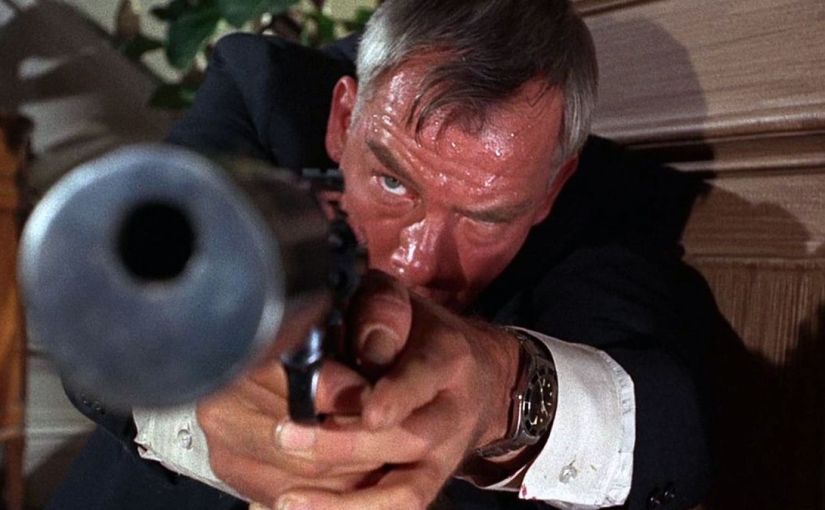
In Brute Force, released seventy-five years ago, we are witness to: a man getting crushed by a metal press, a suicide, a brutal interrogation with the help of a length of metal pipe, a prisoner machine-gunning dead cops out of sheer frustration (okay, you got me, that part is off camera), and the kind of nihilistic ending that you typically only see in old French films.  Wages of Fear, for example.  I mean, this movie is violent by TODAY’S standards, let alone just a couple of years after World War II ended.

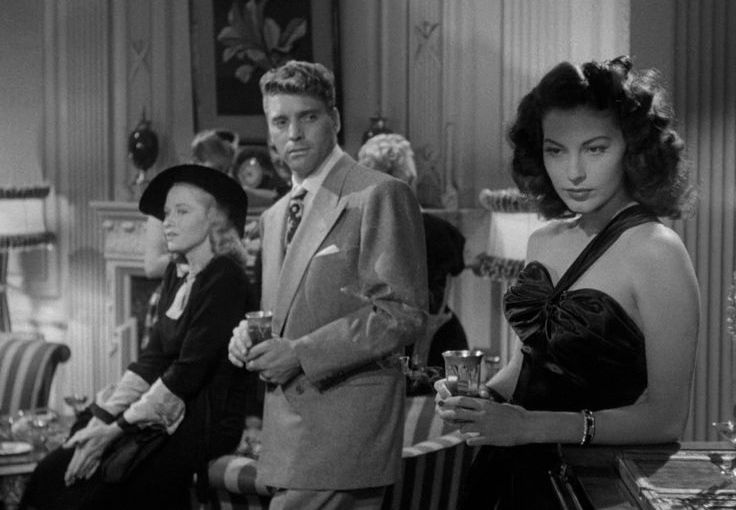
Joe Collins (Burt Lancaster in only his second film) is just getting out of solitary confinement at Westgate Penitentiary when he sees one of his cellmates being driven out of prison…in a hearse.  This only solidifies his resolve to escape with the help of his remaining cellmates.  Meanwhile, we get glimpses of life elsewhere in the prison.  The current warden is a trembling coward who addresses the prisoners only through a P.A. system in his office.  The prison physician, Dr. Walters, sees injustice and top-down barbarism on a daily basis and has his own method of escape: whiskey.  Inmate informants and stool pigeons are dealt with promptly and carefully.

Looming above everyone, despite his relatively small stature, is Captain Munsey (Hume Cronyn).  He has the real power at Westgate.  He rarely raises his voice and even stops his lieutenant from beating a prisoner unnecessarily.  But he unflinchingly doles out punishments and even strong-arms other convicts into ratting out their buddies.  Of course, the stoolies are usually found out and wind up dead.  Shame about that.

The crux of the story is the escape plan, an ambitious endeavor involving capturing the yard tower which controls the gate and lowers the drawbridge – an actual drawbridge! – to the mainland.  Between making these plans and various other intrigues involving the warden and an imperious visiting government official, we are also treated to flashbacks showing how some of Joe’s cellmates wound up in prison to begin with.  Here the film gets a little overly melodramatic, a typical trait of many dramas of the ‘40s, but director Jules Dassin wisely doesn’t dwell on them for too long.  The scenes do just enough to create more audience empathy for these “bad men” without bathing in soap.

I put “bad men” in quotes because these guys are, in fact, criminals, but they’re also our protagonists.  When it comes to Joe himself, it seems clear by his demeanor and his flashback that he wasn’t just a criminal, he was a leader of criminals, head of his own little gang.  This is not a very nice man.  The only convict sharing a cell with Joe who might conceivably be considered a “good guy” is Tom, a man who embezzled money from the company he worked for to buy his frustrated wife a fur coat.  Everyone else looks capable of perpetrating real violence.

Why do we root for these men?  Partly because it’s in our nature to support anyone who is out to give authority figures the finger.  From Cool Hand Luke all the way to Hannibal Lecter and beyond, we are instinctively drawn to men and women who are bucking the system.  But it’s especially prominent in this movie where we see these men at the mercy of a broken system that eventually revokes all their privileges, even visiting hours, in the name of restoring discipline.  Armed guards watch the prisoners everywhere, even in the chapel.  There is no longer any attempt at actual rehabilitation.  In the prison’s auto garage, a prisoner is asked what he’s learned while working there.  His answer: “I’ve learned that, when I get out, I don’t wanna be a mechanic.”  He hasn’t learned anything.  He’s just learned that it’s better to not get caught.  For this we pay our taxes?

So, yes, there is a strong message in Brute Force.  It’s not especially subtle, especially during the liberal Dr. Walters’ various monologues about the corrupting nature of power and the futility of expecting lasting behavioral changes through punitive measures.

But what stood out to me was the unexpected level of violence in the story.  Sure, some of it is discreetly left off screen, but what is left to the imagination can be infinitely worse than what the screen shows us.  Case in point: Se7en, where we are always shown murder scenes, never the murders themselves.  Or the infamous ear scene in Reservoir Dogs, where we never actually see the deed being done, yet it’s remembered as one of the most violent scenes in film history.

In Brute Force, during an interrogation, we see Captain Munsey winding up to deliver several blows with a lead pipe to the head of a handcuffed prisoner.  We push past the prisoner, so we only see Munsey, and down comes the first blow.  We hear the impact, then cut to just outside Munsey’s office where other officers are killing time playing cards or writing reports.  And through the doorway we hear more impacts, one after the other after the other.  Some officers look uncomfortably toward the office but make no move to stop what’s happening in there.  One officer is so disturbed he throws down his cards and stalks away.  Right away, we’re thinking, jeez, if HE’S that upset, something terrible is going on in that office.

This is not the kind of “realness” I was expecting from a 1947 film.  And it doesn’t end there.  There are other little vignettes of violence during the climactic escape attempt that made me gasp, including a hand-to-hand fight where one guy appears to be getting hit in the head and neck with a belt of machine gun bullets…for real.  At least twice.  Looked convincing to me, anyway.

Jules Dassin (1911-2008) is known for directing some of the best loved film noirs of all time, including The Naked City [1948], Night and the City [1950], and Rififi [1955], which won him the Best Director award at Cannes that year.  His best films are steeped in atmosphere and a fatalistic sense of…well, fate, an idea that no matter how hard we kick and scream at the walls of our existence, any attempts to escape will be met with massive resistance and will most likely end in failure, or at best only a partial victory.  Not a particularly uplifting outlook, but who says all movies must have a happy ending?  Sometimes you get the bear, sometimes the bear gets you.  By the end of Brute Force, Dassin ingeniously combines those two outcomes.  Tricky.

TURNING RED (2022)

by Miguel E. Rodriguez

Director: Domee Shi
Cast: Rosalie Chiang, Sandra Oh, Wai Ching Ho, James Hong
My Rating: 10/10
Rotten Tomatometer: 95% Certified Fresh

PLOT: A 13-year-old girl named Meilin wakes up one morning with the rather inconvenient power to turn into a giant red panda whenever she gets too excited.


Disney/Pixar’s Turning Red is one of the best, funniest animated movies I’ve seen since Inside Out.  Or The Lego Movie.  Take your pick.

If you’ve seen the trailer, you know the plot.  A 13-year-old Chinese-Canadian girl named Meilin [may-LINN] discovers one day she has the (inconvenient) ability to turn into a giant red panda.

Details: Meilin’s relationship with her mom, Ming (Sandra Oh), is complicated enough without this new tangle.  Ming encourages Meilin to excel at everything and has enlisted her help with running and maintaining a small Chinese temple devoted to an ancient ancestor of theirs who supposedly channeled the power of the red panda to defend her children thousands of years ago.

When Meilin learns to control her newfound power to a certain degree, she decides to use it, not to fight crime, but to earn some money to buy a ticket to see this awesome boy band, called 4Town (even though they have five members), with her three besties.  Like, Oh.  Em.  GEE!

Complications ensue, Meilin tells a crucial, heartbreaking lie at one point, and previously unsuspected powers are unleashed.  That’s all you’re getting out of me, story-wise.

While the story was great, and worthy to stand with Pixar’s finest films, what made Turning Red stand out for me was the humor.  It is just plain laugh-out-loud funny.  I was laughing through almost the entire movie.

Through a completely believable misunderstanding, Meilin’s mom, Ming, thinks she knows what’s behind Meilin’s strange new behavior and asks her, ever so delicately, “Did the scarlet peony bloom?”  There’s a brilliant moment when Ming chases Meilin to school and, in front of an entire classroom, holds up an item she forgot to pack in her bag: a box of pads.  That’s right out of a John Hughes movie, man!  I laughed like a maniac.

Meilin’s three friends are a treat, especially the little spitfire named Abby, whose face seems to be permanently stretched into a fierce scowl.  There’s a moment when she catches one of those red playground balls with her teeth.  Maybe SHE’S the monster.

As with all the best Pixar films, though, the humor, as effective as it is, is just window-dressing for the real thrust of the story.  The exploration of the mother-daughter relationship hasn’t been done this well since Brave.  And I’ve gotta say, it was refreshing to see how real the character of Meilin was.  Because she’s rooted in the real world (of 2002 Toronto), her attitude felt more authentic somehow.  Sure, in Brave, Merida had the same rebelliousness and determination to forge her own path despite an imposing mother figure.  But with Turning Red, everything was more grounded.

There’s a moment when Meilin has turned into a panda and is running down a city street trying to hide.  She passes a convenience store where a cute guy works the counter.  She is desperate to get out of sight…but she stops just long enough to glance through the window at the cute guy, stomp her foot like Thumper, and yell, “Ah-OOO-gah, ah-OOO-gah!”  Another big laugh.  And I thought to myself, “See, that’s normally what you would see GUYS do in a movie.  Who makes a Disney film about a girl obsessed with boys?  What a treat!”  (I know, I know, the early Disney princesses weren’t exactly models of modern feminism, I’m talking about more recent films, stay with me here…)

Naturally, there’s a lot of symbolism with Meilin being thirteen, coming of age, and suddenly going through all sorts of changes.  What’s great about the storytelling is that the symbology is secondary, at least initially.  There’s the usual very well-executed denouement where all the emotional threads come together.  But before we get there, it’s just a story about a young girl with a weird problem.  And I have to say again, it is doggone FUNNY.

I took a glance at the “rotten” reviews at rottentomatoes.com, and I kept seeing one repeated phrase among several of them: the lead character was “irritating.”  I am at a loss to explain this point of view.  Meilin is a 13-year-old girl.  Of COURSE, she’s irritating.  AND obnoxious.  What were you expecting?  Meilin is endearing precisely because she’s portrayed as someone who isn’t perfect, even though she’s trying hard to be.  She lies to her parents.  When she has to think of something to calm herself down, she doesn’t think of her mom…she thinks of her best friends.  She feels bad about it, but what are you gonna do, she’s thirteen.

Further pontificating from me seems pointless.  Take it from a lifelong Pixar fan.  Turning Red is one of their finest moments.  It’ll make you laugh, and if you’re not careful it’ll make you cry.  It might make you remember what it was like to scream like crazy at a rock concert.  It’ll make you remember your first real best friends.  And it’ll make you wonder why more people don’t make movies like this.  Because they should.

GREAT EXPECTATIONS (1946, Great Britain)

by Miguel E. Rodriguez

Director: David Lean
Cast: John Mills, Valerie Hobson, Jean Simmons, Martita Hunt, Alec Guinness
My Rating: 8/10
Rotten Tomatometer: 100%

PLOT: A humble orphan boy in 1810s Kent is given the opportunity to go to London and become a gentleman, with the help of an unknown benefactor.


Before moving on to full-blown epics like Lawrence of Arabia and Doctor Zhivago, Sir David Lean’s reputation was already assured with his small-scale masterpieces like Brief Encounter [1945], Oliver Twist [1948], and Summertime [1955], one of the finest Katharine Hepburn films you’ve probably never heard of.  Among these little gems is another Dickens adaptation, Great Expectations [1946], co-starring an impossibly young Alec Guinness.

Having never read the source novel nor, in fact, seen any of the other adaptations (there are at least five others, according to IMDb), I was able to go in “cold” with no preconceived notions or, ahem, expectations of my own.  What I found was a surprisingly engaging melodrama full of gothic overtones and the kinds of coincidences and contrivances that are rife in Dickens’ literature.  Yet they do not feel like contrived literary devices.  They feel like the kinds of coincidences, large or small, that populate our ordinary lives.  (I’ll bet the narrator at the beginning of Magnolia LOVED Dickens.)

The movie opens with a young boy, Pip, visiting the graves of his mother and father.  These opening scenes set the tone: dark skies, bare trees creaking in the incessant wind, and an unexpected encounter with an escaped convict who demands food and a file, for the shackles still hanging from his wrists.  Pip is terrified and complies.  Later the convict is captured and has the opportunity to give up Pip as one who aided a criminal, but in an oddly moving scene, he merely says he stole the food with no one’s assistance.

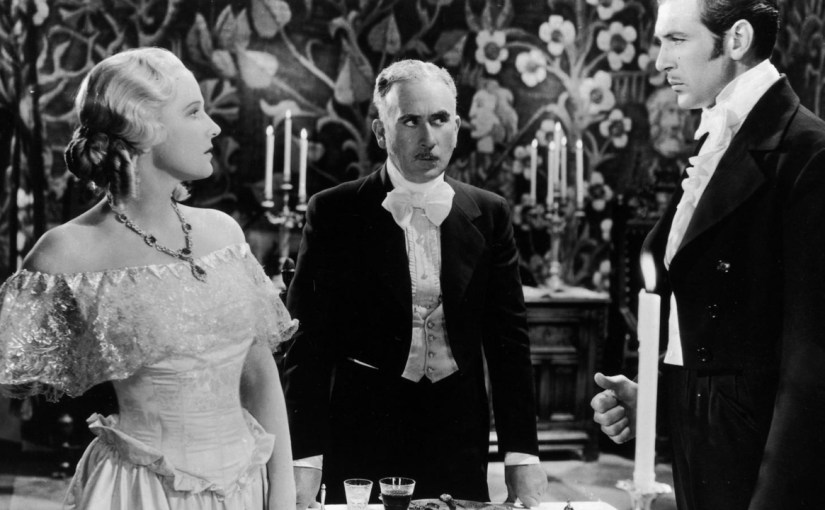
Later, Pip is introduced to the lovely young Estella (Jean Simmons in one of her earliest roles), who lives in a sprawling, decaying mansion owned by the eccentric old Miss Havisham (Martita Hunt).  Miss Havisham has summoned/hired Pip because it amuses her to watch children play, but more importantly because it also amuses her to watch Estella flirt with and continuously berate Pip as being a commoner, a blacksmith’s son, and someone who is otherwise unworthy of Estella’s affections.  The reasons for Miss Havisham’s cruel games may be guessed at by the dilapidated state of the wedding dress she wears day and night and by the crumbling, molding wedding cake sitting on a cobwebbed banquet table.  (Miss Havisham’s mansion is one of the creepiest gothic locations I’ve ever seen.  I half-expected the story to take a macabre turn, a la Edgar Allen Poe, with a deserting bridegroom rotting away under the floorboards or something.)

Time passes, and in the first of those melodramatic contrivances of which Dickens is so fond, Pip is granted the chance to go to London to become a gentleman.  His livelihood will be sponsored by a handsome annual stipend from an anonymous benefactor through a corpulent attorney named Mr. Jaggers.  (Dickens has some of the greatest character names in literature: Jaggers, Magwitch, Herbert Pocket, Uncle Pumblechook, Mrs. Whimple…I love it.)  Pip enters this new stage of his life assuming, as we all do, that his anonymous benefactor is none other than Miss Havisham.  Makes sense, right?

Through the course of this second act, Pip falls in love with the beautiful but heartless Estella, who warns him she has no heart and only seeks to conquer and discard her many suitors.  This is her way of expressing genuine affection for Pip.  Would Pip rather she do the same to him?

He also meets and befriends his London roommate and business partner, Herbert Pocket, played by an inconceivably young Alec Guinness in his first major screen role.  This was, as they say, the beginning of a beautiful friendship, leading to collaborations between Lean and Guinness on The Bridge on the River Kwai, Lawrence of Arabia, and Doctor Zhivago, not to mention Guinness’ very next role as the odious Fagin in Lean’s own version of Oliver Twist.

The rest of the story, involving Jaggers’ mysterious maid, a test of Pip’s loyalty, the identity of his benefactor, and the wholly unforeseen fate of Miss Havisham, I leave for you to discover.  It all ends, it seemed to me rather abruptly, but it is satisfying.

To fans of Lean’s more ambitious films, a small film like this one hardly seems as if it were made by the same director.  In today’s terms, it might be like watching a small character-driven film made by the Russo brothers (Avengers: Endgame, Captain America: Civil War, etc.).  In his Great Movies Review for this film, Roger Ebert points out the difference between these two stages of Lean’s directing style:

“[Lean] was an editor for seven years before directing his first film, and his career stands as an argument for the theory that editors make better directors than cinematographers do. …What the earlier films have is greater economy, and thus greater energy, in their storytelling.”

Indeed, Great Expectations hurtles along breathlessly, not as quickly paced as a Marx Brothers comedy, but certainly without wasting a single moment on anything that is not necessary to move the story along, or at least provide just a small dash of character or color to the proceedings.  (One of my favorite small touches was the gruesome death masks hanging on the wall of Mr. Jaggers’ office.  For me, it was a kind of foreshadowing, alluding to the possible fate of the convict Pip encountered at the beginning of the film.) In his later epics, Lean’s pacing slows down in favor of presenting the viewer with grand desert or mountain vistas, so instead of watching a play, it feels like we’re at a museum. This isn’t a bad thing. It’s merely a different style of storytelling.

There is another, perhaps more famous, adaptation of Great Expectations out there, by the famed Mexican filmmaker Alfonso Cuarón, starring Ethan Hawke, Gwyneth Paltrow, and no less than Anne Bancroft as Miss Havisham, renamed Ms. Dinsmoor in this version.  It was updated to present day, some other character names were changed, and it is supposedly drenched in atmosphere.  I have yet to see it.  Until I do, Lean’s early masterpiece will remain my favorite version of this timeless tale, abrupt finale and all.

HOUSE OF GAMES (1987)

by Miguel E. Rodriguez

Director: David Mamet
Cast: Lindsay Crouse, Joe Mantegna, J.T. Walsh, Ricky Jay
My Rating: 8/10
Rotten Tomatometer: 96%

PLOT: A psychiatrist is led by a smooth-talking grifter into the shadowy but compelling world of stings, scams, and con men.


I’m sitting here trying to figure out how to summarize the story of David Mamet’s House of Games without giving away plot points, and it’s virtually impossible.  Mamet’s screenplay is composed almost entirely of double-crosses, triple-crosses, short cons, long cons, and the kinds of surprises that are greatly diminished in their description.  Remove one surprise, and the whole thing collapses like a house of cards.

A distinguished psychiatrist, Margaret Ford (Lindsay Crouse) pays a visit to a handsome con artist, Mike (Joe Mantegna), on behalf of one of her clients, who is distraught because of how much money he owes to Mike.  Dr. Ford is unexpectedly intrigued by Mike’s business methods, Mike senses this, and takes her to a back room where he and some other gentlemen are playing poker.

(These men don’t talk much, but when they do, it’s almost exclusively in poker patter.  “A man with style is a man who can smile.”  “Damn cards are as cold as ice.”  “The man says you gotta give action to get action.”  “Everybody stays, everybody pays.”  It’s like they learned how to talk from watching endless episodes of the World Series of Poker on ESPN2.)

Mike makes a deal with Margaret: if she helps him beat the hot player (Ricky Jay) at the table, he’ll tear up her patient’s marker.  The hot player has a tell when he’s bluffing.  Mike will go to the restroom.  If the hot player shows the tell, Margaret will tell Mike, and Mike will beat him because he’ll know he’s bluffing.  Mike goes to the bathroom, the hot player reveals his tell, and Margaret tells Mike when he comes back.  The hot player raises the pot, but Mike can’t cover it.  Margaret comes to the rescue: she’ll stake Mike with her own money.  But, uh oh, turns out the hot player wasn’t bluffing…and now Margaret owes $6,000 to a total stranger.

And that’s where I have to stop. If you think I’ve given too much away, you’ve got to trust me – I haven’t.  That’s barely the preface.  What follows is a character study of a woman who suddenly realizes that, after a lifetime of helping patients, she needs some kind of release, a change in routine.  Mike can provide this much-needed change.  The fact that it involves conning innocent people out of their hard-earned money is incidental.

Her fascination lies in Mike’s method.  For a great con to work, you can’t take someone’s money.  They have to give it to you.  They have to trust you to do the right thing.  The trick is working out how to gain the other person’s confidence without them realizing what’s happening.  We are shown two or three examples, and they’re all brilliantly sneaky.  At one point, Mike tells Margaret the cardinal rule of the con: “Don’t trust nobody.”  After watching this movie, I can’t say I agree 100% with this credo, but a healthy dose of skepticism never hurt anybody.

So how does Margaret square that credo, or anything about Mike’s lifestyle, with her profession?  She helps people for a living.  Her livelihood depends on getting strangers to trust her, but not to take their money…although let’s not forget she is well paid for her services.  Is her fascination with Mike an acknowledgement of the similarities between the two of them?

The screenplay doesn’t provide easy answers.  When we get to the final shot of the film, we can clearly see the choices Margaret has made, but it’s still unclear as to why she made them.  This is one of those movies where the complexities only really come alive during lively discussions afterwards.

Before watching it for this review, the last time I had seen House of Games was over thirty years ago.  At the time, I was unimpressed.  I originally gave it a 2 out of 10 on the IMDb website.  It was slow, the actors looked like they were giving bad performances, and nobody talked like real people talked.

Since then, I’ve had the opportunity to see not one, but three films by a French director named Robert Bresson.  (Bear with me here, I do have a point.)  Bresson, who was active mainly in the ‘50s and ‘60s, was famous for his method of shooting scenes over and over again, take after take, until all emotions had been drained from the actor.  His philosophy, in a nutshell, was that, in a film, the story isn’t everything, it’s the only thing.  If a screenplay couldn’t carry an emotional impact just by virtue of the story alone, if he had to rely on someone’s specific performance to make the movie work, he wasn’t interested.  The results are films that are curiously compelling, despite their utter lack of anything modern audiences might recognize as a typical acting performance.  His films are routinely included on the most prestigious lists of greatest films ever made; seven of them made it onto the 2012 critics’ poll by Sight & Sound magazine, a feat unequaled by any other director.

Sitting down to watch House of Games for the first time in three decades, after having seen Bresson’s films for the first time, I think I see what David Mamet was going for, in this, his directorial debut.  The actors aren’t quite dead-panning the entire time, but their performances (with one or two necessary exceptions) are pared down to the bare minimum of emotion.  Vocally, they’re angry, curious, flirtatious, what have you.  Facially, they’re ciphers.  Which, if you’re a good con man, that’s exactly what you want to be: a blank slate for the unlucky mark to interact with, then forget immediately.

I think back to those poker players and their mournful aphorisms, always said in nearly monotone.  And then I think to the film’s finale when Margaret believes she might be able to turn the tables on Mike (long story), and as the frantic words come out of her mouth, there’s not a smidgen of emotion on her face.  Like…a poker player.  Neat.

ALL ABOUT MY MOTHER (1999, Spain)

by Miguel E. Rodriguez

Director: Pedro Almodóvar
Cast: Cecilia Roth, Marisa Paredes, Penelope Cruz, Antonia San Juan
My Rating: 8/10
Rotten Tomatometer: 98% Certified Fresh

PLOT: A single mom fulfills her son’s last wish by going on a search for her estranged husband, whom she has not seen since before her son was born.


Whatever you might think personally of director Pedro Almodóvar’s films, you can’t say he doesn’t have range and/or versatility.  In one of his previous films, Women on the Verge of a Nervous Breakdown [1988], he takes potentially dark material (a suicidal woman’s quest to find out why her lover abruptly left her) and turns it into farce (police officers accidentally eat drug-laced gazpacho intended for another suicide attempt).  In All About My Mother, winner of 1999’s Oscar for Best Foreign Film, Almodóvar takes potentially farcical material (a mother searches for her estranged husband, who happens to be a transvestite named Lola, and makes friends with a pregnant nun) and turns it into solid, albeit soapy, melodrama that is rather unique in its matter-of-fact treatment of its transvestite characters and situations.

Manuela (Cecilia Roth), a single mother and part-time actor, takes her teenaged son, Esteban, to see a local production of A Streetcar Named Desire in Spanish.  (The night before, they watched All About Eve together, so she’s clearly teaching him right.)  Esteban is so taken with the performance of Huma Rojo (Marisa Paredes), the lead actress playing Blanche, that he waits outside the stage door to get her autograph.  Huma absently gets in a cab and drives away, Esteban runs after her, and is struck dead by a car in traffic.  In a scene of poignant irony, Manuela must sign some official forms to release her son’s body as an organ donor, just days after portraying a grieving mother in a hospital video about…becoming an organ donor.

Manuela discovers her son’s journal in which he is literally writing all about his mother, and he mentions his sadness because he never knew his father, and his mother has told him nothing about his father his entire life.  So begins her quest to locate the long-lost father, whom she refers to as either Esteban or Lola, depending on the context.

After she travels across Spain to Barcelona, her first encounter is with an old friend, a transvestite hooker named Agrado, which roughly translates to “liking” or “agreeable.”  Agrado helps Manuela find a job through the social services of a nunnery, where they meet Rosa (Penelope Cruz), a nun dedicated to assisting hookers of all sorts escape their scandalous lives and find wholesome work elsewhere.  Rosa talks about leaving soon to go to El Salvador to assist in similar work there…but alas, she soon finds out she is pregnant herself.

Meanwhile, Manuela also connects with Huma, the actress whose autograph her son was seeking.  Soon she is hired as an assistant and even, through circumstantially suspicious events, manages to appear onstage as an emergency substitute for Nina, the actress portraying Stella, who is also having an on-again/off-again fling with Huma…

And so on and so on.  At times, All About My Mother feels a little too much like a telenovela, those famous Spanish-language soap operas whose plotlines pack more melodrama into one episode than Dynasty did in an entire season.  But as wacky as the situations got, the movie never gets out of hand, so to speak.  It never wallows in the trashy elements, like a John Waters or Russ Meyer movie, for example.  It simply presents the situations, and the characters face it, deal with it, and move on with their lives.  If I find the situations trashy or overly sensational, that’s my problem, at least in Almodóvar’s world.

That’s one of the charms of this film.  There is a running gag where Agrado, the transvestite hooker – pre-op, by the way – gets hit on by both men and women, and neither gender seems to care about her seemingly incompatible sets of equipment, if you get my drift.  (The guy even offers to do to her what she would normally do to him.  I don’t remember the exact line, but at one point the guy says something like, “Hey, if you think it will relax me, I’ll try anything.”)  In virtually any other movie, that scene would be milked for laughs, or it might be the defining scene for the Agrado character.  But instead, it showcases the…I’m not sure what word I’m looking for here…the “non-issue” attitude that everyone in the movie has to transvestites, gays, lesbians, or any other sexual orientation that might otherwise be a distraction in most American films.  Manuela’s husband is himself a transvestite hooker.  Okay, she accepts it, everyone accepts it, even Rosa the pregnant nun accepts it, and let’s get on with the story.

There is a remarkable scene where Agrado has gotten a job as an assistant to Huma, the actress, and for various reasons a performance has to be cancelled.  Agrado goes in front of the curtain, informs the audience, and offers to tell her life story as compensation for anyone who wants to stay.  She proceeds to itemize every bit of cosmetic surgery she has had done to herself in the past few years in order to become…herself.  Eyes, nose, breasts, jaw reduction…all so she can be more authentic.  “And one can’t be stingy with these things, because you are more authentic the more you resemble what you’ve dreamed of being.”

And then the movie moves on.  It’s a bravura moment that might have been the centerpiece of another film, but in this one, it’s just a dash of character color that deepens everything around it.

I should also mention the lighting style throughout nearly the entire film.  On a few occasions, we are treated to scenes from that stage production of Streetcar, and we clearly see the theatrical lighting.  But in many, if not ALL interior scenes throughout the rest of the movie, the lighting is roughly similar to that of a stage production, or maybe a TV production.  Nothing is lit like I have come to subconsciously expect.  Instead, it all has a kind of heightened reality to it, or maybe “un-reality”, which paradoxically makes it more engaging to watch instead of being distracting.  I think I’m being a little contradictory, but it’s the best description I can provide.

Pedro Almodóvar has been directing shorts and feature films since 1974 and shows no signs of slowing down.  I can’t promise I’ll eventually watch everything he’s ever done, but of the two films of his I’ve seen, this one is my favorite so far.  There’s an abundant love of theater, theatricality, and especially for his characters in his work.  You or I may not like all of them, but he doesn’t seem to care.  Almodóvar seems to be arguing there is humanity in everyone, not exactly a groundbreaking message, but certainly one that was still not widely accepted, even as recently as 1999, and even less so today, unfortunately.  He’s saying, “Look at someone, and don’t see their differences.  See them.  And get on with your life.”

ARRIVAL (2016)

by Miguel E. Rodriguez

Director: Denis Villeneuve
Cast: Amy Adams, Jeremy Renner, Forest Whitaker, Michael Stuhlbarg
My Rating: 9/10
Rotten Tomatometer: 94% Certified Fresh

PLOT: When 12 alien spacecraft descend to Earth at seemingly random points around the globe, a linguistics expert (Adams) is recruited to interpret the aliens’ speech in order to find out why they are here, among other things.


“If you could see your whole life from start to finish, would you change things?” – Louise Banks (Amy Adams), Arrival

That seemingly simple question lies at the heart of Denis Villeneuve’s sci-fi brainteaser, Arrival.  Surrounding it is a film of uncommon grace, beauty, and intellectual stimulation that deserves comparison to Kubrick’s 2001 or Tarkovsky’s Solaris.  When I first saw it in 2016, I’ll admit to some slight confusion at the end, but after many repeat viewings, I believe I understand it fully enough to call it a masterpiece.

After a prologue where we witness a montage of her losing a daughter to an unnamed but ravaging disease, we see Dr. Louise Banks (Amy Adams) teaching linguistics at a university.  Classes are interrupted when news breaks of not one, but TWELVE alien spacecraft suddenly appearing at random points around the globe.  Eventually, the military contacts her and reveals that contact has been made between us and the aliens, but to say we can’t comprehend their language is an understatement.  She and a top-notch mathematician, Ian Donnelly (Jeremy Renner) are flown to the US sites in Montana and are given an impossible task: decipher the alien language and ask them why they’re here.

The design of the aliens and their ship are visual masterstrokes.  The ship, in fact, bears a striking resemblance to the famous Cloud Gate sculpture, aka “The Bean”, in downtown Chicago.  (Google it if you’re unfamiliar with it.)  But imagine it standing vertical on end, matte gray-black instead of chrome, and hundreds of feet tall.  Ominous and delicate at the same time.  The aliens themselves…well, I won’t spoil it for anyone who hasn’t seen it, but I will say they are called “heptapods” by the scientists.  Seven legs.  Cool.

The US researchers and military are connected via satellite to every other landing site around the globe, each attempting to make a communications breakthrough, but it’s Dr. Banks who realizes the aliens may have a form of written communication.  Using a whiteboard and simple words at first, she can have very limited conversations with the heptapods.  But when Banks is finally able to ask the all-important question, “Why are you here”, the answer she gets throws the military and government representatives into a tizzy and they cut off all communications to the other landing sites.

Meanwhile, Dr. Banks has periodically been having extremely vivid visions or memories of her daughter at random moments.  At one point, she is struggling to remember the scientific term for a “win-win” situation, and the memory comes back to her in a flash from a previous conversation with her daughter.  Although it is odd that we hear the term first in the present, and then she remembers it in the past…but enough about that.

Arrival may strike some as slow and plodding.  I suppose they’re right, in a sense.  It lacks any of the deliberately manipulative editing of, say, a Spielberg or a Scorsese film, where the cuts are specifically designed to grab the audience member by the collar and propel them to the film’s high and low points.  By contrast, Arrival takes its time.  It stands back and presents us with all the information we need to really, actively watch the film and work those brain cells.

[The score of Arrival deserves special mention.  In a film whose story arc involves linguistics and translations, it’s appropriate that, at key moments, the score includes multiple human voices harmonizing in ethereal chords or pulsing in a rhythm that sounds utterly alien, not just foreign.  A brilliant touch.]

What gives Arrival that extra push is that question Dr. Banks asks at one point in the film.  “If you could see your whole life from start to finish, would you change things?”  This question, when it comes, has poignant undertones that were not even hinted at in previous scenes.  And I find it to be incredibly moving, every time.  In fact, I wonder if I’m not really the prime target audience for this movie.  I wonder if it’s most effective for people who have lost loved ones to disease or accidents – untimely, unbearable deaths.  For those people, I cannot even begin to imagine how they would answer, or if they agree with Dr. Banks’s answer to her own question.

For myself, I have been blessed in this life, knock wood.  I have lost family members, but mostly to old age, although two uncles were taken by cancer in their fifties and sixties.  But I found myself thinking about this question today more than any other time, for some reason.  If I could magically go back in time, while retaining all my current knowledge, would I change things?

It’s deceptively easy to say “yes”, especially when it concerns the big things.  Sure, I would probably not stay as silent as I did when I learned a dear friend was being molested in high school and college.  No, I would probably not have gotten romantically involved that one time with the absolute wrong person.  No, I would most certainly not have skipped work that one day to see Spider-Man 3.  I would have remembered my driver’s license that one time I was pulled over.  I would have rearranged my schedule to go with my father and sister to Spain that one time.  And on and on.

But…if I hadn’t done some of those things…I may not be where I am now.  In a wonderful relationship with my best friend.  Working at a job that has its challenges but is rewarding and accommodating enough for me to do theater.  Surrounded by a support structure of friends that is second to none.  Able to leap tall buildings in a single bound.  Just kidding.

Your answer may differ from mine, or from Dr. Banks’s answer in the film.  That’s fine.  We all have our own reasons for our own answers to that question.  What’s wonderful about Arrival is its ability to couch that existential question in a top-notch sci-fi drama that, in its own unflashy way, is every bit as exciting and though-provoking as ten Independence Days.  It looks great, sounds great, acted great…what more could I ask for?