COME DRINK WITH ME (Hong Kong, 1966)

by Miguel E. Rodriguez

DIRECTOR: King Hu
CAST: Pei-Pei Cheng, Hua Yueh, Chih-Ching Yang
MY RATING: 8/10
ROTTEN TOMATOMETER: 100%

PLOT: A highly skilled martial artist (Pei-Pei Cheng) is dispatched to rescue her own brother from kidnappers.


King Hu’s Come Drink with Me feels like a multiverse version of Ang Lee’s Crouching Tiger, Hidden Dragon, and no wonder: Lee, like so many of his countrymen, is a huge fan of the wuxia genre of films that have been around since the 1930s.  Come Drink with Me created the template that was faithfully followed by many other films in the succeeding years, and while I cannot claim to have seen them all, it is plainly visible that this film was their prototype, much like Halloween laid the groundwork for countless other slasher films.

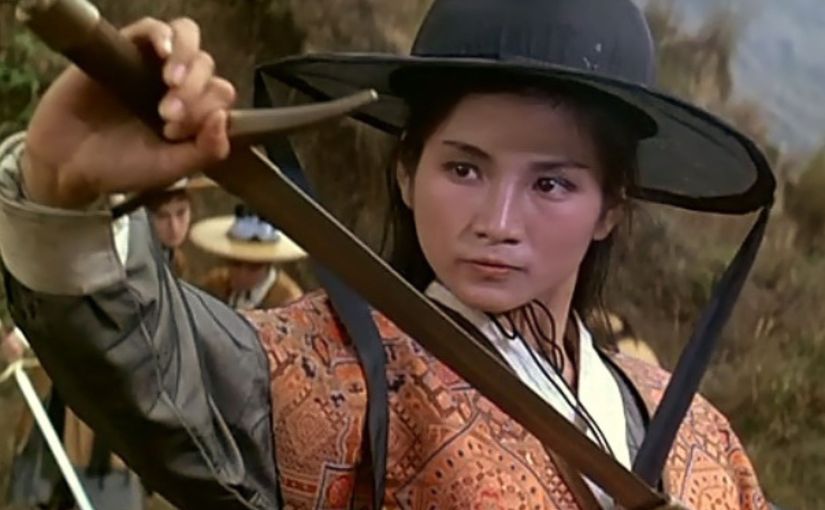
Right from the opening scene, the focus is clearly on action above all else.  We watch a caravan taking prisoners to jail, in the traditionally accepted timeframe of what looks like medieval China.  The caravan is stopped by a lone figure who announces himself as the leader of the bandits known as The Five Tigers.  The gang’s name alone evokes scores of kung-fu films aired on Saturday afternoons on Channel 44. A furious battle ensues in which the prisoners are freed, and a government official is kidnapped by the bandits and ransomed in exchange for the release of another one of their comrades.  Rather than pay the ransom, the government sends a lone warrior, Golden Swallow (Pei-Pei Cheng), to rescue the captured man. (If Golden Swallow looks familiar, that’s because she played the villainous Jade Fox in Crouching Tiger, Hidden Dragon, further enhancing the idea that we’re in some kind of wuxia multiverse.)

That’s all in literally the movie’s first five-to-ten minutes.  Everything that happens afterwards is one action sequence after another, with only two breaks for a breather.  There is a bar brawl that looks curiously similar to the one featured in Crouching Tiger, Hidden Dragon, complete with some impossible acrobatics from the heroine as she leaps from a wall to the upturned legs of a table to the other side of the room.  Granted, it’s not as technically sophisticated as the newer film, but the influence is undeniable.

There is a chase across the rooftops at night, another element clearly appropriated by Crouching Tiger.  Golden Swallow fights off wave after wave of enemy thugs, most of them wielding swords, but some of them hurling wicked needles and darts, one of which finds its mark and lands Golden Swallow in the care of a man, Fan Ta-p’I, who she thought was a drunkard, but who turns out to be a skilled martial artist himself.  These two will eventually cooperate to accomplish their mission, along with a second mission that reveals itself organically.

I must say I wasn’t altogether thrilled with this secondary plot element because it takes the spotlight from Golden Swallow, who dominates three-quarters of the movie.  However, I immediately let it slide when it provided the opportunity to showcase one of Fan’s hidden skills: the ability to manipulate and focus the air so it flows from his hand and can part the cascading stream of a nearby waterfall.  That’s right out of comic books, man.  Or “Avatar: The Last Airbender.”  Take your pick.

To say Come Drink with Me is inferior because it is not as technically sophisticated as modern martial arts films is to overlook its relevance.  Yes, there are a lot of quick cuts used to hide some otherwise impossible-to-perform maneuvers.  Yes, a lot of the dialogue (what little of it there is) is either hammy or overly expository, or both.  Yes, the fight choreography, on close inspection, is not as polished as we’ve come to expect after seeing The Matrix or House of Flying Daggers.

But as an artifact of where today’s martial arts films began, Come Drink with Me is incredibly valuable and still entertaining, even in its relative crudeness.  I loved being able to draw straight lines from specific scenes in this movie to Crouching Tiger, or even all the way to the John Wick franchise.  The last John Wick film featured a scene where Wick fights off an almost literal army of henchmen on a long staircase.  I laughed at the audacity and absurdity of the situation…but I rolled with it, because that’s just what John Wick does: he fights, and he endures.  Why?  Because if he didn’t, he wouldn’t be named John Wick.  Same thing applies to Jason Bourne and James Bond.

And the same thing with Come Drink with Me.  The obviously overmatched Golden Swallow picks off the hordes of attackers one by one because they’re foolish enough to only attack her one or two at a time.  Why?  Because the story demands it.  It’s tradition, even when it looks goofy and unrealistic.  It took me some time to grasp that core concept, but when I did, my enjoyment of these older swordplay films deepened considerably.

THE PAWNBROKER (1964)

by Miguel E. Rodriguez

DIRECTOR: Sidney Lumet
CAST: Rod Steiger, Geraldine Fitzgerald, Brock Peters, Jaime Sánchez
MY RATING: 7/10
ROTTEN TOMATOMETER: 86%

PLOT: A Jewish pawnbroker, victim of Nazi persecution, loses all faith in his fellow man until he realizes too late the tragedy of his actions.


One of my favorite books about movies is Making Movies by Sidney Lumet, in which the legendary director explains in detail the moviemaking process from script selection through the preview screening and ancillary rights distribution.  He uses, of course, the movies from his own career as examples, from 12 Angry Men through Guilty as Sin (the book was first published in 1995).  One of the films he brings up many times is one I had not heard of when I picked up the book for the first time: The Pawnbroker, from 1964, starring Rod Steiger.  After reading the book many times, I found myself obsessed with finding and watching this, to me, unknown film.

For a long time, it remained a kind of missing link in Lumet’s filmography.  It wasn’t available on home video, and it wasn’t streaming anywhere.  In 2008, it was selected for preservation by the National Film Registry, and the New York Times calls it one of the 1,000 best films ever made.  Lumet is one of my favorite directors.  I was desperate to see this movie.

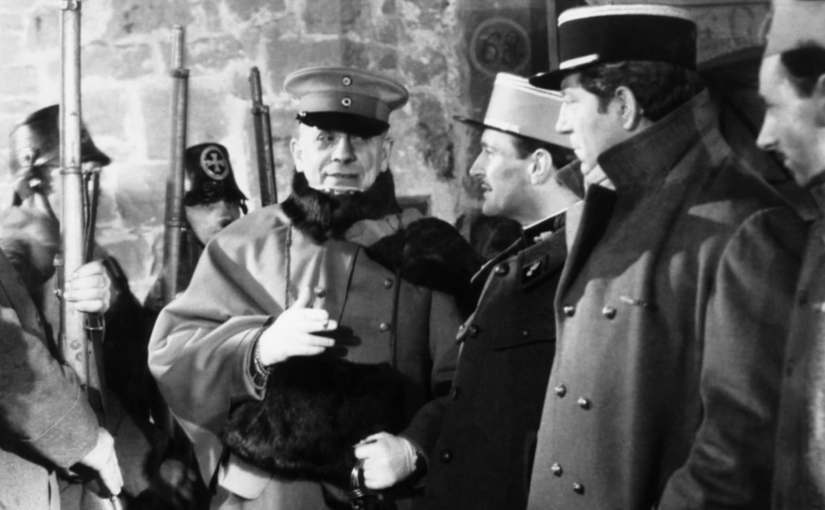
Some time ago, I finally found a (relatively) cheap copy on Blu Ray, and I sat down and pushed PLAY with anticipation.  I mention all of this because I believe I inadvertently made myself a victim of my expectations.  The film that unfolded was not quite as hard-hitting as I had hoped, even though the story is deep and dark.  Perhaps I am too jaded as a modern filmgoer, with so many other Holocaust-related films under my belt, to fully appreciate this intensely acted character study of a man in crisis.  I can see myself changing my opinion of this movie at some point in the future, maybe when I’m a little older.  For now, in my opinion, The Pawnbroker is a well-crafted film, thoughtfully written, but a little too heavy-handed for its own good.

Sol Nazerman (Rod Steiger) is the aging Jewish owner of a pawn shop in New York City…I’m not familiar with the specific neighborhood, but I wanna say somewhere in the Bronx, or maybe Queens.  He and his Puerto Rican employee, Jesus Ortiz (Jaime Sánchez), run the shop with maximum efficiency and minimal customer interaction.  (Hey, look at that, a guy named Jesus with a Jewish boss, I only just now got that…)  Sol is not interested in the backstories of these desperate folks who bring in radios and candlesticks and school trophies in exchange for a couple of bucks each.  “Here’s your money, get out.”  Jesus, on the other hand, is a bundle of energy who sincerely wants to learn the trade and earn some money so he can get out of the 2-room apartment he shares with his mother.  Sol tolerates Jesus the same way a parent tolerates a hyperactive child.

Lumet and his production designer, Richard Sylbert, are very careful to show Sol’s store as nothing but a series of cages and bars.  We learn the reason for this as we see a series of flashbacks from Sol’s past: he was a Holocaust survivor.  (There’s a brilliant scene where Jesus asks Sol what those numbers on his arm are.  “Is that a secret society or something?  What do I do to join?”  Sol’s one-line answer is one of the best things in the script, followed later in the film by a monologue about clinging to a “bearded legend” that showcases Steiger’s talent to the nth degree, but feels a tad over-dramatic.)

Sol’s tragic past is the fuel that runs the engine of the film because it’s made him the man he is today: someone who doesn’t believe in anything anymore, not God, science, art, anything at all…except for one thing: money.  “Next to the speed of light, which Einstein says is the only absolute in the universe, second only to that, I rank money!”  While this sentiment seems as if it would feed into a racist stereotype, Sol never overtly occupies that space.  He is just a man who has seen too much and wants nothing except to get by.

There are suggestions that he is experiencing survivor’s guilt.  In his shop is a tear-a-day calendar showing September 29th.  When Jesus wants to rip it for the next day, Sol stops him.  Later, someone asks him if it’s an anniversary of something.  He says it is: “The day I didn’t die.”  That was the day he was powerless to stop a tragedy, and he should have died, but didn’t.  But he doesn’t frame it as a dramatic act.  I found that a marvelously layered response.  (There is another “suggestion” of his guilt in a monologue by a much older man, but that’s another one of the movie’s heavy-handed moments, so the less said about that, the better.)

There is also a suggestion that Sol is accepting payoffs from a local slum lord to launder money through his pawn shop.  A man comes by, says he needs money to repaint the building, Sol writes the man a check for $5,000, and the man gives him $5,000 in cash.  Why does Sol willingly acquiesce to this process of aiding and abetting a criminal?  I think it’s because he has learned to survive no matter the cost.  In one of his increasingly disturbing flashbacks to his days in the Nazi concentration camp, we watch as a man frantically attempts to scale a fence.  There’s no real hope of escape, but he tries anyway.  The guards don’t shoot him, but watch almost in bemusement.  One of them finally calls for another guard with a German shepherd.  And just yards away, Sol and other prisoners watch helplessly as the man is torn apart.  (Presumably, anyway.)

I haven’t even mentioned the social worker who comes by one day to solicit donations for a youth center, the local thugs (former friends of Jesus) who reek of foreshadowing, the slum lord himself (Brock Peters, playing totally against type as an amoral crook), or Jesus’s hooker girlfriend who knows how desperate Jesus is to get some money of his own and boldly offers her body to Sol in exchange for some cash.  Her act of desperation (featuring the first waist-up female nudity in a post-Code Hollywood film) only triggers more flashbacks for poor Sol. [HA! Jesus has a girlfriend who’s a prostitute…I only just got that one, too…]

By the end of the movie, events conspire that trigger even more feelings of guilt for Sol so that the film ends with him wandering out of his store and into the inner-city jungle with his hands bloody and his head bowed.  Has he realized the error of his ways, of his tendency to reject any kind of human connection?  Certainly his last act seems to demonstrate his remorse, but…has he really changed?  It’s said that, to figure out what a movie is about, look at how the main character changes from beginning to end.  Maybe I’m naïve, maybe I’ve been lucky enough in my life not to have experienced anything remotely resembling the tragedy of Sol’s life, but I felt nothing except mild shock at the end of The Pawnbroker, not because of any realizations about Sol’s character, but because of the events of the plot.  I don’t think that means the same thing as character development.  So, ultimately, I couldn’t really say what this movie is about beyond the ability of a fine director and a courageous actor to show the details of a man wounded so grievously in his past that he can barely tolerate mankind in the present.  Yes, we see the error of his ways…but does he?  You tell me.

ONIBABA (Japan, 1964)

by Miguel E. Rodriguez

DIRECTOR: Kaneto Shindô
CAST: Nobuko Otowa, Jitsuko Yoshimura, Kei Satô
MY RATING: 7/10
ROTTEN TOMATOMETER: 90%

PLOT: In feudal Japan, two women kill samurai and sell their belongings for a living. While one of them is having an affair with their neighbor, the other woman meets a mysterious samurai wearing a bizarre mask.


Squint your eyes, and long stretches of Onibaba look as if they were adapted from comic books.  I’m not talking about the eye-popping colors of Kirby, though.  More like the moody noir of Miller or McFarlane…especially Miller.  Extreme closeups, off-centered faces (to make room for word balloons, of course), sneering lips and bared teeth, gratuitous female nudity, shocking violence, the possibility of supernatural elements getting involved in the story – we’ve got all the makings of a new chapter for the Sin City saga.

But Onibaba misses its chance for true greatness by the disappointing nature of its ending, which I cannot, in good faith, describe in detail here.  The last time I felt this cheated by the ending of a film was when I watched the original Night of Living Dead for the first time.  When the credits for that movie rolled, I wanted to throw popcorn at the TV.  Since I didn’t have popcorn, I cursed out my friends instead.  C’est la vie.

The story of Onibaba begins as we see two women – one older, one younger – living in poverty in medieval Japan.  Some later exposition informs us of an ongoing war far away between two warlords.  Weary soldiers from both sides wander into the tall grassy fields where the women live, and the women promptly kill them, take their clothes and belongings, and sell them to local merchant for bags of millet.  (We never learn the women’s names, by the way.  They are identified only by how they relate to Kichi, a man we never see: one is Kichi’s mother, the other is Kichi’s wife.)  The bodies of the men they kill are disposed of in a large, ominous pit hidden by the tall grass.

I should mention yet another stylistic and visual flourish.  The two women live in a grass hut constructed in a vast field of tall grass at least six, possibly seven feet tall.  There is poetry in many shots when the wind rises and pushes the grass.  In one neat overhead shot, the only way we can see a man pushing his way through the grass is by tracking the hole he makes as he walks.  It’s an indescribably lyrical moment in an otherwise mundane scene.

ANYWAY.  A neighbor arrives, Hachi, with sad news for the two women: Kichi has been killed.  When he asks how the women got by during his absence, they are cagey.  It’s here where we get the first of many masterful sequences where faces and eyes are used to convey emotion more vividly than any prose could.  When Hachi propositions the young woman, now a freshly-minted widow, she sneers.  But as days go by, Hachi wears her down, and they begin an affair, much to the mother-in-law’s disapproval.

Night after night, the young widow wanders off to Hachi’s shack, while the mother-in-law sneaks off and follows her, disapproving but never interrupting their liaisons.  All she offers as a rebuke are stern words and resentful glares.  This cycle repeats itself several times, and despite the visually unique methods of showing us these middle passages, I found myself wondering where this was going.  No doubt people more knowledgeable than I can make conjectures about how this might be a representation of Japanese culture at the time: the old severely disapproving of the young, but powerless to stop the march of progress.  It’s not a far-fetched theory, but if so, it’s an obvious one.  So, what’s the point?

Hope arrives (story-wise) in the form of a tall samurai warrior the mother-in-law encounters in the tall grass one night.  He wears a fearsome demon mask and demands the old woman show him the way to the nearest town.  She asks him to remove the mask.  He refuses, but he assures her that he is very handsome underneath.  Right.

At this point, I was on the edge of my seat.  At last, here we go, some real horror-story stuff.  The mask looks awesomely horrifying, not like the kind of demons we tend to think of, but a weird, bug-eyed, fanged face that still looks vaguely human, which only makes it that much creepier.  When the old woman finally gets her hands on the mask (I won’t say how), she formulates a plan.  The next night, when the younger woman sneaks off to another rendezvous with Hachi, she is confronted by a tall figure with long black hair with the face of a demon…gliding through the grass is if it were floating over the ground.  Floating?  People can’t float.  …what exactly is going on here?

At this point, I was primed for a Twilight Zone kind of twist, revealing the true nature of the samurai warrior, the mask, and the old woman.  (Onibaba translates to “demon woman”, according to the main titles of the movie.)  But what?  I was pleasantly surprised by my eagerness to see what would happen next, even if it were mildly predictable.  The movie had shown great visual flair, so even if the ending was a cliché story-wise, it would look really cool.

But…alas.  The film’s ending teases us with several minutes of truly disturbing stuff psychologically, and then throws it away in a moment of ambiguity, the kind of open-endedness that may inspire discussions on the movie blogs, but which is terribly unsatisfying when it doesn’t work.  And here, unfortunately, it doesn’t work.  It leaves us with more questions than answers, and when “The End” appears, it almost feels like the director and/or screenwriter said, “That’s it, I’m out of story.”

The liner notes of the Criterion Blu Ray for Onibaba inform me that it’s based on an ancient samurai legend, so I guess I can’t totally blame the director/screenwriters.  But I just wish there had been something meatier waiting at the end of what had been a visual treat.  If it had provided a nudge into something deeper or more visceral, I’d have been ready to put Onibaba near the top of my favorite Japanese films.  Visually, it’s stunning with a surprisingly modern feel.  But, oy, that ending.

WHAT EVER HAPPENED TO BABY JANE? (1962)

by Miguel E. Rodriguez

DIRECTOR: Robert Aldrich
CAST: Bette Davis, Joan Crawford, Victor Buono, Maidie Norman
MY RATING: 9/10
ROTTEN TOMATOMETER: 92% Certified Fresh

PLOT: A delusional former child star torments her paraplegic sister in their decaying Hollywood mansion.


I have heard of this movie by reputation almost my entire life, and only now, near the end of my 52nd year on Earth, have I finally sat down to watch What Ever Happened to Baby Jane?, a movie that has been called a camp classic, a horror film in the guignol tradition, and a showcase for two of the greatest bitches in the history of cinema.  And let me tell you, it was worth the wait.  Bette Davis’s performance as Baby Jane Hudson is the stuff of legend: evil, despicable, vile, and impossible to look away from.  She doesn’t just chew the scenery, she purees it.

And yes, before faithful readers get up in my grill, this is one of the slowly growing list of films where the main character is an absolute douchebag, and I not only tolerate it, I celebrate it.  It’s impossible not to.  Like Christian Bale or Jack Torrance, Davis hypnotizes viewers by so perfectly embodying the character that it becomes impossible to imagine anyone else playing it.  It’s been said that at one point, Joan Crawford was going to play Baby Jane, but as talented as Ms. Crawford was, I can’t imagine her improving on Davis’s fearless performance.  This is the very definition of “commit to the bit.”

If you’re like me before I watched the movie, you know the bare bones of the story.  Back in the heyday of vaudeville, Baby Jane Hudson with her golden curls was the darling of the stage, entrancing audiences with her heartbreaking rendition “I’ve Written a Letter to Daddy.”  Her slightly older sister, Blanche, was ignored by her talented sister and, tragically, her father.  But karma is a bitch, and in the early-to-mid-1930s, Blanche becomes a Hollywood superstar, while Baby Jane toils in obscurity, clearly an inferior talent to her celebrated older sister.

One night, there is a terrible “accident” in front of their house (an old Hollywood mansion that once belonged to Valentino), and Blanche is paralyzed from the waist down.  For the next thirty years, Blanche is confined to a wheelchair on the second floor of their mansion, while the delusional Jane, who in her late sixties still wears her Baby Jane makeup and curls, dutifully brings up Blanche’s meals and verbally abuses her.  Their part-time maid, Elvira (Maidie Norman, unknown to me, but quite good in a pivotal role), discovers a trove of Blanche’s fan mail…opened and discarded by Jane.

How to describe these scenes of emotional and verbal abuse?  The words that come out of Jane’s mouth are as harsh as you can get in a movie from 1962.  (In one scene, watch her mouth carefully, and you can see her call Blanche a “bitch” just as a buzzer drowns out her voice.)  But because Blanche, with the patience of a saint, puts up with it, we the audience are forced to accept it.  I mean, I wanted to punch Jane in the face about 30 minutes into this two-plus-hour movie, but I had to tough it out because Blanche is toughing it out.  At that point, I just wanted to see what kind of karmic fate awaited this intolerable harridan.  I wanted her to get trampled by horses while being drawn and quartered by four tractors.

But this is just summary.  I’m not doing the movie justice.  For a 61-year-old movie, it felt just as tense and thrilling as anything I’ve seen in theaters this or any year.  The term “camp” I absolutely disagree with when applied to this movie.  Camp occurs when someone genuinely believes they’re making a great film, and the result is so laughably bad it’s good.  Ed Wood is camp.  Reefer Madness is camp.  Troll 2 is camp.  But NOT What Ever Happened…  Director Robert Aldrich knew what a casting coup he got with Davis and Crawford in the leads, two actresses whose well-known feuds were constantly reported.  All he had to do was turn them loose on the script and keep the cameras rolling.  Rather than getting a movie that got overcooked by hammy histrionics, Aldrich got a top-notch thriller that keeps audiences off-kilter right up to the last five minutes.  That’s not an exaggeration.  As such, this cannot qualify as “camp” because the result was not a bad movie, but a brilliant one.

The different ways in which the screws get turned in such a claustrophobic thriller are ingenious.  Blanche has a pet parakeet that flies away while Jane is cleaning the cage…so she says.  Jane serves dinner to Blanche one day, always with a covered dish, and just as she walks out, she casually mentions there are rats in the basement.  Blanche and we look with horror at the covered dish waiting on her table.  Blanche tries to send a distress signal to their next-door neighbor; the way THAT scene plays out would have warmed the cockles of Hitchcock’s heart.  Blanche discovers that Jane has been practicing forging Blanche’s signature…UH oh.  One day the maid, Elvira, sees too much, and I found myself yelling at the screen when it becomes apparent her life is in danger.

The whole movie works on you like that.  I did a lot of yelling at the screen, just like your stereotypical rude audience member.  At one point, Jane has lied and lied and dug a hole so deep she can’t find a way out, and she pleads to Blanche, “Help me, Blanche, I don’t know what to do!”  The things I yelled at the screen at that point, I will not repeat here, but they involved words that rhymed with “witch”, “ducking”, and “blunt.”  That’s how well the movie got under my skin, in a good way, I should hasten to add.

What Ever Happened to Baby Jane? is one of the finest thrillers I’ve ever seen.  I hesitate to call it a horror film because, in a way, I guess it transcends the horror genre.  It includes some occasional horrific imagery, but the movie is too complex, too rooted in real-world physics and situations for me to see it as a horror film.  It’s a domestic thriller that flirts with self-indulgence, but the performances are so good, we forgive it when, for example, Jane performs her old Baby Jane number, her voice croaking on the high notes like a frog on helium.  In any other movie, I can imagine people would shake their heads and mutter, “Oh, brother…”  In this movie, we still shake our heads, but in awe of an utterly unafraid actor.

As for why I give it a “9” instead of a “10”…ask me after watching it yourself and I’ll tell you.

SEVEN DAYS IN MAY (1964)

by Miguel E. Rodrigugez

DIRECTOR: John Frankenheimer
CAST: Burt Lancaster, Kirk Douglas, Fredric March, Ava Gardner, Edmond O’Brien, Martin Balsam
MY RATING: 9/10
ROTTEN TOMATOMETER: 91%

PLOT: United States military leaders plot to overthrow the President because he supports a nuclear disarmament treaty, and they fear a Soviet sneak attack.


Barely two years after The Manchurian Candidate shocked audiences, director John Frankenheimer delivered the goods again with a political conspiracy thriller that is the equal of Candidate in almost every way.  Were it not for some overcooked sermonizing during a transitional scene, I would almost call Seven Days in May a perfect example of the genre.  I’m frankly a little surprised it’s not mentioned more often in the same breath with other similar thrillers like Fail Safe, The Parallax View, and Three Days of the Condor.

The action starts on a Monday and, predictably, spools out over the next seven days.  We learn that the current American President, Jordan Lyman (Fredric March) has just signed a nuclear disarmament treaty with the Soviets, this being the height of the Cold War in the early 1960s.  His actions have brought his approval ratings to a record-setting low, and demonstrators outside the White House express their desire to see someone else in the Oval Office: General James Scott (Burt Lancaster), a hawkish individual who sees no evidence the Russians will ever honor such a treaty.  General Scott’s aide is Colonel “Jiggs” Casey (Kirk Douglas), a soldier who disagrees with Scott’s views privately, but who knows his duties and performs them admirably.

Over the next couple of days, Casey picks up scraps of conversations from senators and other generals critical of the President.  There is talk of the President attending an “alert”, or an exercise in which armed forces are scrambled in a drill; uncharacteristically, he’s attending alone – no press.  A friend of Casey’s mentions something called “ECOMCON”, a secret Army base in El Paso, and a mysterious “Site Y.”  A Pentagon messenger relays a teletype message from General Scott to other members of the Joint Chiefs about who’s placing bets in the Preakness pool…then gets transferred to Pearl Harbor.  Casey wonders why questions about a horse race would be broadcast over Top Secret channels…

Watching Casey piece the clues together is one of the pleasures of this movie.  It never talks down to the audience, depending on them to follow Casey’s line of reasoning while he draws his own conclusions.  Once he brings his suspicions to the President, and the President elects not to attend the alert, things start happening very fast.  It’s here where the height of suspense occurs, as three men are sent in different directions to accomplish three separate fact-finding missions.  As each man got closer to achieving their goal, there was a feeling in the air, a vibe, a tone that felt like disaster was just around the corner, knocking on the next-door window.  A man drives his car into the desert in search of the secret base in El Paso, and I half-expected the sands to just open up and swallow him whole.

Frankenheimer always was an expert at that kind of suspense generation.  Second only to Hitchcock among his contemporaries, he was a genius at creating tense situations with a minimum of flash, depending on strength of story and screenplay, and his actors, to generate a nervous tension in his viewers.  Those powers are on full display here.

It’s odd…Seven Days in May is a political thriller that doesn’t have any real action scenes or sequences.  A plane crash is referenced but never seen, as opposed to today’s films that would make room in the special FX budget to show audiences the crash.  At least in this film, it’s far more effective when it’s revealed but never seen.  That’s pretty gutsy.  There are no pumped-up chase scenes between a guy with crucial evidence and the shadow forces trying to keep it a secret.  It’s all handled very simply, which makes everything more plausible…and, as a further result, much more suspenseful.

I haven’t mentioned Ava Gardner’s character yet, Eleanor Holbrook, a former lover of General Scott’s.  How she figures in Casey’s plans to uncover evidence of Scott’s treason leads to a devastating scene involving old love letters and mistaken assumptions.  It’s some brilliantly incisive writing, and another example of how the movie achieves plausibility through simplicity.

Any further discussion would necessarily involve spoilers, so I’ll stop here.  Seven Days in May is a prime example of a good story told well, with hardly any bells or whistles.  It reminded me, for some reason, of some of those classic ‘80s thrillers where their only reason for existence was to turn up the tension without getting bogged down in subtext (Body Heat, No Way Out, Blow Out).  There is that one sermonizing speech, as I mentioned before, and I cringed a little when it happened, but it’s a minor quibble.  This is a superior thriller that deserves to be seen.

EYES WITHOUT A FACE (France, 1960)

by Miguel E. Rodriguez

DIRECTOR: Georges Franju
CAST: Pierre Brasseur, Alida Valli, Juliette Mayniel, Edith Scob
MY RATING: 9/10
ROTTEN TOMATOMETER: 97% Certified Fresh

PLOT: A surgeon goes to extreme lengths to give his daughter a new face, which was disfigured in an accident he caused.

[NOTE: This review contains mild spoilers.]


I have become a fan of many of the new breed of horror films released in the last ten years or so – Under the Skin, The Babadook, Get Out, Hereditary, Doctor Sleep, and Saint Maud, just to name a few.  Despite their cosmetic differences, these movies all accomplished the same thing: they got under my skin.  They were genuinely unsettling as their stories unfolded, and they can still creep me out to this day.

Imagine my surprise when I sat down to watch George Franju’s Eyes Without a Face, a French horror film released over sixty years ago, during a time when most mainstream American horror films (Hitchcock aside) were exercises in jump scares, cheesy special effects, and outrageous premises.  I was not prepared for how effectively this movie grabbed me from the outset and, except for a brief middle passage, did not let go.  When a movie from 1960 begins with a woman dumping a corpse into a river…a corpse with a clearly, hideously disfigured face…I don’t know about you, but I sat forward a little in my seat.  Where is THIS going?

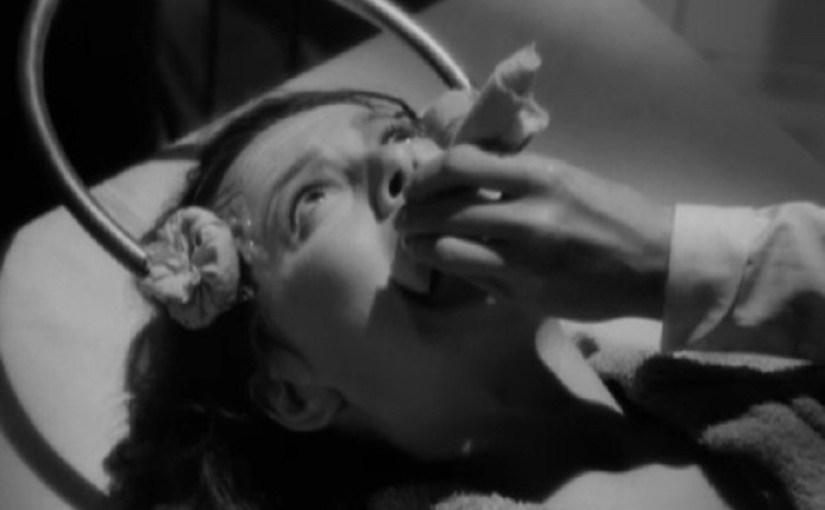
When the body is discovered, the esteemed Dr. Génessier (Pierre Brasseur) solemnly identifies it as his daughter, Christianne.  There is a funeral, Christianne’s fiancé is distraught, and the police are satisfied.  When the good doctor returns home to his large, gothic estate in the country, he goes upstairs to a room where we find his actual daughter, still alive and so disfigured the camera dares not show her face.  The doctor’s assistant, Louise (Alida Valli, still exotic-looking 11 years after The Third Man), brings in a simple but disturbing mask for Christianne to wear.  “Get into the habit of wearing it,” says the doctor.

Who was the girl in the opening scene?  What happened to Christianne’s face?  And why does Louise start searching the nearby city for young unattached women with blond hair and pretty faces?  Why, indeed?

Eyes Without a Face may not have a particularly inscrutable or complicated story, but that doesn’t matter.  The movie unfolds like a modern-day Grimm’s fairy tale, poetic, with princesses locked in tall towers, an evil father figure, and unspeakable violence hinted at but never quite seen.  Except this time, in an unforgettably shocking scene, we witness one of the doctor’s operations.

In most films of this era, shockingly violent acts were tactfully carried out offscreen.  I am thinking, for some reason, of Lawrence of Arabia, where Lawrence must execute a man in order to keep the peace between two Arabian tribes.  Lawrence pulls his gun, we see the bound man try to escape, and we cut to Lawrence as he fires his gun, once, twice, several times.  It’s a shocking scene, but we never see the carnage of those bullets.  It’s left to our imagination.

In Eyes Without a Face, we watch as the doctor gently draws a grease pencil outline around his anesthetized victim’s pretty face.  (“I must try removing it in one large section, not in pieces as before.”  Yikes.)  Then Louise hands him a scalpel, and the camera stays on Louise’s face, and I expected it to stay there for several seconds as the horror of what the doctor was doing was left to our imaginations.  But no.  We cut back to the scalpel piercing the skin as he gingerly follows his outline around her face.  Some excess blood drips down, and Louise dutifully sponges it away.

This is already pretty strong stuff for 1960, at least when I compare it to other films I’ve seen from that era (again, Hitchcock aside).  But I was doubly shocked when the movie didn’t stop there.  The face must still be removed, but to do that we need clamps, more incisions (taking care around the eyes, of course), and we watch this process in several long takes which must have had some audience members fainting in disbelief.

When the doctor is finished, another body must be disposed of, Christianne has a new face, and all seems to be well.  (The doctor reminds his daughter: “Smile.  Smile.  …not too much.”)  What makes this movie great is that there is still so much more to the story, but I’ll leave that for you to discover.

This is the kind of gothic stuff that screams for a remake today, maybe by del Toro or Ari Aster.  Although perhaps they are already fans and have made the decision that the film is too perfect as it is.  I can’t blame that viewpoint.  Eyes Without a Face has just about everything a modern horror fan could desire.  Franju plays many of the film’s creepiest scenes with no score, creating a deeply unnerving mood like in The Blair Witch Project.  It doesn’t shy away from disturbing gore.  Christianne is not just a shrinking violet, but prone to heartbreaking philosophy.  (“My face frightens me.  My mask frightens me even more.”)  To say the resolution of the story is satisfying is an understatement; it takes “poetic justice” to a whole new level.  There is Hitchcockian – or, perhaps more accurately, Clouzot-esque – suspense when Christianne’s fiancé begins to suspect there is something fishy about Dr. Génessier’s clinic and tries to set up a sting operation with the help of local police.

And so much more.  Eyes Without a Face is, for me, one of those buried treasure movies that I normally do not seek out, but when they turn out to be more than worth my time, I can’t help but share it with others.  It holds its own with modern horror films, and then some.  The fact it was made in 1960 still boggles my mind, and that just makes it even more fascinating.

[P.S… According to IMDb, John Carpenter once suggested that the selection of the mask worn by Michael Myers was influenced by Christianne’s mask from this film. I believe it.]

MAESTRO (2023)

by Miguel E. Rodriguez

DIRECTOR: Bradley Cooper
CAST: Carey Mulligan, Bradley Cooper, Matt Bomer, Sarah Silverman, Maya Hawke
MY RATING: 8/10
ROTTEN TOMATOMETER: 80% Certified Fresh

PLOT: This love story chronicles the lifelong relationship of conductor-composer Leonard Bernstein and his wife, actress Felicia Montealegre Cohn Bernstein.


Bradley Cooper’s Maestro is a film of scope and depth and tremendous technical artistry, both in front of and behind the camera.  The performances from the two leads contain some of the best acting I’ve ever seen, especially their argument during a Thanksgiving Day parade.  But I cannot deny that, for reasons I’ll try (and probably fail) to explain, I did not feel emotionally invested in the story until the final two or three reels, when something occurs that, if it were fiction, could easily be dismissed as a shameless attempt at Oscar-baiting.  The fact that this really happened lends these final scenes an emotional weight that was missing from everything that came before.

The story is straightforward, but beautifully told, visually.  After a brief prologue, we meet a young Leonard Bernstein (Bradley Cooper), in bed with his male lover (hope that’s not a spoiler), as he gets an early morning phone call that will change his life forever.  This opening scene sets the visual tone for the first half of the film: standard 1:1.33 framing as opposed to widescreen to give it a classic feel, as well as gorgeous black-and-white cinematography.  Indeed, this opening shot alone looks like it could hang in a museum of modern art and not look out of place.

Everything proceeds breathlessly from there, with some conversations held at speeds that would make the Gilmore Girls dizzy.  After a series of early musical triumphs, he meets the woman that will become the polestar of his personal life: actress Felicia Montealegre Cohn (Carey Mulligan, in a performance that will almost certainly win her an Oscar nomination).  After some verbal sparring/flirtation, it becomes clear to them, and to us, that they are meant for each other, despite his later dalliances with male fans and hangers-on.

I especially liked a scene during this early section where Felicia and Lenny – as his friends and family called him – dine with some older friends (or family? I can’t quite remember), and an older gentleman gives him some advice: “They’ll never give Leonard Bernstein an orchestra in America.  But Leonard S. Burns…”  I loved that scene because I loved how Bernstein’s entire career is a rebuke to that well-meant but wrong-minded sentiment.

This gentleman advises Bernstein to give up writing scores for musicals, but Felicia disagrees.  That sets up a wonderful sequence where Felicia and Lenny watch a rehearsal of the stage musical On the Town, with sailors leaping balletically, and then in a fantasy reminiscent of The Red Shoes, Bernstein himself becomes one of the sailors, and the dance becomes a micro-miniature of their relationship and his early successes.  It’s a thrilling little cutaway that had me grinning the whole time.

From there, the movie jumps forward chronologically in leaps and bounds, giving only a cursory glance at the 1960s before settling more or less for the rest of the film in the mid-to-late 1970s, with Bernstein’s face becoming the craggy icon that I personally remember from my own youth, while Felicia Bernstein somehow looks just as beautiful as she did thirty years and four children ago.  I would blame that on movie magic, but I mean, we are talking about Carey Mulligan here, so they get a pass.  And then the last act of the film arrives and we get a glimpse perhaps of why Mulligan receives top billing over the actor-star-director Cooper.  And that’s all I’ll say about that.

As I said, the movie looks amazing.  Obviously the period décor and costuming are all spot on, but the cinematography and direction – what theatre or film studies majors would call mise-en-scène – are just incredible to behold.  Another shot that stands out in my mind is a scene where Bernstein is conducting, and we get an angle where we are looking into the wings, but his undulating shadow looms large, and standing in that shadow, but still illuminated, is Felicia.  Verbal descriptions won’t do them justice, just see for yourself.

But as I mentioned, I just wasn’t invested in the story from an emotional standpoint.  I felt like I was watching an extremely inventive and ingenious exercise in moviemaking.  I suppose I could compare it to the recent sci-fi film The Creator, if that doesn’t get me accused of hyperbole.  Both films show supreme confidence in staging, cinematography, and direction.  But like The Creator, Maestro feels like something is missing where its heart should be for the first 75% of its running time.  Things happen, arguments take place, children are born, Lenny gets a little sloppy with his paramours, but I never felt like any of it really meant anything to me as the viewer.

I tried asking myself, “What statement is the film making?”  And I couldn’t answer that question, aside from fulfilling its purpose in presenting the facts of a story in almost documentary-like fashion.  But the performances and cinematography are so stunning that I must acknowledge that fact with a higher rating than I would normally give a film that doesn’t really grab me emotionally.  (EXCEPT for the last 25%, I mean…I don’t want to give anything away, but the last reels are heart-tugging.)

So, do you want to see this movie?  Well, certainly not if you are an absolute acolyte of Leonard Bernstein.  You’ll see some pretty cool stuff musically, but Maestro does not paint an altogether flattering picture when it comes to his personal life.  But if you want to see one of the best-acted, best-directed, best-LOOKING films of the year…Maestro is your ticket.

BAD SANTA: Director’s Cut (2003)

by Miguel E. Rodriguez

DIRECTOR: Terry Zwigoff
CAST: Billy Bob Thornton, Tony Cox, Brett Kelly, Lauren Graham, Bernie Mac, John Ritter
MY RATING: 9/10
ROTTEN TOMATOMETER: 78% Certified Fresh

PLOT: The world’s worst department-store Santa experiences an existential crisis in between drunken benders and burgling department stores.

[Author’s note: This review is of the Terry Zwigoff-approved Director’s Cut, NOT the studio-released Unrated “Badder Santa” version created without Zwigoff’s input. The Director’s Cut improves on the original theatrical release, in my opinion, by removing a lot of extraneous scenes (the Advent Calendar shots, Willie teaching the Kid how to fight, etc.) while keeping some bits from the Unrated version, resulting in a leaner, darker, yet even funnier movie.]


I recently re-watched this movie with my girlfriend, first time for her, first time in a long time for me.  I had forgotten how relentlessly funny it is, specifically because of how vulgar, offensive, and, let us not mince words, dirty it gets.  I don’t know if it’s because this was the Director’s Cut as opposed to the original version, but I was also reminded of the earlier films of Kevin Smith.  It has all the coarseness and low-budget production values of Mallrats, but with a better story and a funnier script (all due respect to Mr. Smith).

The film opens with our “hero”, Willie T. Soke (Billy Bob Thornton) getting drunk and puking in an alley while dressed as Santa Claus.  This is the high point of the movie in terms of his character.  It’s all downhill from here.  Almost.  Sort of.  Anyway, we learn that he is involved in a somewhat-feasible scam with Marcus, a felonious dwarf (Tony Cox), and his rather materialistic wife, Lois (Lauren Tom, aka “Julie” from Friends…I was today years old when I learned that, thanks to Penni).  After Soke does the Santa thing, muttering profanities under his breath the whole time, Marcus stays behind after hours, deactivates the store’s security system, and lets Soke in the back so he can crack the store’s safe.  Meanwhile, Marcus steals whatever is on the list his wife gives him.  (I liked that little touch; he’s not a random thief, he’s a very SPECIFIC thief.)

One day, a literally snot-nosed kid (Brett Kelly) perches on Santa/Soke’s knee and solemnly tells him, “You’re not Santa”…then peppers him with questions about the reindeer, Mrs. Santa, the elves, ad infinitum, while Willie does his best to keep up through his alcoholic haze.  To say this is the start of a beautiful relationship is straining the definition of “beautiful” and “relationship”, but there is a point to all of it.  Trust me.

There’s more, much more, that’s been crammed into this barely ninety-minute-long movie.  The bartender (Lauren Graham) whose non-traditional sexual kink makes Willie implausibly irresistible.  The department store detective (Bernie Mac) who senses Willie and Marcus are trouble but has plans of his own.  The store manager (John Ritter) who claims he’s no prude but who can barely pronounce the words he heard coming from the dressing-room stall in the plus-size section where Willie was…well, modesty forbids.  Not to mention the Kid’s grandmother with the apparent obsession with making sandwiches.  And the profanity.  The virtually non-stop stream of profanity pouring from Willie’s mouth.  In a comic strip, his dialogue would be almost entirely composed of symbols and punctuation marks.

The executives at the now-defunct Dimension Films must have had cojones of solid rock to give this movie the green light.  Who is this movie for?  I’ve seen so-called “polarizing” movies before, but this achieves some kind of high bar.  Some of the lines must be heard to be believed.  Bernie Mac and Tony Cox have an exchange late in the film that belongs in some kind of cuss-word Hall of Fame.  I can imagine Kevin Smith watching that scene and nodding his head in a kind of salute.

As I’ve said many times before, I have always had a hard time watching movies or TV shows with loathsome characters as the leads, no matter how funny they are.  I have never been able to stomach Seinfeld for this reason, but I do acknowledge the ingenuity of the show’s writing and the comic skills of the actors.  I just find it a shame it’s all been attached to characters whom I would cross the street to avoid.  But here is Bad Santa, with a lead character who is not only alcoholic, but who is also suicidal, who haunts mall arcades to hit on teenage girls (“She said she was eighteen”, he says at one point), has no compunction about swearing around children, and beats the crap out of some local bullies who are picking on his new friend…then has the chutzpah to look at the beating as a turning point in his life.  “You need many, many, many f***in’ years of therapy”, Marcus tells him.

And yet I don’t just like this movie, I LOVE this movie, because it makes me laugh.  I’ve been sitting here trying to self-analyze my affection (if that’s the right word) for this film, but I am failing.  I can only report that it has some of the raunchiest dialogue I’ve ever heard, that it is definitely NOT appropriate for kids, that it is certainly NOT one of Penni’s favorite movies (kudos to her for making it all the way through), and that hand-carved wooden pickles stained with blood are not the best Christmas presents ever.

And I laugh like a loon whenever I watch it.  Sue me.

NEXT GOAL WINS (United Kingdom, 2023)

by Miguel E. Rodriguez

DIRECTOR: Taika Waititi
CAST: Michael Fassbender, Oscar Kightley, Kaimana, David Fane
MY RATING: 9/10
ROTTEN TOMATOMETER: 41%

PLOT: In 2011, the literal world’s-worst soccer team from American Samoa gets a new coach one month before the next World Cup qualifiers.


In all the best ways imaginable, Next Goal Wins is a throwback to those countless formulaic sports movies of yore, from The Bad News Bears to Little Giants to Cool Runnings to The Mighty Ducks and beyond, right down to some of the songs used on the soundtrack. The underdog formula is nearly as old as film itself, and there have been many, many bad attempts at using it.  Where Next Goal Wins succeeds is in making the audience really care about the players and the coach before the big match.

Apparently, that’s not easy to do.  The list of films that get this basic concept wrong is long and undistinguished, from badly-thought-out sequels (Rocky V, Major League: Back to the Minors) to original concepts that crashed and burned (The Air Up There, The Babe).  In fact, there have been so many BAD sports films that I initially didn’t want to see Next Goal Wins.  But it’s from a director I admire, New Zealander Taika Waititi (Jojo Rabbit, Thor: Ragnarok), and the trailers made it look mildly interesting with its exotic setting in American Samoa.

After watching it, I am once again compelled to repeat Roger Ebert’s axiom: “It’s not what a movie is about, it’s how it is about it.”  The formula may be old, but Next Goal Wins executes it beautifully, like a textbook sliding tackle.

The story begins with a flashback to when the American Samoan national football team – that’s “soccer” to us Yanks – legendarily lost 31-0 to Australia in the first round of the 2001 World Cup qualifiers.  (The device for this flashback is a charming narration from Taika Waititi himself, playing a Samoan priest…or preacher…it’s not quite clear, but it’s pretty funny.)  Flash forward to 2011 when a down-on-his-luck soccer coach Thomas Rongen (Michael Fassbender) is given a take-it-or-leave-it offer to coach the American Samoan team…a team which, by the way, had never scored a single goal since its inception.  The existing coaching staff, along with the team’s devoted fans, are so beaten down by disappointment and defeat that they don’t even necessarily want a win.  They’ll take just a single goal in official competition.

(I should mention here that before you think this is going to be another “white savior” movie, I assure you, it’s not. In fact, one of the characters brings up that very question, and the team ultimately rises and falls based on how they incorporate their own attitudes and customs rather than in utilizing new methods from their new Caucasian coach. This is key.)

What happens next is predictable to anyone who has ever seen Major League.  We meet the team members, a squad of misfits that includes an oversized goalie, a guy who looks like a reject from the old Geico caveman commercials, and a transgender player who spends most of her time on the practice field standing alone and playing with her hair.  Tradition says that the goalie must redeem himself, the caveman guy will reveal hitherto-unknown skills, and the transgender player will rise to the occasion when it counts.

Does all of this happen?  Well, yes and no.  I don’t want to reveal too much, because a lot of the pleasure in this film is watching how it toys with cliches, turning some of them slightly sideways while fully embracing others.  …okay, I’ll reveal one example.  Remember the overweight goalie?  You’ve probably seen him in the trailer, where the coach tells him to go around instead of jumping over him during a drill.  In another, less-inspired film, he would somehow save the day during the climactic match.  Nope.  He’s replaced about halfway through the movie with the ORIGINAL goalie from ten years earlier, the one who allowed 31 goals against Australia.  (But, as another team member points out, he did make 60 saves in that same game.)  Now this guy has something to prove.

Predictably, everything leads up to the first qualifier against Tonga.  We’re never given much info about this team other than they are the opponents and are therefore two-dimensional douchebags.  They insult the Samoan team unnecessarily and taunt the transgender player at a pre-game mixer.  Formulaic, yes, but it fits neatly into the mold of this movie, and I’m willing to let it slide.  There’s even a revelatory discovery halfway through the match that blindsided me and imparted even more emotional weight to the entire movie.  Don’t let anyone spoil it for you.

After looking at the critical comments regarding Next Goal Wins, it seems like this is just going to be one of those movies that either works for you, or it doesn’t.  One critic calls it “deeply irritating” because it follows the underdog sports movie formula in lockstep.  Well, yes, but it does it so well and with enough variations on that theme that I forgive its predictability.  Another critic says the film “doesn’t seem nearly as challenging or risky as most of what Waititi has given us before.”  Well, geez, what were you expecting, Slap Shot crossed with Jojo Rabbit?  Other critics make that same complaint, that the film suffers relative to Waititi’s previous films.  Well, wouldn’t it be fairer to judge the movie itself instead of comparing it to his earlier work?  Or is that just me?

Next Goal Wins was just a great time at the movies.  It may not unlock the secrets of the universe, but I had more fun than I expected.  I can’t ask for much more than that.

(P.S. For those of you keeping score, my girlfriend cried twice.  Do with that information what you will.)

SPEEDY (1928)

by Miguel E. Rodriguez

DIRECTOR: Ted Wilde
CAST: Harold Lloyd, Ann Christy, Bert Woodruff, Babe Ruth (!)
MY RATING: 10/10
ROTTEN TOMATOMETER: 100% Fresh
Everyone’s a Critic Assignment: “Watch a Silent Film”

PLOT: An everyman helps his girlfriend’s grandfather keep his obsolete horse-drawn trolley business alive by finding odd jobs in New York City (when he’s not having fun at Coney Island with his gal).


Speedy is charming, delightful, inventive, funny, thrilling…I could go on.  For me, this movie, along with the other Harold Lloyd films I’ve seen (The Freshman, Safety Last!, The Kid Brother), cements my perception about Harold Lloyd when compared to the other giants of his day: Chaplin will always be The Tramp, and Keaton is the Great Stone Face, but Harold Lloyd, in his films, is us.

Lloyd plays Harold “Speedy” Swift (get it?), a young man who loves his girlfriend, Jane, almost as much as he loves Yankees baseball.  How much does he love it?  He interrupts his duties at a soda shop with frequent phone calls to a friend who gives him the up-to-the-minute score of the Yankees game.  (No radio stations or televisions yet…ancient history, folks.)  He then passes the score to the workers in the kitchen by using a pastry case as a scoreboard and doughnuts and crème horns as zeros and ones.  When he finds out the Yankees have scored three runs in an inning, I found myself actively wondering what pastry item he would use for a “3.”  The answer may or may not surprise you.

Jane’s grandfather, Pop, owns and runs the last horse-drawn trolley service in New York City.  Big-shot railroad owners want his track for themselves, but Pop won’t sell until they meet his price (craftily inflated by Speedy himself in one of the movie’s funnier scenes).  The rail tycoons learn that Pop must run the track’s route at least once in a 24-hour period, so they hire some goons to hijack the trolley the next day.  When Harold learns of their plan…

But this is just a synopsis.  There is a story here, but it is almost secondary to the delights to be had just from watching the film play out, not just because every scene is cleverly executed, but also because many of those scenes present the viewer with what amounts to a travelogue of New York City in 1927, from Times Square to Bowling Green to Washington Square Park to Coney Island.  (A documentary on the Criterion Blu-ray of Speedy reveals there were several skillfully concealed cuts to the streets of Los Angeles, but I was absolutely fooled, so I stand by my statement.)

The highlight of the film is the sequence when Harold takes Jane to spend his week’s pay at Coney Island.  These scenes left me flabbergasted.  I have seen many vintage photos of Coney Island in the 1920s, but never had I seen film footage of any kind.  Some of the rides there defy belief.  There’s a giant flat disk that spins on the floor and guests pay for their chance at a prize if they can stay on the revolving disk for three minutes.  There’s a flume ride where the ride vehicle shoots out into the bay instead of staying in a chute.  There’s something called the Steeplechase that looks like a death-defying ride on a gravity coaster, but instead of sitting in a car, you’re riding on top of a metal carousel horse…no lap bars!

The Coney Island segment is home to some of Speedy’s funniest gags, like the live crab that improbably winds up in Speedy’s pocket and causes havoc on the midway by popping balloons, pinching passersby, and stealing a woman’s negligee…from her purse, of course.  And let’s not forget the scene when Speedy looks at his reflection in a funhouse mirror, doesn’t like what he sees…and flips himself off.  That’s right: in this pre-Hays-Code film, a character in a mainstream movie, certainly seen by children and adults alike, gives himself the finger.  Don’t believe me?  Take a look:

I must have rewound that scene five times to make sure I saw what I saw.

Anyway, the other highlight of Speedy is when Speedy gets a job as a cabdriver and gets to drive Babe Ruth to Yankee Stadium.  That’s right.  BABE.  RUTH.  Just like with Coney Island, I had only ever seen The Babe in grainy newsreel footage and still photos.  To see the Sultan of Swat in a fantastically restored film from nearly a century ago was…damn, I seriously cannot think of the right word for it.  I had a big grin plastered on my face during his entire scene, and it’s a long scene, with Speedy careening through traffic, barely avoiding accidents, while Ruth hangs on for dear life.

The experience of watching Speedy, with its real NYC locations and the inclusion of genuine sports royalty, felt less like watching a movie and more like watching a magic window into the past, like a wormhole through space and time.  The last film that made me feel transported like that was the fascinating documentary Dawson City: Frozen Time, about a trove of forgotten films and newsreels from the turn of the century and slightly beyond found buried under the permafrost in the Yukon.  To be sure, there are plenty of old films that I’ve seen before, but Speedy is the first one of those that presents, not a manufactured set or a western town that was already old in the 1920s, but a living snapshot of a real, tangible place where the locations in the film can still be seen today.

And I haven’t even started on the brilliant performance from Harold Lloyd himself.  Lloyd carries the movie on his shoulders from the get-go, establishing himself as an everyday Joe who just wants to earn that cash and help his girlfriend.  He doesn’t mug, like Chaplin, and he doesn’t stare, like Keaton.  He just IS.  He never comes off as overacting, playing every scene absolutely straight, expressing consternation and exasperation at the fates that, for example, gets him away from a dirty mutt on the street, only to back into a freshly painted fence.  Or watch his face on the midway when he wins a special prize: a baby’s crib.  Jane, his girlfriend, lights up.  Speedy does what any man not ready for commitment would do: tries to give the damn thing back.

After a frantic chase under the city’s elevated train tracks that results in a genuinely unplanned accident – SUCK it, French Connection, we were here first! – everything comes together in a massive rumble (between the rail tycoons, their thugs, and residents of Speedy’s and Pop’s neighborhood) that has to be seen to be believed.  At the end of the film, I still had that stupid smile plastered on my face from earlier.  What a treasure this movie is.  What a delight.  I don’t know if Speedy is available on any streaming service, but if it’s not, I would urge anyone who loves film to buy or borrow a copy whenever they can.  For film aficionados, it’s a gem.  For anyone new to silent films, this would be a great place to start.