SCENT OF A WOMAN

By Marc S. Sanders

When it comes to Thanksgiving films, majority turn to that John Hughes road picture.  However, there’s another film that is just as meaningful to the spirit of the holiday and that is Martin Brest’s Scent Of A Woman which features Al Pacino’s Oscar winning Best Actor performance; at last!!!!

Before Chris O’Donnell became Robin in some tired Batman movies or a tough guy on NCIS, he was the staple prep school achiever (see also School Ties).  Here he plays Charlie, a student attending a prestigious boarding school in New Hampshire.  He does not have the wealthy background of his classmates and without the funds to go home for Thanksgiving, he opts to accept a weekend job tending to retired Lt. Col. Frank Slade, U.S. Army (Pacino).  Frank is a frightening lost soul with Pacino’s signature outbursts.  What’s even more challenging is that Frank has been plagued with blindness following a reckless accident with a hand grenade.  Unbeknownst to Charlie, Frank assumes control once his niece’s family leaves town for the weekend and sends himself with Charlie in tow to New York City.  Frank plans to enjoy a pleasant stay at the famed Waldorf Astoria, have a nice meal, crash his older brother’s holiday dinner, get a new tailored suit, bed a beautiful girl and drive a Ferrari.  Afterwards, he’s going to blow his brains out in full dress uniform.

This is not a problem Charlie needs to be dealing with right now.  The pressure is on the young man to identify the students of a prank that occurred just before the holiday break.  The Dean of Students (James Rebhorn) has given Charlie and another student, the privileged George Jr. (Phillip Seymour Hoffman, in a very early role) the weekend to ponder how they should respond.  Charlie, however, seems to face expulsion and likely an opportunity to miss out on admittance to Harvard.  George Sr., a former student and benefactor, will likely save his son.  Frank has predicted this outcome, and Charlie can’t deny that it is likely the truth.  Charlie’s dilemma is in his own morals as a man.  He’s not a snitch who will sell out his future to satisfy the esteemed integrity of the prep school and the ego of the Dean.

I miss the director, Martin Brest.  He has some magnificent films on his resume (Beverly Hills Cop, Midnight Run & Scent Of A Woman).  His other two popular films are broader in action comedy.  Here he is much more sensitive, and he uses the legacy of Pacino’s craft to the highest level.  He allows Al Pacino the freedom to be intimidating and frightening and intrusive.  A most uncomfortable Thanksgiving dinner at Frank’s brother’s house begins with awkwardness and ends in terrifying fear for Frank and all at the dinner table. 

Brest also lives up to the title of the picture.  There’s really not a main female character in the picture.  However, the camera captures a woman entering the frame at random times for Frank’s heightened senses to kick in.  If Frank is going to end his life soon, then he will at least absorb the finest things the world has to offer and that is a beautiful woman.  Charlie doesn’t realize this yet, having spent most of his days at an all-boys private school.  Martin Brest does such good work.  He’ll position his close up on Pacino doing his work and then a brown-haired young lady will enter from behind.  The scene will shift gears from morose to eye opening. Simple, yet great technique at play here.

Pacino may have won the Oscar, where some debate this was not his finest material and that it was a more likely a long-time coming career award at this point.  The portrayal has also become spoofed so many times over since the release of the film (Seinfeld) and “Hoo Ahh!”.  Still, look at the individual scenes on display here.  There are so many different angles to this guy.  Frank Slade is a lonely man who doesn’t directly identify his sorrow, but rather masks it with drill sergeant persona.  Yet, Frank is also a charming man who graciously does a sensual tango in the middle of a dining room with a beautiful young girl (Gabrielle Anwar).  Reader, if you are a regular subscriber to my write ups, then you know I adore a dance scene that occurs within a non-musical.  Scent Of A Woman may feature the number one ranked scene in that category.  Try not to grin or smile during this marvelous centerpiece.  How fortunate for Anwar – the one woman who got to do a tango on film with the great Al Pacino.  I’m thankful it is cemented in my consciousness for eternity.  It’s an amazing scene; one that can be taken out of context from the film and adored on You Tube, many times over.

Pacino and O’Donnell have brilliant chemistry together and it makes sense that the story takes place during the Thanksgiving weekend.  These are two men from very different backgrounds and neither realizes how much they need to be rescued by one another.  Charlie will have to literally save Frank’s life, no matter how intimidating he appears.  Frank will have to save Charlie’s future against an established school that’s offered up some of the country’s most brilliant minds.  Poor Charlie from Oregon, without the coat tails of a legacy to ride upon doesn’t fit the mold for the next President or championship football coach.  Both issues have insurmountable odds of being overcome, and yet these two are the only ones who plow through the challenges.

Scent Of A Woman has delightful moments to simply watch, such as a blind Frank driving a Ferrari through So Ho district and of course that tango scene, but this is an actor’s piece for sure.  The climax confirms that distinction.  The holiday weekend has come to an end and Charlie must face his peers and the Dean and confirm what he will do, but Frank will make sure to attend this makeshift trial. Then the opportunity is given for an outstanding monologue performance that only confirms one simple notion.  Al Pacino is one of the greatest film actors in history. I imagine the dialogue for this wrap up scene is quite something to read on a page.  However, to watch Pacino bring it to life is something else entirely. 

Therefore, on this Thanksgiving, I’m thankful for Al Pacino and Chris O’Donnell and Martin Brest, along with the tango, and I’m especially thankful for Scent Of A Woman.

NO TIME TO DIE

By Marc S. Sanders

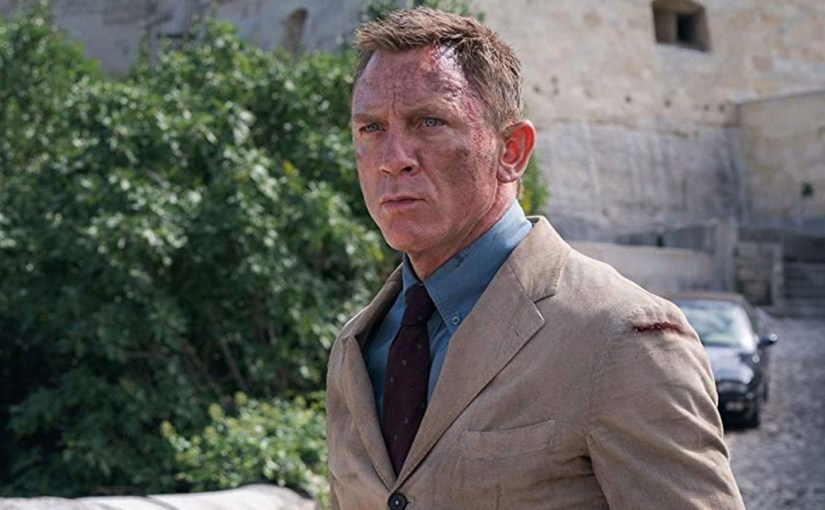
Any die-hard James Bond fan should absolutely love Daniel Craig’s final outing in No Time To Die.  Not only does the film work as a salute to the more serious aspects of past Bond films (not just Craig’s installments), but it is working with its tongue placed firmly in its cheek.  That is not to say that I still did take issue with a few narrative choices the film steers into.

Years have gone by for Craig’s interpretation of the famed secret agent.  He’s comfortably in love with Madeleine Swann (Lea Seydoux) from the prior film Spectre, and known daughter of Mr. White, one of Bond’s prior adversaries.  Suddenly though, Spectre seems to be back with a vengeance.  The imprisoned Blofeld (Christoph Waltz) somehow seems to be involved and 007 puts his guard back on opting not to trust Madeleine or anyone ever again.  The story jumps to five years later and Bond’s CIA friend, Felix Leiter (Jeffrey Wright) has convinced him to come out of seclusion and assist with recovering a kidnapped scientist who holds the formula to a deadly nanobot virus manufactured through plant life.  Bond travels to Jamaica to complete the mission.  From there, the story gets more complicated and more interesting.  Though I dare not spoil what comes next.  This film has a lot to tell in the near three hour running time.

Daniel Craig always had some sort of challenge with the general public while playing James Bond.  First, how dare he be blond?  James Bond is not blond.  He survived that ordeal to continue to make more films.  His second film suffered in storytelling due to a writer’s strike.  During press junkets for his fourth film, Craig was quoted out of context noting that he’d rather “slit his wrists” than play the character again.  As well, his films broke convention in the long running EON Production series, as each film served as a continuing story with much more serious, dramatic and sorrowful undertones than was ever presented before.  None of these challenges seemed fair to me.  After 25 films, you gotta stir the pot a little bit on a character that has been on screen for nearly 60 years.  It’s not enough that his gadgets change with the times of technology. 

I divert into this observation because No Time To Die offers some shocking developments for the Bond character, but when you return back to Craig’s first film, Casino Royale, you really start to understand why this latest picture goes in this wildly off direction.  In other words, the four films Craig performed in prior to this 2021 installment seemingly spell out the inevitable conclusion of his tenure as James Bond.  So, reader, when you go to see this last film from arguably the most controversial actor to play 007 to date, give some thought to what has already been covered before and maybe you’ll agree it beautifully makes a lot of sense.

As an action film, No Time To Die works solidly.  There’s amazing stunts and vehicles with car chases galore and nail biting shootouts.  I think this film has the longest pre-credit sequence of all the films and it’s amazing where one of the feature attractions is the famed Aston Martin DB5 against a slew of Range Rovers and motorcycles.

Rami Malek fills in as the lead villain eerily known as Safin, complete with the signature facial deformity, a shattered kabuki mask and a hell bent determination to destroy the world by means of turning people’s DNA against themselves.  Just go with it.  There’s not much weight to this dastardly mission.  It’s Malek’s performance that works. 

A new agent is also in the works and what’s this?  She is identified as 007????  Again, the newer films bravely go against convention to keep it interesting. Lashana Lynch plays Nomi.  This character was angled extensively in trailers and press junkets but honestly doesn’t live up to the hype enough.  The actor is fine.  She’s just not given much to make any kind of impact.  Ana de Armas is the actor who really makes a splash in a brief moment dressed in a gorgeous evening gown while giving high kicks to bad guys and armed with an adorable naivety about her and a killer machine gun.  Her character is reminiscent of the Bond girls who elevated the tongue and cheek elements of the series.  In a three hour film, more room should have been left for de Armas to play.

Moneypenny (Naomie Harris), Q (Ben Whishaw), Tanner (Rory Kinnear) and M (Ralph Fiennes) all return making for a solid support team for Bond.  It needs to be noted how well cast the Craig films always remained. During the five film series, each one of the characters had their memorable moments for sure.

The regrettable ingredients in No Time To Die lie in the lacking treatments of Lashana Lynch and Ana de Armas for sure.  Forgivable for the most part however.  Still, the story steers into one angle that I wish it didn’t when a young child is brought into the fold.  Children in serious peril was never part of the Bond formula.  So, while this is another new convention for the long running series, I think it was a poor choice.  I see the necessity of the young character to the story, but was it ever really necessary to put a child amid massive gun play, car wrecks and explosions.  There was something a little unsettling about that aspect of the film and the imminent danger to the girl really isn’t needed to heighten any kind of suspense.  Rather than play dramatically, it moves a little too disturbing.  Early on in the film, another child is placed in disturbing peril as well.  The story options here just don’t seem altogether appropriate.

No Time To Die is an appreciated conclusion to Daniel Craig’s version of the character.  There are great puns for Bond to deliver.  His interactions with Q and M are biting and fun.  His love story portrayal with Madeleine works more solidly here than in the last film they shared together, and his tete a tete with the villains, Blofeld and Safin, are equally strong.  These different relationships broaden the dimensions of Bond.  He’s no longer a cookie cutter character.  There’s a motivation to the guy. 

Having seen the film twice, I have an even further appreciation for this new film.  Hans Zimmer comes in to do the original score and particularly salutes the unexpected favorite among fans, On Her Majesty’s Secret Service with select notes and rhythms from that film.  Granted the script for No Time To Die makes obvious references as well.  I also appreciated the wink and nods to Bond’s very first adventure, Dr. No.  There was just a lot of smart, subtle honors presented here. 

Still, the best reference is left for one of the best lines in the film.  When Bond meets Felix’ partner ahead of a mission, Daniel Craig as 007 has to ask “Who’s the popular blond?”  After five hugely successful films, over a fifteen-year span, any one of us better know that the only blond that matters is “Bond.  James Bond.”

THE FRENCH CONNECTION

By Marc S. Sanders

Popeye’s in town.

“You been picking yer feet in Poughkeepsie?”

One of the first gritty crime dramas.

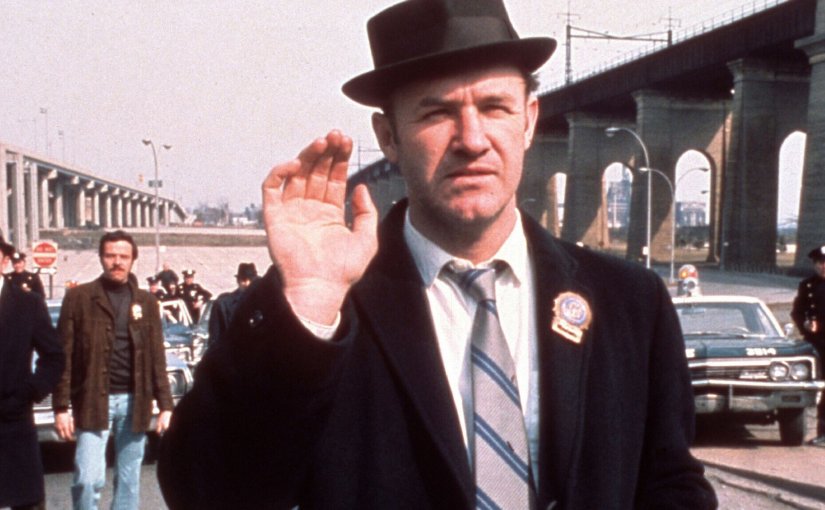
With modern cinema offering huge bravura performances a la Daniel Day Lewis or Christoph Waltz these days, it’s any wonder that today’s generation of movie goers would be puzzled that Gene Hackman won the Best Actor Oscar for this film, The French Connection, which also happened to win Best Picture. His character has no big monologues, no huge crying scenes. In fact for most of the film, he’s slamming guys up against a wall or following them up and down the dirty Brooklyn streets. Yet, his accolades were nothing short of deserved.

Watch as Hackman’s Popeye Doyle gradually exhausts himself in pursuit of “Frog 1.” His character starts out as a thrill seeking detective only to find his limits pushed against a better cat and mouse player. Dialogue isn’t sophisticated here to show his state of mind, but rather his expressions offer everything. Simply look at his close up following the extensive car search (an incredibly satisfying scene for me as a viewer).

If that’s not enough, the car/foot chase through Brooklyn is one that still has not been matched. See how it was done before CGI.

A simple drug deal is plotted perfectly from Marseille to New York, and best of all, it is all true (well mostly).

What’s most curious is the film provides one of the oddest and most unforgiving endings in a film ever. Perhaps you’ll agree (????). But, remember…THAT IS HOW IT HAPPENED!!!!

This was a film from 1971 that was raw in its language, gritty in its setting, spiteful and unafraid of the image it would leave, and that is why it won Best Picture, Best Director and Best Actor.

Bottom line, it would never have been made today. Never!

(Word of advice, ignore the sequel. A prime example of Hollywood shamelessly cashing in.)

THE LAST PICTURE SHOW

By Marc S. Sanders

Peter Bogdonovich’s classic adaptation of Larry McMurtry’s The Last Picture Show is a display of the ends of things that perhaps at one time had life.

The film opens on the main street of the fictional town of Anarene, Texas in November 1951, just as the Korean War was occurring.

A strong gust of wind blows while a mute, mentally handicapped boy fruitlessly sweeps a dusty street, and a junky pick up truck careens down carrying Duane Jackson (Jeff Bridges) and Sonny Crawford (Timothy Bottoms); both on the brink of adulthood with no future in sight. Anarene is a town that has a past and only a few remnants of a present represented by a pool hall, a diner and movie house. All three are owned by Sam “The Lion” (Ben Johnson in an Oscar winning performance). Sam is old and wise. The town speaks through Sam, who is well aware nothing of promise is offered here anymore. So it’s no surprise that all the remaining townsfolk can occupy themselves with are their televisions and sexual conquests.

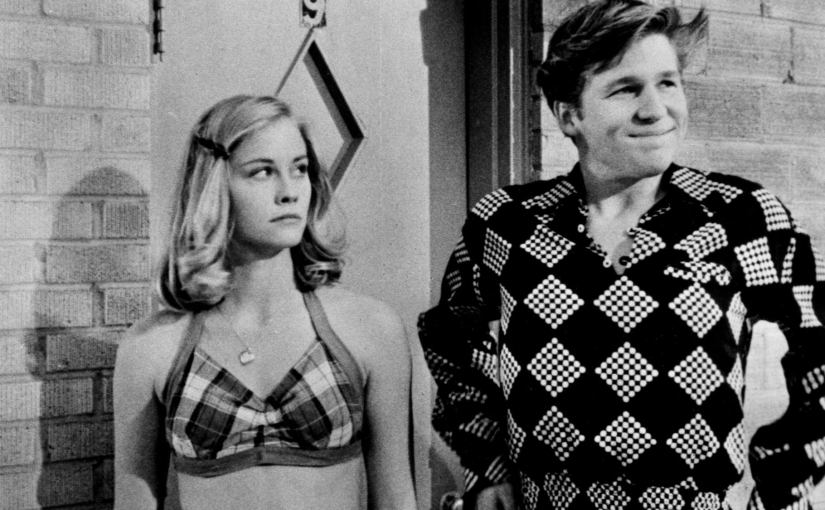
Variations of perspectives that are sexual in nature continue to symbolize what is dying in Anarene. Cybill Shepherd in her very first role portrays Jacy, the pretty girl. Her innocence will be lost as soon as she gives away her virginity. It matters little to her how that happens. Bogdanovich offers a great scene where Jacy attends a swimming pool skinny dip party. Jacy is pressured into standing on a diving board to undress in front of the revelers. I looked at this moment as a teetering balancing act. Jacy is bordering saying goodbye to her youth forever. She does undress all the way only to almost trip off the board. For the moment, Bogdonovich saves the character’s present state as she narrowly avoids falling in the water.

Later, on a whim during New Year’s Eve, Sonny and Jackson go off to Mexico with little money in their pockets and no plan in mind. When they return, an unexpected turn of events has occurred. The fate of this town is withering away with the breeze that’s always intruding. The mute boy will occasionally sweep the street again but accomplish nothing from it.

The films in the movie house represent those that were once celebrated but are now almost never noticed as these families are becoming more glued to the next common household appliance, the television with variety hour shows.

The music never changes or grows up. Hank Williams Sr, occupies the minds of folk who maintained this town at one time and are slowly dying off. The next generation does not have much appreciation for it.

I could go on. Every scene in The Last Picture Show brings about another example of an ending. Bogdonovich was meticulous in his symbolic method of McMurty’s story.

I love that the film, released originally in 1971, was shot in black & white because it shows the story in a historical context; this is what’s left of what once was. The sexual situations don’t hold back in nudity. It’s wise as I thought the nudity clashed with the black & white; it was almost intrusive. The nudity is overcoming the home life heartland that small towns like Anarene used to be remembered for. Sadly, the characters have a hard time accepting this fate.

Cloris Leachman portrays Ruth Popper, the wife of the high school coach who she suspects of being gay. She engages in an affair with young Sonny and her big moment comes when she frustratingly throws a coffee pot at the wall in a rage. She’s terrified that Sonny could never retreat to her pace of life. He’s apt to move on from her. She’ll be stuck with a closeted gay husband in an unstimulating environment. Time has become stagnant for Ruth within the confines of a lifeless marriage and a dead town.

A new way of life awaits. Destiny for Jacy, Sonny and Duane do not include Anarene in their plans.

Eventually Sonny and Duane attend a showing of John Ford’s “Red River” featuring John Wayne. The next morning, after the movie house has closed forever (no one buys tickets anymore), a new fate awaits, maybe even death. Worse yet, maybe for one of them, there is no fate. Maybe, for one of them all that’s offered is an absence of life while residing in Anarene, Texas.

I didn’t realize how much material I absorbed until after The Last Picture Show was over. Peter Bogdonovich provided more for me to think about then I was aware of. The initial slow pace of the film seems mundane at first until you understand that people like Ruth and Sam have memories they experienced but will never carry forward. It’s sad. Their history had meaning at one time. The legacy of their past, however, has no future.

The Last Picture Show is on AFI’s 100 best movies from 2007. It deserves to be as Bogdonovich deftly shows how a past withers away from a nowhere future. His set pieces and direction of characters show the suffering they endure with an unsure end they can not escape.

I haven’t stopped thinking about The Last Picture Show since it ended.

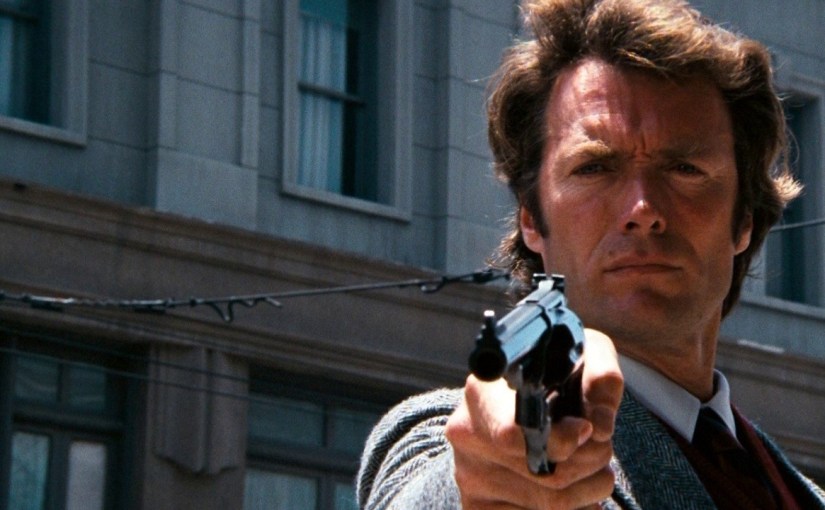
DIRTY HARRY

By Marc S. Sanders

The very first R rated film I ever saw was Dirty Harry. I was probably 7 or 8 when my brother introduced me to it, and it eventually led to my first R rated film to see in the theatres, Sudden Impact, the fourth film in the series.

The original installment had such an influence on me, and it remains as one of my favorite films. I did not necessarily understand at the time the complex, albeit simplistic summary, of the law and the barriers Harry Callahan breaks to get the bad guy. I was more impressed with the 44 Magnum he carried and sociopathic behavior of the serial killer, Scorpio.

All these years later, followed by numerous viewings, and I’m just grateful director Don Siegel’s film was actually made. Had it been considered today for a treatment, it would have never come to light. The film is too candid and frank in its liberties of racist undertones and the underworld of a seedy San Francisco during the 1970s. Harry just didn’t care about the sensitivity of any demographic. He also just didn’t care about what was at stake to capture a hardened, dangerous, apathetic killer. Arguably, and only in the fictional world of film, audiences were probably grateful for that. Cut the bullshit. We all know who the guilty party is. Let’s get him off the streets, regardless of what is mandated to avoid any further loss of life. At least through the first 4 of the 5 Dirty Harry films that has been the common theme. (I’m especially fond of Magnum Force for challenging Harry’s own code of law enforcement. There are great debates to think about in that film.)

Dirty Harry is a deliberately ugly film. Siegel shows the worst of people at times, including Harry. Yet, there are sick people on the streets like actor Andy Robinson’s Scorpio killer that treat murder, mayhem and extortion as a twisted game of insane pleasure. Robinson was perfect in this role, a precursor I thought for Heath Ledger’s Joker many years later. Only a guy like Dirty Harry Callahan is right to nab a guy like this.

The film offers great moral questioning on the rights of men whether they are clearly the culprit or not. Miranda and several amendments are appropriately referenced and questioned. Is it ever appropriate to exercise brute force on a suspect? Can a near impossible scenario justify any actions of that measure? “Well then the law’s crazy,” Harry says. Even by today’s standards you can’t help but wonder if Harry is right.

What would be Harry’s opinion of today’s ongoing theme of domestic abuse among NFL athletes? Fair trials, and innocent until proven guilty are necessary but (at least this is how I feel) the circumstances of these stories make it abundantly clear that the guy did it. He beat his girlfriend into oblivion. The evidence is so much easier to uncover these days. It’s easy for me to say this from the comfort of my own home and not on a jury box. What would Harry think? He always knew to see beyond the bullshit. Heck, if I ever got a chance to interview the guy, all he’d probably tell me is get out of here. He’s got work to do. Harry Callahan was never up for sharing anyway.

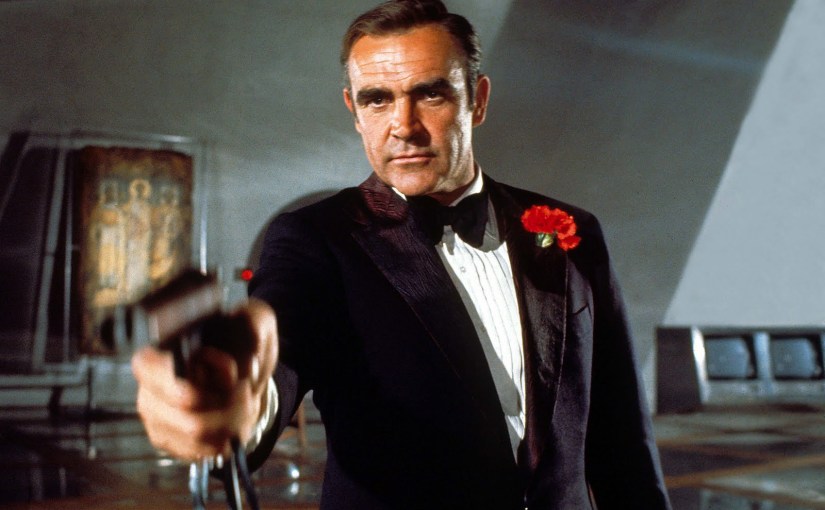
DIAMONDS ARE FOREVER

By Marc S. Sanders

Director Guy Hamilton (Goldfinger) returns to helm Sean Connery’s final portrayal of 007 in the EON Productions series with Diamonds Are Forever. Unfortunately, this film doesn’t even come close to measuring up to Hamilton’s prior effort.

Little regard is offered to the shocking ending of the prior installment, On Her Majesty’s Secret Service. A quick opening has Bond tossing Blofeld (head of SPECTRE, here played gleefully by Charles Grey) into a lava pit. Following Shirley Bassey’s pretty good theme song, 007 is assigned to acquire diamonds that are getting smuggled from the mines of South Africa and intercepted by a beautiful American red head named Tiffany Case (Jill St. John, who is pretty fun in the role). Only problem is that nearly every person the diamonds pass through ends up dead by the homosexual henchmen Mr. Kidd & Mr. Wendt. Considering the sexual tête-à-tête the Bond films became known for by the 7th film, Hamilton and company play up these guys like a weird joke in their inflection with one another, and even the fact that they hold hands at times. The music resorts to a mischievous note on the saxophone. In 1971, this might have held for a good laugh. In the PC era, it really doesn’t feel appropriate to imply these assassins are disturbing simply because they’re gay.

Eventually, the pursuit of said diamonds moves to Las Vegas where some silly Smokey & The Bandit (which was not even close to being released yet) humor occurs. Bond pilots a moon buggy through the Nevada desert while cars that are chasing him fall apart and flip over against the sandy terrain. More silly car chases happen in the heart of Vegas. The sheriff and his men are turned into Keystone Cops. It’s a little too much slapstick actually.

Still, why the need for the diamonds and what does a mysterious, unseen, wealthy man named Willard Whyte (Jimmy Dean) have to do with it?

Bond films work best when the villains work. There’s not much given from a powerhouse villain here like there was in Goldfinger. The necessary shootout ending occurs on an oil tanker this time, and Bond is hardly threatened or under much duress. Thus, killing any kind of suspense.

Connery is fine but you can also tell his commitment is hardly in the role. He’s working just enough for a paycheck-reportedly collecting a record million dollars to return to the role one more time.

By the time the film ends, you feel ready for a drastic change in the franchise. The ‘60s camp is over with. Disco seventies is here. So you wish that 007 can make a smooth transition to the changing cultural times. We would have to wait and see what producers Harry Saltzman & Albert Broccoli could do next to reinvigorate the franchise.

ON HER MAJESTY’S SECRET SERVICE

By Marc S. Sanders

Director Peter Hunt was awarded the opportunity to take the James Bond franchise in a double curve ball direction with 1969’s On Her Majesty’s Secret Service. For the first time in the Eon Productions series, helmed by Harry Saltzman & Albert Brocolli, the role of Bond is recast with George Lazenby. Plus-what’s this? 007 falls in love????

Lazenby is serviceable in the role, seeming to have a taller and more slender appearance than his predecessor (Sean Connery), and not a huge departure in looks. Still his tongue in cheek pun delivery is no match for the original Bond.

OHMSS is a bit hit and miss. The fight scenes look great as the film starts off with Bond fending off a couple of thugs on the beach and a later downhill ski chase is exhilarating and well edited. Telly Savalas also works as a different kind of Blofeld (replacing Donald Pleasence as the cat loving villain). I just wonder why the long middle act was so cheesy, almost like a bad episode of “Batman” or “Star Trek.” The swinging ’60s might have been coming to a close but James Bond was not ready to put it behind him.

After the first third of the story establishes a love story between Bond and Tracy (Diana Rigg as the daughter of Draco, a competing criminal mastermind of Blofeld & SPECTRE), the super spy is off to Piz Gloria, a lodge located on the highest snowy mountain of Switzerland.

Bond goes undercover as a genealogist (I really don’t know why) while looking not the least bit macho in a ruffled shirt with a kilt and knee high socks adorned with red bows. It’s hard to accept James Bond in this image. I couldn’t imagine Connery adopting this get up.

At the lodge Bond uncovers a stupid plot orchestrated by Blofeld where he’s brainwashing a group of swinging girls to, I think, poison the world populace with makeup kits, or maybe bomb the population. I’m not sure exactly.

Eventually, and thankfully, Bond makes an escape in a well shot ski scene while being pursued by Blofeld and his men. It’s a fun sequence.

This film takes some odd turns. Per the prior entry, “You Only Live Twice,” Bond and Blofeld come face to face. Here, it is as if they never met before. Why the neglect for what’s already been established?

It’s also a bit curious to see Bond fall in love and (SPOILER ALERT) marry Tracy, especially when the franchise is breaking in a new actor for audiences to get used to. Were they thinking new actor means new kind of Bond?

No question OHMSS stands out from the rest of the franchise for the change in casting but also the odd story turns it takes. Not to mention, it has the most somber ending of all Bond films.

It’s worth a look even if it is not the best in the series.

I’ll be interested to see what Lazenby does in future films with the role…oh wait…. Nevermind.

NIGHT OF THE LIVING DEAD

By Marc S. Sanders

There’s no question that George A. Romero’s 1968 classic Night Of The Living Dead is a pioneering film in horror and suspense. Without it, we don’t get The Walking Dead or World War Z or Pride & Prejudice & Zombies or endless shoot em up gore filled video games that turn our minds to mush.

Romero’s film is not a favorite of mine but I can’t deny its importance or the merits that got the film into the National Film Registry.

A young couple approach a grave to pay respect and leave flowers. In the background is a man walking oddly who then unleashes a terrorizing pursuit of them. One of them manages to get away and eventually take refuge with others in a nearby isolated house.

The leader of this group known as Ben, manages to board up every door and window. Fortunately, the television works and newscasts inform us of a government response to an epidemic of mass killings from “flesh eating ghouls” otherwise known as the dead coming back to life. The word “zombie” is never used in this film (though I do recall a dame calling The Three Stooges zombies in one of their classic shorts). Debates then arise as to whether these survivors make a run for it, stay put or hide in the basement.

Romero really could care less about any of his characters. He cares most about his new invention of monster; not a vampire or a mummy or even a creature from the black lagoon. The most developing dimension he offers is to go from showing one ghoul to showing 50 ghouls all at once with the barriers of the house coming apart and the attempts at escape unexpectedly coming undone.

He also doesn’t much care for explaining the science of this horror. Sure the ghouls eat flesh but did you know what else they do? They pick up rocks to break windows and stab their prey with gardening tools. Go figure!

It all works, especially with the government news footage set against a Washington DC backdrop. Look! The Capital! Put an actor in a military uniform, carrying a briefcase and have him get in and out of a black sedan, and now you’re convinced this is some serious shit you’re dealing with here.

I imagine it especially worked more effectively in 1968 amid the fears of a nuclear apocalypse and presidential assassinations, along with men in space and on the moon covered by monotone news reports. Then again, maybe this was just drive in movie escapism spoof from all that serious stuff. If Romero had the unlimited funds, he might have coaxed Walter Cronkite to headline the intermittent news stories and updates. Cronkite would have advised us best on how to dispatch an undead marauder. “A single shot to the head is what the General advises,” Cronkite would have emphasized.

For film aficionados and students, Night Of The Living Dead is necessary material to cover. Much of fear and suspense is simply covered by crowding a caption with people in dirty, loose fitting clothes (monster makeup was too expensive for Romero’s budget). Since it’s a black and white film, go with chocolate sauce for blood like Hitchcock did, and have your monster chomp on a turkey leg. Yup! The audience will buy that is an elbow or a knee, perhaps.

Night Of The Living Dead is also a significant piece for its main protagonist, Ben, played by Duane Jones, one of the first African American heroes to lead a film. Race is never acknowledged here which is hard to believe amid the prominent racial tensions of the sixties. Yet here is a character (albeit two dimensional like everyone else in the film) that audiences of the time accepted without any consideration for his appearance despite being the only black character in the film. The zombie plague seems to have only affected the white populace of Pennsylvania. It’s refreshing to see Jones carry through with the role. He takes it all seriously, and you pay attention to his commitment even if he’s just hammering a nail into a board.

The other surprise to me is that I’d never heard a mention of the ending to this film. It comes out of nowhere and is certainly never implied and yet your jaw drops. You’re either gonna die laughing at it, or maybe you’ll think it’s tragic, or maybe you’ll hate it. One thing for sure it reminds me again that Romero loves his flesh eating ghouls much more than he ever cared for his heroes.

YOU ONLY LIVE TWICE

By Marc S. Sanders

James Bond is murdered in a murphy bed!!!!

Thereafter, he ventures off to Japan to uncover who is capturing American & Russian spacecraft in an effort to pit the two countries in a global war. 007 already has his suspicions. Could it be SPECTRE?

In Sean Connery’s 5th outing as the super spy, Roald Dahl (yes, the same guy who wrote James & The Giant Peach and Charlie & The Chocolate Factory) pens the script for You Only Live Twice, a story that finally reveals the architect in charge of the terrorist organization. His name is Ernst Stavro Blofeld. Donald Pleasence appears as the man with the white cat, long before he chased after slasher Michael Myers every October 31st. “Austin Powers” films have taken all of the shock & awe away from this Blofeld. You can’t help but see Dr. Evil when Pleasence appears.

Still, there is so much to be impressed with. Producers Harry Salzman & Albert Brocolli throw all the money into this film with a hidden fortress beneath a giant volcano, plus gorgeous footage of the Orient, as well as in simulated outer space and underwater, for the secret agent’s funeral.

The first two thirds are fast paced storytelling as Bond encounters one informant or enemy after another. He even gets into a great brawl with the grandfather of Dwayne “The Rock” Johnson. A large sofa makes a great battering weapon.

Regrettably, the movie languishes very unnecessarily into a silly subplot where Bond has to disguise himself as a Japanese man (Mickey Rooney may have looked better in Breakfast At Tiffany’s), learn how to be a ninja in four days (ummmmm…why????), and get married to a Japanese woman (again…..why?????). This apparently is all necessary to raid the hidden volcano fortress. Yeah. It’s ridiculous and you can almost see how ridiculous Connery thinks this is. One of Dahl’s everlasting gobstoppers might have been more useful.

Fortunately, the film redeems itself very well in its ending with an explosive battle between ninjas and henchmen. Bond serves the biggest henchman to some quick eating piranhas. That’s pretty fun.

You Only Live Twice is a gigantic production of grand indulgence largely thanks to the success of 007’s four prior large screen adventures. It’s got big moments, cool gadgets like “Little Nellie” and some unexpected surprises too.

It’s good entertainment.

THE GOOD, THE BAD AND THE UGLY

By Marc S. Sanders

Sergio Leone closes out his Dollars trilogy with the epic The Good, The Bad, & The Ugly, respectfully portrayed by screen legend Clint Eastwood, tough as nails Lee Van Cleef and one of the great scene stealers, Eli Wallach.

It’s clear from the start that Leone had at least triple the budget he had when he made A Fistful Of Dollars. This installment offers broad landscapes, gutted out old west towns, locomotives, and an infinite amount of extras to capture an extraordinary Civil War battle over a bridge.

For the three main characters, the Macguffin is $200,000 buried in a grave, yet each one knows a different piece of information relative to its location.

Eastwood’s quiet temperament takes a back seat to Wallach’s boorish ugly bandit and the film stays on a fast pace trajectory because of it. Wallach is given great moments whether he’s hanging by a noose or taking a bath (“If you’re gonna shoot, shoot. Don’t talk.”) It is one of the all time great roles.

While Van Cleef was a huge attraction in a For A Few Dollars More, he surprisingly isn’t given much material here. That’s okay though. He makes the most of what he’s given and again he plays the man in black as cold and calculating. I’d like to uncover more films with Van Cleef. Such an interesting guy with as great a voice as say James Earl Jones or Morgan Freeman. Fortunately for him the Dollars films revived his career following a bout with alcoholism.

Eastwood just does his thing, and it’s great entertainment to see him in a standoff followed by a twirl of his pistol back in his holster. He just has such a presence. The legend he’s become was truly recognized with The Man With No Name.

Leone recruits Ennio Morricone to compose what has become one of the most recognized scores in film history. The whistle harmonica that pursues the three players is as familiar as Monty Norman’s James Bond Theme or John Williams Jaws opening. Morricone is fortunately still working and he is partnering up with Quentin Tarantino again (first time with The Hateful Eight) on his upcoming film Once Upon A Time In Hollywood. It makes sense really. The Good, The Bad & The Ugly is one Tarantino’s favorite films.

Leone made a gorgeous looking film. It’s any wonder that his resume consists of only 9 films altogether.

Sergio Leone was an inspiring master filmmaker and it’s easy to recognize elements of his films that appear to have inspired some of the greatest box office hits of present day. Funny, but whenever I see Eastwood blow an outlaw away with no questions asked, what comes to mind is Han Solo taking out Greedo in an off the map, lawless cantina. Those that know me, know what a high compliment that is for Leone’s efforts.